Go-To-Market Strategy for Europe: The 2026 B2B Playbook
Europe is not one market. It is 27 legal regimes, 24 official languages, and buying committees that treat your US playbook as noise. Here is what actually works in 2026.
TL;DR
- A go to market strategy for Europe fails when you treat "Europe" as one territory. It is 27 EU member states plus the UK, Switzerland and Norway, with different languages, procurement norms, payment terms and data rules.
- Pick two beachhead markets, not eight. Most successful US and APAC expansions land in UK & Ireland plus DACH or Benelux first, then widen once one motion is repeatable.
- GDPR does not ban B2B outbound. It changes how you source, document and verify contact data — legitimate interest plus a clean audit trail is the workable path.
- Localisation is not translation. Pricing in EUR, local invoicing terms, a local phone number and a native-speaker first touch move reply rates more than a translated sequence does.
- Data hygiene is the silent killer: European corporate domains have far higher catch-all and role-account rates than US SaaS domains, so verification has to sit inside the workflow, not after it.
What does a go to market strategy for Europe actually mean?#
A go to market strategy for Europe is the specific set of decisions you make about which European countries you sell into, in what order, with what pricing, through which channel, and with what data and legal footing. It is not a translated version of your North American plan with a EUR price list bolted on.
The mistake is almost always sequencing. Teams launch "EMEA" as a single region, hire one generalist AE in London, and expect that person to cover Stockholm, Milan, Frankfurt and Madrid. Six months later the pipeline is a thin smear across nine countries with no reference customer anywhere.
Europe rewards depth over breadth. One country where you have three named logos, a local case study, a partner and a native-speaking rep beats nine countries where you have a logo each and no story to tell.
Three structural facts shape every decision that follows:
- Language is a buying signal, not a nice-to-have. English works at C-level in the Nordics and Netherlands. It works far less well with mid-market ops buyers in France, Italy and Spain, and it is tolerated rather than welcomed in much of DACH.
- Procurement is slower and more documented. Expect security reviews, works-council involvement in Germany, and 30–60 day payment terms as standard rather than exceptional.
- Data protection is a purchasing question, not just a legal one. Buyers ask where data is hosted before they ask about features. Have the answer in the deck.
Why do US go-to-market playbooks stall in Europe?#
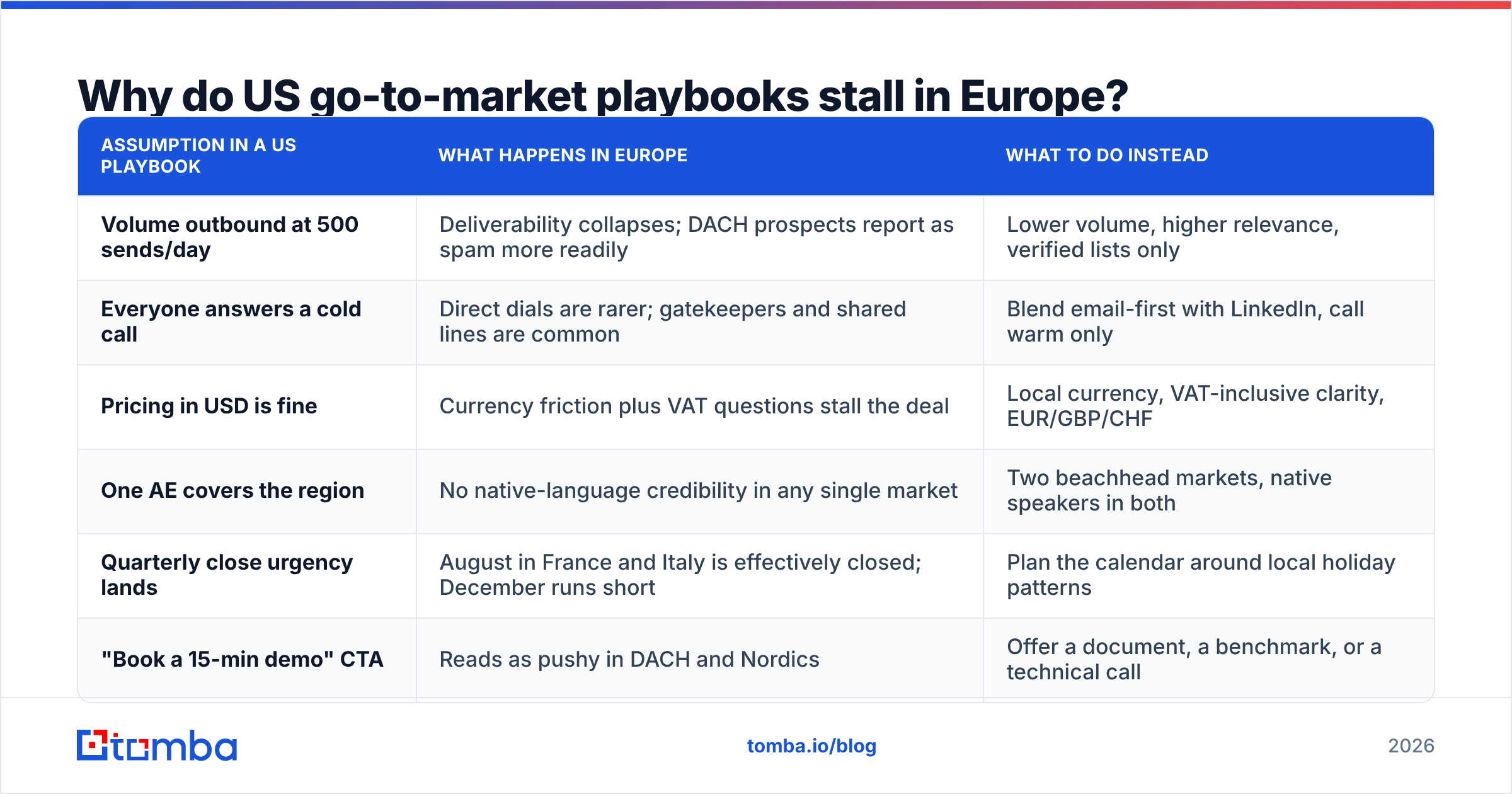
Because the playbook's assumptions are silently American. Here is where they break.
| Assumption in a US playbook | What happens in Europe | What to do instead |
|---|---|---|
| Volume outbound at 500 sends/day | Deliverability collapses; DACH prospects report as spam more readily | Lower volume, higher relevance, verified lists only |
| Everyone answers a cold call | Direct dials are rarer; gatekeepers and shared lines are common | Blend email-first with LinkedIn, call warm only |
| Pricing in USD is fine | Currency friction plus VAT questions stall the deal | Local currency, VAT-inclusive clarity, EUR/GBP/CHF |
| One AE covers the region | No native-language credibility in any single market | Two beachhead markets, native speakers in both |
| Quarterly close urgency lands | August in France and Italy is effectively closed; December runs short | Plan the calendar around local holiday patterns |
| "Book a 15-min demo" CTA | Reads as pushy in DACH and Nordics | Offer a document, a benchmark, or a technical call |
The single most expensive mistake is the volume one. If you port a US-style outbound motion into Europe with a list scraped from a general database, bounce rates on European corporate domains routinely land far above what your team is used to. Sending infrastructure that took a year to warm up gets torched in three weeks.

That bounce number is not bad luck. It comes from three data realities specific to Europe: more catch-all domains at mid-sized industrial companies, more role accounts (info@, kontakt@, commerciale@) in the source data, and heavier employee churn than static databases keep up with. Any European list needs a verification step before it touches your sending domain — run the file through an email verifier and split catch-all results into a separate, slower track rather than blasting them.
Which European markets should you enter first?#
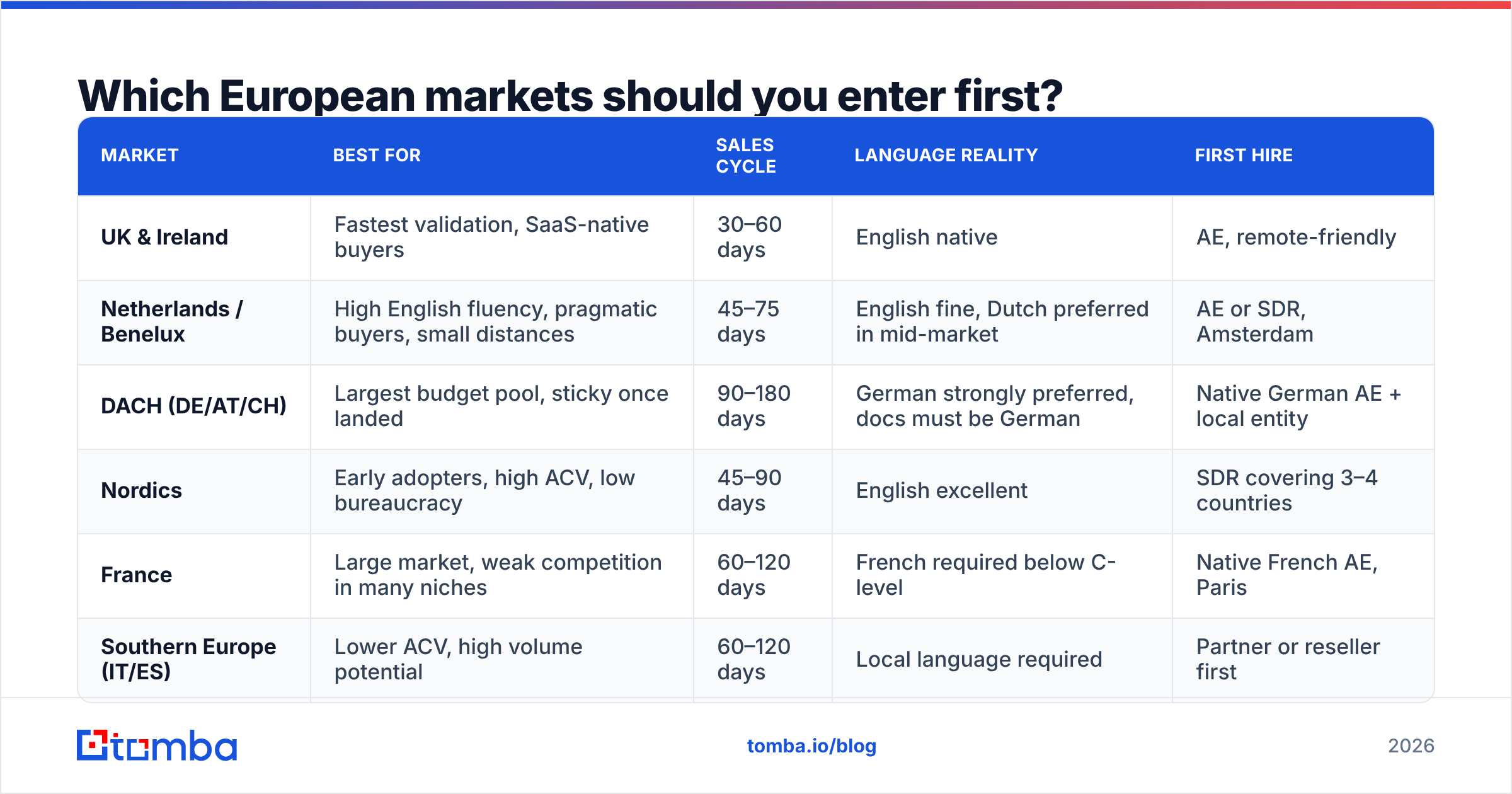
Choose beachheads on four criteria: English tolerance in your buyer persona, software spend per employee, sales-cycle length, and how easily one reference customer travels to the next country.
| Market | Best for | Sales cycle | Language reality | First hire |
|---|---|---|---|---|
| UK & Ireland | Fastest validation, SaaS-native buyers | 30–60 days | English native | AE, remote-friendly |
| Netherlands / Benelux | High English fluency, pragmatic buyers, small distances | 45–75 days | English fine, Dutch preferred in mid-market | AE or SDR, Amsterdam |
| DACH (DE/AT/CH) | Largest budget pool, sticky once landed | 90–180 days | German strongly preferred, docs must be German | Native German AE + local entity |
| Nordics | Early adopters, high ACV, low bureaucracy | 45–90 days | English excellent | SDR covering 3–4 countries |
| France | Large market, weak competition in many niches | 60–120 days | French required below C-level | Native French AE, Paris |
| Southern Europe (IT/ES) | Lower ACV, high volume potential | 60–120 days | Local language required | Partner or reseller first |
A practical default for a company entering Europe from outside: UK first for speed, DACH second for size. UK gives you revenue and reference logos in one quarter. DACH gives you the budget that justifies the entity, the German-language documentation, and the compliance work. If your product is technical and sold to engineers, swap DACH for the Nordics and Netherlands, where English-first sales works cleanly.
Avoid the temptation to open Southern Europe early with direct sales. Partner and reseller motions there tend to outperform a single remote AE, and Gartner's sales research has consistently pointed at channel leverage as the more capital-efficient route into fragmented markets.
How do you build a GDPR-compliant European prospect list?#
This is the part most expansion plans hand-wave, and it is the part that gets you fined. The GDPR does not outlaw B2B outbound, but it does require a lawful basis, transparency, and the ability to honour deletion requests. Legitimate interest is the standard basis for B2B prospecting — it just has to be documented and defensible.
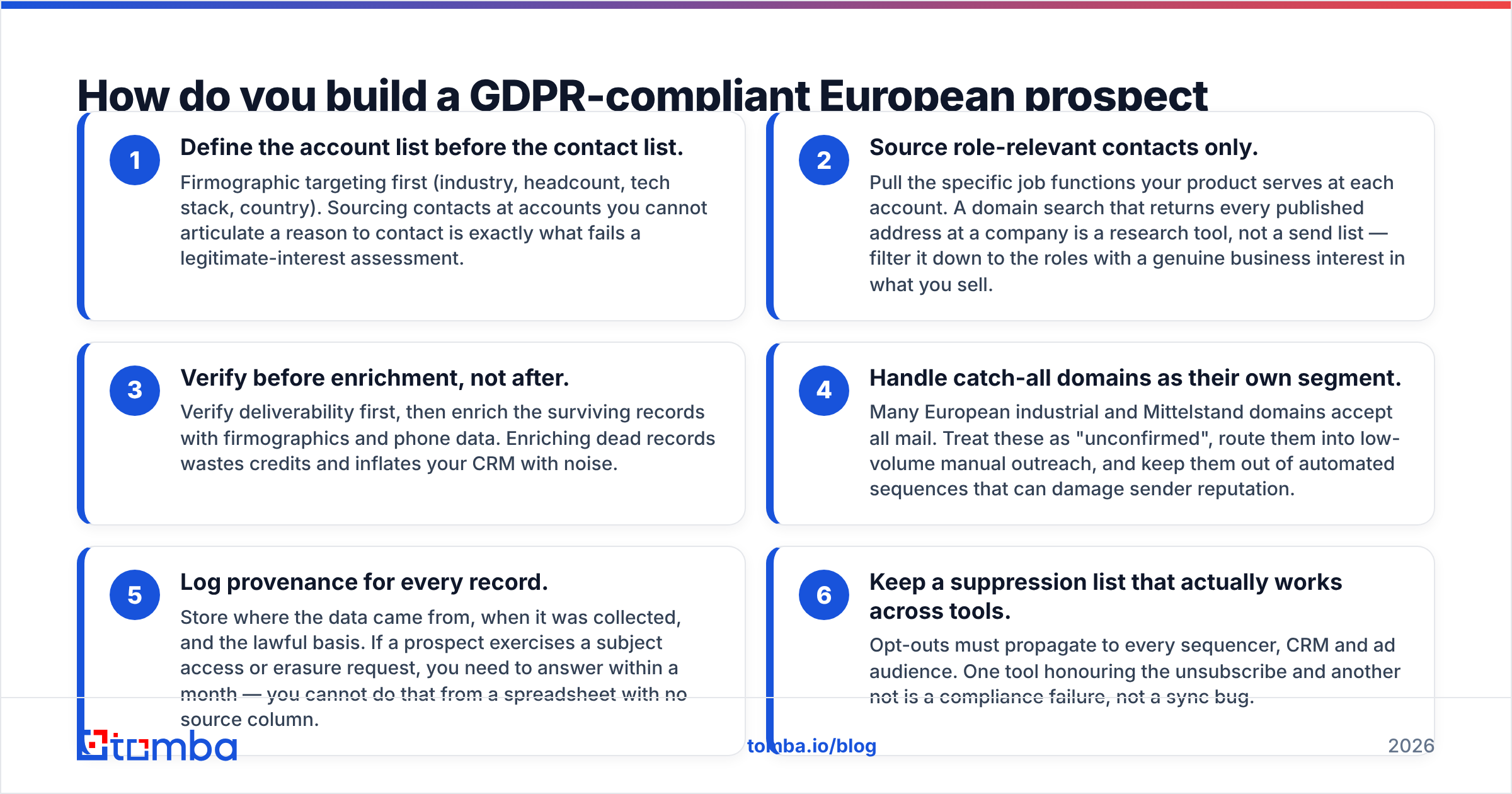
Build the list in this order:
- Define the account list before the contact list. Firmographic targeting first (industry, headcount, tech stack, country). Sourcing contacts at accounts you cannot articulate a reason to contact is exactly what fails a legitimate-interest assessment.
- Source role-relevant contacts only. Pull the specific job functions your product serves at each account. A domain search that returns every published address at a company is a research tool, not a send list — filter it down to the roles with a genuine business interest in what you sell.
- Verify before enrichment, not after. Verify deliverability first, then enrich the surviving records with firmographics and phone data. Enriching dead records wastes credits and inflates your CRM with noise.
- Handle catch-all domains as their own segment. Many European industrial and Mittelstand domains accept all mail. Treat these as "unconfirmed", route them into low-volume manual outreach, and keep them out of automated sequences that can damage sender reputation.
- Log provenance for every record. Store where the data came from, when it was collected, and the lawful basis. If a prospect exercises a subject access or erasure request, you need to answer within a month — you cannot do that from a spreadsheet with no source column.
- Keep a suppression list that actually works across tools. Opt-outs must propagate to every sequencer, CRM and ad audience. One tool honouring the unsubscribe and another not is a compliance failure, not a sync bug.
Point six is where most RevOps teams have real exposure. If you run revenue operations across three continents, the European suppression list has to be enforced globally, because the person who opted out in Munich is still in your US-sourced dataset.
How should you price and package for European buyers?#
Price in local currency, always. A EUR price list is table stakes; GBP for the UK and CHF for Switzerland are worth the extra effort in those markets. Beyond currency, four adjustments matter:
- Annual billing is more normal than monthly. European mid-market finance teams often prefer a single annual invoice with a purchase order over a card-on-file monthly subscription.
- Payment terms stretch. Net 30 is the floor, Net 60 is common in France and Italy, and public sector buyers can go beyond that. Model cash accordingly.
- VAT clarity beats VAT complexity. Show whether the price excludes VAT and support reverse-charge for cross-border B2B sales. Ambiguity here creates procurement tickets.
- Data residency can be a paid tier or a deal-breaker. EU-hosted data is frequently a hard requirement in DACH and in regulated sectors. Decide whether you sell it as an enterprise feature or make it the default.
Do not simply convert your US list price at spot rate. Willingness to pay differs materially between Stockholm and Seville, and a single European price often means you are too expensive in Southern Europe and leaving money on the table in the Nordics and Switzerland.
What does a European outbound sequence look like?#
The shape is different from a US sequence: fewer touches, longer gaps, more substance per message, and a softer close. The progression most teams go through looks like this.
Concretely, a sequence that works in DACH or France looks like:
- Touch 1 (day 0): Email in the local language, 90 words, one specific observation about the account, no calendar link.
- Touch 2 (day 3): LinkedIn connection with no pitch. Building LinkedIn outreach as a parallel channel matters more in Europe, where inbox trust is lower.
- Touch 3 (day 7): Email with a resource — a benchmark, a short technical doc, a customer result from the same country.
- Touch 4 (day 12): Phone call to a verified direct number, only if the first three touches produced any engagement signal.
- Touch 5 (day 20): Soft break-up that offers to follow up next quarter. European buyers respond to this at a surprisingly high rate because it removes pressure.
Five touches over three weeks, not fourteen touches over eight days. HubSpot's sales research on cadence quality over quantity applies doubly here, because the tolerance for repeated unsolicited contact is lower and the reputational cost of getting it wrong is higher.
One operational note: the phone step only works if the number is real. European direct dials decay fast and switchboard numbers waste rep hours, so validate before dialling rather than discovering it live on the call.
How do you know the European GTM is working?#
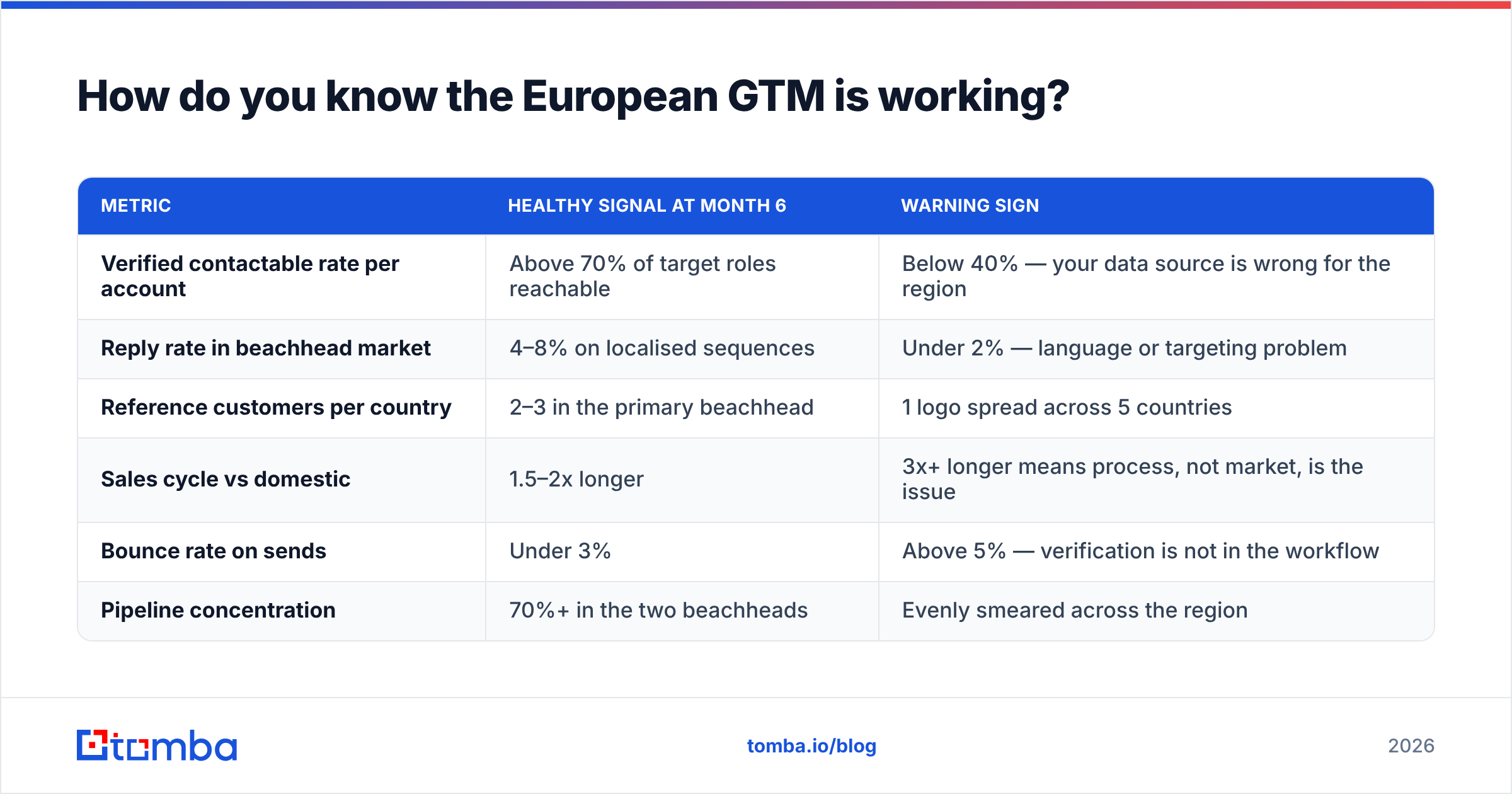
Do not measure Europe against your domestic funnel in month three. The cycle is longer and the early cohort is small. Measure these instead:
| Metric | Healthy signal at month 6 | Warning sign |
|---|---|---|
| Verified contactable rate per account | Above 70% of target roles reachable | Below 40% — your data source is wrong for the region |
| Reply rate in beachhead market | 4–8% on localised sequences | Under 2% — language or targeting problem |
| Reference customers per country | 2–3 in the primary beachhead | 1 logo spread across 5 countries |
| Sales cycle vs domestic | 1.5–2x longer | 3x+ longer means process, not market, is the issue |
| Bounce rate on sends | Under 3% | Above 5% — verification is not in the workflow |
| Pipeline concentration | 70%+ in the two beachheads | Evenly smeared across the region |
The concentration metric is the one to watch hardest. Evenly distributed pipeline across seven countries looks like progress on a dashboard and is usually the signature of a team that has not committed to a market.
What should you do in the first 90 days?#
- Days 1–30: Choose two beachheads. Build the account list with firmographic criteria. Stand up the data and verification workflow, and document your legitimate-interest assessment.
- Days 31–60: Hire or contract one native speaker per beachhead. Localise pricing, the top five sequence assets and your security/data-residency one-pager. Warm the sending domains properly.
- Days 61–90: Run the sequence at low volume in one market only. Fix targeting and messaging on real replies before adding the second market. Only after the first market produces two reference customers should you widen.
Resist the urge to buy a general-purpose all-in-one platform on day one. Most expansion teams do better assembling a narrow stack — a targeting source, a verified contact layer, a sequencer and a CRM — and swapping components as the motion clarifies. Peers like BookYourData occupy a genuinely useful slot here for teams that want pre-built regional lists to test a hypothesis quickly, while a search-and-verify workflow suits teams building lists account by account. Compare the cost of both approaches against your actual weekly volume before committing; the pricing details matter more than feature lists at this stage, since expansion budgets are usually tight until the beachhead proves out.
Where does contact data fit into the plan?#
Every element above depends on one thing: knowing you can actually reach the right person at the right company in the right country. A brilliant localised sequence sent to a stale address is worth nothing, and in Europe the address decay is faster than most teams model.
If you are building a European target list account by account, the Tomba Email Finder is the right starting point — search by company domain and role, verify deliverability in the same pass, and keep catch-all domains flagged so they never enter an automated sequence. Start on the free tier at 25 searches a month to test list quality in your first beachhead, then move to Starter at $49/mo once the motion is repeatable. Get the data layer right first, and the rest of your go to market strategy for Europe has something solid to stand on.
Related guides#
Ready to find emails that actually work?
Join 150,000+ professionals who stopped guessing and started sending. Free credits on signup — no credit card required.
Get the Tomba newsletter
Practical outbound tactics and product updates — once every two weeks.
About the author