Go4Database vs ZoomInfo: B2B Data Compared for 2026
One sells you a downloadable contact list. The other sells you a GTM platform with a seat-based contract. Here is how Go4Database and ZoomInfo actually compare on price, accuracy, coverage, and compliance in 2026.
TL;DR
- Go4Database sells lists. ZoomInfo sells a platform. Go4Database is a list broker: you buy a pre-built or custom-built contact file, download it, and own the CSV. ZoomInfo is a subscription GTM data platform with search, intent signals, enrichment, and CRM sync — billed per seat, per year.
- Price gap is enormous. Go4Database quotes are typically one-time, four-figure list purchases. ZoomInfo contracts commonly land in the $15,000–$40,000+/year range for a small team, based on public buyer reports on G2 and Vendr.
- Neither is a verification layer. Bought lists decay roughly 22–30% per year, and platform records go stale between refresh cycles. You still need SMTP-level verification before you send.
- Choose Go4Database if you need a one-off bulk file for a defined segment and you have no budget for annual software. Choose ZoomInfo if you have an SDR team, a CRM to enrich, and intent-based routing to build.
- Choose neither if your real need is "find the verified email for this specific person at this specific company" — that is a per-lookup problem, and a pay-per-use email finder solves it for a fraction of both.
What is Go4Database and who actually uses it?#
Go4Database is a B2B contact list provider. You go to go4database.com, pick a segment — industry list, technology users list, healthcare professionals, C-level executives by geography — and request a quote. The company builds or pulls the file, you pay once, and you receive a spreadsheet with names, job titles, company details, emails, and often phone numbers and postal addresses.
The model is old-school data brokerage. It predates SaaS, and it survives because a real segment of buyers still wants it: agencies running one-time campaigns, event marketers who need attendee-adjacent audiences, and companies expanding into a new geography who want a snapshot of the market rather than a recurring seat license.
What you get:
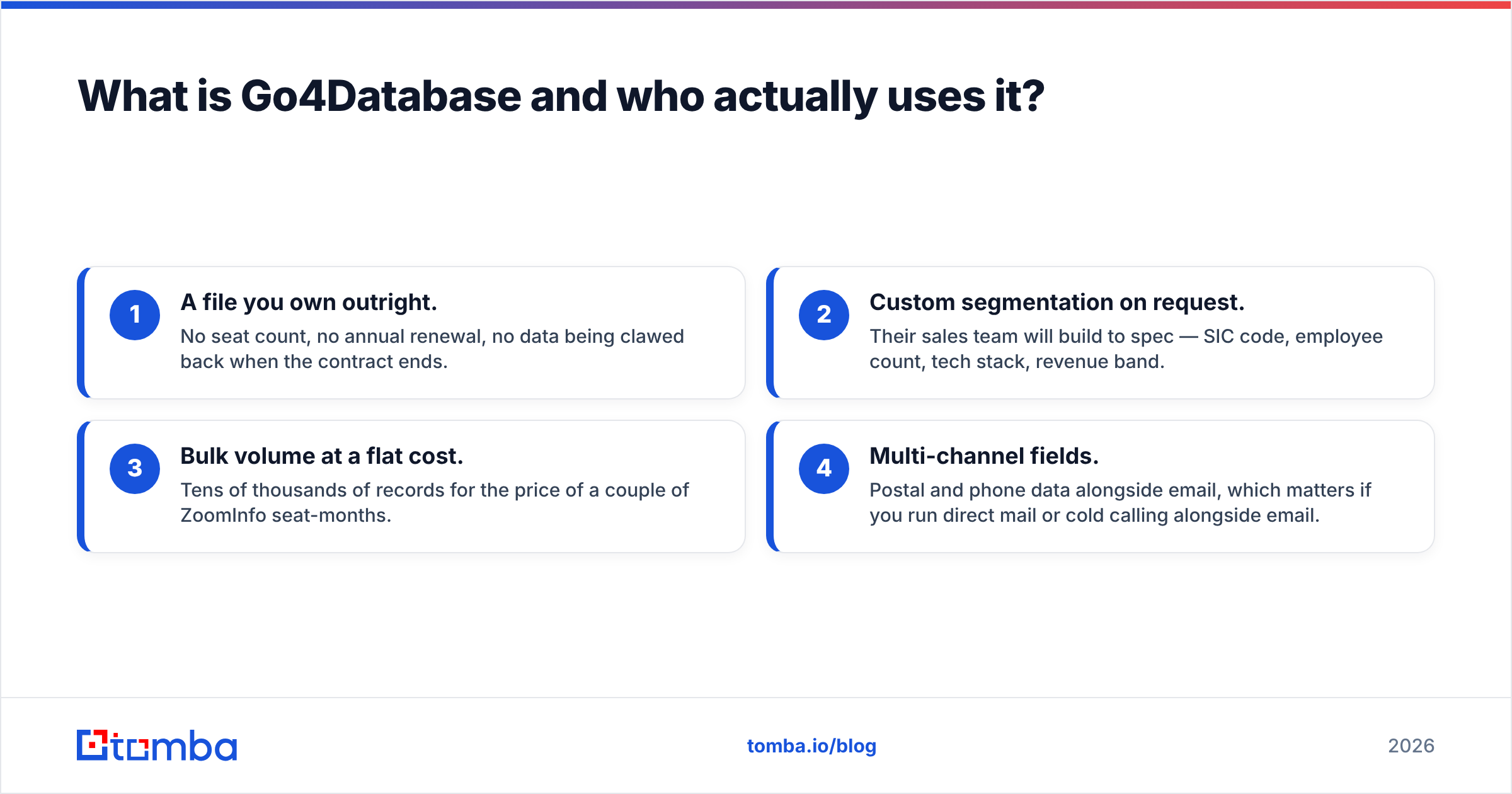
- A file you own outright. No seat count, no annual renewal, no data being clawed back when the contract ends.
- Custom segmentation on request. Their sales team will build to spec — SIC code, employee count, tech stack, revenue band.
- Bulk volume at a flat cost. Tens of thousands of records for the price of a couple of ZoomInfo seat-months.
- Multi-channel fields. Postal and phone data alongside email, which matters if you run direct mail or cold calling alongside email.
What you do not get: a live interface, real-time refresh, intent data, CRM enrichment, or an API. The file is a snapshot of a moment in time, and the moment starts aging the day it lands in your inbox.

What is ZoomInfo and what does the platform actually include?#
ZoomInfo is the largest commercial B2B data platform in the market, built from the 2019 merger of DiscoverOrg and ZoomInfo and now sold as a full go-to-market operating system. The database claims well over 100 million professional profiles and tens of millions of company records, sourced from a contributory network, web crawling, public filings, and a large human research operation.
The 2026 product is not a list — it is a stack:
- Search and filtering across firmographic, technographic, and demographic attributes
- Intent data (topic-level surge signals sourced from bidstream and content networks)
- WebSights — de-anonymizing site visitors
- Copilot — AI account prioritization and message drafting
- Enrich — continuous CRM hygiene against Salesforce, HubSpot, Dynamics
- Engage — a built-in sequencer, if you do not already own Outreach or Salesloft
That breadth is the product. If you have four SDRs, an ops person, and a CRM full of half-empty records, ZoomInfo replaces five tools. If you are two founders sending 200 emails a week, you are paying for a jet to cross the street.
The commercial reality: ZoomInfo does not publish pricing. Buyer-reported figures on G2 and procurement marketplaces consistently show entry contracts starting around $15,000/year, with credit caps, seat minimums, and annual auto-renewal clauses that have generated a steady stream of renewal complaints. Budget for negotiation and read the export limits clause carefully — bulk export is usually metered separately from viewing.
Go4Database vs ZoomInfo: how do they compare head to head?#
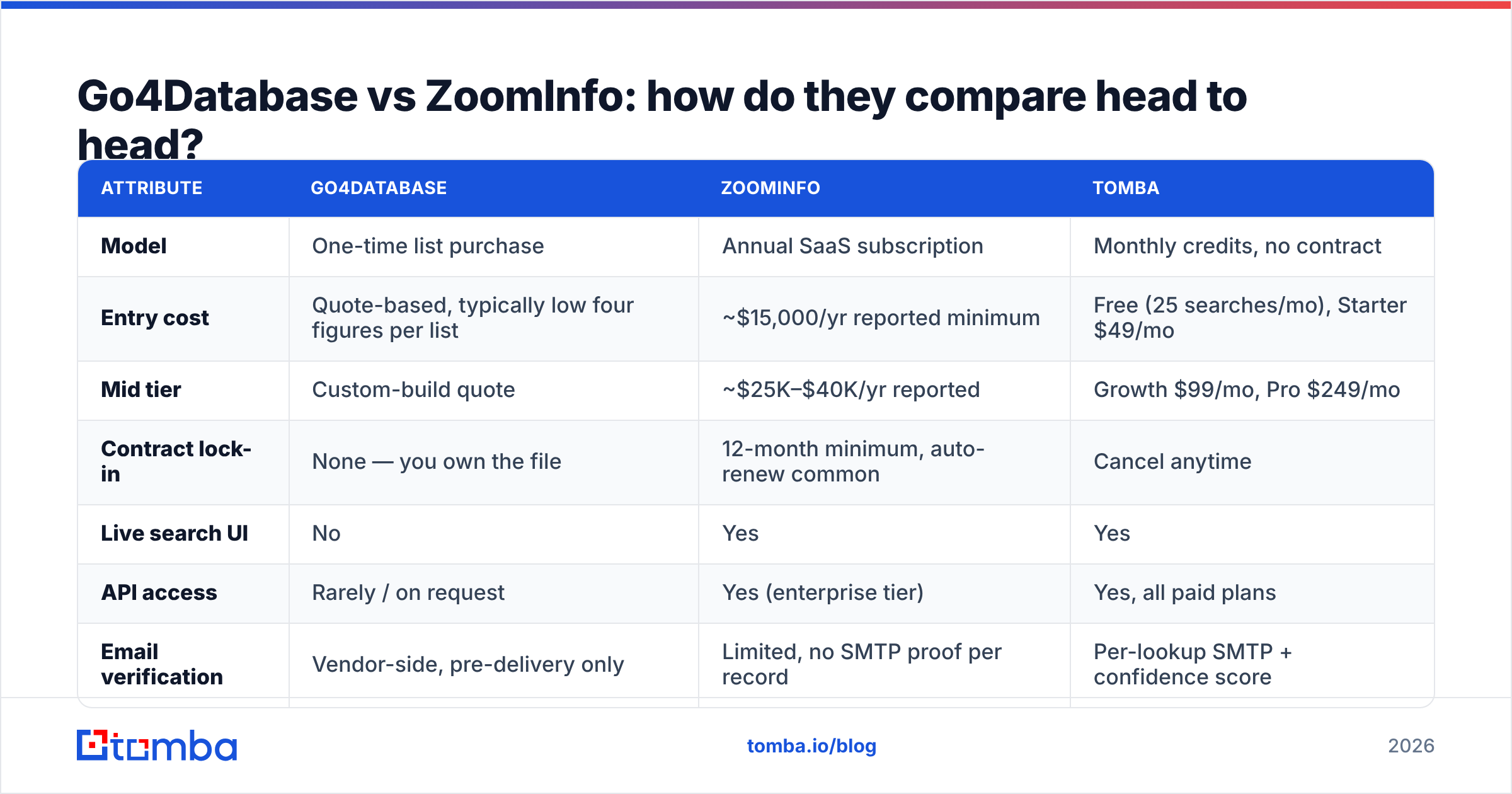
Here is the honest side-by-side. Prices marked "reported" come from public buyer reviews, not vendor rate cards.
| Attribute | Go4Database | ZoomInfo | Tomba |
|---|---|---|---|
| Model | One-time list purchase | Annual SaaS subscription | Monthly credits, no contract |
| Entry cost | Quote-based, typically low four figures per list | ~$15,000/yr reported minimum | Free (25 searches/mo), Starter $49/mo |
| Mid tier | Custom-build quote | ~$25K–$40K/yr reported | Growth $99/mo, Pro $249/mo |
| Contract lock-in | None — you own the file | 12-month minimum, auto-renew common | Cancel anytime |
| Live search UI | No | Yes | Yes |
| API access | Rarely / on request | Yes (enterprise tier) | Yes, all paid plans |
| Email verification | Vendor-side, pre-delivery only | Limited, no SMTP proof per record | Per-lookup SMTP + confidence score |
| Intent data | No | Yes | No |
| CRM enrichment | Manual CSV import | Native, continuous | Via API + HubSpot/Salesforce integrations |
| Phone numbers | Yes, in most files | Yes, including mobile | Yes, via phone finder |
| Best for | One-off bulk campaigns | Enterprise SDR teams | Precision lookup + verification |

The table makes the structural point: these two products barely overlap in what they are, only in what they contain. Comparing them on "who has better data" misses that one is a purchase and one is a subscription. The right question is which failure mode you can live with.
Which one has more accurate data?#
Neither vendor can honestly promise you a clean send, and here is why.
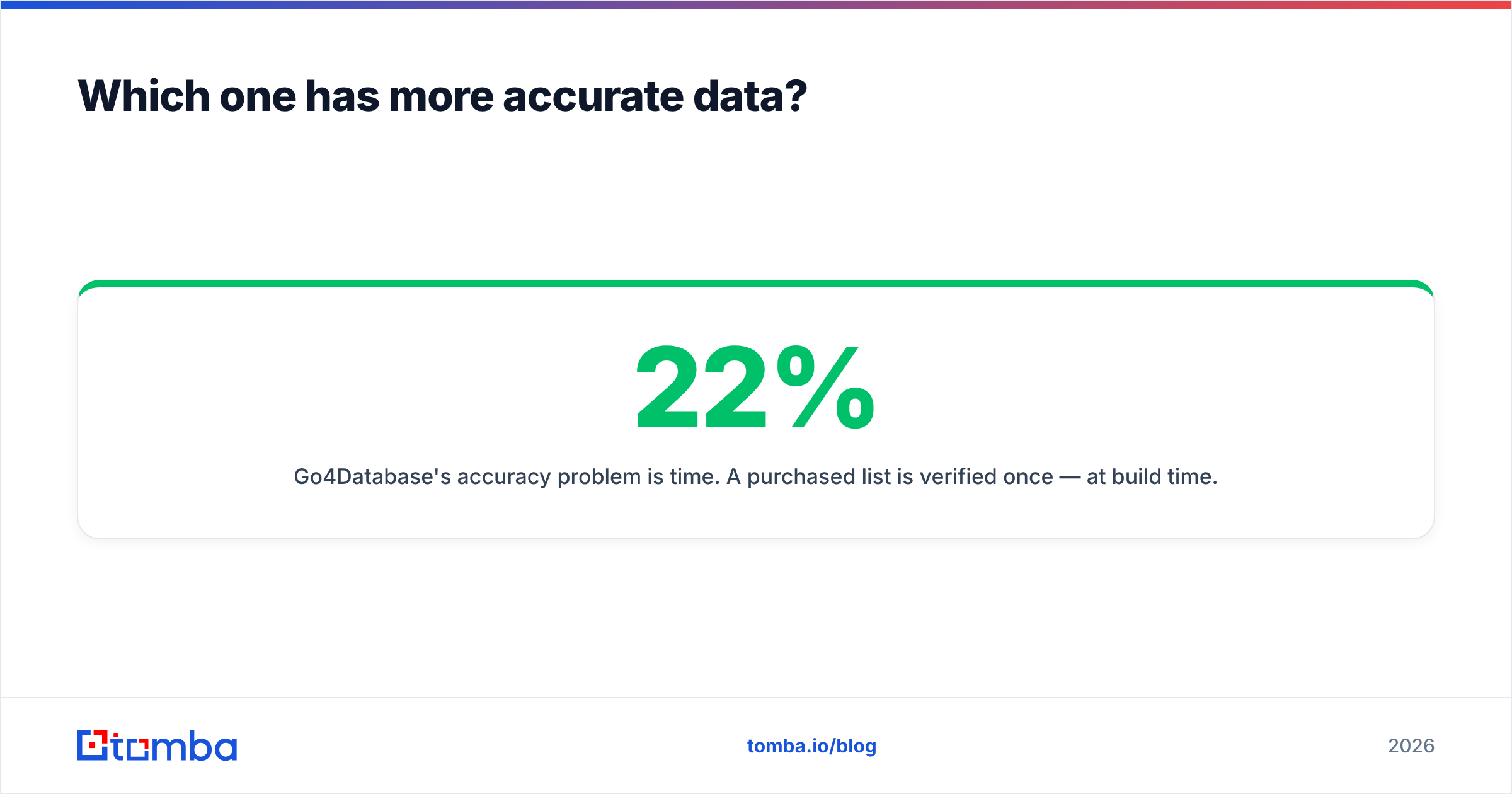
Go4Database's accuracy problem is time. A purchased list is verified once — at build time. B2B contact data decays fast: HubSpot's research and multiple industry studies put annual database decay between 22% and 30%, driven by job changes, company rebrands, and domain migrations. A file that was 92% accurate the day it was compiled is somewhere near 70% accurate a year later. If the list was compiled six months before it was sold to you, you inherit that decay for free.
ZoomInfo's accuracy problem is scale. Maintaining 100M+ profiles means refresh cycles are prioritized by account popularity. Records for well-covered US tech companies are excellent. Records for a 40-person manufacturer in Lyon or a family logistics firm in Ohio are frequently stale, generic (info@), or missing the individual entirely. Coverage outside North America and outside tech remains the most common complaint theme in enterprise reviews.

The operational fix is the same in both cases: verify at send time, not at purchase time. Run every address through an email verifier immediately before it enters a sequence. That means an SMTP handshake, MX record check, syntax validation, disposable-domain detection, and a catch-all determination — not just a regex pass.
Catch-all domains deserve special attention. A large share of corporate domains accept all mail at the server level, so a naive verifier returns "valid" for addresses that will silently vanish. A dedicated catch-all verifier applies pattern confidence and historical deliverability signals instead of guessing. Skipping this step is the single most common reason a purchased list torches a sending domain in week one.
Is a bought list from Go4Database compliant with GDPR and CAN-SPAM?#
This is where list purchases get genuinely risky, and it deserves more attention than most comparison posts give it.
Under CAN-SPAM (US), buying a list is legal. You must include a valid physical address, an honest subject line, and a working one-click unsubscribe honored within 10 business days. Purchased B2B lists clear this bar if you handle opt-outs properly.
Under GDPR (EU/EEA) and PECR (UK), the picture changes. You need a lawful basis to process personal data, and for cold B2B outreach that is normally legitimate interest — which requires a documented balancing test, a clear privacy notice at first contact, and proof of where the data came from. A broker file with no provenance record makes that documentation very hard to produce during a complaint. Under CASL (Canada), the rules are stricter still: consent is the default and B2B exemptions are narrow.
Practical guidance regardless of vendor:
- Demand provenance. Ask any list vendor, Go4Database included, to state the collection source per segment in writing.
- Segment by jurisdiction before you send. Do not blast an EU-inclusive file with a US-designed sequence.
- Suppress aggressively. Deduplicate against your CRM and your existing suppression list before the first send.
- Log everything. Purchase date, vendor, collection basis, verification date. If a regulator asks, that log is your defense.
ZoomInfo's advantage here is documentation maturity: they publish a privacy center, run notification programs for EU data subjects, and give you contractual coverage. That is a real part of what the $15K buys, and it is why enterprise legal teams often prefer the subscription even when the data is not measurably better.
When should you pick Go4Database over ZoomInfo?#
Pick Go4Database when all of these are true:
- You need volume, once. A trade-show follow-up campaign, a regional launch, a one-time market survey.
- You have no recurring software budget. A single file purchase beats a 12-month contract you will use for six weeks.
- Your segment is broad and firmographic, not person-specific. "Manufacturing CFOs in Texas" works. "The head of RevOps at these 43 named accounts" does not.
- You have a verification workflow already. Otherwise the list will do more harm than good.
Pick ZoomInfo when:
- You run a real SDR team — three or more reps who live in the tool daily.
- Intent and prioritization matter more than raw contact count.
- Your CRM is the system of record and needs continuous enrichment, not quarterly imports.
- Procurement wants one vendor with a DPA, SOC 2, and an account manager.
Pick neither when your actual workflow is: build a target account list → identify the right person → get their verified email → send. That is a per-lookup problem, and paying $15K/year or buying 50,000 records you will never touch is the wrong shape of solution.
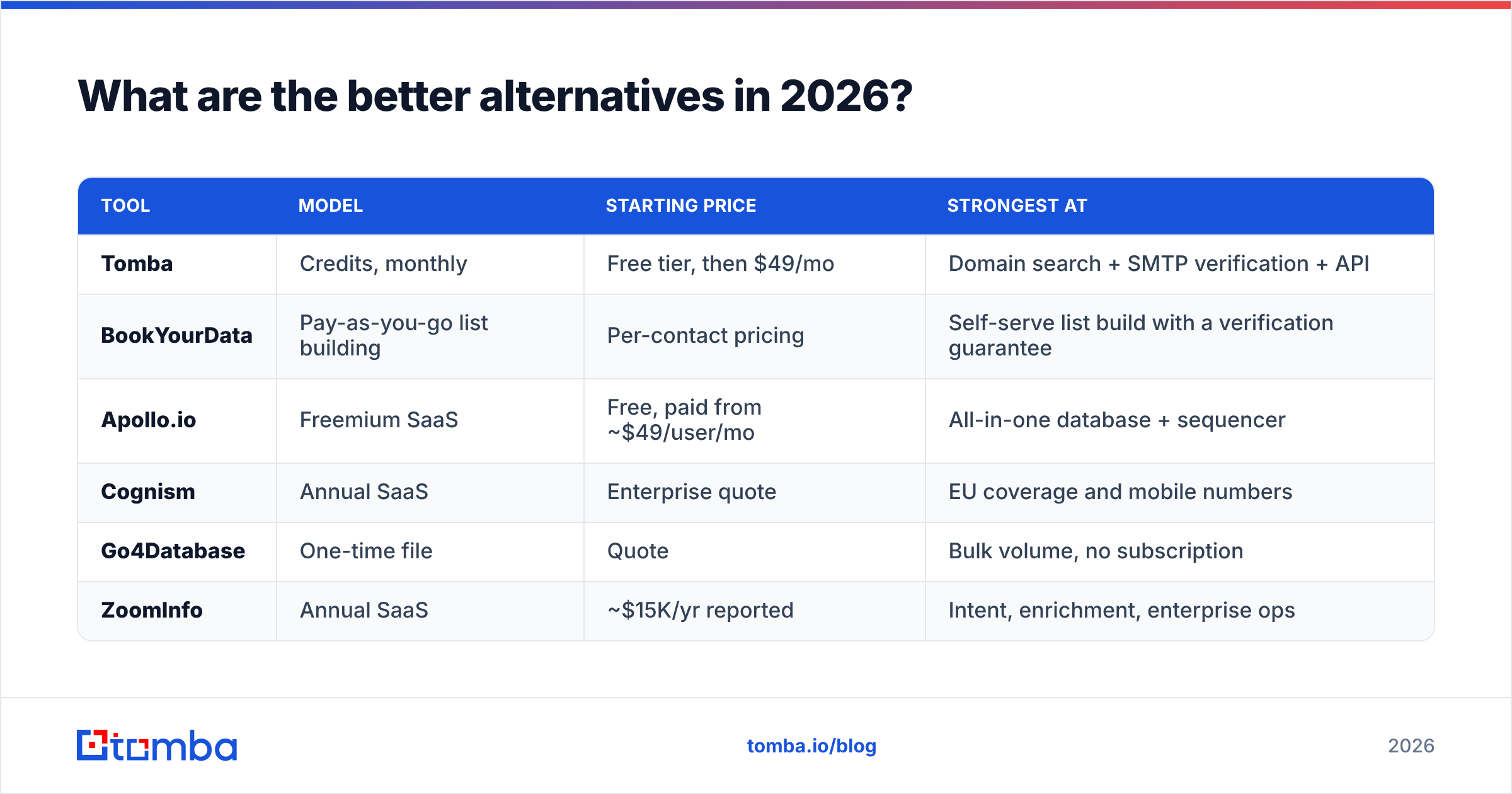
What are the better alternatives in 2026?#
The middle of this market has gotten crowded, and that is good news for buyers.
| Tool | Model | Starting price | Strongest at |
|---|---|---|---|
| Tomba | Credits, monthly | Free tier, then $49/mo | Domain search + SMTP verification + API |
| BookYourData | Pay-as-you-go list building | Per-contact pricing | Self-serve list build with a verification guarantee |
| Apollo.io | Freemium SaaS | Free, paid from ~$49/user/mo | All-in-one database + sequencer |
| Cognism | Annual SaaS | Enterprise quote | EU coverage and mobile numbers |
| Go4Database | One-time file | Quote | Bulk volume, no subscription |
| ZoomInfo | Annual SaaS | ~$15K/yr reported | Intent, enrichment, enterprise ops |
BookYourData is worth a specific look if the Go4Database model appeals but you want self-serve control — you build the segment yourself in a UI, see the count before you pay, and only buy the records you need, with a verification guarantee attached. It solves the "black box quote" problem that makes traditional brokerage uncomfortable.
For teams that want precision rather than volume, the workflow that actually performs looks like this:
- Build the target account list from your ICP — not from a pre-built segment.
- Run domain search on each account to see every discoverable contact and the company's email pattern.
- Find the specific decision maker by name and domain rather than scrolling a database.
- Verify every address before it enters a sequence.
- Enrich in your CRM via API so the data stays current instead of decaying in a spreadsheet.
That sequence costs a rounding error compared to either vendor here, and it produces a list where every record was verified this week — not last quarter, not last year.
The bottom line#
Go4Database and ZoomInfo solve two different problems and both charge accordingly. Go4Database gives you ownership and volume at a one-time cost, with decay and compliance risk transferred entirely to you. ZoomInfo gives you a live platform, intent signals, and legal cover, at a price that only makes sense with a team big enough to consume it.
If neither shape fits — if you want verified, current, per-person data without a five-figure contract or a 50,000-row CSV of unknowns — start with the Tomba Email Finder. Find email addresses by name and domain, confirm each one with a real SMTP check and a confidence score, and pull it all into your CRM through the API. The free tier gives you 25 searches a month to test the accuracy against whatever list you are currently paying for; paid plans start at $49/mo. Check the Tomba pricing page and run your own head-to-head before you sign anyone's annual contract.
Related guides#
Ready to find emails that actually work?
Join 150,000+ professionals who stopped guessing and started sending. Free credits on signup — no credit card required.
Get the Tomba newsletter
Practical outbound tactics and product updates — once every two weeks.
About the author