GoAgentic Pros and Cons: Honest 2026 Review for B2B Teams
Agentic AI SDR platforms promise a pipeline machine that never sleeps. Here is a neutral breakdown of GoAgentic's real strengths, its structural weaknesses, and the setups where it quietly underperforms a simpler stack.
TL;DR — here are the GoAgentic pros and cons in one screen.
GoAgentic is an "agentic AI SDR" tool. Software agents research accounts, draft outreach, and run sequences with little human input. The big win is compression. One operator can run work that used to need three SDRs.
The biggest con is not the AI. It is your data. An agent inherits the list you feed it. A perfect email to a dead address still bounces.
Pricing is quote-led. Expect a seat fee plus usage. Budget for the data and inbox layer too. That second line item is what surprises most teams.
Best fit: mid-market outbound teams with a clear ICP, a clean CRM, and one owner for playbook quality.
Worst fit: solo founders testing a first ICP. Same for teams whose lists are scraped and unverified.
A cheaper path exists. Buy verified contact data, plug it into a sequencer you already own, and skip the agent for now.
What is GoAgentic, and what does it claim to do?#
GoAgentic sells agentic AI for outbound sales. You can read the pitch in the vendor's own words on the official GoAgentic site. The idea is simple. AI "agents" take over the boring middle of the sales motion. That means account research, list building, writing, sequencing, reply sorting, and handoff to a human.
Here is the everyday version. A normal sales tool is a dishwasher. You load it, press start, and it runs the cycle you set. An agentic tool claims to be a line cook. It decides what to prep based on who walks in the door. In technical terms, an LLM layer sits on top of your data sources, your sending tools, and a feedback loop.
That gap matters, because it changes where things break. With a dishwasher, a bad result means you loaded it wrong. With a line cook, the cause could be bad ingredients, bad judgment, or bad instructions. Telling those apart is genuinely hard.
Two caveats first. GoAgentic moves fast, and so does the whole category. Features and prices shift every quarter. Treat this page as a starting point, then confirm on the vendor's pricing page or in a demo. Also, third-party reviews here are thin. Read current listings on G2 rather than trusting vendor case studies alone.
GoAgentic pros and cons: what are the real pros?#
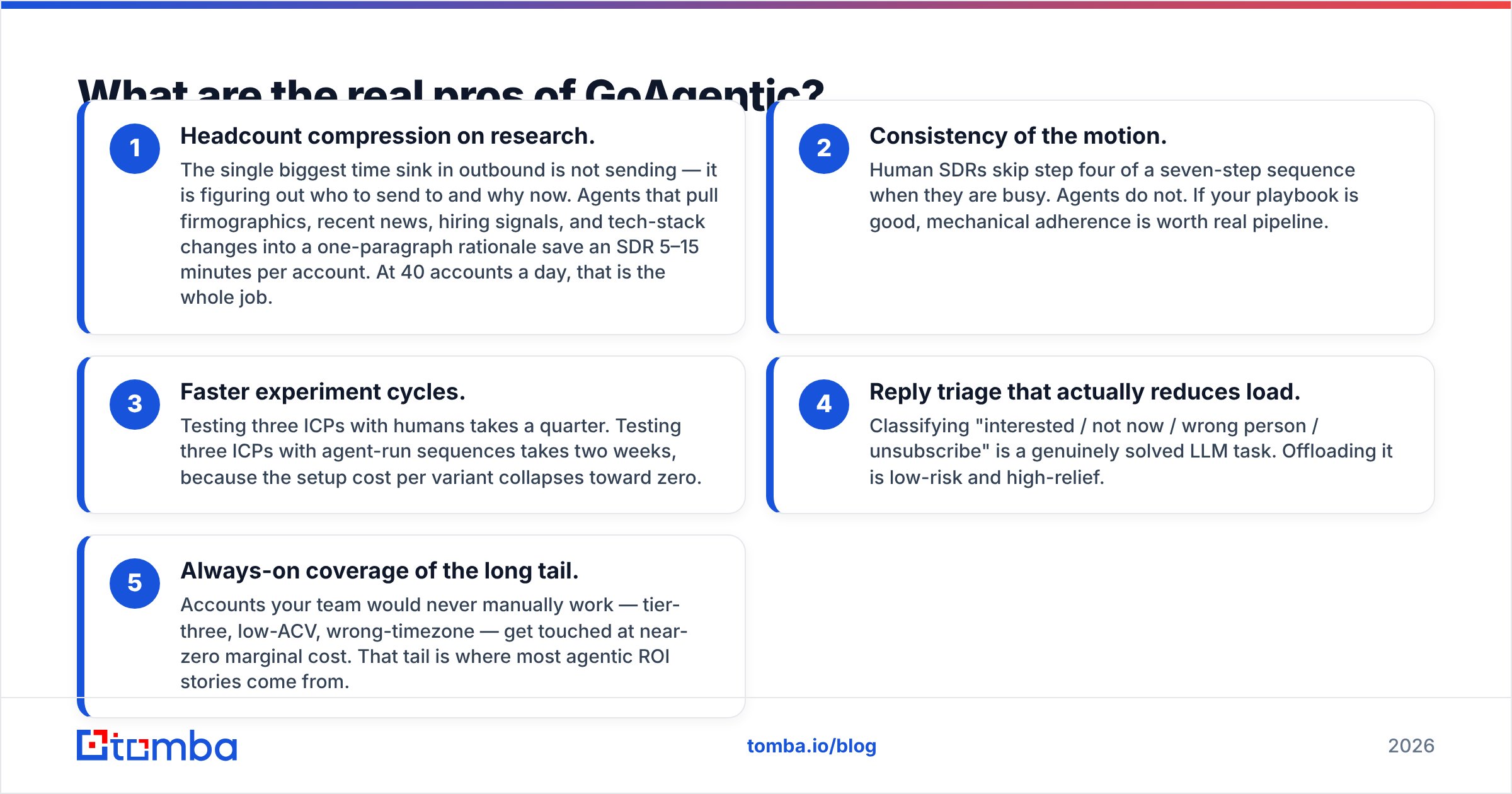
Here is where these tools earn their keep. They are ranked by how often teams actually feel the benefit.
Less time lost to research. The hard part of outbound is not sending. It is picking who to write to, and why now. Agents pull firmographics, news, hiring signals, and tech changes into one short rationale. That saves a rep 5–15 minutes per account. At 40 accounts a day, that is the whole job.
A motion that never skips a step. Busy reps drop step four of a seven-step sequence. Agents do not. If your playbook is good, that discipline is worth real pipeline.
Faster tests. Testing three ICPs with people takes a quarter. Testing three with agents takes two weeks. The setup cost per variant falls to almost nothing.
Reply sorting that truly reduces load. Tagging "interested / not now / wrong person / unsubscribe" is a solved job for an LLM. Handing it over is low risk and a big relief.
Coverage of the long tail. Tier-three, low-value, wrong-timezone accounts never get worked by hand. Agents touch them for close to nothing. Most ROI stories come from that tail.
What are the cons nobody puts in the demo?#
It multiplies your data quality, good or bad. This is true of every agentic outbound tool. It is not a GoAgentic flaw. Say an agent writes a sharp, relevant email to j.smith@acmecorp.com. That address was shut off in 2024. You just made a bounce with extra steps. Worse, you made it fast and at scale. That is how sending domains get burned. If your list hygiene is weak, run every address through an email verifier first.
Custom copy has a low ceiling. "I noticed you recently posted about..." felt new in 2023. By 2026, buyers spot it in a second. Agent-written copy is reliably above average. It is almost never distinctive. In a crowded inbox, average is invisible. Gartner keeps finding the same thing. B2B buyers spend little of their time with any vendor rep. More forgettable mail does not move that number.
You lose track of what worked. The agent picks the account. It writes the copy. It sets the timing. It books the meeting. So you learn very little about why it worked. Teams that lean hard on agents often cannot explain their own funnel six months later. That is a real strategic cost.
Costs stack up. The platform fee is rarely the full bill. Most teams also pay for contact data, email verification, extra domains and mailboxes, a warmup tool, and CRM sync middleware. Teams that budget only for line one are the ones who churn at renewal.
Brand and legal risk. An agent sending 4,000 messages a week gets 4,000 chances to go off-brand. It can also get a fact wrong or break GDPR and CAN-SPAM rules. You need review sampling and a kill switch. Most teams build that after the first incident, not before.
Setup is not plug and play. Plan for 2–6 weeks. You need playbooks, ICP rules, exclusion lists, and CRM mappings in good shape first. Vendors quote days. Practitioners report weeks.
How does GoAgentic compare to the alternatives?#
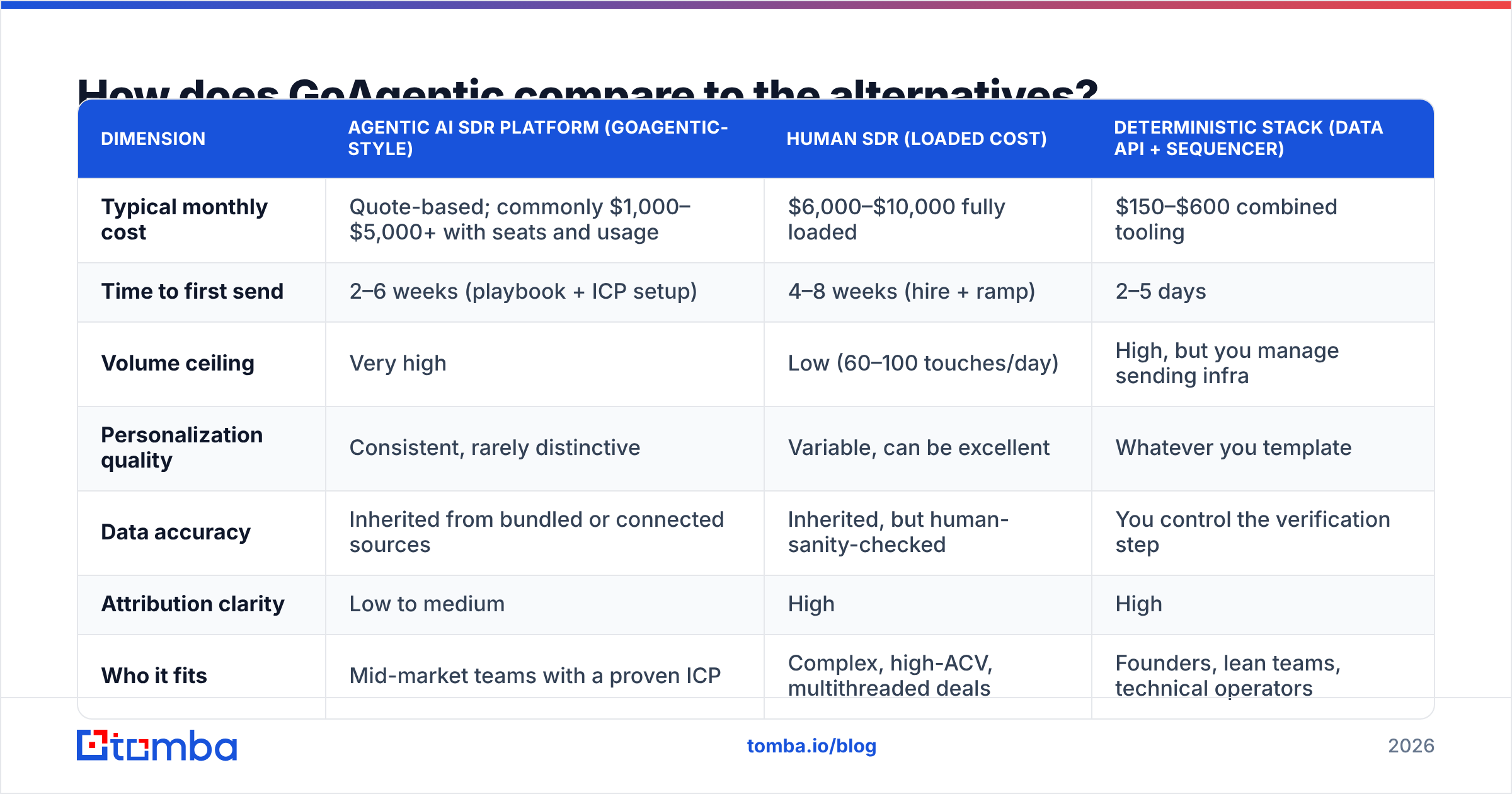
The real choice is not GoAgentic versus one rival. It is an agent versus a human rep versus a simple stack you build yourself. The costs below are planning figures, not quotes.
| Dimension | Agentic AI SDR platform (GoAgentic-style) | Human SDR (loaded cost) | DIY stack (data API + sequencer) |
|---|---|---|---|
| Typical monthly cost | Quote-based; often $1,000–$5,000+ with seats and usage | $6,000–$10,000 fully loaded | $150–$600 in combined tooling |
| Time to first send | 2–6 weeks (playbook + ICP setup) | 4–8 weeks (hire + ramp) | 2–5 days |
| Volume ceiling | Very high | Low (60–100 touches a day) | High, but you run the sending setup |
| Copy quality | Steady, rarely distinctive | Mixed, can be excellent | Whatever you template |
| Data accuracy | Inherited from bundled or connected sources | Inherited, but a human sanity-checks it | You control the verification step |
| Clarity on what worked | Low to medium | High | High |
| Who it fits | Mid-market teams with a proven ICP | Complex, high-value, multi-threaded deals | Founders, lean teams, technical operators |
| Main failure mode | Sending at scale on bad data | Does not scale | You build the glue yourself |
The row that decides most deals is "data accuracy". An agent multiplies reach, not truth. Feed it a bundled database with a 70% deliverable rate and you have automated a 30% bounce rate. Feed it verified records and the same tool looks like magic. Those records can come from an email finder API, a reputable list vendor like BookYourData, or your own enriched CRM.
Is GoAgentic worth it for your team?#
Score yourself on these five. The answer usually falls out.
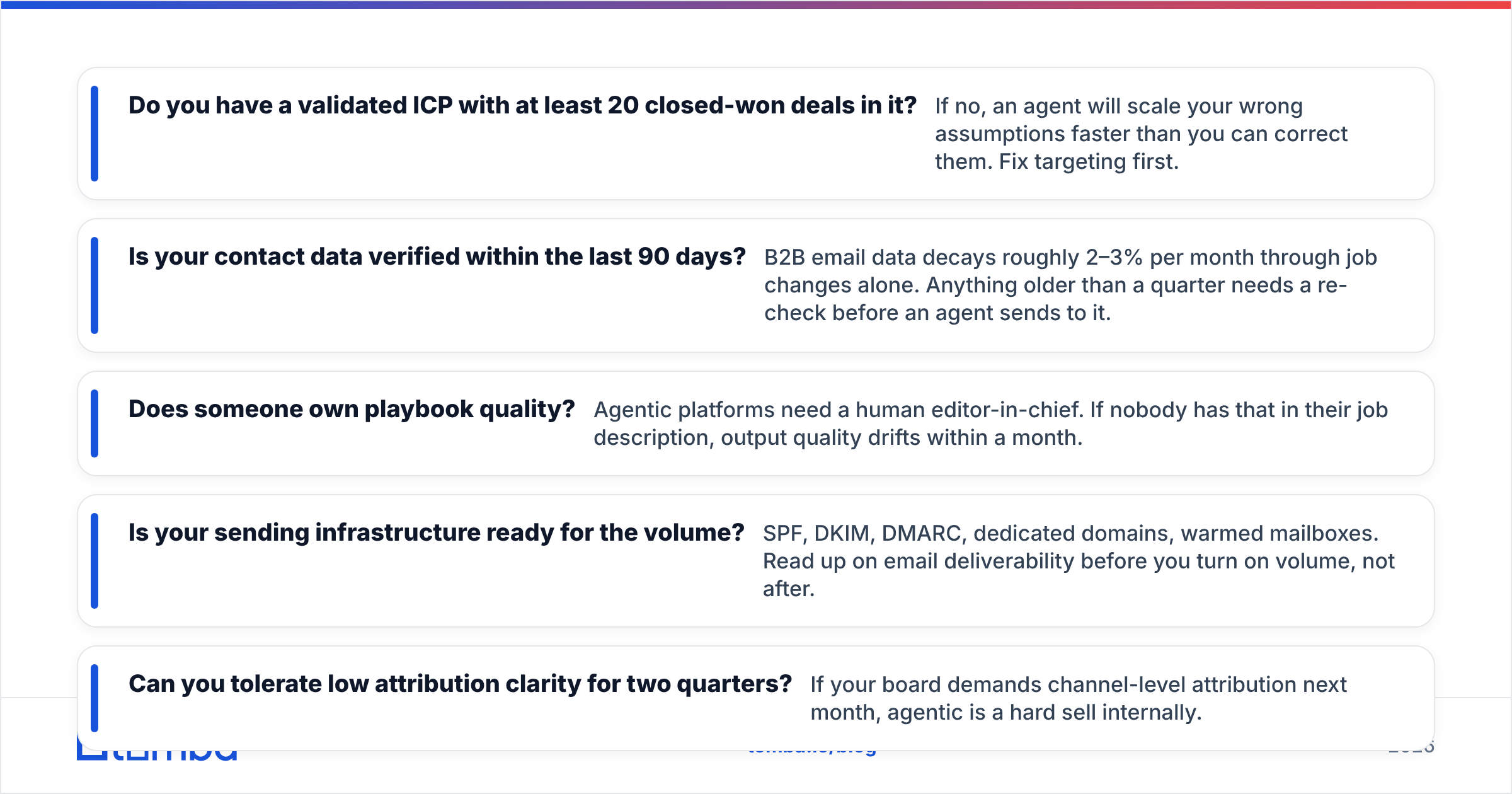
Do you have a proven ICP with at least 20 closed-won deals in it? If not, an agent will scale your wrong guesses faster than you can fix them. Fix targeting first.
Is your contact data less than 90 days old? B2B email data decays 2–3% a month from job changes alone. Anything older than a quarter needs a re-check.
Does someone own playbook quality? Agents need a human editor in chief. With no owner, output drifts within a month.
Is your sending setup ready for the volume? That means SPF, DKIM, DMARC, dedicated domains, and warmed mailboxes. Read up on email deliverability before you turn on volume, not after.
Can you live with fuzzy credit for two quarters? If your board wants channel-level attribution next month, this is a hard sell.
Three or more yes answers? GoAgentic is a fair bet. Run a 60-day paid pilot on one ICP segment, and keep a human-run control group. Two or fewer? Build the simple stack first. Prove the motion with people. Revisit agents in two quarters, once you have a playbook worth automating.
What should you fix before buying any agentic platform?#
Teams who have run these rollouts say the same thing. Most agentic AI letdowns are data problems in an AI costume. Do these five things before you sign anything.
Audit your current list. Pull 500 random contacts from your CRM and verify them. If deliverability comes back under 90%, the problem is not your sequencer or your copy. Dedupe, drop role accounts, and pick a policy on catch-all domains. Those addresses quietly skew every number you report.
Set a refresh cadence. Re-verify on a rolling schedule, not once at import. A nightly job through an email verification API costs almost nothing. It also stops the slow rot that kills a sending domain over six months.
Enrich before you personalize. An agent needs role, seniority, and company size to write anything true. Running data enrichment on your records lifts output more than prompt tuning does.
Read a weekly sample. Pull 20 agent-written messages a week and read them. Not for QA theater. You want drift detection. You will catch tone problems and factual errors months before a prospect complains in public.
Hold back a control group. Give the agent a segment, but keep 20% on your old motion. Without it, you will credit the platform for normal seasonality and renew on a mirage.
Do these five and one of two things happens. Either your pipeline improves enough that you no longer need an agent, or the agent performs far better than it would have. Either way you win. That is why HubSpot and other GTM vendors keep repeating the same point about data hygiene preceding automation.
The verdict on GoAgentic pros and cons#
The category is real and useful. For high-volume, low-complexity outbound against a proven ICP, agents beat a human-only team on speed. But they do not tell you who your buyer is. And on unverified data they are dangerous. The failure mode is not "no results". It is damage at scale.
So buy the platform last, not first. Targeting, then verified data, then deliverability, then agents. In that order, the pros win. In any other order, you pay a premium to repeat old mistakes faster.
Start with the layer everything else sits on. Before you look at a single vendor, run your target accounts through the Tomba Email Finder. See what your real deliverable-contact rate is. The free tier covers 25 searches a month. Starter is $49/mo. Growth is $99/mo with bulk and API access. Check current Tomba pricing for the full breakdown. Verify first, automate second. Every tool you add on top will look better than it deserves to.
Related guides#
Ready to find emails that actually work?
Join 150,000+ professionals who stopped guessing and started sending. Free credits on signup — no credit card required.
Get the Tomba newsletter
Practical outbound tactics and product updates — once every two weeks.
About the author