Goava vs Jet Leads Pro: Which B2B Data Tool Wins in 2026?
Goava sells Nordic sales intelligence with an AI recommendation engine. Jet Leads Pro sells cheap lead lists. Here is how the two actually compare on data depth, pricing transparency, and contact accuracy.
TL;DR
- Goava is a Nordic-focused sales intelligence platform: deep company data on Sweden, Norway, Denmark and Finland, an AI recommendation engine that ranks accounts, and CRM-embedded workflows. Pricing is quote-based.
- Jet Leads Pro sits at the opposite end: a low-cost lead-list and contact-export tool aimed at solo founders and small agencies. Public documentation is thin, so verify every claim inside a trial before you buy.
- They are not really competitors. Goava answers which accounts should I work? Jet Leads Pro answers give me a CSV of contacts, cheaply.
- Neither is primarily an email-verification engine. If bounce rate is your bottleneck, pair either one with a dedicated finder/verifier layer.
- Budget reality check: Goava is an annual seat commitment negotiated on a demo call; Jet Leads Pro is a low monthly ticket with credit limits. A tool like Tomba starts at $49/mo with published pricing and an API.
What are Goava and Jet Leads Pro?#
Goava is a Swedish sales intelligence company. Its pitch is not "more contacts" — it is "better accounts." Goava aggregates registry data, financials, technographics, hiring signals and news mentions for Nordic companies, then scores your total addressable market against the profile of customers you already closed. Reps log into their CRM and see a ranked list of accounts with a reason attached: this company just filed growth financials, this one hired three developers, this one added a checkout technology you integrate with. You can see the current positioning on the official Goava site.
Jet Leads Pro occupies a very different shelf. It is marketed as a fast, inexpensive way to pull B2B lead lists — search by industry, location, company size, export the rows, load them into a sequencer. The product publishes far less about its data sources, refresh cadence, and verification method than an enterprise vendor does. That is not automatically disqualifying; plenty of useful tools are small and quiet. It does mean you should treat any coverage or accuracy number you see in marketing copy as unverified until you test it against a sample of accounts you already know.
The honest framing for Goava vs Jet Leads Pro is this: one is a decision-support system, the other is a list vendor. Comparing them on a single "which is better" axis is like comparing a mortgage advisor to a price-comparison site. They both touch money, but you hire them for different jobs.
How do Goava and Jet Leads Pro differ on data coverage?#
Coverage breaks into four dimensions, and the two tools invert each other on almost all of them.
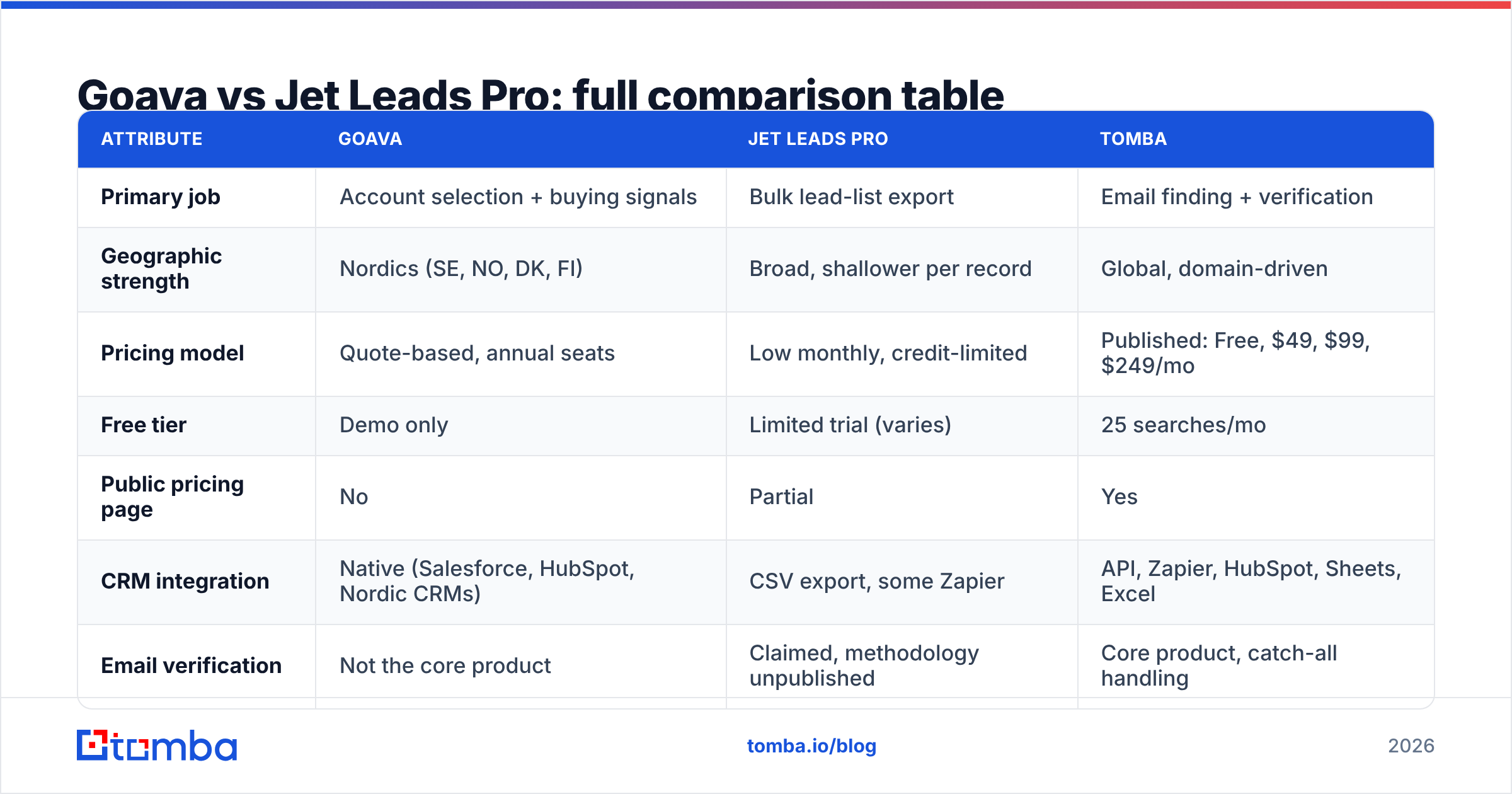
- Geographic depth vs breadth. Goava is deliberately narrow — the Nordics — and correspondingly deep. Company registry filings, board members, revenue history and credit signals are genuinely hard to fake and Goava has them at a level a global aggregator rarely matches for Sweden or Finland. Jet Leads Pro aims for broad international coverage, which almost always means shallower records per company.
- Account data vs contact data. Goava's centre of gravity is the company record and the buying signal attached to it. Jet Leads Pro's centre of gravity is the person record — name, title, email, sometimes phone. If you need both, you will end up buying both categories from someone.
- Signals vs static fields. A signal decays. "Hired 4 engineers last month" is worth acting on for maybe six weeks. Goava is built around that decay; its value is timing. A static list export has no timing built in — you decide when to work it, and it starts ageing the moment it lands in your CSV.
- Verification posture. Enterprise sales-intelligence platforms typically warrant company data, not personal email deliverability. Budget list tools usually claim verification but rarely publish their methodology. Either way, the safe assumption is that email addresses arriving from a data platform need a second pass through an email verifier before they touch a sending domain.
- Refresh cadence. Registry-derived data updates on filing schedules. Scraped contact data decays at roughly 25–30% per year as people change jobs. That decay rate, not the headline database size, is what determines your bounce rate in month six.

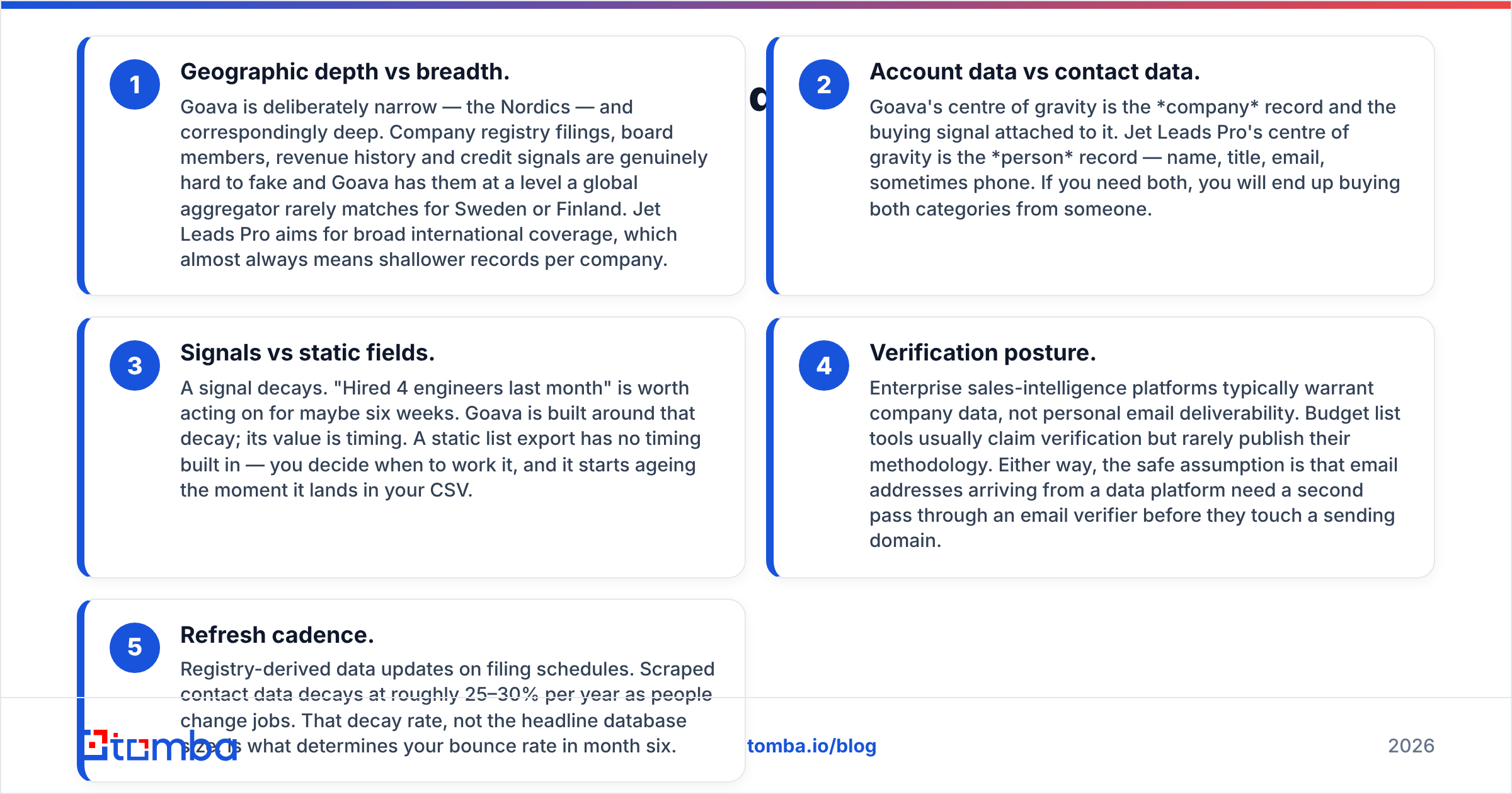
Goava vs Jet Leads Pro: full comparison table#
| Attribute | Goava | Jet Leads Pro | Tomba |
|---|---|---|---|
| Primary job | Account selection + buying signals | Bulk lead-list export | Email finding + verification |
| Geographic strength | Nordics (SE, NO, DK, FI) | Broad, shallower per record | Global, domain-driven |
| Pricing model | Quote-based, annual seats | Low monthly, credit-limited | Published: Free, $49, $99, $249/mo |
| Free tier | Demo only | Limited trial (varies) | 25 searches/mo |
| Public pricing page | No | Partial | Yes |
| CRM integration | Native (Salesforce, HubSpot, Nordic CRMs) | CSV export, some Zapier | API, Zapier, HubSpot, Sheets, Excel |
| Email verification | Not the core product | Claimed, methodology unpublished | Core product, catch-all handling |
| API access | Enterprise tier | Limited | All paid plans |
| Best for | Nordic mid-market field sales | Solo founders, cheap volume | Teams who need accurate addresses at scale |
| Contract risk | Annual commitment | Low | Monthly, cancel anytime |
Two things jump out of that grid. First, pricing transparency is a real differentiator in 2026 — buyers increasingly filter out vendors that hide numbers behind a demo gate, and G2's sales intelligence category is now full of tools that publish tiers openly. Second, neither Goava nor Jet Leads Pro is trying to be the accuracy layer. That gap is where most outbound teams get burned.
Which one has better contact data accuracy?#
Neither publishes an independently audited accuracy figure, so anyone quoting you a hard percentage is guessing. What you can do is run the same three-step test on both before committing budget.
Step 1 — the known-accounts test. Pick 50 companies you have already sold to or lost. Pull them from each platform. Count how many records are present, how many have a current decision-maker, and how many list a title that matches reality. Presence is easy; currency is where tools fail.
Step 2 — the bounce test. Take 200 exported addresses from each and run them through an independent verifier. Anything above a 5% hard-bounce rate on "verified" data means the vendor's verification is cosmetic. This is the single most predictive test you can run, and it takes about ten minutes.
Step 3 — the catch-all test. Roughly a third of B2B domains are catch-all, meaning the mail server accepts everything and tells you nothing. Cheap tools frequently mark catch-all addresses as valid, which is how you end up with a clean-looking list and a wrecked sender reputation. Check how each platform labels them, and route the ambiguous ones through a dedicated catch-all verifier rather than guessing.
Goava will generally win step 1 on Nordic accounts by a wide margin, because registry data is authoritative. Jet Leads Pro may win on raw contact volume outside the Nordics. Both are likely to leave you needing step 2 and step 3 handled elsewhere.
How do the pricing models compare?#
Goava does not publish prices. Expect a discovery call, a seat-based annual quote, and a number that scales with how many reps need daily access plus whether you want CRM sync and API access. For a Nordic mid-market sales team of eight to twenty reps, that is a defensible spend — the platform is replacing manual account research that costs more in salary than in licence fees.
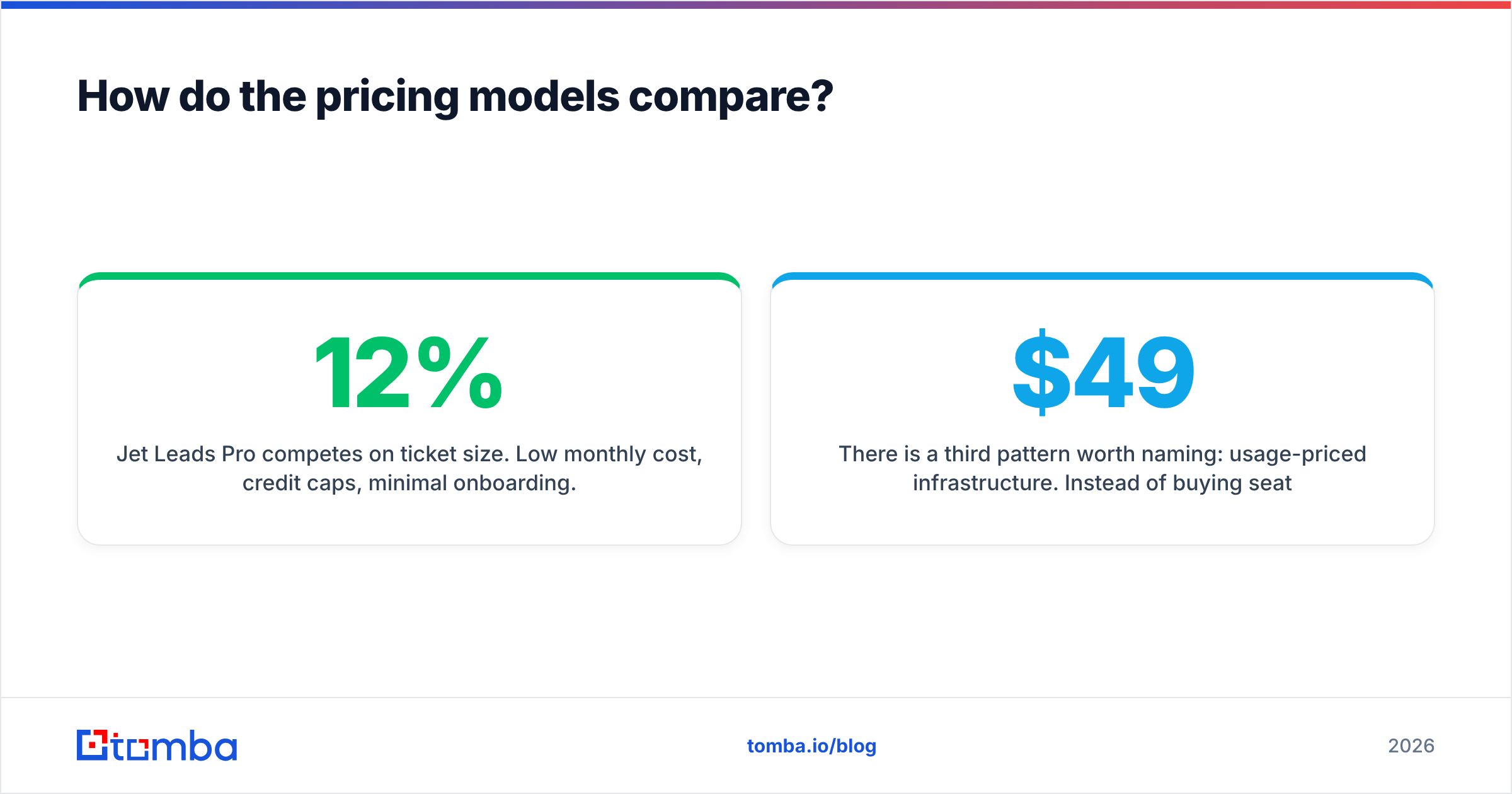
Jet Leads Pro competes on ticket size. Low monthly cost, credit caps, minimal onboarding. The hidden cost is not the invoice; it is the downstream damage of bad addresses. A 12% bounce rate on a $30/mo tool is more expensive than a 2% bounce rate on a $99/mo tool, because the first one costs you a warmed sending domain.
There is a third pattern worth naming: usage-priced infrastructure. Instead of buying seats or lists, you pay for the lookups you actually run. Tomba pricing works this way — a free tier at 25 searches per month, Starter at $49/mo, Growth at $99/mo, Pro at $249/mo, and custom enterprise terms. Every tier includes API access, which matters if your RevOps team wants enrichment to run automatically on inbound form fills rather than as a manual export ritual.

Who should choose Goava?#
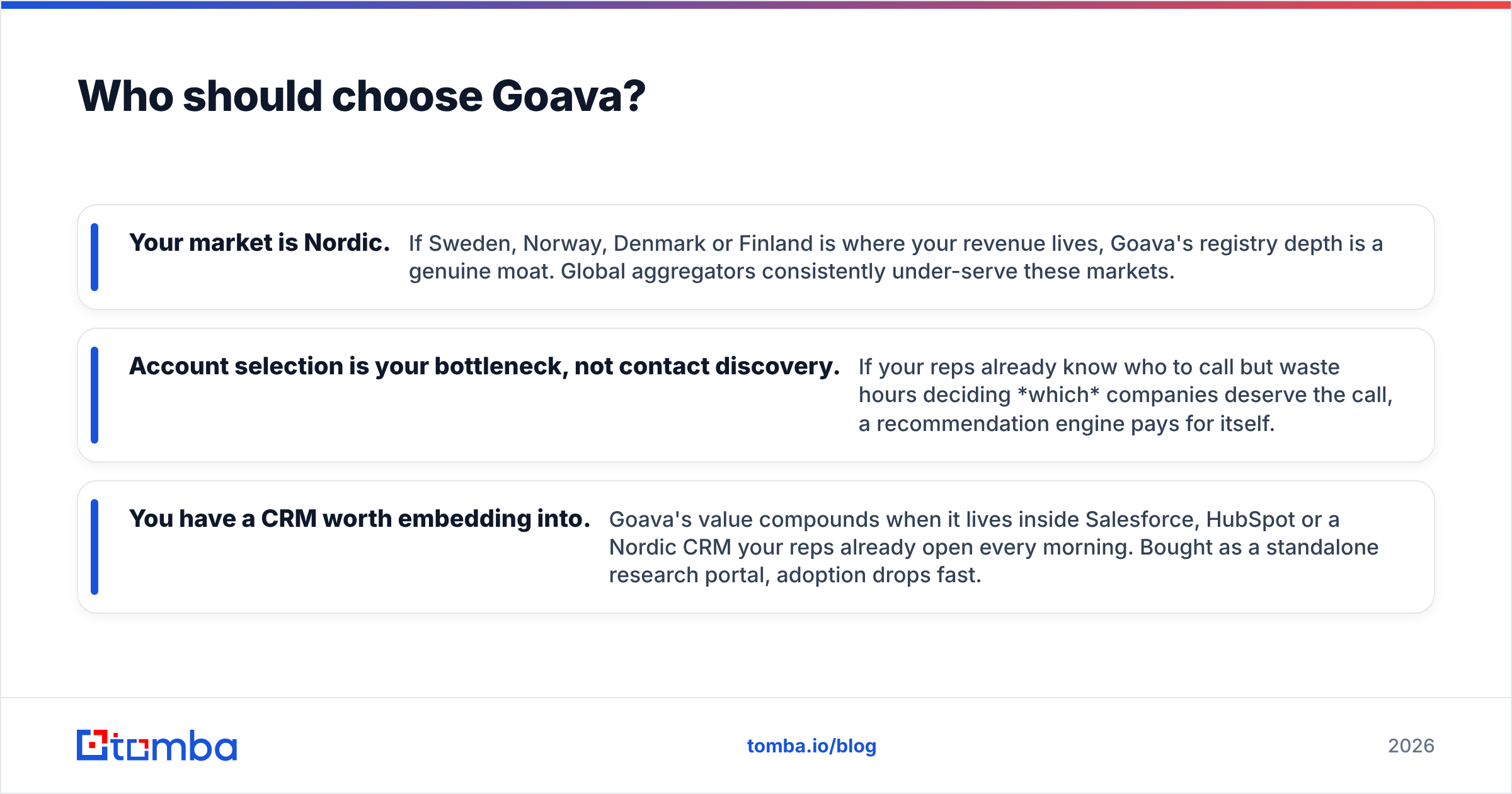
Choose Goava when all three of these are true:
- Your market is Nordic. If Sweden, Norway, Denmark or Finland is where your revenue lives, Goava's registry depth is a genuine moat. Global aggregators consistently under-serve these markets.
- Account selection is your bottleneck, not contact discovery. If your reps already know who to call but waste hours deciding which companies deserve the call, a recommendation engine pays for itself.
- You have a CRM worth embedding into. Goava's value compounds when it lives inside Salesforce, HubSpot or a Nordic CRM your reps already open every morning. Bought as a standalone research portal, adoption drops fast.
Skip Goava if you sell globally, if your team is under five reps, or if you cannot commit to an annual contract.
Who should choose Jet Leads Pro?#
Choose Jet Leads Pro when you need volume cheaply and you are willing to do your own quality control:
- Solo founders and two-person agencies running early outbound experiments, where the cost of being wrong is a wasted week rather than a wasted quarter.
- Market-mapping exercises where you need a rough census of an industry and precision matters less than breadth.
- Teams that already own a verification layer and treat every inbound list as raw material rather than finished data.
Skip it if you are sending at scale from a domain you cannot afford to burn, if you need auditable data provenance for compliance reasons, or if you need contract terms and support SLAs that a small vendor cannot offer. And do the bounce test first — always.
Where does a dedicated email finder fit alongside either tool?#
This is the part most comparison posts skip. Sales intelligence platforms and list tools both hand you contacts; almost none of them own deliverability. The stack that actually works looks like three separate layers:
- Targeting layer — decides which accounts matter. Goava, or your own ICP scoring, or intent data.
- Contact layer — resolves a company into named people with reachable addresses. This is where domain search and a bulk email finder earn their keep, because you can go from a list of 400 target domains to named, pattern-matched, verified addresses without buying a whole second platform.
- Verification layer — kills the bounces before your sequencer sees them, including the catch-all cases that break naive verifiers.
Running all three inside one vendor is convenient right up until that vendor's coverage gaps become your coverage gaps. Keeping the contact and verification layers separate and API-driven means you can swap the targeting layer — Goava this year, something else next year — without rebuilding your outbound machine. It also means you can enrich records from any source: a conference attendee list, a scraped directory, a partner referral spreadsheet, or a CRM full of stale rows that need data enrichment before your next campaign.
For teams doing account-based work, HubSpot's own research on inbound and outbound alignment makes the same structural point from a different angle: the tooling that identifies demand and the tooling that reaches it are different problems with different failure modes.
What is the actual verdict on Goava vs Jet Leads Pro?#
Goava wins if you sell into the Nordics and your problem is prioritisation. It is a serious platform with data you cannot easily replicate, and the AI ranking layer meaningfully shortens rep research time. Price it honestly against the salary hours it saves.
Jet Leads Pro wins only on budget, and only if you supply your own quality control. It is a reasonable starter tool for a founder testing a channel. It is not infrastructure you should build a ten-person outbound team on.
Neither wins on email accuracy, because neither is built to. That is a separate purchase, and treating it as an afterthought is the most common way outbound programs quietly fail — good targeting, good copy, and a 14% bounce rate that torpedoes email deliverability before anyone reads the message.
The pragmatic 2026 stack for most B2B teams: one targeting tool matched to your geography, one contact-and-verification engine with an API and published pricing, and a sequencer you already know how to operate. Buy those three deliberately rather than hoping one vendor covers all of it.
Ready to fix the layer both tools leave open? Start with the Tomba Email Finder — find professional email addresses by domain, name or company, with catch-all handling and verification built into the same call. The free tier gives you 25 searches a month to run the bounce test described above on your own data, and paid plans start at $49/mo with full API access on every tier. Test it against whatever list your current platform exports, and let the bounce rate settle the argument.
Related guides#
Ready to find emails that actually work?
Join 150,000+ professionals who stopped guessing and started sending. Free credits on signup — no credit card required.
Get the Tomba newsletter
Practical outbound tactics and product updates — once every two weeks.
About the author