Goava vs LeadMine 2026: Which B2B Prospecting Tool Wins?
Goava sells Nordic sales intelligence behind a demo call. LeadMine sells self-serve contact search by the credit. Here is how they actually differ on data, price, and email quality — and when neither is the right buy.
TL;DR
- Goava is a Nordic-focused sales intelligence platform: company signals, registry-grade firmographics, AI account recommendations, and CRM sync. Pricing is quote-based behind a demo.
- LeadMine is a self-serve B2B contact database and email finder: search by title and location, pull emails, export CSV, pay by credit.
- They are not really the same product. Goava answers which accounts should I work? LeadMine answers what is this person's email?
- If your territory is Sweden, Norway, Denmark or Finland and you sell to mid-market accounts, Goava's registry data is hard to replicate. Everywhere else, its coverage advantage shrinks fast.
- Neither tool removes the step that actually protects your domain: verifying every address before it hits a sequence. Budget for a dedicated email verifier regardless of which you pick.
What is Goava and who is it built for?#
Goava is a Swedish sales intelligence platform built around a simple premise: most B2B reps waste their week researching accounts that were never going to buy. Instead of handing you a raw contact list, Goava ingests company data — official business registry records, financial filings, web technology signals, hiring activity, news mentions — and scores which companies in your addressable market look most like your existing customers.
The workflow is account-first. You connect your CRM, Goava reads your closed-won history, and it starts surfacing lookalike companies with a recommendation score and the reasoning behind it. Reps get a prioritized list rather than a search box.
That design has consequences. Goava is strongest where its underlying registry data is strongest, which is the Nordics — Sweden above all. Official company registers in those markets are unusually rich and machine-readable, so Goava can tell you a company's exact revenue, employee count, board changes, and credit standing rather than estimating them. Try the same thing on a US mid-market target and you are back to modelled guesses like everyone else.
Goava also sells like an enterprise tool. There is no public price list and no instant signup; you book a demo, scope seats, and get a quote. That is normal for sales intelligence, but it matters if you are a two-person team that wants to test something on Tuesday afternoon.
What is LeadMine and how does it work?#
LeadMine sits at the opposite end of the market. It is a B2B lead database with a search interface and a Chrome extension. You filter by job title, company, industry, and location, get a list of matching people, and spend credits to reveal their business email addresses. There is a built-in verification step and a CSV export.
The mental model is a search engine for contacts, not a strategy layer. LeadMine does not tell you which accounts deserve attention — it assumes you already decided that and just need the contact details. Its Chrome extension lets you pull emails while browsing a company site or a professional profile, which is how most of its users actually work day to day.
Pricing is self-serve and credit-based, published on the site, with a small free allowance to test the match rate before paying. You can be running searches in ten minutes without talking to anyone.
How do Goava and LeadMine compare head-to-head?#
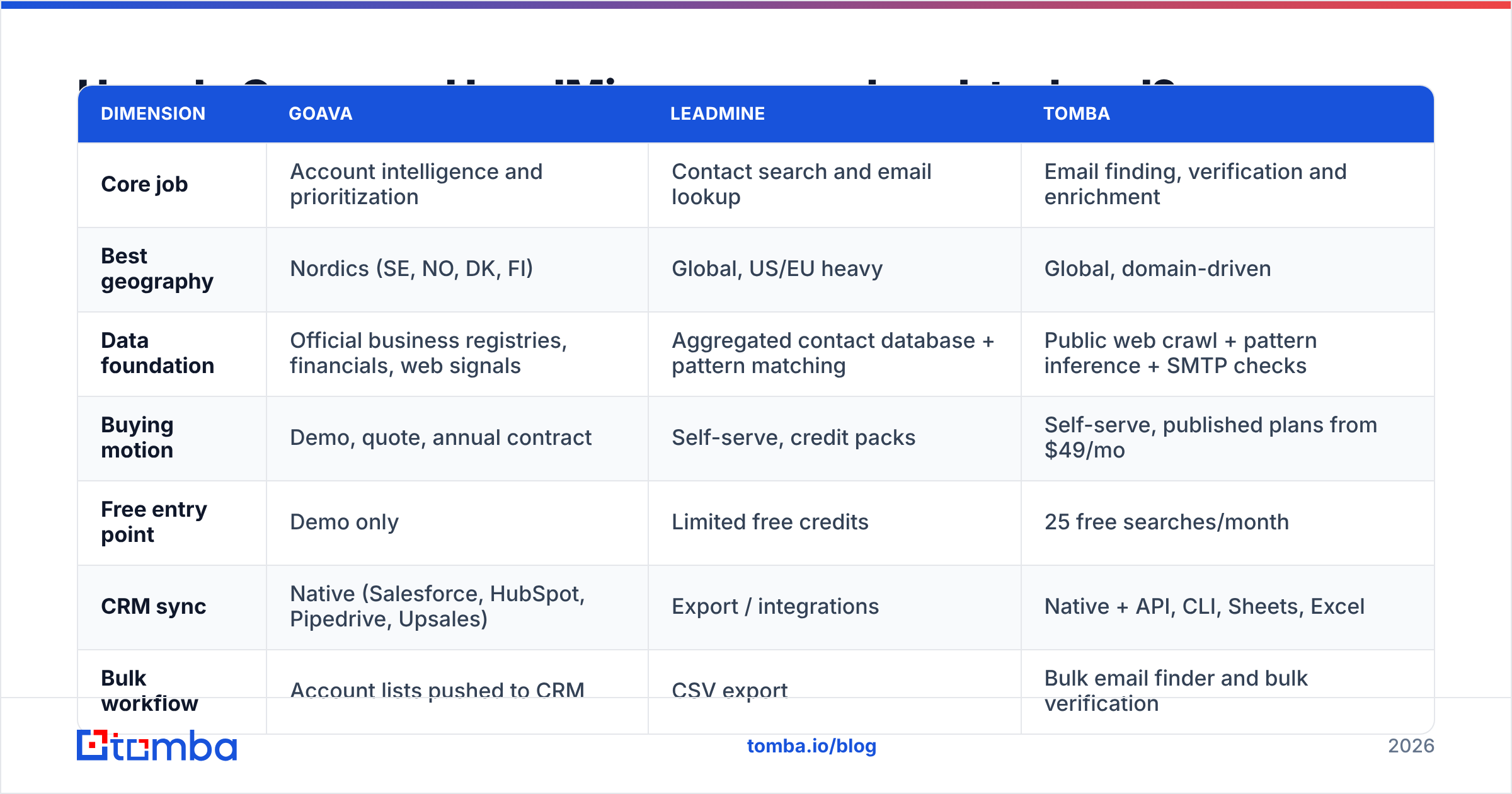
| Dimension | Goava | LeadMine | Tomba |
|---|---|---|---|
| Core job | Account intelligence and prioritization | Contact search and email lookup | Email finding, verification and enrichment |
| Best geography | Nordics (SE, NO, DK, FI) | Global, US/EU heavy | Global, domain-driven |
| Data foundation | Official business registries, financials, web signals | Aggregated contact database + pattern matching | Public web crawl + pattern inference + SMTP checks |
| Buying motion | Demo, quote, annual contract | Self-serve, credit packs | Self-serve, published plans from $49/mo |
| Free entry point | Demo only | Limited free credits | 25 free searches/month |
| CRM sync | Native (Salesforce, HubSpot, Pipedrive, Upsales) | Export / integrations | Native + API, CLI, Sheets, Excel |
| Bulk workflow | Account lists pushed to CRM | CSV export | Bulk email finder and bulk verification |
| Verification depth | Not the product's focus | Basic built-in check | Dedicated verifier incl. catch-all handling |
| Typical buyer | Nordic mid-market sales teams | SDRs, agencies, founders | Ops teams and developers building pipelines |
The table makes the real split obvious: these tools overlap in the sales stack but barely overlap in function. A Nordic sales team could plausibly run Goava and a contact-finding tool together and never feel redundancy. A US agency comparing them will find Goava expensive and geographically thin, and LeadMine perfectly adequate but strategically silent.
Which one has better data coverage?#
It depends entirely on what you mean by coverage.
Company coverage. Goava wins in the Nordics by a wide margin and loses outside it. Registry-sourced firmographics are verifiable facts, not estimates — when Goava says a Swedish company did SEK 84M last year with 62 employees, that came from a filing. Most global databases model those numbers and are routinely off by a tier. Outside the Nordics, Goava has to rely on the same third-party and web-derived sources everybody else uses, so the edge largely disappears.
Contact coverage. LeadMine wins on raw person-level reach. Its whole business is having an email for the person you searched. Goava's contact layer exists but is secondary to the account layer, and Nordic markets are notoriously thin on published direct emails because of stricter privacy norms and lower use of predictable formats.
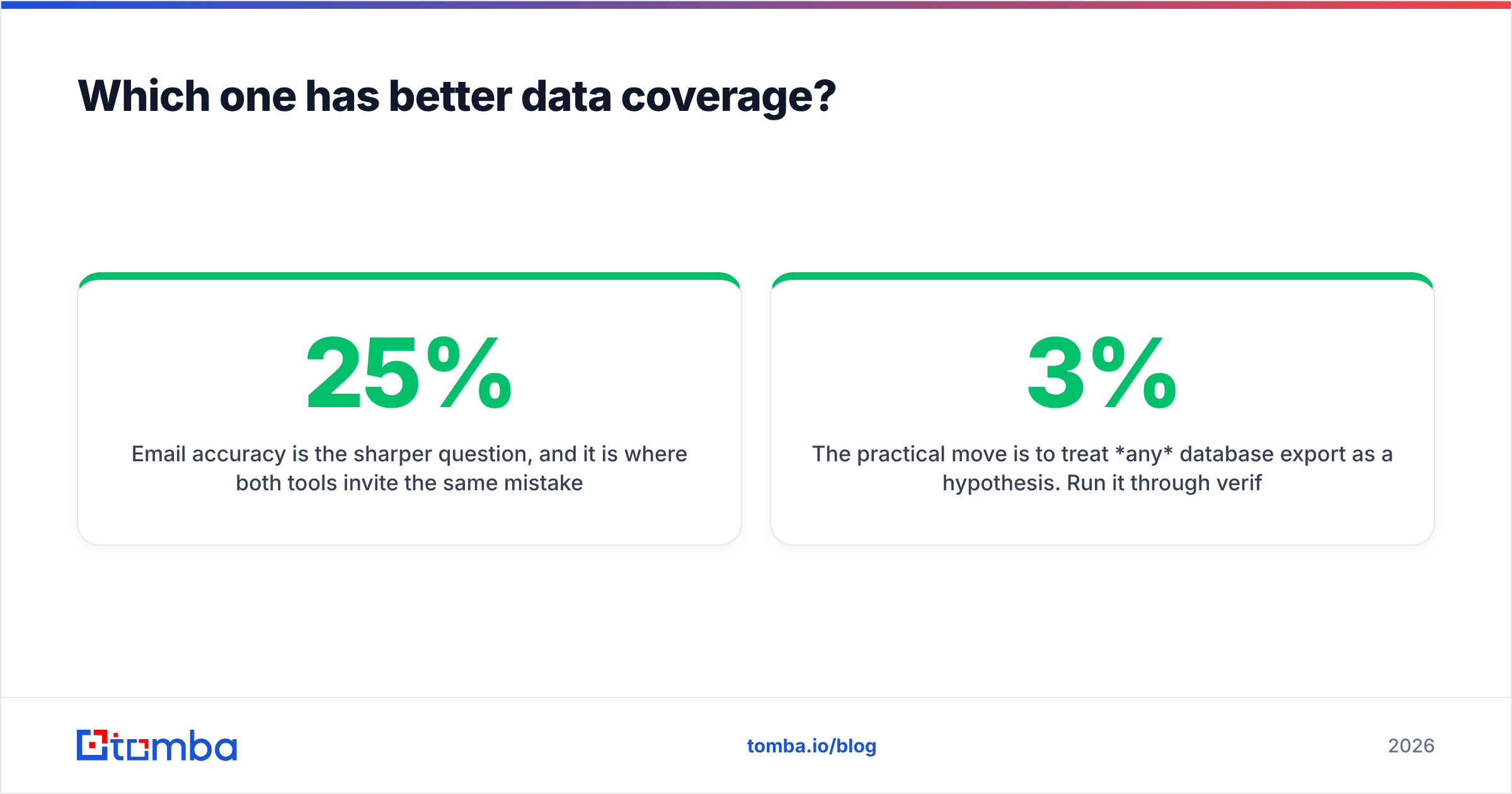
Email accuracy is the sharper question, and it is where both tools invite the same mistake. A "found" email is not a deliverable email. Databases age: people change jobs at roughly 20–25% a year in tech sales, and every one of those moves silently rots a row in someone's export. G2 reviews of contact databases across the category (g2.com) consistently flag stale records as the top complaint, regardless of vendor.
The practical move is to treat any database export as a hypothesis. Run it through verification before it touches a sending domain. That means checking syntax, MX records, mailbox existence via SMTP, and — critically — handling catch-all domains, which accept everything at the gateway and tell you nothing. A catch-all verifier is the difference between a 3% bounce rate and a 20% one on enterprise domains that all run catch-all.

What do Goava and LeadMine cost?#
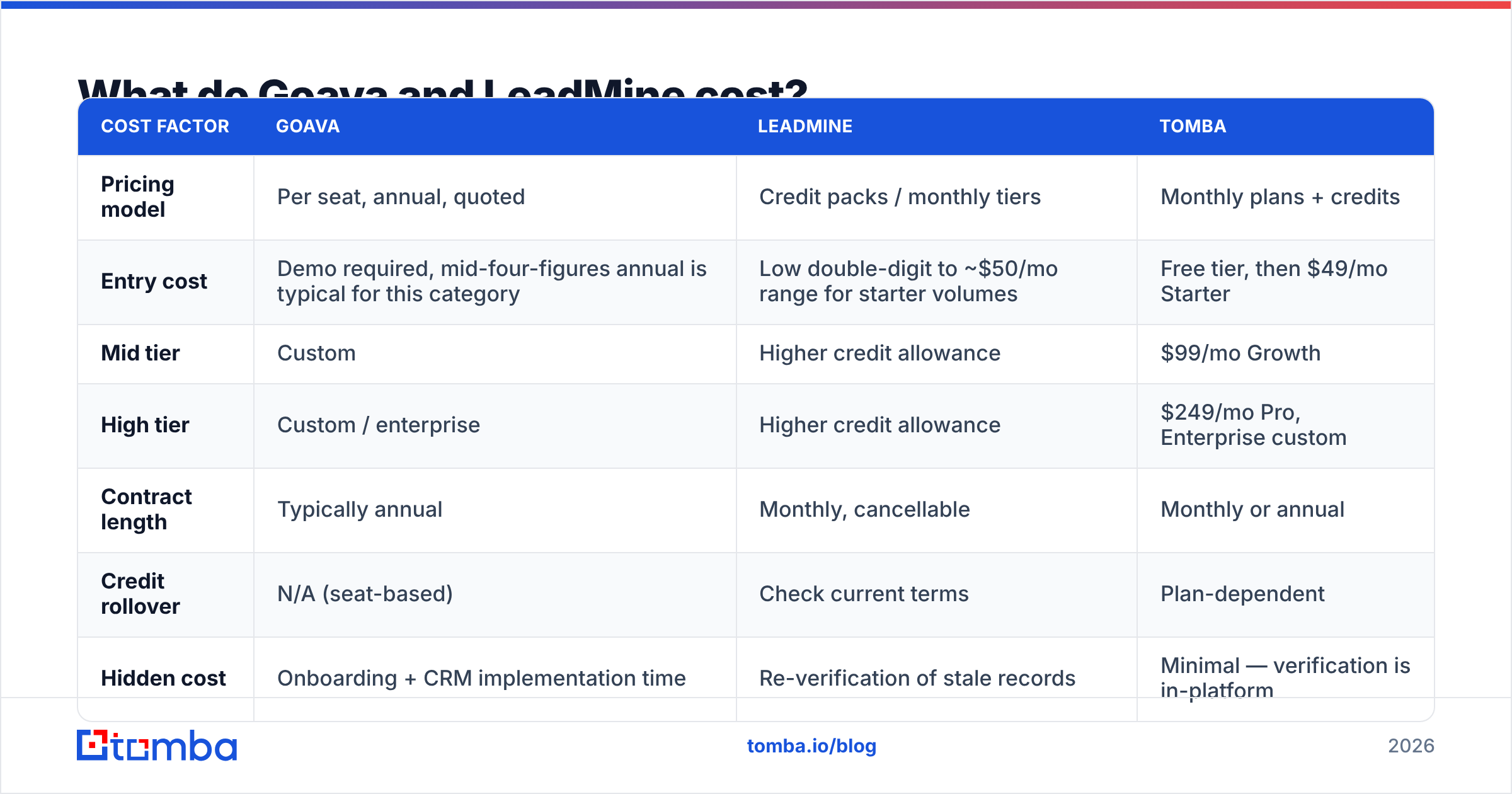
Straight answer: Goava is quote-only, LeadMine is published and cheap. Always confirm current numbers on the vendors' own pricing pages before you budget — both change tiers, and neither publishes a rate card that survives a year unchanged.
| Cost factor | Goava | LeadMine | Tomba |
|---|---|---|---|
| Pricing model | Per seat, annual, quoted | Credit packs / monthly tiers | Monthly plans + credits |
| Entry cost | Demo required, mid-four-figures annual is typical for this category | Low double-digit to ~$50/mo range for starter volumes | Free tier, then $49/mo Starter |
| Mid tier | Custom | Higher credit allowance | $99/mo Growth |
| High tier | Custom / enterprise | Higher credit allowance | $249/mo Pro, Enterprise custom |
| Contract length | Typically annual | Monthly, cancellable | Monthly or annual |
| Credit rollover | N/A (seat-based) | Check current terms | Plan-dependent |
| Hidden cost | Onboarding + CRM implementation time | Re-verification of stale records | Minimal — verification is in-platform |
The hidden costs matter more than the sticker. With Goava, the cost is implementation: connecting the CRM, defining ICP inputs, and getting reps to actually trust the recommendation score instead of their own account list. Teams that skip enablement end up paying enterprise money for an expensive company lookup tool.
With LeadMine, the hidden cost is data hygiene. Cheap credits are only cheap if the addresses work. Burning 2,000 credits on records that produce a 15% bounce rate is not a bargain — it is a deliverability incident with an invoice attached. Read up on how bounce rates feed sender reputation before you assume export volume equals pipeline.
When should you choose Goava over LeadMine?#
Pick Goava when most of these are true:
- Your territory is Nordic. Sweden, Norway, Denmark, Finland. This is the single biggest deciding factor and it is not close.
- You sell to mid-market or enterprise accounts where firmographic precision — revenue tier, employee bands, ownership structure, credit risk — actually changes who you call.
- You have a CRM worth learning from. Goava's recommendations get better with closed-won history. A CRM with 40 deals in it will not produce useful lookalikes.
- Reps waste hours on research. If your SDRs are manually reading annual reports, an intelligence layer pays for itself in reclaimed time.
- You can absorb an annual contract and a multi-week rollout without stalling the quarter.
Pick LeadMine when:
- You already know your target accounts and the bottleneck is contact details, not account selection.
- You need to start this week with no procurement cycle and no demo.
- Your volume is spiky — agency projects, campaign bursts, founder-led outbound — and credits suit you better than seats.
- Your market is global, where Goava's registry advantage does not apply.
- Budget is the constraint. The price gap between the two is an order of magnitude, not a rounding difference.
Where do both tools leave gaps?#
Three gaps show up repeatedly in teams running either product.
The verification gap. Goava does not position itself as an email verification tool, and LeadMine's built-in check is a basic pass, not a deep validation. Neither gives you a defensible catch-all verdict. If you are sending cold, you need a verification layer that handles risky, catch-all, role-based, and disposable addresses distinctly — not a binary valid/invalid flag.
The enrichment gap. Both give you a snapshot. Neither continuously re-enriches the records already sitting in your CRM. A contact you exported in March is a different person in September — new title, possibly new company. Scheduled data enrichment against your existing database catches the drift before your AE emails a title that no longer exists.
The pipeline gap. Goava is CRM-native; LeadMine is CSV-native. If your GTM motion runs through scripts, warehouses, or an internal tool, you want programmatic access rather than a UI. That is where an API-first approach wins — you can hit domain search endpoints from your own enrichment job and skip the export-import shuffle entirely.
How do you actually build a stack from this?#
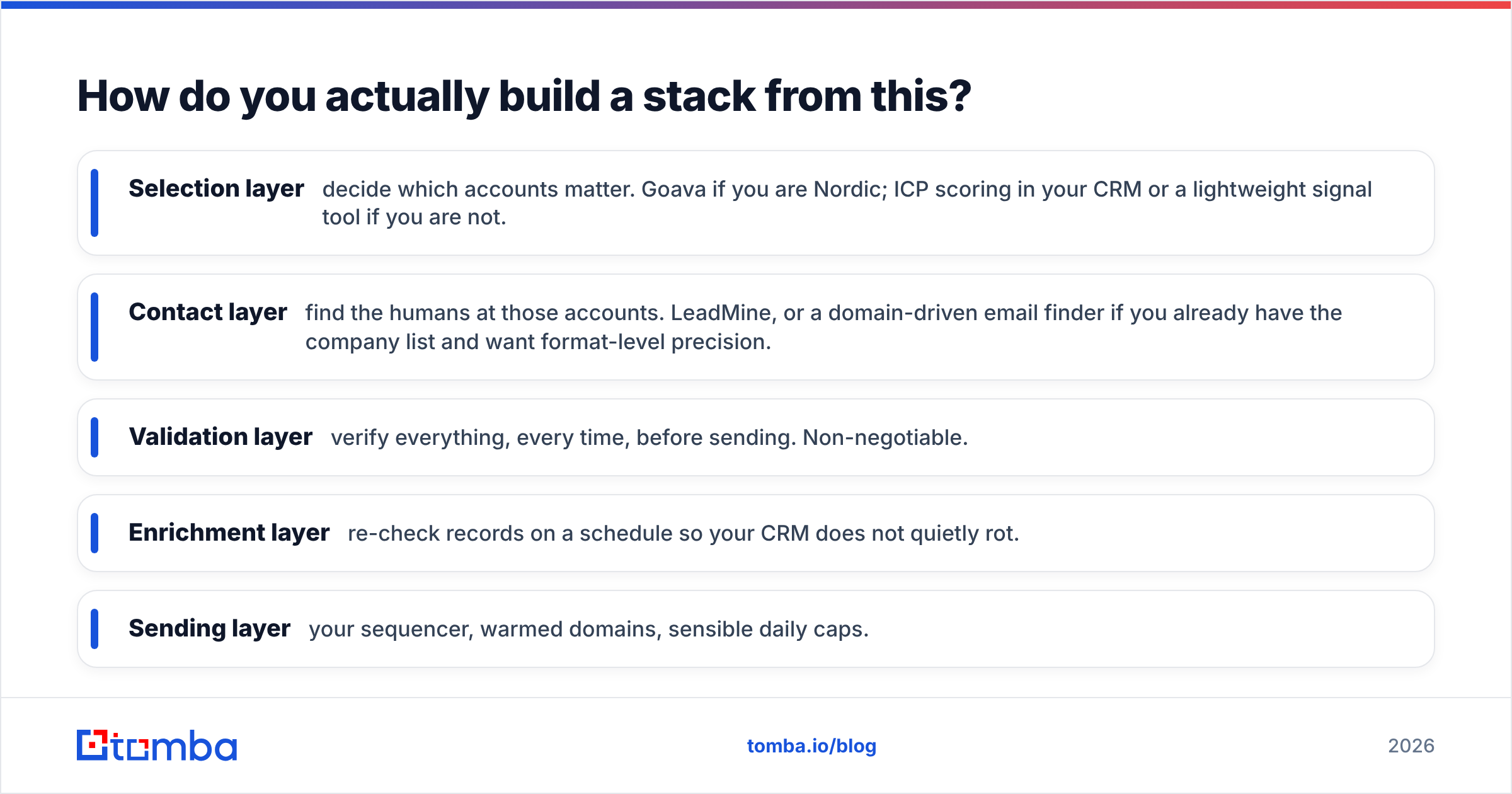
A workable pattern for most teams:
- Selection layer — decide which accounts matter. Goava if you are Nordic; ICP scoring in your CRM or a lightweight signal tool if you are not.
- Contact layer — find the humans at those accounts. LeadMine, or a domain-driven email finder if you already have the company list and want format-level precision.
- Validation layer — verify everything, every time, before sending. Non-negotiable.
- Enrichment layer — re-check records on a schedule so your CRM does not quietly rot.
- Sending layer — your sequencer, warmed domains, sensible daily caps.
Most teams over-invest in layer one and under-invest in layers three and four. A perfectly prioritized account list emailed at a 20% bounce rate is worse than a mediocre list emailed cleanly, because the second one still has a sending domain at the end of the month.
Final verdict: Goava vs LeadMine#
Goava wins if you sell in the Nordics to mid-market or larger accounts, have CRM history worth mining, and can justify an annual seat contract. Its registry-grade data is a genuine moat in those markets and nobody replicates it cheaply.
LeadMine wins if you need contact data now, globally, without a sales call, and your accounts are already chosen. It is the pragmatic pick for SDRs, agencies, and founders who measure tools in credits rather than seats.
Neither wins the accuracy question outright, because that is a different job. Whichever you buy, the address quality problem lands on your side of the fence.
That is where Tomba fits alongside either choice. The Tomba Email Finder resolves company domains and names into verified professional addresses, with catch-all handling, bulk processing, and an API you can wire into whatever you already run. Start on the free tier at 25 searches a month, move to Starter at $49/mo when volume justifies it, and stop paying for bounces you could have caught before send.
Related guides#
Ready to find emails that actually work?
Join 150,000+ professionals who stopped guessing and started sending. Free credits on signup — no credit card required.
Get the Tomba newsletter
Practical outbound tactics and product updates — once every two weeks.
About the author