Goava vs LeadRocks 2026: Which B2B Data Tool Actually Wins?
Goava sells Nordic sales intelligence. LeadRocks sells a global contact database with emails and phone numbers. They solve different problems — and picking the wrong one costs you a quarter of pipeline. Here is the honest breakdown.
TL;DR
- Goava picks companies. It scores Nordic accounts from registry data, finances, tech stacks, and buying signals.
- LeadRocks picks people. It hands you work emails and direct dials across the globe.
- Short answer to Goava vs LeadRocks: take Goava for Nordic account work, take LeadRocks for cheap global contacts.
- Neither tool checks an address at send time. Both ship emails that bounce.
- Most teams that weigh Goava vs LeadRocks buy one, then bolt a finder and a verifier on top.
What are Goava and LeadRocks, exactly?#
The Goava vs LeadRocks matchup confuses buyers. The two products barely overlap.
Goava is a sales intelligence tool built in Stockholm. It serves Nordic B2B teams. It pulls public company filings, revenue and profit numbers, staff counts, industry codes, website tech, and trigger events. Triggers include funding, hiring bursts, and new leaders. Goava then scores the accounts that look like your best customers. It pushes those records into the CRMs Nordic teams use: Salesforce, HubSpot, Pipedrive, Upsales, Lime, and SuperOffice.
LeadRocks is a contact database. It indexes tens of millions of B2B profiles, most of them from professional-network data. You search in a web app or a Chrome plug-in. It returns work emails and direct phone numbers. It grew through lifetime deals, which is why it lands on lists next to tools that cost ten times more.
One tool picks accounts. The other picks people. That gap drives every call below.

Goava vs LeadRocks: how do they compare head-to-head?#
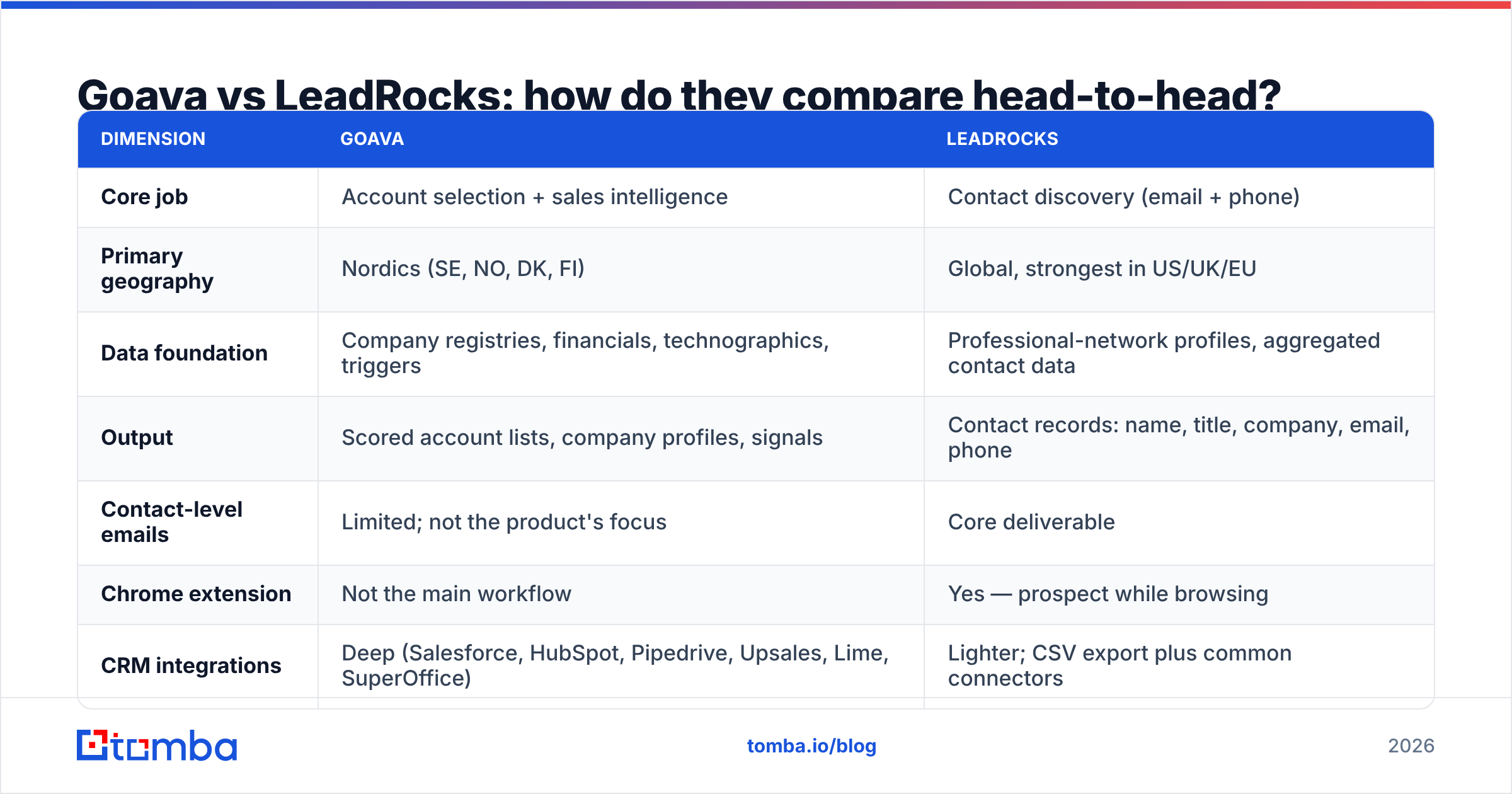
| Dimension | Goava | LeadRocks |
|---|---|---|
| Core job | Account selection + sales intelligence | Contact discovery (email + phone) |
| Primary geography | Nordics (SE, NO, DK, FI) | Global, strongest in US/UK/EU |
| Data foundation | Company registries, financials, technographics, triggers | Professional-network profiles, aggregated contact data |
| Output | Scored account lists, company profiles, signals | Contact records: name, title, company, email, phone |
| Contact-level emails | Limited; not the product's focus | Core deliverable |
| Chrome extension | Not the main workflow | Yes — prospect while browsing |
| CRM integrations | Deep (Salesforce, HubSpot, Pipedrive, Upsales, Lime, SuperOffice) | Lighter; CSV export plus common connectors |
| Pricing model | Quote-based, annual seats | Published credit tiers, periodic lifetime deals |
| Typical buyer | Nordic mid-market/enterprise sales team | SMB, agency, high-volume outbound team |
| Learning curve | Moderate — it is a platform | Low — search, filter, export |
Short version: Goava is a strategy tool, and sales leaders buy it. LeadRocks is a tactical tool, and SDRs or founders buy it with a credit card.
Which tool actually has better data coverage?#
Coverage is not one number. It settles most Goava vs LeadRocks arguments, so split it into parts.
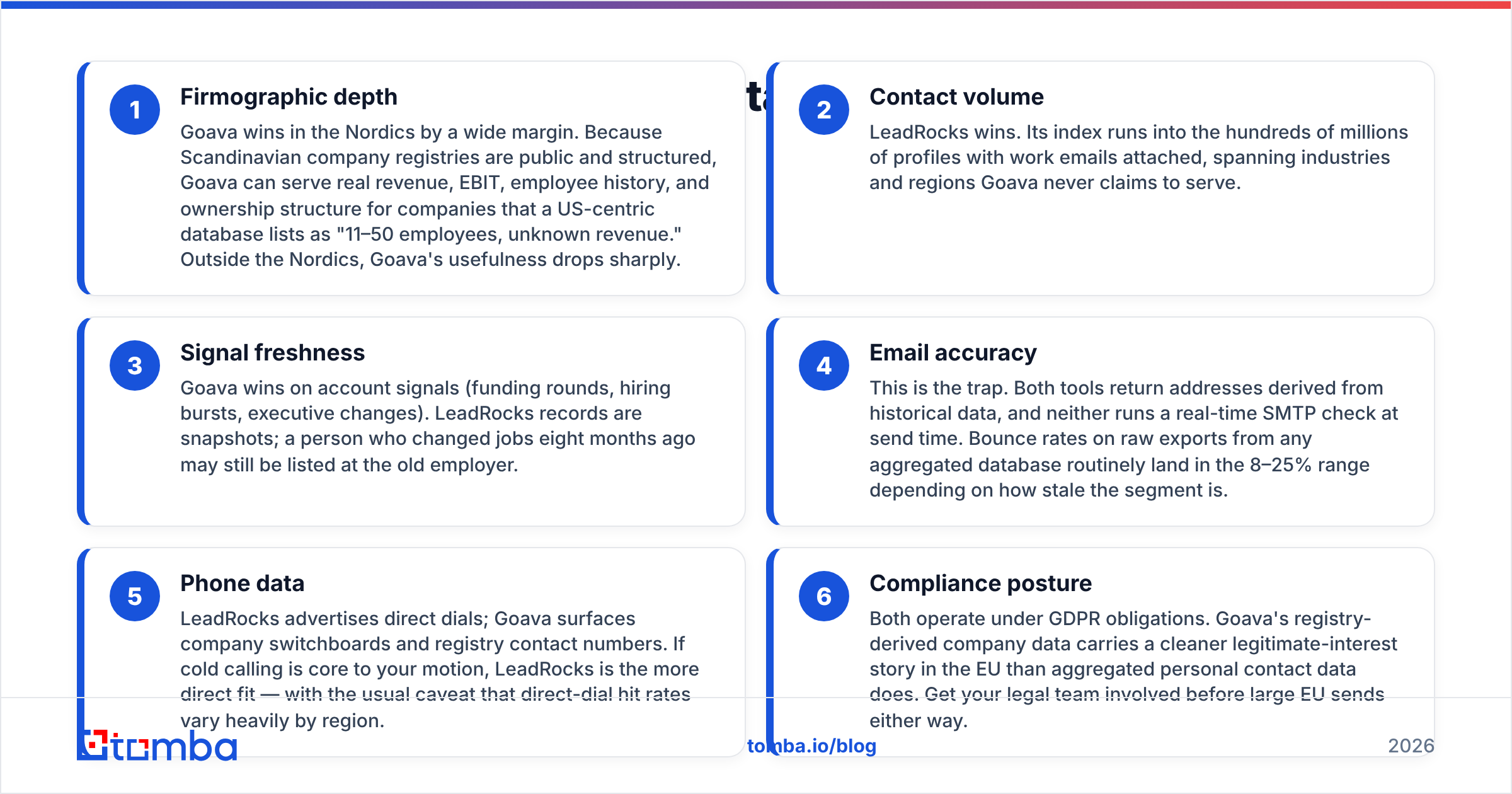
- Company depth — Goava wins in the Nordics, and it is not close. Nordic registries are public and clean. Goava can show real revenue, profit, staff history, and owners. A US-built database often shows "11–50 staff, revenue unknown." Outside the Nordics, Goava thins out fast.
- Contact volume — LeadRocks wins. Its index runs to hundreds of millions of profiles with work emails. It covers regions Goava never claims to serve.
- Freshness — Goava wins on account signals: funding, hiring, new execs. LeadRocks rows are snapshots. A person who moved jobs last year may still sit under the old employer.
Three more factors decide the Goava vs LeadRocks call:
- Email accuracy — this is the trap. Both tools store addresses built from old data. Neither pings the mail server as you send. Raw exports from any pooled database bounce at 8–25%. Stale segments sit at the top of that range.
- Phone data — LeadRocks sells direct dials. Goava gives switchboards and registry numbers. If you cold call, LeadRocks fits better. Hit rates still swing by country.
- Compliance — both fall under GDPR. Goava's registry data has a cleaner story in the EU than pooled personal data. Ask your legal team before a large EU send.
Want a sanity check before you sign? Read user reviews on G2, not vendor case studies. Look at the one-star reviews that mention data. Bounce complaints show up there.
How much do Goava and LeadRocks cost?#
Price is where Goava vs LeadRocks splits hardest.
Goava does not publish rates. It sells annual contracts. The quote depends on seats, markets, and CRM modules. Expect a call, a demo, and a proposal. Treat it as a platform line item, not a tool subscription.
LeadRocks publishes credit tiers and runs lifetime deals on deal sites. Entry plans sit in the low tens of dollars a month for a few thousand credits. Credits burn per revealed contact. So your real cost per usable lead is the sticker price divided by the share of records that pass a check. Few buyers run that math.
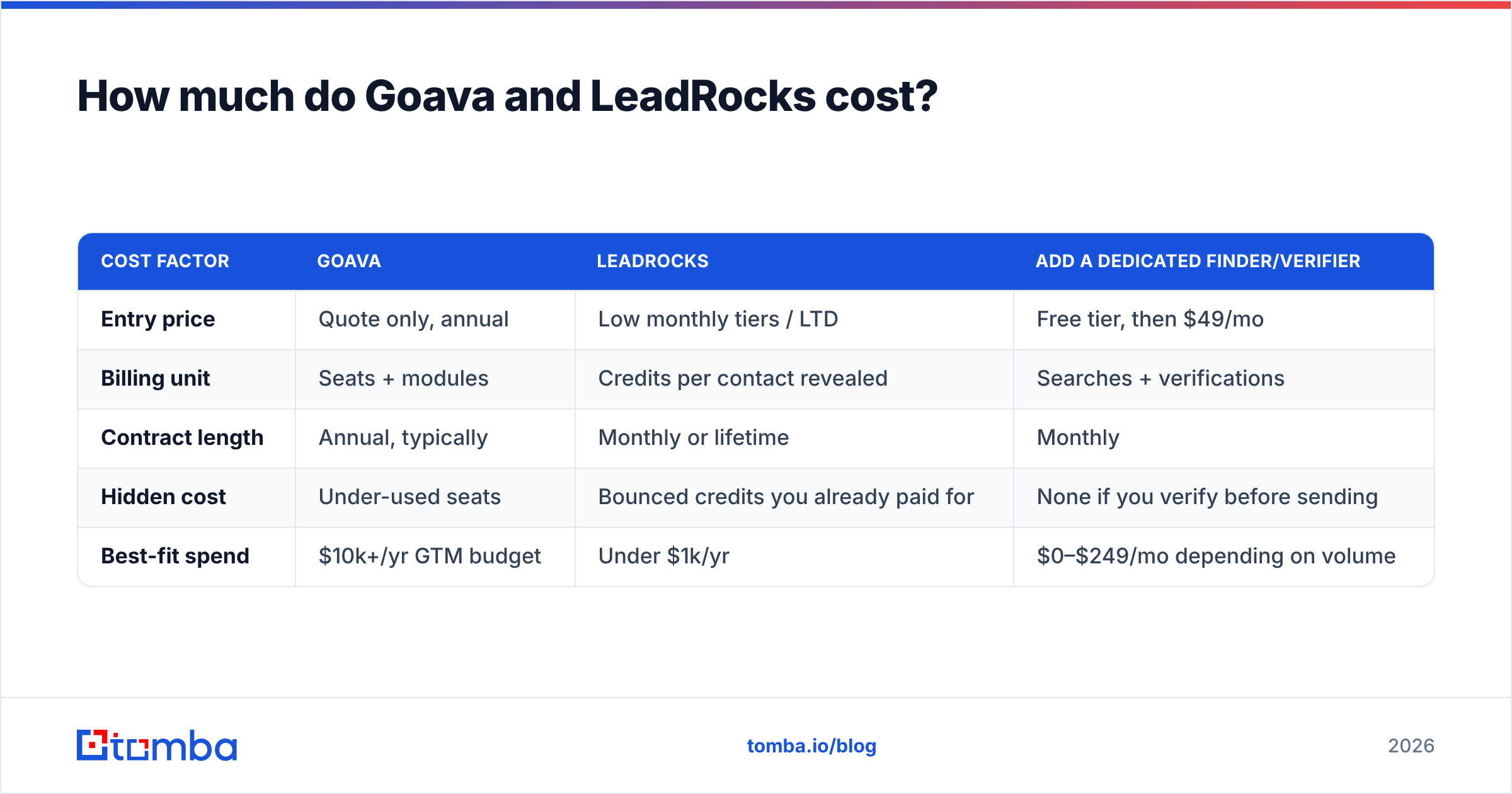
| Cost factor | Goava | LeadRocks | Add a dedicated finder/verifier |
|---|---|---|---|
| Entry price | Quote only, annual | Low monthly tiers / LTD | Free tier, then $49/mo |
| Billing unit | Seats + modules | Credits per contact revealed | Searches + verifications |
| Contract length | Annual, typically | Monthly or lifetime | Monthly |
| Hidden cost | Under-used seats | Bounced credits you already paid for | None if you verify before sending |
| Best-fit spend | $10k+/yr GTM budget | Under $1k/yr | $0–$249/mo depending on volume |
For a sense of the extra layer, Tomba pricing starts free at 25 searches a month. Paid plans run $49 (Starter), $99 (Growth), and $249 (Pro). Next to a Goava contract that is a rounding error. Next to a raw LeadRocks export it is a real lift in accuracy.
When should you choose Goava?#
Choose Goava when picking accounts is the bottleneck, not finding people.
Signs you are a Goava buyer:
- Your buyers are Nordic. You sell to Swedish makers, Norwegian energy firms, Danish logistics, or Finnish industry. You need real numbers before a rep spends a week on an account.
- Your deals are big. At €30k and up, one avoided quarter of wrong targeting pays for the seats.
- Your team lives in a CRM. You want rich accounts there, not in a sheet.
- Your leaders want territory plans and market sizing, not a list.
Skip Goava if you sell worldwide, your deals run under €5k, you need 5,000 contacts by Friday, or nobody on the team will run a platform.
When should you choose LeadRocks?#
Choose LeadRocks when you need reach, speed, and a price that skips procurement.
Signs you are a LeadRocks buyer:
- You run outbound in many countries, and no single-region tool covers your map.
- You are an agency building lists for clients, and margin per list matters.
- You mix email with cold calls, so a direct dial is worth as much as an inbox.
- You want to prospect inside the browser, not wait for a batch export.
Skip LeadRocks if you need audited financials, you sell only in Scandinavia, or your compliance team wants a documented source for every record.

What do both tools get wrong about email accuracy?#
Both treat an email as a field in a row. It is not. An address is a claim about a mail server today, and the claim rots by the day.
Here is the cost of skipping the check. You export 3,000 contacts. Between 240 and 750 no longer work. People left. Domains moved. Aliases died. You send anyway. Your bounce rate crosses the line where inbox providers throttle you. Your sender reputation drops. Then the 2,300 good addresses land in spam too. You did not just burn 700 credits. You hurt the channel for the rest.
The fix takes ten minutes:
- Run every export through an email verifier before it hits your sequencer. Drop anything not marked deliverable.
- Send catch-all domains to a catch-all verifier. Catch-alls accept mail at the door and bounce it later, which is the worst case.
- For thin accounts, run a domain search to pull the contact map and the email pattern. Then build the address you need instead of paying per stale record.
- Push the list through bulk verify on a schedule. Monthly for live lists, quarterly for old ones.
Goava vs LeadRocks does not settle this part. Both leave the check to you. Neither vendor is lying about it. Verifying contacts is simply a different job than scoring accounts or pooling profiles.
Can you use Goava and LeadRocks together?#
Yes. For Nordic-plus-global teams it is often the right stack. Few teams need both at full price.
A workable setup looks like this:
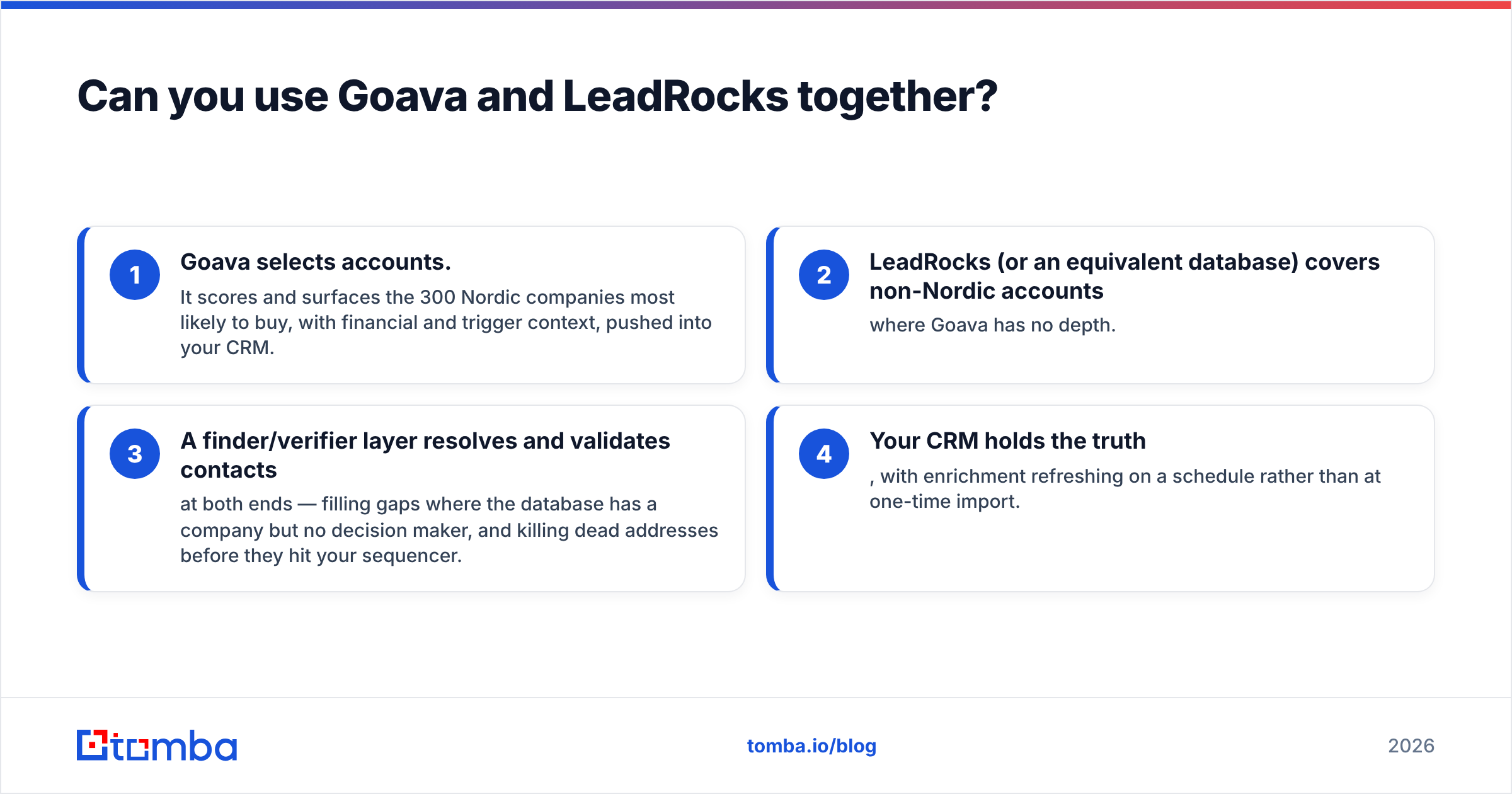
- Goava picks accounts. It surfaces the 300 Nordic firms most likely to buy, with finance and trigger context, right in your CRM.
- LeadRocks covers the rest of the map, where Goava has no depth.
- A finder and verifier clean the contacts at both ends. They fill gaps and kill dead addresses before your sequencer sees them.
- Your CRM holds the truth. Enrichment refreshes on a schedule, not once at import.
If the budget forces a pick, use this rule. Buy the account platform only when the Nordics are your core market and deals run large. Otherwise buy the cheaper database. Spend the rest on data enrichment and checks. You will do more account research by hand, and that trade is fine.
Which one wins the Goava vs LeadRocks comparison?#
No tool wins Goava vs LeadRocks outright. They do not chase the same job. Any post that crowns a winner is selling you something.
- Nordic mid-market or enterprise, €25k+ deals: Goava. The registry and finance depth is hard to buy elsewhere, and reps use it because it sits in the CRM.
- Global SMB outbound, agencies, founder-led sales: LeadRocks. Reach and cost per record beat a one-market platform.
- Anyone sending cold email at volume: add a verifier on top. It is the cheapest line in the stack.
- One budget, both needs: start with contact data and a verifier. Build account scores from CRM history. Less elegant, and it works.
Whatever you pick, test the same thing on both trials. Not records returned. Deliverable records per dollar. Run 500 rows from each through one verifier and compare what survives. That one number ends the Goava vs LeadRocks debate faster than a demo call.
Close the accuracy gap in your stack. Your account tool does not decide whether mail lands. The contact layer does. Tomba Email Finder finds work emails by name and domain. It checks them against live mail servers before you export. It plugs into the same CRMs Goava and LeadRocks feed. Start free with 25 searches a month, run your current export through it, and compare the bounce rate with what you send today.
Related guides#
Ready to find emails that actually work?
Join 150,000+ professionals who stopped guessing and started sending. Free credits on signup — no credit card required.
Get the Tomba newsletter
Practical outbound tactics and product updates — once every two weeks.
About the author