Goava vs Limeleads (2026): Which B2B Data Platform Wins?
Goava sells Nordic sales intelligence with buying signals. Limeleads sells cheap, self-serve US lead lists. They solve different problems — and neither one is a great email finder. Here is the honest breakdown.
Goava vs Limeleads is not really a fair fight. One tool tells you which accounts to chase. The other hands you a list of contacts to email. Here is the short version, then the detail.
TL;DR
- Goava is a Nordic sales intelligence platform. It pulls company data from official registries, scores your ICP, tracks buying signals, and pushes to your CRM. It is a targeting tool, not a contact-export tool.
- Limeleads is a US self-serve lead database. Filter by industry, title, and location, then export contacts by the credit. It is a volume tool, not an intelligence tool.
- They barely overlap. Sell into Sweden, Norway, Denmark, or Finland and need account priorities? Goava wins. Need 5,000 US contacts by Friday? Limeleads wins.
Both tools share the same blind spot:
- Email accuracy on the day you send. Static databases decay 25–30% a year. Neither vendor re-checks the address the morning you email it.
- The 2026 stack that works: one targeting source, plus a live email finder and verifier on top. That is where a per-lookup tool like Tomba fits, at a fraction of a database seat.
Goava vs Limeleads: what is each tool, exactly?#
They are not real competitors. They get compared because both show up in searches for "B2B lead database." That phrase hides a big difference in what you actually get.
Goava is a Swedish sales intelligence platform built for the Nordic market. Its core idea is recommendation. Instead of writing filters, you let Goava study your closed-won accounts and surface companies that look like them. Each one arrives with financials, org data, tech signals, and trigger events like hiring or funding. It pushes into CRMs — Salesforce, HubSpot, Upsales, Lime CRM. It sells as an annual seat contract, and you start with a demo.
Limeleads is a US self-serve lead database. You search by industry, employee count, revenue, location, and job title. You preview the results, then spend credits to unlock emails and phone numbers. It checks addresses at export, and credits do not expire. There is no recommendation engine, no signal layer, and almost no Nordic coverage.
Read that back and the choice gets simpler. One tool tells you who to call. The other hands you a list to call.

Goava vs Limeleads: how do they compare head-to-head?#
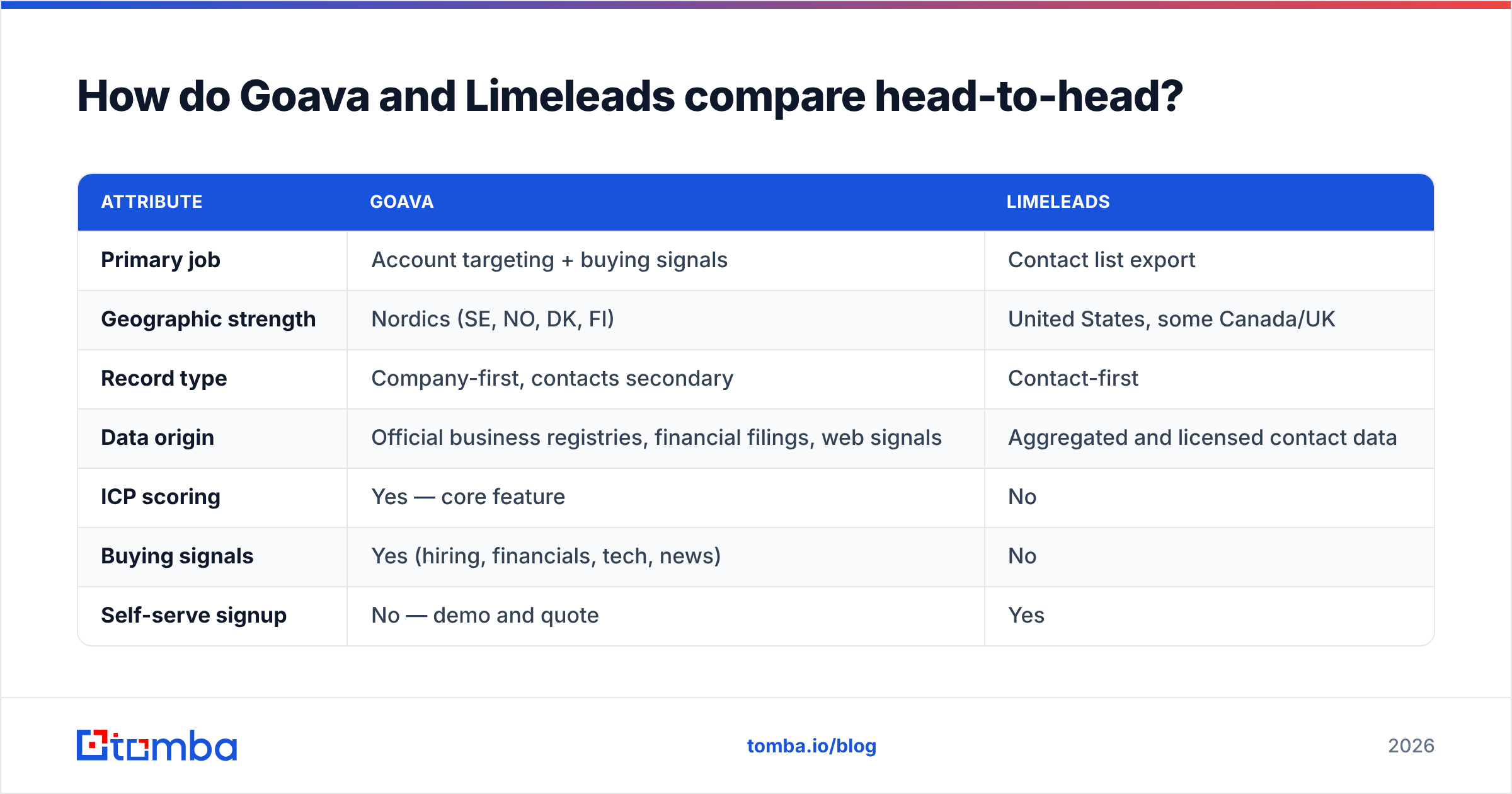
| Attribute | Goava | Limeleads |
|---|---|---|
| Primary job | Account targeting + buying signals | Contact list export |
| Geographic strength | Nordics (SE, NO, DK, FI) | United States, some Canada/UK |
| Record type | Company-first, contacts secondary | Contact-first |
| Data origin | Official business registries, financial filings, web signals | Aggregated and licensed contact data |
| ICP scoring | Yes — core feature | No |
| Buying signals | Yes (hiring, financials, tech, news) | No |
| Self-serve signup | No — demo and quote | Yes |
| Pricing model | Annual seat licence, quote-based | Credit packs / monthly plans |
| Free trial | Trial via sales | Free preview, limited credits |
| CRM integrations | Salesforce, HubSpot, Upsales, Lime CRM | CSV export, basic integrations |
| Email verification | Not the core promise | Verification at export |
| Best for | Nordic mid-market and enterprise AEs | SMB outbound and agencies needing volume |
Two rows matter most. First, geography is a hard wall, not a soft preference. Goava's registry data is excellent inside the Nordics and thin outside it. Limeleads' US file gets sparse the moment you filter for Stockholm or Oslo. Second, the pricing model decides who can even buy. A two-person agency will never clear a Goava annual contract. An enterprise RevOps team will not plan a year on credit packs.
Which one has better data coverage?#
Wrong question. Ask which one covers your territory and your record type.
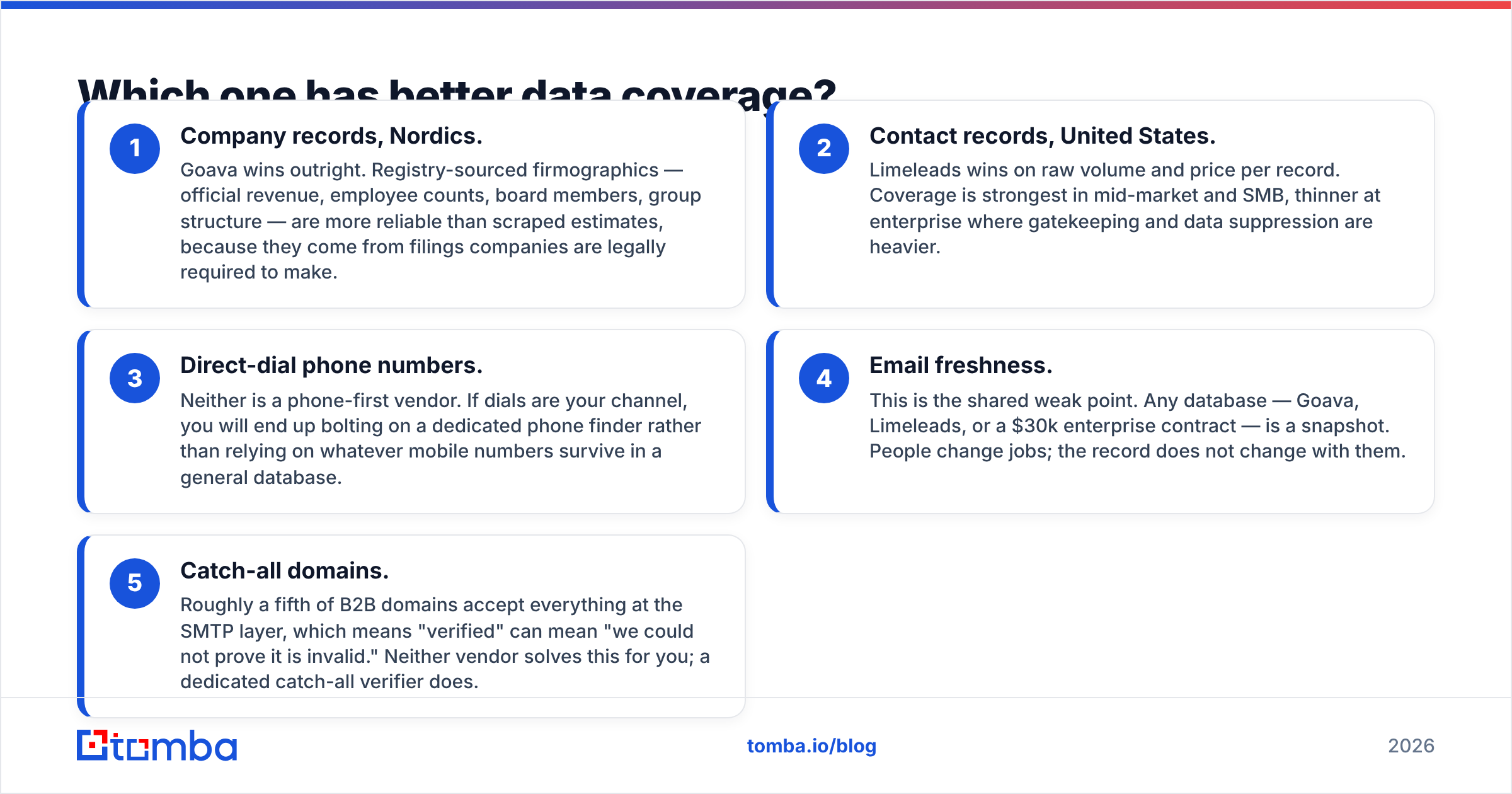
- Company records, Nordics. Goava wins outright. Registry-sourced firmographics — official revenue, employee counts, board members, group structure — beat scraped estimates. They come from filings that companies are legally required to make.
- Contact records, United States. Limeleads wins on raw volume and price per record. Coverage is best in mid-market and SMB. It thins out at enterprise, where gatekeeping and data suppression are heavier.
- Direct-dial phone numbers. Neither vendor is phone-first. If dials are your channel, bolt on a dedicated phone finder instead of trusting whatever mobile numbers survive in a general database.
The next two gaps apply to both tools equally.
- Email freshness. This is the shared weak point. Every database is a snapshot — Goava, Limeleads, or a $30k enterprise contract. People change jobs. The record does not change with them.
- Catch-all domains. Roughly a fifth of B2B domains accept every address at the SMTP layer. So "verified" can mean "we could not prove it is fake." Neither vendor solves this for you. A dedicated catch-all verifier does.
B2B contact data decays about 25–30% a year. G2 reviewer patterns across the lead-intelligence category say the same thing. The top complaint about every vendor here is stale contacts, not missing companies. Company facts age slowly. People move fast.
Goava vs Limeleads: how does pricing actually work?#
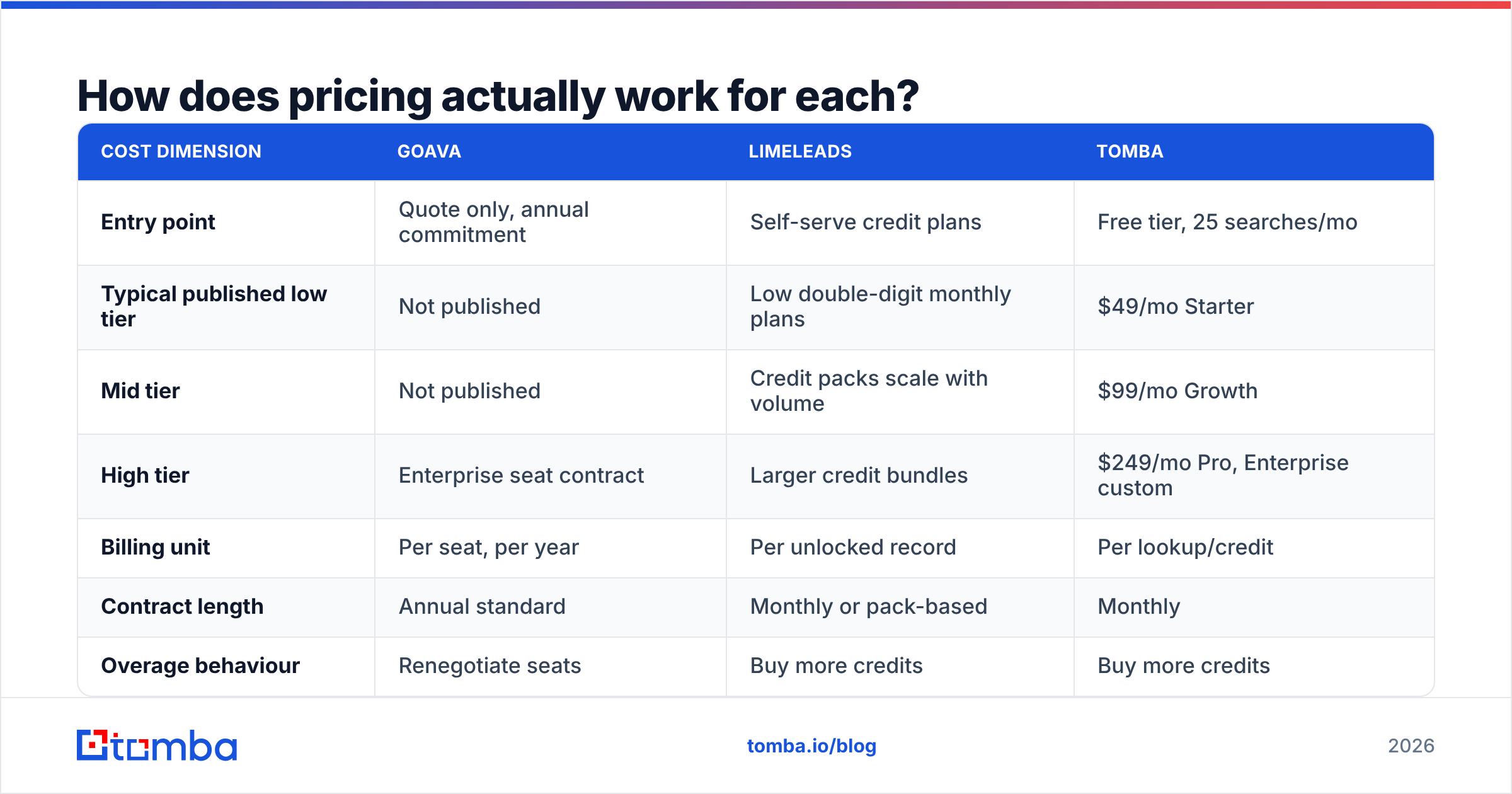
Neither vendor publishes a clean price sheet. Treat the table below as shape, not gospel. Check current numbers on each vendor's own page before you sign.
| Cost dimension | Goava | Limeleads | Tomba |
|---|---|---|---|
| Entry point | Quote only, annual commitment | Self-serve credit plans | Free tier, 25 searches/mo |
| Typical published low tier | Not published | Low double-digit monthly plans | $49/mo Starter |
| Mid tier | Not published | Credit packs scale with volume | $99/mo Growth |
| High tier | Enterprise seat contract | Larger credit bundles | $249/mo Pro, Enterprise custom |
| Billing unit | Per seat, per year | Per unlocked record | Per lookup/credit |
| Contract length | Annual standard | Monthly or pack-based | Monthly |
| Overage behaviour | Renegotiate seats | Buy more credits | Buy more credits |
The structure matters more than the sticker price. Goava's seat model ties cost to headcount. Five AEs cost five times one AE, whether they log in or not. Limeleads' credit model ties cost to volume. A slow quarter costs you almost nothing. A per-lookup tool behaves like the second model. That is why layering one on top of a targeting platform rarely blows up a budget. You can check current Tomba pricing against whichever quote lands on your desk.
One trap is worth naming. Unlocking a record you never email is pure waste. A team that exports 10,000 Limeleads contacts and mails 2,000 has paid a 5x premium on its real usage. Filter hard before you spend, not after.
Is Goava worth it for non-Nordic teams?#
Mostly no. Goava's edge is registry-grade Nordic data plus a recommendation layer tuned to that market. Take the geography away and you are paying enterprise prices for a scoring engine. You could get close with your own CRM data and a decent enrichment API.
Goava earns its price when:
- Your ICP is Nordic mid-market. Registry data beats estimates, and estimate error is what wrecks territory planning.
- You run account-based motions. Signal-driven priorities are worth real money when each account is worth five figures.
- Your CRM is the system of record. The push into Upsales or Lime CRM kills the CSV shuffle.
- You have AEs, not SDR spray. Seat pricing punishes large, low-intensity teams.
Goava is the wrong buy if you sell globally, if you need contact volume more than account intelligence, or if you cannot commit for a year.
What does Limeleads get right — and where does it fall short?#
Right: it is cheap, it is self-serve, and credits never expire. That is friendlier than the monthly-reset plans common in this category. For a founder-led outbound push, or an agency building a US list for a client, that is a real advantage. You can be exporting ten minutes after signup, with no discovery call.
Short: the file is just a file. There is no signal layer, no ICP learning, no account scoring. Coverage outside North America drops off fast. Checking addresses at export beats nothing, but it is a check at export time. If the list sits in a spreadsheet for six weeks before your sequence launches, you are mailing stale addresses and paying for it in sender reputation.
The fix is boring and it works. Re-verify right before you send, every time, no matter who sold you the list. Running an export through an email verifier on launch morning usually strips 8–15% of a three-month-old list. Those are the exact addresses that would have hard-bounced.

Where does a dedicated email finder fit alongside either tool?#
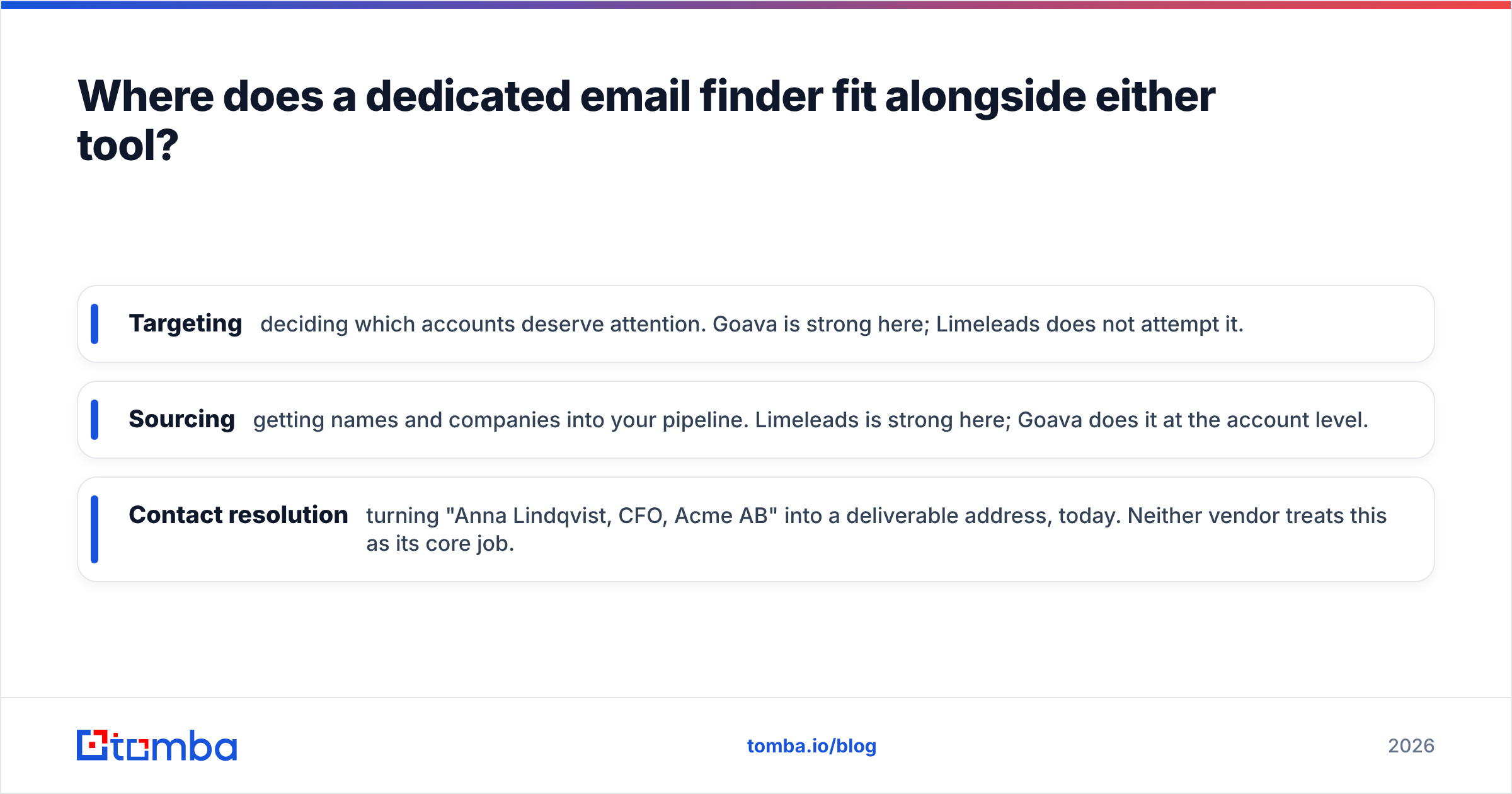
Think of three separate jobs that vendors keep bundling badly:
- Targeting — deciding which accounts deserve attention. Goava is strong here. Limeleads does not attempt it.
- Sourcing — getting names and companies into your pipeline. Limeleads is strong here. Goava does it at the account level.
- Contact resolution — turning "Anna Lindqvist, CFO, Acme AB" into a deliverable address, today. Neither vendor treats this as its core job.
Contact resolution is where outbound quietly breaks, and it is the Goava vs Limeleads gap that costs you the most. You already know the target. The account came from Goava, the persona came from LinkedIn, the company came from a conference list. Now you need one live, verified address right now. Paying a seat licence or burning a full record credit for that is overkill.
So build around a simple pattern: keep one targeting source, then resolve contacts on demand. A domain search returns a company's addresses and email pattern in one call. A bulk email finder does the same job across a whole account list before a campaign starts. The unit is a lookup, not a seat, so cost tracks what you actually send.
Which should you choose in 2026?#
Pick by the constraint that binds hardest. The Goava vs Limeleads decision is really a question about territory and budget shape.
Choose Goava if: you sell into the Nordics, your deal sizes justify annual seats, your team needs priorities more than volume, and you want signals pushed into a CRM instead of pulled from a UI.
Choose Limeleads if: you sell into the US, you need contact volume at low cost, you want to buy without a sales call, and your workflow is export-then-sequence.
Choose neither as your only tool if: your bounce rate is above 3%, your list ages more than a couple of weeks before send, or your territory spans both regions. In those cases the database is not your bottleneck. Contact freshness is.
Blended play most teams land on: one targeting layer (Goava for the Nordics, Limeleads or a similar US file elsewhere), one live layer for emails and phones, and a verification pass right before every send. It costs less than two full database contracts. Deliverability improves too, because addresses get checked at send time instead of purchase time.
A quick sanity checklist before you buy either#
- Run the same 20 target accounts through both trials. Count how many usable, current contacts you get out.
- Check bounce rate on a 200-contact test send, not the vendor's claimed accuracy number.
- Ask what happens to your credits or seats if headcount changes mid-contract.
- Confirm coverage in your top three territories specifically, not globally.
- Test the CRM push with your actual field mapping. This is where integrations quietly fail.
Ready to fix the part neither tool solves?#
Targeting platforms tell you who to chase. Lead databases hand you a spreadsheet. Neither one promises the address still works on the morning you press send. That is the number your deliverability actually depends on.
Start with the Tomba Email Finder. Give it a name and a domain, and get a verified work address back with a confidence score. Or run a whole account list through it before your next sequence. The free tier gives you 25 searches a month, enough to test it against your existing Goava or Limeleads exports. Paid plans start at $49/mo and scale by lookup, not by seat. Run 100 of your current contacts through it and count how many come back flagged. That number tells you more about your data problem than any comparison page, this one included.
Related guides#
Ready to find emails that actually work?
Join 150,000+ professionals who stopped guessing and started sending. Free credits on signup — no credit card required.
Get the Tomba newsletter
Practical outbound tactics and product updates — once every two weeks.
About the author