Goava vs Pubrio: Which B2B Sales Intelligence Tool Wins?
Goava is deep Nordic sales intelligence with quote-based pricing. Pubrio is a self-serve global lead database. Here is where each one wins, where each one breaks, and what neither does well.
Goava vs Pubrio is a choice between depth and reach. Goava knows Nordic companies inside out. Pubrio covers the world at self-serve speed. Here is where each one wins, where each one breaks, and what neither does well.
TL;DR
- Goava is a Nordic-first sales intelligence platform. It goes deep on Swedish, Norwegian, Danish and Finnish companies. You get financials, org numbers, hiring signals and tech stack, plus AI-scored prospect picks pushed into your CRM.
- Pubrio is a self-serve, global B2B lead database. It offers AI search, contact lookup, technology filters and website-visitor tracking. Its edge is breadth. You can sign up and pull records today.
- Pricing is the sharpest split in the Goava vs Pubrio matchup. Pubrio publishes self-serve tiers. Goava runs on quotes and demos. If you need a number before a sales call, that matters.
- Neither is a contact-data specialist. Both bundle emails into a wider platform. That is why teams often add a dedicated finder and verifier before a send.
- Pick by geography and buying motion. Nordic enterprise account-based selling → Goava. Global volume prospecting on a card → Pubrio. Deliverability-critical outbound → add a specialist layer.
What are Goava and Pubrio?#
They solve the same job — "tell me who to contact and how to reach them" — from opposite ends.
Goava is a Stockholm-built sales intelligence platform for B2B teams selling into the Nordics. It pulls in official registry data, financial filings, web technology signals and news. Then it scores your total market against your existing customers. The pitch is not "here is a search box." It is "here are the 40 companies most likely to buy from you this quarter, ranked, in your CRM." That makes it an account-based product at heart.
Pubrio is a newer, AI-forward lead generation platform. It offers a global contact and company database, plain-English search, an email finder, verification, technology lookup and anonymous visitor tracking. The pitch is self-serve throughput. Describe your ICP, get a list, export it, run the campaign.
That split in philosophy shapes almost every trade-off below. Goava aims for fewer, better accounts in one region. Pubrio aims for more, faster records across many.
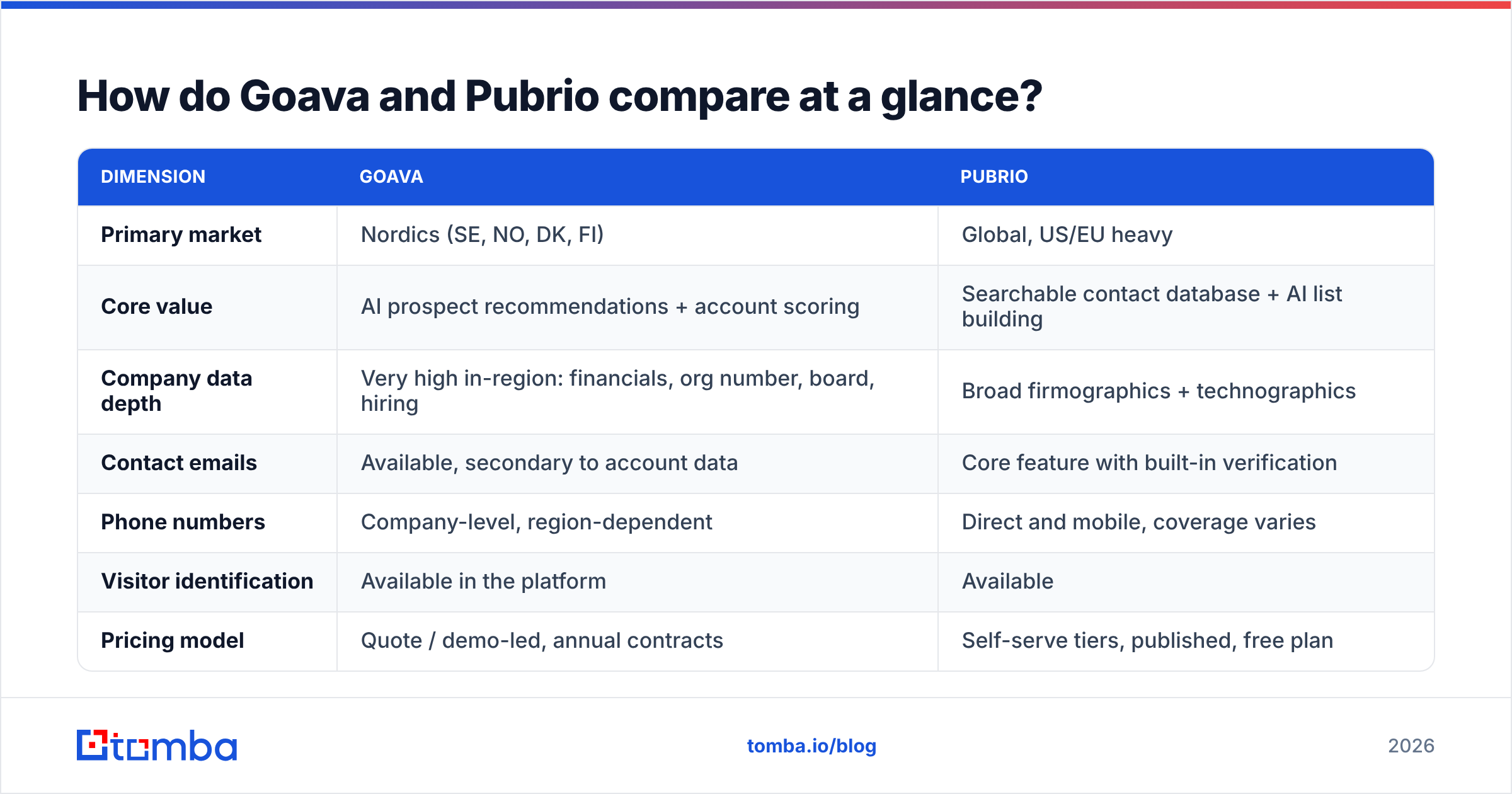
Goava vs Pubrio: how do they compare at a glance?#
| Dimension | Goava | Pubrio |
|---|---|---|
| Primary market | Nordics (SE, NO, DK, FI) | Global, US/EU heavy |
| Core value | AI prospect recommendations + account scoring | Searchable contact database + AI list building |
| Company data depth | Very high in-region: financials, org number, board, hiring | Broad firmographics + technographics |
| Contact emails | Available, secondary to account data | Core feature with built-in verification |
| Phone numbers | Company-level, region-dependent | Direct and mobile, coverage varies |
| Visitor identification | Available in the platform | Available |
| Pricing model | Quote / demo-led, annual contracts | Self-serve tiers, published, free plan |
| Time to first list | Days (onboarding, ICP setup) | Minutes |
| Best fit | Nordic mid-market and enterprise ABM | Global SMB/mid-market volume outbound |
Read that table as two different purchases, not two versions of one thing. A Nordic SaaS team selling €60k contracts to Swedish manufacturers is buying a targeting engine. A global agency booking 40 meetings a month is buying rows.
What does Goava actually do well?#
Four things, and they are hard to copy:
- Registry-grade company data. In the Nordics, company financials are public and structured. Goava turns that into filters most global databases cannot match: revenue trend, staff growth by year, credit signals, legal form, exact org number. Say your ICP is "Swedish manufacturers with 50–200 staff, revenue growing 10%+, no ERP vendor listed." Goava can express that. Most global tools cannot.
- Lookalike scoring against your closed-won deals. Connect the CRM and let it read who actually bought. It then ranks your unworked market by resemblance. This is the feature that justifies the price, if you have enough past deals to learn from.
- CRM-native workflow. Picks land where reps already work: HubSpot, Salesforce, Pipedrive, Upsales, Lime. Reps never open a second tool to get value. That single factor predicts whether sales intelligence survives past month three.
- Trigger and signal monitoring. New funding, leadership change, expansion, hiring spikes. Timing beats targeting more often than most teams admit.
The weakness mirrors the strength. Outside the Nordics, that depth thins out fast. If half your pipeline is German or American, you pay for a moat you cannot swim in.
What does Pubrio actually do well?#
- Speed to value. Sign up, search, export. No procurement cycle. No implementation call. No annual commitment before you know whether the data fits.
- Plain-English list building. Describe the segment instead of stacking twelve filters. It is not magic. It does remove the learning curve that kills adoption on filter-heavy platforms.
- Technographic filtering. You can find every company running a given CRM, payment processor or analytics stack. That is a strong wedge if you sell into those platforms.
- Bundled verification. Emails arrive with a validity signal rather than raw. That reduces the "export straight into a sequence and torch the domain" failure mode.
- A usable free tier. Test the data on your own accounts before you spend. That is worth more than any G2 badge. Always check a vendor against 25 companies you already know.
The weakness: breadth-first databases are uneven. Coverage can be excellent for US SaaS decision-makers and thin for European mid-market operations roles. Treat any vendor's accuracy claim — Pubrio included — as marketing until you test your own segment.
How different is the data quality, really?#
Here is the uncomfortable truth about every "vs" post in this category. Vendor-published accuracy numbers are not comparable. They use different samples, different definitions of "valid," and different dates. A 98% claim on a clean US tech sample and an 85% claim on a global sample can hide identical quality.
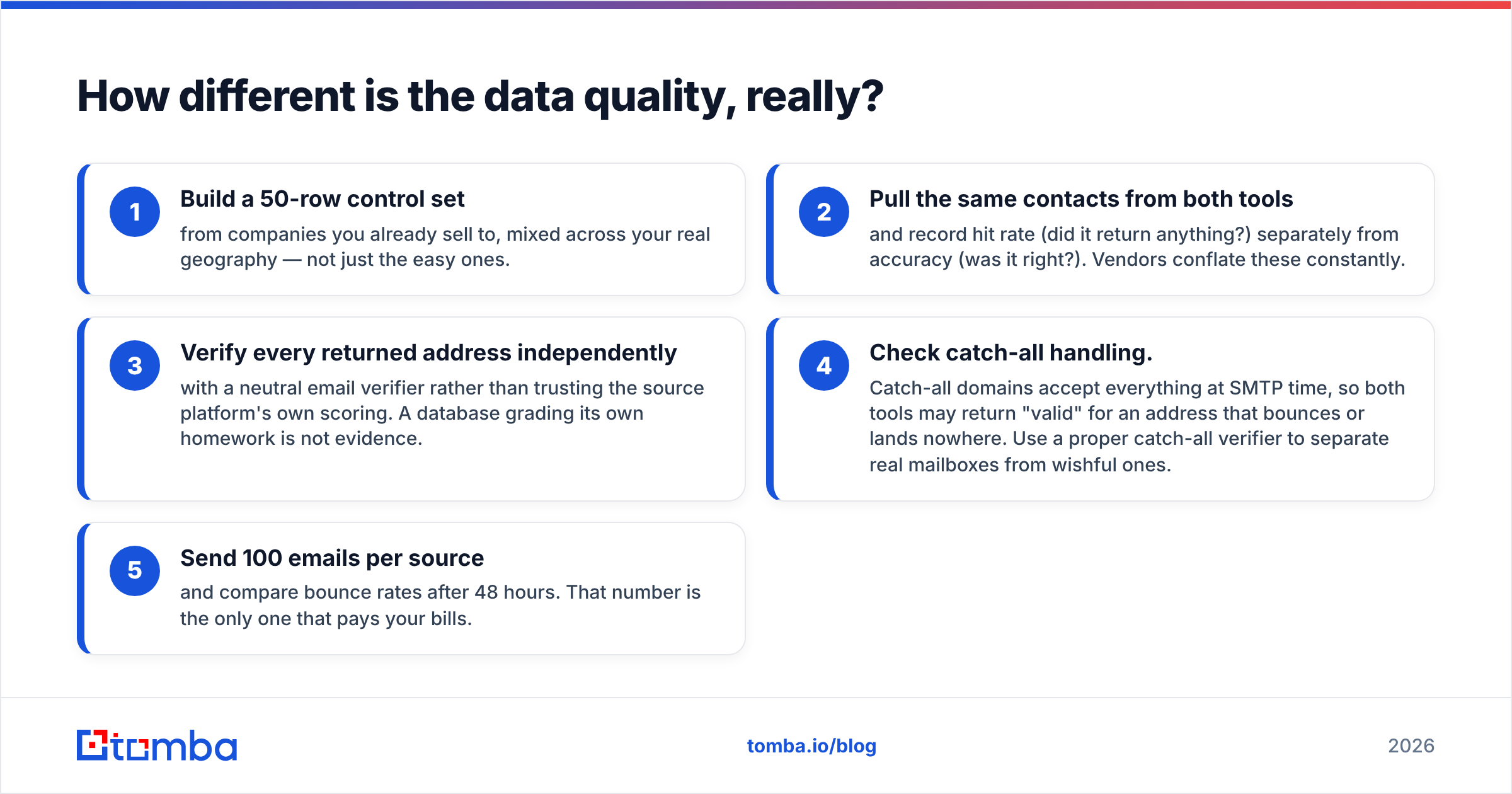
What you can control is your own test. Run this before you sign anything:
- Build a 50-row control set from companies you already sell to. Mix them across your real geography, not just the easy ones.
- Pull the same contacts from both tools. Record hit rate (did it return anything?) apart from accuracy (was it right?). Vendors blur these two constantly.
- Verify every returned address on your own with a neutral email verifier. Do not trust the source platform's own score. A database grading its own homework is not evidence.
- Check catch-all handling. Catch-all domains accept everything at SMTP time. So both tools may return "valid" for an address that bounces or lands nowhere. Use a proper catch-all verifier to sort real mailboxes from wishful ones.
- Send 100 emails per source. Compare bounce rates after 48 hours. That number is the only one that pays your bills.
Teams that run this test get surprised in both directions. The "premium" platform can flop on their odd vertical. The cheap one can nail it. Peer reviews on G2 help with support and contract friction. They cannot tell you whether a database covers your segment.
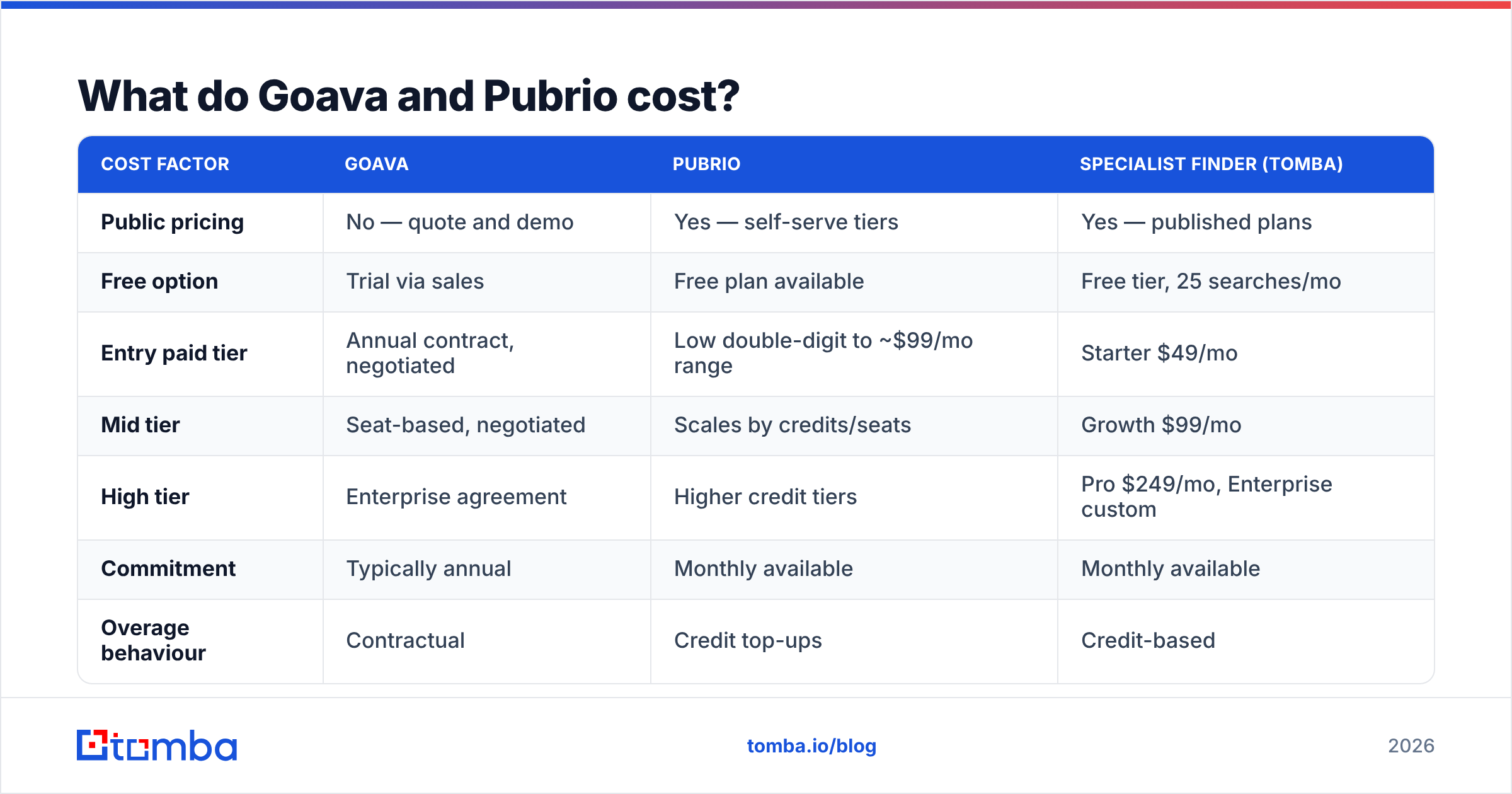
Goava vs Pubrio pricing: what does each one cost?#
| Cost factor | Goava | Pubrio | Specialist finder (Tomba) |
|---|---|---|---|
| Public pricing | No — quote and demo | Yes — self-serve tiers | Yes — published plans |
| Free option | Trial via sales | Free plan available | Free tier, 25 searches/mo |
| Entry paid tier | Annual contract, negotiated | Low double-digit to ~$99/mo range | Starter $49/mo |
| Mid tier | Seat-based, negotiated | Scales by credits/seats | Growth $99/mo |
| High tier | Enterprise agreement | Higher credit tiers | Pro $249/mo, Enterprise custom |
| Commitment | Typically annual | Monthly available | Monthly available |
| Overage behaviour | Contractual | Credit top-ups | Credit-based |
Two practical notes. First, always confirm current numbers on each vendor's own pricing page. This category re-prices constantly, so any figure in a blog post has a shelf life.
Second, quote-based pricing is not automatically worse. It usually means the vendor sells at a deal size where onboarding and data customisation are part of the product. It is worse when you are a three-person team. You need 2,000 contacts this quarter, and you do not want a 45-minute discovery call to learn the price.
Is Goava better than Pubrio?#
No. Most Goava vs Pubrio debates miss the point, because the two tools chase different buyers. Treating this as a straight ranking is how teams end up with expensive shelfware. Match the tool to the motion:
- Choose Goava if the Nordics are your main market, your average contract value covers an annual deal, you have 100+ closed-won deals for lookalike modelling to learn from, and your reps live in a supported CRM.
- Choose Pubrio if you sell globally, you want to start this week, your buying committee is you, and you need volume with technographic or intent-style filters more than registry-grade financials.
- Choose neither if your real bottleneck is deliverability. No database fixes a burnt domain, a missing SPF record, or a 4-line pitch that reads like a template. Fix the email deliverability basics first.
- Run both briefly if you are mid-expansion, with a Nordic core and global edges. Overlap costs less than a quarter of bad targeting.
- Layer a specialist either way if outbound volume is meaningful. Platform-bundled contact data is a feature. For a contact-data specialist, it is the product.
Where does a dedicated email finder fit alongside either?#
Think of it like a kitchen. A sales intelligence platform is the pantry. It tells you what ingredients exist and which ones to cook with. A finder-and-verifier is the knife: narrow, sharp, used constantly. You notice at once when it is dull.
Here is the pattern that works for most teams running real volume:
- Use Goava or Pubrio for account selection. Who is worth contacting, and why now?
- Use a specialist for the last mile. Resolve the specific person at that account to a real, current, deliverable mailbox.
- Verify at send time, not at export time. A list exported in January is badly wrong by March. Roughly a quarter of B2B contact data decays each year through job changes alone.
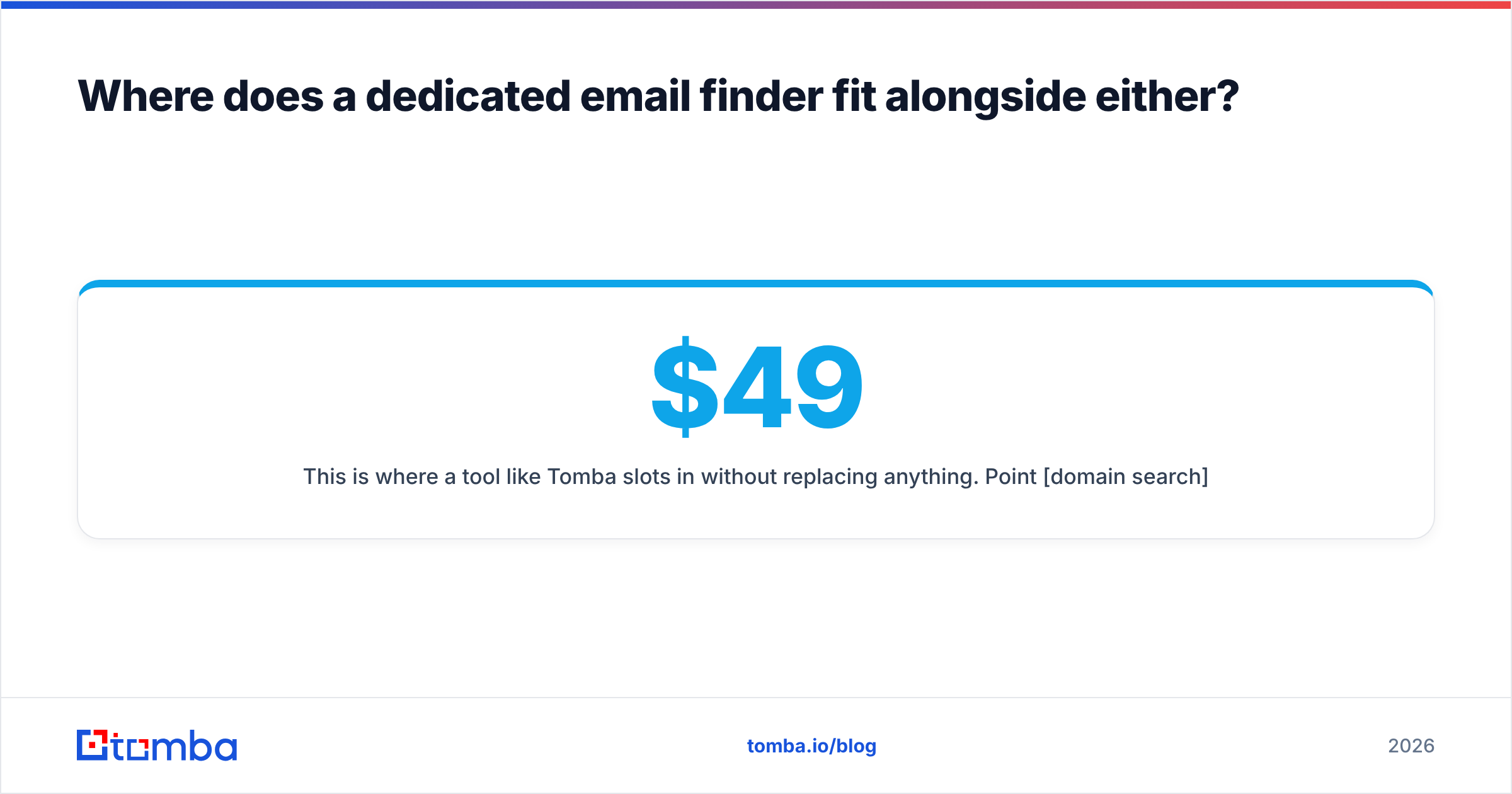
This is where a tool like Tomba fits in without replacing anything. Point domain search at a target account to see the live email pattern and who sits behind it. Resolve individuals with the email finder, then run the batch through verification. Push the clean result into your CRM.
The Tomba API makes that a step in your enrichment pipeline, not a manual export-import-export dance. Pricing stays visible too: Free at 25 searches/month, Starter $49/mo, Growth $99/mo, Pro $249/mo. So you can model cost per booked meeting without a sales call.
What should you do next?#
Run the 50-row control test above against both platforms in the same week. Use the same accounts and independent verification. It takes an afternoon. It will settle the Goava vs Pubrio question for your specific business better than any comparison article, including this one.
Then close the last-mile gap. Whichever platform you pick for targeting, the address you actually send to deserves its own check. Start with the Tomba Email Finder on the free tier. Verify a live batch of your current list. Compare the bounce rate against what your current source delivers. If the numbers improve, you have found your knife — and you can keep the pantry you already like.
Related guides#
Ready to find emails that actually work?
Join 150,000+ professionals who stopped guessing and started sending. Free credits on signup — no credit card required.
Get the Tomba newsletter
Practical outbound tactics and product updates — once every two weeks.
About the author