Goava vs ReachStream (2026): Which B2B Data Tool Wins?
Goava sells Nordic sales intelligence with AI-scored prospect recommendations. ReachStream sells a cheap, high-volume global contact database. They solve different problems. Here is how they compare on coverage, accuracy, pricing and export rights.
Goava vs ReachStream is a comparison of two tools that solve different problems. Goava picks the Nordic accounts you should call next. ReachStream sells you a big, cheap contact list. Here is how they compare on data, accuracy, pricing and export rights.
TL;DR
- Goava is a Nordic-focused sales intelligence platform. It ranks and recommends the companies you should call next. It uses Swedish, Norwegian, Danish and Finnish registry data plus buying signals. It is not a global contact database.
- ReachStream is a volume-first B2B contact database. You filter by industry, title and geography, then export contacts as CSV at a low cost per record. It is not a signal engine.
- The choice only matters if you are picking between "who should I target" (Goava) and "give me a big list" (ReachStream).
Most teams that ask about Goava vs ReachStream need a third thing: verified email addresses for accounts they have already picked. Two more points before the detail:
- Neither vendor publishes a full self-serve price list. Goava is quote-only. ReachStream sells packaged credit bundles that look cheap until you factor in bounce rates on aging records.
- If your bottleneck is contact accuracy rather than account selection, a dedicated finder-plus-verifier stack (Tomba starts at $49/mo, with a free tier for testing) will beat both on cost per delivered email.
What are Goava and ReachStream, exactly?#
They are not the same category of product, and that is the single most important thing to understand before you compare price tags.
Goava is a Swedish sales intelligence platform built around a product called Goava Discover. It ingests company registry data, financials, hiring activity, technology signals and web behaviour. It then produces a ranked list of accounts that look like your existing best customers. The pitch is account prioritisation: instead of 40,000 companies in a territory, you get the 200 that look ready. It plugs into the CRMs Nordic teams actually run — HubSpot, Salesforce, Upsales, Lime and SuperOffice — and pushes enriched company records into them.
ReachStream is a contact data vendor. You build a search with filters: industry, employee count, revenue band, job function, seniority and country. You see a match count, then buy the records. The database spans tens of millions of B2B contacts across most major markets, with a heavy weighting toward North America. Output is a spreadsheet: name, title, company, email, sometimes phone, sometimes LinkedIn URL.
One tool tells you which accounts deserve attention. The other hands you people in bulk. Comparing them straight across is like comparing a scouting report to a phone book.
Goava vs ReachStream: how do they compare head-to-head?#
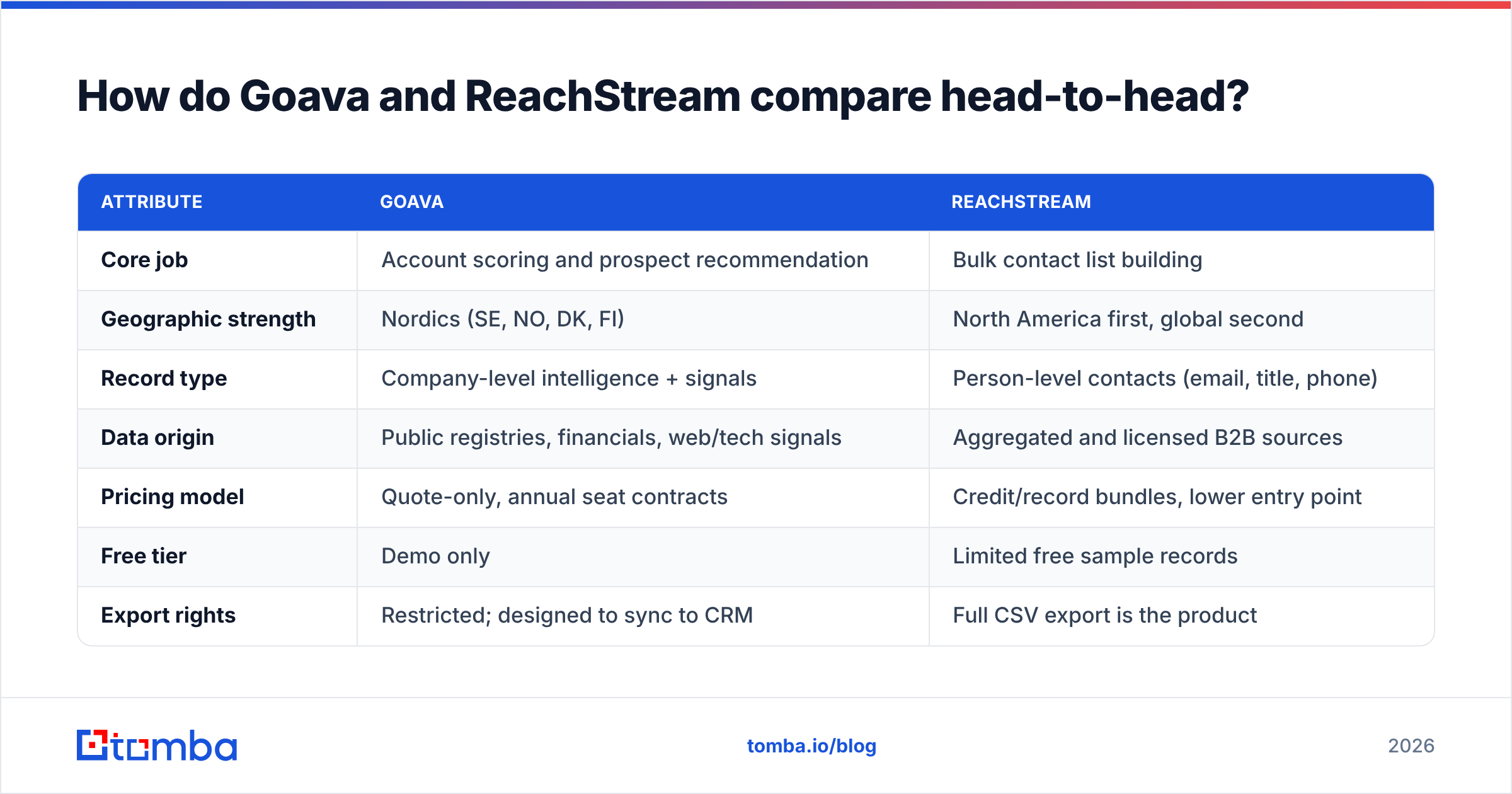
| Attribute | Goava | ReachStream |
|---|---|---|
| Core job | Account scoring and prospect recommendation | Bulk contact list building |
| Geographic strength | Nordics (SE, NO, DK, FI) | North America first, global second |
| Record type | Company-level intelligence + signals | Person-level contacts (email, title, phone) |
| Data origin | Public registries, financials, web/tech signals | Aggregated and licensed B2B sources |
| Pricing model | Quote-only, annual seat contracts | Credit/record bundles, lower entry point |
| Free tier | Demo only | Limited free sample records |
| Export rights | Restricted; designed to sync to CRM | Full CSV export is the product |
| Verification layer | Not a verification tool | Basic hygiene, no real-time SMTP check |
| Best for | Nordic mid-market AEs picking targets | SDR teams needing volume fast |
| Weak spot | Useless outside the Nordics | Contact freshness on long-tail titles |
The table exposes the real trade-off. Goava optimises for precision at the account layer and gives you almost nothing at the individual layer. ReachStream optimises for volume at the contact layer and gives you almost nothing at the account-intelligence layer.

Which one has better data quality?#
Different definitions of quality, so the honest answer is "both, at different things."
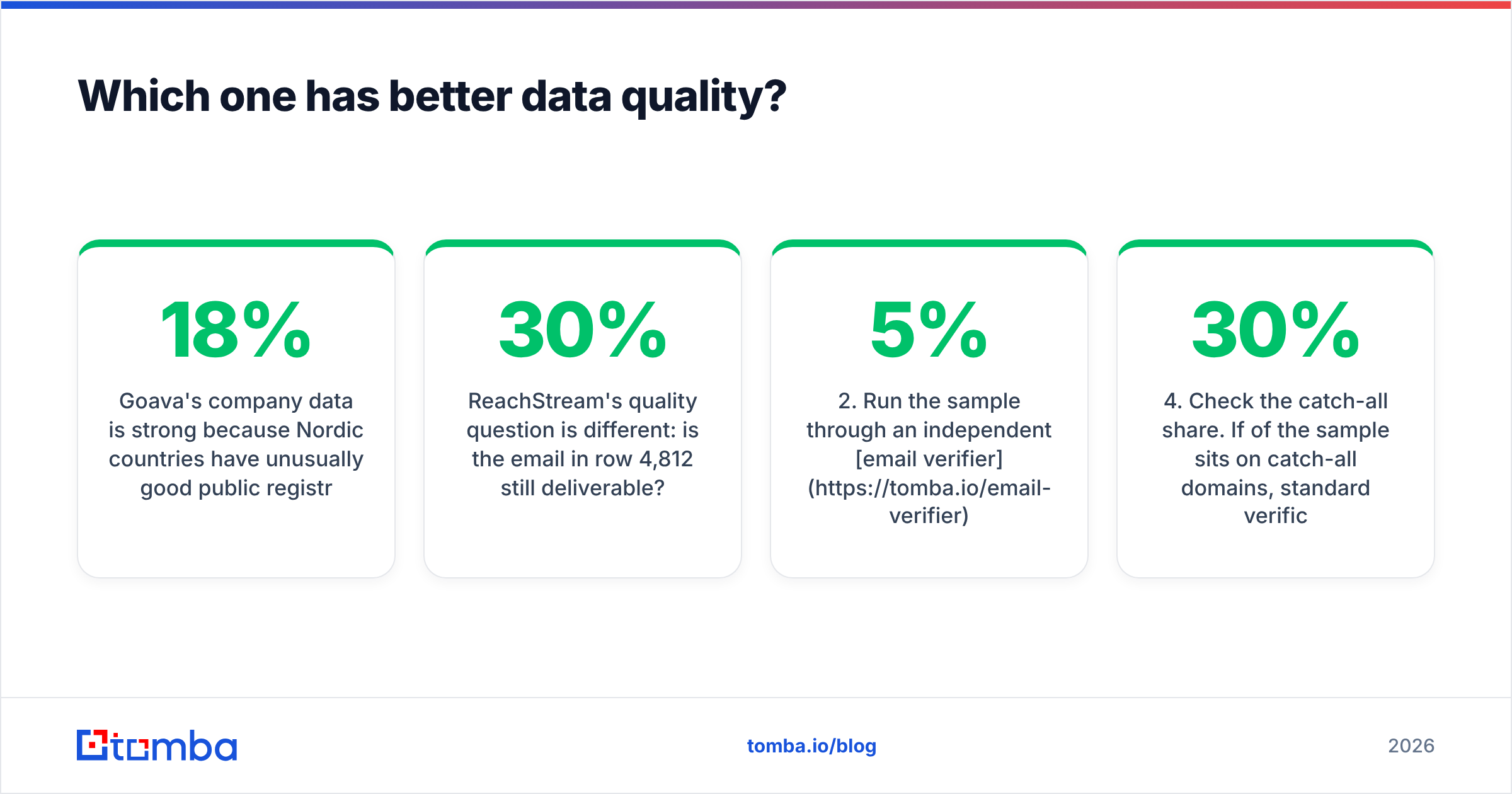
Goava's company data is strong because Nordic countries have unusually good public registries. Swedish organisation numbers, filed annual accounts, board changes and employee counts are all machine-readable. They are updated on a predictable cadence. When Goava says a company has 47 employees and grew revenue 18% last year, that number is traceable to a filing. That is a higher trust floor than most US-centric platforms can offer, where firmographics are often modelled estimates.
ReachStream's quality question is different: is the email in row 4,812 still deliverable? Aggregated B2B databases decay by roughly 22–30% a year. People change jobs, companies rebrand domains, and catch-all servers hide the truth. Vendors in this tier clean on ingestion and on a set schedule, not at the moment you export. So list buyers often see bounce rates of 8–15% on records that were "verified" at some point in the past.
Neither behaviour is dishonest. It is structural. A database sold by the record cannot economically re-verify every row on every export.
Four practical checks before you trust either dataset:
- Ask for a 100-row sample in your exact ICP — not a curated demo list. Filter it to the titles and countries you actually sell into.
- Run the sample through an independent email verifier and record the hard-bounce rate. Anything above 5% will damage your sender reputation before the campaign gets warm.
- Spot-check 10 records by hand on LinkedIn and the company website. Look for people who left, titles that were promoted, and domains that migrated.
- Check the catch-all share. If 30% of the sample sits on catch-all domains, standard verification will return "unknown" and your real bounce risk is hidden. A catch-all verifier is the only way to resolve those.
Do this before you sign anything. Both vendors will show you a good demo; only your own ICP sample tells you the truth.
What does each one cost in 2026?#
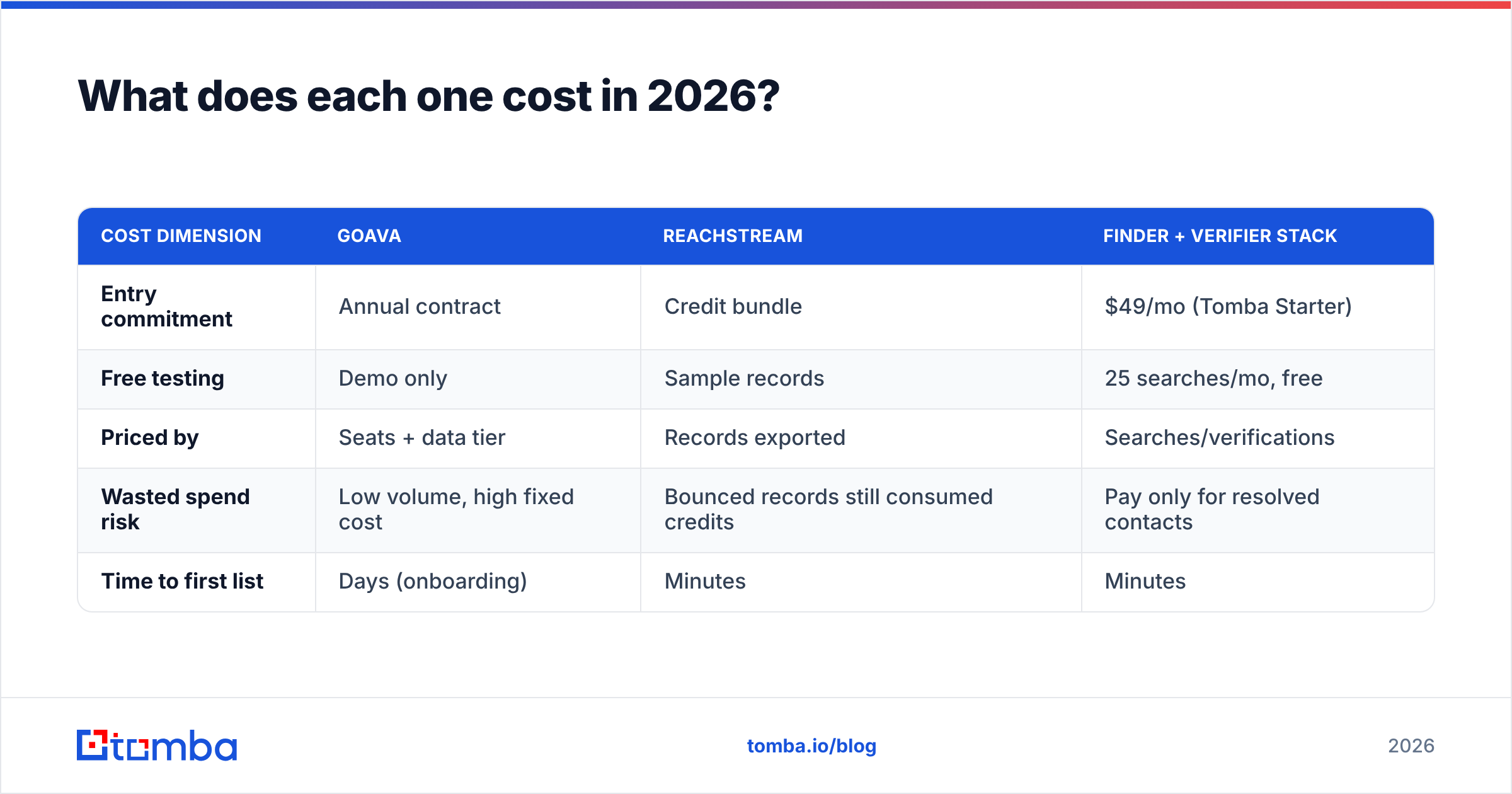
Goava does not publish pricing. It is sold as an annual contract, per seat, usually with a platform fee. The data tier scales with how many markets and CRM syncs you need. Expect a real sales cycle, a demo, and a number that only makes sense if you have a Nordic sales team of meaningful size. Buyer reviews on G2 describe it as a considered purchase rather than a card-swipe tool.
ReachStream is the opposite: packaged credit bundles, a low entry point, a free sample to get you started, and self-serve checkout for smaller volumes. The headline cost per record is genuinely low. The cost that matters, though, is cost per delivered email.
| Cost dimension | Goava | ReachStream | Finder + verifier stack |
|---|---|---|---|
| Entry commitment | Annual contract | Credit bundle | $49/mo (Tomba Starter) |
| Free testing | Demo only | Sample records | 25 searches/mo, free |
| Priced by | Seats + data tier | Records exported | Searches/verifications |
| Wasted spend risk | Low volume, high fixed cost | Bounced records still consumed credits | Pay only for resolved contacts |
| Time to first list | Days (onboarding) | Minutes | Minutes |
Run the arithmetic that vendors never put on the pricing page. If you buy 10,000 records at a low unit price and 12% bounce, you did not buy 10,000 contacts. You bought 8,800 contacts, plus a deliverability problem that suppresses the other 8,800. That is the hidden line item in every cheap-list purchase.
You can compare that math directly against transparent Tomba pricing — Free (25 searches/mo), Starter $49/mo, Growth $99/mo, Pro $249/mo — because per-search costs are published rather than negotiated.
Is Goava better than ReachStream for outbound?#
For Nordic outbound where the hard problem is choosing accounts: yes, Goava is better, and it is not close. If you sell into Sweden and your reps waste half their week deciding who to call, an account-scoring layer built on real registry filings is worth paying for. Goava also survives procurement and GDPR review more easily than a bulk list vendor, because its company-level data comes from public sources with clear provenance.
For everything outside that geography, or for teams whose problem is reaching people they have already identified: ReachStream is the more practical purchase. It is fast, cheap, self-serve, and gives you an exportable file instead of a CRM-locked view.
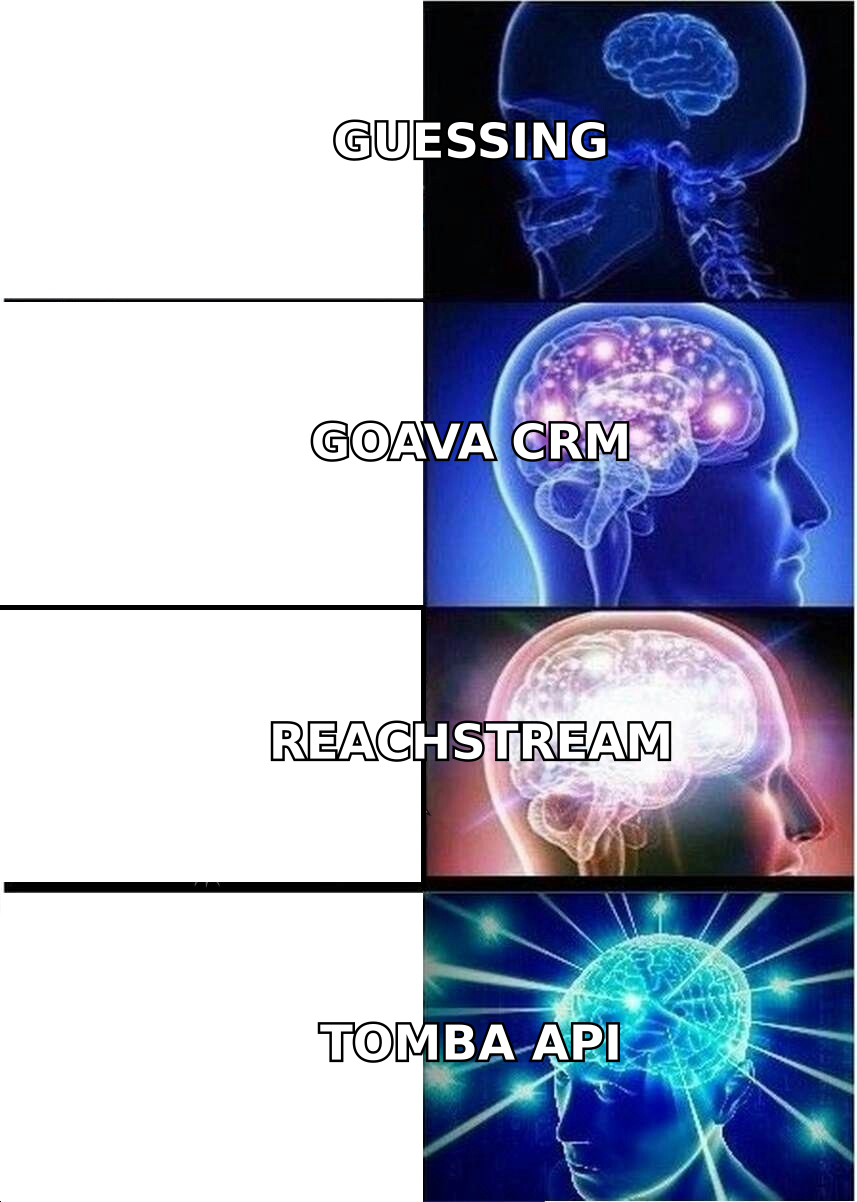
There is a third scenario that catches most teams. You already know your target accounts — from your CRM, from a conference list, from a funding-round tracker, from your own website traffic. You do not need an AI to rank them. You need the email address of the VP of Operations at each one. Buying an account-intelligence subscription to solve that is overkill; buying 20,000 generic contacts to solve it is waste.
That scenario is where a domain-first workflow wins. Point a domain search at each target company, pull the people who match your title filters, verify, and go. You are paying for exactly the accounts on your list and nothing else.
Which should you choose for your team?#
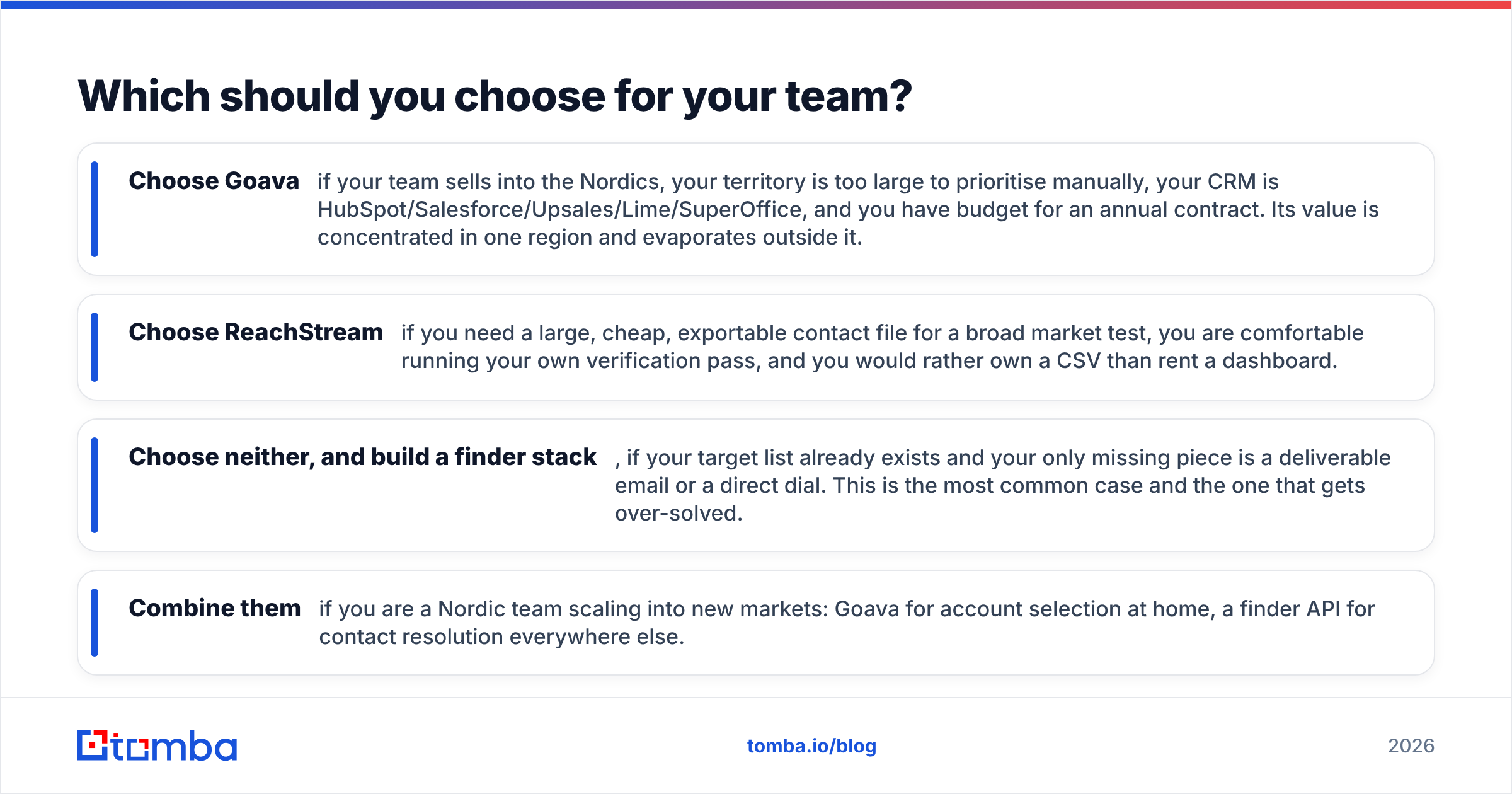
Match the tool to your actual bottleneck, not to the demo that impressed you most.
- Choose Goava if your team sells into the Nordics, your territory is too large to prioritise manually, your CRM is HubSpot/Salesforce/Upsales/Lime/SuperOffice, and you have budget for an annual contract. Its value is concentrated in one region and evaporates outside it.
- Choose ReachStream if you need a large, cheap, exportable contact file for a broad market test, you are comfortable running your own verification pass, and you would rather own a CSV than rent a dashboard.
- Choose neither, and build a finder stack, if your target list already exists and your only missing piece is a deliverable email or a direct dial. This is the most common case and the one that gets over-solved.
- Combine them if you are a Nordic team scaling into new markets: Goava for account selection at home, a finder API for contact resolution everywhere else.
How do you keep any purchased list from wrecking deliverability?#
Whatever you buy, treat the file as raw material rather than finished product.
Deduplicate first — overlapping exports from two vendors will double-send to the same person and torch your reply rate. Then verify every row, not a sample. Then segment catch-all domains into a separate, slower sending track. Those are the addresses that quietly generate spam complaints when a shared mailbox receives a cold pitch.
Only after that should the list touch a sending tool. Sender reputation is the one asset in outbound you cannot buy back once it is damaged, and a single 12%-bounce campaign can cost you weeks of recovery. A bulk email finder that verifies as it resolves collapses those three steps into one and removes the temptation to skip the boring part.
FAQ#
Is Goava available outside the Nordics? Its coverage and signal quality are built on Nordic public registries. You can technically look at other markets, but the depth advantage disappears, and you would be paying a premium for data other platforms provide more cheaply.
Does ReachStream guarantee email accuracy? Like most database vendors it publishes an accuracy target and offers replacement credits for bad records. Guarantees are backward-looking — you still discover the bounces after sending unless you verify independently first.
Can I use either for GDPR-regulated outbound in the EU? Goava's company-level, registry-sourced data is generally easier to defend under legitimate interest. Any person-level contact list, from any vendor, requires you to document your lawful basis, honour opt-outs, and keep sourcing records. Get your DPO to review the vendor's data processing addendum before the first send.
What is the cheapest way to test both? Take 100 accounts you genuinely want. Ask Goava to score them in a demo. Pull the matching contacts from a ReachStream sample. Then resolve the same 100 accounts yourself with a free finder tier and compare deliverability on all three outputs. The winner will be obvious inside a week.
The bottom line#
Goava vs ReachStream is not a like-for-like fight. Both are defensible purchases for the team they were built for. Goava earns its price when account selection is your constraint and you sell in the Nordics. ReachStream earns its price when raw volume is your constraint and you will do your own hygiene. Neither one is a general-purpose answer, and both get expensive when bought for the wrong bottleneck.
If your real problem is simpler — you know the companies, you need the people — start with the Tomba Email Finder. Search by domain, name or company, get verified addresses with a confidence score and the sources behind them, and pay for resolved contacts instead of database access you use twice a quarter. The free tier gives you 25 searches a month, which is enough to benchmark it against whatever a vendor sends you in a sample file.
Related guides#
Ready to find emails that actually work?
Join 150,000+ professionals who stopped guessing and started sending. Free credits on signup — no credit card required.
Get the Tomba newsletter
Practical outbound tactics and product updates — once every two weeks.
About the author