Goava vs Salesbot (2026): Which Sales Tool Actually Wins?
Goava sells Nordic sales intelligence. Salesbot sells conversational AI automation. They solve different halves of the same pipeline problem — and neither one hands you verified contact data. Here is the honest breakdown.
TL;DR
- Goava and Salesbot are not really competitors. Goava is a sales intelligence and account-recommendation platform with deep Nordic company data. Salesbot is a conversational AI layer that automates qualification and follow-up. Buying one does not remove the need for the other.
- Pick Goava if your ICP is Swedish, Norwegian, Danish, or Finnish companies and your reps waste hours deciding who to call. Its scoring and triggers are the product.
- Pick Salesbot if your bottleneck is response volume — inbound chats, unqualified form fills, and follow-up sequences that die because nobody has time.
- Neither tool is priced transparently. Both run on quote-based annual contracts, which means your real cost depends on seats, data volume, and how hard you negotiate.
- Both leave the same gap: verified, deliverable contact data. A recommendation engine that hands you a company and a bot that drafts a message are both useless if the email bounces.
What are Goava and Salesbot, actually?#
They sit at opposite ends of the same funnel, which is why comparing them on a single spec sheet is misleading.
Goava is a Swedish sales intelligence platform. Its core promise is prioritization: instead of a rep exporting a 4,000-row list and guessing, Goava scores companies against your existing customer base and surfaces the accounts most likely to convert. It leans on Nordic registry data — financials, employee counts, industry codes, and buying signals like new funding, hiring bursts, or leadership changes.
Salesbot describes a category more than a single fixed product: an AI conversational agent that qualifies leads, answers routine questions, books meetings, and pushes structured data back into your CRM. Depending on the vendor you are evaluating, "Salesbot" may ship as a standalone chat agent or as a workflow module inside a broader CRM. Confirm the exact feature set with the vendor before you sign — this space consolidates and rebrands fast.
Here is the practical split:
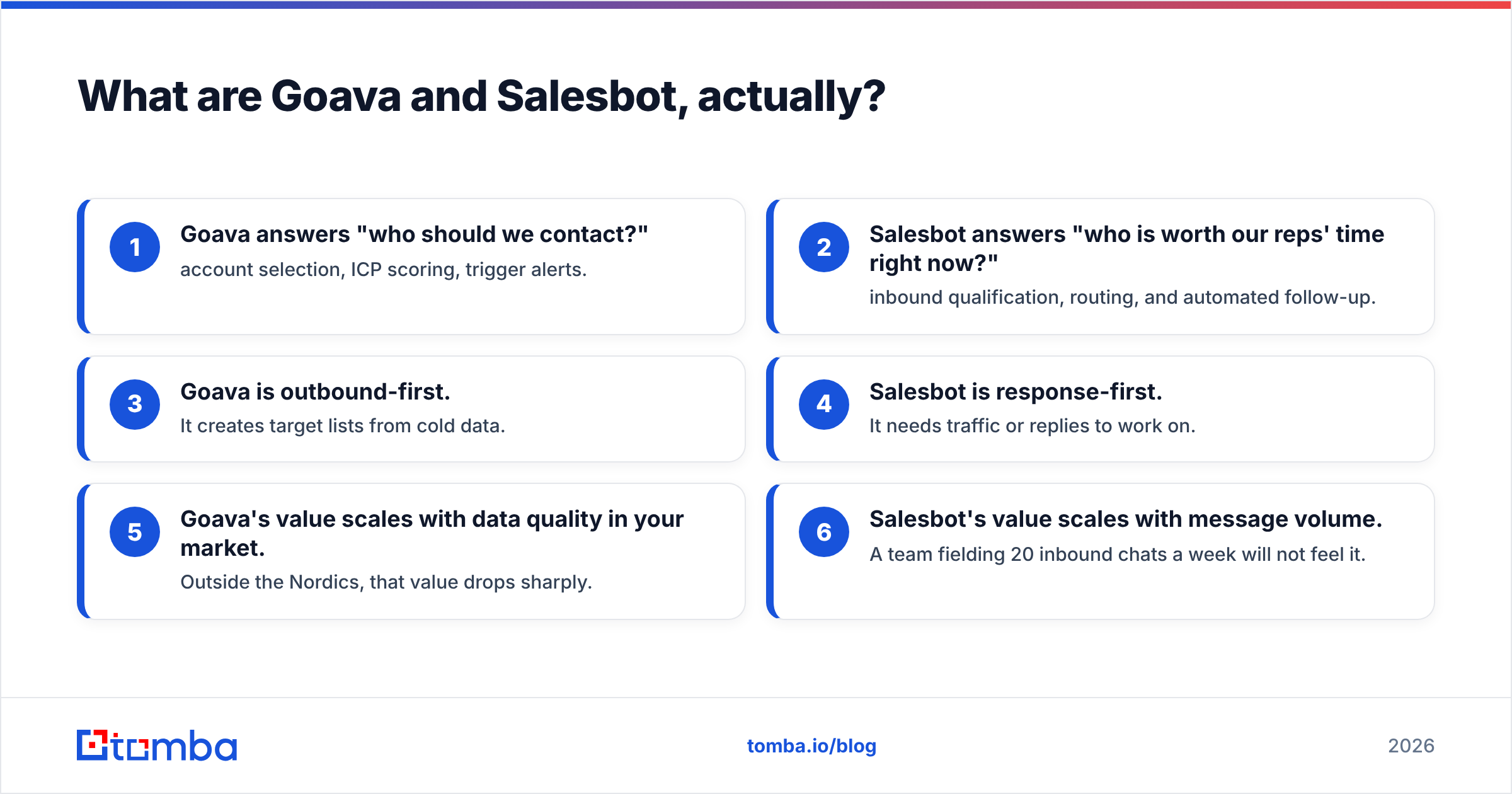
- Goava answers "who should we contact?" — account selection, ICP scoring, trigger alerts.
- Salesbot answers "who is worth our reps' time right now?" — inbound qualification, routing, and automated follow-up.
- Goava is outbound-first. It creates target lists from cold data.
- Salesbot is response-first. It needs traffic or replies to work on.
- Goava's value scales with data quality in your market. Outside the Nordics, that value drops sharply.
- Salesbot's value scales with message volume. A team fielding 20 inbound chats a week will not feel it.
If you only have budget for one, that ordering matters more than any feature comparison: you cannot automate replies to conversations that never start.

How do Goava and Salesbot compare head to head?#
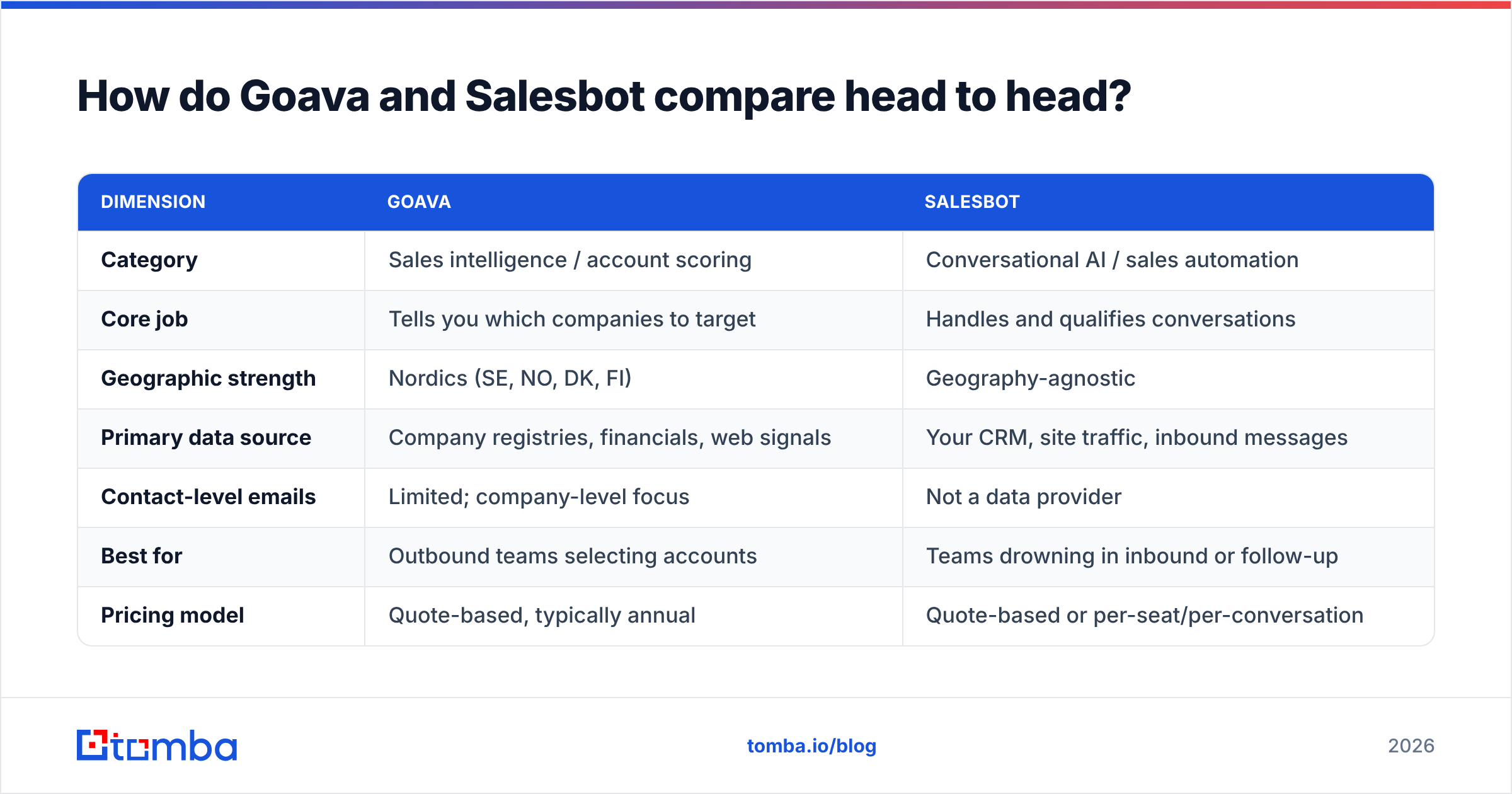
| Dimension | Goava | Salesbot |
|---|---|---|
| Category | Sales intelligence / account scoring | Conversational AI / sales automation |
| Core job | Tells you which companies to target | Handles and qualifies conversations |
| Geographic strength | Nordics (SE, NO, DK, FI) | Geography-agnostic |
| Primary data source | Company registries, financials, web signals | Your CRM, site traffic, inbound messages |
| Contact-level emails | Limited; company-level focus | Not a data provider |
| Best for | Outbound teams selecting accounts | Teams drowning in inbound or follow-up |
| Pricing model | Quote-based, typically annual | Quote-based or per-seat/per-conversation |
| Free tier | No public self-serve free tier | Varies by vendor; often a trial only |
| Time to value | Days (list building is immediate) | Weeks (needs training and tuning) |
| Replaces a data vendor? | Partially, in the Nordics | No |
The row that decides most evaluations is the third one. Goava's advantage is structural: Nordic company registries are unusually rich and public, so a specialist can build something a global aggregator will not match locally. That same structure is a ceiling. If your pipeline is 70% DACH, UK, or US accounts, you are paying for a database that thins out exactly where you need it.
Salesbot has the opposite profile. It does not care where your prospect is because it does not source your prospects. It processes what already arrived. That makes it a poor first purchase for a team with a top-of-funnel problem and a strong second purchase for a team with a throughput problem.
Is Goava worth it outside the Nordics?#
Usually not, and the vendor will generally tell you so if you ask directly.
Goava's differentiation is depth in a specific market, not breadth. In Sweden, the combination of Bolagsverket-style registry data, financial filings, and local news signals produces genuinely useful triggers — a company that just filed a strong year, hired three engineers, and changed CFO is a real signal, not a guess. That is defensible.
Push the same engine at a US mid-market list and it competes against much larger global databases. You end up with a smaller universe, thinner firmographics, and the same annual contract. The honest evaluation question is not "is Goava good?" but "is more than half my target list Nordic?" If yes, run the trial. If no, look at the broader sales intelligence category on G2 before you take a demo.
One more caveat that shows up in real deployments: account recommendations are only as good as the customer data you feed them. If your CRM is full of half-filled records and stale closed-won reasons, the scoring model inherits that noise. Budget time for a data cleanup before onboarding, not after.
What does Salesbot actually solve?#
Three things, reliably:
- Speed to first response. An AI agent replying in 30 seconds beats a rep replying in six hours, and the research on lead generation response windows has been consistent about this for years.
- Qualification consistency. The bot asks the same five questions every time. Reps do not.
- Follow-up survival. Most sequences die at touch two or three. Automation does not get bored.
What it does not solve: sourcing. A conversational agent has nothing to converse with until a human lands on your site, replies to a cold email, or fills a form. Teams that buy chat automation to fix a pipeline shortage almost always end up disappointed, then blame the tool.
There is also an honest failure mode worth naming. Over-automated qualification annoys senior buyers. A VP who wants a straight answer about pricing and gets three rounds of scripted discovery questions from a bot will bounce. Configure an obvious escape hatch to a human, and measure the rate at which people use it — that number tells you whether your script is working better than any satisfaction survey will.
How much do Goava and Salesbot cost in 2026?#
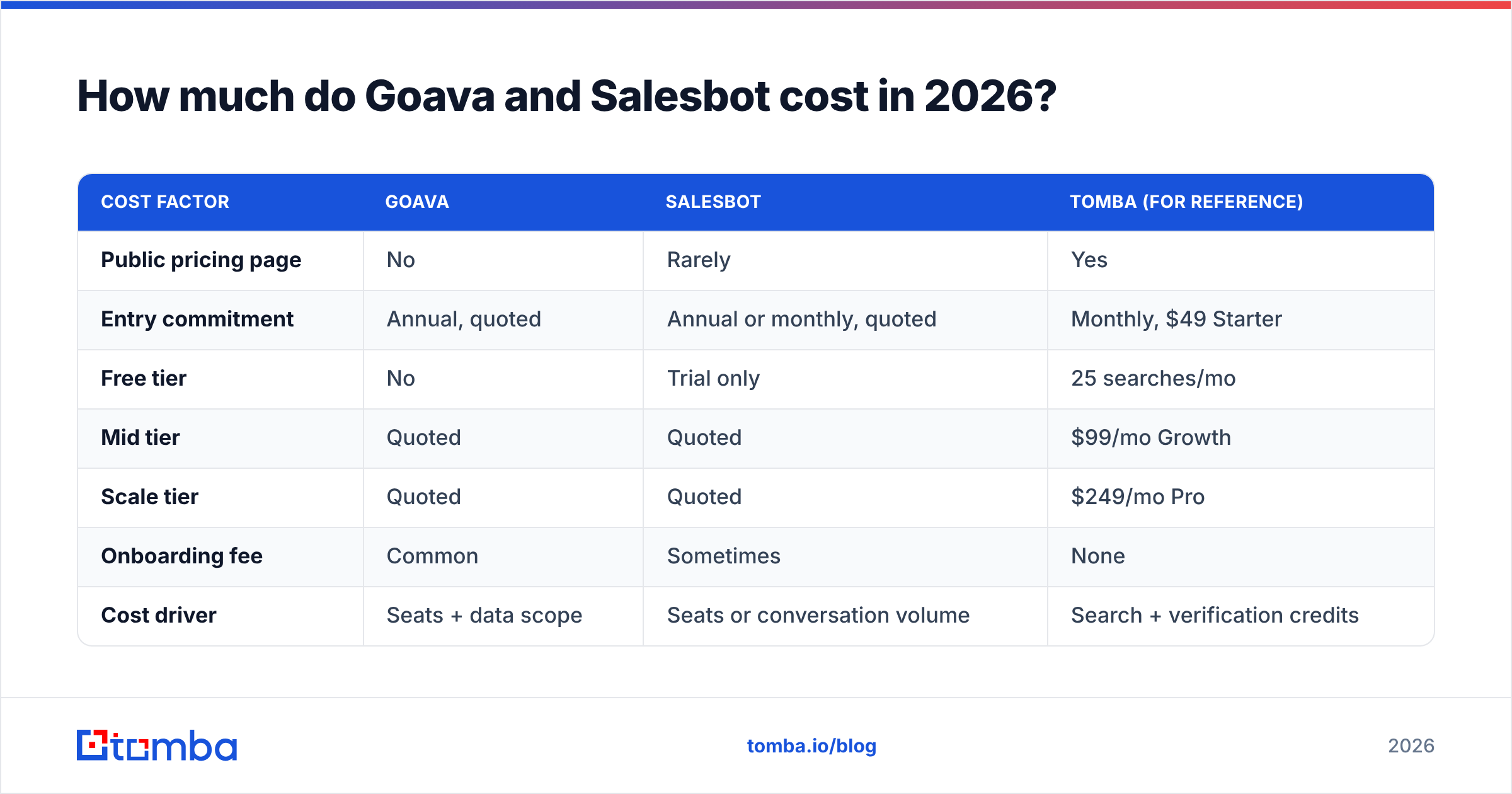
Neither publishes list pricing, which is itself information: quote-based pricing usually means seat-count negotiation, annual commitment, and an onboarding fee.
| Cost factor | Goava | Salesbot | Tomba (for reference) |
|---|---|---|---|
| Public pricing page | No | Rarely | Yes |
| Entry commitment | Annual, quoted | Annual or monthly, quoted | Monthly, $49 Starter |
| Free tier | No | Trial only | 25 searches/mo |
| Mid tier | Quoted | Quoted | $99/mo Growth |
| Scale tier | Quoted | Quoted | $249/mo Pro |
| Onboarding fee | Common | Sometimes | None |
| Cost driver | Seats + data scope | Seats or conversation volume | Search + verification credits |
| Cancel anytime | Rarely | Varies | Yes on monthly plans |
Treat that table as a budgeting framework, not a quote. Ask both vendors the same four questions in writing: what is the minimum term, what happens to my data on cancellation, is onboarding billed separately, and what is the overage rate. The answers vary more than the feature sets do.
For comparison, transparent Tomba pricing exists because contact data is a commodity with a measurable unit — a found and verified email either works or it does not. Sales intelligence and conversational AI are harder to price per unit, which is why both categories default to "book a demo." That is not a scam; it is just a slower, less comparable buying process, and you should plan two to four extra weeks for it.
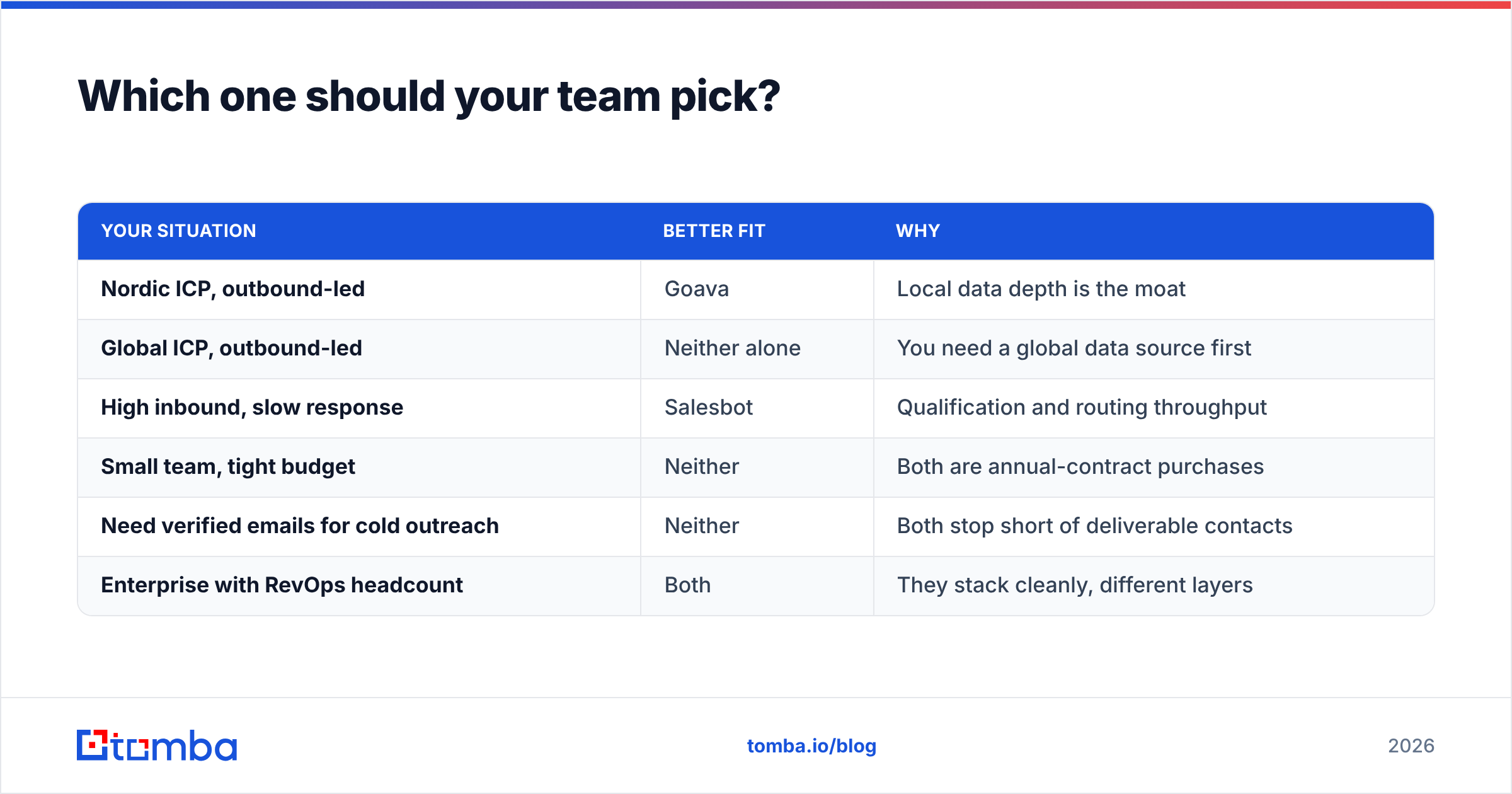
Which one should your team pick?#
| Your situation | Better fit | Why |
|---|---|---|
| Nordic ICP, outbound-led | Goava | Local data depth is the moat |
| Global ICP, outbound-led | Neither alone | You need a global data source first |
| High inbound, slow response | Salesbot | Qualification and routing throughput |
| Small team, tight budget | Neither | Both are annual-contract purchases |
| Need verified emails for cold outreach | Neither | Both stop short of deliverable contacts |
| Enterprise with RevOps headcount | Both | They stack cleanly, different layers |
The last row is the realistic enterprise answer. Goava narrows 50,000 companies to 400 that look like your best customers. Salesbot handles the conversations those 400 generate. They do not overlap, and a mature revenue operations function will run both alongside a CRM and a sequencer.
The realistic answer for everyone else is to buy the layer where you are actually bleeding. Measure it first: if your reps have a list but no replies, the problem is messaging or deliverability, not scoring. If they have replies but no list, the problem is sourcing. Buying the wrong layer is the most common six-figure mistake in this category.
What do both tools leave out?#
Contact-level data that actually delivers.
This is the gap nobody in the demo mentions. Goava can tell you that a Stockholm SaaS company just raised a round and is hiring sales engineers. It will not reliably hand you the CRO's working email address. Salesbot can run a flawless five-touch follow-up sequence into an inbox that does not exist, and it will report those sends as delivered activity.
The compounding cost is worse than the wasted sends. Bounce rates above roughly 3% damage your sender reputation, which suppresses inbox placement for the campaigns that were well targeted. You end up paying an annual contract for better targeting and then destroying the delivery channel that targeting depends on.
The fix is boring and cheap relative to either platform:
- Source the contact. Use an email finder or run a domain search against the accounts your intelligence layer surfaced.
- Verify before send. Run every address through an email verifier and drop anything that fails SMTP checks.
- Handle catch-alls separately. Do not treat "accept-all" as valid; segment it and send at lower volume.
- Enrich, then hand off. Push clean records into the CRM so both Goava's scoring and Salesbot's automation are operating on real people.
- Automate it. The Tomba API or a bulk workflow makes this a background job, not a weekly manual chore.
Do that and both platforms get materially better, because both are downstream of contact quality. Skip it and you are optimizing the middle of a funnel with a broken exit.
So what is the verdict on Goava vs Salesbot?#
Goava wins if you sell into the Nordics and your problem is account selection. Salesbot wins if your problem is conversation throughput. Neither wins the general "best sales tool" argument because they were never in the same fight, and any comparison page that declares an outright winner is selling you something.
The more useful conclusion: before you commit to a quoted annual contract in either category, make sure your contact data layer is solid. It is the cheapest part of the stack and the one that gates the return on everything above it. Teams routinely spend five figures on intelligence and automation while sending to a list where a third of the addresses are dead — and then conclude the platform underperformed.
Start with data you can trust. Tomba's Email Finder turns the companies your intelligence platform surfaces into verified, deliverable contacts — by domain, by name, or in bulk, with verification built in. The free tier covers 25 searches a month so you can test accuracy against your own target list before spending anything, and paid plans start at $49/mo with no annual lock-in. Run it against 100 accounts from your current pipeline and compare bounce rates. That test costs you nothing and settles the argument faster than any demo will.
Related guides#
Ready to find emails that actually work?
Join 150,000+ professionals who stopped guessing and started sending. Free credits on signup — no credit card required.
Get the Tomba newsletter
Practical outbound tactics and product updates — once every two weeks.
About the author