Goava vs Warpleads in 2026: Which B2B Data Tool Wins?
Goava sells Nordic sales intelligence with CRM-native signals. Warpleads sells unlimited B2B lead exports for cold email. They solve different problems — here is which one actually fits your pipeline, and where each one leaves you exposed.
TL;DR
- Goava is a Nordic-focused sales intelligence platform. It scores and recommends companies to target using registry data, financials, tech stack, and buying signals, then pushes them into your CRM. Pricing is quote-only.
- Warpleads is a volume play: a large B2B contact database plus on-demand scraping, sold on "unlimited export" style plans aimed at cold email teams running high-volume sequences.
- They are not really competitors. Goava answers which accounts deserve your time. Warpleads answers how do I get 50,000 contacts into Instantly by Friday.
- Neither is primarily a verification engine. If you buy either one, budget separately for email validation — bounced sends damage your sending domain faster than any list size can compensate for.
- If your actual bottleneck is "I have the company list, I need reliable, verified work emails," a dedicated email finder is the cheaper, more accurate layer to add.
What is Goava, and who is it built for?#
Goava is a Stockholm-based sales intelligence platform built around a simple thesis: most B2B reps waste the majority of their week on accounts that were never going to buy. Goava's product, usually branded Goava Discover, ingests company data — official registry filings, financial statements, employee counts, industry codes, website technology, and news or trigger events — and ranks your total addressable market by how closely each company resembles the customers you already closed.
The practical output is a prioritized account list inside your CRM. Goava integrates with the CRMs Nordic mid-market companies actually run: Salesforce, HubSpot, Pipedrive, SuperOffice, Upsales, and Lime. That CRM-native delivery is the point. Reps do not log into another tab; scored accounts and enrichment fields appear where they already work.
Where Goava is strong:
- Nordic registry depth. Sweden, Norway, Denmark, and Finland all maintain rich public company registries. Goava leans on this hard, which means financial data and org structure for a 40-person Swedish manufacturer is genuinely good — better than what a US-centric global database will show you.
- Account scoring, not contact dumping. The model is ideal-customer-profile fit, not raw record count.
- Trigger events. Funding, hiring, leadership changes, and tech adoption surface as reasons to reach out now.
- CRM workflow. Data lands in the system of record instead of a CSV that dies in someone's Downloads folder.
Where it is weak: contact-level coverage outside the Nordics thins out fast, pricing is opaque (expect an annual contract and a sales call), and it is not designed to hand you 20,000 verified personal work emails for a cold sequence.
What is Warpleads, and what problem does it solve?#
Warpleads sits at the opposite end. It is a lead generation platform selling access to a very large B2B contact database, plus an on-demand scraping service for niches the static database misses. The headline pitch is export volume: plans marketed around unlimited or very high export ceilings, so outbound teams can pull tens of thousands of records without watching a credit counter.
The intended workflow is blunt and effective for what it is. Filter by industry, geography, headcount, or job title. Export. Push to a cold email sender like Instantly or Smartlead. Send. Warpleads also markets an included verification step, which matters, because a database sold on volume without verification is a deliverability grenade.
Where Warpleads is strong: cost per record at volume, breadth of geography, speed from filter to CSV, and a workflow that assumes you are running cold email rather than account-based selling.
Where it is weak: database records skew toward whatever was crawled and inferred, "unlimited" always has fair-use guardrails somewhere, and the data model is contact-first with far less account intelligence than Goava. You get a name, title, company, and email — not a reason to call.

How do Goava and Warpleads compare head-to-head?#
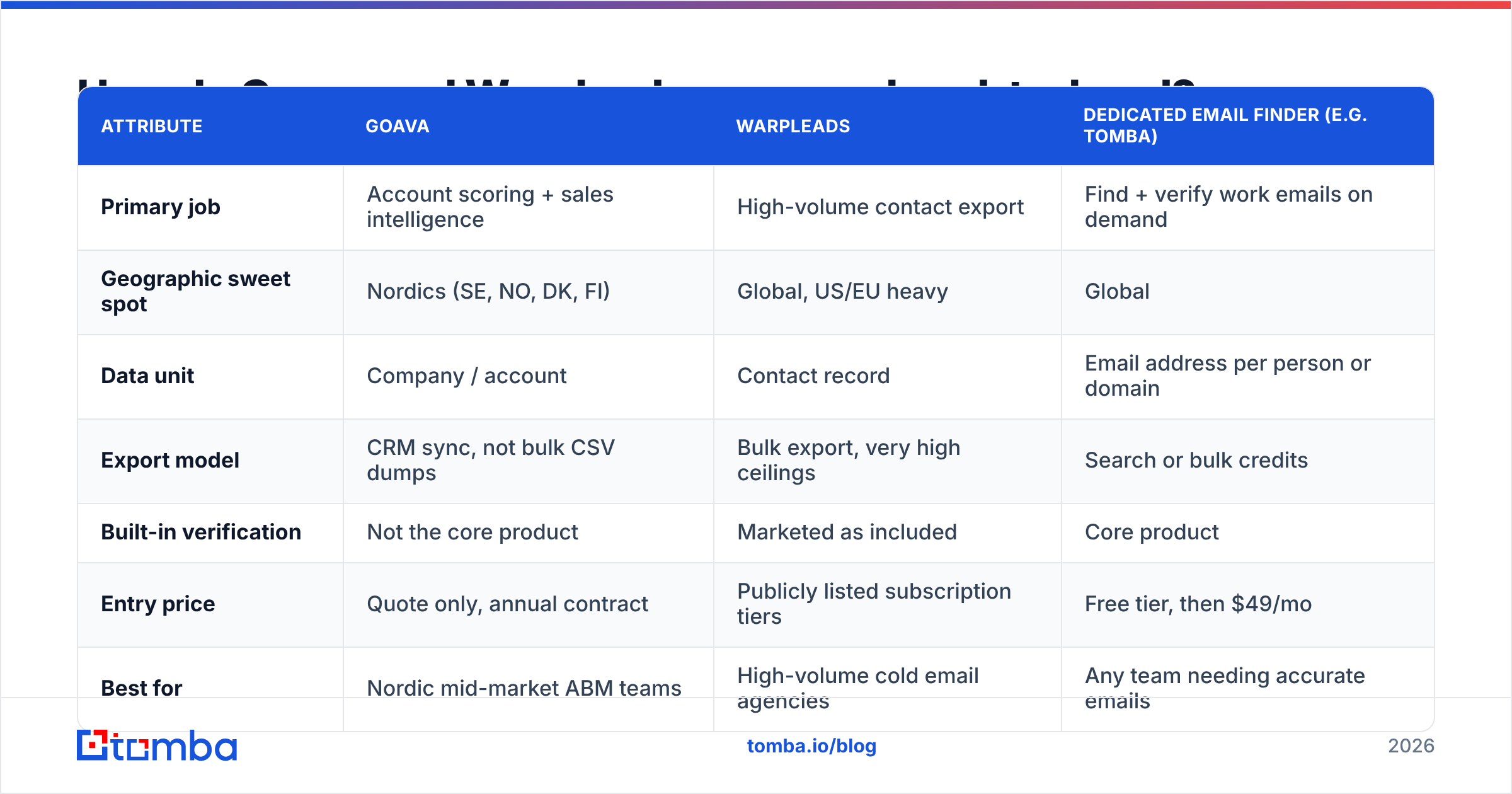
The honest comparison has to acknowledge that these tools are optimized for different jobs. Here is the side-by-side, with a dedicated email-finding layer included for context, since most teams end up needing one regardless of which platform they pick.
| Attribute | Goava | Warpleads | Dedicated email finder (e.g. Tomba) |
|---|---|---|---|
| Primary job | Account scoring + sales intelligence | High-volume contact export | Find + verify work emails on demand |
| Geographic sweet spot | Nordics (SE, NO, DK, FI) | Global, US/EU heavy | Global |
| Data unit | Company / account | Contact record | Email address per person or domain |
| Export model | CRM sync, not bulk CSV dumps | Bulk export, very high ceilings | Search or bulk credits |
| Built-in verification | Not the core product | Marketed as included | Core product |
| Entry price | Quote only, annual contract | Publicly listed subscription tiers | Free tier, then $49/mo |
| Best for | Nordic mid-market ABM teams | High-volume cold email agencies | Any team needing accurate emails |
| Weak spot | Coverage outside Nordics, opaque pricing | Thin account context, variable record freshness | Not a full account-intelligence suite |
Two caveats on that table. First, both vendors change pricing and packaging; check their own pages before you budget. Second, "included verification" is not a binary. Verification quality varies enormously by provider, and a list marked 95% valid by a vendor's internal check can still bounce at 6-8% when it hits a real inbox provider. Independent review data on G2 is useful here mostly for spotting complaint patterns, not for trusting headline accuracy claims.
Which one has better data coverage?#
Depends entirely on where you sell. Break it down:
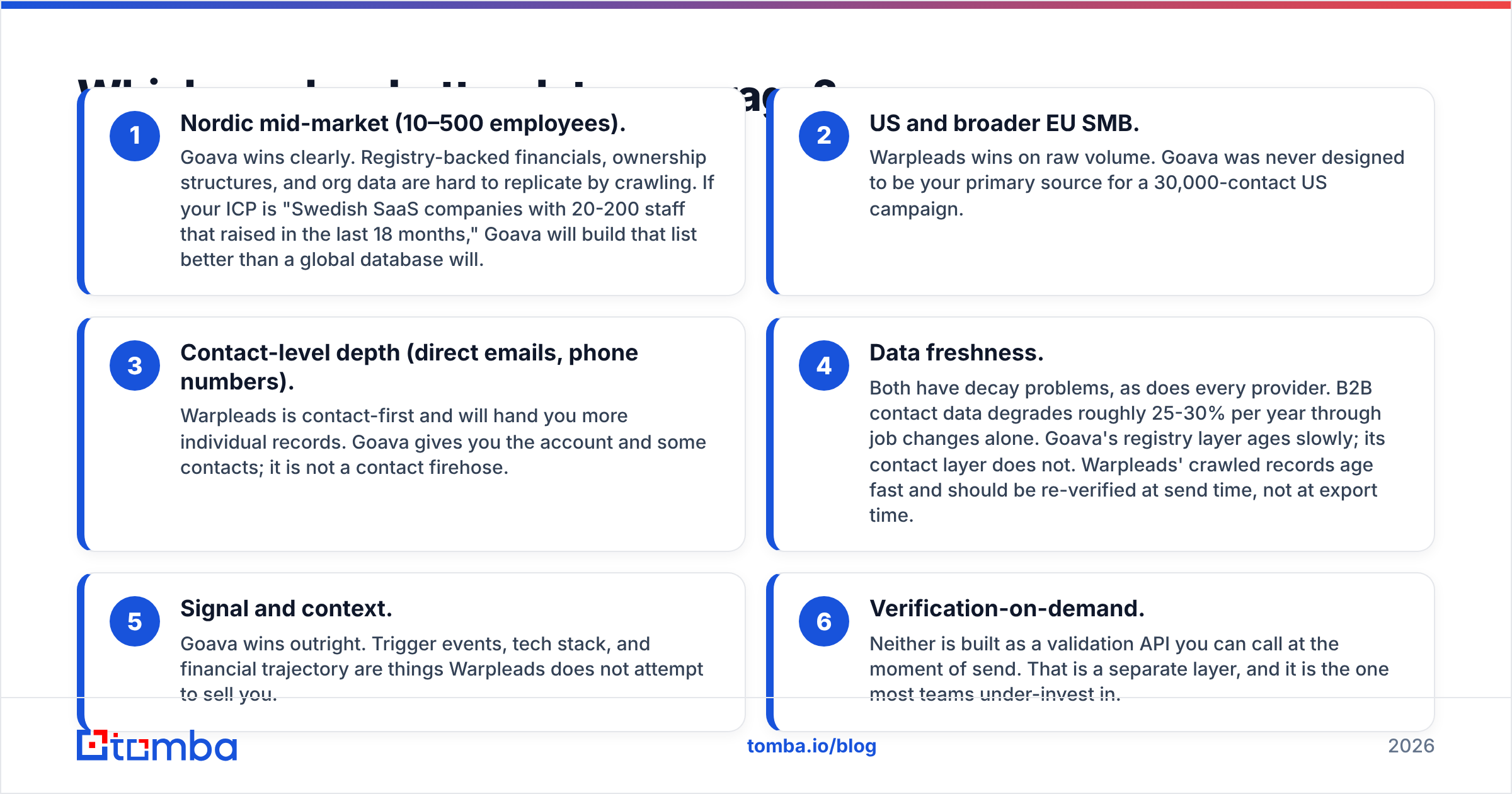
- Nordic mid-market (10–500 employees). Goava wins clearly. Registry-backed financials, ownership structures, and org data are hard to replicate by crawling. If your ICP is "Swedish SaaS companies with 20-200 staff that raised in the last 18 months," Goava will build that list better than a global database will.
- US and broader EU SMB. Warpleads wins on raw volume. Goava was never designed to be your primary source for a 30,000-contact US campaign.
- Contact-level depth (direct emails, phone numbers). Warpleads is contact-first and will hand you more individual records. Goava gives you the account and some contacts; it is not a contact firehose.
- Data freshness. Both have decay problems, as does every provider. B2B contact data degrades roughly 25-30% per year through job changes alone. Goava's registry layer ages slowly; its contact layer does not. Warpleads' crawled records age fast and should be re-verified at send time, not at export time.
- Signal and context. Goava wins outright. Trigger events, tech stack, and financial trajectory are things Warpleads does not attempt to sell you.
- Verification-on-demand. Neither is built as a validation API you can call at the moment of send. That is a separate layer, and it is the one most teams under-invest in.
That last point is where most prospecting stacks break. You can buy the best account list in the Nordics and still torch your domain reputation because the emails attached to those accounts were inferred, not confirmed. Running exports through a proper email verifier before they enter a sequence is cheap insurance — usually a fraction of a cent per record against the cost of a burned sending domain.
How accurate are the emails you actually get?#
Treat every vendor accuracy claim as a marketing number until you test it. The only benchmark that matters is your own: take 500 records from a trial export, run them through an independent verifier, then send a small batch and measure the real hard-bounce rate.
Here is a sane test protocol:
- Pull a stratified sample. 500 records across at least three industries and two company-size bands. Vendors optimize for popular filters; a single-segment test flatters them.
- Verify independently. Do not use the vendor's own verification to grade the vendor's own data. Use a third-party checker so the pass/fail is not marking its own homework.
- Separate catch-all domains. A large share of B2B domains accept everything at the SMTP layer, so a naive verifier marks them "valid" when they are simply unknowable by that method. A dedicated catch-all verifier is the difference between a real answer and a guess.
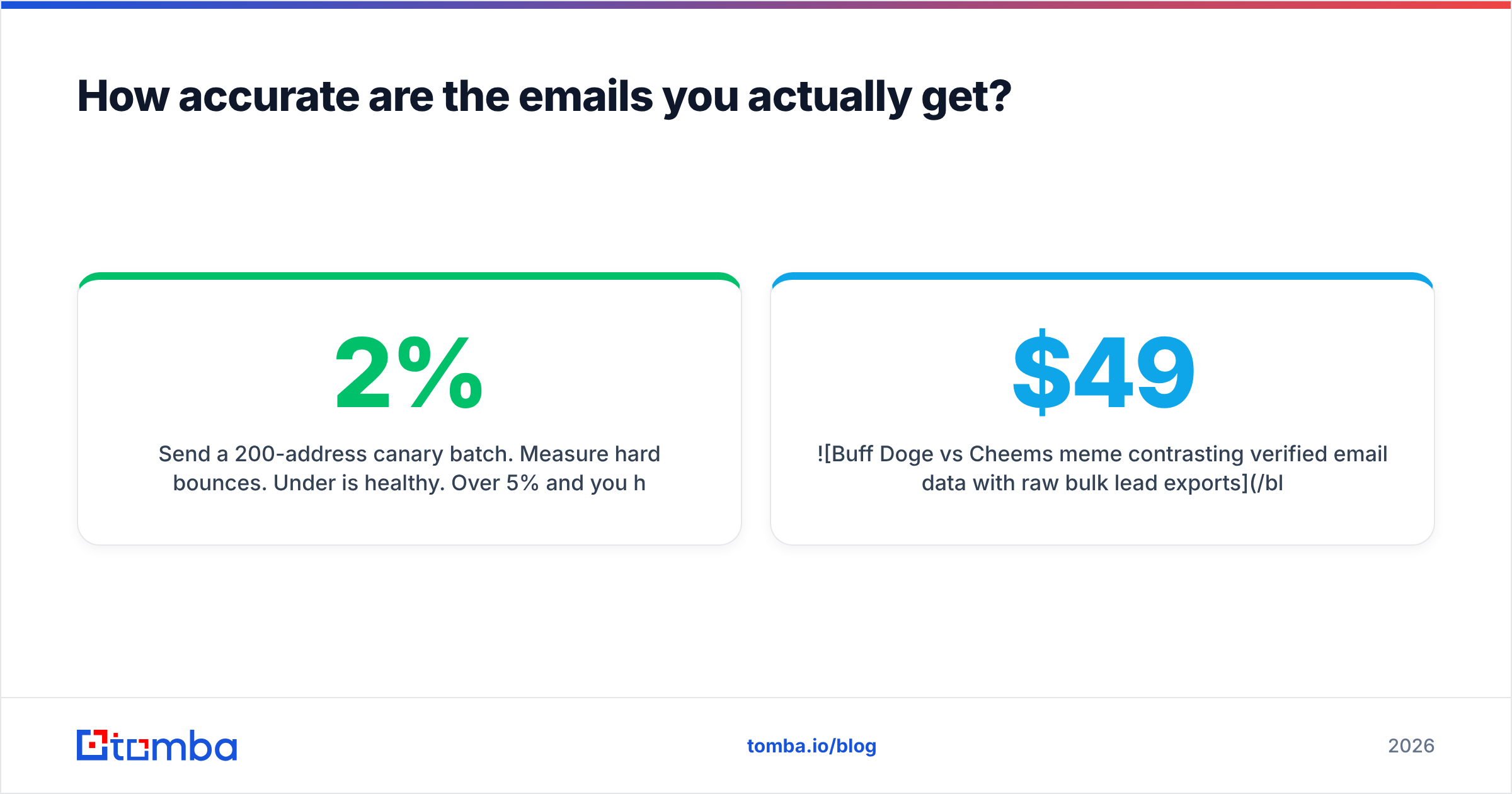
- Send a 200-address canary batch. Measure hard bounces. Under 2% is healthy. Over 5% and you have a data problem no amount of copywriting fixes.
- Repeat at 60 days. Freshness, not day-one accuracy, is what determines whether a subscription is worth renewing.
Do this before you sign an annual contract with either vendor. It takes an afternoon and routinely saves five figures.
What do Goava and Warpleads cost?#
Goava does not publish pricing. Expect a discovery call, an annual commitment, and per-seat pricing that scales with CRM integration depth and data volume. This is normal for European sales intelligence platforms selling to mid-market, and it means your negotiating leverage comes from timing (end of quarter) and multi-year terms rather than a public price list.
Warpleads publishes subscription tiers positioned around export volume rather than seats. The pitch is that a fixed monthly fee unlocks exports that would cost far more under a credit model. Verify the current tier structure directly, and read the fair-use terms — "unlimited" in the lead data category almost always carries throughput ceilings, and knowing them before you plan a campaign matters more than the headline.
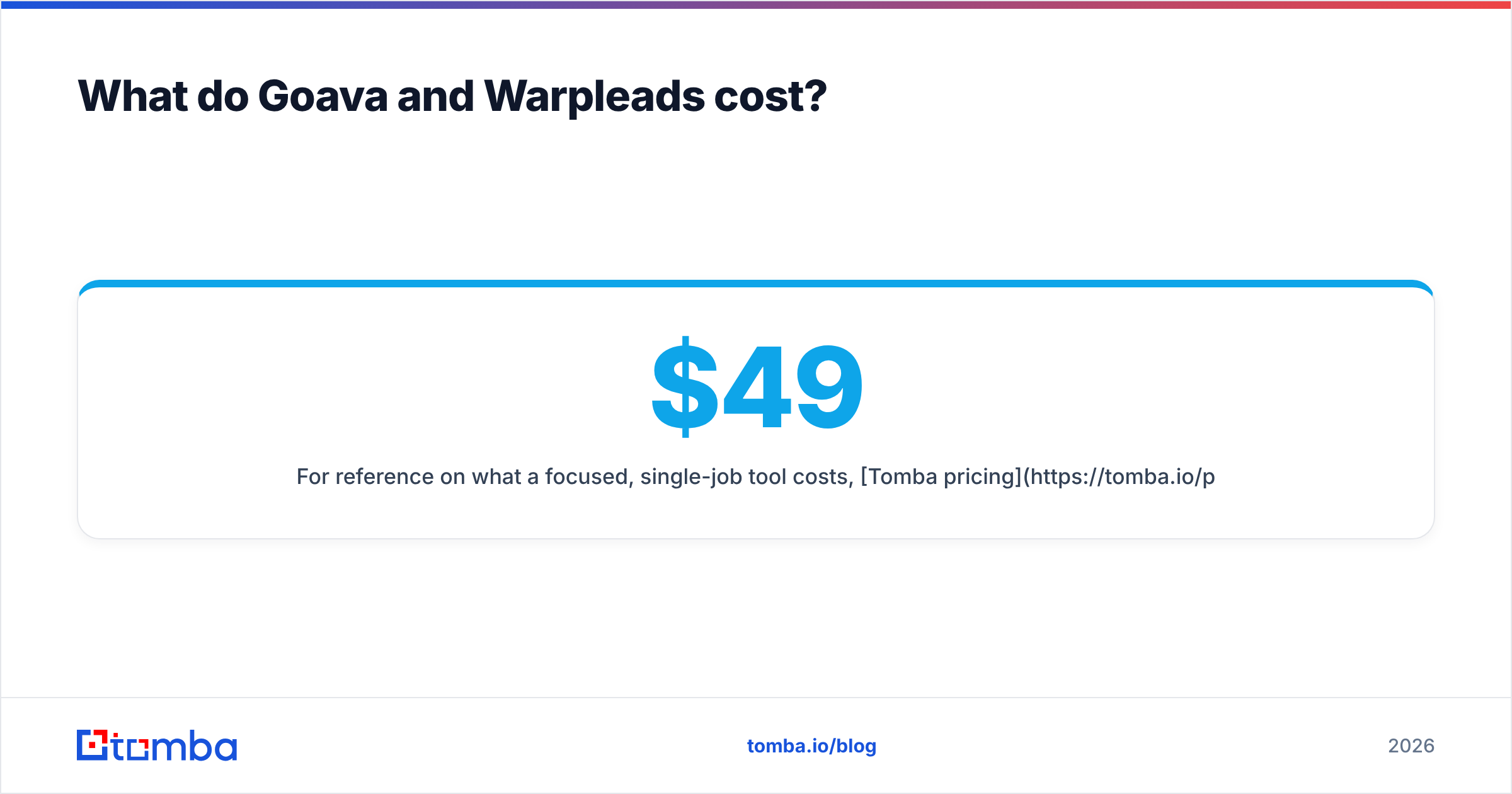
For reference on what a focused, single-job tool costs, Tomba pricing runs a free tier at 25 searches per month, Starter at $49/mo, Growth at $99/mo, Pro at $249/mo, and custom Enterprise pricing. That is a useful anchor when a sales intelligence vendor quotes you a five-figure annual number: you are paying for scoring, workflow, and account context, not for email addresses. Decide whether you need the former, because the latter is available far cheaper.
Who should choose Goava?#
Choose Goava if most of these are true:
- Your ICP is concentrated in Sweden, Norway, Denmark, or Finland.
- You sell to mid-market accounts where financial data and org structure genuinely change your qualification.
- You run an account-based motion — a rep works 40 accounts deeply, not 4,000 shallowly.
- You already run one of the CRMs Goava integrates with natively, and adoption depends on data arriving inside it.
- Deal sizes justify a quote-based annual platform fee.
Do not choose Goava if you need a global contact firehose, if your average contract value is small enough that per-seat intelligence tooling cannot pay for itself, or if what you actually needed was verified emails for a list you already have.
Who should choose Warpleads?#
Choose Warpleads if most of these are true:
- You run high-volume outbound and your bottleneck is record count, not targeting sophistication.
- You are an agency or lead-gen shop where cost per exported record is the governing metric.
- Your ICP is broad — geography and headcount filters get you close enough, and the sequence does the qualifying.
- You already own a sending stack and want the data layer to be cheap and fast.
Do not choose Warpleads if you sell six-figure deals into a narrow named-account list, if your compliance posture requires clear provenance for every contact record, or if you expect account-level intelligence. And whatever the marketing says about included verification, still run a pre-send validation pass. Volume tools and clean lists are not the same thing.
Where does a dedicated email finder fit into this?#
In practice, most teams end up with a two-layer stack rather than one platform. Layer one decides who to contact — that is Goava's job, or your CRM plus a target account list, or Warpleads' filters. Layer two produces a deliverable address for a specific person at a specific company — and that is a different technical problem, solved better by tools built only for it.
That second layer is where a focused email finder earns its keep. Give it a company domain and it returns the people and patterns behind it via domain search. Give it a list of names and companies and it resolves them at scale through bulk email finder workflows. Every result comes back with a confidence signal and a verification status rather than a silent guess.
The economics favor this split. Sales intelligence platforms charge for judgment and workflow; email finders charge for a narrow, measurable output. Paying a premium intelligence price for contact records is the most common overspend in outbound stacks — and the most common cause of the reverse problem too, where a team buys cheap volume, skips verification, and burns a sending domain that took six months to warm.
Goava vs Warpleads: what is the verdict?#
Goava wins if you sell into the Nordics with an account-based motion. Nobody else combines registry-grade Nordic company data with ICP scoring and native CRM delivery quite as cleanly. The cost is opaque pricing, an annual commitment, and a geographic ceiling.
Warpleads wins if your metric is cost per exported contact. For agencies and high-volume outbound teams, the unlimited-style export model is a genuinely different cost curve than credit-metered databases. The cost is thinner account context and data you must verify yourself before sending.
Neither wins the accuracy layer, because neither is built to. That is the gap worth budgeting for separately — and it is the cheapest part of the stack to get right.
If your real problem is that you already know which companies to target and just need reliable, verified work emails for the people inside them, start with the Tomba Email Finder. Free tier gets you 25 searches to run your own accuracy test against whatever Goava or Warpleads quotes you, Starter is $49/mo, and every result ships with a verification status instead of a shrug. Run the 500-record benchmark described above before you sign anything annual — the afternoon it costs you is the best-spent time in your entire evaluation.
Related guides#
Ready to find emails that actually work?
Join 150,000+ professionals who stopped guessing and started sending. Free credits on signup — no credit card required.
Get the Tomba newsletter
Practical outbound tactics and product updates — once every two weeks.
About the author