GoCustomer vs SeamlessAI: Which B2B Data Tool Wins in 2026?
GoCustomer sells AI-personalized outreach. Seamless.AI sells a real-time contact database. They solve different halves of the same problem — and the pricing gap is bigger than either advertises.
GoCustomer vs SeamlessAI is a choice between two different products. GoCustomer writes and sends your outreach. SeamlessAI (branded Seamless.AI) sells the contact data. This guide compares both on data quality, credits, contracts, and real cost.
TL;DR
- GoCustomer is an AI outreach platform: it writes and personalizes sequences, then sends them. Its contact data is a bundled convenience, not its core asset.
- Seamless.AI is a contact database with a real-time search engine and a Chrome extension. Its core asset is volume — hundreds of millions of records — with accuracy that varies sharply by segment.
- They are not true substitutes. Buying one expecting the other's strength is the most common and most expensive mistake in this comparison.
- Seamless.AI's pricing is quote-only with annual contracts and credit caps that bite fast; GoCustomer is cheaper up front but thinner on data depth.
- The real GoCustomer vs SeamlessAI question is simple: are you buying the writing, or the data?
- If you only need accurate email addresses on demand, a dedicated finder like Tomba Email Finder at $49/mo beats paying platform prices for a database you use twice a week.
What are GoCustomer and Seamless.AI, actually?#
Think of it like buying a kitchen. Seamless.AI sells you the pantry — shelves of raw ingredients, some fresh, some past date, and you decide what to cook. GoCustomer sells you a meal-kit service — it picks the ingredients, writes the recipe, and cooks. Very different purchases. Both get shortlisted together because both get pitched as "how you fill pipeline."
GoCustomer positions itself as an AI-driven sales engagement platform. The pitch: connect your ICP and let the AI research each prospect. It then writes first lines and full sequences, and runs multichannel outreach with no copywriter in the loop. Contact discovery exists inside the product. But it is the on-ramp to the sending engine, not the product itself.
Seamless.AI (seamless.ai) is a B2B contact database. It claims to build records in real time rather than serve a static list. You search a company or a title, and the engine crawls and assembles contacts on request. It ships a heavily used Chrome extension for LinkedIn and company sites, plus CRM sync into Salesforce and HubSpot.
The category confusion is real. On G2, both appear under sales intelligence tags. That pushes buyers to treat them as interchangeable. They aren't.
How do GoCustomer and Seamless.AI compare head to head?#
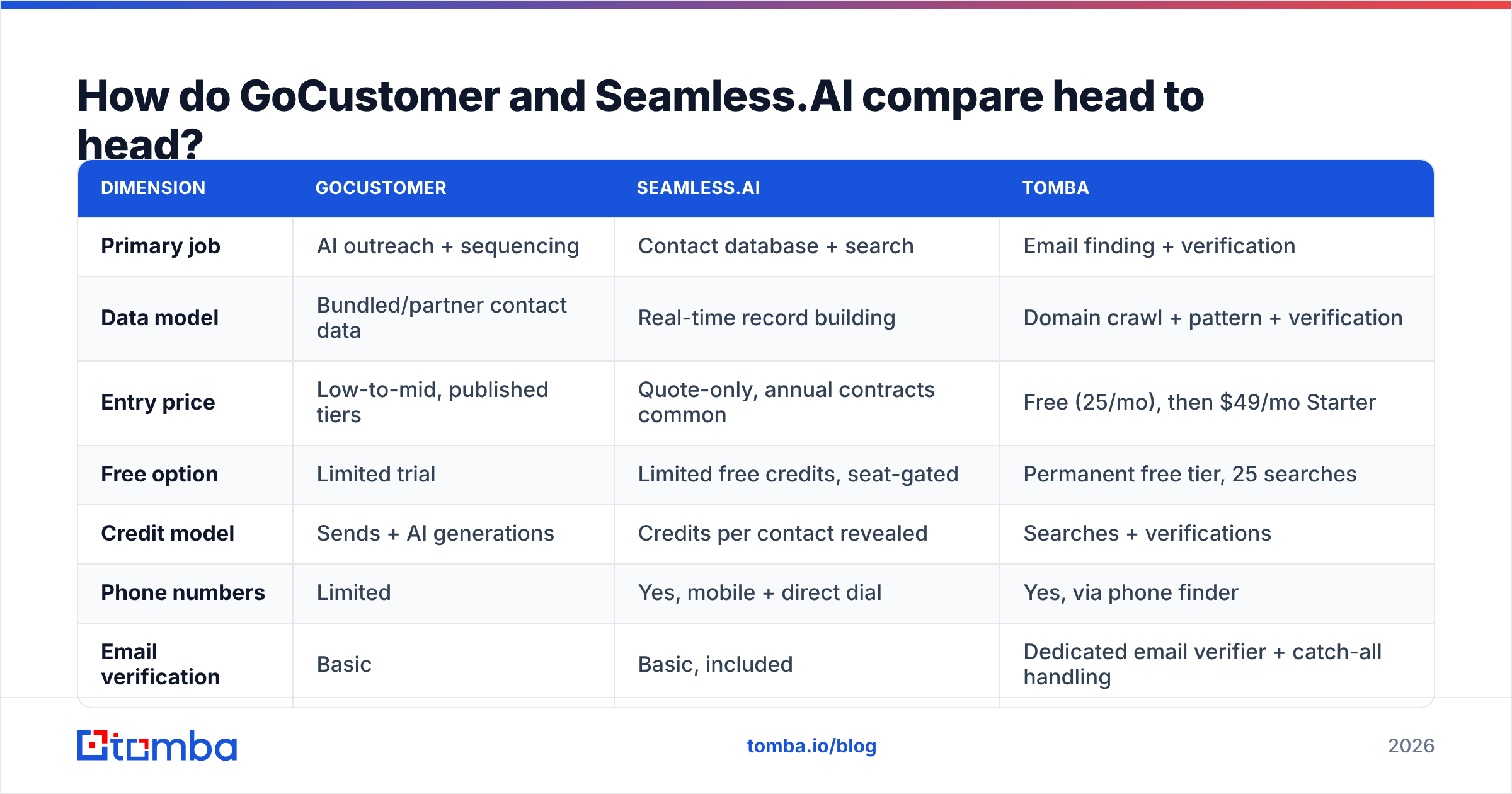
Here is the practical GoCustomer vs SeamlessAI breakdown. Treat published pricing as directional. Seamless.AI is quote-driven, and what you pay depends on seat count and negotiation.
| Dimension | GoCustomer | Seamless.AI | Tomba |
|---|---|---|---|
| Primary job | AI outreach + sequencing | Contact database + search | Email finding + verification |
| Data model | Bundled/partner contact data | Real-time record building | Domain crawl + pattern + verification |
| Entry price | Low-to-mid, published tiers | Quote-only, annual contracts common | Free (25/mo), then $49/mo Starter |
| Free option | Limited trial | Limited free credits, seat-gated | Permanent free tier, 25 searches |
| Credit model | Sends + AI generations | Credits per contact revealed | Searches + verifications |
| Phone numbers | Limited | Yes, mobile + direct dial | Yes, via phone finder |
| Email verification | Basic | Basic, included | Dedicated email verifier + catch-all handling |
| API access | Limited | Available on higher tiers | Full Tomba API on all paid plans |
| Best for | Teams with no copywriter | High-volume SDR floors | Precision list building, dev workflows |
| Worst for | Teams needing deep firmographics | Buyers who hate annual lock-in | Teams wanting a sending engine |
Two structural differences matter more than any feature checkbox:
- Contract shape. Seamless.AI has a long-standing reputation for annual agreements and hard-to-exit terms. Check Capterra reviews and you'll find the recurring complaint isn't data quality — it's billing rigidity. Budget for the year, not the month.
- Credit semantics. "Credits" mean different things. Seamless.AI burns credits when you reveal a contact, whether or not the email bounces. Tomba only charges for a search and lets you verify emails separately, so you can gate spend on quality.
- Who owns the copy. GoCustomer's value evaporates if your team already has a strong messaging system. If your reps write better than the model, you're paying for a feature you'll turn off.
- Where the data goes. Both push into CRMs. But if your workflow is a spreadsheet or an internal tool, an API-first vendor with a Google Sheets add-on removes an entire integration project.
Is Seamless.AI's data accurate enough for cold outreach?#
Short answer: accurate enough for volume plays, risky for tight ICP lists.
Real-time record building is a real engineering feat. It also has a predictable failure mode. The engine sometimes returns a plausible email rather than a confirmed one. Pattern-guessed addresses at firstname.lastname@company.com look right and bounce anyway. On a 5,000-contact blast, a 12% bounce rate is survivable if you're on dedicated infrastructure. On a 200-account ABM list where every send matters, it isn't.
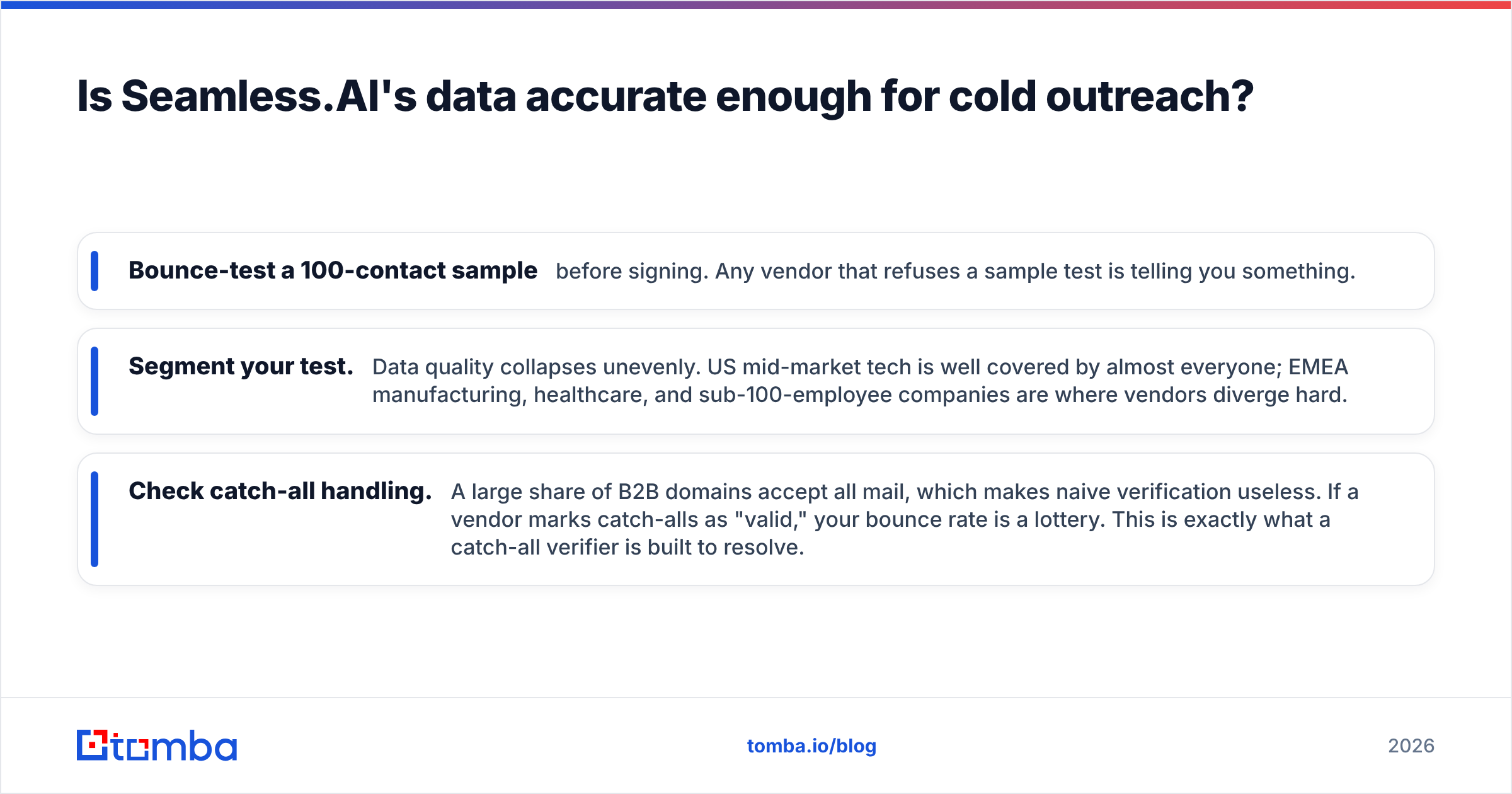
Three checks before you trust any dataset from either vendor:
- Bounce-test a 100-contact sample before signing. Any vendor that refuses a sample test is telling you something.
- Segment your test. Data quality collapses unevenly. US mid-market tech is well covered by almost everyone. EMEA manufacturing, healthcare, and sub-100-employee companies are where vendors diverge hard.
- Check catch-all handling. A large share of B2B domains accept all mail, which makes naive verification useless. If a vendor marks catch-alls as "valid," your bounce rate is a lottery. This is exactly what a catch-all verifier is built to resolve.
GoCustomer's data problem is different: there is less of it. Its contact layer can find a few hundred prospects that match a simple filter. It is not a research database. If firmographic depth, intent signals, or org-chart mapping matter to your motion, neither tool is your primary source. That is an honest answer, not a hedge.
One more option worth naming. For verified-email volume in specific verticals, providers like BookYourData keep strong curated datasets. They are a fair choice next to either platform. The right stack is often two narrow tools, not one wide one.
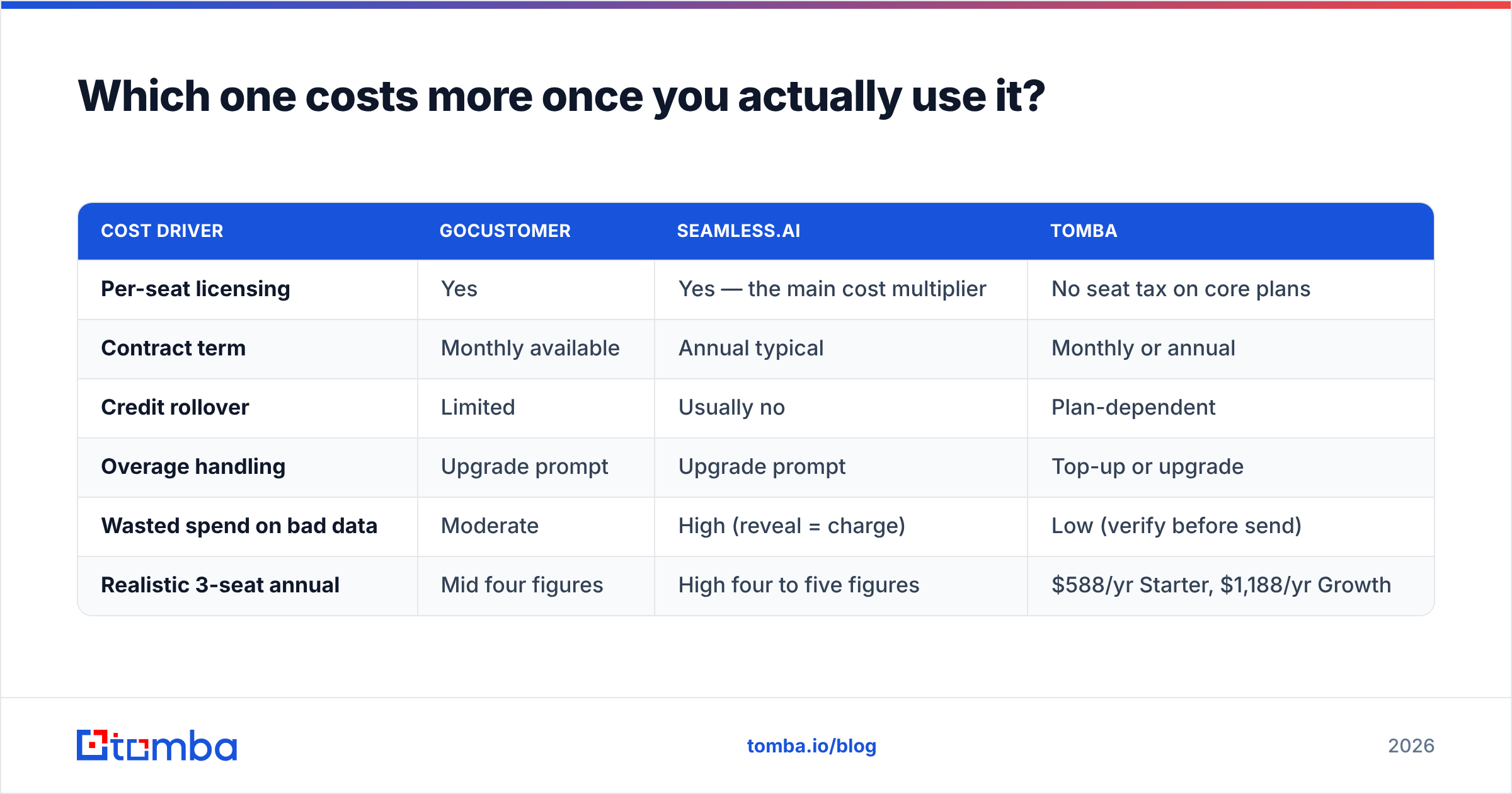
Which one costs more once you actually use it?#
The sticker price is not the price. Run this arithmetic before you sign anything.
| Cost driver | GoCustomer | Seamless.AI | Tomba |
|---|---|---|---|
| Per-seat licensing | Yes | Yes — the main cost multiplier | No seat tax on core plans |
| Contract term | Monthly available | Annual typical | Monthly or annual |
| Credit rollover | Limited | Usually no | Plan-dependent |
| Overage handling | Upgrade prompt | Upgrade prompt | Top-up or upgrade |
| Wasted spend on bad data | Moderate | High (reveal = charge) | Low (verify before send) |
| Realistic 3-seat annual | Mid four figures | High four to five figures | $588/yr Starter, $1,188/yr Growth |
The seat multiplier is where budgets break. A five-person SDR team on a database platform is five licenses, and most of those reps pull the same 300 accounts. If your actual need is "get me correct email addresses for a list I already have," you are paying platform economics for a lookup problem.
That's the case for unbundling. Tomba pricing runs Free (25 searches/mo), Starter $49/mo, Growth $99/mo, Pro $249/mo, and Enterprise custom. The email finder API is on every paid plan, so one integration serves the whole team instead of one login per rep.
When should you pick GoCustomer?#
Pick GoCustomer when the bottleneck is writing and sending, not finding.
- You have a defined ICP and can source lists elsewhere, but nobody on the team writes good outbound copy.
- You're running one to three reps and can't justify a dedicated sequencer plus a copywriter plus a data vendor.
- Your outreach is multichannel and you want the AI research step baked in rather than stitched from four tools.
- You want month-to-month flexibility while you test whether outbound works at all.
Where it disappoints: if you need to build a 20,000-contact list segmented by tech stack and headcount band, you'll hit the ceiling fast. AI personalization on a bad list just produces well-written emails to the wrong people.
When should you pick Seamless.AI?#
Pick Seamless.AI when the bottleneck is volume of contacts, and you have the process to absorb imperfect data.
- You run a real SDR floor — five-plus reps burning through lists weekly.
- Phone numbers matter as much as emails, and you're doing genuine multi-touch with dials.
- Your team lives in the Chrome extension on LinkedIn, and workflow speed beats surgical accuracy.
- You have a verification step downstream, so bad records get filtered before they hit your sender.
Where it disappoints: an annual commitment on a tool you might churn in four months, credit burn that outpaces forecasts, and a support and billing experience that reviewers flag again and again. Read the contract clause on renewal and cancellation before you get excited about the demo. HubSpot publishes solid neutral guidance on evaluating sales tooling contracts if you want a checklist.
What does a leaner stack look like?#
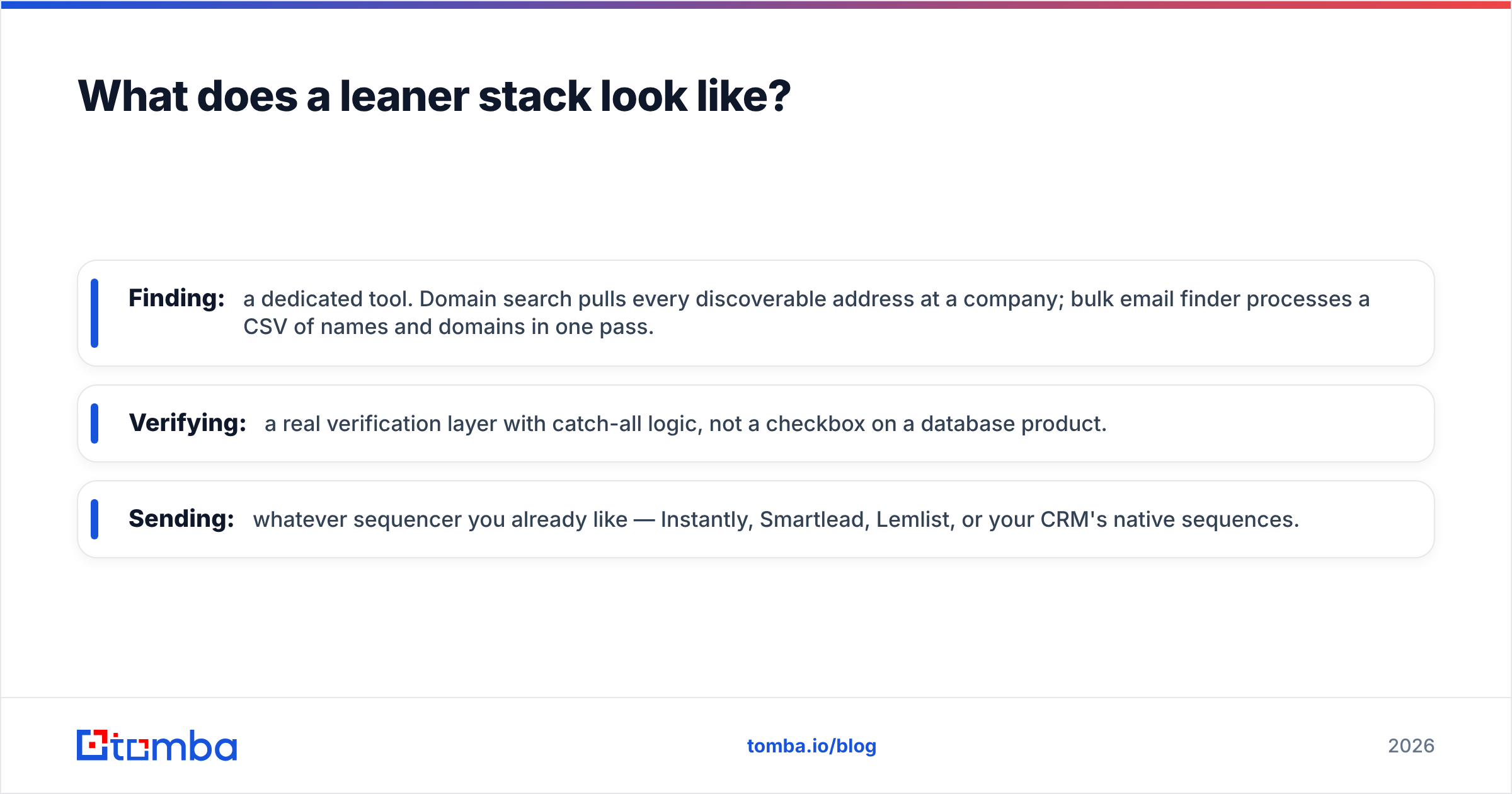
Most teams comparing GoCustomer vs SeamlessAI are trying to solve three separate jobs with one purchase order:
- Find contacts — get correct emails and phones for target companies.
- Verify contacts — confirm deliverability before sending, including catch-all domains.
- Send and sequence — run the multi-touch campaign and track replies.
Bundled platforms charge you for all three whether you use all three or not. The unbundled version usually costs less and performs better:
- Finding: a dedicated tool. Domain search pulls every discoverable address at a company; bulk email finder processes a CSV of names and domains in one pass.
- Verifying: a real verification layer with catch-all logic, not a checkbox on a database product.
- Sending: whatever sequencer you already like — Instantly, Smartlead, Lemlist, or your CRM's native sequences.
This is also the stack that survives budget review. When someone asks what each line item does, "database seat licenses for five reps who share one list" is a hard defense. "Lookup API at $99/mo plus a sequencer" is not.
You can also get the AI-writing benefit without the platform commitment. The writing layer is close to commoditized now. A cold email AI generator and a subject line generator cover most of what a personalization engine does, with no seat license attached.
GoCustomer vs SeamlessAI: which actually wins?#
Verdict: neither, for most buyers — and that's the useful answer.
If you must choose between only these two:
- Choose Seamless.AI if you're a volume outbound org with five or more reps, phone dials in the motion, and a verification step you control. Negotiate the term hard and test data on your exact segment first.
- Choose GoCustomer if you're small, writing is your weak point, and you'd rather pay for output than for a database you'll under-use. Keep sourcing lists separately.
But run the third option through the same math. If your genuine need is accurate B2B contact data — not a sending engine, not an AI copywriter — a focused finder with transparent pricing and no seat tax will do the job for a fraction of a platform contract. The teams with the best cost-per-meeting numbers do not have the biggest platform. They bought narrow tools and connected them well.
Test this on your own list before you commit to anyone's annual contract. Start with Tomba Email Finder. The free tier gives you 25 searches a month with no card. That is enough to bounce-test a real sample against whatever the demo shows you. If the accuracy holds on your segment, Starter at $49/mo and the API will cover a whole team for less than one database seat.
Related guides#
Ready to find emails that actually work?
Join 150,000+ professionals who stopped guessing and started sending. Free credits on signup — no credit card required.
Get the Tomba newsletter
Practical outbound tactics and product updates — once every two weeks.
About the author