GoHighLevel vs HubSpot (2026): Which CRM Actually Wins?
GoHighLevel bundles agency tooling for $97/mo. HubSpot sells depth at 10x the price. Here is the honest breakdown of pricing, deliverability, data quality and which one fits your team.
GoHighLevel vs HubSpot comes down to one question. Are you reselling marketing services, or running your own revenue team? GoHighLevel is built for agencies. HubSpot is built for in-house teams. Here is how the two compare on price, CRM depth, email limits, and the gaps both leave open.
TL;DR
- GoHighLevel is a white-label agency operating system: CRM, funnels, SMS, calls, booking, and reputation management. It runs $97–$497/mo flat, with unlimited sub-accounts on the top tier. It wins on cost-per-client and breadth.
- HubSpot is a full enterprise CRM platform. It brings reporting, permissions, integrations, and an ecosystem GoHighLevel cannot match. But Marketing Hub Professional starts at $890/mo, and the price climbs with each contact tier.
- Pick GoHighLevel if you resell marketing services to SMB clients. Pick HubSpot if you have an in-house revenue team that needs forecasting, attribution, and clean data.
- Neither platform finds or verifies contact data. Both will happily import a garbage list and burn your sending domain doing it.
- The real cost gap is not the sticker price. It is HubSpot's per-seat model against GoHighLevel's per-agency model. Then add what you spend patching GoHighLevel's reporting gaps.
What is GoHighLevel and who actually buys it?#
GoHighLevel (often written "HighLevel" or GHL) is a consolidated SaaS platform built for marketing agencies and SMB service businesses. The pitch is replacement, not integration. Instead of paying for ClickFunnels, ActiveCampaign, Calendly, a CRM, and a call tracker, you pay one bill. You get working versions of all of them under your own brand.
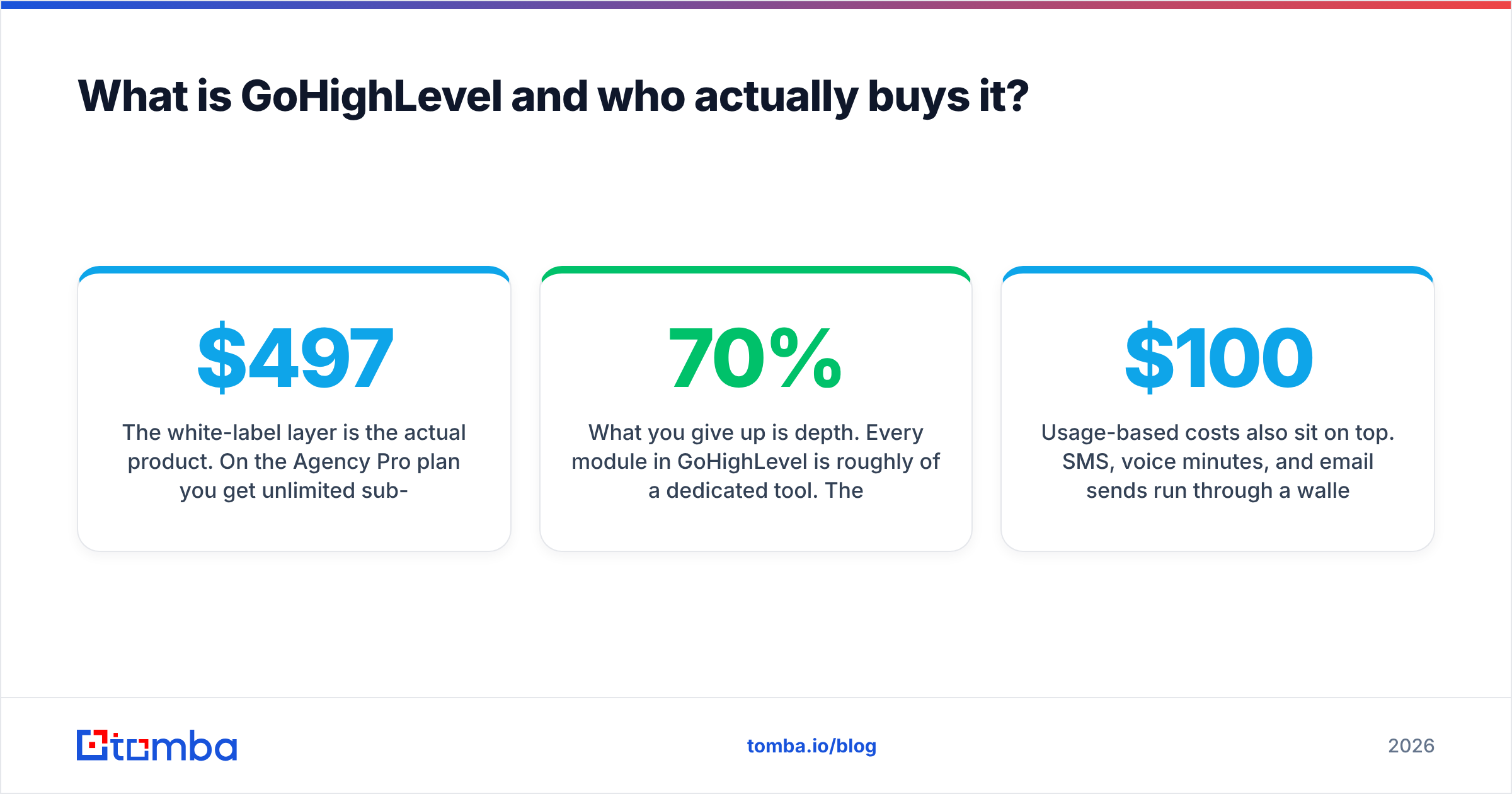
The white-label layer is the actual product. On the $497/mo Agency Pro plan you get unlimited sub-accounts, your own domain, and your own logo. You can then resell the platform to clients at whatever margin you want. Agencies routinely charge clients $297/mo for a sub-account that costs them a fraction of that. That model is why GoHighLevel grew so fast. The buyer is not an end user. The buyer is a reseller.
What you give up is depth. Every module in GoHighLevel is roughly 70% of a dedicated tool. The email builder is fine, but it is not Klaviyo. The pipeline is fine, but it is not Salesforce. Reporting is where most teams hit the wall. You get activity counts and pipeline value. You do not get multi-touch attribution or cohort analysis.
Usage-based costs also sit on top. SMS, voice minutes, and email sends run through a wallet system at rebilled rates. A single sub-account doing heavy SMS outreach can add $100+/mo that never appears in the advertised price.
What is HubSpot and where does it draw the line?#
HubSpot is a CRM platform sold in five hubs: Marketing, Sales, Service, Content, and Operations. Each hub has Free, Starter, Professional, and Enterprise tiers. The free CRM is genuinely usable, and it is how most companies enter the ecosystem. The bill comes later. Contact counts grow, and you need Pro features like workflows, custom reports, and revenue attribution.
HubSpot's advantage over GoHighLevel is structural, not feature-by-feature. It has an app marketplace with 1,700+ integrations, a mature API, granular permission sets, sandbox environments, and reporting a CFO will accept. If your board asks for pipeline coverage by segment and source, HubSpot answers in three clicks. GoHighLevel answers with a CSV export and a spreadsheet.
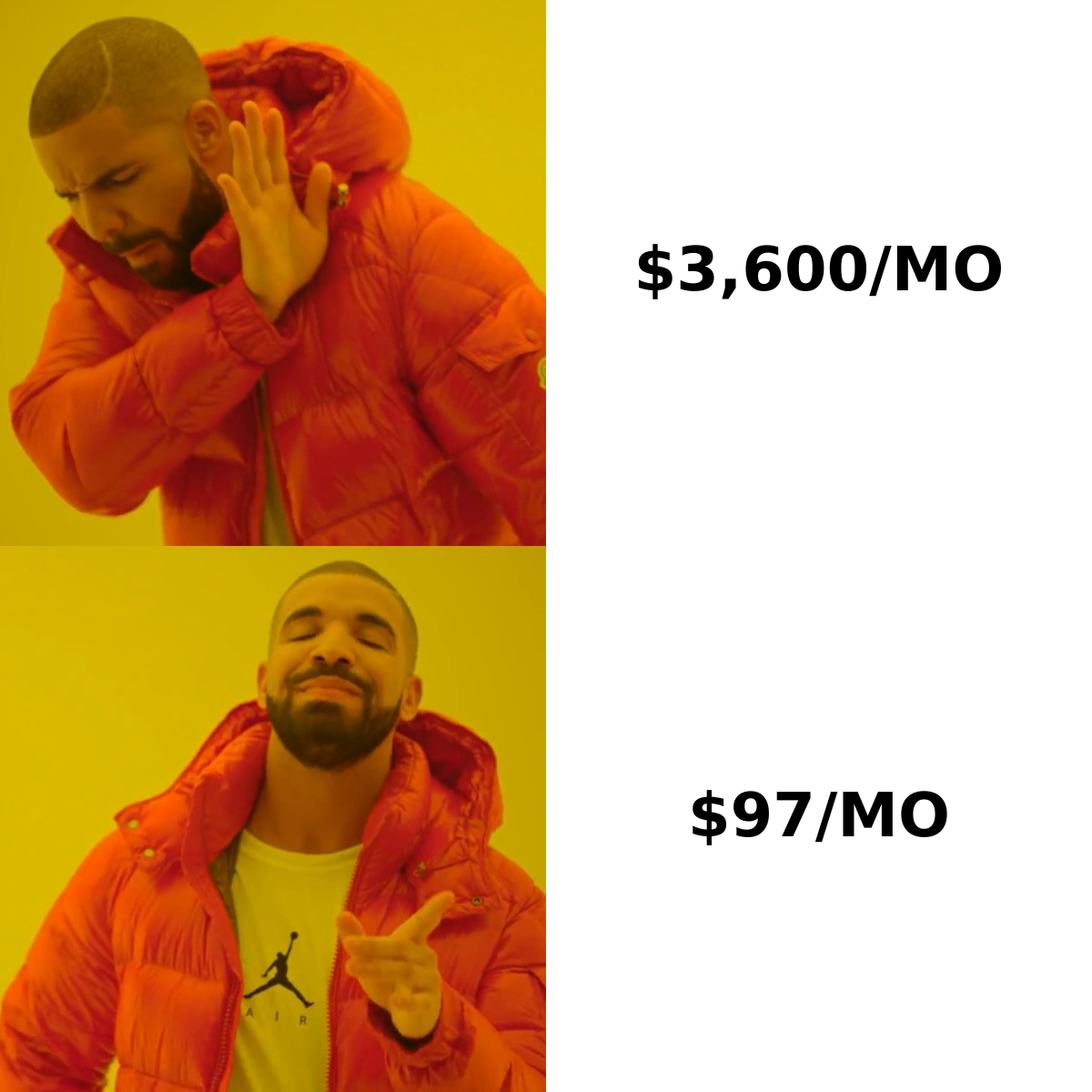
The catch is pricing architecture. Marketing Hub Professional is $890/mo for 2,000 marketing contacts, and extra contacts are sold in blocks. Sales Hub Professional is per seat. Enterprise tiers jump again, and onboarding fees are mandatory on Professional and above. A ten-person team running Marketing Pro, Sales Pro, and a few contact blocks lands north of $3,000/mo before anyone writes an email.
GoHighLevel vs HubSpot: how do the prices and features compare?#
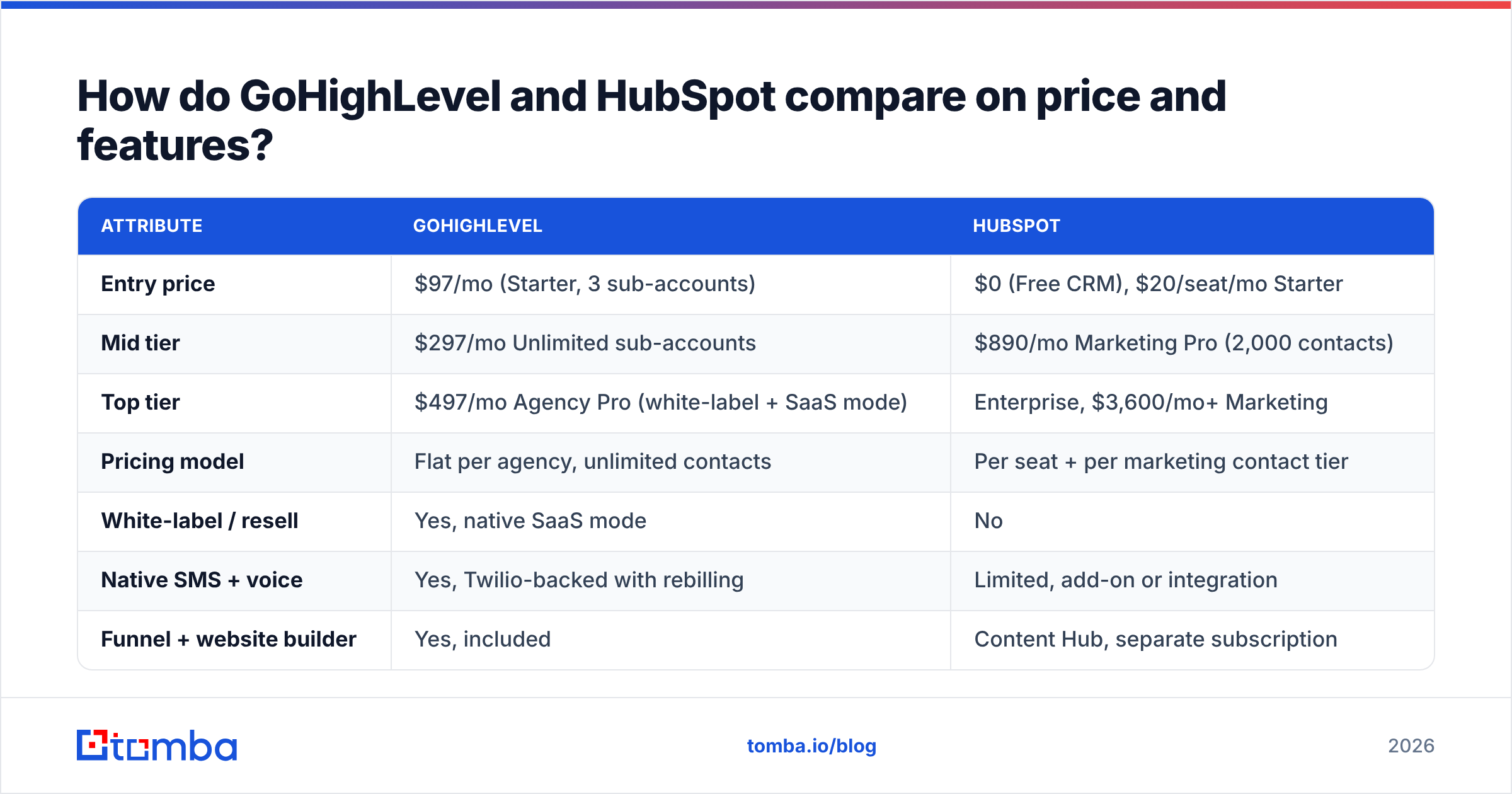
| Attribute | GoHighLevel | HubSpot |
|---|---|---|
| Entry price | $97/mo (Starter, 3 sub-accounts) | $0 (Free CRM), $20/seat/mo Starter |
| Mid tier | $297/mo Unlimited sub-accounts | $890/mo Marketing Pro (2,000 contacts) |
| Top tier | $497/mo Agency Pro (white-label + SaaS mode) | Enterprise, $3,600/mo+ Marketing |
| Pricing model | Flat per agency, unlimited contacts | Per seat + per marketing contact tier |
| White-label / resell | Yes, native SaaS mode | No |
| Native SMS + voice | Yes, Twilio-backed with rebilling | Limited, add-on or integration |
| Funnel + website builder | Yes, included | Content Hub, separate subscription |
| Reporting depth | Basic dashboards, limited attribution | Multi-touch attribution, custom reports |
| Integrations | ~50 native + Zapier | 1,700+ marketplace apps |
| Onboarding fee | None | $3,000 (Pro), $7,000 (Enterprise) |
| Best fit | Agencies, SMB service businesses | In-house revenue teams, scale-ups |
Read the table with one filter: who is your buyer? If you bill clients monthly for marketing services, GoHighLevel's flat pricing turns into gross margin the moment you add a third client. If you are an operating company with a sales team, HubSpot's per-seat cost stings. But the reporting pays for itself the first time you kill an underperforming channel.
Which one handles email deliverability better?#
Neither is a deliverability product. Both will let you shoot yourself in the foot.
GoHighLevel routes email through Mailgun (or your own LC Email setup) and SMS through Twilio. Agencies often run dozens of sub-accounts on shared infrastructure. If you do not isolate domains properly, one bad sender can drag down the rest. Set up a dedicated sending domain per client, authenticate it, and do not skip the SPF record and DKIM setup. GoHighLevel makes this possible, but it does not force it.
HubSpot enforces more guardrails. It requires domain authentication before you can send marketing email. It suppresses hard bounces automatically. It will throttle or flag accounts with high complaint rates, and it can suspend sending outright. That friction is annoying during setup and valuable six months in.
The deeper truth: both platforms inherit your list quality. If 18% of your imported contacts are stale or invalid, your bounce rate spikes and your sender reputation drops. No platform setting rescues you. Run imports through an email verifier before they touch either CRM. HubSpot punishes you twice. Bad contacts count against your marketing contact tier, so you pay for the privilege of bouncing.
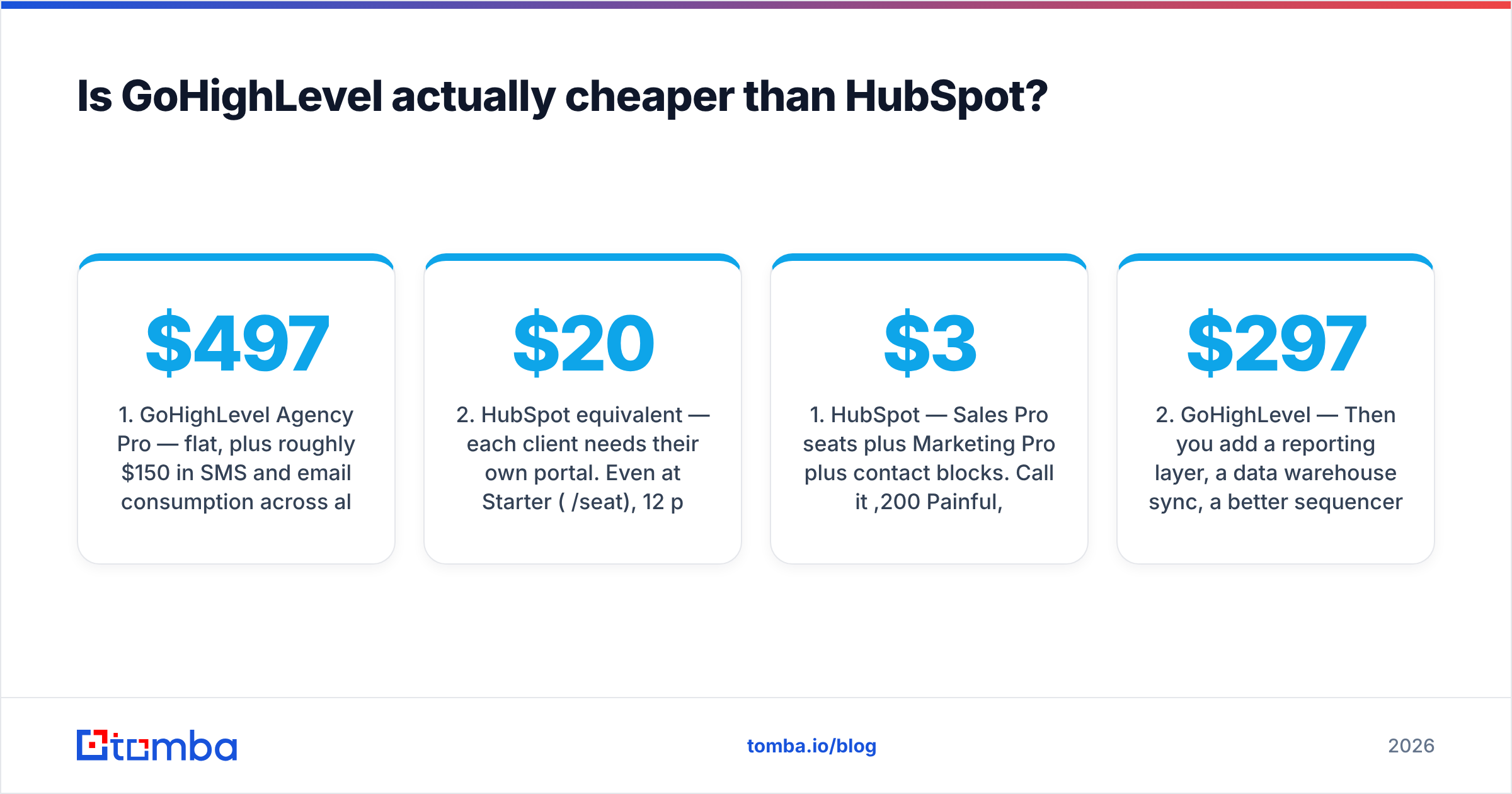
Is GoHighLevel actually cheaper than HubSpot?#
Yes for agencies, and it is not close. No for single operating companies past a certain size. There the gap narrows, and sometimes it reverses.
Work an example. An agency with 12 clients:
- GoHighLevel Agency Pro — $497/mo flat, plus roughly $150/mo in SMS and email use across all sub-accounts. Total: ~$647/mo, or $54 per client.
- HubSpot equivalent — each client needs their own portal. Even at Starter ($20/seat), 12 portals with real contact volume lands around $1,800–$3,000/mo. And you cannot white-label any of it.
Now flip it. A 25-person SaaS company with an SDR team, a marketing team, and a board that wants attribution:
- HubSpot — Sales Pro seats, plus Marketing Pro, plus contact blocks. Call it $3,200/mo. Painful. But it replaces a BI tool, a sequencer, and a meeting scheduler, and everyone already knows the interface.
- GoHighLevel — $297/mo. Then you add a reporting layer, a data warehouse sync, a better sequencer, and an ops contractor to hold it together. The sticker savings evaporate somewhere around month four.
The honest framing is that these tools are not competing for the same dollar. They compete for attention from buyers who have not yet decided which kind of company they are.
What do both platforms fail to solve?#
Contact data. This is the gap nobody markets around.
GoHighLevel and HubSpot are both systems of record and systems of action. Neither is a system of acquisition. HubSpot sells Breeze Intelligence for enrichment as a credit-based add-on. GoHighLevel has no first-party data product at all. In both cases, the contacts come from forms, imports, scrapes, or a separate prospecting tool.
That creates three recurring failure modes:
- Stale imports — a list bought 14 months ago, imported wholesale, 20%+ of it invalid. Bounces follow within hours of the first send.
- Missing decision-makers — you have the company but not the buyer. Your pipeline shows 400 accounts and 90 contacts.
- No verification loop — contacts decay at roughly 25–30% per year as people change jobs. Neither CRM re-checks them.
The fix is upstream, not inside the CRM. Use a dedicated email finder to build the contact layer. Run a domain search when you have the company but not the person. Push only verified records into whichever platform you chose. Both GoHighLevel and HubSpot have APIs and Zapier connectors, so this is a one-time plumbing job. Tomba's HubSpot integration handles the sync directly.
GoHighLevel vs HubSpot: how should you choose?#
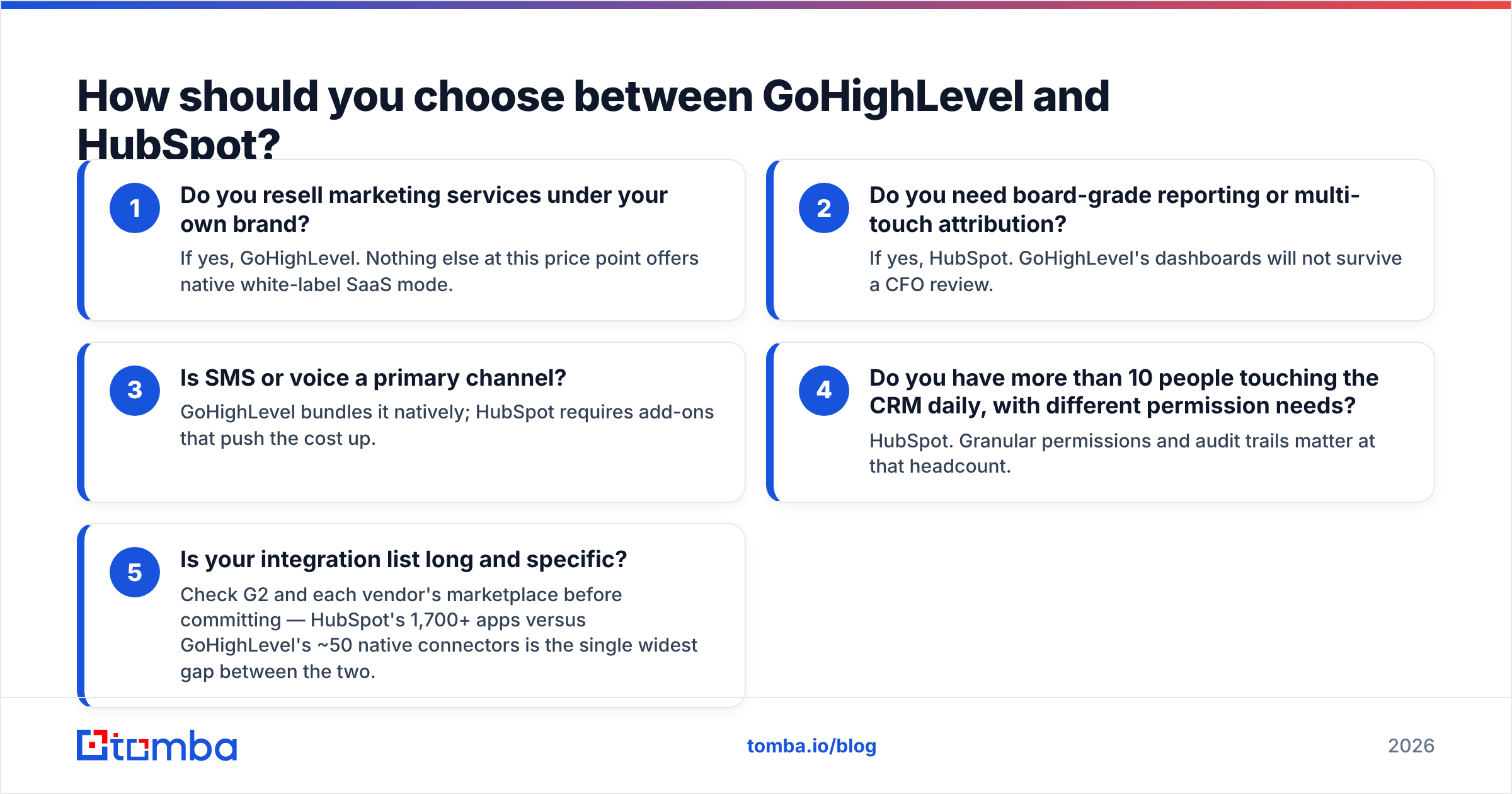
Run these five questions in order. The first "yes" usually decides it.
- Do you resell marketing services under your own brand? If yes, GoHighLevel. Nothing else at this price offers native white-label SaaS mode.
- Do you need board-grade reporting or multi-touch attribution? If yes, HubSpot. GoHighLevel's dashboards will not survive a CFO review.
- Is SMS or voice a primary channel? GoHighLevel bundles it natively. HubSpot needs add-ons that push the cost up.
- Do more than 10 people touch the CRM daily, with different permission needs? HubSpot. Granular permissions and audit trails matter at that headcount.
- Is your integration list long and specific? Check G2 and each vendor's marketplace first. HubSpot's 1,700+ apps against GoHighLevel's ~50 native connectors is the widest gap between the two.
A pattern worth noting: plenty of agencies run both. GoHighLevel for client delivery, HubSpot Free or Starter for their own internal pipeline. It costs almost nothing, and it sidesteps the false choice entirely.
What about migrating between them?#
Migration difficulty is asymmetric.
GoHighLevel to HubSpot is the easier direction. Export contacts, opportunities, and notes as CSV. Map the fields into HubSpot's import wizard, then rebuild workflows. The main losses are funnel pages and SMS history. Rebuild the pages in Content Hub or keep them on a separate builder. SMS history rarely maps cleanly.
HubSpot to GoHighLevel is harder. You will lose custom report definitions, revenue attribution history, some association structures between objects, and any marketplace integration without a GHL equivalent. Budget four to six weeks. Expect to simplify your data model, not port it.
Migration is also the right moment to clean the database. Do not move dirt from one warehouse to another. Deduplicate, re-verify every email address, drop anything that has not engaged in 18 months, and enrich what remains. A bulk verify pass before import usually removes 10–20% of a legacy list. Those records would otherwise eat HubSpot contact tiers or trip GoHighLevel sending limits.
Frequently asked questions#
Can GoHighLevel replace HubSpot entirely? For an SMB or agency, usually yes. For a company with a dedicated RevOps function, no. The reporting, permissions, and integration depth are not there.
Does HubSpot have a free tier that competes with GoHighLevel? HubSpot's free CRM is strong for contact management and basic deal tracking. But marketing automation, sequences, and custom reporting all sit behind paid tiers. GoHighLevel has no free tier.
Which has better native automation? HubSpot's workflow builder is more capable for branching logic, enrollment criteria, and cross-object actions. GoHighLevel's automation covers most SMB use cases, and it includes SMS and voice steps HubSpot charges extra for.
Is GoHighLevel good for cold outreach? It can send, but it was not built as a cold-email platform. Sending reputation controls are thinner than a dedicated tool's, so you carry more of the deliverability burden yourself.
The bottom line#
GoHighLevel vs HubSpot is not really one contest. The two solve different problems that happen to share a category label. GoHighLevel is a margin machine for agencies that deliver ten services under one login. HubSpot is an operating system for companies that need to explain their revenue to someone else. Choose wrong and you lose capability or cash. Usually both, because you end up bolting on the thing you skipped.
What neither one gives you is a reliable contact layer. Whichever platform you land on, the pipeline only works if the emails are real and the right people are in it. Start with Tomba's Email Finder to build a verified contact base by domain, name, or company. Then push clean records into your CRM of choice. The free tier covers 25 searches a month, and paid plans start at $49/mo. See the full breakdown on Tomba pricing. Fix the data first. The CRM decision gets a lot cheaper after that.
Related guides#
Ready to find emails that actually work?
Join 150,000+ professionals who stopped guessing and started sending. Free credits on signup — no credit card required.
Get the Tomba newsletter
Practical outbound tactics and product updates — once every two weeks.
About the author