9 Best Goodmeetings Alternatives for Sales Teams in 2026
Goodmeetings covers AI meeting notes and call coaching, but it is not the only option — or the cheapest. Here are nine alternatives compared on price, coaching depth, CRM sync, and who each one actually fits.
TL;DR
- Goodmeetings is a solid AI meeting assistant for revenue teams, but most teams leave for one of three reasons: coaching depth, CRM sync reliability, or per-seat cost at scale.
- If you only need accurate notes and searchable transcripts, Fireflies, Fathom, and tl;dv do the job for $0–$29 per user per month.
- If you need real conversation intelligence — deal risk, talk ratios, scorecards — Gong, Clari Copilot, Jiminny, and Avoma are the serious tier, and they cost 5–20x more.
- The tool you pick matters far less than the meetings you get in the first place; no notetaker fixes an empty calendar.
- Budget realistically: notetakers start free, revenue-intelligence platforms often land above $1,000 per seat per year plus a platform fee.
What is Goodmeetings, and why do teams look for alternatives?#
Goodmeetings records, transcribes, and summarizes sales calls, then layers coaching and CRM push on top. It sits in the crowded middle of the market: more than a raw notetaker, lighter than an enterprise revenue-intelligence suite. For a 5–30 rep team running demos on Zoom, Meet, or Teams, that middle is often exactly right.
Teams still shop around. The recurring triggers look like this:
- Coaching depth plateaus. Summaries are fine, but managers want scorecards, objection tracking, and rep-vs-team benchmarks they can run a weekly 1:1 from.
- CRM sync friction. If notes land in the wrong object, or custom fields do not map, RevOps ends up doing manual cleanup — which defeats the point.
- Language and region coverage. Non-English pipelines expose transcription accuracy gaps in every vendor, not just this one. Test on your own recordings.
- Per-seat math at scale. Rolling a $20–$40 seat out to 40 reps is a line item someone will question at renewal.
- Consolidation. Some teams already pay for a dialer, a sequencer, and a CRM, and want fewer vendors rather than better ones.
None of these make Goodmeetings a bad product. They make it a product with a specific fit. The question is whether your fit changed.
What should you look for in a Goodmeetings alternative?#
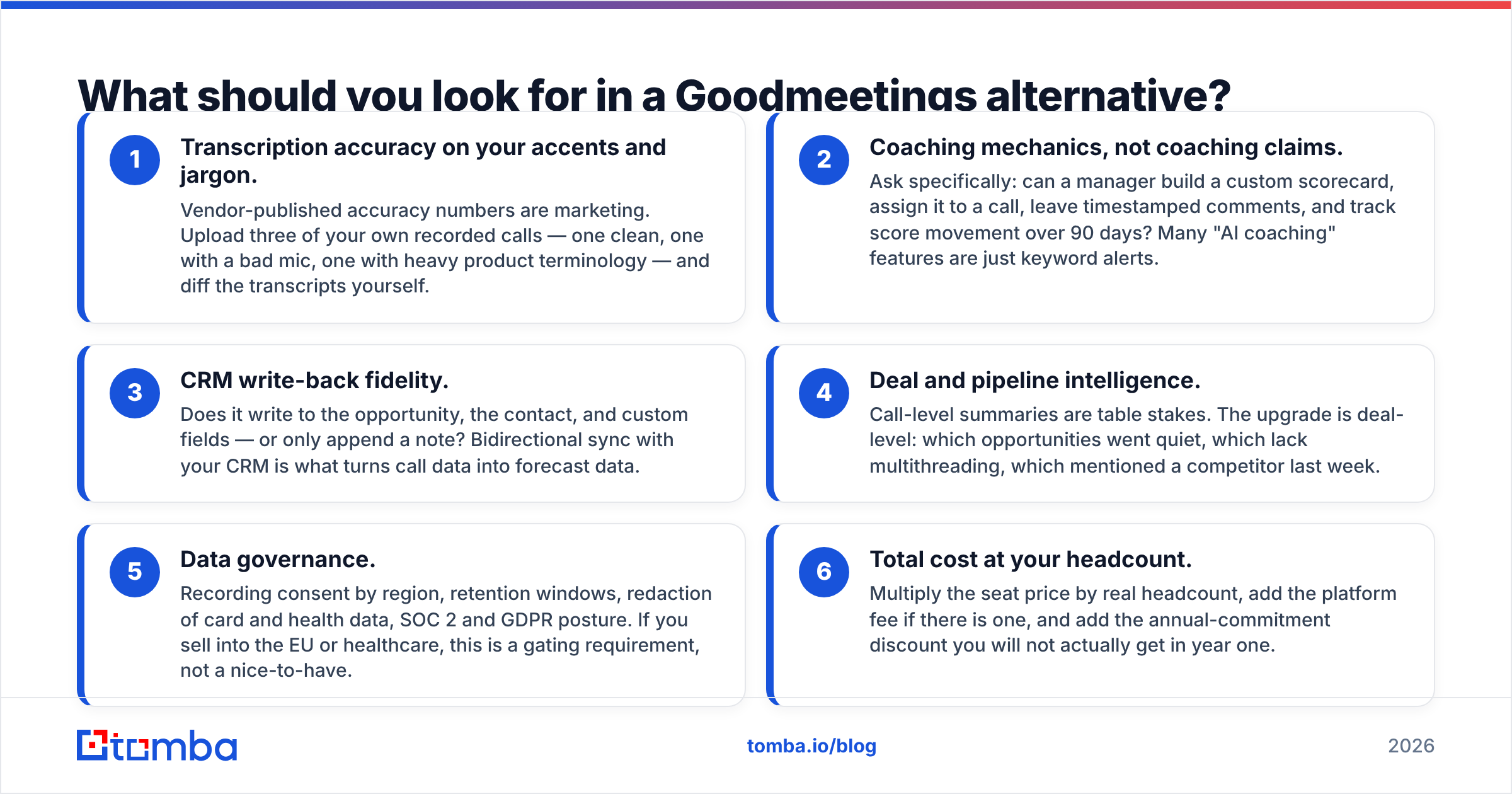
Score every option on the same six axes before you look at price. Most buying regret comes from evaluating a demo instead of a workflow.
- Transcription accuracy on your accents and jargon. Vendor-published accuracy numbers are marketing. Upload three of your own recorded calls — one clean, one with a bad mic, one with heavy product terminology — and diff the transcripts yourself.
- Coaching mechanics, not coaching claims. Ask specifically: can a manager build a custom scorecard, assign it to a call, leave timestamped comments, and track score movement over 90 days? Many "AI coaching" features are just keyword alerts.
- CRM write-back fidelity. Does it write to the opportunity, the contact, and custom fields — or only append a note? Bidirectional sync with your CRM is what turns call data into forecast data.
- Deal and pipeline intelligence. Call-level summaries are table stakes. The upgrade is deal-level: which opportunities went quiet, which lack multithreading, which mentioned a competitor last week.
- Data governance. Recording consent by region, retention windows, redaction of card and health data, SOC 2 and GDPR posture. If you sell into the EU or healthcare, this is a gating requirement, not a nice-to-have.
- Total cost at your headcount. Multiply the seat price by real headcount, add the platform fee if there is one, and add the annual-commitment discount you will not actually get in year one.
Which Goodmeetings alternatives compare best overall?#
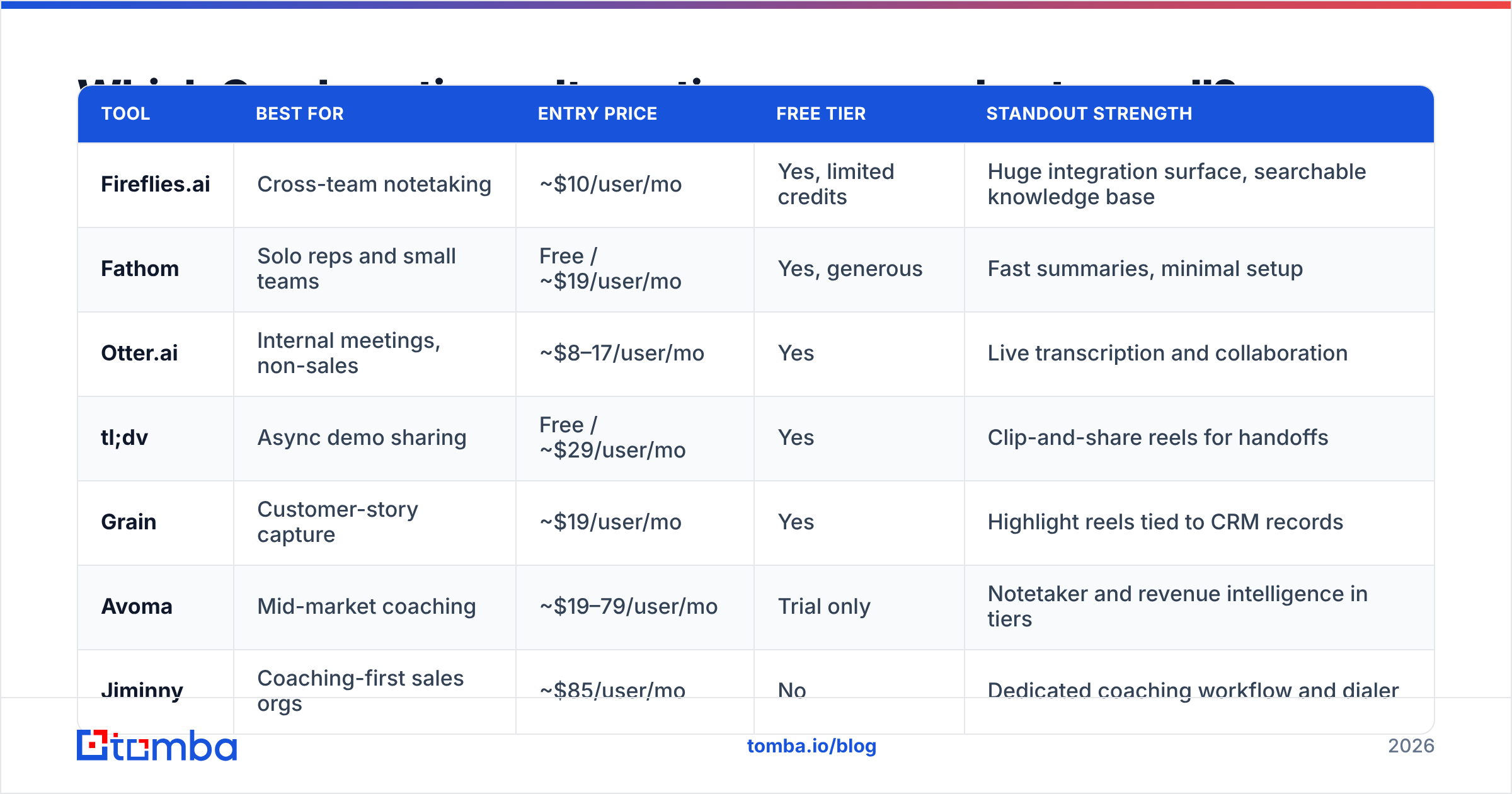
Here is the shortlist side by side. Prices are list prices published at the time of writing; annual billing and negotiated enterprise terms will move them.
| Tool | Best for | Entry price | Free tier | Standout strength |
|---|---|---|---|---|
| Fireflies.ai | Cross-team notetaking | ~$10/user/mo | Yes, limited credits | Huge integration surface, searchable knowledge base |
| Fathom | Solo reps and small teams | Free / ~$19/user/mo | Yes, generous | Fast summaries, minimal setup |
| Otter.ai | Internal meetings, non-sales | ~$8–17/user/mo | Yes | Live transcription and collaboration |
| tl;dv | Async demo sharing | Free / ~$29/user/mo | Yes | Clip-and-share reels for handoffs |
| Grain | Customer-story capture | ~$19/user/mo | Yes | Highlight reels tied to CRM records |
| Avoma | Mid-market coaching | ~$19–79/user/mo | Trial only | Notetaker and revenue intelligence in tiers |
| Jiminny | Coaching-first sales orgs | ~$85/user/mo | No | Dedicated coaching workflow and dialer |
| Clari Copilot | Forecast-linked calls | Quote (~$1,000+/user/yr) | No | Call data feeding forecast |
| Gong | Enterprise revenue intelligence | Quote (platform fee + seats) | No | Deepest deal and market intelligence |
The pattern is clear once it is laid out: there is a $0–$29 notetaker tier and a $60–$150+ revenue-intelligence tier, with Avoma straddling both through packaging. Goodmeetings competes across that seam, which is why the "right" alternative depends entirely on which side of the seam your actual need sits.
Which alternatives are best if you just need better notes?#
Fireflies.ai is the default answer for teams that want one notetaker across sales, CS, and product. It joins calls, transcribes, produces summaries, and pushes into most CRMs and messaging tools. Its real advantage is search: months of calls become a queryable archive. Check the current plan structure on fireflies.ai before budgeting, since credit limits on lower tiers move periodically.
Fathom wins on time-to-value. Install, join a call, get a summary that is usable without editing. The free tier is unusually generous, which makes it the easiest tool to trial without a procurement conversation. Coaching features are thinner than Goodmeetings — that is the trade.
Otter.ai is strongest for internal and cross-functional meetings rather than sales-specific workflows. If your primary pain is "nobody remembers what was decided," Otter is cheaper and lighter than a revenue tool. If your pain is "reps do not handle pricing objections well," it is the wrong category entirely.
tl;dv is built around sharing. Clipping a 40-second objection out of a demo and dropping it into Slack for a manager to review is a one-step action. For teams doing a lot of AE-to-CSM handoff, that clip workflow is worth more than another summary format.
Grain overlaps heavily with tl;dv, with a stronger lean toward capturing customer stories for product and marketing. Reasonable pick if voice-of-customer is a shared objective, not just a sales one.
Which alternatives are best for coaching and revenue intelligence?#
Gong is the category benchmark and priced like it. Deal boards, market intelligence, forecast contribution, and a coaching layer that managers actually adopt. There is no public pricing — expect a platform fee plus per-seat cost, and expect an annual commitment. Review current positioning at gong.io and cross-check buyer reviews on G2 before you take a quote at face value. For a 10-rep team, the number will likely be uncomfortable. For a 60-rep team with a real enablement function, it usually pencils out.
Clari Copilot (formerly Wingman) makes the most sense when you already run Clari for forecasting. Call signals feeding directly into forecast rollups is the argument; standalone, it is a harder sell against cheaper coaching tools.
Jiminny targets teams that want coaching as the primary workflow rather than a feature. Scorecards, live call support, and a built-in dialer put it closer to a sales-execution platform. At roughly $85 per user per month it is meaningfully cheaper than Gong and meaningfully pricier than a notetaker.
Avoma is the most direct like-for-like comparison to Goodmeetings. Its tiering lets you start with the notetaker and step up to conversation and revenue intelligence as the team grows, which avoids the "pay enterprise prices for a 12-rep team" problem. See current tier definitions on avoma.com — the feature boundaries between tiers matter more than the headline price.
How do the real costs compare at 20 reps?#
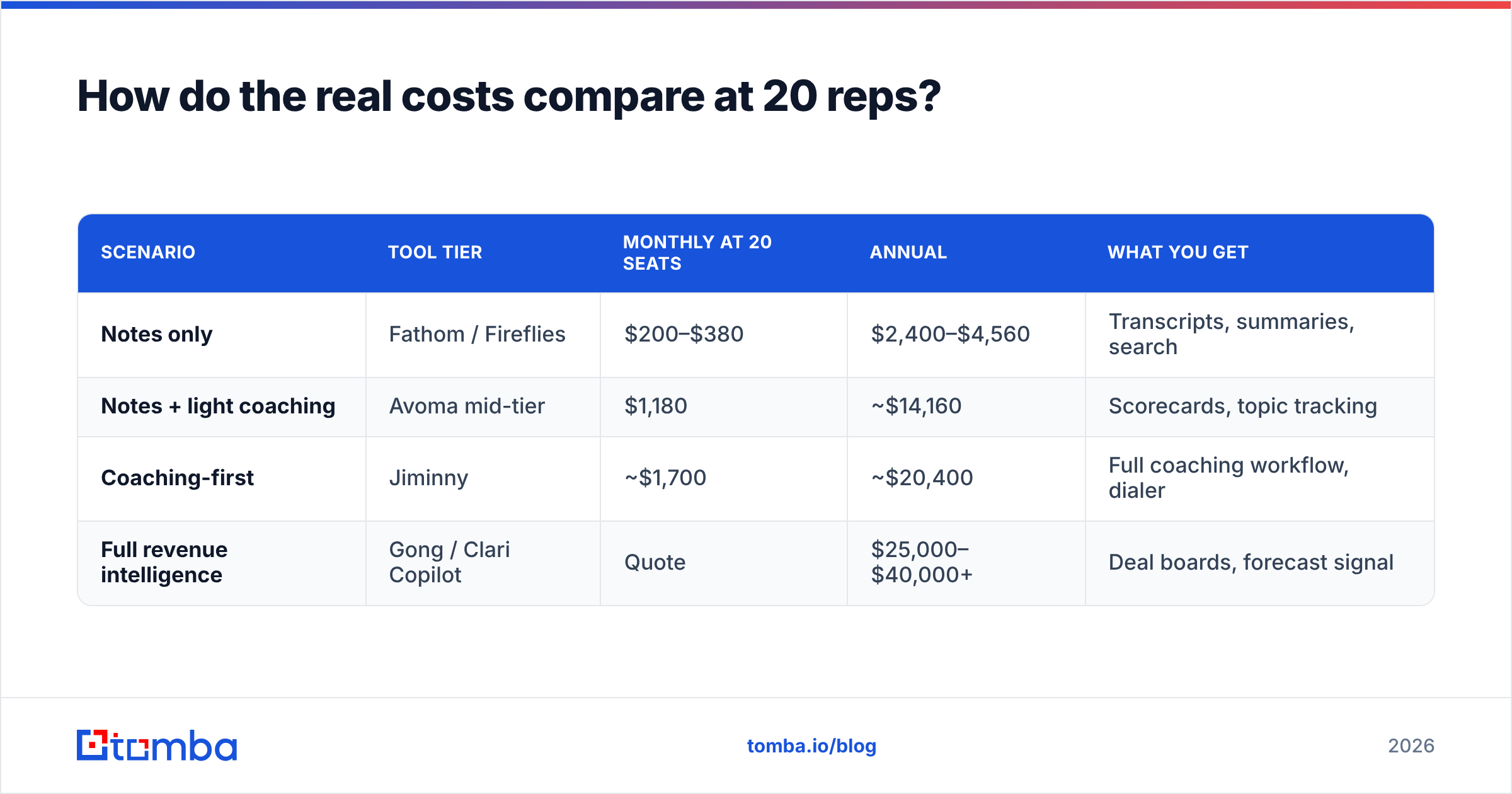
Seat price is not the number that gets approved. This is:
| Scenario | Tool tier | Monthly at 20 seats | Annual | What you get |
|---|---|---|---|---|
| Notes only | Fathom / Fireflies | $200–$380 | $2,400–$4,560 | Transcripts, summaries, search |
| Notes + light coaching | Avoma mid-tier | $1,180 | ~$14,160 | Scorecards, topic tracking |
| Coaching-first | Jiminny | ~$1,700 | ~$20,400 | Full coaching workflow, dialer |
| Full revenue intelligence | Gong / Clari Copilot | Quote | $25,000–$40,000+ | Deal boards, forecast signal |
Two things fall out of this table. First, the jump from notetaking to revenue intelligence is roughly 5–10x, so it needs a business case beyond "the summaries are nicer." Second, if your team is under about 15 reps and you have no dedicated enablement owner, the expensive tier will be underused — the tooling outruns the process.
What do none of these tools actually solve?#
Every product on this list improves what happens inside a meeting. None of them create the meeting.
That distinction gets lost during tool evaluations. A team with a 6% reply rate and 40 booked calls per quarter does not have a call-intelligence problem — it has a top-of-funnel problem. Buying Gong to fix it is an expensive way to record the same thin pipeline in higher fidelity.
The upstream inputs that actually move booked-meeting volume:
- Contact accuracy. Bounced emails do not just waste sends, they degrade sender reputation and drag down every campaign that follows. Running your list through an email verifier before launch is the cheapest lift available.
- Coverage of the buying committee. Most lost deals are single-threaded. Pulling every relevant contact at an account with a domain search is how you multithread before the deal stalls, not after.
- Enrichment for routing and personalization. Title, seniority, and company data drive both territory logic and the first line of the email. Thin records produce generic outreach and bad routing. Contact enrichment fills those gaps at the point of import.
Get those three right and your notetaker has more to work with. Get them wrong and you are paying per seat to transcribe a slow quarter.
How do you switch without losing your call history?#
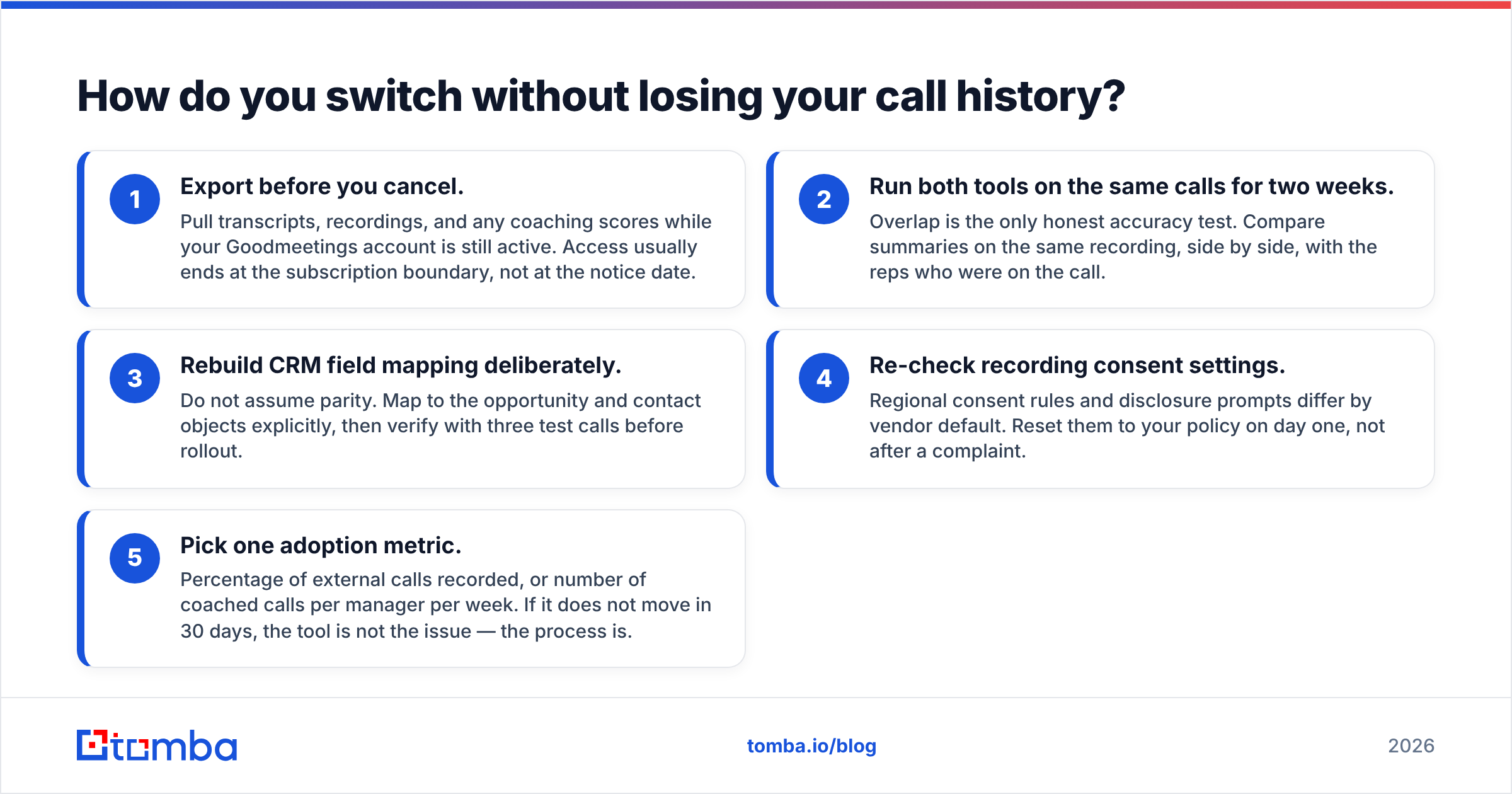
Migration is where these projects stall. Run it in this order:
- Export before you cancel. Pull transcripts, recordings, and any coaching scores while your Goodmeetings account is still active. Access usually ends at the subscription boundary, not at the notice date.
- Run both tools on the same calls for two weeks. Overlap is the only honest accuracy test. Compare summaries on the same recording, side by side, with the reps who were on the call.
- Rebuild CRM field mapping deliberately. Do not assume parity. Map to the opportunity and contact objects explicitly, then verify with three test calls before rollout.
- Re-check recording consent settings. Regional consent rules and disclosure prompts differ by vendor default. Reset them to your policy on day one, not after a complaint.
- Pick one adoption metric. Percentage of external calls recorded, or number of coached calls per manager per week. If it does not move in 30 days, the tool is not the issue — the process is.
Which Goodmeetings alternative should you pick?#
Short version: Fathom or Fireflies if you need clean notes and searchable history at near-zero cost. Avoma if you want a genuine Goodmeetings replacement with room to grow into coaching. Jiminny if coaching is the entire point. Gong or Clari Copilot only if you have the headcount, the enablement owner, and the budget to use them fully — and staying on Goodmeetings is a legitimate outcome if its coaching and CRM sync already fit your motion.
Then fix the input side. Meeting intelligence compounds only when there are enough meetings to analyze, and that starts with reaching the right people at the right accounts. Use the Tomba Email Finder to build verified contact lists by domain, name, or company, then push them straight into your sequencer or CRM. The free tier covers 25 searches per month, Starter is $49/mo, and Growth is $99/mo — see full Tomba pricing for volume tiers. Fill the calendar first; let the notetaker handle the rest.
Related guides#
Ready to find emails that actually work?
Join 150,000+ professionals who stopped guessing and started sending. Free credits on signup — no credit card required.
Get the Tomba newsletter
Practical outbound tactics and product updates — once every two weeks.
About the author