Grasshopper vs Nextiva (2026): Which Phone System Wins?
Grasshopper is a virtual phone line. Nextiva is a full business phone platform. Here is the honest breakdown of pricing, call features, CRM depth, and which one your team should actually buy in 2026.
TL;DR
- Grasshopper is a virtual phone number, not a phone system. It forwards calls from a business number to phones you already own. Flat monthly price, no per-user seat cost, almost no admin overhead.
- Nextiva is a full cloud phone platform (UCaaS). Per-user pricing, real PBX features: auto-attendant, IVR routing, call recording, analytics, CRM integrations, SMS, and contact-center add-ons.
- Price only looks comparable at 1–3 people. Grasshopper's flat $18–$80/mo beats Nextiva under about four users. Past that, per-seat pricing buys features Grasshopper simply does not sell.
- If your team dials for revenue, Grasshopper will run out of runway fast. No serious call recording, no queue routing, no dashboard your manager can coach from.
- Neither tool fixes the actual bottleneck: bad phone numbers. A dialer with a 40% wrong-number rate is a productivity problem no phone vendor can solve.
Two products get compared constantly because they show up in the same search results, but they solve different problems. Grasshopper sells you a business identity on top of your cell phone. Nextiva sells you the phone infrastructure a 40-person company runs on. Picking between them is less "which is better" and more "which category am I actually shopping in."
Here is the full breakdown.
What is Grasshopper and who is it built for?#
Grasshopper is a virtual phone service now owned by GoTo. You get a business number — local, toll-free, or vanity — plus extensions, and calls forward to the devices you already have. There is a desktop and mobile app, but there is no desk phone deployment, no SIP trunking, no PBX to configure.
What you get:
- A business number that keeps your personal cell number private
- Extensions for team members ("press 2 for sales")
- Voicemail with transcription, business texting, simultaneous call handling
- Custom greetings and basic business-hours routing
- Setup measured in minutes, not a deployment project
What you do not get: call queues with skill-based routing, real-time supervisor dashboards, call recording as a standard feature, native CRM integrations, or contact-center reporting. Grasshopper is deliberately narrow. That narrowness is the product.
The typical Grasshopper buyer is a solo consultant, a two-person agency, a real-estate agent, a trades business, or a founder who wants a professional front door without an IT project. If that describes you, most of this article's "Nextiva is more capable" arguments are irrelevant to you — you would be paying for capability you never touch.
What is Nextiva and how is it different?#
Nextiva is a unified communications platform. Voice is one channel among several: it bundles VoIP calling, video meetings, team chat, business SMS, and — on higher tiers — social messaging, review management, and contact-center functionality. It competes with RingCentral, 8x8, Dialpad, and Zoom Phone, not with Grasshopper.
Nextiva assumes you have a company, not a side hustle. That means:
- Auto-attendant and multi-level IVR — route callers through menus and departments, not just extensions.
- Call queues and routing rules — round-robin, longest-idle, skills-based, with hold music and overflow.
- Call recording and voice analytics — a manager can pull a rep's call from Tuesday and coach on it.
- CRM integrations — click-to-dial and call logging into Salesforce, HubSpot, Zendesk, and similar tools, so activity lands in the CRM without manual entry.
- Admin controls and reporting — provisioning, permissions, and dashboards for call volume, answer rate, and abandonment.
The tradeoff is complexity and cost. You configure things. You pay per user, every month, for every user — including the ones who make four calls a week.
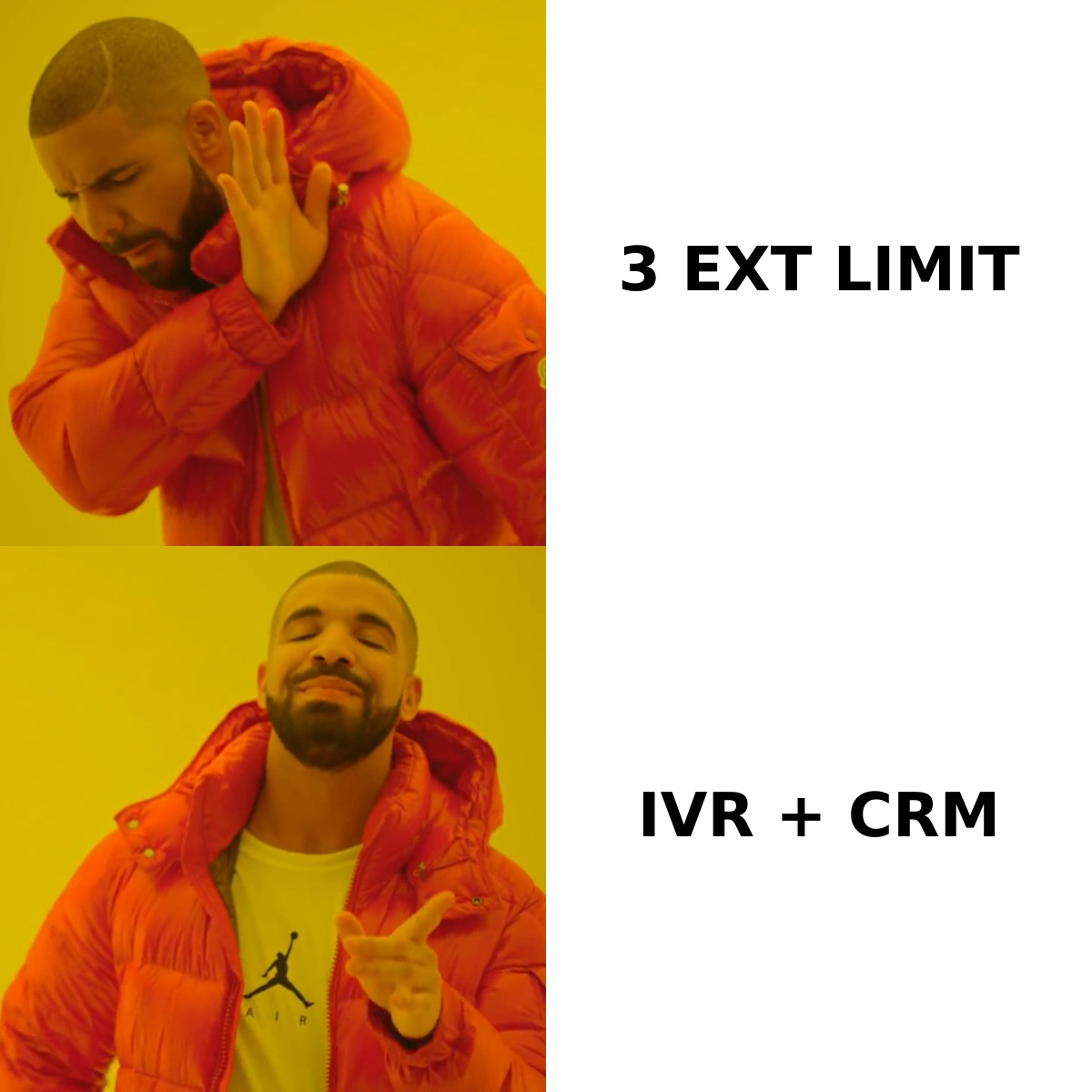
Grasshopper vs Nextiva: how do the features compare?#
This is the table most buyers actually need. Assume "no" means the vendor does not sell it as a standard capability, not that a workaround is impossible.
| Capability | Grasshopper | Nextiva |
|---|---|---|
| Product category | Virtual phone number / call forwarding | Full cloud phone system (UCaaS) |
| Pricing model | Flat monthly, unlimited users | Per user, per month |
| Entry price (annual billing) | ~$18/mo total | ~$20–$30/user/mo |
| Included users | Unlimited on all plans | Each seat billed separately |
| Numbers included | 1–4 depending on plan | 1 per user, plus add-ons |
| Auto-attendant / IVR | Basic extension menu only | Multi-level IVR |
| Call queues & routing rules | No | Yes |
| Call recording | Not a core feature | Yes, on higher tiers |
| Analytics dashboard | Minimal | Full call and agent reporting |
| CRM integrations | Very limited | Salesforce, HubSpot, Zendesk, more |
| Video meetings | No | Yes |
| Desk phone support | No | Yes (provisioned handsets) |
| Contact center features | No | Available on top tiers |
| Setup time | Minutes | Days to weeks |
| Best fit | Solo operators, 1–3 people | 5+ users, sales and support teams |
The pattern is clear. Every row where Nextiva wins is a row that only matters once you have a team, a process, and someone accountable for call outcomes. Every row where Grasshopper wins is about cost and speed at very small scale.
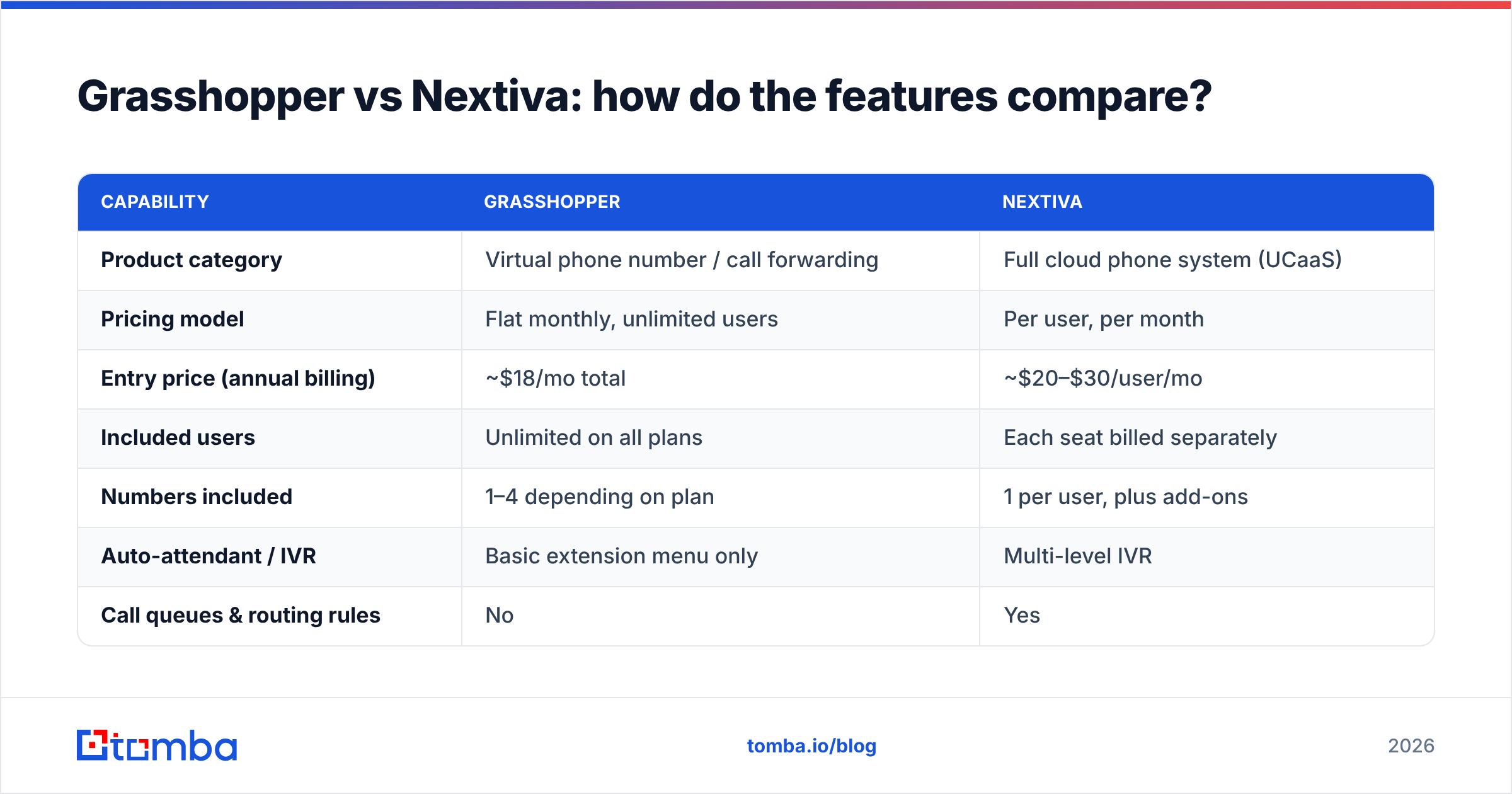
What do Grasshopper and Nextiva actually cost in 2026?#
Published list prices move constantly and both vendors discount annual billing heavily, so treat these as directional and confirm on the vendor pricing pages before you sign anything.
| Plan tier | Grasshopper | Nextiva |
|---|---|---|
| Entry | True Solo — ~$18/mo, 1 number, 1 extension | Digital — ~$20/user/mo (no voice on this tier) |
| Mid | Solo Plus — ~$32/mo, 1 number, 3 extensions | Core — ~$30/user/mo, voice + video + SMS |
| Upper | Small Business — ~$80/mo, 4 numbers, unlimited extensions | Engage — ~$40/user/mo, adds IVR depth and channels |
| Top | — | Power Suite — ~$60/user/mo, contact-center grade |
| Trial | Free trial available | Free trial available |
| Monthly vs annual | Monthly billing costs noticeably more | Monthly billing costs noticeably more |
Run the arithmetic for your headcount:
- 2 users: Grasshopper Solo Plus ≈ $32/mo total. Nextiva Core ≈ $60/mo. Grasshopper wins on price.
- 5 users: Grasshopper Small Business ≈ $80/mo total. Nextiva Core ≈ $150/mo. Grasshopper still cheaper, but you now have zero recording and zero reporting.
- 15 users: Grasshopper ≈ $80/mo but functionally unusable as a team phone system. Nextiva ≈ $450/mo and does the job.
The crossover point is not a price — it is a process. The moment you need to answer "why did we miss 30 calls last Thursday?" or "play me the call where the deal died," Grasshopper stops being a bargain and starts being a blind spot.
Which one should a sales team pick?#
Nextiva, and it is not close — with one important caveat about what a phone system can and cannot fix.
A team that dials for revenue needs four things a virtual number cannot provide:
- Recording and coaching. Call reviews are how reps improve. Without recordings, sales management becomes anecdote management.
- Routing that reflects your org. Inbound leads should hit the right rep in the right territory, not the first person who happens to pick up.
- CRM activity logging. If dials do not write themselves into the CRM, your pipeline data is a fiction reps maintain by hand at 6 pm on Friday.
- Reporting that ties calls to outcomes. Connect rate, talk time, and answer rate are leading indicators of your response rate and, eventually, your pipeline.
Grasshopper gives you none of these. That is not a knock on the product — it never claimed to. But every "we outgrew Grasshopper" story on G2 reads the same way: it worked great until we hired a third rep.
If you are a solo founder still doing founder-led sales, invert the advice. Nextiva at one seat is overkill you will spend a Saturday configuring. Get the number, forward it to your cell, and go sell.
What neither Grasshopper nor Nextiva fixes?#
Your phone data. This is the part buyers systematically underweight.
Sales teams obsess over dialer features and then feed the dialer a list where a third of the mobile numbers are stale, a third belong to a company switchboard, and the rest are gatekeeper lines. Nextiva's routing engine cannot rescue a number that stopped working in 2023. Grasshopper's cheap flat rate does not help either — you are just paying less for the same wasted dials.
The math is brutal and easy to run. A rep making 60 dials a day at a 45% valid-number rate spends most of the day listening to disconnect tones. Improve the list to 85% valid and the same rep gets roughly twice the conversations without touching the phone system at all. No plan upgrade at either vendor buys that.

Fix the input layer first:
- Source direct dials, not switchboards. A phone finder that returns direct numbers tied to a specific person beats a scraped company main line every time.
- Validate before you load. Run the list through a phone validator to strip disconnected lines, catch bad formatting, and confirm line type — mobile numbers connect at very different rates than landlines.
- Enrich the record, not just the number. Title, company size, and tech stack make the opener land. Data enrichment turns a phone list into a call plan.
- Pair phone with email. The highest-converting sequences use both. Reps who only dial are one channel away from a reply they could have earned by email.
Cheap phone systems are a rounding error next to rep hours. Ten hours a month of wasted dialing costs more than the difference between every plan discussed in this article.
How do you choose between Grasshopper and Nextiva?#
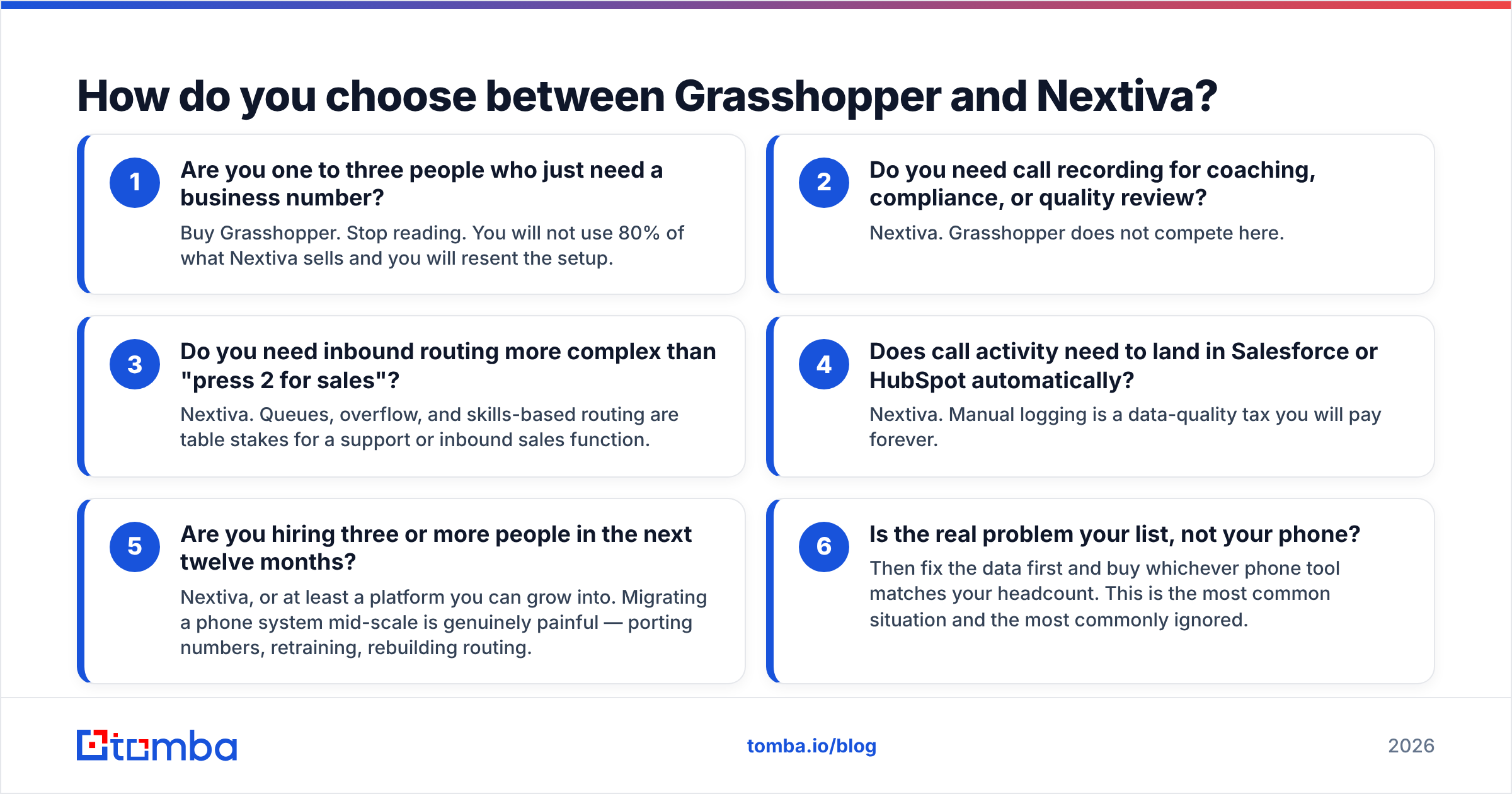
Work through these in order. The first "yes" that stops you is your answer.
- Are you one to three people who just need a business number? Buy Grasshopper. Stop reading. You will not use 80% of what Nextiva sells and you will resent the setup.
- Do you need call recording for coaching, compliance, or quality review? Nextiva. Grasshopper does not compete here.
- Do you need inbound routing more complex than "press 2 for sales"? Nextiva. Queues, overflow, and skills-based routing are table stakes for a support or inbound sales function.
- Does call activity need to land in Salesforce or HubSpot automatically? Nextiva. Manual logging is a data-quality tax you will pay forever.
- Are you hiring three or more people in the next twelve months? Nextiva, or at least a platform you can grow into. Migrating a phone system mid-scale is genuinely painful — porting numbers, retraining, rebuilding routing.
- Is the real problem your list, not your phone? Then fix the data first and buy whichever phone tool matches your headcount. This is the most common situation and the most commonly ignored.
A note on switching cost, because it is the hidden variable. Number porting between providers typically takes days to weeks and both vendors will handle it, but the ancillary work — updating your website, Google Business Profile, email signatures, and every printed asset — is what actually burns a week. Pick the platform that fits where you will be in eighteen months, not the one that fits today by a $30 margin.
What are the honest weaknesses of each?#
Grasshopper's weaknesses: extension caps on lower tiers, no meaningful analytics, no native CRM connectivity, and a feature set that has evolved slowly under GoTo ownership. Reviewers also note that at the $80/mo tier you are paying real money for something a full platform does better.
Nextiva's weaknesses: annual contracts are the norm and monthly billing is priced to discourage you; the tier structure means the feature you want often sits one plan above the one you budgeted for; and the platform breadth means onboarding a small team takes longer than anyone estimates. Voice does not appear on the entry tier at all, which surprises buyers comparing headline prices.
Neither product is bad. They are calibrated for different companies, and most of the frustration in reviews comes from people who bought the wrong category rather than the wrong vendor.
Ready to make your dials actually connect?#
Pick your phone system on headcount and process — Grasshopper under three people, Nextiva once you have a team to manage. Then spend the next hour on the thing that moves the number: the list you are dialing.
Tomba's Email Finder gives you verified business contacts to pair with your calls, so every dial is backed by an email that can land the follow-up, and every prospect record is a real person at a real company. Start on the free tier at 25 searches a month, or check Tomba pricing — plans run $49/mo (Starter), $99/mo (Growth), and $249/mo (Pro) with an Enterprise option when volume gets serious. Build the list first. The phone system is the easy part.
Related guides#
Ready to find emails that actually work?
Join 150,000+ professionals who stopped guessing and started sending. Free credits on signup — no credit card required.
Get the Tomba newsletter
Practical outbound tactics and product updates — once every two weeks.
About the author