Grasshopper vs RingCentral (2026): Which Phone System Wins
Grasshopper is a virtual number bolted onto phones you already own. RingCentral is a full communications platform with per-seat pricing. Here is the honest breakdown of cost, features, and which one your sales team should actually buy.
TL;DR
- Grasshopper is a virtual phone number, not a phone system. It forwards calls to devices you already own. There is no desk phone, no softphone-first architecture, no analytics layer worth the name.
- RingCentral is a full UCaaS platform — voice, SMS, video, team chat, 300+ integrations, contact-center upgrade path, and a 99.999% uptime SLA on paper.
- Price flips depending on headcount. Grasshopper bills per plan (flat), RingCentral bills per user. Under roughly 4 users Grasshopper is cheaper; past 5–6 users the flat plans stop making sense.
- Neither tool solves the harder problem: having correct numbers and decision-maker contacts to dial in the first place. That is a data problem, not a telephony problem.
- Verdict: solo consultants and 1–3 person shops → Grasshopper. Any team running outbound, using a CRM, or planning to grow past five seats → RingCentral.
What are Grasshopper and RingCentral, exactly?#
They get compared constantly because both sell you a business phone number. That is where the similarity ends.
Grasshopper is a virtual phone service, now part of the GoTo family. You buy a business number (local, toll-free, or vanity), set up extensions, and Grasshopper routes inbound calls to the mobile phones and landlines your team already carries. There is a mobile and desktop app, voicemail transcription, business texting, and a simple auto-attendant. The mental model is a receptionist that lives in the cloud and forwards calls to your cell.
RingCentral is a unified communications platform. Its RingEX product replaces your phone system outright: cloud PBX, per-user extensions, hardware desk phones or softphones, HD video meetings, team messaging, SMS/MMS, call queues, IVR trees, call recording, real-time analytics, and deep CRM integrations. There is an upgrade path into RingCX for actual contact-center work.
The analogy that fits: Grasshopper is a mail-forwarding address for your phone calls. RingCentral is the whole office building with a switchboard, meeting rooms, and a facilities team.
That distinction drives every other difference — pricing model, feature depth, and who each one is genuinely right for.
How do Grasshopper and RingCentral compare feature by feature?#
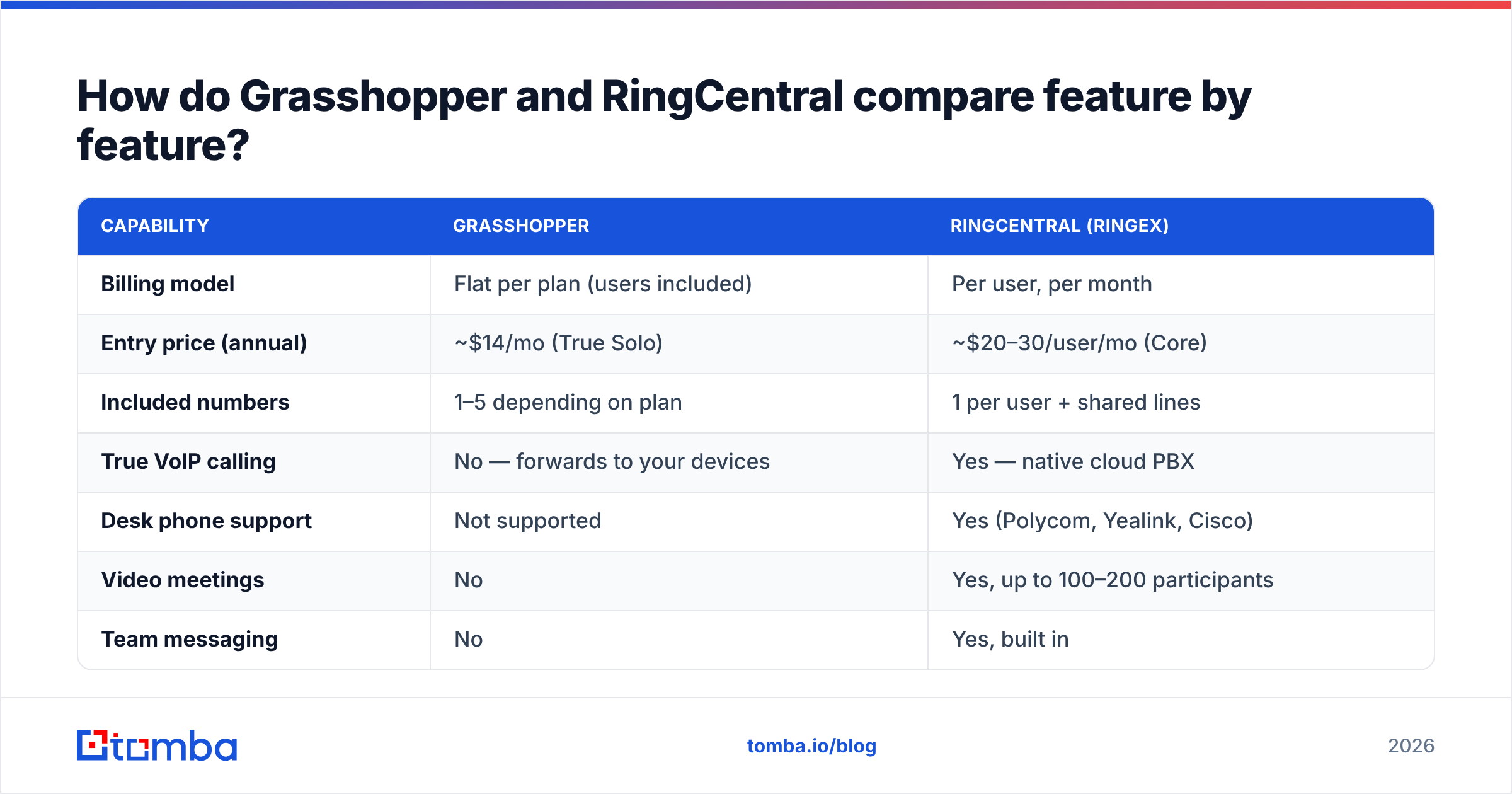
Here is the head-to-head on the attributes that actually change how a sales or support team operates day to day.
| Capability | Grasshopper | RingCentral (RingEX) |
|---|---|---|
| Billing model | Flat per plan (users included) | Per user, per month |
| Entry price (annual) | ~$14/mo (True Solo) | ~$20–30/user/mo (Core) |
| Included numbers | 1–5 depending on plan | 1 per user + shared lines |
| True VoIP calling | No — forwards to your devices | Yes — native cloud PBX |
| Desk phone support | Not supported | Yes (Polycom, Yealink, Cisco) |
| Video meetings | No | Yes, up to 100–200 participants |
| Team messaging | No | Yes, built in |
| Call queues / advanced routing | Basic auto-attendant only | Full queues, skills routing, IVR |
| Call recording | No | On-demand and automatic (paid tiers) |
| CRM integrations | Effectively none | Salesforce, HubSpot, Zoho, 300+ apps |
| Analytics / reporting | Minimal call logs | Live dashboards, QoS, historical reports |
| Uptime SLA | Not published as a five-nines SLA | 99.999% on qualifying plans |
| International calling | Limited, US/Canada focus | 100+ countries, global numbers |
| Best for | Solo operators, 1–3 person teams | 5+ seats, outbound teams, support |
The pattern is obvious once you see it laid out: Grasshopper wins on simplicity and floor price, RingCentral wins on everything that matters after your third hire.
One caveat worth flagging. Grasshopper's lack of true VoIP is sometimes framed as a weakness, and for a growing team it is. But for a solo consultant on shaky home internet, routing calls over the cellular network is more reliable than a softphone fighting a bad Wi-Fi uplink. Feature-poor is not always the same as worse.
What does each one actually cost in 2026?#
Pricing pages move. Treat these as the shape of the market rather than a quote, and confirm on the vendors' own pages before you sign.
Grasshopper charges per plan, with users and extensions bundled:
- True Solo — around $14/mo annually. One number, one extension. Fine for a freelancer who just wants to stop giving out a personal cell.
- Solo Plus — around $28/mo. One number, three extensions. The most common starting point for a two-person operation.
- Partner — around $46/mo. Three numbers, six extensions.
- Small Business — around $80/mo. Five numbers, unlimited extensions. This is the ceiling, and it is where the model starts to strain.
RingCentral charges per user, per month, with annual commitments discounting roughly 30% against monthly:
- Core — roughly $20–30/user/mo. Unlimited domestic calling, SMS, basic IVR, video meetings.
- Advanced — roughly $25–35/user/mo. Adds automatic call recording, advanced call monitoring, CRM integrations, and multi-site support.
- Ultra — roughly $35–45/user/mo. Adds unlimited storage, device analytics, and higher meeting capacity.
- RingCX / Contact Center — quoted separately, for teams running queues, workforce management, and omnichannel support.
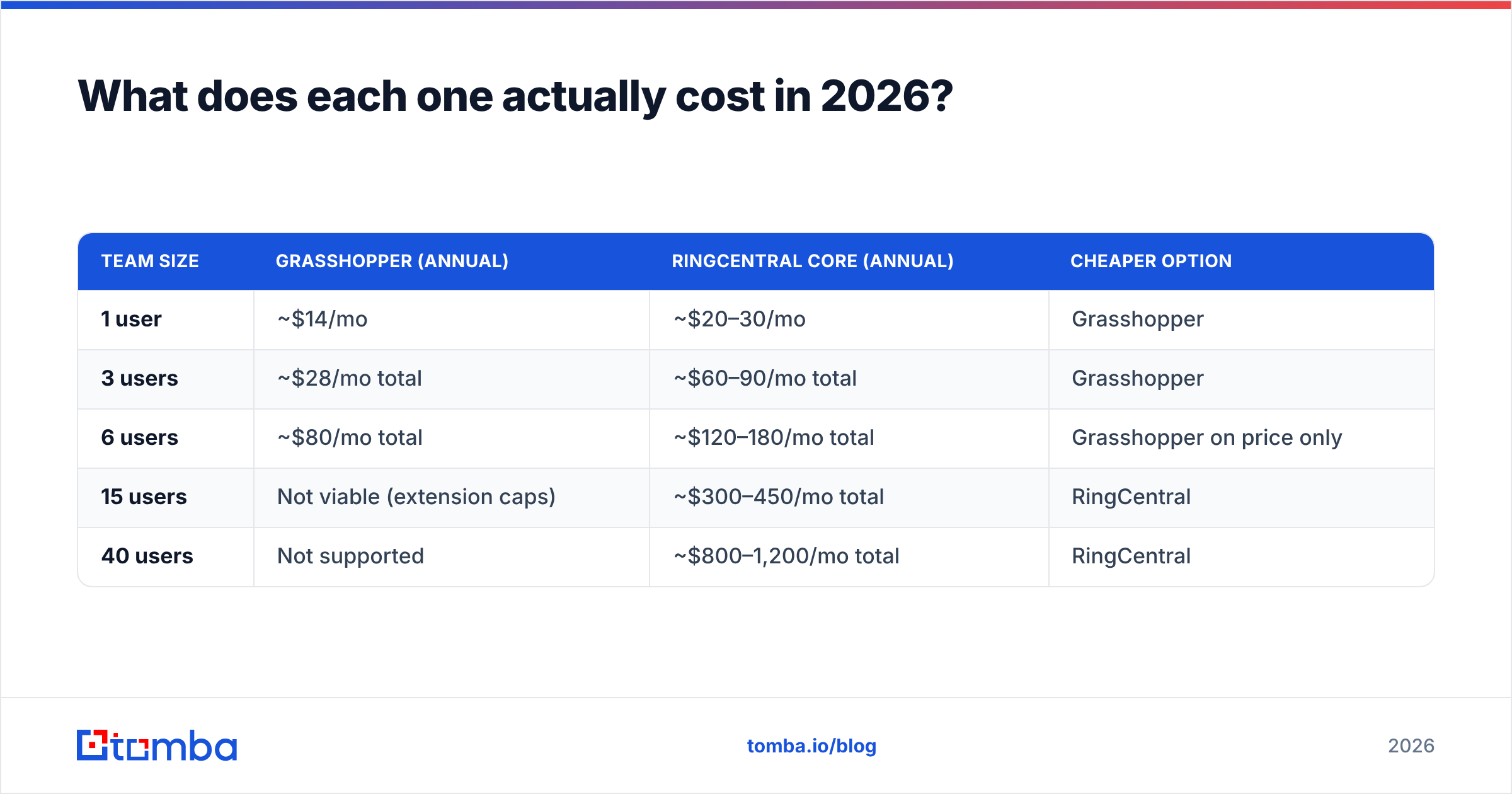
Run the math for your headcount, because the crossover is sharper than people expect:
| Team size | Grasshopper (annual) | RingCentral Core (annual) | Cheaper option |
|---|---|---|---|
| 1 user | ~$14/mo | ~$20–30/mo | Grasshopper |
| 3 users | ~$28/mo total | ~$60–90/mo total | Grasshopper |
| 6 users | ~$80/mo total | ~$120–180/mo total | Grasshopper on price only |
| 15 users | Not viable (extension caps) | ~$300–450/mo total | RingCentral |
| 40 users | Not supported | ~$800–1,200/mo total | RingCentral |
Grasshopper stays nominally cheaper for longer than the sticker prices suggest — but "cheaper" and "adequate" are different questions. At six users you are paying $80/mo for a service with no call recording, no queue reporting, and no CRM sync. If those absences cost you one lost deal a quarter, the $100/mo delta was never the real number.
Which one handles cold calling better?#
RingCentral, and it is not close.
Outbound calling has requirements that a forwarding service structurally cannot meet:
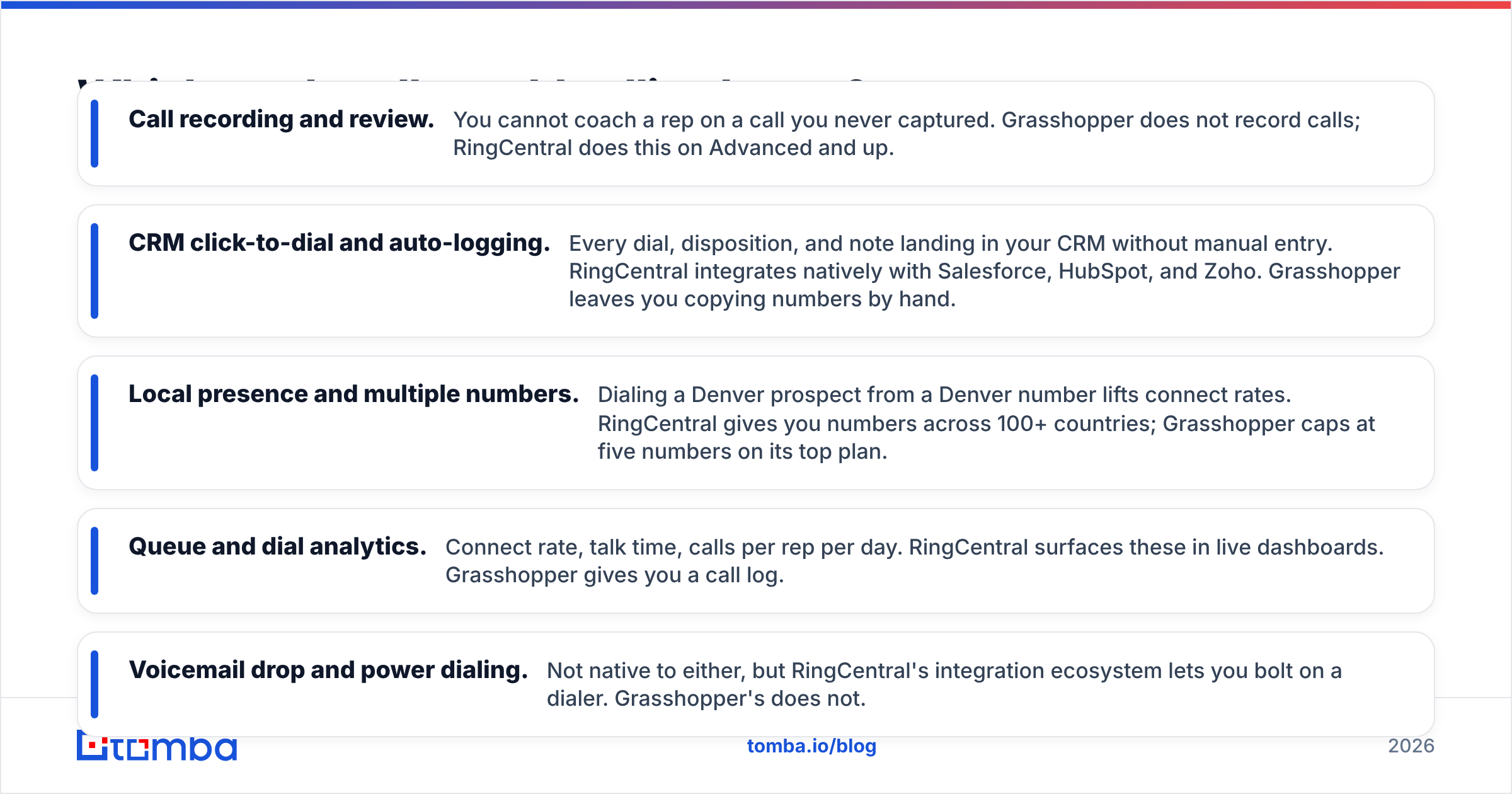
- Call recording and review. You cannot coach a rep on a call you never captured. Grasshopper does not record calls; RingCentral does this on Advanced and up.
- CRM click-to-dial and auto-logging. Every dial, disposition, and note landing in your CRM without manual entry. RingCentral integrates natively with Salesforce, HubSpot, and Zoho. Grasshopper leaves you copying numbers by hand.
- Local presence and multiple numbers. Dialing a Denver prospect from a Denver number lifts connect rates. RingCentral gives you numbers across 100+ countries; Grasshopper caps at five numbers on its top plan.
- Queue and dial analytics. Connect rate, talk time, calls per rep per day. RingCentral surfaces these in live dashboards. Grasshopper gives you a call log.
- Voicemail drop and power dialing. Not native to either, but RingCentral's integration ecosystem lets you bolt on a dialer. Grasshopper's does not.
If your team makes more than about 20 outbound calls a day, Grasshopper becomes an active drag. You will spend the savings in wasted rep hours within the first month.
Where Grasshopper genuinely holds its own is inbound. A consultant, agency owner, or local services business that needs a professional number, a decent greeting, and calls that reach a cell phone anywhere is well served. Adding RingCentral's full stack for that job is buying a forklift to move a chair.
Where do both tools leave a gap?#
Here is the uncomfortable part. Neither Grasshopper nor RingCentral gives you anyone to call.
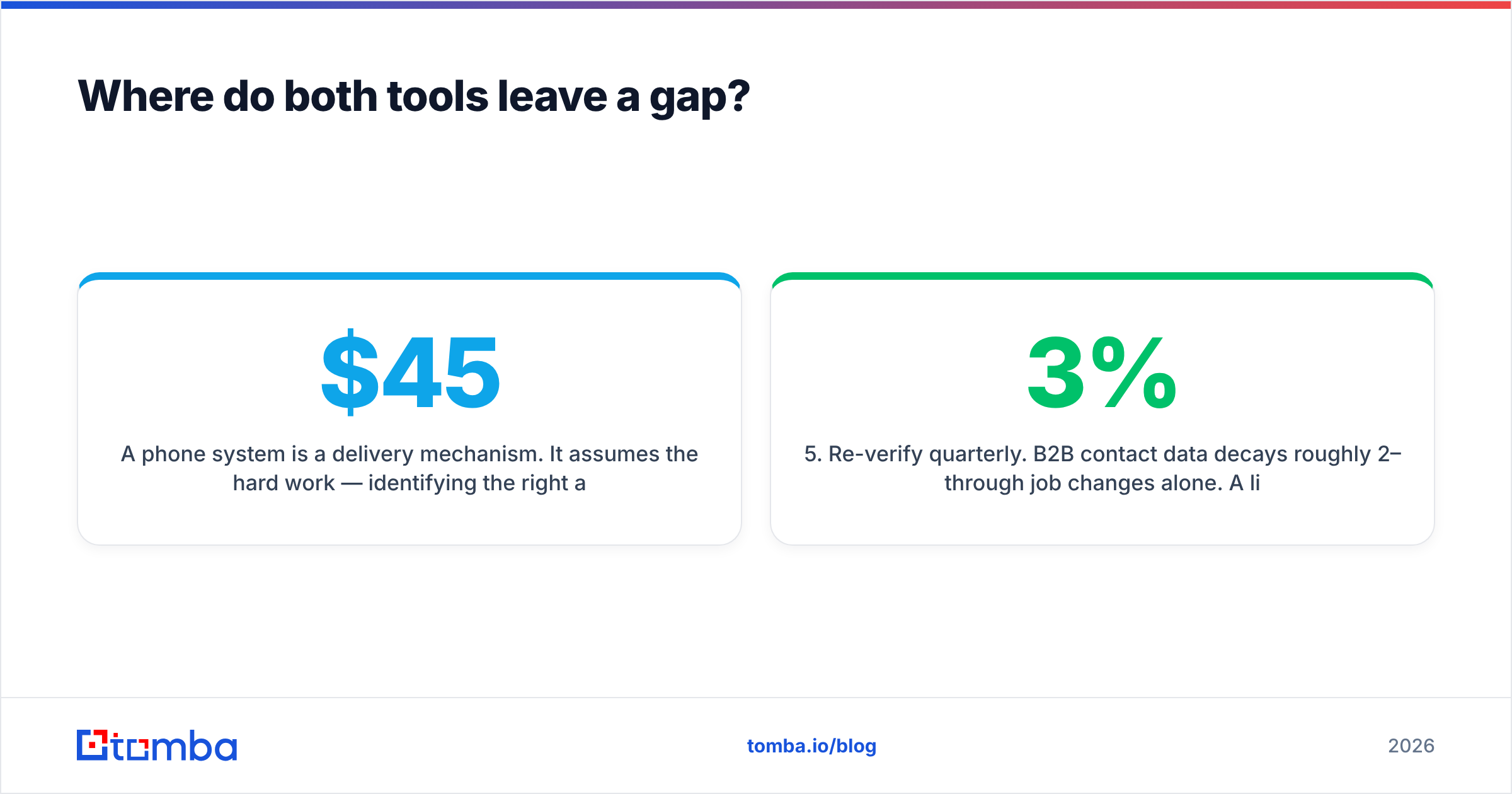
A phone system is a delivery mechanism. It assumes the hard work — identifying the right accounts, finding the right person inside them, getting a number and an email that actually connect — is already done. In practice that assumption is where most outbound programs quietly fail. Teams buy a $45/user platform, load it with a scraped list where 30% of the numbers are disconnected and half the titles are two years stale, and then blame the dialer when connect rates crater.
The fix is boring and it happens upstream of telephony:
- Verify the number before the dial. A phone validator filters disconnected lines, landlines misfiled as mobiles, and invalid formats before they ever reach a rep's queue.
- Source direct dials, not switchboards. A phone finder that returns direct B2B numbers is worth more than any routing feature, because a gatekeeper transfer is a lost minute either way.
- Pair every call with an email. Multichannel sequences beat call-only ones consistently. An email finder that returns verified addresses for the same contacts lets you follow a voicemail with a reference-able message the same hour.
- Enrich before you segment. Data enrichment — headcount, tech stack, funding, role — is what turns a flat list into a prioritized one. Reps calling the top decile of a scored list post very different numbers than reps calling alphabetically.
- Re-verify quarterly. B2B contact data decays roughly 2–3% per month through job changes alone. A list built 18 months ago is mostly fiction now.
Do that work and a mid-tier RingCentral plan outperforms a top-tier one fed with garbage. Skip it and no phone system saves you. This is also why comparing Grasshopper and RingCentral in isolation is a slightly wrong question — the phone system is maybe the third most important line item in an outbound stack, behind data quality and rep coaching.
What do real users say about each?#
Both hold respectable ratings on G2, and the review patterns are consistent enough to be useful.
Grasshopper — recurring praise: setup takes minutes, no hardware, no IT involvement, the flat price is predictable, and support is reachable. Solo users repeatedly describe it as the thing they stopped thinking about.
Grasshopper — recurring complaints: app reliability on Android, no call recording, thin reporting, and the growth wall. The most common negative review is some version of "great until we hired our fourth person."
RingCentral — recurring praise: feature depth, call quality on stable connections, the breadth of integrations, and admin controls that scale to hundreds of seats without falling apart.
RingCentral — recurring complaints: contract rigidity, a support experience that varies by tier, an admin console with a real learning curve, and add-on costs (extra numbers, international minutes, contact-center modules) that push the effective per-seat price above the advertised one. Budget 15–20% above list.
So which should you choose?#
Match the tool to the situation rather than to the feature count.
Choose Grasshopper if: you are a solo operator, consultant, or 2–3 person team; your call volume is mostly inbound; you want a business number without changing how anyone works; you value a flat, predictable bill; and you have no near-term plan to run a structured outbound motion.
Choose RingCentral if: you have five or more people on the phone; you run outbound and need recording, coaching, and dial analytics; you live inside Salesforce or HubSpot and need calls logged automatically; you need video and team messaging in the same contract; or you expect headcount to double in 18 months and want to avoid a migration.
Choose neither if your actual bottleneck is list quality. Fix the data first — the phone system decision gets much easier once your reps are dialing people who exist, hold the title you think they hold, and answer.
Whichever platform you land on, feed it properly. Tomba's Email Finder returns verified professional email addresses by domain, name, or company, so every number in your dialer has a matching email for the follow-up that actually converts. Start on the free tier at 25 searches a month, or check Tomba pricing — Starter runs $49/mo — when you are ready to build lists at real volume. Your phone system routes the call. Your data decides whether it was worth making.
Related guides#
Ready to find emails that actually work?
Join 150,000+ professionals who stopped guessing and started sending. Free credits on signup — no credit card required.
Get the Tomba newsletter
Practical outbound tactics and product updates — once every two weeks.
About the author