Grata vs Salesbot in 2026: Which Fills Your Pipeline Faster?
Grata finds the companies. Salesbot talks to the people. Neither hands you a verified email address. Here is an honest breakdown of what each tool does, what it costs, and which one belongs in your stack.
TL;DR
- Grata and Salesbot are not competitors. Grata is a private-company search engine built for deal sourcing and account discovery. Salesbot is the name used for AI conversational agents that qualify and reply to leads inside a CRM or chat widget.
- Pick Grata if your bottleneck is finding the right companies — thesis-driven M&A sourcing, ABM list building, or mapping a fragmented niche where standard firmographic filters fail.
- Pick a Salesbot if your bottleneck is response speed and volume — inbound leads sitting unanswered for hours, or reps burning time on qualification questions a script could handle.
- Neither gives you reliable contact data. Grata returns companies, not verified inboxes. Salesbot only works on people who already raised their hand. You still need an email finder in the middle.
- Budget reality: Grata is quote-only and lands in enterprise-contract territory. Salesbot-class features are usually bundled into a per-seat CRM plan for a fraction of that.
What is Grata?#
Grata is a private-company intelligence platform. Instead of filtering a static database by SIC code and headcount, you describe what you are looking for in plain language — "companies doing HVAC preventive maintenance for commercial buildings in the Southeast" — and it searches company websites, filings, news, and job posts to surface matches, including the small private businesses that never appear in a standard B2B database.
That machine-learning-driven search over unstructured web content is the whole product thesis. It was built for private equity and corporate development teams doing thesis-driven mergers and acquisitions sourcing, where the hard part is not contacting a target but discovering that a $12M revenue family-owned business exists at all. You can see the current feature set on the official Grata site.
Where Grata earns its price:
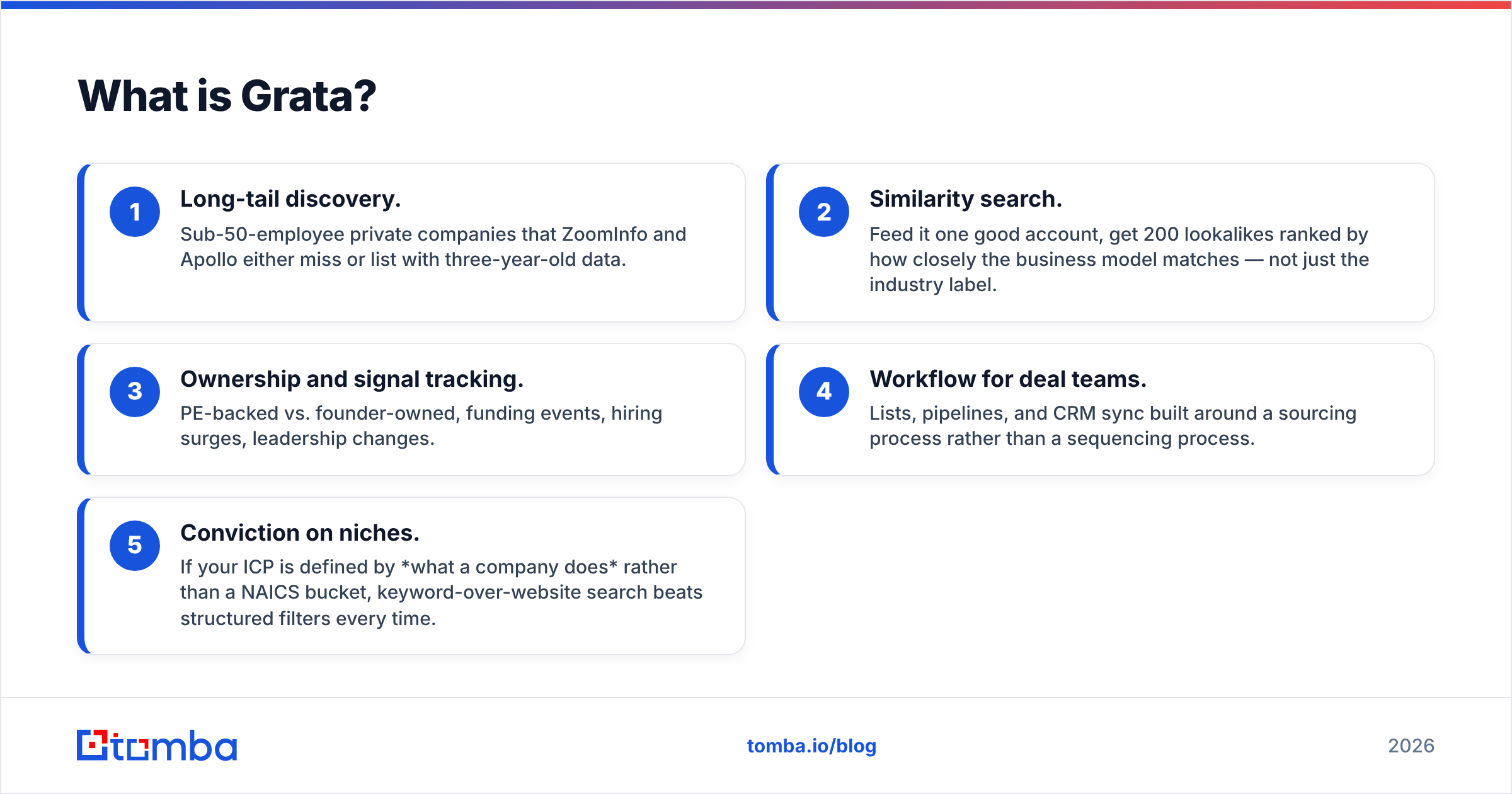
- Long-tail discovery. Sub-50-employee private companies that ZoomInfo and Apollo either miss or list with three-year-old data.
- Similarity search. Feed it one good account, get 200 lookalikes ranked by how closely the business model matches — not just the industry label.
- Ownership and signal tracking. PE-backed vs. founder-owned, funding events, hiring surges, leadership changes.
- Workflow for deal teams. Lists, pipelines, and CRM sync built around a sourcing process rather than a sequencing process.
- Conviction on niches. If your ICP is defined by what a company does rather than a NAICS bucket, keyword-over-website search beats structured filters every time.
The tradeoff: it is a discovery engine, not an outreach engine. It tells you who to talk to. Getting a working email address for the right person at that company is a separate job.
What is Salesbot?#
"Salesbot" is less a single product than a category label. The most widely deployed version is the Salesbot built into Kommo — a no-code conversational agent that lives inside the CRM and handles messaging on WhatsApp, Instagram, Facebook, live chat, and email. Several other vendors ship a feature under the same name, so always confirm which one a colleague means before you compare notes.
Functionally, a Salesbot does four things:
- Instant first response. A lead fills a form or DMs you at 11pm; the bot replies in seconds instead of the next morning.
- Qualification by script. Budget, timeline, company size, use case — asked conversationally, written back to CRM fields.
- Routing and task creation. Qualified leads get assigned to the right rep with context attached; unqualified ones get a nurture tag.
- Follow-up automation. Nudges on no-reply, meeting reminders, re-engagement after a stall.
Modern versions layer an LLM on top of the branching logic so the bot handles unscripted phrasing instead of dead-ending on "wat r ur prices". That is a real improvement over the 2019 generation of chatbots, and it is why bot-assisted qualification keeps showing up in buyer reviews on sites like G2 as a speed-to-lead fix.
The tradeoff mirrors Grata's, inverted: a Salesbot is excellent at working demand that already exists and useless at creating it. It cannot tell you which 400 companies to approach next quarter.
Grata vs Salesbot: how do they actually compare?#
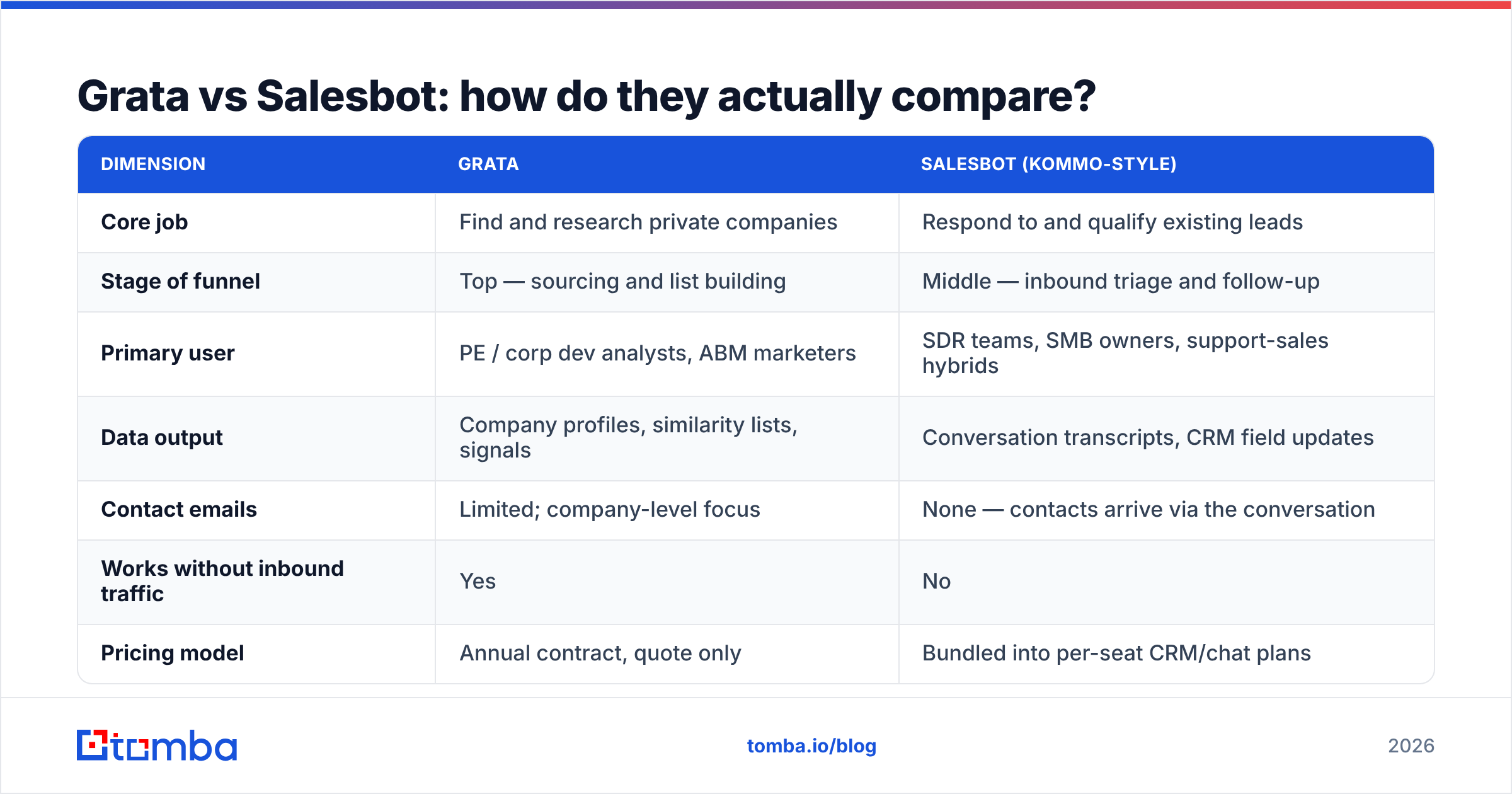
| Dimension | Grata | Salesbot (Kommo-style) |
|---|---|---|
| Core job | Find and research private companies | Respond to and qualify existing leads |
| Stage of funnel | Top — sourcing and list building | Middle — inbound triage and follow-up |
| Primary user | PE / corp dev analysts, ABM marketers | SDR teams, SMB owners, support-sales hybrids |
| Data output | Company profiles, similarity lists, signals | Conversation transcripts, CRM field updates |
| Contact emails | Limited; company-level focus | None — contacts arrive via the conversation |
| Works without inbound traffic | Yes | No |
| Pricing model | Annual contract, quote only | Bundled into per-seat CRM/chat plans |
| Typical spend | Five figures per year | Tens of dollars per user per month |
| Setup effort | Low — it is a search UI | Medium — you script and test the flows |
| Best-fit team size | 5+ analysts or a funded ABM program | 1–50 reps handling inbound volume |
The table makes the honest answer obvious: comparing them head-to-head is like comparing a metal detector to a cash register. One finds the opportunity, one processes it. The real question is which gap is costing you more money right now.
Which one fits your go-to-market motion?#
Run your situation against these five patterns before you spend anything.
- You are a search fund or PE associate mapping a fragmented industry. Grata, clearly. No conversational tool solves "I need every independent pest control company in Texas doing $3–15M." This is Grata's home turf and the price is defensible against a single sourced deal.
- You get 200+ inbound leads a month and reply in hours, not minutes. Salesbot. Speed-to-lead is one of the few sales metrics with a brutal, well-documented decay curve, and an always-on bot fixes it for the cost of a couple of seats.
- You do outbound to a defined mid-market ICP. Neither is your first purchase. You need a source of company data plus a way to reach humans there — a domain search over your target list will produce more usable pipeline per dollar than either platform.
- You run ABM into 300 named accounts. Grata for expansion of the account list and lookalike discovery, then contact-level enrichment on top. Salesbot only helps once those accounts start replying.
- You are a solo founder doing your first 100 cold emails. Skip both. Get accurate addresses, write something specific, and send. Tooling at this stage is procrastination with a purchase order.
Most teams that ask "Grata or Salesbot?" are really asking "where is my funnel actually leaking?" Answer that first, and the tool choice stops being a debate.
What does each one cost in 2026?#
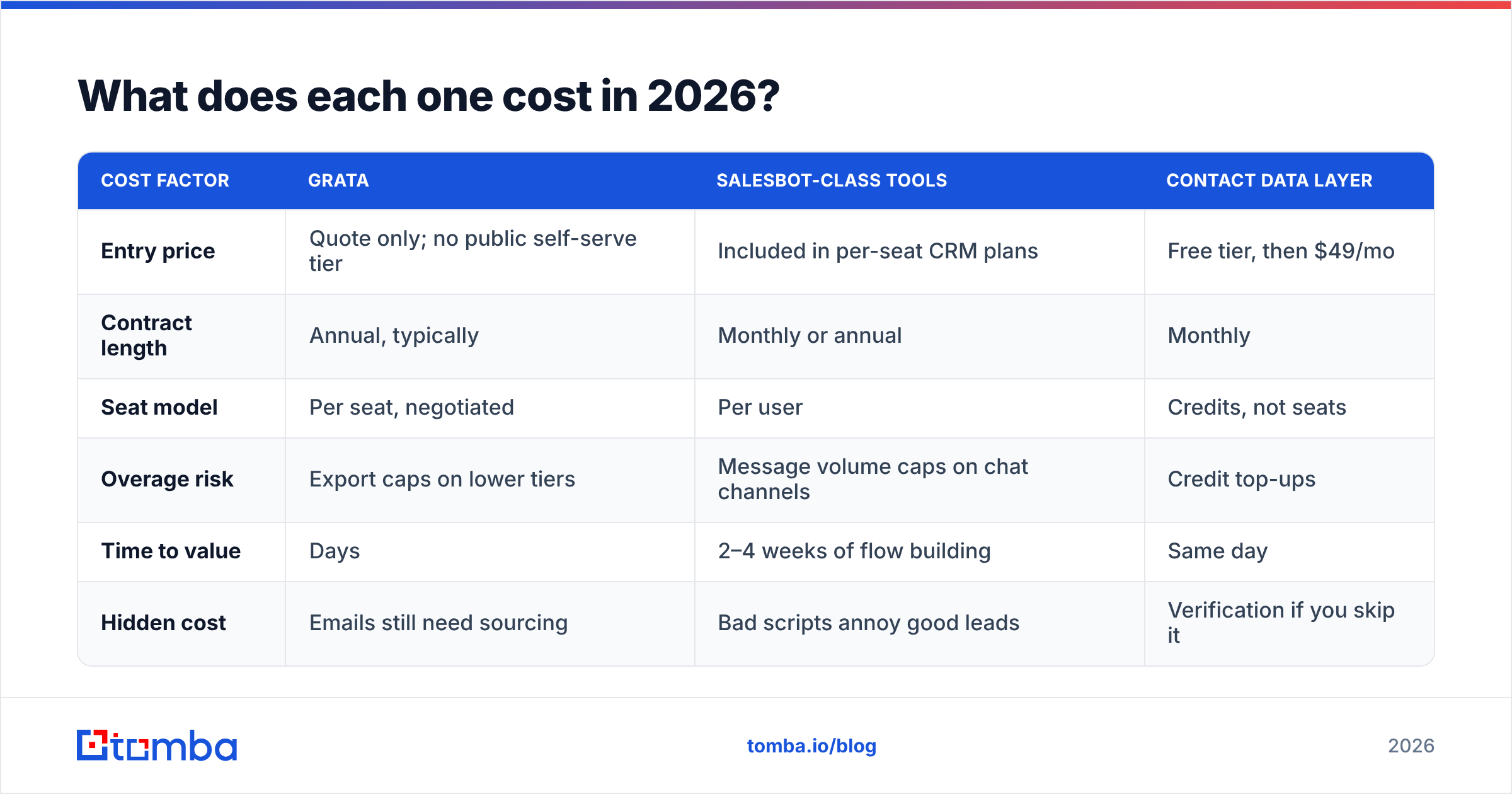
| Cost factor | Grata | Salesbot-class tools | Contact data layer |
|---|---|---|---|
| Entry price | Quote only; no public self-serve tier | Included in per-seat CRM plans | Free tier, then $49/mo |
| Contract length | Annual, typically | Monthly or annual | Monthly |
| Seat model | Per seat, negotiated | Per user | Credits, not seats |
| Overage risk | Export caps on lower tiers | Message volume caps on chat channels | Credit top-ups |
| Time to value | Days | 2–4 weeks of flow building | Same day |
| Hidden cost | Emails still need sourcing | Bad scripts annoy good leads | Verification if you skip it |
Grata does not publish pricing, which by itself tells you the target buyer. Expect an enterprise sales cycle, a demo, and an annual commitment. Salesbot features, by contrast, ride along with a CRM subscription — the marginal cost of switching one on is close to zero if you already use the platform, which is why the "is it worth it" question is much easier there.
For the third column, Tomba pricing is deliberately boring: 25 free searches a month to test, $49/mo Starter, $99/mo Growth, $249/mo Pro, custom above that. Credits, not seats — so a two-person team and a ten-person team pay for the same thing: data volume.
Where do both tools leave a gap?#
Here is the failure mode nobody demos.
Grata hands you 340 perfectly-matched private companies. Beautiful list. Now find the operations director at each one. Grata is a company-intelligence product; person-level coverage at small private firms is thin by nature, because those people are not in press releases or funding rounds. So the list goes into a spreadsheet and someone spends two weeks guessing formats and LinkedIn-stalking.
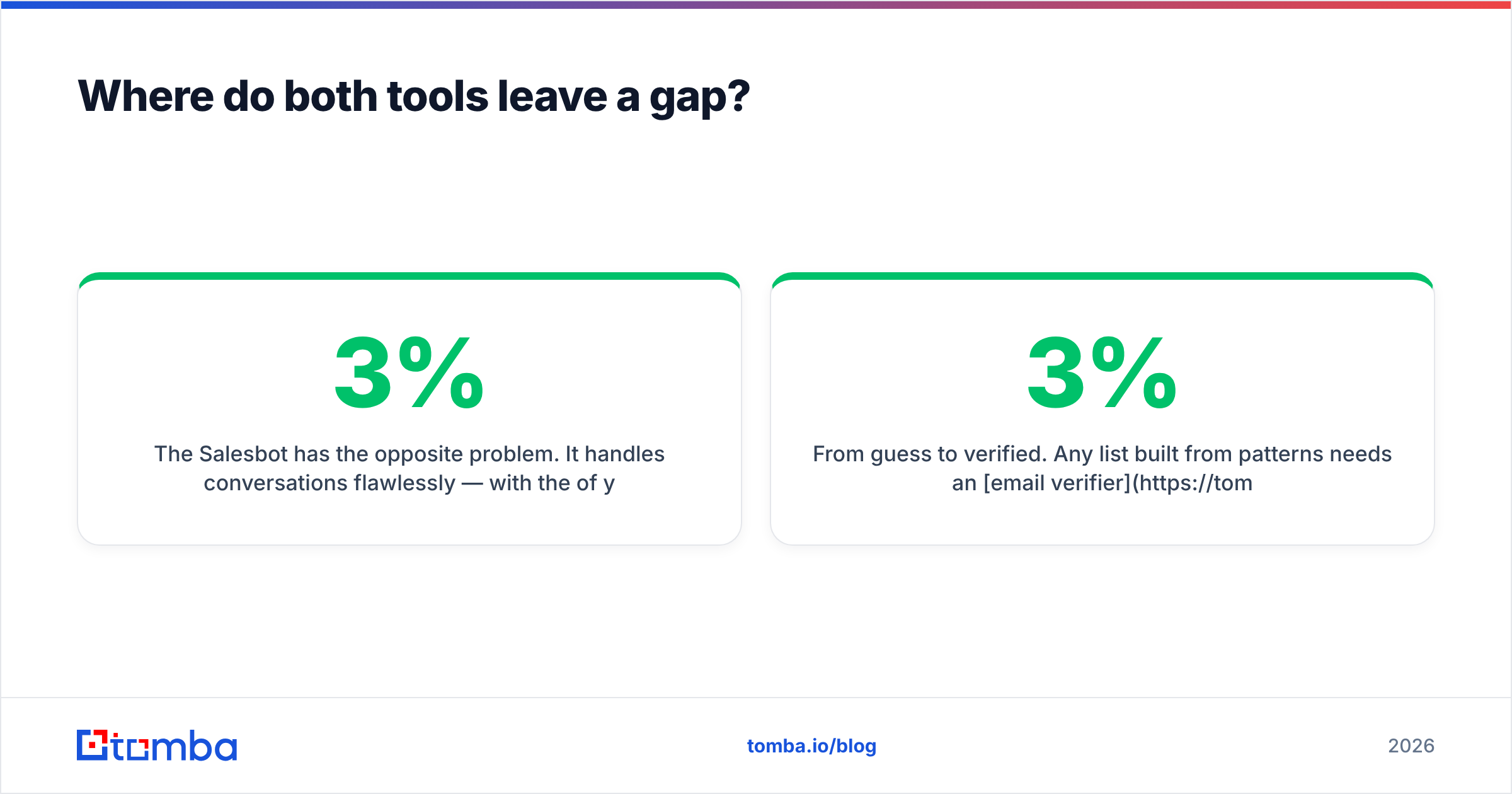
The Salesbot has the opposite problem. It handles conversations flawlessly — with the 3% of your market that came to you. The other 97% never touches it.
The connective tissue in both cases is contact data:
- From company to inbox. Feed a domain list into a bulk email finder and get named contacts with role filters, instead of one generic info@ per company.
- From guess to verified. Any list built from patterns needs an email verifier pass before it touches a sending domain. Bounce rates above 3% start eating your sender reputation, and that damage outlasts the campaign.
- From flat record to context. Data enrichment fills in role, seniority, and company attributes so the first line of your email is not "Hi there".
- From manual to pipeline. If you already sync Grata to a CRM, the Tomba API sits in the same automation so enrichment happens on record creation, not on a Tuesday when someone remembers.
Is Grata worth it for a small sales team?#
Usually not — and that is not a knock on the product.
Grata's value is proportional to how hard your ICP is to find. If your targets are Series B SaaS companies in North America, every mainstream database already has them, and you are paying a premium for discovery you do not need. If your targets are independent regional manufacturers with no funding history and a 2011 website, Grata may be the only thing that surfaces them, and the price is trivially justified.
Ask one question: when you build a target list today, is the hard part finding companies or reaching them? If it is reaching them, Grata solves a problem you do not have.
Can a Salesbot replace an SDR?#
Partly, and only for a specific slice of the job.
What it genuinely replaces: after-hours first responses, repetitive qualification questions, meeting scheduling, and the mechanical follow-up cadence on inbound. That is real work and reps hate doing it.
What it does not replace: research, point-of-view, handling a skeptical buyer, or any form of outbound. A bot cannot decide that a company's job postings imply a migration project worth calling about. Teams that fire SDRs and buy a bot end up with a very responsive front door and an empty street outside it.
The healthiest configuration is a bot on inbound, humans on outbound, and shared contact data feeding both — so a lead the bot qualified and a prospect the rep sourced land in the same enriched record.
How do you combine them into one workflow?#
If you have the budget for both, sequence them like this:
- Source with Grata. Build the thesis list — companies matching the business model you actually win against, not the industry code.
- Enrich to person level. Run the domain list through an email finder and pull decision-makers by role, then verify before anything sends. Catch-all domains are common at small private companies, so use a catch-all verifier rather than deleting those rows or blind-sending to them.
- Run outbound to the verified set. Human-written, specific, low volume per domain.
- Point the Salesbot at every reply channel. Website chat, WhatsApp, the shared inbox — anything a warmed prospect might use when they finally respond at 9pm on a Sunday.
- Write everything back to one CRM record. Sourcing signal, verified contact, bot transcript. Without this step you have three tools and three versions of the truth.
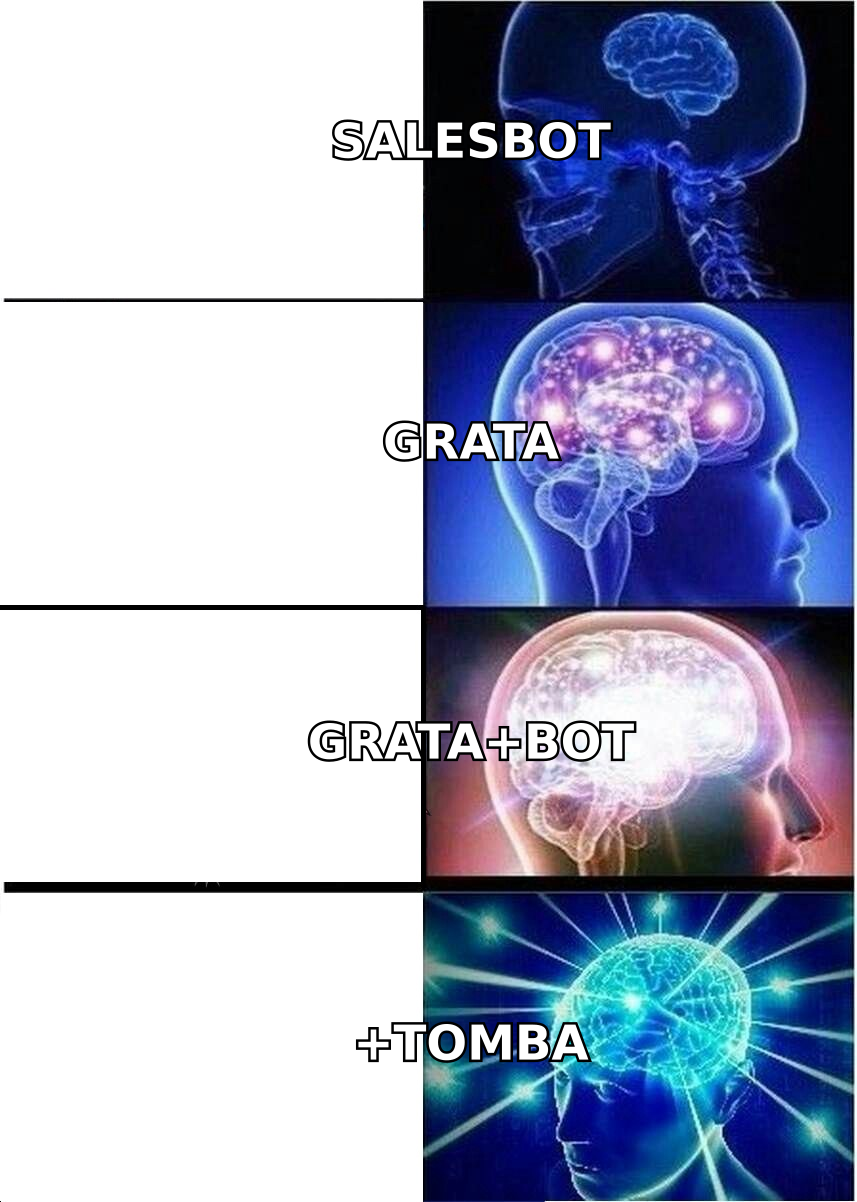
The pattern generalizes past these two products: discovery layer → data layer → engagement layer. Grata is one option for the first, a Salesbot is one option for the third, and the middle layer is the one teams consistently under-buy — then wonder why a $30k sourcing tool produced eleven meetings.
The bottom line#
Grata wins if your problem is finding companies nobody else can find, and you have the budget and the deal size to justify an enterprise contract. A Salesbot wins if your problem is responding fast enough to demand you already generate, and it costs a rounding error by comparison. They do not overlap, so "which is better" is the wrong frame — the right frame is which leak you are patching this quarter.
What both leave on your desk is the same: a list of organizations with no reliable way to reach the humans inside them. That is the layer worth getting right before you sign anything expensive.
Start there. Run a target domain list through the Tomba Email Finder, verify the results, and see how many usable contacts you get before you commit to a five-figure sourcing platform. The free tier covers 25 searches a month — enough to test whether your pipeline problem is discovery, data, or delivery. Most teams find out it was data all along.
Related guides#
Ready to find emails that actually work?
Join 150,000+ professionals who stopped guessing and started sending. Free credits on signup — no credit card required.
Get the Tomba newsletter
Practical outbound tactics and product updates — once every two weeks.
About the author