Grata vs Warpleads (2026): Which B2B Data Tool Wins?
Grata sells company intelligence for deal sourcing. Warpleads sells lead volume for outbound. They barely compete — and picking wrong costs you a year of budget. Here's the honest split.
Grata vs Warpleads is an odd match-up. One tool finds private companies. The other ships contact lists in bulk. This guide shows which one fits your team, and what both of them miss.
TL;DR
- The two barely compete. Grata is a search engine for private companies. It serves M&A, private equity, and corp dev teams. Warpleads is a bulk B2B lead export tool built for cold outbound.
- Pick Grata if your unit of work is a company. You need every US industrial cybersecurity firm doing $5M-$20M in revenue. Then you track each one for two years.
- Pick Warpleads if your unit of work is a contact. You need 40,000 rows this month to feed a sequencer.
- The pricing models are opposites. Grata is quote-only, annual, and per seat. Warpleads is self-serve, monthly, and tiered by export volume.
- Neither one is a verification layer. Whatever you export still needs a bounce check before it hits your domain. That is a separate job for a dedicated email verifier.
What are Grata and Warpleads, exactly?#
Start here. Most Grata vs Warpleads comparisons treat the two as the same kind of tool. They are not.
Grata is a private-market search tool. It finds firms that standard databases miss. Think bootstrapped, founder-owned shops under $50M in revenue. They never filed with a regulator. They never raised a round.
Grata crawls company websites and reads what each site says about itself. So you search by plain description, such as "contract makers of sterile injectables in the Midwest." You do not search by SIC code. Then you filter by headcount, revenue band, owner type, and growth signals. Finally you push the list into a CRM or a deal pipeline.
Warpleads is a lead export tool. Its promise is volume with no per-record tax. You filter a large B2B contact database by title, industry, place, and company size. Then you export. Plans are built around high or unlimited export caps, not metered credits.
It also builds lists on demand. You define a target, and it gathers the rows. The output is a CSV, or a push into your outbound tool.
One tool asks which firms exist and are worth a call. The other says: give me 50,000 rows to email on Monday. Both are fair. They solve different problems in different budget lines.
How do Grata and Warpleads compare head-to-head?#
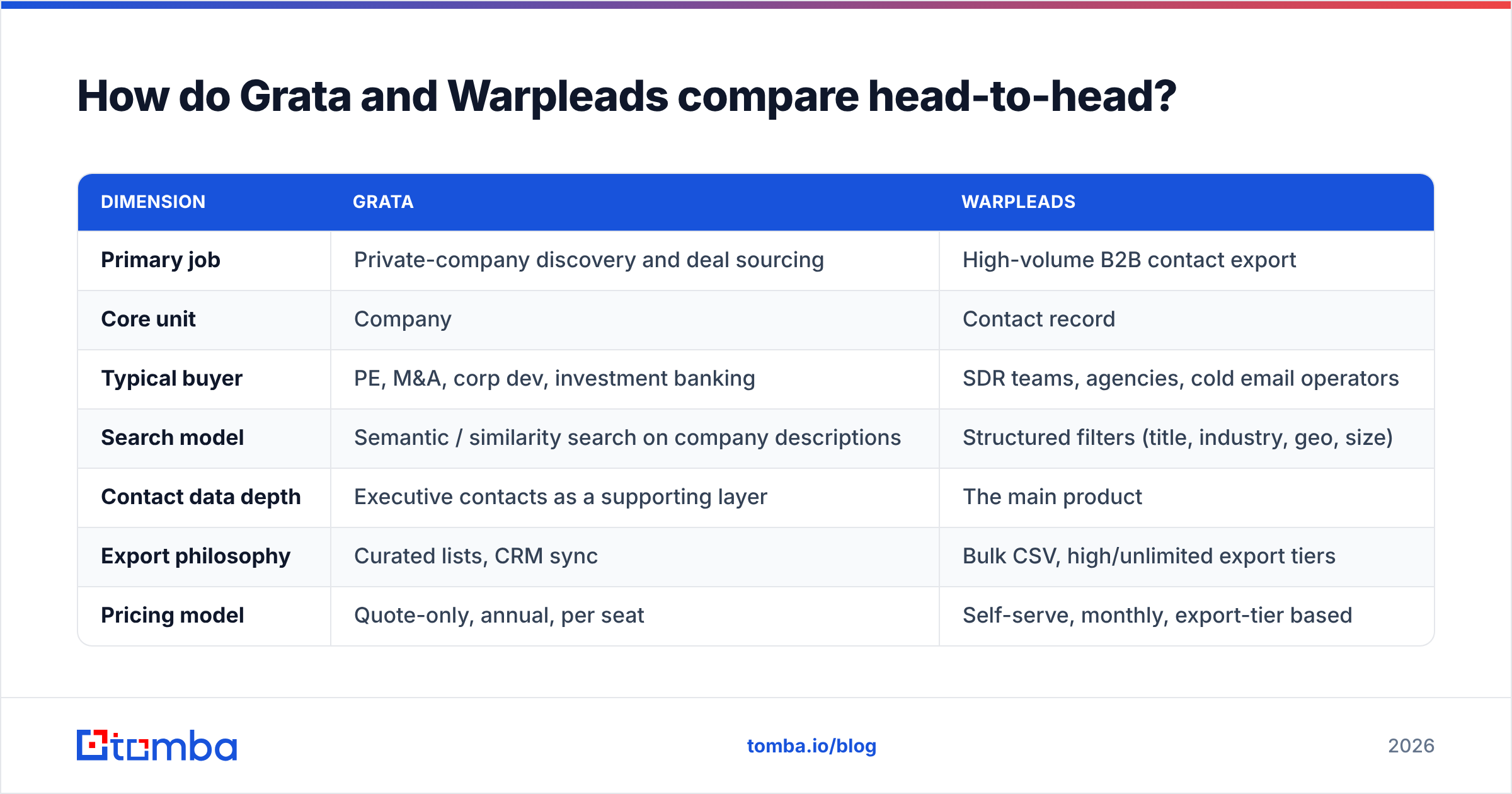
| Dimension | Grata | Warpleads |
|---|---|---|
| Primary job | Private-company discovery and deal sourcing | High-volume B2B contact export |
| Core unit | Company | Contact record |
| Typical buyer | PE, M&A, corp dev, investment banking | SDR teams, agencies, cold email operators |
| Search model | Semantic / similarity search on company descriptions | Structured filters (title, industry, geo, size) |
| Contact data depth | Executive contacts as a supporting layer | The main product |
| Export philosophy | Curated lists, CRM sync | Bulk CSV, high/unlimited export tiers |
| Pricing model | Quote-only, annual, per seat | Self-serve, monthly, export-tier based |
| Typical annual cost | Five figures | Low four figures or less |
| Free tier | No — demo/trial by request | Entry plans and trial options are self-serve |
| Verification included | Not a verification product | Some verification on exported emails |
| Best-fit motion | Long-cycle, relationship-led, few targets | Short-cycle, volume-led, many targets |
Read the Grata vs Warpleads table as a fork in the road, not a scoreboard. Say you lead an SDR team on a $500 monthly budget. Grata was never an option for you. Now say you source add-on deals in a split-up market. A bulk export tool hands you contacts for firms you had no way to name in the first place.
Which one has better data quality?#
Wrong question. Ask instead: better at what? Quality splits into a few axes. Each tool wins different ones.
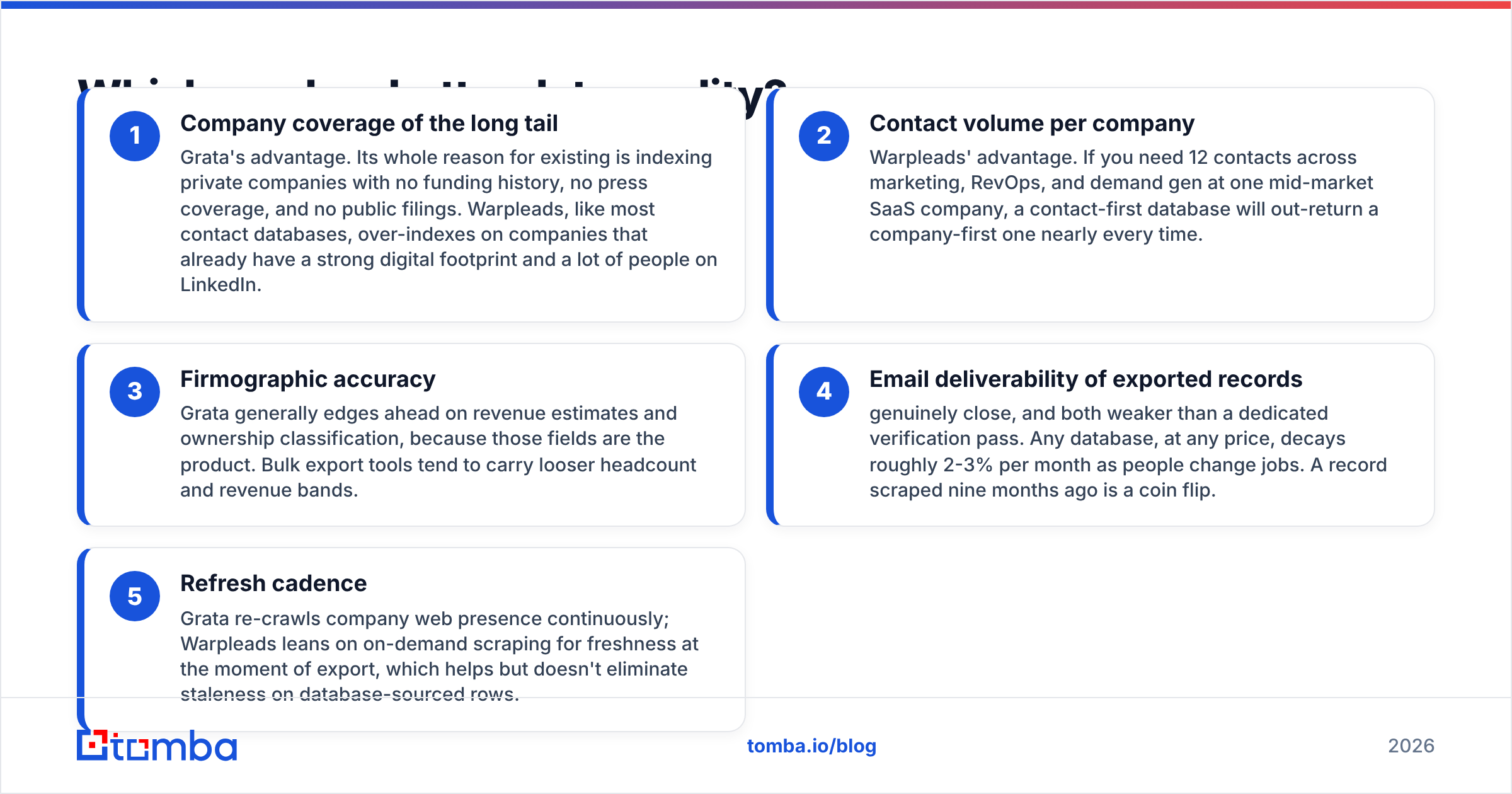
- Long-tail company coverage — Grata wins. It exists to index private firms with no funding news and no filings. Warpleads, like most contact databases, leans toward firms with a big web footprint.
- Contacts per company — Warpleads wins. Say you need 12 people across marketing, RevOps, and demand gen at one mid-market SaaS firm. A contact-first database wins that nearly every time.
- Firm data accuracy — Grata wins. Revenue estimates and owner type are the product. Bulk export tools carry looser headcount and revenue bands.
- Email accuracy — close, and both are weak. Any database decays 2-3% a month as people change jobs. A record pulled nine months ago is a coin flip.
- Refresh rate — split. Grata re-crawls company sites all year. Warpleads scrapes on demand at export time. That helps, but older rows still go stale.
Point 4 is the one to act on. No vendor flag beats a check made right before you send. Reviews on G2 show the same gripe for every tool in this class. Bounce rates run higher than the sales page implied. That is not vendor dishonesty. It is what happens when you export a still photo of a moving crowd.
How does pricing actually work for each?#
Price tells you who each tool is for. Here the gap is huge.
Grata is an enterprise sale. There is no price page. You book a demo, share your team size and use case, then get an annual quote per seat. Deal-sourcing tools in this class tend to land in the five-figure range each year. Cost grows with seats and export rights. Expect a buying cycle, a security review, and a 12-month term. In return you get onboarding, a named CSM, and CRM support.
Warpleads is a self-serve sale. Prices are public and monthly, tiered by export volume. The pitch is simple: stop rationing credits. Cancel or upgrade in the dashboard. No procurement, no CSM, and no annual lock unless you want the discount. Its real rivals are Apollo, Seamless, or your own scraper plus an enrichment API.
That gap matters more than any feature. A four-person outbound agency will never sign a five-figure check for company data. A PE associate cannot work from a title-filtered contact export. The tools sit in separate budget lines because they do separate jobs.
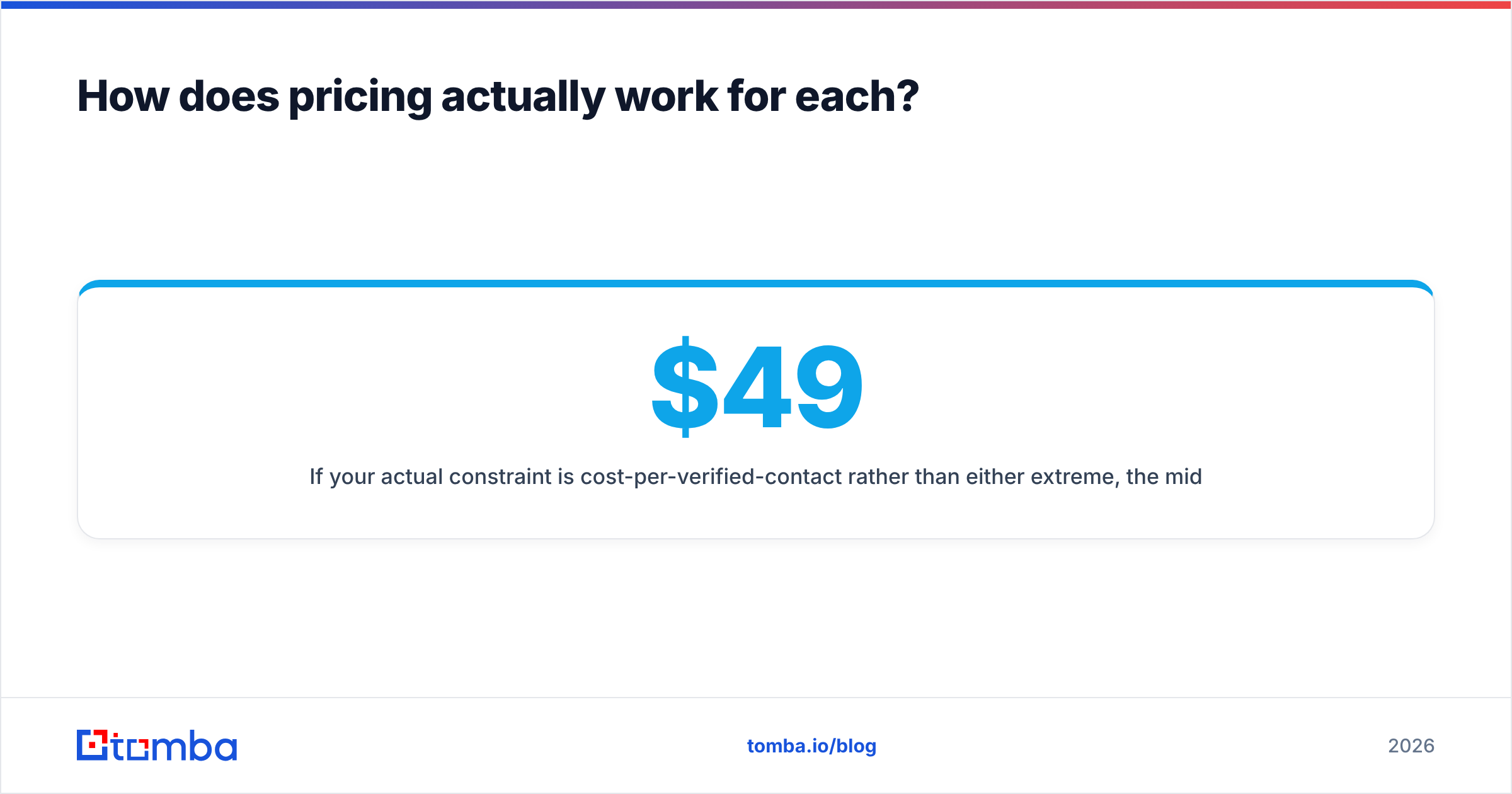
Maybe your real limit is cost per verified contact. Then look at the middle of the market. Tomba pricing starts free at 25 searches a month. Paid plans run $49 Starter, $99 Growth, and $249 Pro. That covers a lot of ground between bulk self-serve and an annual contract.
Who should choose Grata?#
Pick Grata when all of these are true:
- Your target list does not exist yet. You map a split-up market, such as HVAC roll-ups, specialty clinics, or niche part makers. No filter in a standard database returns the right set.
- Owner type matters to you. Sponsor-backed, founder-owned, or a subsidiary. That fact changes whether a firm is even worth a call.
- Your sales cycle runs in quarters. You may track a target for 18 months before the first real talk. Company-level alerts pay for themselves.
- You can spend above $20K a year on data. Below that, this is not a live option.
Grata has an honest weak spot for a normal GTM team. It costs a lot per contact, and contact depth is thin next to prospecting databases. It never tried to win that fight.
Who should choose Warpleads?#
Pick Warpleads when these are true:
- Volume is your bottleneck. Your sequences eat lists faster than credits refill. Credit anxiety now shapes your plan.
- Your ICP is broad. "Marketing directors at 50-500 person SaaS firms in North America" is a filter query. It needs no smart company discovery.
- You want to start today. No demo call. No legal review.
- You run your own checks and warmup. Volume tools reward teams with good sending habits, and punish those without.
Warpleads has an honest weak spot too. Big export caps invite spray. If your reply rate is 0.4%, five times more contacts means five times more spam flags, not five times more pipeline. Volume without aim is a risk to your domain.

Where do both tools leave a gap?#
Same place. The truth about a contact at the moment you press send.
Both hand you a snapshot. It was right the day it was built. Then people got promoted. They changed jobs. Their address moved from first.last@ to flast@. Some now sit behind a catch-all server that accepts all mail and delivers none. Neither tool is built to be the last gate before your mail goes out.
So the working stack for either tool looks like this:
- Source the accounts. Grata for hard-to-map markets, Warpleads for easy filters.
- Fill the contact gaps. When a target firm shows up with no usable contacts, run a domain search to pull the people and email patterns that tool did not have.
- Verify before you send. Run the whole list through checks. Handle catch-all domains rather than guess. A catch-all verifier tells "the server takes all mail" apart from "this mailbox is real." That gap is the top source of hidden bounce risk in bulk exports.
- Enrich what survives. Add firm data, tech stack, and role context so your notes are real. Data enrichment at this stage costs less than enriching 50,000 rows you will never email.
- Suppress and re-check each month. A list checked in January is a new list by April.
Step 3 is not optional. HubSpot's email benchmark research and every big mailbox provider agree on one point. Bounce rates above roughly 2% put your domain at risk. That damage takes far longer to fix than it took to cause.
Is there a middle option between the two?#
Yes. It is what most teams actually need.
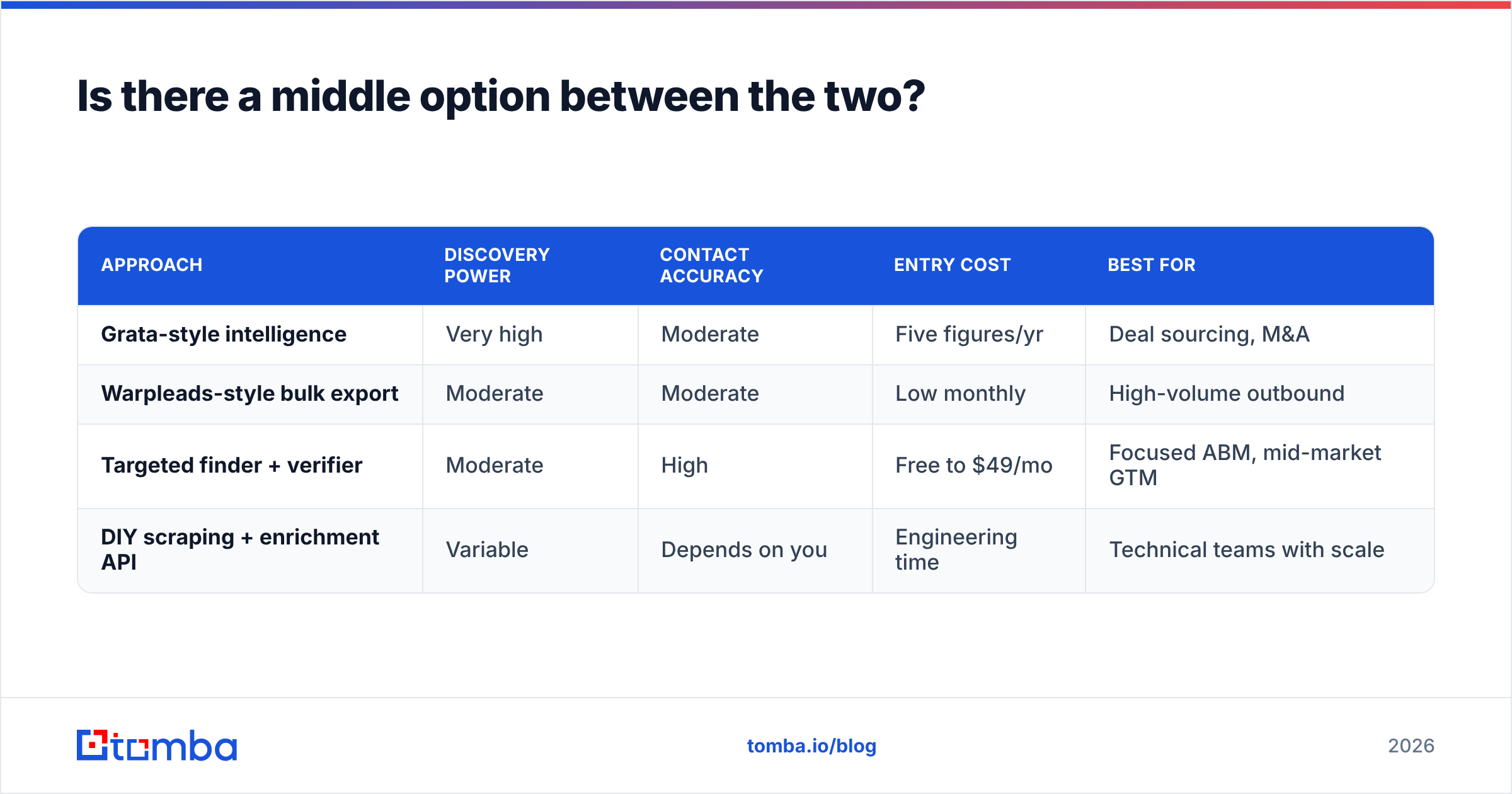
The Grata vs Warpleads choice sits between two poles. One is company data priced for institutional capital. The other is bulk export priced for high-volume outbound. The middle is a third lane. Accurate contacts on a list you define, at a set monthly price, with checks built in.
That lane works like this. Bring your own account list, from Grata, a CRM, a conference roster, or LinkedIn. Then turn it into verified, sendable contacts. You skip enterprise rates for discovery you do not need. You also skip the domain damage that comes with volume you cannot use.
| Approach | Discovery power | Contact accuracy | Entry cost | Best for |
|---|---|---|---|---|
| Grata-style intelligence | Very high | Moderate | Five figures/yr | Deal sourcing, M&A |
| Warpleads-style bulk export | Moderate | Moderate | Low monthly | High-volume outbound |
| Targeted finder + verifier | Moderate | High | Free to $49/mo | Focused ABM, mid-market GTM |
| DIY scraping + enrichment API | Variable | Depends on you | Engineering time | Technical teams with scale |
What's the verdict on Grata vs Warpleads?#
Neither wins outright. They answer different questions. Still, here is the pick.
For deal sourcing, corp dev, and any job where naming the right company is the hard part: Grata, and it is not close. No bulk export tool copies its search over the private long tail.
For cold outbound with a clear ICP and a throughput problem: Warpleads, as long as you pair it with real checks. Big export caps only help if your sending habits can carry the load.
For everyone in between, and that is most B2B teams, both are wrong. One overshoots. The other undershoots. Build your account list from what you already have. Then spend on making that contact data correct.
Start with the Tomba Email Finder. Search by domain, name, or company. You get verified work emails with confidence scores and source attribution. Stop shipping raw rows into your sequencer. The free tier gives you 25 searches a month. Run the same 50 firms through each tool and compare bounce rates, not sales claims. That is the only Grata vs Warpleads test that counts.
Related guides#
Ready to find emails that actually work?
Join 150,000+ professionals who stopped guessing and started sending. Free credits on signup — no credit card required.
Get the Tomba newsletter
Practical outbound tactics and product updates — once every two weeks.
About the author