GrowMeOrganic vs HitHorizons: Which B2B Data Tool Wins in 2026?
GrowMeOrganic sells outreach-ready contacts; HitHorizons sells European company registry data. They solve different problems — and picking wrong costs you a quarter. Here's the honest breakdown.
TL;DR
- These tools are not substitutes. GrowMeOrganic is a LinkedIn-centric prospecting + outreach suite. HitHorizons is a European company registry database. Comparing them head-to-head only makes sense if you're deciding what kind of data problem you actually have.
- GrowMeOrganic wins if you need names, emails, and a sequencing tool in one $39–$99/mo subscription and you accept variable email accuracy.
- HitHorizons wins if you need firmographics on 80M+ European companies — registry-sourced legal names, IDs, revenue estimates, and hierarchy — for TAM sizing, account scoring, or compliance.
- Neither is a strong standalone email finder. GrowMeOrganic's emails come from a scrape-and-guess pipeline; HitHorizons barely deals in personal contact data at all.
- Most teams end up with a stack: company data for targeting, a dedicated finder + verifier for contacts, and a sending tool for delivery. We'll show you what that costs.
What are GrowMeOrganic and HitHorizons, actually?#
They land in the same search results and almost never in the same shortlist.
GrowMeOrganic is an all-in-one B2B prospecting platform built around a Chrome extension. You browse LinkedIn or Sales Navigator, scrape a list, it appends emails and phone numbers, and then you push those contacts into its built-in drip campaign tool. It sells unlimited-ish credits at a flat monthly rate and markets heavily to solo founders, agencies, and small SDR teams who don't want to buy four tools.
HitHorizons is a company data provider. It aggregates official business-registry filings across roughly 40 European countries into a single searchable database of 80M+ companies — legal entity names, registration numbers, addresses, industry codes, employee bands, revenue estimates, and corporate family trees. It's sold as a web app and an API, and its buyers are usually RevOps, credit risk, procurement, or compliance teams that need authoritative company records, not a list of SDR targets.
The distinction matters more than any feature table. One tool answers "who do I email?" The other answers "which companies exist, and are they real?"
How do GrowMeOrganic and HitHorizons compare feature by feature?#
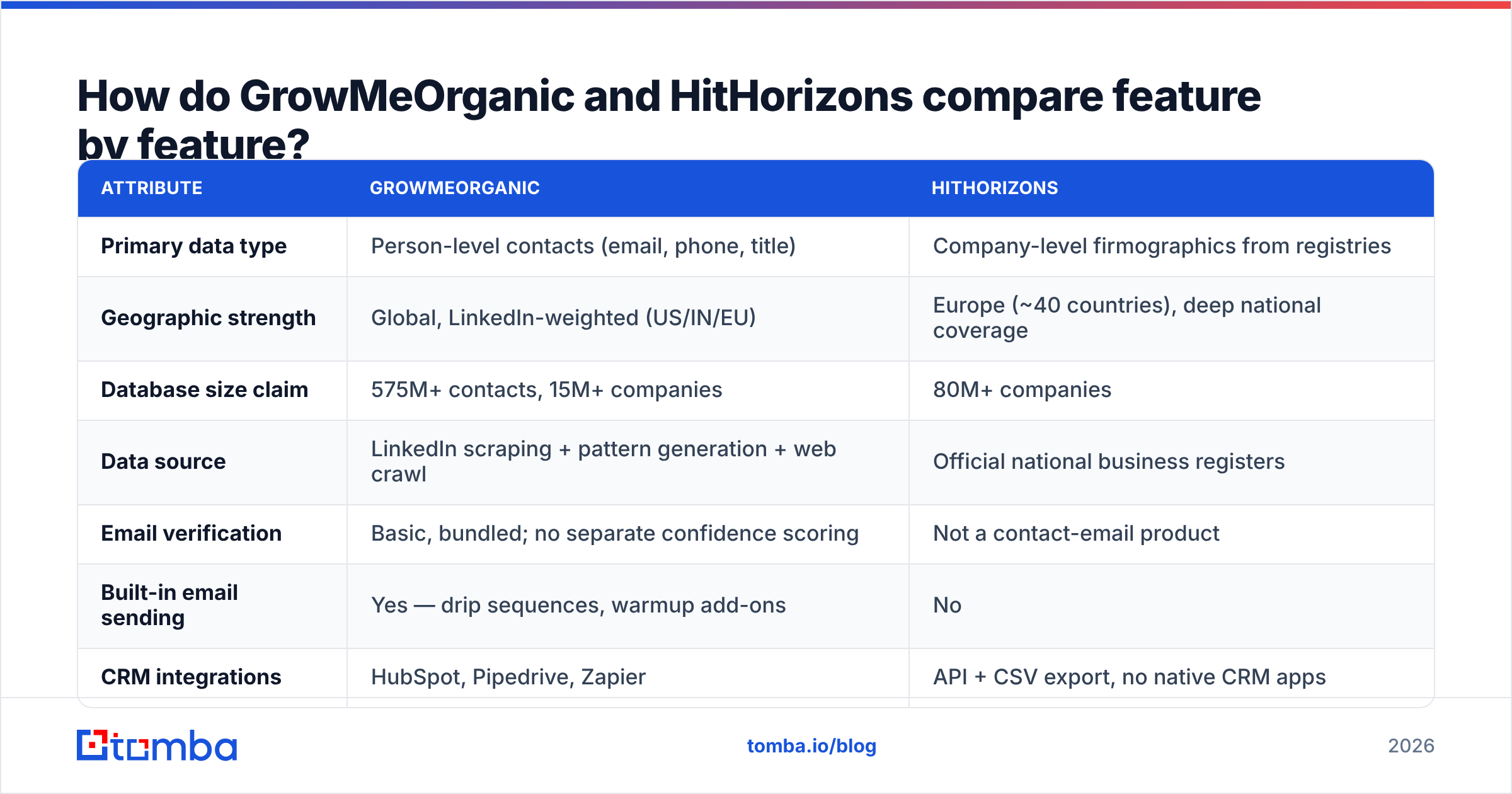
| Attribute | GrowMeOrganic | HitHorizons |
|---|---|---|
| Primary data type | Person-level contacts (email, phone, title) | Company-level firmographics from registries |
| Geographic strength | Global, LinkedIn-weighted (US/IN/EU) | Europe (~40 countries), deep national coverage |
| Database size claim | 575M+ contacts, 15M+ companies | 80M+ companies |
| Data source | LinkedIn scraping + pattern generation + web crawl | Official national business registers |
| Email verification | Basic, bundled; no separate confidence scoring | Not a contact-email product |
| Built-in email sending | Yes — drip sequences, warmup add-ons | No |
| CRM integrations | HubSpot, Pipedrive, Zapier | API + CSV export, no native CRM apps |
| API | Limited, higher tiers | Yes, core to the product |
| Entry price | ~$39/mo (annual) | Free search tier; paid plans from ~€49/mo |
| Best for | Solo founders, agencies, small SDR teams | RevOps, compliance, credit risk, EU TAM sizing |
| Biggest weakness | Email accuracy varies by list | No personal contacts; Europe-only |
Read that table twice. The row that decides most purchases is the first one — person data vs company data. If your CRM is starving for verified emails, HitHorizons will not feed it. If your problem is that you don't know which 4,000 German manufacturers between €10M and €50M revenue are worth targeting, GrowMeOrganic's LinkedIn scrape will give you noisy, self-reported company sizes and nothing registry-grade.

Is GrowMeOrganic's contact data accurate enough for cold outreach?#
Accuracy is where all-in-one tools get squeezed, and GrowMeOrganic is no exception.
Its email discovery works the way most LinkedIn-extension tools work: it identifies the person, identifies the company domain, applies known or inferred email patterns, then runs a lightweight SMTP or MX check. That pipeline is fast and cheap, and it produces good results on companies with a clean, single, guessable pattern (first.last@domain.com) and a mail server that answers honestly.
It degrades in three predictable places:
- Catch-all domains. A catch-all server accepts every address, so a basic SMTP ping returns "valid" for
asdfgh@company.com. Anything that doesn't do dedicated catch-all handling will hand you addresses that bounce or land in a black hole. A proper catch-all verifier is a separate technology, not a checkbox. - Multi-pattern companies. Enterprises that acquired their way to scale often run three or four active patterns across subsidiaries. Pattern inference picks one and guesses wrong for the rest.
- Stale LinkedIn profiles. The profile says VP of Marketing at Acme. The person left in November. The scrape doesn't know.
Users on G2 and Capterra generally rate GrowMeOrganic well on value and poorly on data quality consistency — the recurring theme in reviews is "great price, but I run everything through a separate verifier." That's a reasonable summary of the tradeoff.
If you're building sequences on top of this data, run a dedicated email verifier before the first send. Bounce rate above 3% starts damaging sender reputation, and reputation damage costs more to repair than the verification credits cost to buy.
What does HitHorizons actually give you that scraped data can't?#
Provenance. That's the whole pitch, and it's a real one.
HitHorizons pulls from national commercial registers — the same filings that establish a company's legal existence. That produces four things scraped data structurally cannot:
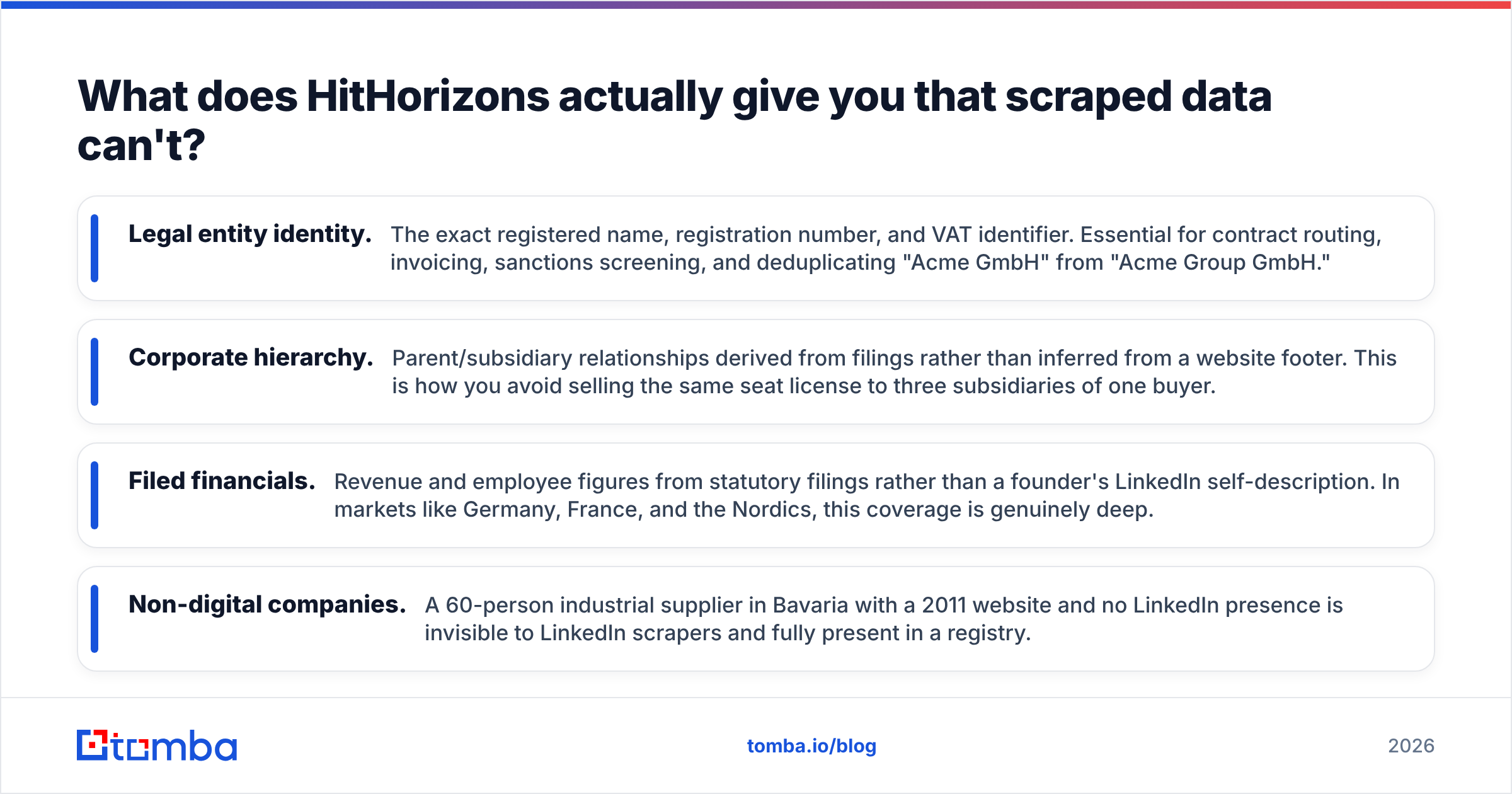
- Legal entity identity. The exact registered name, registration number, and VAT identifier. Essential for contract routing, invoicing, sanctions screening, and deduplicating "Acme GmbH" from "Acme Group GmbH."
- Corporate hierarchy. Parent/subsidiary relationships derived from filings rather than inferred from a website footer. This is how you avoid selling the same seat license to three subsidiaries of one buyer.
- Filed financials. Revenue and employee figures from statutory filings rather than a founder's LinkedIn self-description. In markets like Germany, France, and the Nordics, this coverage is genuinely deep.
- Non-digital companies. A 60-person industrial supplier in Bavaria with a 2011 website and no LinkedIn presence is invisible to LinkedIn scrapers and fully present in a registry.
That last point is underrated. If your ICP is European mid-market industrials, logistics, manufacturing, or professional services, a LinkedIn-first tool systematically under-samples your market. You will conclude your TAM is 3,000 companies when it's 22,000.
The flip side: HitHorizons gives you the company and mostly leaves you at the front door. You still need to identify the decision-maker and find their email — which is a different tool entirely.
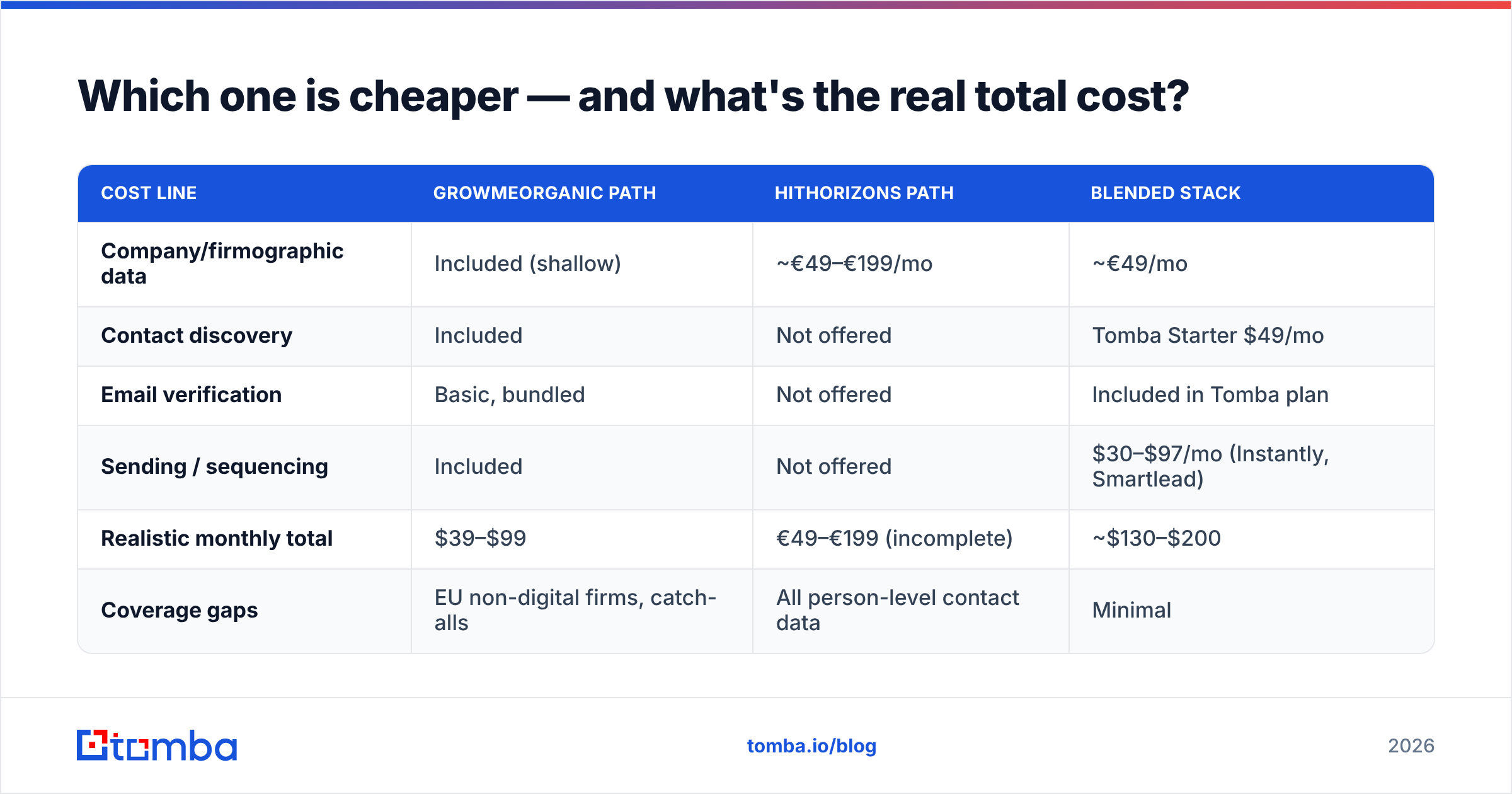
Which one is cheaper — and what's the real total cost?#
Sticker prices mislead here, because neither tool covers the whole job.
| Cost line | GrowMeOrganic path | HitHorizons path | Blended stack |
|---|---|---|---|
| Company/firmographic data | Included (shallow) | ~€49–€199/mo | ~€49/mo |
| Contact discovery | Included | Not offered | Tomba Starter $49/mo |
| Email verification | Basic, bundled | Not offered | Included in Tomba plan |
| Sending / sequencing | Included | Not offered | $30–$97/mo (Instantly, Smartlead) |
| Realistic monthly total | $39–$99 | €49–€199 (incomplete) | ~$130–$200 |
| Coverage gaps | EU non-digital firms, catch-alls | All person-level contact data | Minimal |
GrowMeOrganic is the cheapest complete motion if your standards for data quality are moderate and your volume is low. That's a legitimate position for a founder sending 200 emails a week.
The blended stack costs 2–3x more and is what most teams migrate to once bounce rates, deliverability complaints, or a sales leader asking "why is our TAM number wrong?" force the issue. Tomba pricing starts free at 25 searches/month, then $49/mo Starter, $99/mo Growth, and $249/mo Pro — sized so you can add a dedicated finder and verifier to an existing company-data source without doubling your spend.
One honest note on category shopping: if your priority is a large, pre-verified static list rather than a discovery workflow, prepackaged database vendors like BookYourData occupy a different and legitimate niche — you buy records outright instead of renting search credits. That model suits one-off campaigns into a fixed market well.
When should you pick GrowMeOrganic over HitHorizons?#
Pick GrowMeOrganic when:
- You're a team of 1–5 and tool sprawl is the real enemy. One subscription, one login, one support thread. The consolidation is worth real accuracy points.
- Your ICP lives on LinkedIn. SaaS, agencies, tech services, startups — populations with high profile completeness and current job titles.
- You want to send from the same tool you prospect in. No CSV shuffling between systems.
- Your monthly volume is under a few thousand contacts. Flat-rate pricing is very favorable at that scale.
Pick HitHorizons when:
- You need to size or segment a European market. Registry data gives you counts you can defend in a board deck.
- Compliance, credit, or procurement is a stakeholder. Legal entity IDs and filed financials are non-negotiable for those functions.
- Your ICP has weak digital presence. Manufacturing, wholesale, logistics, construction, regional services.
- You're enriching an existing CRM via API. Company records keyed on registration number are far more stable than name-matching.
Pick neither as your primary contact source when email accuracy is the metric your quarter depends on. That's a job for a dedicated email finder plus verification, layered on top of whichever company-data source fits your market.
How do you combine company data and contact data without paying twice?#
The pattern that works is a three-layer stack, and each layer should be best-in-class rather than bundled.
- Company layer — define the universe. Registry or firmographic data (HitHorizons for Europe, or a broader provider for global). Output: a list of target domains with revenue, headcount, industry, and hierarchy.
- Contact layer — find the humans. Run those domains through a domain search to surface every discoverable role-holder, then narrow by title. This is also where you handle catch-alls and multi-pattern companies properly instead of guessing.
- Delivery layer — send and track. A dedicated sequencer with warmup, inbox rotation, and reply detection.
Two practical rules make this stack cheaper than it looks:
- Enrich in bulk, not per-lead. Batch your domain list and run it through bulk email finder jobs once a month rather than firing one-off lookups from an extension all day. Credit consumption drops sharply.
- Verify at send time, not at import time. Data decays about 2–3% per month. An address you verified in March is a coin flip by September. Re-verify the segment you're about to mail, not your whole database.
If you're automating this, the Tomba API handles the contact layer programmatically — you pass a domain and role, you get back a scored email — so the whole pipeline can live in one scheduled job rather than three browser tabs.
What do real users complain about with each tool?#
Worth knowing before you commit a quarter to either.
GrowMeOrganic complaints that show up repeatedly:
- Email accuracy varies noticeably by industry and region; users report needing a second verification pass.
- Credit and limit definitions can be confusing across plan tiers.
- Support responsiveness scales down as the plan price does.
- The built-in sender is functional but thinner than dedicated tools like Instantly or Smartlead on deliverability controls.
HitHorizons limitations that surprise buyers:
- Europe-only. If your market includes North America or APAC, you need a second source.
- Registry data lags reality — a company that changed size in Q1 may not show it until its next annual filing.
- No person-level contacts, so it never replaces a prospecting tool.
- Smaller-country coverage depth varies; test your specific markets before signing.
Neither list is disqualifying. Both are the predictable consequence of each tool's architecture — cheap breadth versus authoritative depth.
What's the verdict on GrowMeOrganic vs HitHorizons?#
If you have to pick one and you sell globally to digital-native companies: GrowMeOrganic, with a separate verifier bolted on. It's the more complete go-to-market motion at a lower price, and its weaknesses are patchable for about $49/month.
If you sell into Europe, especially outside tech: HitHorizons, plus a contact-discovery tool. Its market view is one that scraped sources genuinely cannot reproduce, and no amount of LinkedIn extension work will surface the companies it finds.
If your honest answer is "both, sort of": that's the common case, and it's why the three-layer stack exists. Buy company data where your market lives, buy contact data from a specialist, and don't let a bundled feature convince you it's equivalent to a purpose-built one.
The one thing you shouldn't do is treat either tool's bundled email output as send-ready. Whatever you use for targeting, the contact layer deserves its own budget line — and its own accuracy standard. Start free with the Tomba Email Finder at 25 searches a month, run it against a sample of your existing list, and compare bounce rates before you renew anything. That test takes twenty minutes and settles the argument better than any comparison article — including this one.
Sources: G2, Capterra, HitHorizons
Related guides#
Ready to find emails that actually work?
Join 150,000+ professionals who stopped guessing and started sending. Free credits on signup — no credit card required.
Get the Tomba newsletter
Practical outbound tactics and product updates — once every two weeks.
About the author