GrowMeOrganic vs Interseller (2026): Which One Wins?
GrowMeOrganic and Interseller both promise contact data plus outreach in one tab, but they were built for different jobs. Here is the honest breakdown of pricing, data quality, sending limits, and who each tool actually fits.
GrowMeOrganic vs Interseller comes down to one question: do you sell to companies, or do you hire people? Here is the short answer, then the detail.
TL;DR
- GrowMeOrganic is a B2B prospecting suite. You get a contact database, LinkedIn and Sales Navigator extraction, an email finder, and a built-in cold email sender. Plans are flat-rate with generous export caps.
- Interseller (now part of Greenhouse) is a recruiting-first sourcing tool. Find a candidate, resolve a personal email, drop them into a multi-step sequence, sync to your ATS.
- If you sell B2B software or services, GrowMeOrganic is the closer fit. If you place candidates, Interseller is built for your workflow and your ATS.
- Both bundle data and sending together. That is convenient until one half underperforms, because you cannot swap out just the data layer.
- The unbundled route is a dedicated finder like Tomba Email Finder plus your sending tool of choice. It usually beats both on cost per verified contact once you pass ~5,000 lookups a month.
What are GrowMeOrganic and Interseller?#
They get lumped together because both sell "find contacts and email them from one screen." That is where the similarity ends.
- GrowMeOrganic launched as an all-in-one growth stack for SMBs and agencies. It ships a claimed 575M+ B2B contact database and a Chrome extension that scrapes LinkedIn and Sales Navigator lists. You also get an email finder, a verifier, and cold email sending across connected mailboxes. Pricing has leaned on flat plans and lifetime deals rather than per-credit metering. (growmeorganic.com)
- Interseller was built for recruiters. Its core loop is sourcing. Pull a candidate profile, resolve a work or personal email, enroll them in a drip sequence, and write the activity back to your ATS or CRM. Greenhouse bought it in 2021 and folded it into their sourcing automation product. (interseller.io)
- The shared bet is bundling. Both companies decided you would rather buy data and sending from one vendor than stitch two together. That is a real convenience win. It is also a real lock-in risk.
- The divergent bet is the buyer. GrowMeOrganic optimizes for volume prospecting on a budget. Interseller optimizes for a recruiter working 40 high-value conversations with clean ATS records.
Pick the wrong one and you will feel it in month two, not week one. It usually shows up as a high bounce rate. Sometimes it shows up as a CRM full of records nobody can trace.

GrowMeOrganic vs Interseller: how do they compare head-to-head?#
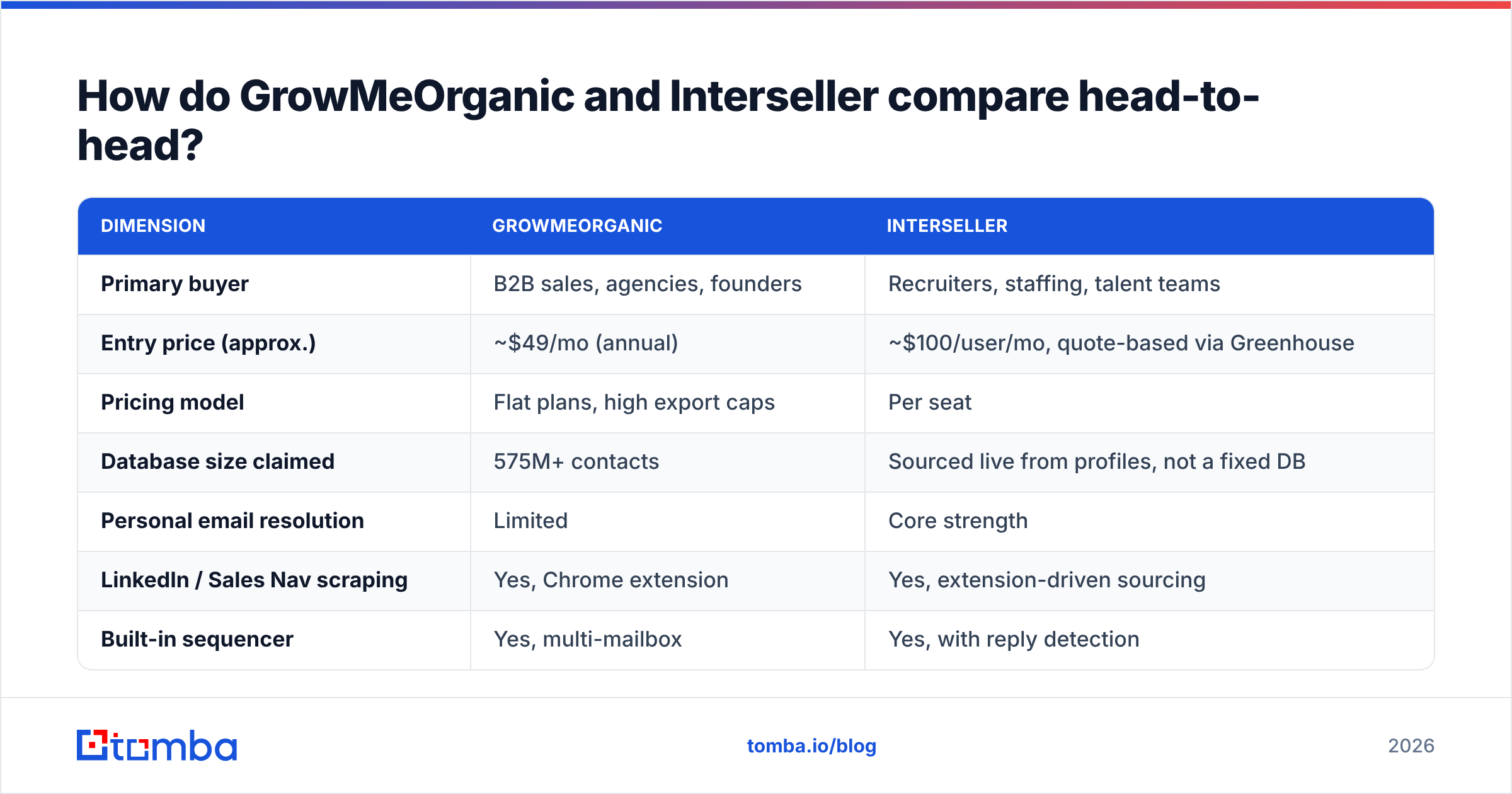
Here is the practical comparison. Treat the pricing rows as directional. Both vendors revise plans, and Interseller's pricing now routes through Greenhouse in most cases. Confirm on their site before you budget.
| Dimension | GrowMeOrganic | Interseller |
|---|---|---|
| Primary buyer | B2B sales, agencies, founders | Recruiters, staffing, talent teams |
| Entry price (approx.) | ~$49/mo (annual) | ~$100/user/mo, quote-based via Greenhouse |
| Pricing model | Flat plans, high export caps | Per seat |
| Database size claimed | 575M+ contacts | Sourced live from profiles, not a fixed DB |
| Personal email resolution | Limited | Core strength |
| LinkedIn / Sales Nav scraping | Yes, Chrome extension | Yes, extension-driven sourcing |
| Built-in sequencer | Yes, multi-mailbox | Yes, with reply detection |
| ATS integration | Weak | Strong (Greenhouse, Bullhorn, Lever) |
| CRM integration | HubSpot, Pipedrive, Zapier | CRM + ATS two-way sync |
| Free tier | Limited trial | No standing free tier |
| Best at | Cheap volume prospecting | Candidate outreach with clean records |
The table exposes the real decision. You are not choosing between two email finders. You are choosing between two workflows. Interseller's value is the ATS write-back and the personal-email resolution that recruiting demands. GrowMeOrganic's value is a lower cost per contact on large B2B lists.
Which tool has better data accuracy?#
Neither publishes an audited accuracy figure. Ignore both marketing pages and test on your own list.
Here is the honest read from user reviews on G2 and from teams we have talked to:
- Interseller wins on personal emails. Recruiters need to reach someone who is not at their desk. Interseller resolves personal domains (Gmail, Outlook, iCloud) much better than a typical B2B finder.
- GrowMeOrganic wins on the sheer number of corporate contacts. But its bounce rate is the most common complaint in reviews. Users often need a second verification pass, which quietly doubles the cost per usable contact.
- Both degrade on catch-all domains. Some domains accept every address at the SMTP layer. No tool can confirm a mailbox exists from that handshake alone. A dedicated catch-all verifier earns its keep here, and both products leave the gap open.

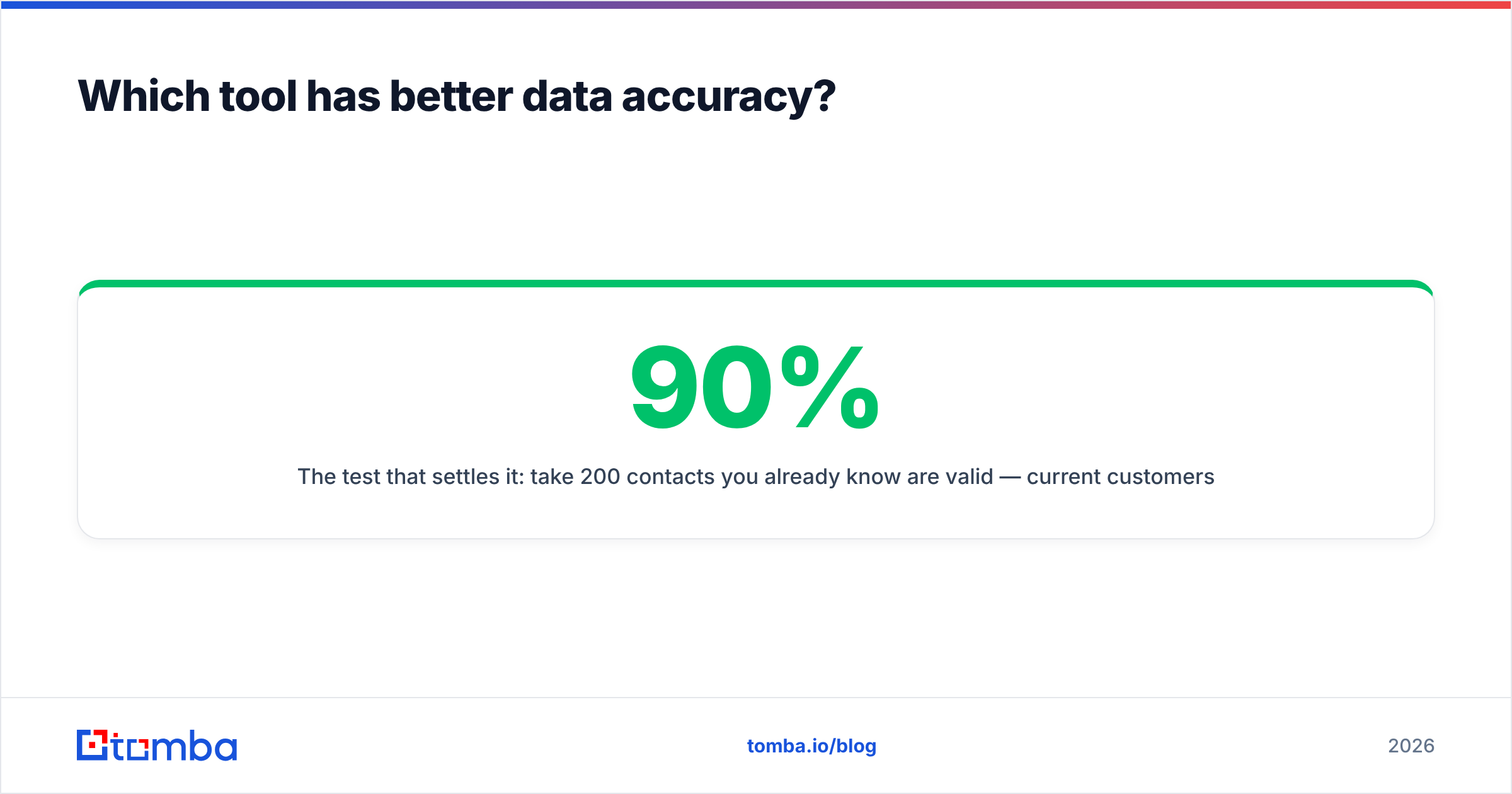
One test settles the GrowMeOrganic vs Interseller data argument. Take 200 contacts you already know are valid: current customers, past deals, people who have replied to you. Run them through each tool. Then measure three things. Hit rate, meaning did it return anything at all. Accuracy, meaning was the answer right. And confidence, meaning when the tool said "high confidence," was it actually right?
A tool that returns 90% of your list at 60% accuracy is worse than one returning 60% at 95%. The first one burns your sending domain.
How does the pricing actually compare?#
This is where the two diverge hardest. It is also where most teams make the wrong call.
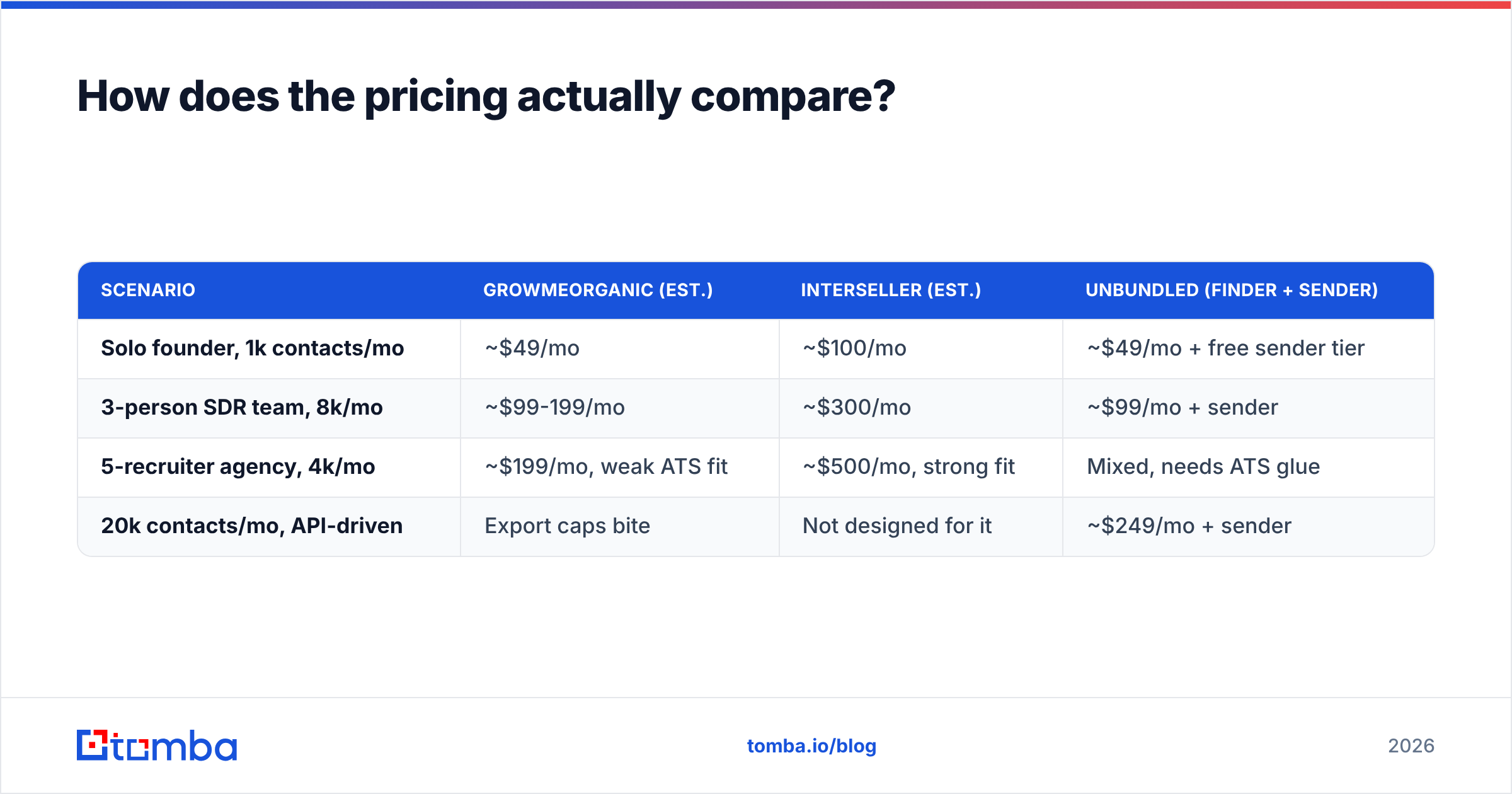
GrowMeOrganic sells flat plans. You pay a monthly fee and get an export ceiling. For a two-person team running 3,000 prospects a month, that is genuinely cheap. The catch is that unverified contacts count against your cap. At a 30% bad-data rate, you pay for 3,000 exports and reach 2,100 real people.
Interseller sells seats. At roughly $100 per user per month, a five-recruiter team pays $500/mo before any volume discussion. That is fair when one placement is worth $20k. It is hard to justify for an SDR team sending 10,000 emails a month, because seats do not scale the way credits do.
| Scenario | GrowMeOrganic (est.) | Interseller (est.) | Unbundled (finder + sender) |
|---|---|---|---|
| Solo founder, 1k contacts/mo | ~$49/mo | ~$100/mo | ~$49/mo + free sender tier |
| 3-person SDR team, 8k/mo | ~$99-199/mo | ~$300/mo | ~$99/mo + sender |
| 5-recruiter agency, 4k/mo | ~$199/mo, weak ATS fit | ~$500/mo, strong fit | Mixed, needs ATS glue |
| 20k contacts/mo, API-driven | Export caps bite | Not designed for it | ~$249/mo + sender |
For reference, Tomba pricing runs Free (25 searches/mo), Starter $49/mo, Growth $99/mo, Pro $249/mo, and custom Enterprise. Verification is included rather than sold as a separate line item.
That matters in the third column above. When the finder verifies before it charges you, your cost per usable contact drops even if the sticker price looks the same.

Is GrowMeOrganic or Interseller better for recruiting?#
Interseller, and it is not close.
Recruiting outreach has three requirements a general B2B tool ignores:
- Personal email resolution. Candidates change jobs. A work email that bounces in six weeks is worthless to a recruiter tracking a long relationship.
- ATS write-back. Sourcing activity has to land in Greenhouse, Bullhorn, or Lever on its own. If it does not, your recruiters will either double-enter or stop logging. Both outcomes destroy pipeline reporting.
- Reply detection that stops sequences correctly. Nothing kills a candidate relationship faster than step 3 arriving after they already replied. Interseller's reply handling is one of its most consistently praised features.
GrowMeOrganic can technically do candidate outreach. It will feel like using a spreadsheet as an ATS: possible, brittle, and eventually abandoned.
Is GrowMeOrganic or Interseller better for B2B sales?#
GrowMeOrganic, on cost. But check the data quality before you commit to an annual plan.
The B2B sales workflow is different. You need company-level filters, domain-level discovery (find everyone in marketing at these 200 accounts), and volume that makes per-seat pricing absurd. GrowMeOrganic's domain search-style discovery and flat plans map to that shape. Interseller's per-seat model does not.
The catch is deliverability. Your finder returns bad addresses. Your sender ships them anyway, inside one product, with no verification gate in between. That is how you burn a sending domain. Google and Yahoo's bulk sender rules, in force since 2024, cap spam complaints at 0.3%. A 15% bounce rate on a cold list gets you throttled long before that. Read Google's sender guidelines once, properly. It is the highest-ROI 10 minutes in outbound.
That is the actual lesson of this comparison. Teams spend weeks A/B testing subject lines while one in five addresses on their list does not exist. The list caps the reply rate, no matter what the subject line says. Fix the data layer first. Everything downstream is gated by it: response rate, sender reputation, meetings booked.
What are the real weaknesses of each tool?#
GrowMeOrganic's weak points:
- Bounce rates run high enough that most users add a second verification pass. That pass was supposed to be included.
- Support responsiveness is the most frequent complaint in public reviews.
- The built-in sender works, but it is thin next to dedicated platforms. Warmup is limited, analytics are basic, and there is no real inbox rotation strategy.
- A long lifetime-deal history left a large legacy user base on grandfathered terms. That sometimes shows up as inconsistent feature access.
Interseller's weak points:
- Price per seat rules out volume outbound entirely.
- After the acquisition, the roadmap serves Greenhouse's platform strategy. Standalone buyers are no longer the priority customer.
- Weak fit for non-recruiting use cases, despite occasional marketing to sales teams.
- Less transparent pricing. Expect a sales conversation rather than a checkout page.
Shared weakness: bundling. When your finder and your sender are the same vendor, a data quality problem becomes a migration project. Teams that keep those layers separate can swap a data provider in an afternoon. Sequences, templates, and warmed mailboxes stay untouched.
Should you unbundle instead?#
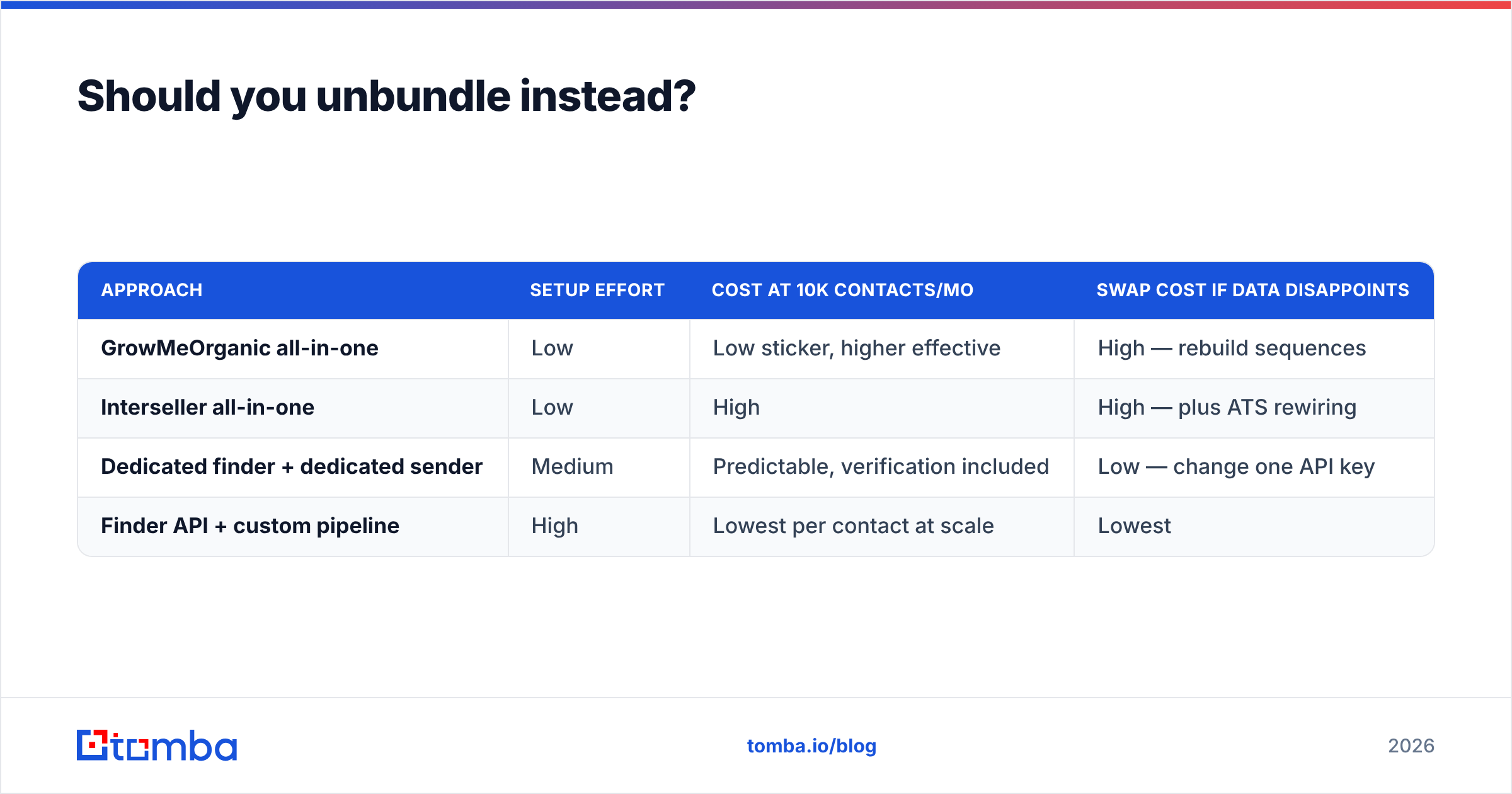
Run this arithmetic before you sign either contract.
| Approach | Setup effort | Cost at 10k contacts/mo | Swap cost if data disappoints |
|---|---|---|---|
| GrowMeOrganic all-in-one | Low | Low sticker, higher effective | High — rebuild sequences |
| Interseller all-in-one | Low | High | High — plus ATS rewiring |
| Dedicated finder + dedicated sender | Medium | Predictable, verification included | Low — change one API key |
| Finder API + custom pipeline | High | Lowest per contact at scale | Lowest |
The unbundled path costs you roughly a day of setup. What you buy is the freedom to switch. Point a bulk email finder at your account list. Gate every result through an email verifier before it reaches your sender. Then let your sequencer do the one job it is good at. If the data provider underperforms next quarter, you replace it without touching a single sequence.
For engineering-led teams, the Tomba API removes the UI entirely. Enrich on form submit, on CRM record creation, or inside whatever pipeline already runs your GTM motion.
GrowMeOrganic vs Interseller: which should you choose?#
- You recruit and live in Greenhouse, Bullhorn, or Lever: Interseller. The ATS sync and personal-email resolution justify the seat price.
- You run B2B outbound on a tight budget and can live with a verification pass: GrowMeOrganic, on a monthly plan first. Do not commit annually until you have measured bounce rate on your own list for 30 days.
- You need data quality above all, or you are past 5,000 lookups a month: unbundle. A dedicated finder with verification built in, plus your preferred sender, costs less per usable contact and locks you into nothing.
- You are not sure yet: run the 200-contact accuracy test described above against all three options. It takes an hour. It is the only evidence that matters.
Ready to test the data layer on its own?#
Before you commit to a bundled platform, find out what your list quality actually looks like. Tomba Email Finder gives you 25 free searches a month, no card needed. Verification is included in every result rather than sold back to you as an add-on.
Run your 200 known-good contacts through it. Compare the hit rate and accuracy against whatever GrowMeOrganic or Interseller returns on the same list. Then let the numbers pick your stack. If the data holds up, plans start at $49/mo and scale to API-driven volume without per-seat math.
Sources: growmeorganic.com, interseller.io, g2.com, Google bulk sender guidelines
Related guides#
Ready to find emails that actually work?
Join 150,000+ professionals who stopped guessing and started sending. Free credits on signup — no credit card required.
Get the Tomba newsletter
Practical outbound tactics and product updates — once every two weeks.
About the author