GrowMeOrganic vs LakeB2B (2026): Which B2B Data Tool Wins?
One sells you software with a credit meter. The other sells you a spreadsheet with an invoice. Here is how GrowMeOrganic and LakeB2B actually compare on pricing, data quality, and who each one is really built for.
GrowMeOrganic vs LakeB2B is not a fair fight, because they are not the same kind of product. One is software you drive yourself. The other is a data service that builds lists for you. This guide compares both on price, data quality, and fit.
TL;DR
- They are not the same category. GrowMeOrganic is self-serve prospecting software: LinkedIn scraping, email finding, sending sequences. LakeB2B is a managed data provider that sells custom-built contact lists on a quote.
- Pricing works differently. GrowMeOrganic is a flat monthly subscription with credit limits. LakeB2B is a per-record or per-project quote. Your cost depends on how narrow your ICP is.
- Accuracy is the real decision. Scraped-then-verified data goes stale between refreshes. Compiled database data can be resold and over-mailed. They fail in different ways.
- If you already have a target list, an API-first email finder plus a verifier is usually cheaper than either. You pay per lookup, not per seat or per record.
- Rule of thumb: GrowMeOrganic suits a small SDR team running LinkedIn-sourced outbound. LakeB2B suits enterprise or healthcare list buys where you need volume you cannot scrape.
GrowMeOrganic vs LakeB2B: what each one actually is#
They solve the same problem — get me contactable buyers. They just start from opposite ends.
GrowMeOrganic is an all-in-one prospecting suite for SMB sales and agency teams. You install a Chrome extension. You scrape leads from LinkedIn or Sales Navigator. You enrich them with work emails and phone numbers. Then you push them into a built-in email sequencer. It prices itself against Apollo and Lusha. The main hook is unlimited email sending on paid plans, rather than per-email metering.
LakeB2B is a data vendor, not a software product. You tell their team who you want: job titles, SIC codes, revenue bands, technology installs, healthcare specialty. NPI-level targeting is one of their better-known offerings. Their team then builds the list and delivers it as a CSV or a CRM push. There is no dashboard where you run your own searches at 11pm. There is a rep, a scoping call, and a quote.
That single difference drives everything else in the GrowMeOrganic vs LakeB2B choice. It sets how you buy, how fast you start, what happens when the data is wrong, and what you pay per usable contact.
How the two business models differ#
Get the shape of each deal right before you compare feature lists. These six differences explain most of the friction buyers hit.
- Buying motion — GrowMeOrganic is credit-card self-serve with a free trial. You can be scraping in ten minutes. LakeB2B is a sales-led quote with a scoping call and a minimum order.
- Unit of cost — GrowMeOrganic charges per seat per month with credit caps. LakeB2B charges per record or per project. A 5,000-contact niche list can cost more per name than a 50,000-contact broad one.
- Who does the work — With GrowMeOrganic, you build the list. With LakeB2B, their research team does. That is the whole value proposition when your ICP is hard to filter for.
- Refresh cadence — Self-serve tools re-verify at lookup time. Compiled databases refresh on their own schedule. Your file is only as fresh as their last pass, not as fresh as your purchase date.
- Exclusivity — People forget this one. A list you bought is not a list only you have. The same records often go to competitors in your space. Software-generated lists are at least yours to build.
- Failure mode — GrowMeOrganic fails as bounced sends you spot in your inbox. LakeB2B fails as a replacement-credit negotiation with an account manager, weeks later.

What does each one cost in 2026?#
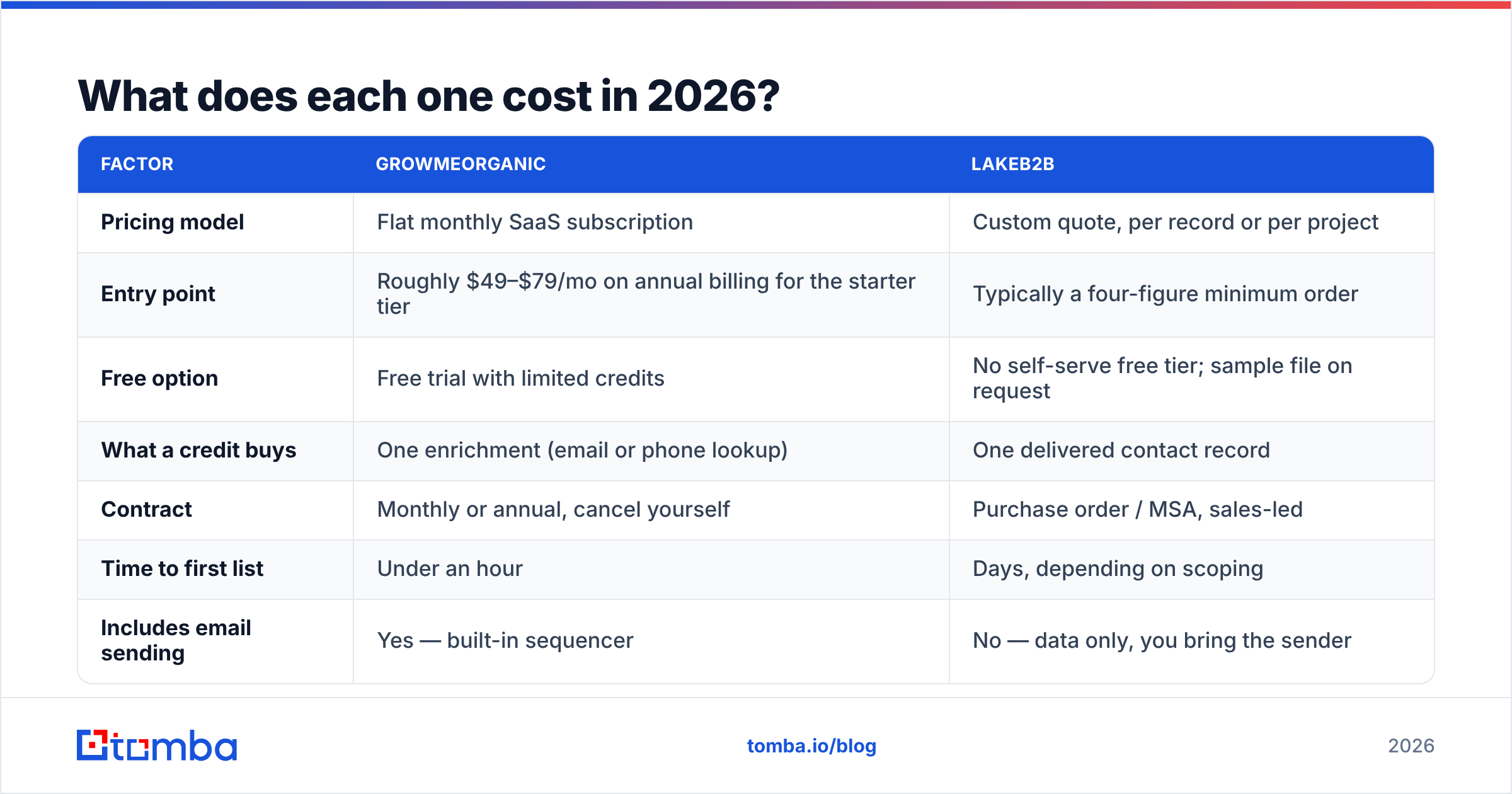
Published pricing moves. LakeB2B does not publish a rate card at all. So treat this as a shape-of-the-deal comparison, not a quote. Confirm current numbers on the vendor's own page before you commit.
| Factor | GrowMeOrganic | LakeB2B |
|---|---|---|
| Pricing model | Flat monthly SaaS subscription | Custom quote, per record or per project |
| Entry point | Roughly $49–$79/mo on annual billing for the starter tier | Typically a four-figure minimum order |
| Free option | Free trial with limited credits | No self-serve free tier; sample file on request |
| What a credit buys | One enrichment (email or phone lookup) | One delivered contact record |
| Contract | Monthly or annual, cancel yourself | Purchase order / MSA, sales-led |
| Time to first list | Under an hour | Days, depending on scoping |
| Includes email sending | Yes — built-in sequencer | No — data only, you bring the sender |
| Best-fit team size | 1–20 reps | Mid-market to enterprise, or agencies buying in bulk |
The honest math is simple. Do you need 2,000 contacts a month with a sending stack already in place? Then GrowMeOrganic's subscription is almost certainly cheaper. Do you need 80,000 healthcare decision-makers filtered by specialty and facility size? No self-serve tool will assemble that for you, and LakeB2B's quote starts to look fair per name.
There is a third path most teams skip: pay per lookup. If you already know which companies you want, a domain search plus an email finder gets you the same contacts. No seat license. No minimum order. Compare that against Tomba pricing. The free tier gives you 25 searches a month, Starter is $49/mo, Growth $99/mo, Pro $249/mo. You can then benchmark cost per verified contact directly instead of guessing.
GrowMeOrganic vs LakeB2B: whose data is more accurate?#
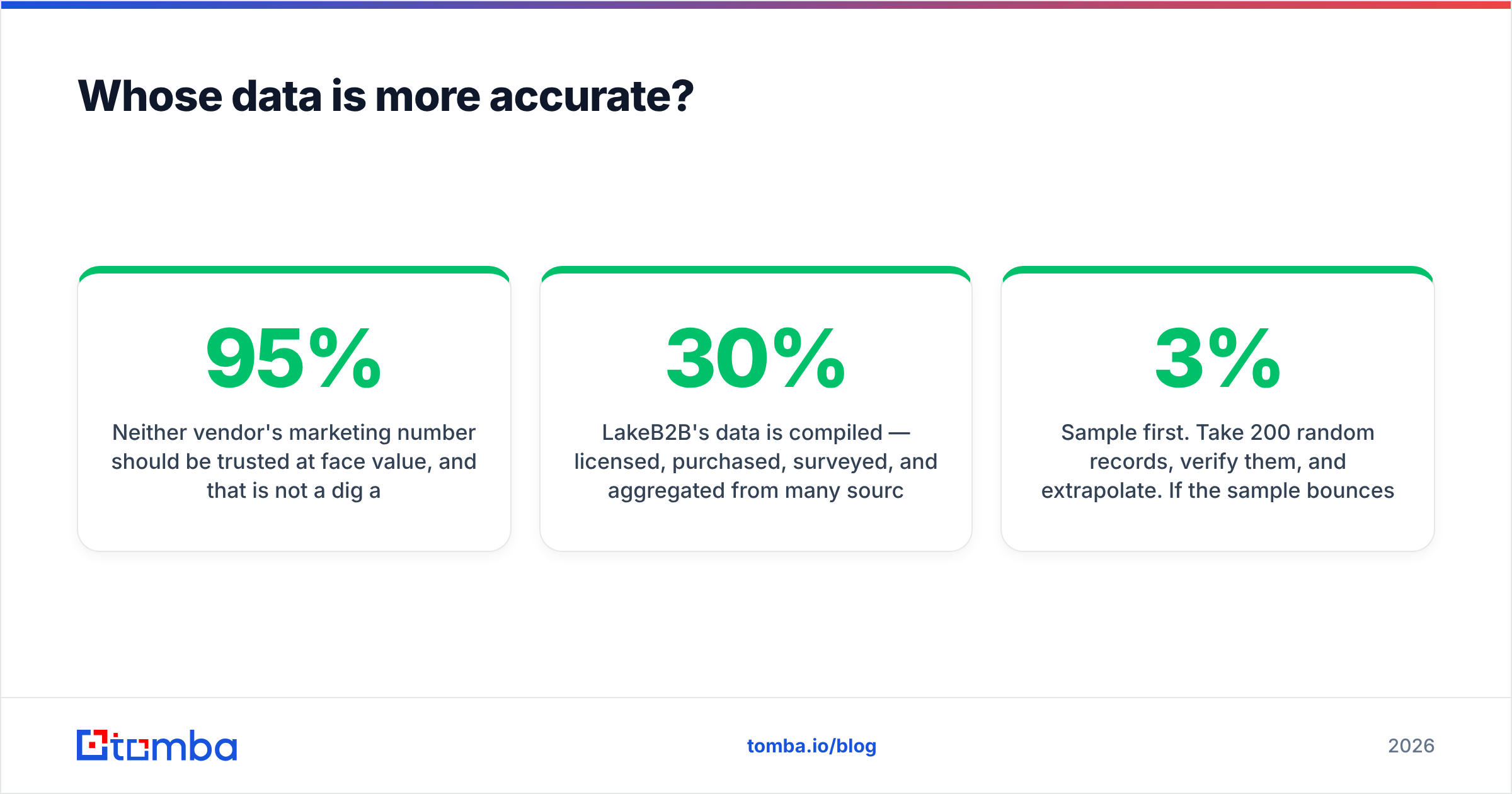
Do not take either vendor's headline number at face value. That is not a dig at them. It is true of the whole category. "95% accuracy" usually means "95% of records passed a syntax and MX check." That is a very different claim from "95% of these people will receive your email."

Here is what actually drives the gap between the two approaches.
GrowMeOrganic's data is built at request time. Profile data gets scraped, matched against email patterns, then verified before delivery. The upside is freshness. If the person changed jobs last month, a fresh scrape reflects it. The downside is coverage. Pattern-based finding works well for companies with predictable formats. It works poorly for small firms, catch-all domains, and anyone on a non-obvious alias.
LakeB2B's data is compiled. It is licensed, purchased, surveyed, and aggregated from many sources, then cleaned. The upside is reach into segments you cannot scrape, especially regulated verticals. The downside is decay. B2B contact data degrades at roughly 22–30% per year through job changes alone. So a compiled record is only as good as its last refresh pass.
Whichever side of the GrowMeOrganic vs LakeB2B split you land on, run your own verification pass before sending. That single step does more for deliverability than any vendor guarantee:
- Bounce-test the file with an email verifier before it touches your sequencer.
- Isolate catch-all domains. They pass a basic SMTP check and still bounce. A dedicated catch-all verifier separates "probably fine" from "unknown".
- Sample first. Verify 200 random records and extrapolate. If the sample bounces above 3%, renegotiate before you buy the other 20,000.
- Watch your sender reputation for two weeks after a new list goes live, not two days.
Which tool wins for your use case?#
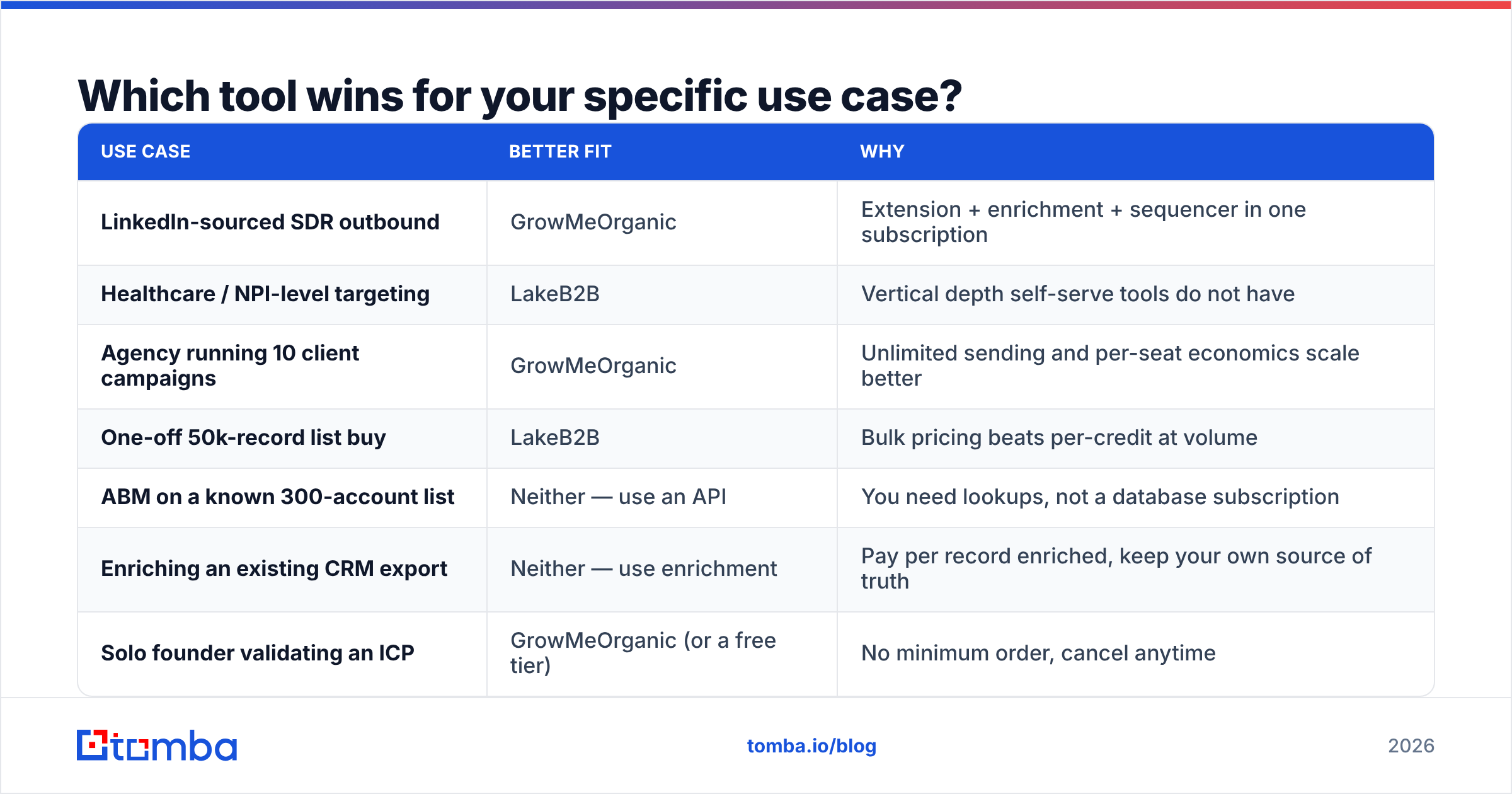
The category comparison only matters until you name your actual job. Here is the head-to-head by scenario.
| Use case | Better fit | Why |
|---|---|---|
| LinkedIn-sourced SDR outbound | GrowMeOrganic | Extension + enrichment + sequencer in one subscription |
| Healthcare / NPI-level targeting | LakeB2B | Vertical depth self-serve tools do not have |
| Agency running 10 client campaigns | GrowMeOrganic | Unlimited sending and per-seat economics scale better |
| One-off 50k-record list buy | LakeB2B | Bulk pricing beats per-credit at volume |
| ABM on a known 300-account list | Neither — use an API | You need lookups, not a database subscription |
| Enriching an existing CRM export | Neither — use enrichment | Pay per record enriched, keep your own source of truth |
| Solo founder validating an ICP | GrowMeOrganic (or a free tier) | No minimum order, cancel anytime |
| Regulated EU outbound (GDPR) | Depends on documentation | Ask both for lawful-basis and source documentation in writing |

The two rows worth staring at are the "neither" ones. A large share of teams weighing GrowMeOrganic vs LakeB2B need neither product. They have already identified their accounts. They just need contact details for them. That is a lookup problem, not a database problem. Run your account list through a bulk email finder, or wire the Tomba API into your enrichment job. It costs a fraction of either subscription, and you never inherit someone else's stale file.

Where does each one fall short?#
GrowMeOrganic's weak spots:
- Coverage drops outside North America and Western Europe. It also drops outside standard corporate email patterns.
- The built-in sequencer is convenient but thin. Deliverability controls, inbox rotation, and reporting lag behind Instantly or Smartlead.
- Some workflows consume credits on attempts. A low-hit-rate list then burns budget without producing contacts. Check the current credit policy before you plan a month's volume.
- Support is documentation and tickets, not an account manager. Fine at $49/mo. Frustrating at scale.
LakeB2B's weak spots:
- There is no self-serve option. You cannot evaluate the product without talking to sales, which is a real cost when you only want to test 500 records.
- You are buying a snapshot. The file is accurate on delivery day and decaying from that moment. Ongoing freshness is a separate conversation.
- Exclusivity is not guaranteed. Assume competitors can buy overlapping records.
- Replacement guarantees usually cover hard bounces only. They rarely cover "this person left the company," which is the more common and more expensive failure.
Both vendors have real, positive reviews from customers who bought the right thing. Read them on G2 with the reviewer's company size and use case visible. A 12-person agency's review of a list broker tells you little about a 200-rep enterprise team. The reverse is just as true.
What alternatives should you shortlist?#
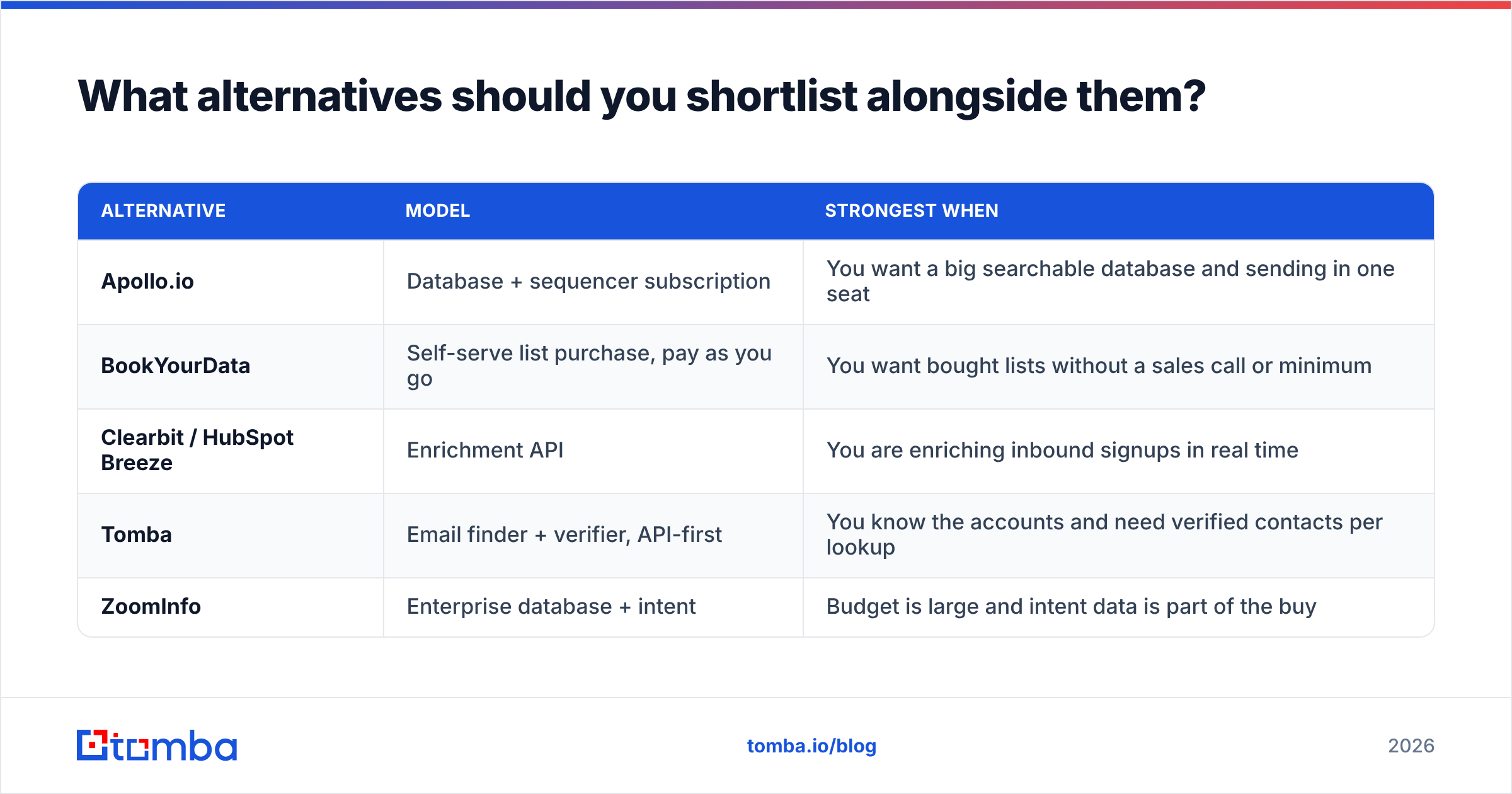
Do not run a two-horse race. The category has a dozen credible options with different cost structures.
| Alternative | Model | Strongest when |
|---|---|---|
| Apollo.io | Database + sequencer subscription | You want a big searchable database and sending in one seat |
| BookYourData | Self-serve list purchase, pay as you go | You want bought lists without a sales call or minimum |
| Clearbit / HubSpot Breeze | Enrichment API | You are enriching inbound signups in real time |
| Tomba | Email finder + verifier, API-first | You know the accounts and need verified contacts per lookup |
| ZoomInfo | Enterprise database + intent | Budget is large and intent data is part of the buy |
BookYourData deserves a mention if LakeB2B's sales-led motion is what puts you off. It delivers the same "buy a targeted list" outcome with transparent self-serve pricing. You keep the vertical filtering and lose the scoping-call bottleneck.
If your objection to GrowMeOrganic is the opposite one — you want the finding without the bundled sequencer — go leaner. A standalone email finder plus your existing sending tool covers it.
How should you run the evaluation?#
Give yourself two weeks and a fixed test set. This process produces a defensible answer instead of a vibe.
- Define one narrow ICP. Say, VP Marketing at 50–200 employee SaaS companies in the US. Not three ICPs. One.
- Pull 300 target companies into a spreadsheet before you touch any vendor. This is your control set.
- Ask each vendor for the same 300 companies. Match rate on identical input is the only fair comparison. A vendor's self-reported database size is not.
- Verify every delivered record with a neutral third-party verifier, not the vendor's own. Record valid, catch-all, and invalid counts separately.
- Compute cost per verified contact. Not cost per credit. Not cost per record. This number often reverses the ranking you expected.
- Send to a 100-record sample from each. Watch bounce rate and reply rate over 10 days. Data that verifies clean but never replies is a targeting problem, not a data problem.
Most teams that run this test find the same thing. The gap between vendors is smaller than the gap between "verified before sending" and "sent straight from the CSV."
GrowMeOrganic vs LakeB2B: the bottom line#
GrowMeOrganic wins when you want to build lists yourself, cheaply, this afternoon. LakeB2B wins when your ICP lives in a vertical you cannot scrape and you need someone to assemble it at volume. Neither wins when you already know your accounts. That is a lookup job, and paying subscription or brokerage prices for it is the most common overspend in outbound.
If that last case is yours, start with the Tomba Email Finder. Run your 300-company control set through it. Verify the output. Compare cost per verified contact against whatever quote is sitting in your inbox. The free tier covers 25 searches a month, Starter is $49/mo, and the API drops into the enrichment job you already built. That way you settle GrowMeOrganic vs LakeB2B with your own numbers instead of anyone's marketing page.
Related guides#
Ready to find emails that actually work?
Join 150,000+ professionals who stopped guessing and started sending. Free credits on signup — no credit card required.
Get the Tomba newsletter
Practical outbound tactics and product updates — once every two weeks.
About the author