GrowMeOrganic vs LeadsRush (2026): Which Lead Tool Wins?
GrowMeOrganic bundles scraping, enrichment and sending. LeadsRush sells volume lists. We break down data accuracy, pricing, export limits and which one actually belongs in your 2026 outbound stack.
TL;DR
- GrowMeOrganic is an all-in-one suite: LinkedIn/Sales Navigator scraping, a built-in B2B database, email finding, and a sending engine bundled under one seat-based subscription.
- LeadsRush sits closer to the volume-list end of the market: fast bulk pulls, export-first workflow, cheaper per record, thinner on native sending and CRM depth.
- Neither is primarily an accuracy-first email vendor. If bounce rate is your bottleneck, you will end up bolting a dedicated verifier onto whichever one you pick.
- Pick GrowMeOrganic if you want one tool for scrape → enrich → send. Pick LeadsRush if you already own a sequencer and just need records cheaply.
- The most common 2026 setup we see: one prospecting source + a dedicated finder/verifier layer (Tomba, ZeroBounce, or similar) sitting between the list and the mailbox.
What are GrowMeOrganic and LeadsRush, actually?#
They solve overlapping problems from opposite directions.
GrowMeOrganic is an all-in-one B2B prospecting platform. You install a Chrome extension, scrape LinkedIn or Sales Navigator results, pull contacts from an internal database of tens of millions of records, find and verify emails, then run drip campaigns from the same dashboard. Pricing is seat-and-plan based with unlimited-ish credit framing on higher tiers, which is a strong pitch for solo founders and small agencies that don't want four subscriptions.
LeadsRush is a leaner lead-data play. The core promise is speed and volume: filter, pull, export. It leans on bulk record delivery rather than a full sequencing suite, which makes it a natural fit for teams that already run Instantly, Smartlead, Lemlist or Salesloft and only need the raw contacts flowing in.
The practical distinction matters more than the feature checklists:
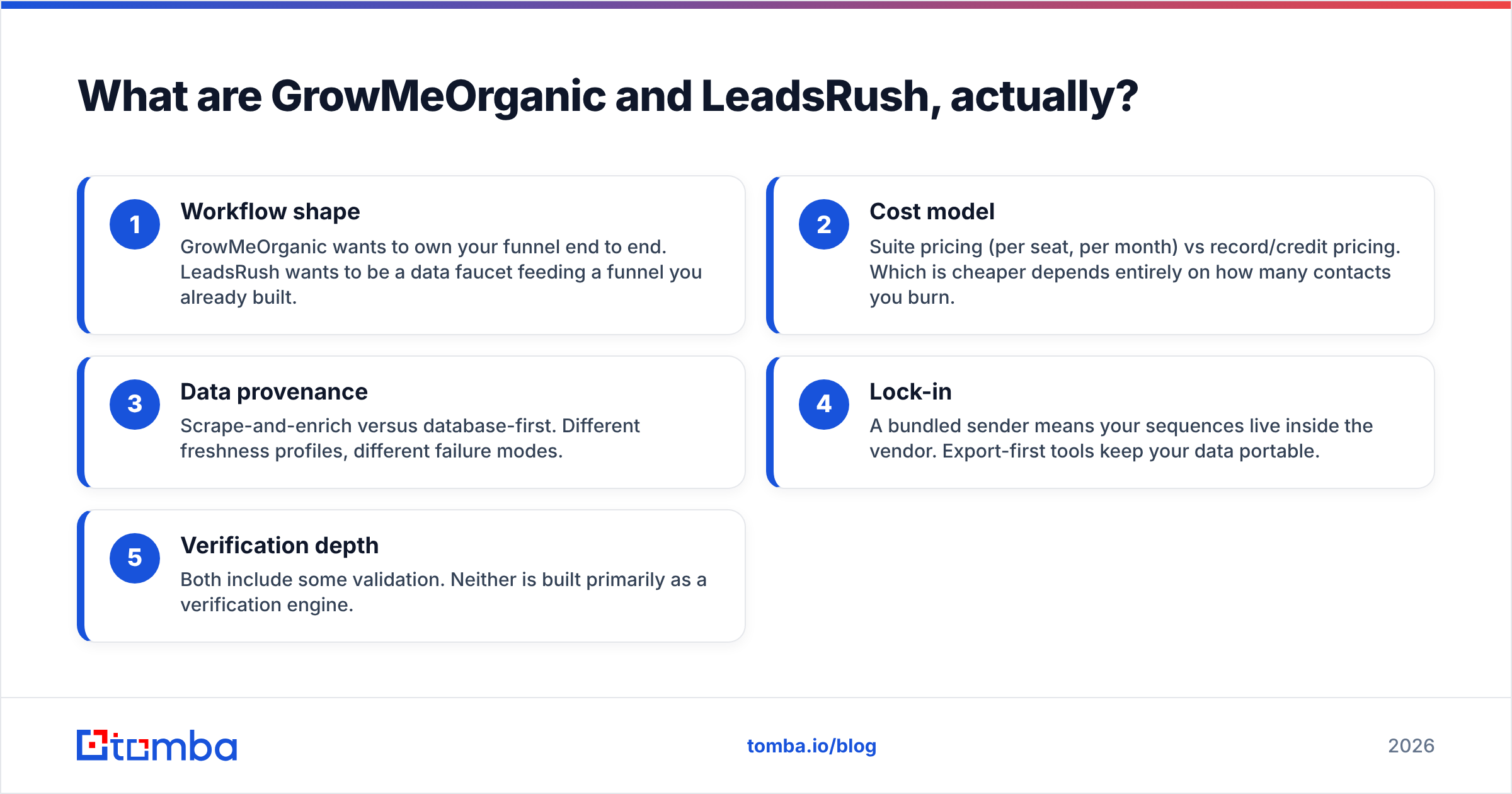
- Workflow shape — GrowMeOrganic wants to own your funnel end to end. LeadsRush wants to be a data faucet feeding a funnel you already built.
- Cost model — Suite pricing (per seat, per month) vs record/credit pricing. Which is cheaper depends entirely on how many contacts you burn.
- Data provenance — Scrape-and-enrich versus database-first. Different freshness profiles, different failure modes.
- Lock-in — A bundled sender means your sequences live inside the vendor. Export-first tools keep your data portable.
- Verification depth — Both include some validation. Neither is built primarily as a verification engine.

How do GrowMeOrganic and LeadsRush compare head to head?#
Here is the practical comparison. Treat pricing as directional — both vendors adjust tiers, and you should confirm current numbers on their own pages before you buy.
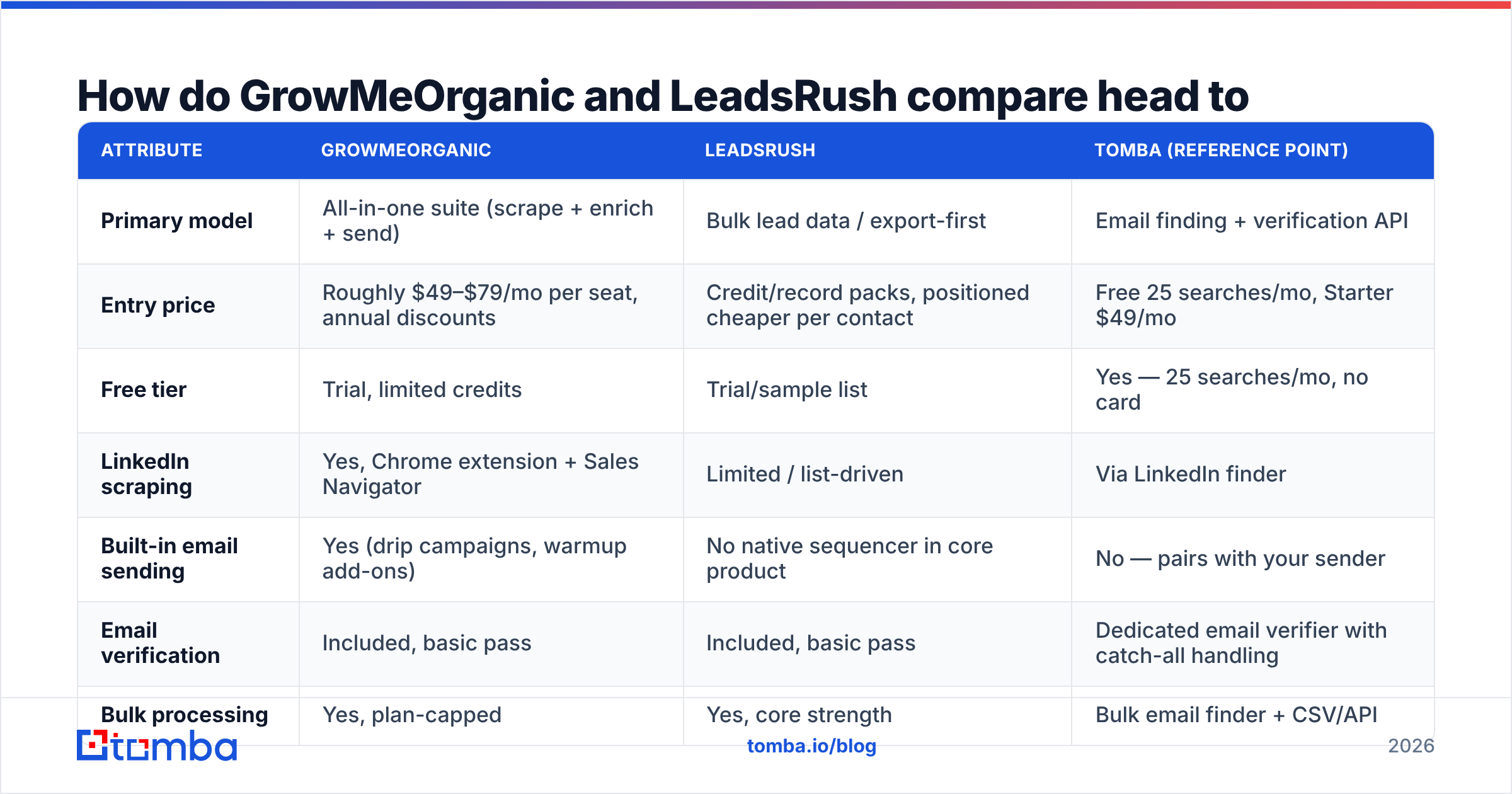
| Attribute | GrowMeOrganic | LeadsRush | Tomba (reference point) |
|---|---|---|---|
| Primary model | All-in-one suite (scrape + enrich + send) | Bulk lead data / export-first | Email finding + verification API |
| Entry price | Roughly $49–$79/mo per seat, annual discounts | Credit/record packs, positioned cheaper per contact | Free 25 searches/mo, Starter $49/mo |
| Free tier | Trial, limited credits | Trial/sample list | Yes — 25 searches/mo, no card |
| LinkedIn scraping | Yes, Chrome extension + Sales Navigator | Limited / list-driven | Via LinkedIn finder |
| Built-in email sending | Yes (drip campaigns, warmup add-ons) | No native sequencer in core product | No — pairs with your sender |
| Email verification | Included, basic pass | Included, basic pass | Dedicated email verifier with catch-all handling |
| Bulk processing | Yes, plan-capped | Yes, core strength | Bulk email finder + CSV/API |
| API access | On higher tiers | Varies by plan | Full Tomba API on all paid tiers |
| Best for | Solo founders, small agencies wanting one bill | Teams with an existing sequencer needing volume | Teams that need deliverable addresses at scale |
The table exposes the real trade. GrowMeOrganic charges more per seat but folds three product categories into one line item. LeadsRush charges less per record but assumes you already pay for sending, warmup and CRM elsewhere. Add those subscriptions back and the "cheaper" option often isn't.
Which one has better data accuracy?#
Neither vendor publishes an independently audited accuracy figure, and you should be suspicious of any comparison post that claims a precise percentage for both. What you can evaluate is methodology, and the methodologies differ.
GrowMeOrganic's strongest data comes from scraped LinkedIn profiles enriched against its database. Freshness on scraped records is good — you're pulling a profile that exists right now — but email inference quality depends on pattern-matching plus SMTP checks. Job-change decay is the usual culprit when bounces spike.
LeadsRush leans on database pulls. Database records are cheap and fast, but a static database ages. A record filtered in 2026 might have been collected in 2024. That's the classic volume-list trade-off, and it's why per-record pricing looks so attractive.

Two things reliably move accuracy in the real world, regardless of which vendor you pick:
- Catch-all domains. Roughly a fifth of B2B domains accept every address at the SMTP layer, which means a naive verifier marks them "valid" and your bounce shows up three days later. A catch-all verifier that scores confidence instead of returning a binary is the difference between a 2% and a 9% bounce rate.
- Verification recency. A list verified 60 days ago is not a verified list. Re-verify immediately before send, not at export time.
If you want the honest framing: use GrowMeOrganic or LeadsRush to source prospects, then run the export through a dedicated verification layer before it touches a mailbox. That's not a Tomba pitch — it's what every deliverability-conscious team does with any list vendor, including the ones we like.
How should you think about pricing?#
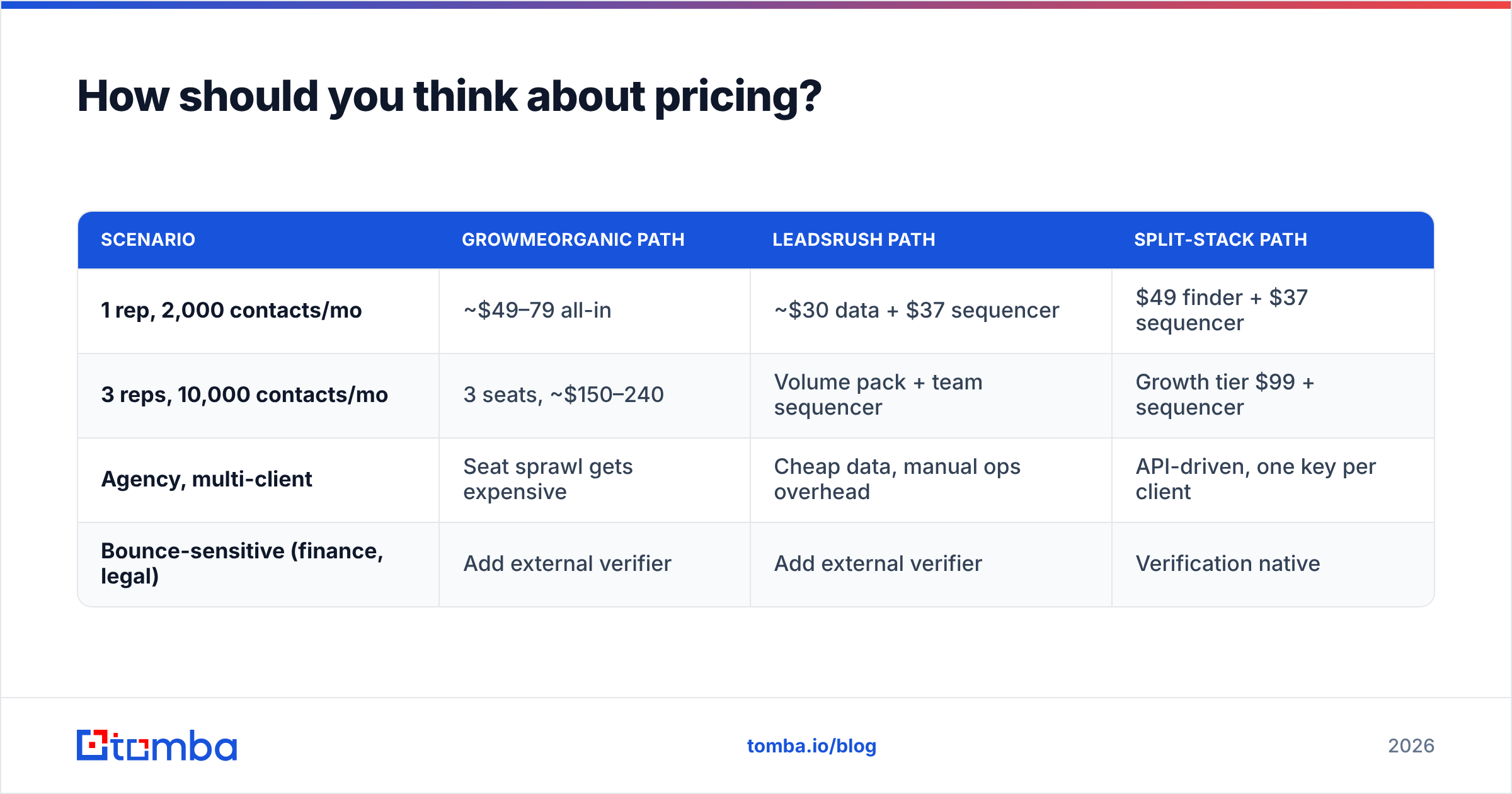
Run the math on cost-per-usable-contact, not cost-per-record. A $0.02 record with a 15% bounce rate is more expensive than a $0.05 record at 2%, once you price in domain reputation damage.
| Scenario | GrowMeOrganic path | LeadsRush path | Split-stack path |
|---|---|---|---|
| 1 rep, 2,000 contacts/mo | ~$49–79 all-in | ~$30 data + $37 sequencer | $49 finder + $37 sequencer |
| 3 reps, 10,000 contacts/mo | 3 seats, ~$150–240 | Volume pack + team sequencer | Growth tier $99 + sequencer |
| Agency, multi-client | Seat sprawl gets expensive | Cheap data, manual ops overhead | API-driven, one key per client |
| Bounce-sensitive (finance, legal) | Add external verifier | Add external verifier | Verification native |
Three patterns show up consistently:
- Seat-based pricing punishes teams. GrowMeOrganic is excellent value at one seat and gets linear-expensive at five. If you're growing headcount, model year two, not month one.
- Credit-based pricing punishes waste. LeadsRush rewards precise filters. Sloppy ICP definitions burn credits on records you'll never email.
- Bundles hide the sequencer cost. GrowMeOrganic's included sender is genuinely useful, but it's rarely as capable as a dedicated tool like Instantly or Smartlead. If you'd replace it anyway, you're paying twice.
For a broader view of how the category prices itself, G2's lead intelligence category is the least biased public source — vendor pricing pages are marketing, review-site filters are at least crowd-checked.
Is GrowMeOrganic better than LeadsRush for cold outreach?#
For a first-time cold email operator: yes, GrowMeOrganic is the safer pick. One login, one bill, one support queue, and a workflow that walks you from "I have an ICP" to "I sent 200 emails" without stitching four tools together. The learning curve is the shallowest in this comparison.
For an established outbound team: LeadsRush usually wins on unit economics. You've already standardised on a sequencer, you have deliverability monitoring, your reps live in the CRM. What you need is records, cheaply, on a schedule — and paying suite pricing for a sender you'll never open is waste.
There's a third answer that beats both for a specific profile. If your bottleneck is reaching people rather than finding companies — you already know the accounts, you just can't get the addresses — neither of these is the right primary tool. A dedicated domain search against your target account list will produce a tighter, more deliverable output than filtering a general database, because you're starting from intent rather than from a filter.

What does the comparison table look like across the wider market?#
Neither GrowMeOrganic nor LeadsRush exists in a vacuum. Buyers evaluating this pair almost always have Apollo, Lusha, BookYourData or Hunter open in another tab. BookYourData in particular is worth a look if you want pre-verified, purchasable lists with a bounce guarantee — a genuinely different model from both tools here, and a strong one for teams that would rather buy a clean file than run a scraper.

A quick market-positioning read:
- All-in-one suites (GrowMeOrganic, Apollo) — best for teams that value one bill over best-in-class components.
- Volume data providers (LeadsRush, BookYourData) — best when you own the rest of the stack and need records at a predictable cost per contact.
- Precision finders (Tomba, Hunter, Findymail) — best when deliverability is the constraint and you'd rather have 500 clean addresses than 5,000 guesses.
- Enrichment layers (Clearbit-style) — best when you have the contacts already and need firmographics attached.
Most mature stacks in 2026 use two of these, not one. The failure mode we see most often is a team buying an all-in-one, discovering the built-in verifier is a checkbox rather than a product, and then bolting on a second tool anyway — at which point they're paying suite pricing for half a suite.
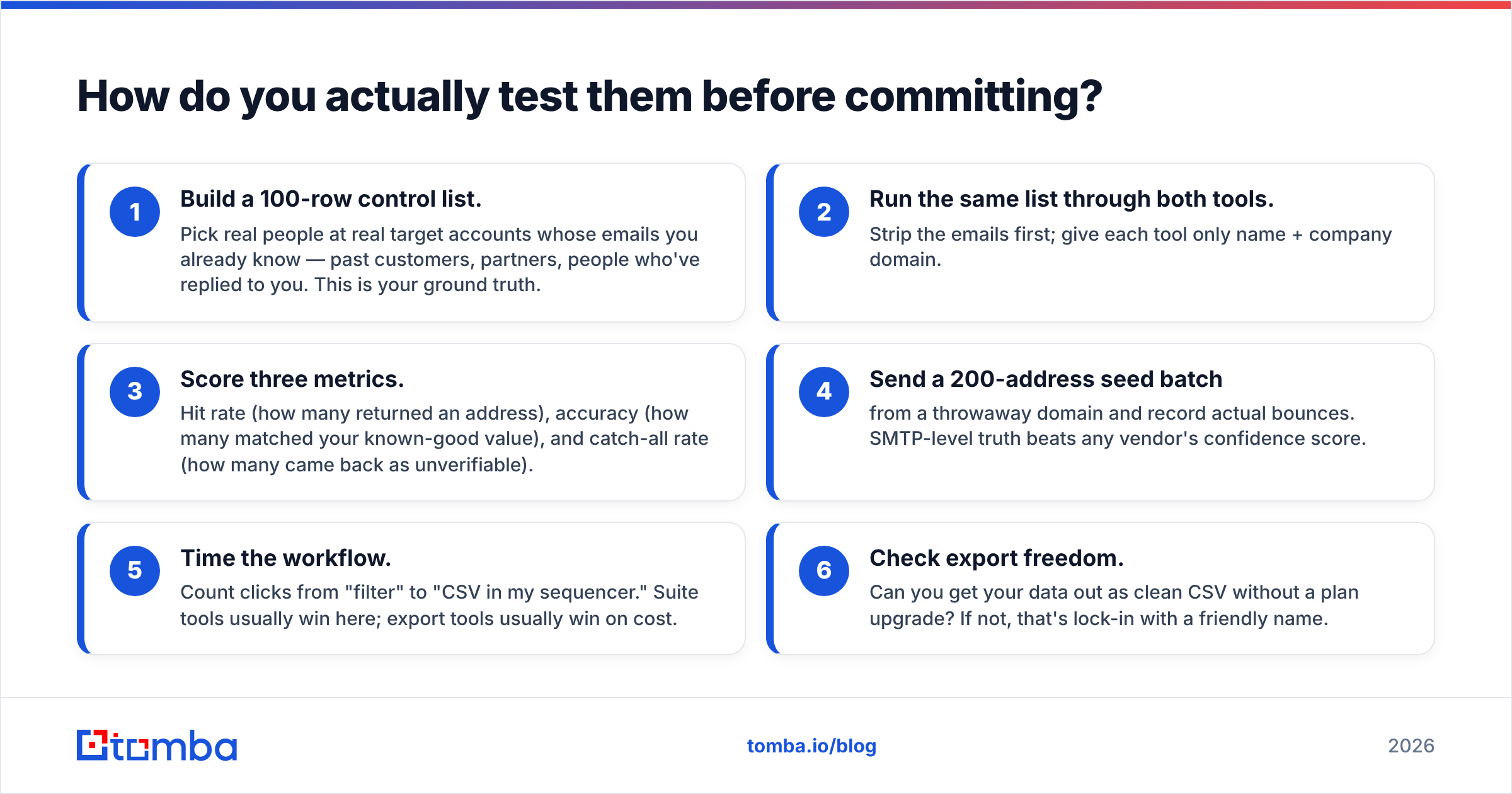
How do you actually test them before committing?#
Don't trust anyone's benchmark, including this one. Run your own in an afternoon:
- Build a 100-row control list. Pick real people at real target accounts whose emails you already know — past customers, partners, people who've replied to you. This is your ground truth.
- Run the same list through both tools. Strip the emails first; give each tool only name + company domain.
- Score three metrics. Hit rate (how many returned an address), accuracy (how many matched your known-good value), and catch-all rate (how many came back as unverifiable).
- Send a 200-address seed batch from a throwaway domain and record actual bounces. SMTP-level truth beats any vendor's confidence score.
- Time the workflow. Count clicks from "filter" to "CSV in my sequencer." Suite tools usually win here; export tools usually win on cost.
- Check export freedom. Can you get your data out as clean CSV without a plan upgrade? If not, that's lock-in with a friendly name.
That test costs you a day and saves you a quarter of bad sending. If you want to shortcut step 1, a free email checker will validate your control list before you use it as ground truth.
One more practical note on CRM hygiene: whichever tool you pick, decide upfront where records land. Pushing raw scraped contacts straight into a shared CRM without a verification gate is how databases rot. Stage them, verify them, then sync.
What's the verdict on GrowMeOrganic vs LeadsRush?#
Choose GrowMeOrganic if you are one to three people, you don't already own a sequencer, and the value of a single unified workflow outweighs the premium you pay for bundled components. It's a genuinely capable product and the fastest path from zero to sent for a non-technical operator.
Choose LeadsRush if you have an existing outbound stack, your cost per contact is a tracked metric, and you want data to flow into tools you've already standardised on. You'll spend more time on ops and less money on seats.
Choose neither as your only tool if deliverability is your actual constraint. Both are sourcing products with verification attached; neither is a verification product with sourcing attached. That distinction is invisible on a feature grid and painfully obvious in your bounce report.
The setup that holds up best across team sizes is boring: one sourcing tool you like, one dedicated finder/verifier in the middle, one sequencer you trust. Keep the layers swappable and no single vendor's roadmap becomes your problem.
Ready to fix the layer that actually breaks? Whichever list source you land on, run every address through the Tomba Email Finder before it hits a mailbox. Start free with 25 searches per month — no card, no seat minimums — and scale to Starter at $49/mo or Growth at $99/mo when your volume justifies it. Full pricing is on the Tomba pricing page, and every tier includes API access so you can wire verification directly into whichever prospecting tool you chose.
Related guides#
Ready to find emails that actually work?
Join 150,000+ professionals who stopped guessing and started sending. Free credits on signup — no credit card required.
Get the Tomba newsletter
Practical outbound tactics and product updates — once every two weeks.
About the author