GrowMeOrganic vs Mystrika: Which B2B Outreach Tool Wins in 2026?
GrowMeOrganic bundles a B2B database with LinkedIn scraping. Mystrika bets everything on inbox placement and unlimited sending. Here is how the two actually compare on data, deliverability, and price.
GrowMeOrganic vs Mystrika comes down to one question. Do you need contacts, or do you need inbox placement?
TL;DR
- GrowMeOrganic is a database-plus-sender bundle. You get a claimed 575M+ B2B contact pool, LinkedIn and Sales Navigator scraping, and a basic cold email sequencer on one flat plan.
- Mystrika is a deliverability-first sender. Unlimited email accounts, a large warmup pool, AI writing, and a lifetime-deal price history. It has no real prospecting database.
- Need contacts? GrowMeOrganic covers more of the job. Need inbox placement at volume? Mystrika is the stronger engine.
- Neither tool is best in class at the other's job. Most teams that scale split the stack: one data source, one sender.
- Verified data decides everything downstream. A 12% bounce list will sink either tool.
What are GrowMeOrganic and Mystrika, actually?#
People compare them constantly. But the two tools solve different halves of the same funnel.
GrowMeOrganic (growmeorganic.com) started as a LinkedIn and Sales Navigator scraper. It then grew into an all-in-one. Pull prospects from LinkedIn, Google Maps, or its own database. Then drop them into a drip sequence without leaving the app. The pitch is coverage: one seat, one flat price, from finding a contact to sending the third follow-up.
Mystrika (mystrika.com) went the other way. It is a cold email sender built around the problem that kills most outbound: landing in the primary inbox. You get unlimited mailboxes, a warmup network of hundreds of thousands of accounts, mailbox rotation, a unified inbox, and AI copy help. It assumes you already have a list.
That gap is the whole comparison. Ask "which is better" without naming the half you are missing, and the answer is useless.
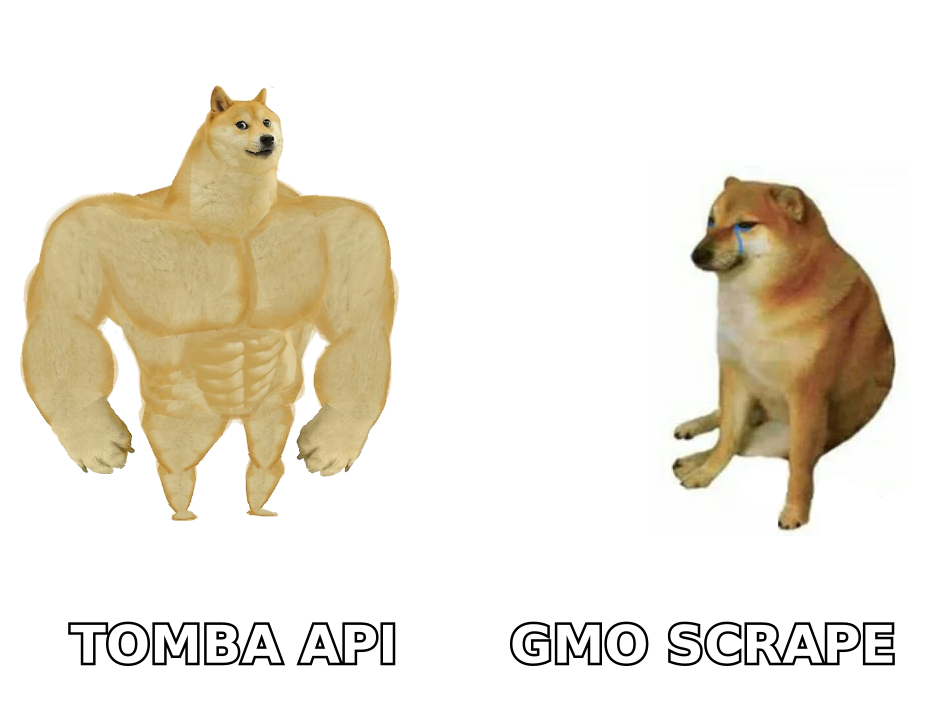
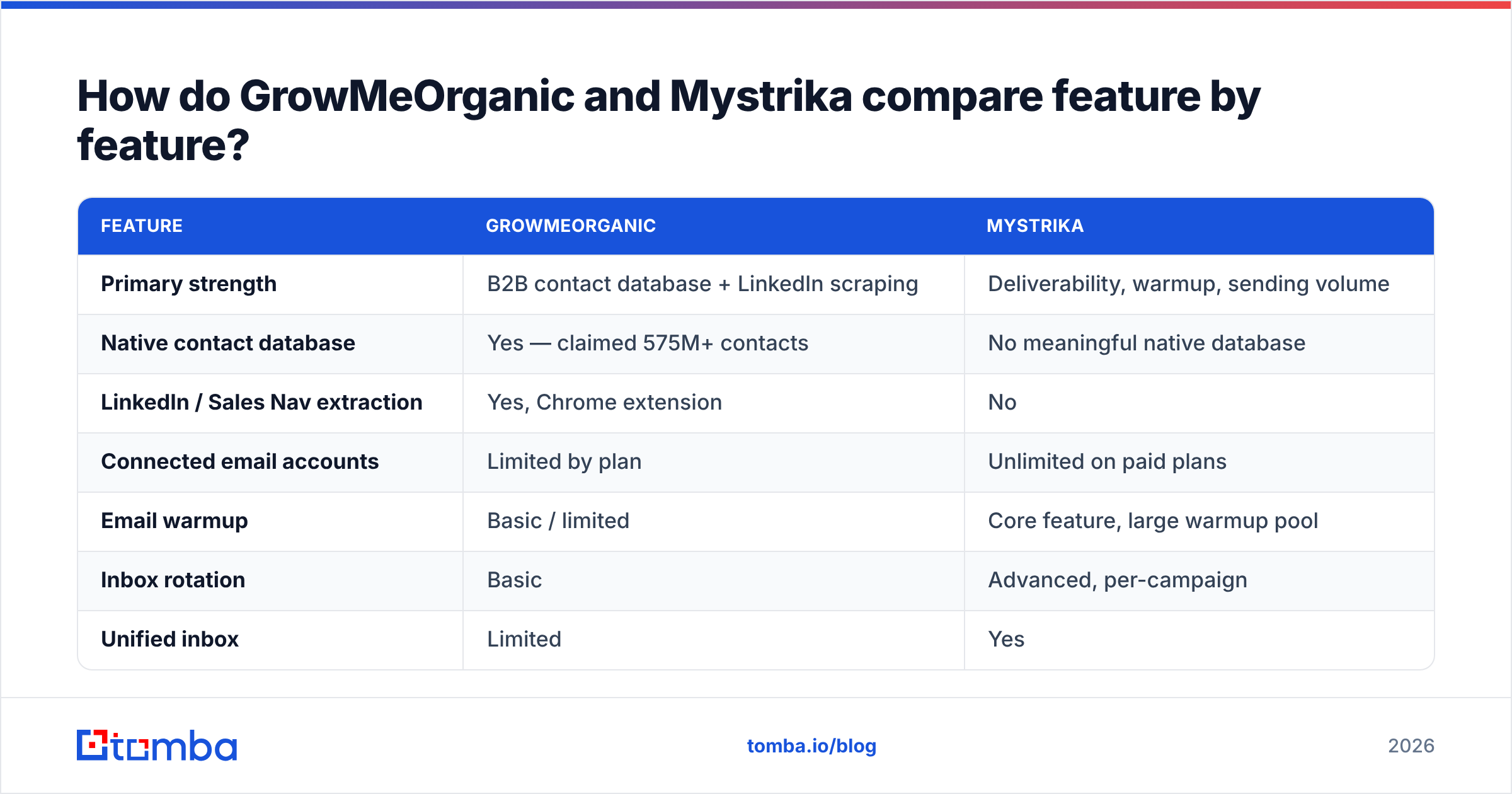
GrowMeOrganic vs Mystrika: a feature-by-feature comparison#
| Feature | GrowMeOrganic | Mystrika |
|---|---|---|
| Primary strength | B2B contact database + LinkedIn scraping | Deliverability, warmup, sending volume |
| Native contact database | Yes — claimed 575M+ contacts | No meaningful native database |
| LinkedIn / Sales Nav extraction | Yes, Chrome extension | No |
| Connected email accounts | Limited by plan | Unlimited on paid plans |
| Email warmup | Basic / limited | Core feature, large warmup pool |
| Inbox rotation | Basic | Advanced, per-campaign |
| Unified inbox | Limited | Yes |
| AI copy assistance | Basic templates | Yes, built-in AI writer |
| Email verification | Bundled, quality varies | Bundled, quality varies |
| Typical entry price | ~$49–$79/mo (annual discounts) | Lifetime-deal history, ~$0–$100+ tiers |
| Best for | Solo founders needing leads + sending in one tab | Agencies and teams sending at real volume |
The table exposes the trap. Both tools claim "all-in-one." Both are genuinely strong on exactly one axis. GrowMeOrganic's sender is fine, not great. Mystrika's data layer is thin, so most users bring their own lists anyway.
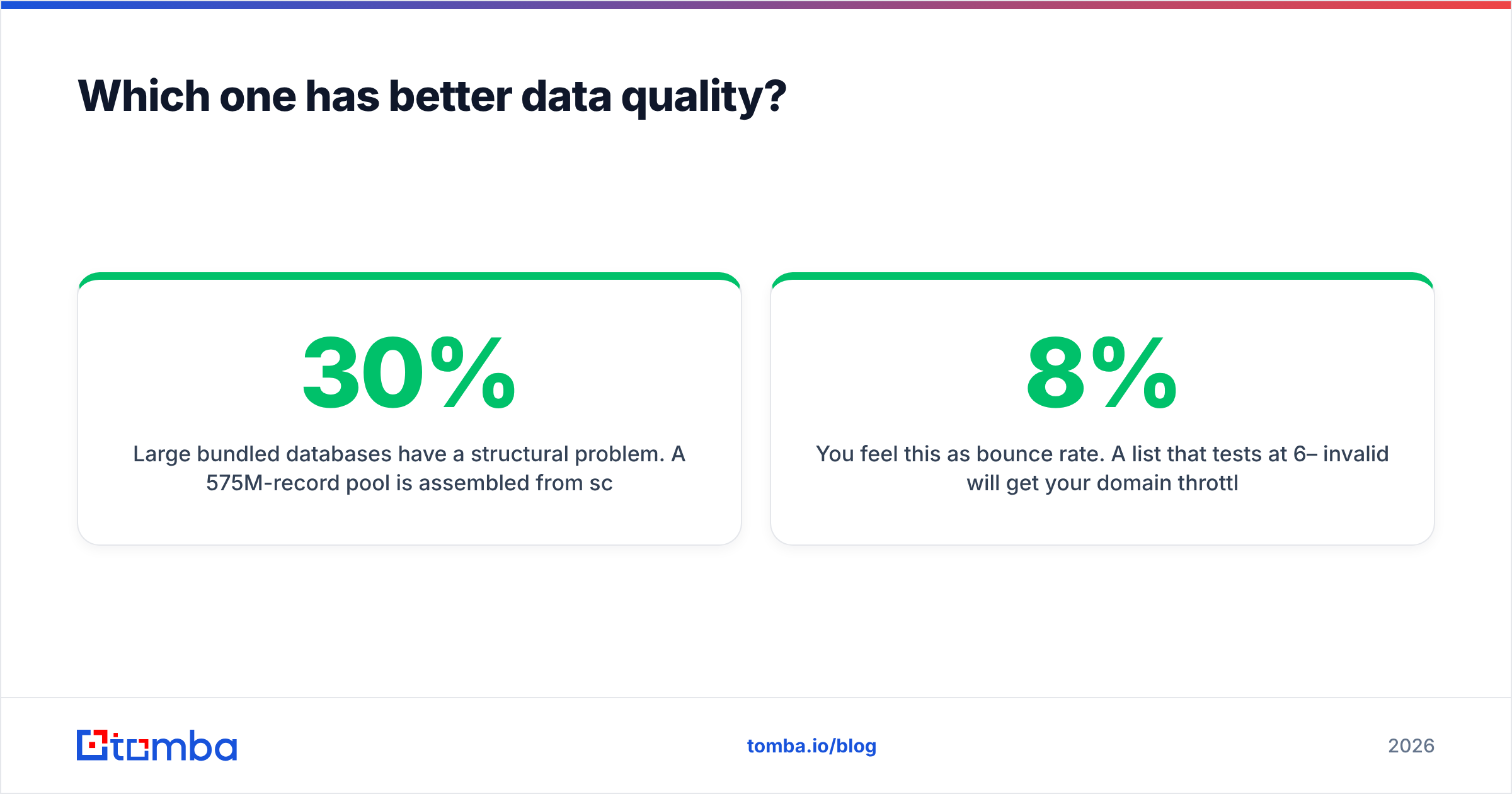
Which one has better data quality?#
GrowMeOrganic wins by default. Mystrika barely competes here. But winning by default is not the same as winning.
Big bundled databases have a built-in problem. A 575M-record pool comes from scraped profiles, public web crawls, and licensed third-party feeds. B2B contact data then decays 22–30% a year as people change jobs. Vendors rarely re-check the long tail, because re-checking half a billion records costs too much. So the headline number is real. The usable slice is much smaller.
You feel this as bounce rate. A list that tests at 6–8% invalid gets your domain throttled by Google and Microsoft. That happens long before your copy gets a fair test. Google's bulk sender rules set a spam-complaint limit under 0.3%, and hard bounces feed the same reputation signal.
The fix is the same for either tool. Treat any bundled database as a sourcing layer, not a verified one. Run every export through a dedicated email verifier before it touches a sequence. For high-value accounts, use a real email finder, because a bad guess there costs you a meeting.
Four checks worth running on any exported list before it goes live:
- Syntax and MX validation — kills the dead records for almost no cost.
- SMTP-level verification — confirms the mailbox accepts mail, not just that the domain resolves.
- Catch-all handling — a catch-all verifier tells you when a domain accepts everything, so you can score the risk instead of blind-sending.
- Role-account filtering — strip
info@,sales@,support@. They inflate volume and drag down reply rates.
Is Mystrika better for deliverability?#
Yes, and it is not close.
Mystrika assumes you will send from many mailboxes across many domains. It rotates volume so no single sender trips a rate limit. That is the shape of a modern outbound program. GrowMeOrganic's sequencer was not built for it. Say your plan is 15 mailboxes across 5 domains at 30 emails a day each. Mystrika routes that natively. GrowMeOrganic starts to feel like a bolt-on.
Here is where Mystrika's edge gets oversold. Warmup does not fix a bad list. Warmup builds a good sending history on your domain. Bounces and spam complaints tear that history down faster than warmup builds it. Teams who expect warmup to cover a 10% bounce rate get the worst of both. They pay for deliverability tooling and still land in spam.
Get the basics right first. Check that your SPF record is valid. Confirm DKIM signs correctly. Set DMARC to at least p=none with reporting on. Then warm up. Then send verified contacts only. Skipping to step two is the most common way email deliverability programs fail.

How does pricing really compare?#
Both vendors use pricing that is hard to read at a glance.
GrowMeOrganic sells "unlimited" plans. They are unlimited in the way that matters least. You can send a lot, but credits on database exports and email finds set the real ceiling. Read the credit table, not the headline. Annual billing gets you the advertised number. Monthly costs more.
Mystrika grew through lifetime deals on AppSumo-style channels. That is great value if you caught one. It also makes comparison strange. A user on a grandfathered lifetime deal pays $0 a month. A new customer pays current list price. So when someone says Mystrika is unbeatable on price, ask which plan they are on.
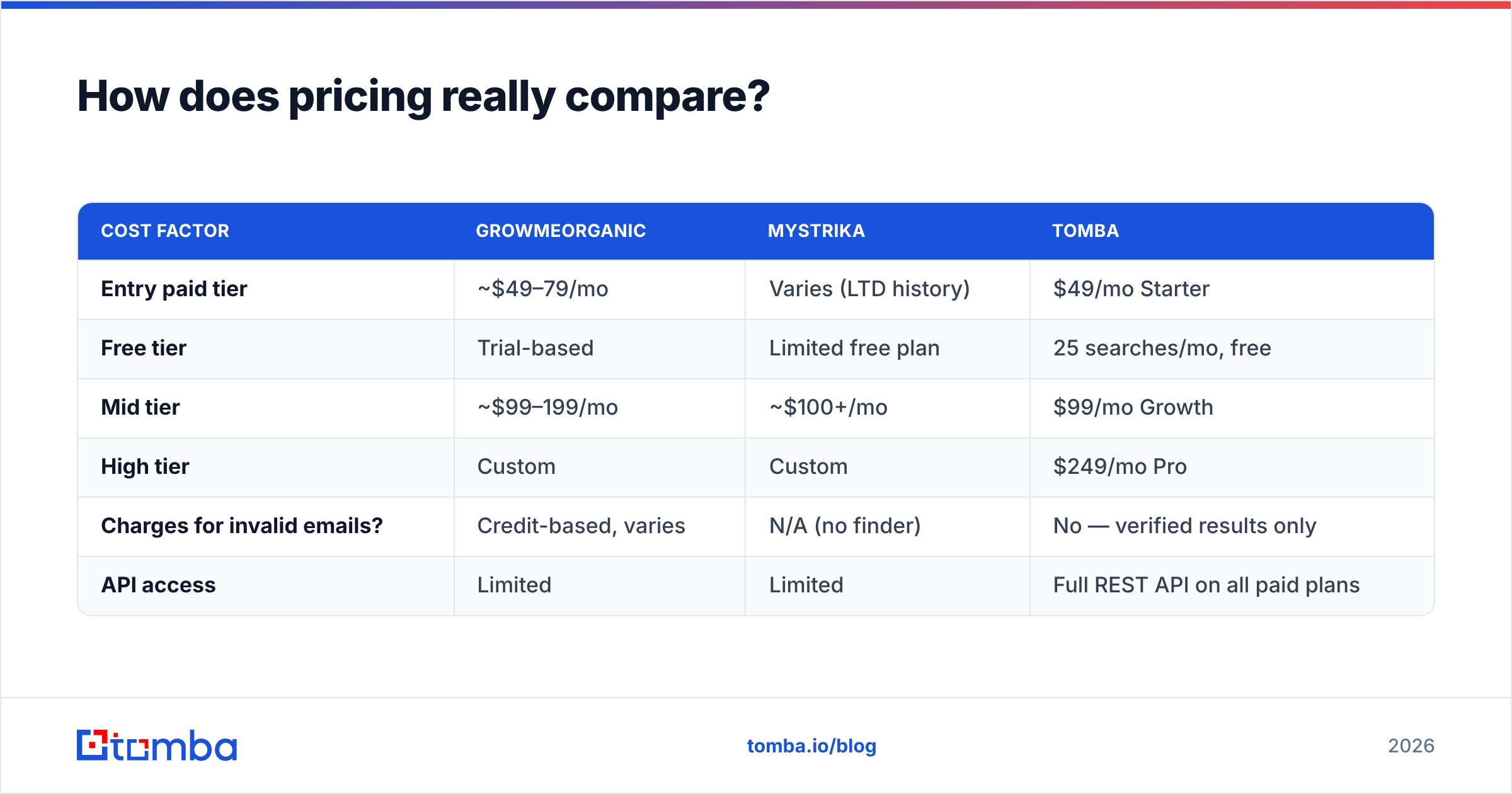
| Cost factor | GrowMeOrganic | Mystrika | Tomba |
|---|---|---|---|
| Entry paid tier | ~$49–79/mo | Varies (LTD history) | $49/mo Starter |
| Free tier | Trial-based | Limited free plan | 25 searches/mo, free |
| Mid tier | ~$99–199/mo | ~$100+/mo | $99/mo Growth |
| High tier | Custom | Custom | $249/mo Pro |
| Charges for invalid emails? | Credit-based, varies | N/A (no finder) | No — verified results only |
| API access | Limited | Limited | Full REST API on all paid plans |
Compare the cost of a working stack, not one line item. Model it as data source + sender + verification. GrowMeOrganic covers the first two. Mystrika owns the second. Neither is strong on the third. Full Tomba pricing is public if you want to price the data layer on its own.
Which should you choose for your use case?#
Pick GrowMeOrganic if: you are a solo founder or small team with no list yet. LinkedIn is your main prospecting surface. You send from one or two mailboxes at modest volume. One tab really does help at that scale, and you will not hit the sending limits.
Pick Mystrika if: you run an agency or a multi-domain outbound team. You already source contacts elsewhere — a CRM, a data vendor, a scraping stack. Inbox placement is your bottleneck. Its unlimited-mailbox model is the cheapest way to send at volume without falling over.
Pick neither as your data source if: accuracy is the constraint. Bundled databases inside sending tools are a convenience feature, not a real data product. When a wrong email costs you a booked meeting with a target account, you want a specialist. That is where a domain search or a bulk email finder run earns its keep.
The nearby options deserve an honest mention too. BookYourData takes another route: a pay-as-you-go verified database with a bounce guarantee. It suits teams who want to own their data without a subscription. Apollo bundles data and sequencing at a larger scale, with more complexity to match. None of these are wrong answers. They just trade coverage, accuracy, and price in different ways. Check current user sentiment on G2 before you sign an annual plan. The gap between marketing claims and the review section is usually where the truth sits.
What do most teams actually end up building?#
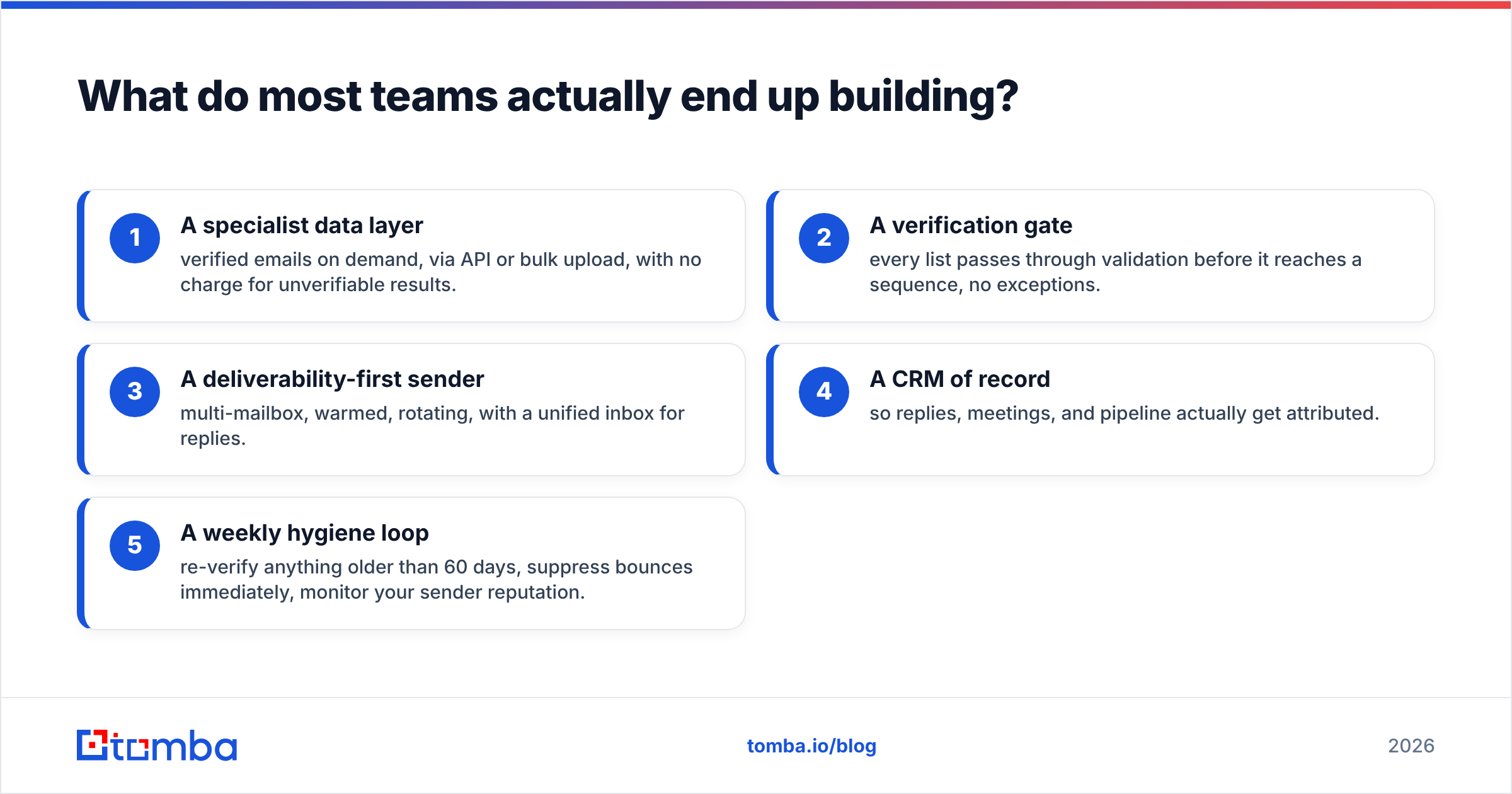
The stack that survives contact with reality looks like this:
- A specialist data layer — verified emails on demand, by API or bulk upload, with no charge for results it cannot verify.
- A verification gate — every list passes validation before it reaches a sequence. No exceptions.
- A deliverability-first sender — many mailboxes, warmed and rotating, with one inbox for replies.
- A CRM of record — so replies, meetings, and pipeline actually get attributed.
- A weekly hygiene loop — re-verify anything older than 60 days, suppress bounces the same day, and watch your sender reputation.
GrowMeOrganic tries to be items 1 and 3. Mystrika is item 3 done well. Neither is item 2 at a level you should trust, and neither is item 4.
That is not really a criticism. It is how these products get built. All-in-one tools are tuned for the demo, where breadth wins. Production outbound is judged on its weakest link, where depth wins. In almost every program that stalls, the weakest link is data accuracy — not copy, not cadence, not the sending tool.
How do you test either tool before committing?#
Settle GrowMeOrganic vs Mystrika with your own data, not with reviews. Run the same 100-contact test on both. It takes an afternoon.
- Pick 100 target accounts in your real ICP, not a generic list.
- Source contacts for those accounts in each tool. Record the match rate: how many of the 100 returned an email at all.
- Export both lists and run them through an independent verifier. Record the true valid rate, not the vendor's confidence score.
- Send the same 3-step sequence from each. Same copy, same times, different subdomains.
- Compare bounce rate, reply rate, and spam-folder placement after two weeks.
The numbers come back less flattering than the marketing pages, for both tools. That is normal. What you want to know is which gap you can patch with a second product. Usually it is the sending gap, because nothing downstream can fix a bad list.
Want the data layer handled before you pick a sender? Start with the Tomba Email Finder. You get 25 free searches a month to test match rates on your own ICP. Paid plans start at $49/mo with verified results only, and every paid plan includes a full API. Pipe contacts straight into whichever sender you land on. Test it against your GrowMeOrganic exports on the same 100 accounts. The delta in bounce rate is the number that decides your outbound results.
Related guides#
Ready to find emails that actually work?
Join 150,000+ professionals who stopped guessing and started sending. Free credits on signup — no credit card required.
Get the Tomba newsletter
Practical outbound tactics and product updates — once every two weeks.
About the author