GrowMeOrganic vs PipiLeads: Which Lead Tool Wins in 2026?
GrowMeOrganic sells unlimited credits and a LinkedIn scraper. PipiLeads sells cheap bulk lookups. We break down accuracy, pricing traps, and export limits so you know which one your outbound team should actually pay for.
GrowMeOrganic vs PipiLeads is an easy call once you know your real problem. One tool scrapes LinkedIn and sends the email for you. The other finds emails in bulk for very little money. Here is the plain answer, plus the traps in each.
TL;DR
- GrowMeOrganic is a LinkedIn-first prospecting suite. You get a Chrome extension, Sales Navigator extraction, built-in drip campaigns, and an "unlimited email credits" pitch on paid plans.
- PipiLeads is a leaner email finder and verifier. It sells cheap bulk lookups, often as a lifetime or low-monthly deal instead of a seat-based plan.
- In GrowMeOrganic vs PipiLeads, the real gap is the data source, not the feature list. Scraper-first tools get what LinkedIn shows. Database-first tools get what was crawled and checked.
- "Unlimited" almost always means unlimited searches, not unlimited verified emails. Budget for a separate check either way.
- Is bounce rate your problem rather than list size? Then a dedicated email finder with SMTP-level checks beats both on cost per delivered email.
GrowMeOrganic vs PipiLeads: what is each tool?#
Both tools do the same job. They turn a list of companies or LinkedIn profiles into people you can email. They just come at it from opposite ends.
GrowMeOrganic started in India as an all-in-one growth stack for small teams. The pitch is breadth. Pull leads from LinkedIn and Sales Navigator with a Chrome extension. Pull local business data. Find emails. Then send sequences from the same dashboard. Pricing is built around unlimited use instead of metered credits. That is rare here, and it is the main reason the tool lands on shortlists. Current plans are on growmeorganic.com.
PipiLeads is the narrower product. It finds and verifies emails, and bulk upload is the main workflow. Drop in a CSV of names and domains. Get emails back. Verify them. Export. It competes on price per lookup. You will see it in deal marketplaces more often than in enterprise buying cycles. There is less depth, but there is also less to learn.
That split matters. Most reviews compare the two on feature checklists. A checklist is the worst way to pick between them.

GrowMeOrganic vs PipiLeads, feature by feature#
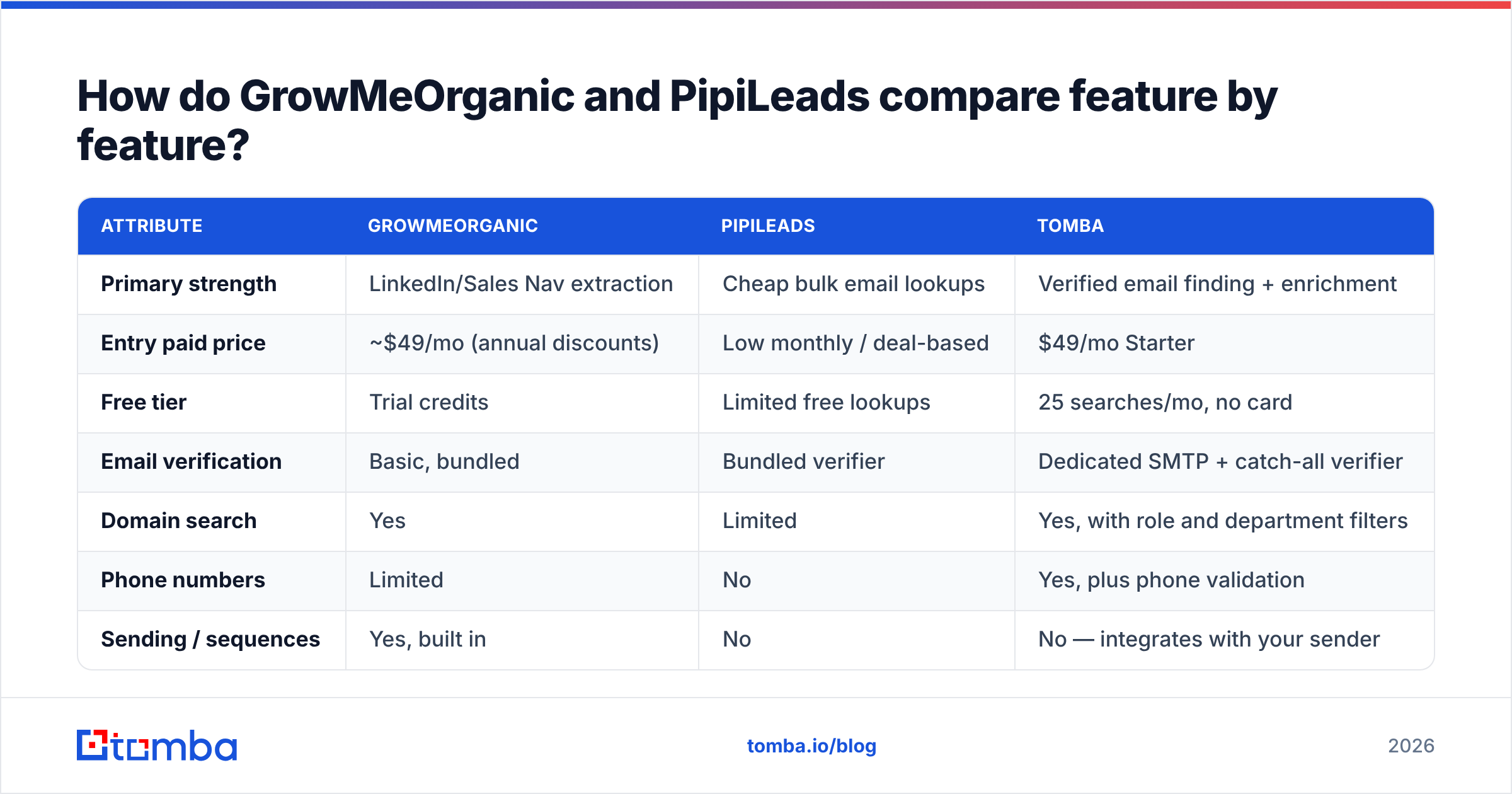
Here is the side-by-side. Treat pricing as a rough guide. Both vendors change plans, and both run deals that never hit the public page.
| Attribute | GrowMeOrganic | PipiLeads | Tomba |
|---|---|---|---|
| Primary strength | LinkedIn/Sales Nav extraction | Cheap bulk email lookups | Verified email finding + enrichment |
| Entry paid price | ~$49/mo (annual discounts) | Low monthly / deal-based | $49/mo Starter |
| Free tier | Trial credits | Limited free lookups | 25 searches/mo, no card |
| Email verification | Basic, bundled | Bundled verifier | Dedicated SMTP + catch-all verifier |
| Domain search | Yes | Limited | Yes, with role and department filters |
| Phone numbers | Limited | No | Yes, plus phone validation |
| Sending / sequences | Yes, built in | No | No — integrates with your sender |
| Public API | Yes | Limited | Full REST API, CLI, MCP server |
| Chrome extension | Yes | Yes | Yes |
| Best for | Solo founders running LinkedIn outbound | Budget bulk enrichment | Teams where bounce rate is the KPI |
The table shows the trade-off. GrowMeOrganic is a workflow product. It wants to own every step from scrape to send. PipiLeads is a utility. It wants to be the cheapest step inside someone else's workflow. Neither one is wrong. They just break in different places.
GrowMeOrganic breaks when your buyers are not on LinkedIn. It also breaks when LinkedIn rate-limits your account and the extraction stalls. PipiLeads breaks when you need hard domains, phone numbers, or any data beyond the email field.
Which one finds more valid emails?#
This is the only question that sets your real cost. GrowMeOrganic vs PipiLeads is won or lost right here. Say one tool returns 1,000 addresses and 78% are good. The other returns 700 and 96% are good. Both land about the same number of emails. But the first one hurts your sender reputation on the way.

Three things separate accurate finders from the rest:
- Guessed patterns vs. seen data. Guessing
first.last@domain.comis easy. Knowing that a company moved fromflast@tofirst@last year takes real records with dates on them. - SMTP check at query time. Some tools reuse a result from months ago. Stale data is the top cause of "verified" emails that bounce.
- Catch-all handling. About a fifth of B2B domains accept every address. Tools that call those "valid" are lying to you. Tools that call them "unknown" and stop are being lazy. A good catch-all verifier reads other signals and gives you a confidence score.
GrowMeOrganic accuracy rests on what the extension can see, plus its own database. On well-known mid-market companies, it does fine. On small firms with generic domains, hit rates drop. The bundled checker is not strict enough to catch that before export.
PipiLeads leans on guessed patterns plus verification. That is a fair strategy, and it is why the price stays low. Guessing is cheap. It also means odd formats are the weak spot: f.lastname@, regional subdomains, holding-company domains.
Neither vendor publishes an audited accuracy number. So treat any figure in their marketing as marketing. Run the same 200-row test list through both, plus a control. Then measure your own bounce rate. That is the only test that counts. Review volume on G2 tells you about support quality. It tells you nothing about data freshness.
GrowMeOrganic vs PipiLeads pricing: what does each one cost?#
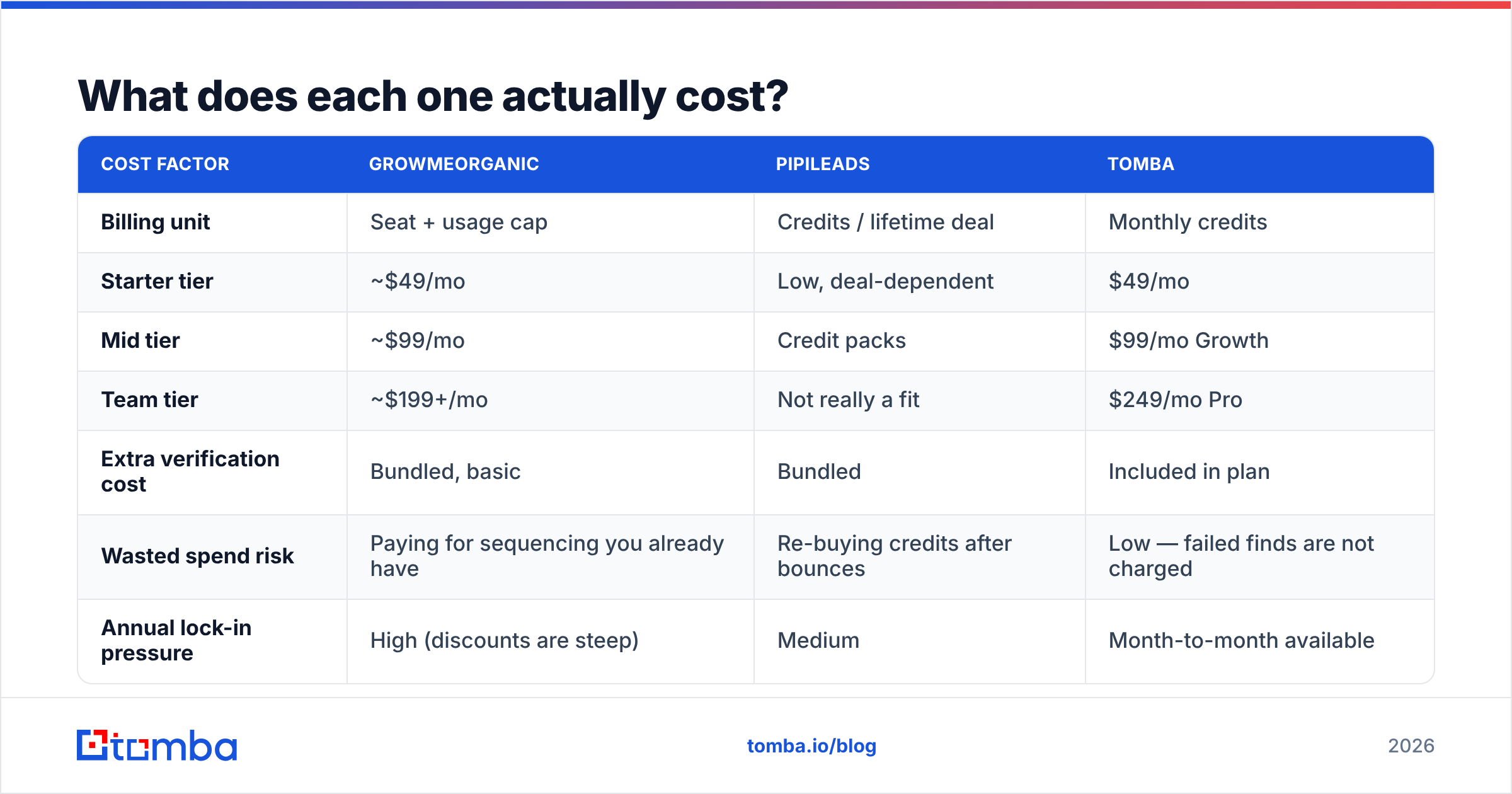
Sticker price misleads here, because the two bill in different units. GrowMeOrganic sells seats with generous use. PipiLeads sells lookups. You have to compare cost per delivered email.

| Cost factor | GrowMeOrganic | PipiLeads | Tomba |
|---|---|---|---|
| Billing unit | Seat + usage cap | Credits / lifetime deal | Monthly credits |
| Starter tier | ~$49/mo | Low, deal-dependent | $49/mo |
| Mid tier | ~$99/mo | Credit packs | $99/mo Growth |
| Team tier | ~$199+/mo | Not really a fit | $249/mo Pro |
| Extra verification cost | Bundled, basic | Bundled | Included in plan |
| Wasted spend risk | Paying for sequencing you already have | Re-buying credits after bounces | Low — failed finds are not charged |
| Annual lock-in pressure | High (discounts are steep) | Medium | Month-to-month available |
Two hidden costs people miss.
Tools that overlap. Do you already run Instantly, Smartlead, Lemlist, or a sequencer in your CRM? Then you are paying GrowMeOrganic for a sending engine you will never open. That is fine if the data earns its keep alone. Check that before you sign a yearly deal.
Re-checking. Cheap lookups that bounce cost you twice. You pay for the credit, then you pay in deliverability. Burn a cheap credit pool, then pay a separate verifier to clean it, and your true cost per usable contact can pass a premium tool's list price. Our numbers all sit on the Tomba pricing page. Hold every other vendor to the same standard.

Is "unlimited" really unlimited?#
Short answer: no. And that is not always dishonest.
Unlimited here almost always means unlimited searches against a database. Fair-use throttling applies. Hard caps sit on exports, API calls, or jobs. The math forces it. Every SMTP check costs the vendor real money in IP reputation and servers.
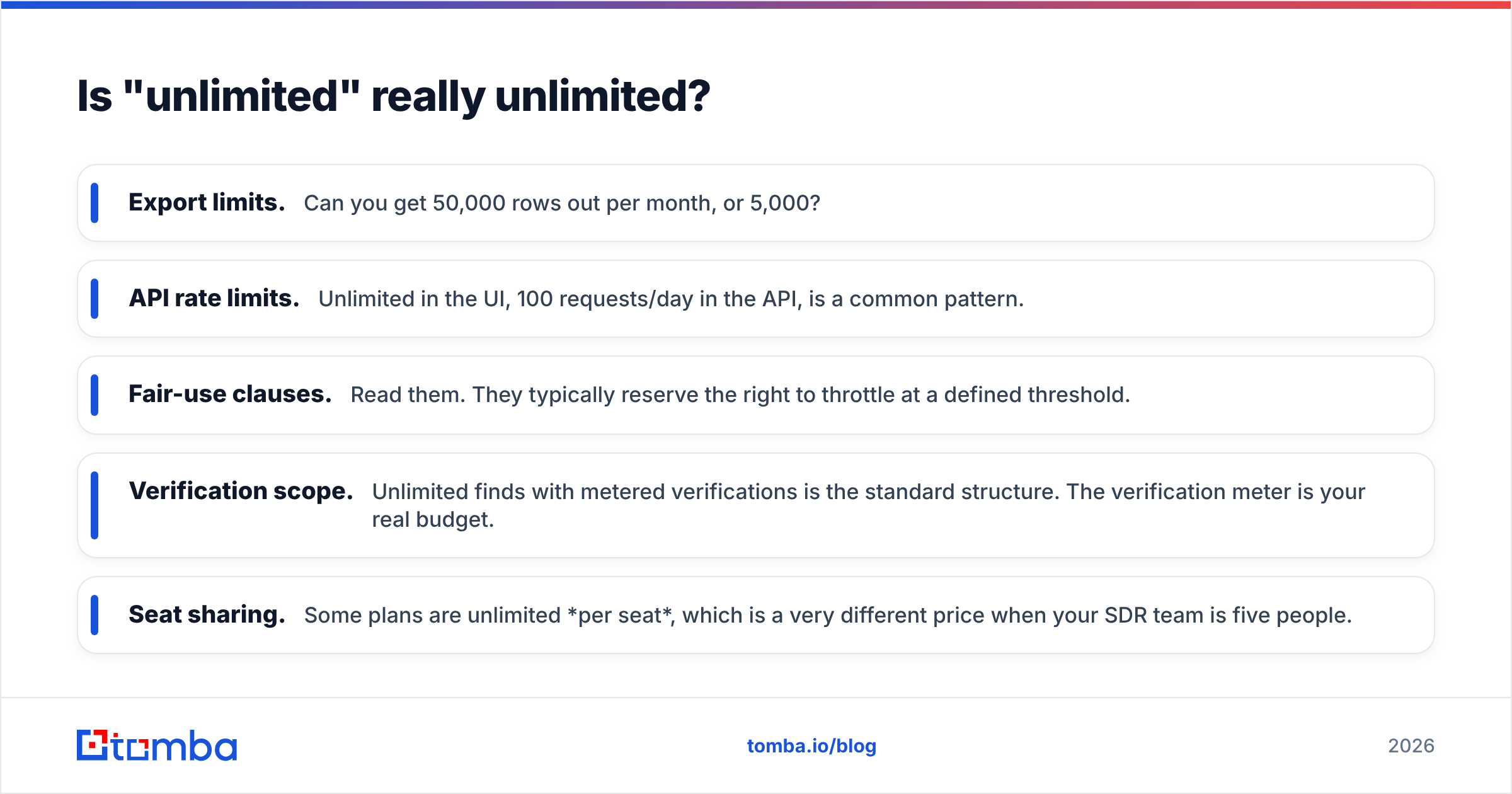
Check five things before you trust an unlimited claim:
- Export limits. Can you pull 50,000 rows a month, or 5,000?
- API rate limits. Unlimited in the app, 100 calls a day in the API, is a common pattern.
- Fair-use clauses. Read them. Most reserve the right to throttle you at some level.
- Verification scope. Unlimited finds with metered checks is the norm. That meter is your real budget.
- Seat sharing. Some plans are unlimited per seat. That is a different price when five reps need it.
GrowMeOrganic is fairly open that its caps exist. Just read the fair-use terms, not the headline on the landing page.
What about LinkedIn scraping risk?#
GrowMeOrganic's big edge is extension-based Sales Navigator extraction. It carries a risk PipiLeads does not.
Automated scraping runs against LinkedIn's user agreement. Account limits do happen, above all at high volume from one profile. That is not a reason to avoid the category. Thousands of teams scrape LinkedIn every day. It is a reason to take three steps:
- Use a spare, warmed LinkedIn account, not your founder's.
- Keep daily volume low for the first few weeks.
- Never make LinkedIn your only source of contacts.
The last point is the big one. If your whole pipeline rests on one platform's mood, you have one point of failure. Pair the extension with a database-backed domain search. Then you still have leads on the day the extension stops working.
PipiLeads carries less of this risk, because it does less. Bulk CSV work against a database is boring and durable. Boring is underrated in outbound.
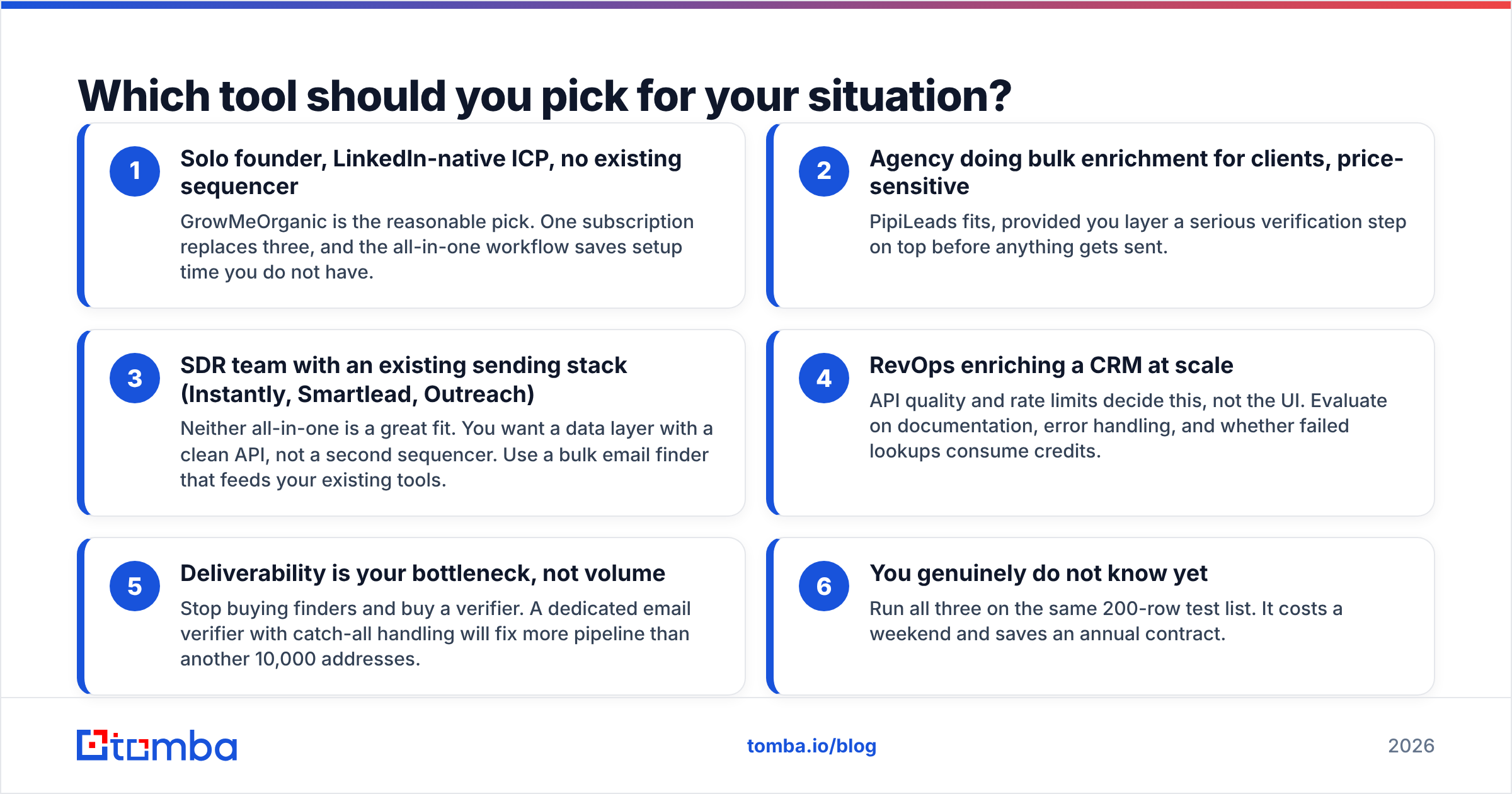
Which tool should you pick?#
Skip the feature matrix. Match the tool to your real constraint.
- Solo founder, LinkedIn-native buyers, no sequencer yet. GrowMeOrganic is the sane pick. One plan replaces three.
- Agency doing bulk work on a tight budget. PipiLeads fits. Add a real verification step before you send.
- SDR team with a sending stack already. Neither all-in-one fits. You want a data layer with a clean API. Feed your tools with a bulk email finder.
- RevOps loading a CRM at scale. API quality and rate limits decide this, not the UI.
- Deliverability is the bottleneck, not volume. Buy a checker instead. A good email verifier fixes more pipeline than 10,000 more addresses.
- You still do not know. Run all three on the same 200-row list. It costs a weekend and saves a yearly contract.
Where does Tomba fit?#
Tomba is narrower than GrowMeOrganic on purpose. It is also deeper than a guess-and-check utility. It does not send your email. It finds and verifies the contact data, then hands it to the tools you already use.
In practice:
- A free tier you can really use. 25 searches a month, no card, enough for a real accuracy test.
- Checks built into the find. SMTP checks and catch-all scoring run at query time, not from an old cache.
- Access built for engineers. A documented Tomba API, a CLI, an MCP server, plus Google Sheets, Excel, HubSpot, and Salesforce connectors.
- No credits burned on misses. You are not charged when a lookup returns nothing.
The honest caveat: do you want one login that scrapes LinkedIn and sends your sequences? Tomba is not that tool, and GrowMeOrganic is closer. Pick based on which half of the job you need done.
What is the verdict on GrowMeOrganic vs PipiLeads?#
GrowMeOrganic wins if you want an all-in-one for LinkedIn outbound and own no sending tool yet. The breadth is real. The unlimited framing does lower cost for high-volume solo operators.
PipiLeads wins if you want cheap bulk data and already handle checks and sending elsewhere. It is a part, not a platform, and it is priced that way.
Neither wins if your problem is bounce rate. Both treat verification as a bundled feature, not as the core craft. That shows up in your deliverability three weeks after launch, long after the refund window shuts.
So test both on your own list. Measure bounce rate, not hit rate. Then decide.
Want to see your list once the data is verified first? Run your next 25 prospects through the Tomba Email Finder free. No card, no yearly lock-in, and an SMTP check on every result. Compare the bounce rate against your current tool, and let the numbers pick your winner.
Related guides#
Ready to find emails that actually work?
Join 150,000+ professionals who stopped guessing and started sending. Free credits on signup — no credit card required.
Get the Tomba newsletter
Practical outbound tactics and product updates — once every two weeks.
About the author