GrowMeOrganic vs Right Inbox: Which Sales Tool Wins in 2026?
GrowMeOrganic builds lead lists and runs campaigns. Right Inbox lives inside Gmail and chases replies. They solve opposite halves of outbound — here is which one your team actually needs, and what both leave you to fix yourself.
GrowMeOrganic vs Right Inbox is an odd match-up. One tool builds your lead list. The other chases replies inside Gmail. Here is which one you need, and what both still leave undone.
TL;DR
- They are not real rivals. GrowMeOrganic finds leads and sends cold campaigns. Right Inbox is a Gmail add-on for tracking and follow-ups. It is like comparing a warehouse to a forklift.
- Pick GrowMeOrganic if you need contact data and multi-step campaigns from one login.
- Pick Right Inbox if you already have a list. It fits one-to-one selling from your own Gmail.
- Neither tool fixes bad data. Both assume your addresses are correct. Bounces are what kill most outbound.
- Cheapest real setup in 2026: a finder and verifier for data, plus the tool that matches how you send. That combo costs less than an all-in-one seat. It also bounces far less.
What are GrowMeOrganic and Right Inbox, exactly?#
Most people who search "GrowMeOrganic vs Right Inbox" have not yet picked a job for the tool. Start there.
- GrowMeOrganic is an all-in-one B2B prospecting suite. It bundles a contact database, a LinkedIn scraper, a Google Maps scraper, an email finder, a verifier, and a drip sender. The pitch is "unlimited": flat pricing, not per-credit metering. See growmeorganic.com.
- Right Inbox is a Gmail layer. The Chrome extension adds tracking, send-later, recurring emails, notes, templates, small mail merges, and follow-ups that fire when nobody replies. Details at rightinbox.com.
- Different unit of work. GrowMeOrganic thinks in campaigns: 500 contacts, five steps, one sequence. Right Inbox thinks in threads: this email, this person, follow up Tuesday.
- Different sending setup. GrowMeOrganic wants spare domains and warmed inboxes. Right Inbox rides on your real Gmail. Google's daily caps apply, so cold blasts are out.
- Different failure mode. GrowMeOrganic fails when your data is stale. Right Inbox fails when you run out of people to email.
That last point beats any feature list. In a GrowMeOrganic vs Right Inbox call, pick based on which failure is closer today.
GrowMeOrganic vs Right Inbox: feature by feature#
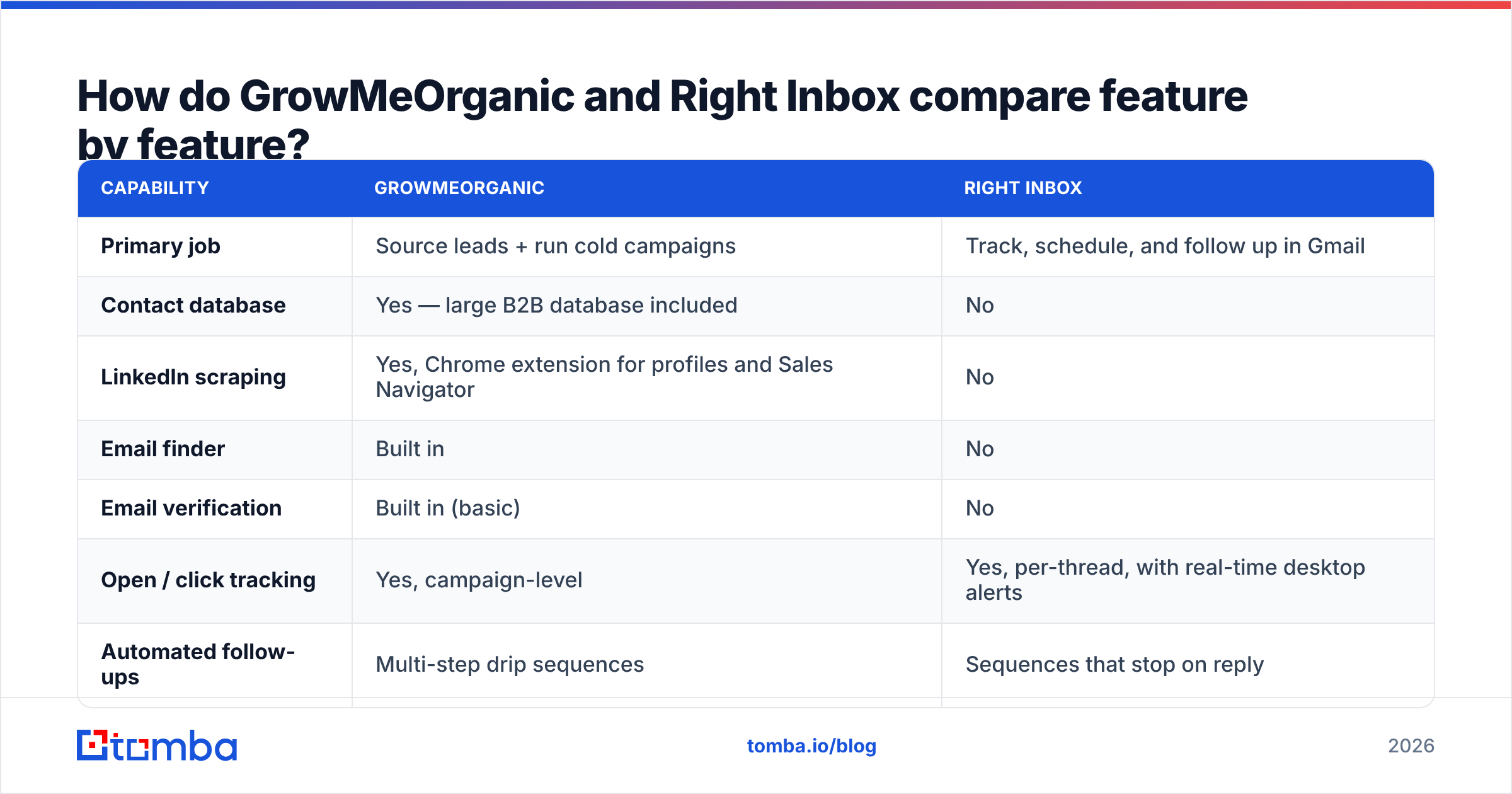
| Capability | GrowMeOrganic | Right Inbox |
|---|---|---|
| Primary job | Source leads + run cold campaigns | Track, schedule, and follow up in Gmail |
| Contact database | Yes — large B2B database included | No |
| LinkedIn scraping | Yes, Chrome extension for profiles and Sales Navigator | No |
| Email finder | Built in | No |
| Email verification | Built in (basic) | No |
| Open / click tracking | Yes, campaign-level | Yes, per-thread, with real-time desktop alerts |
| Automated follow-ups | Multi-step drip sequences | Sequences that stop on reply |
| Send-later scheduling | Campaign scheduling | Per-email, with time-zone picker and recurring sends |
| Mail merge | Yes, at campaign scale | Yes, small batches from Gmail |
| Works inside Gmail UI | Partially | Entirely — it is the Gmail UI |
| Sending infrastructure | Your SMTP / dedicated domains | Your Gmail account only |
| Best team size | 1–20 SDRs running outbound | Founders, AEs, recruiters, consultants |
| CRM depth | Light built-in CRM + integrations | Notes and reminders, syncs via Zapier/HubSpot |
Read that table as two columns that barely touch. Only three rows are true head-to-head: tracking, follow-ups, and mail merge. Even there, GrowMeOrganic works at list scale. Right Inbox works at thread scale.

Which one is cheaper in 2026?#
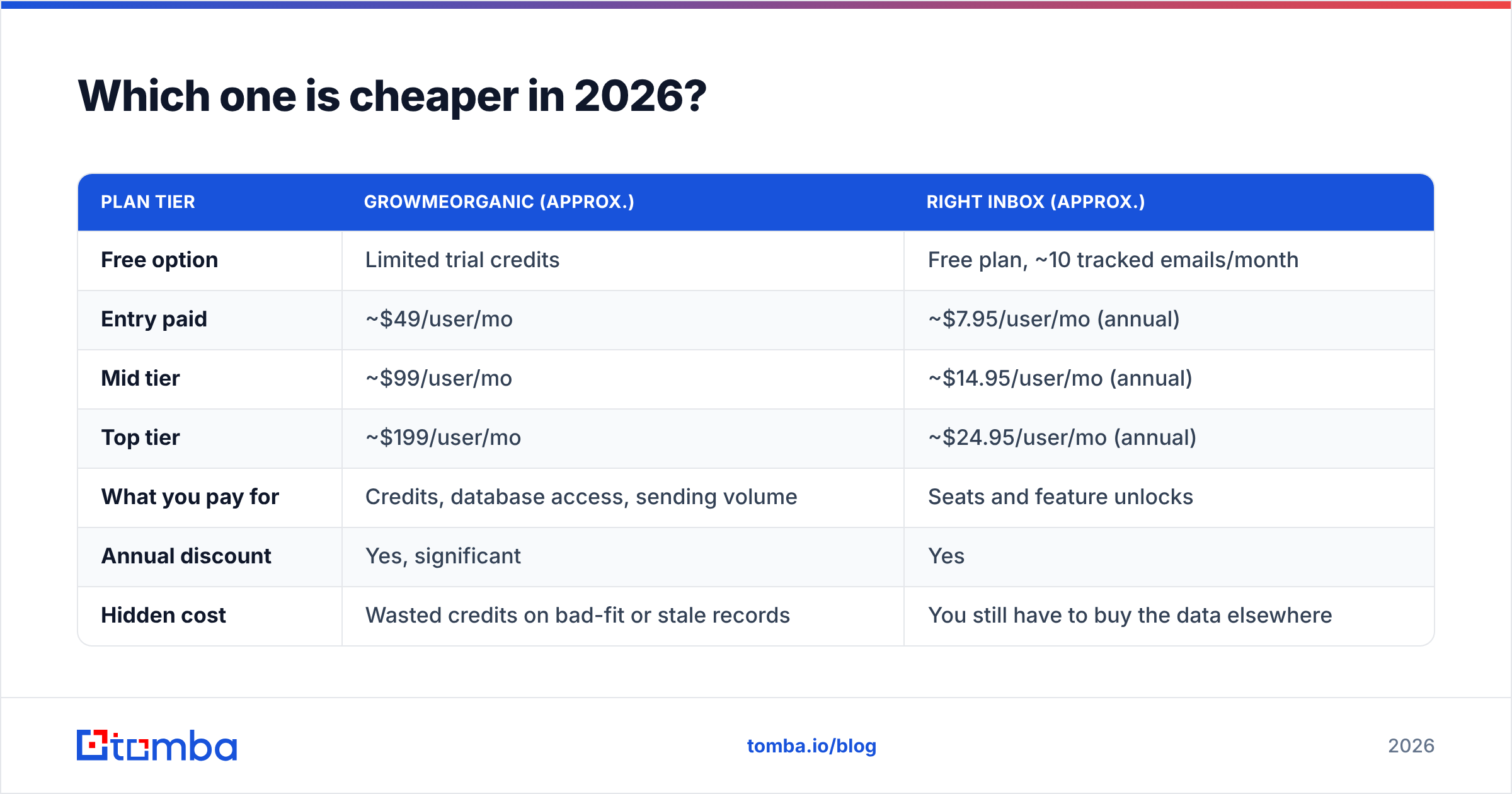
Prices move on both tools. Treat these as ballparks and check the vendor pages first. The shape of the pricing matters more. GrowMeOrganic charges platform rates with credit limits. Right Inbox charges a small seat fee, because it does one job.
| Plan tier | GrowMeOrganic (approx.) | Right Inbox (approx.) |
|---|---|---|
| Free option | Limited trial credits | Free plan, ~10 tracked emails/month |
| Entry paid | ~$49/user/mo | ~$7.95/user/mo (annual) |
| Mid tier | ~$99/user/mo | ~$14.95/user/mo (annual) |
| Top tier | ~$199/user/mo | ~$24.95/user/mo (annual) |
| What you pay for | Credits, database access, sending volume | Seats and feature unlocks |
| Annual discount | Yes, significant | Yes |
| Hidden cost | Wasted credits on bad-fit or stale records | You still have to buy the data elsewhere |
Five people on Right Inbox costs about one lunch per rep per month. The same five on GrowMeOrganic's mid tier is a real budget line. But the Right Inbox price is not the full price. You still buy lead data somewhere else. That is where GrowMeOrganic vs Right Inbox stops being about these two tools.
Check the current numbers on G2 before you sign a year. Both vendors have changed tiers more than once. Reviews show what buyers really pay after discounts.
Who should choose GrowMeOrganic?#
In the GrowMeOrganic vs Right Inbox split, GrowMeOrganic owns the top of the funnel. Choose it when you lack qualified contacts, not follow-up discipline.
- You are starting outbound from zero. No list, no data vendor, no sender. One subscription gets you to 50 sends a day. Each part is a B-grade version of a specialist tool, but it ships.
- You prospect on LinkedIn. The scraper turns a Sales Navigator search into a CSV in minutes. If your buyers live on LinkedIn, that alone can decide it.
- You hate credit math. Flat pricing with a high cap beats per-credit metering when your search volume jumps around.
- You sell to local firms. The Google Maps scraper works well for agencies selling to clinics, dealers, and restaurants.
Now the catch. Bundled email finders are rarely as accurate as dedicated ones. And "unlimited sending" is a claim, not a plan. Your domain reputation does not read your invoice.
Who should choose Right Inbox?#
Choose Right Inbox when you lack follow-through, not list size.
- You live in Gmail. No new tab, no second login, no new interface to learn.
- Your deals are big and few. Twenty careful emails a week beat 2,000 sprayed ones. Right Inbox is built for the twenty.
- You lose deals to silence. Sequences stop when someone replies. Reminders resurface a thread when nobody does.
- You sell across time zones. Send-later and recurring emails are the best part of the tool.
Now the catch. Right Inbox will never find you a contact. It also inherits Google's send limits and your domain's reputation. Push cold volume through it and you burn the inbox you need for real conversations. Send cold mail from a spare domain instead. Keep Right Inbox for warm threads.
What do both tools leave you to fix yourself?#
GrowMeOrganic vs Right Inbox both stop at the same wall: data quality. That is the honest answer, and it applies to most tools here.
Right Inbox never claimed to source contacts. That is a gap in your stack, not a flaw in the product. GrowMeOrganic does claim it. Bundled finders carry the usual trade-off: broad coverage, uneven freshness, and checks that pass on syntax but stall on catch-all domains.
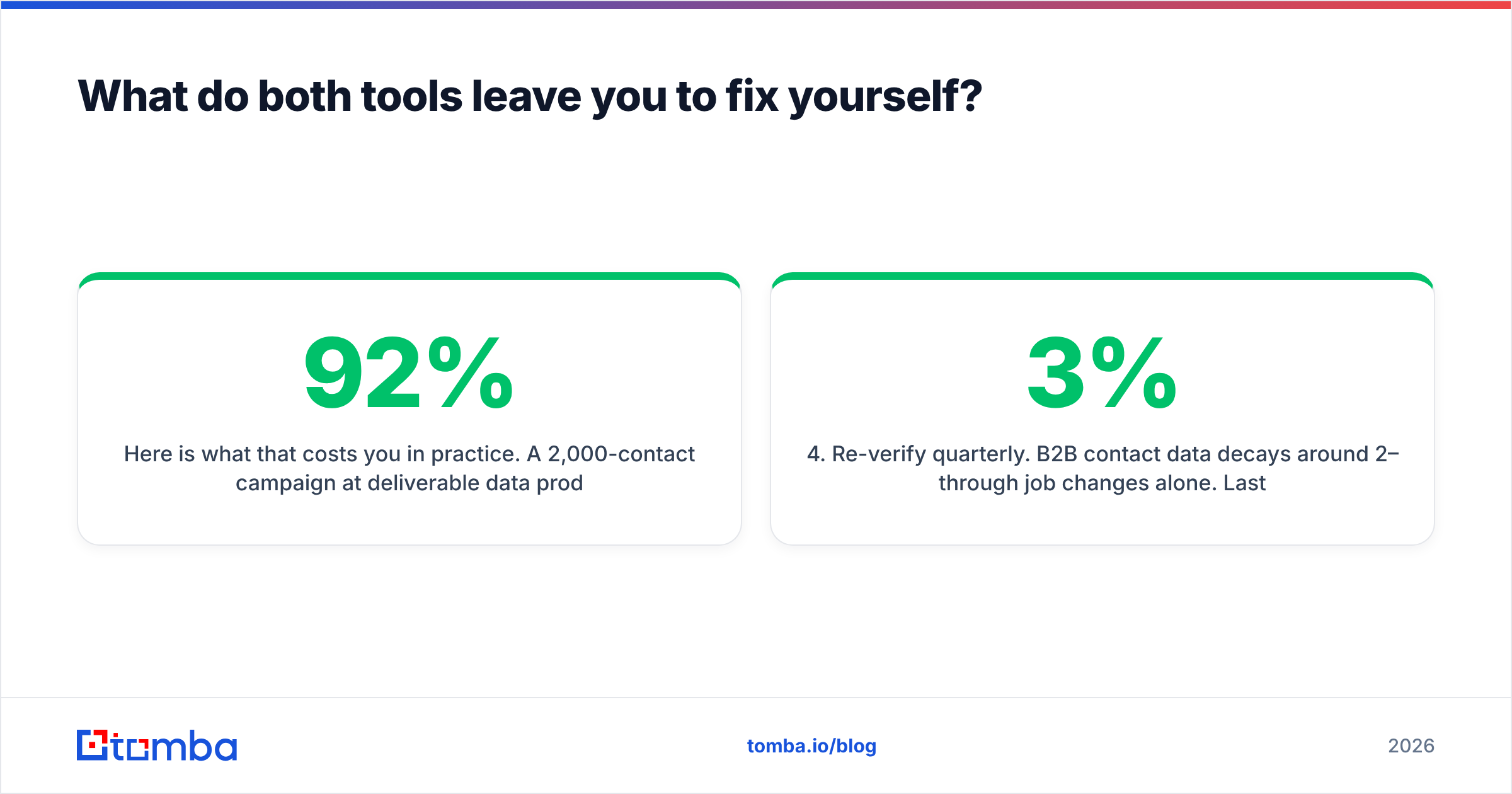
Here is the cost in plain numbers. A 2,000-contact send at 92% good data makes 160 bounces. At 97%, it makes 60. Same list, same copy, same sender. The gap decides whether you stay out of spam folders next quarter. Past a 3% bounce rate, mailbox providers throttle you. No subject-line test fixes that.
The fix is boring and it works:
- Source contacts from a database or a scrape. Use GrowMeOrganic, a scraper, or an email finder that turns a name plus domain into a verified address.
- Verify before every send, not once at import. Run the list through an email verifier so dead and role accounts never reach your sender.
- Handle catch-all domains on purpose. A catch-all verifier tells you which accept-all servers are safe to mail.
- Re-verify each quarter. B2B contact data decays 2–3% a month from job changes alone. Last year's clean list is this year's bounce problem.

Can you use GrowMeOrganic and Right Inbox together?#
Yes. For many teams that is the right call. Treating GrowMeOrganic vs Right Inbox as an either/or is often a false choice. But the setup fails in one common way.
The failure pattern is running both as senders. Cold volume goes out through GrowMeOrganic on a spare domain. Warm threads go out through Right Inbox on your main Gmail. Nobody tracks who was touched. Prospects get hit twice, reps look sloppy, and your CRM tells you nothing.
The working pattern splits by temperature:
- Cold, list-based, multi-step → GrowMeOrganic on a spare domain, with proper warmup.
- Warm, named-account, one-to-one → Right Inbox on your real inbox, where replies protect you.
- One data layer under both → a single source of verified contacts. Push clean records to your CRM with data enrichment instead of keeping two lists.
- A handoff rule → when a cold prospect replies, move the thread to the main inbox for good. Never sequence a replier.
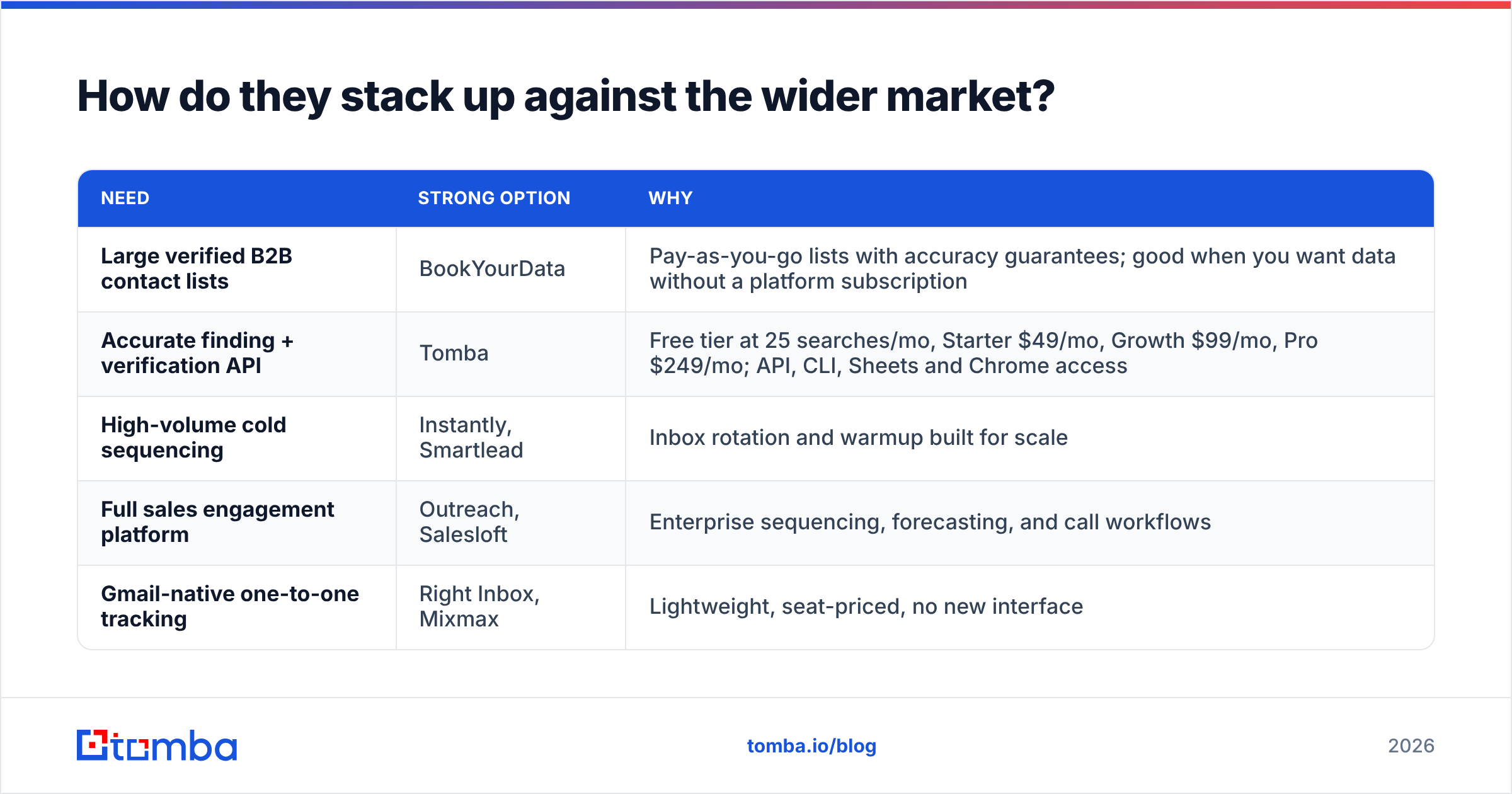
How do they stack up against the wider market?#
GrowMeOrganic vs Right Inbox is not the only choice on the table. Know the neighbours.
| Need | Strong option | Why |
|---|---|---|
| Large verified B2B contact lists | BookYourData | Pay-as-you-go lists with accuracy guarantees; good when you want data without a platform subscription |
| Accurate finding + verification API | Tomba | Free tier at 25 searches/mo, Starter $49/mo, Growth $99/mo, Pro $249/mo; API, CLI, Sheets and Chrome access |
| High-volume cold sequencing | Instantly, Smartlead | Inbox rotation and warmup built for scale |
| Full sales engagement platform | Outreach, Salesloft | Enterprise sequencing, forecasting, and call workflows |
| Gmail-native one-to-one tracking | Right Inbox, Mixmax | Lightweight, seat-priced, no new interface |
BookYourData deserves a look if you wanted GrowMeOrganic for the database, not the sender. Buying verified contacts and pairing them with a cheap Gmail tool is often cleaner. An all-in-one is a poor deal when its weakest part is the part you lean on.
Want to compare senders instead? Our Instantly alternative breakdown covers where campaign platforms split on deliverability tools.
Frequently asked questions#
Is Right Inbox safe for cold email? Not at volume. It sends through your Google Workspace account. Every bounce and spam report lands on the domain you use for real business. Keep it for warm outreach and internal follow-ups.
Does GrowMeOrganic really offer unlimited sending? The plans say unlimited. The real ceiling comes from your SMTP host, your domain warmup, and mailbox throttling. Treat "unlimited" as a billing term, not a technical one.
Which has better email data? GrowMeOrganic, since Right Inbox has none. But bundled databases lag specialists on freshness. Verify outside the tool if accuracy drives your numbers.
Can I replace both with one tool? Only if you give up on sourcing or on Gmail-native work. Most teams under 20 reps end up with three cheap specialists instead of one costly generalist.
What about LinkedIn-sourced contacts? Scraped profiles rarely include a work email. You need a resolution step. A LinkedIn finder turns a profile URL into a verified business address.
Is GrowMeOrganic vs Right Inbox even a fair fight? No. They cover different halves of outbound. Most teams buy one of them plus a data tool, not both.
The verdict#
GrowMeOrganic wins if you have no list. Right Inbox wins if you have no follow-up habit. There is no third answer. They were built for different halves of the same funnel.
Both leave the same job on your desk. Are your addresses real, current, and safe to mail? Sending bad data faster just gets you blocked faster.
Fix the input first. Tomba's Email Finder turns names and domains into verified work addresses. It handles catch-all domains, bulk lists, and an API that plugs into any sender. Start free with 25 searches a month and test it on contacts you already know. Then check Tomba pricing once the numbers hold. Clean data flatters both tools. Bad data breaks both.
Related guides#
Ready to find emails that actually work?
Join 150,000+ professionals who stopped guessing and started sending. Free credits on signup — no credit card required.
Get the Tomba newsletter
Practical outbound tactics and product updates — once every two weeks.
About the author