GrowMeOrganic vs SalesBlink: Which Outbound Tool Wins in 2026?
GrowMeOrganic bundles a lead database with email sending. SalesBlink leans on AI sequences and deliverability. Here's how the two actually compare on data quality, pricing, and where each one breaks.
TL;DR
- GrowMeOrganic is a bundled play: a B2B contact database, a LinkedIn/Chrome scraper, and a basic email sender in one flat-rate subscription. Strong if you want volume cheaply and tolerate mixed data quality.
- SalesBlink is a sending-first platform: AI-assisted sequence writing, multi-channel steps, built-in warmup and rotating inboxes. Weak if you expect it to supply your leads.
- They are not really the same product. GrowMeOrganic competes with data vendors; SalesBlink competes with Instantly and Smartlead.
- Both share the same failure mode — the contact data underneath is the bottleneck, not the UI. Bounce rates decide whether either tool earns its price.
- Most teams end up with a dedicated finder/verifier plus a sending tool. That combination beats either all-in-one on accuracy and costs less than you'd guess.
What are GrowMeOrganic and SalesBlink, exactly?#
GrowMeOrganic sells itself as an all-in-one prospecting suite. You get a searchable B2B database, a Chrome extension that pulls contacts off LinkedIn and Sales Navigator, an email-finder module, and a drip-campaign sender. Its distinguishing commercial move is flat pricing with unlimited-ish usage caps rather than per-credit metering, which is why it shows up constantly in "cheap Apollo alternative" threads.
SalesBlink went a different direction. It started as an outbound automation platform and doubled down on the sending layer: BlinkGPT AI writes your sequences, the platform rotates multiple mailboxes, warms them automatically, and handles reply detection and meeting booking. There is a prospecting element, but nobody buys SalesBlink for its database.
So when you search "GrowMeOrganic vs SalesBlink," you're usually really asking one of two questions:
- Which one gives me usable contact data at the lowest cost?
- Which one gets my cold emails into the primary inbox?
Those have different answers, and neither answer is "both."

How do the two platforms compare feature by feature?#
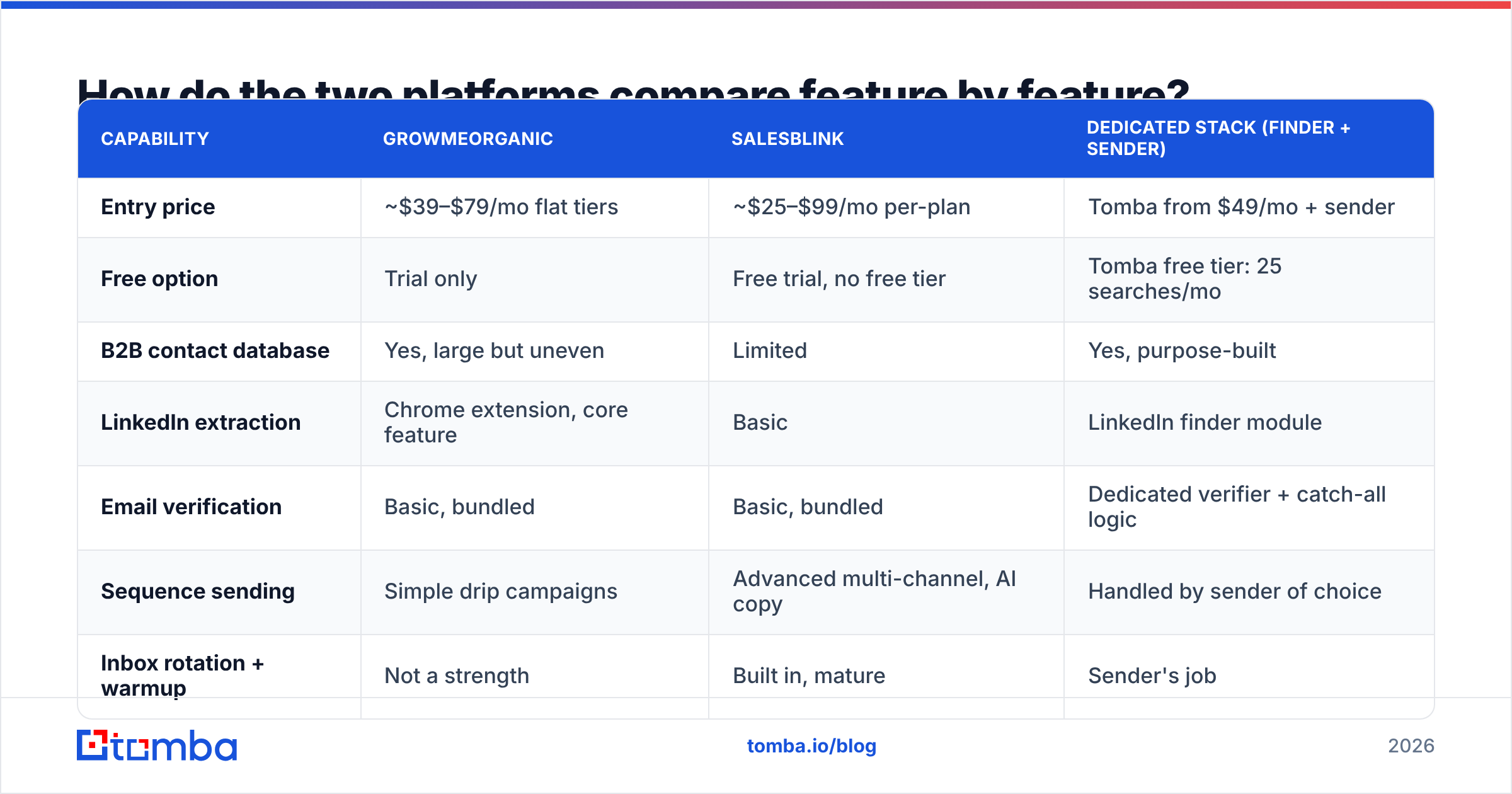
Here is the honest side-by-side. Prices reflect publicly listed plans and move around — check each vendor before you buy.
| Capability | GrowMeOrganic | SalesBlink | Dedicated stack (finder + sender) |
|---|---|---|---|
| Entry price | ~$39–$79/mo flat tiers | ~$25–$99/mo per-plan | Tomba from $49/mo + sender |
| Free option | Trial only | Free trial, no free tier | Tomba free tier: 25 searches/mo |
| B2B contact database | Yes, large but uneven | Limited | Yes, purpose-built |
| LinkedIn extraction | Chrome extension, core feature | Basic | LinkedIn finder module |
| Email verification | Basic, bundled | Basic, bundled | Dedicated verifier + catch-all logic |
| Sequence sending | Simple drip campaigns | Advanced multi-channel, AI copy | Handled by sender of choice |
| Inbox rotation + warmup | Not a strength | Built in, mature | Sender's job |
| Phone numbers | Some coverage | Minimal | Dedicated phone finder |
| API access | Limited | Available | Full REST API |
| Best for | Cheap volume prospecting | Deliverability-led sending | Accuracy-led outbound |
Read that table twice. The overlap is thinner than the marketing implies. GrowMeOrganic wins the data column and loses the sending column. SalesBlink does the reverse. If you buy one expecting it to cover both, you'll be disappointed by half the product.
Which tool has better contact data?#
GrowMeOrganic, on raw volume. But volume and accuracy are different metrics, and this is where all-in-one suites tend to get exposed.
Bundled databases are typically assembled from scraped public profiles, historical purchases, and pattern-guessed addresses. Pattern-guessing is fine as a technique — first.last@domain.com is a real format — but only when the guess is SMTP-validated against the live mail server before it lands in your CSV. Suites that bundle a "free" verifier alongside a flat-rate database have a structural incentive to be generous about what counts as valid, because every rejected address is a credit they can't show you.
The practical test: export 200 contacts from either platform, run them through an independent email verifier, and count how many come back risky or invalid. Teams that run this test on bundled suites routinely find 15–30% of "verified" records don't survive an independent check. On a 5,000-address campaign that is 750 to 1,500 hard bounces — enough to torch a domain's sender reputation in a single week.

SalesBlink doesn't really compete here. Its prospecting is a convenience layer, not a data asset. If you sign up for SalesBlink you are still buying data somewhere else — from GrowMeOrganic, from a dedicated email finder, or by scraping and enriching yourself.
Is SalesBlink better for deliverability?#
Yes, and it isn't close — but that advantage is smaller than vendors want you to believe.
SalesBlink's stack does the things that matter mechanically: warmup on a ramp schedule, rotation across multiple sending mailboxes so no single inbox exceeds safe daily volume, reply detection that pauses sequences, and per-domain throttling. Those are table stakes for cold outbound in 2026 and GrowMeOrganic's sender doesn't match them.
But warmup does not fix bad data. Google and Microsoft both weight bounce rate and spam-complaint rate heavily in their filtering decisions, and Google's bulk-sender requirements formally cap spam complaints at 0.3%. No amount of inbox rotation compensates for a list where one in five addresses doesn't exist. The sequence to email deliverability is:
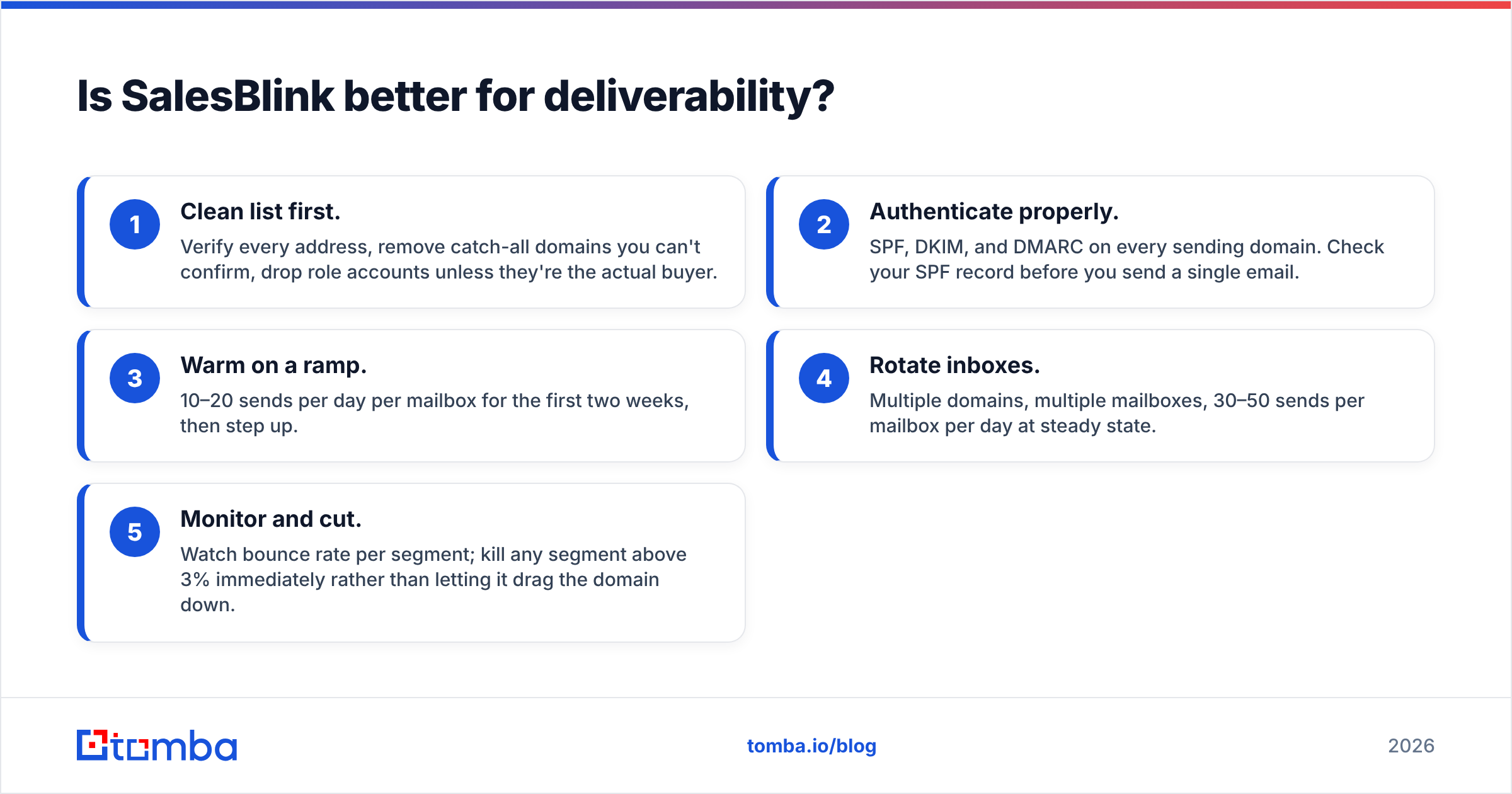
- Clean list first. Verify every address, remove catch-all domains you can't confirm, drop role accounts unless they're the actual buyer.
- Authenticate properly. SPF, DKIM, and DMARC on every sending domain. Check your SPF record before you send a single email.
- Warm on a ramp. 10–20 sends per day per mailbox for the first two weeks, then step up.
- Rotate inboxes. Multiple domains, multiple mailboxes, 30–50 sends per mailbox per day at steady state.
- Monitor and cut. Watch bounce rate per segment; kill any segment above 3% immediately rather than letting it drag the domain down.
SalesBlink handles steps 3 through 5 well. It does not handle step 1, and step 1 is the one that decides whether the other four matter.
What does each one actually cost you?#
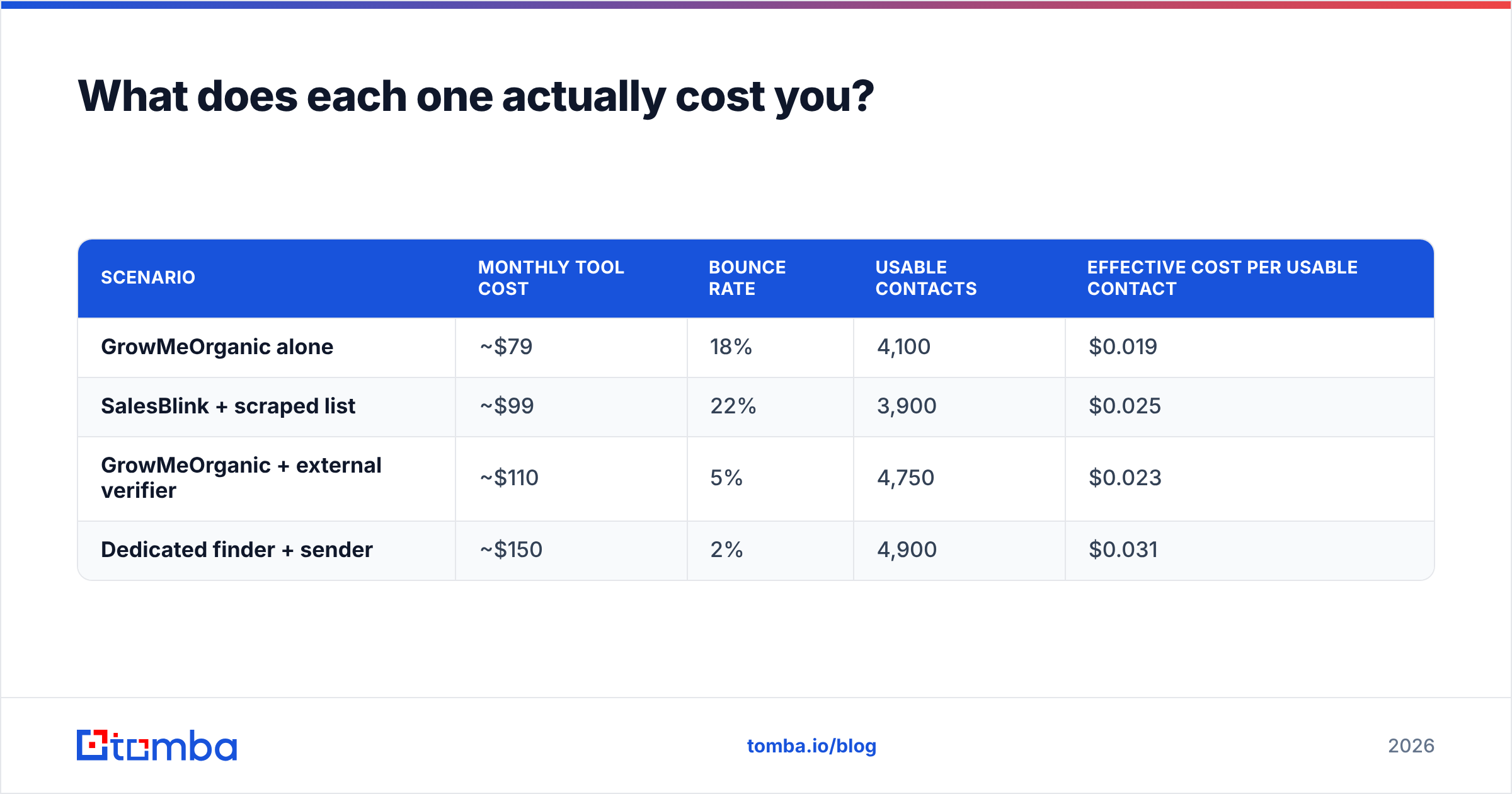
Sticker price is the wrong comparison. Cost per usable, deliverable, replied-to contact is the number that matters.
Take a team sending 5,000 cold emails a month:
| Scenario | Monthly tool cost | Bounce rate | Usable contacts | Effective cost per usable contact |
|---|---|---|---|---|
| GrowMeOrganic alone | ~$79 | 18% | 4,100 | $0.019 |
| SalesBlink + scraped list | ~$99 | 22% | 3,900 | $0.025 |
| GrowMeOrganic + external verifier | ~$110 | 5% | 4,750 | $0.023 |
| Dedicated finder + sender | ~$150 | 2% | 4,900 | $0.031 |
At first glance the cheap option wins. It doesn't, because the table omits the cost of damage. A domain burned by an 18% bounce rate takes four to eight weeks to rehabilitate, and during that window your reply rate on good prospects collapses too. Reps spend that period emailing into spam folders and reporting soft pipeline numbers that have nothing to do with their messaging.
Factor a burned domain at even a conservative $2,000 in lost pipeline velocity and the "expensive" row becomes the cheapest one on the table. This is the same math that makes cheap unlimited-scrape plans a false economy, and it is why the Tomba pricing model meters on verified results rather than raw lookups — Free tier at 25 searches/mo, Starter at $49/mo, Growth at $99/mo, Pro at $249/mo.
Who should pick GrowMeOrganic?#
Choose GrowMeOrganic if:
- You're pre-revenue or bootstrapped and need a large volume of prospect records for market mapping, not immediate sending.
- Your ICP is mainstream — mid-market SaaS, agencies, common job titles in the US and Western Europe. Coverage drops sharply outside that.
- You already own a sending stack (Instantly, Smartlead, Lemlist) and just need a data source feeding it.
- You will verify externally. This is non-negotiable. Treat GrowMeOrganic's output as raw material, not finished product.
Avoid it if you're in a niche vertical, selling internationally outside the major markets, or if your team lacks the discipline to run a verification step before every send.
Who should pick SalesBlink?#
Choose SalesBlink if:
- Deliverability is your current bottleneck and you know your data is fine — your emails are landing in spam, not bouncing.
- You want AI-drafted sequences as a starting point rather than writing every step manually.
- You're running multi-channel and want email plus LinkedIn touches in one timeline.
- You have a data source already. SalesBlink is a sending engine; feed it good fuel and it performs.
Avoid it if you expected it to replace your data vendor. That expectation is the single most common cause of SalesBlink churn, and it's a mismatch of purchase intent rather than a product defect.
Is there a better third option?#
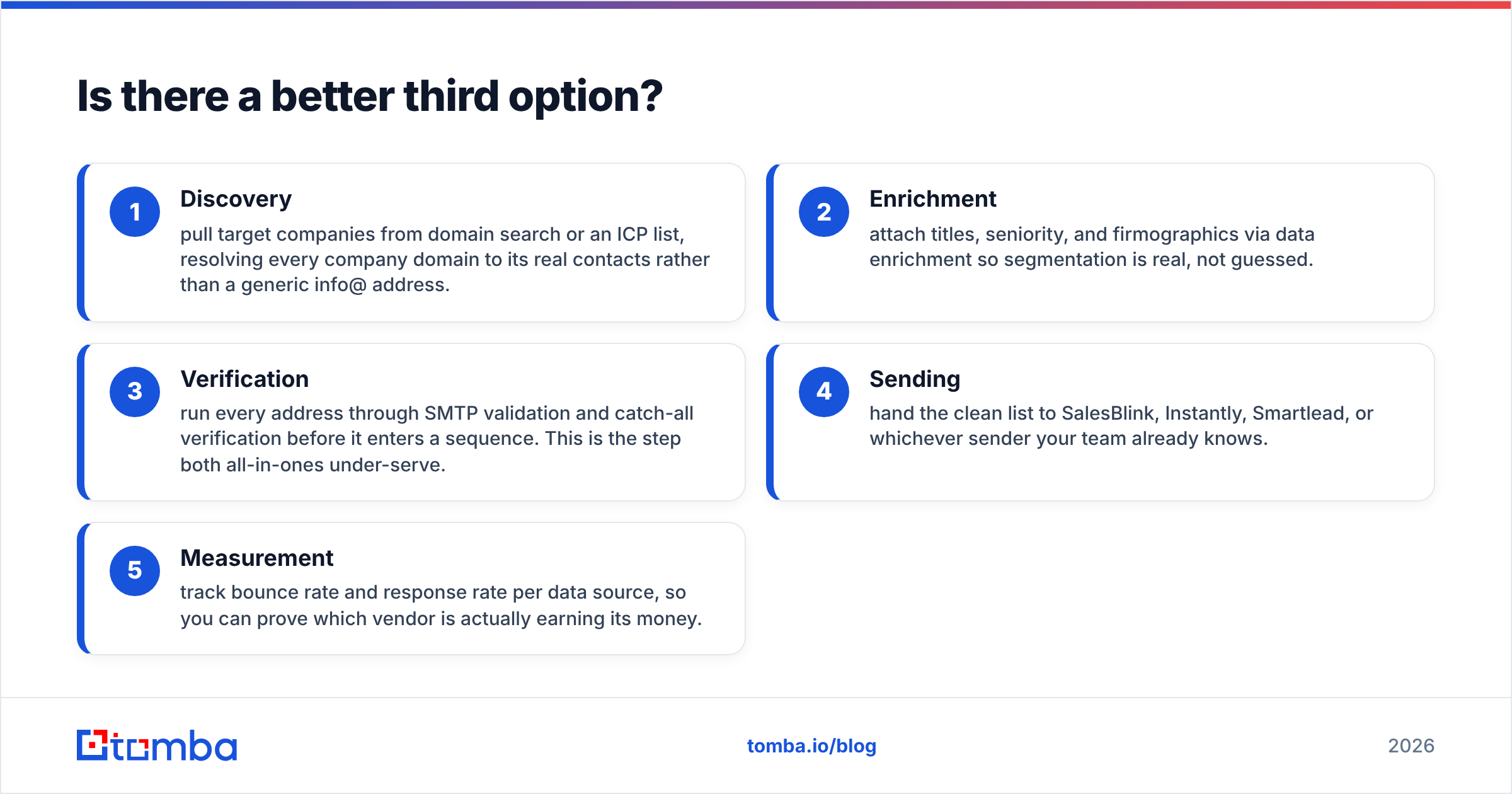
For most teams, yes — and it's the unglamorous one: decouple the layers.
Buy your contact data from a vendor whose only job is contact data. Buy your sending from a vendor whose only job is sending. Each layer improves independently, you can swap either without migrating the other, and neither vendor gets to hide weak performance behind the other's strength.
Concretely, that stack looks like:
- Discovery — pull target companies from domain search or an ICP list, resolving every company domain to its real contacts rather than a generic info@ address.
- Enrichment — attach titles, seniority, and firmographics via data enrichment so segmentation is real, not guessed.
- Verification — run every address through SMTP validation and catch-all verification before it enters a sequence. This is the step both all-in-ones under-serve.
- Sending — hand the clean list to SalesBlink, Instantly, Smartlead, or whichever sender your team already knows.
- Measurement — track bounce rate and response rate per data source, so you can prove which vendor is actually earning its money.
Worth noting: some teams prefer buying pre-built verified lists outright rather than assembling them. Vendors like BookYourData do exactly that with pay-as-you-go verified B2B contacts and a bounce guarantee, which suits campaign-based buyers who don't want a subscription. That's a legitimate path — the principle holds either way. Separate the people who sell you data from the people who sell you sending.
For a broader view of how the tools in this space rank, check independent review aggregators like G2 rather than any vendor's own comparison page — including this one. Read the one-star reviews first; they tell you the failure modes.
Which one wins?#
Verdict: SalesBlink for sending, GrowMeOrganic for cheap volume, neither on its own for a serious outbound program.
If you forced a single pick for a team that already has data: SalesBlink, because deliverability infrastructure is genuinely hard to replicate and its warmup and rotation are mature.
If you forced a single pick for a team that has a sender but no data: GrowMeOrganic, with the loud caveat that you must verify externally and budget for it.
If you're building outbound from scratch and want it to still work in twelve months, don't force a single pick. The all-in-one convenience saves you one login and costs you the accuracy that determines every downstream metric.
Ready to fix the data layer first?#
Bad addresses are the root cause behind most "our sequences stopped working" postmortems — not copy, not timing, not the sending platform. Start by measuring what you actually have: export 200 contacts from whichever tool you're currently using and run them through a real verification pass.
If the results surprise you, Tomba Email Finder is built for exactly this layer. Find verified professional addresses by domain, name, or company, with SMTP-level validation and catch-all handling built into the same call — and a free tier that gives you 25 searches a month to run the test before you spend anything. Pair it with whichever sender you like. That's the stack that survives contact with a real quarter.
Related guides#
Ready to find emails that actually work?
Join 150,000+ professionals who stopped guessing and started sending. Free credits on signup — no credit card required.
Get the Tomba newsletter
Practical outbound tactics and product updates — once every two weeks.
About the author