GrowMeOrganic vs Smarte: Which B2B Data Tool Wins in 2026?
GrowMeOrganic bundles scraping and sequencing at a low flat price. Smarte sells verified GDPR-conscious contact data. We compare coverage, pricing, and accuracy to show which one fits your outbound motion.
GrowMeOrganic vs Smarte — TL;DR
- GrowMeOrganic is a low-cost all-in-one. You get LinkedIn/Sales Navigator scraping, an email finder, and a cold email sequencer on one flat monthly plan.
- Smarte is a data-first platform. It sells verified B2B contacts and company intelligence, with a strong compliance story, aimed at RevOps and enterprise teams.
- They are not real competitors. GrowMeOrganic wins on cost per action for solo founders and small agencies. Smarte wins on data governance, EMEA/APAC coverage, and CRM enrichment at scale.
- Neither one is a best-in-class email accuracy engine. If bounces are your bottleneck, add a dedicated finder and verifier such as Tomba.
- Quick rule: need to send today? Pick GrowMeOrganic. Need clean Salesforce records that survive a legal review? Pick Smarte. Need both? Split the stack.
What are GrowMeOrganic and Smarte, exactly?#
They solve different halves of the same problem. That is why a straight feature-by-feature score misleads people.
GrowMeOrganic started as a LinkedIn extraction tool and grew into a bundled outbound suite. You install a Chrome extension and scrape a Sales Navigator search or a Google Maps result set. Then you run the built-in email finder over those profiles. Finally you push the list into a drip campaign that sends from your own mailbox. The pitch is simple: one flat price replaces a scraper, a finder, and a sequencer.
Smarte sits on the other side of the market. It is a B2B contact and account intelligence provider. You get verified emails and direct dials, plus firmographics, technographics, and intent signals. The focus is privacy compliance and coverage outside North America. RevOps and demand-gen teams buy it to enrich a CRM, build TAM lists, and answer one audit question: where did this record come from?
The practical difference is easy to state. GrowMeOrganic assumes you will do the outreach inside the tool. Smarte assumes you already run Outreach, Salesloft, or HubSpot and just need better rows.

GrowMeOrganic vs Smarte: how do they compare head to head?#
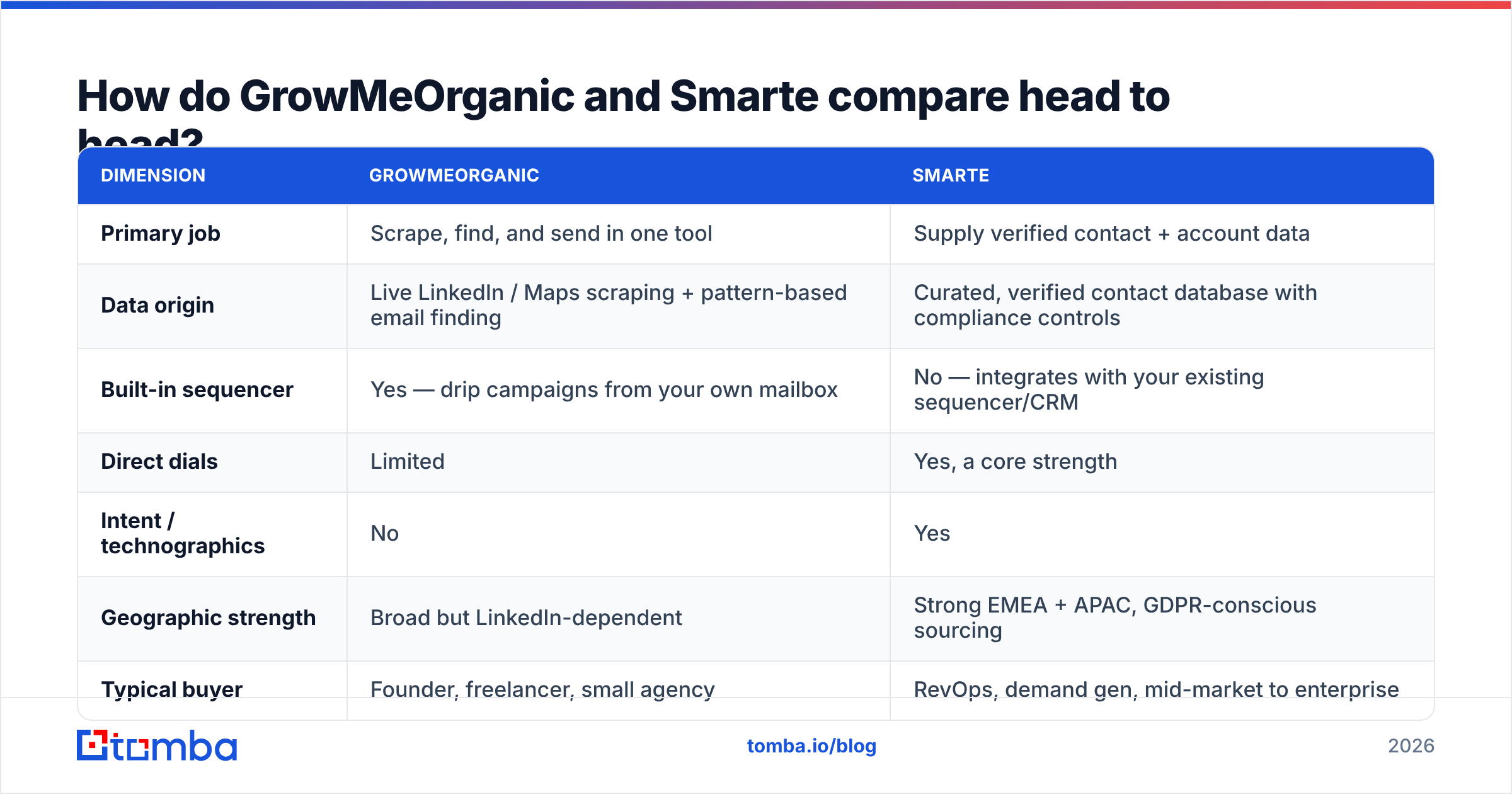
| Dimension | GrowMeOrganic | Smarte |
|---|---|---|
| Primary job | Scrape, find, and send in one tool | Supply verified contact + account data |
| Data origin | Live LinkedIn / Maps scraping + pattern-based email finding | Curated, verified contact database with compliance controls |
| Built-in sequencer | Yes — drip campaigns from your own mailbox | No — integrates with your existing sequencer/CRM |
| Direct dials | Limited | Yes, a core strength |
| Intent / technographics | No | Yes |
| Geographic strength | Broad but LinkedIn-dependent | Strong EMEA + APAC, GDPR-conscious sourcing |
| Typical buyer | Founder, freelancer, small agency | RevOps, demand gen, mid-market to enterprise |
| Entry pricing | Roughly $49–$79/mo flat, annual discounts | Custom quote, credit or seat based, usually four figures annually |
| Free option | Limited trial | Demo / sample data on request |
| Learning curve | Low — a day | Medium — onboarding + CRM mapping |
| Biggest weakness | Email accuracy and deliverability control | Cost and no native sending |
The pricing gap is the headline. GrowMeOrganic publishes its numbers, and they land in the double digits per month. Smarte quotes you instead. Quotes in the enrichment-data category usually start in the low four figures per year and climb with record volume. Check current listings on G2 before you budget. Both vendors repackage often, and public reviews are the fastest way to spot a change.
Which one has better data accuracy?#
Neither is built as an accuracy specialist. They also fail in different ways.
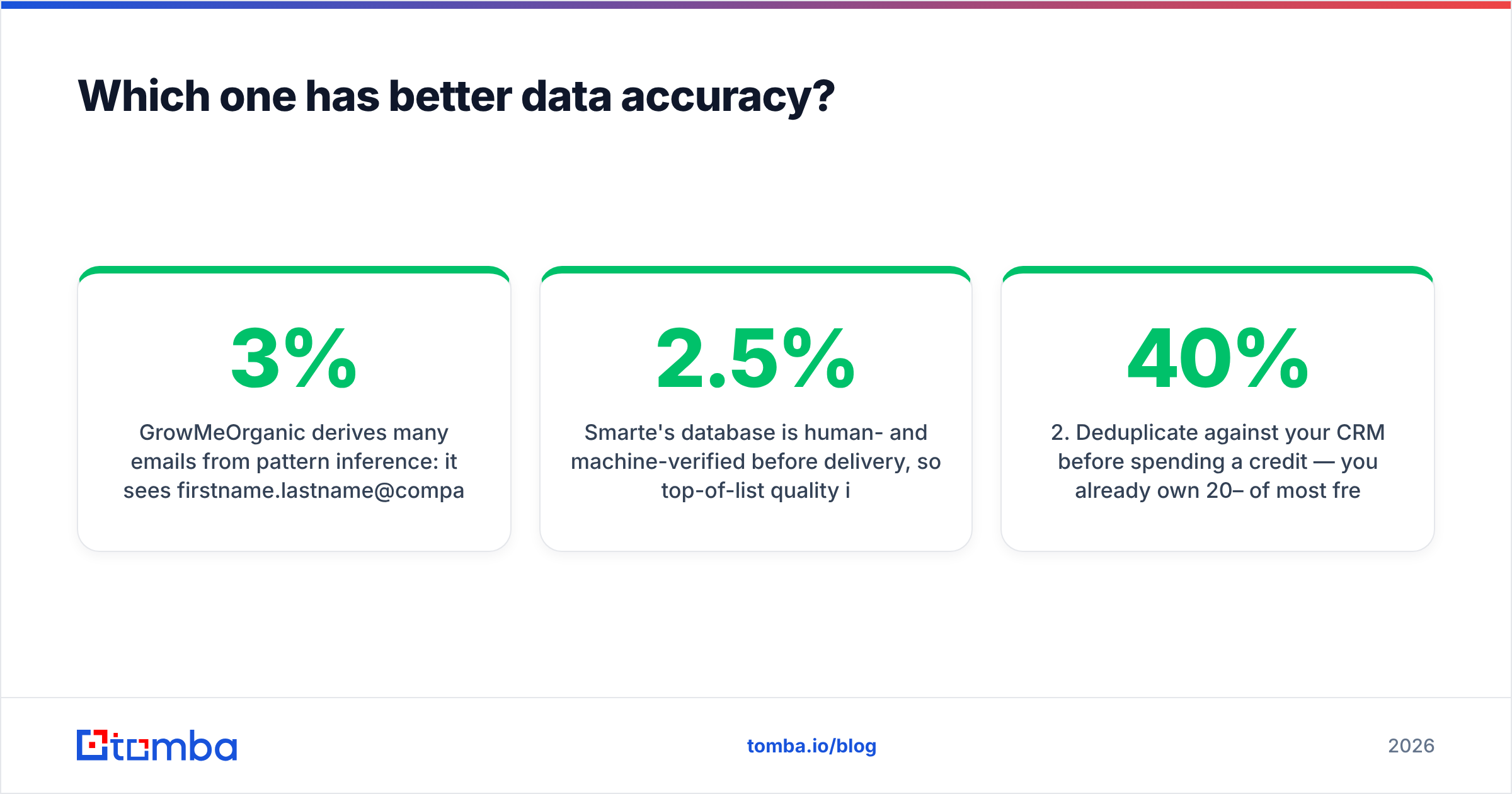
GrowMeOrganic guesses many emails from patterns. It sees firstname.lastname@company.com used at a domain and applies that shape to a new name. That is cheap, fast, and fine on tidy domains. It breaks on companies with mixed formats. It breaks on catch-all domains, where an SMTP check accepts anything. It also breaks on people who joined after your source snapshot. Teams often report bounce rates above 3%. Google and Microsoft treat that line as a reputation warning, so re-verify before you send.
Smarte verifies its database by machine and by hand before delivery, so the top of the list is cleaner. The weak spot is staleness in the long tail. A record checked nine months ago may point at someone who has already moved on. Every static database decays. The industry consensus is that 2–2.5% of B2B contact records go bad each month, which is about a quarter of your list per year.
Here is the point most comparison posts skip. Verification is a separate job from sourcing, and you should treat it that way. Whichever tool sources the record, run the address through a real email verifier right before the send, not at import time. Catch-all domains now cover a large share of enterprise mail. For those, use a catch-all verifier that scores deliverability instead of returning a useless "unknown."
A four-step accuracy workflow that works with either tool:
- Source the contact from GrowMeOrganic (scrape) or Smarte (database pull).
- Deduplicate against your CRM before you spend a credit. You already own 20–40% of most fresh lists.
- Re-verify every address within 48 hours of the send, not at list-build time.
- Route catch-alls into a separate, low-volume sequence sent from a backup domain. A bad guess then never touches your primary sender reputation.
That fourth step alone is worth more than the gap between these two vendors.
Is GrowMeOrganic better than Smarte for cold outreach?#
For pure cold email, yes — with caveats.
GrowMeOrganic collapses three tools into one bill. You scrape 500 profiles from Sales Navigator, enrich them, write a four-step sequence, and start sending the same afternoon. For a two-person agency running outbound for clients, that saves real money and real time. The sequencer handles follow-ups, reply detection, and basic personalization tokens.
The caveats are structural. First, the sending engine works, but it is not a specialist. You get less control over warmup, inbox rotation, and per-domain throttling than dedicated platforms give you. Our breakdown of Instantly alternatives covers what those controls actually buy you. Second, LinkedIn scraping at volume carries account risk, and no vendor can fully protect you from it. Third, guessed emails feed straight into the sequencer, so a sloppy operator can torch a domain in two weeks.
Smarte is simply not built for this. It has no native sender. Buying Smarte for cold email means buying Smarte, a sequencer, and a verifier. That is a fine architecture. It is not a cheap one.
Is Smarte better than GrowMeOrganic for enterprise data teams?#
Yes, and it is not close.
Three things set Smarte apart. Compliance paperwork comes first. If your legal team asks for the lawful basis of processing on an EU contact, Smarte can answer. A scraped LinkedIn export cannot. Under GDPR's legitimate-interest framework, documented sourcing and honored opt-outs matter. The ICO's guidance on direct marketing is the reference most European counsel will point at.
Second is coverage outside North America. GrowMeOrganic only sees what LinkedIn sees. That view is thin in Japan, uneven in parts of continental Europe, and unreliable for mid-market manufacturing. Smarte invests in exactly those regions.
Third is the shape of the enrichment. Smarte returns firmographics, technographics, and intent next to the contact. Account scoring models consume those fields. If you are building a marketing qualified lead model, a name and an email are not enough.
The trade is cost and speed. Enterprise data contracts bring annual commitments, seat minimums, and a procurement cycle. A founder who needs 300 emails this week should skip that conversation.

What does each one actually cost?#
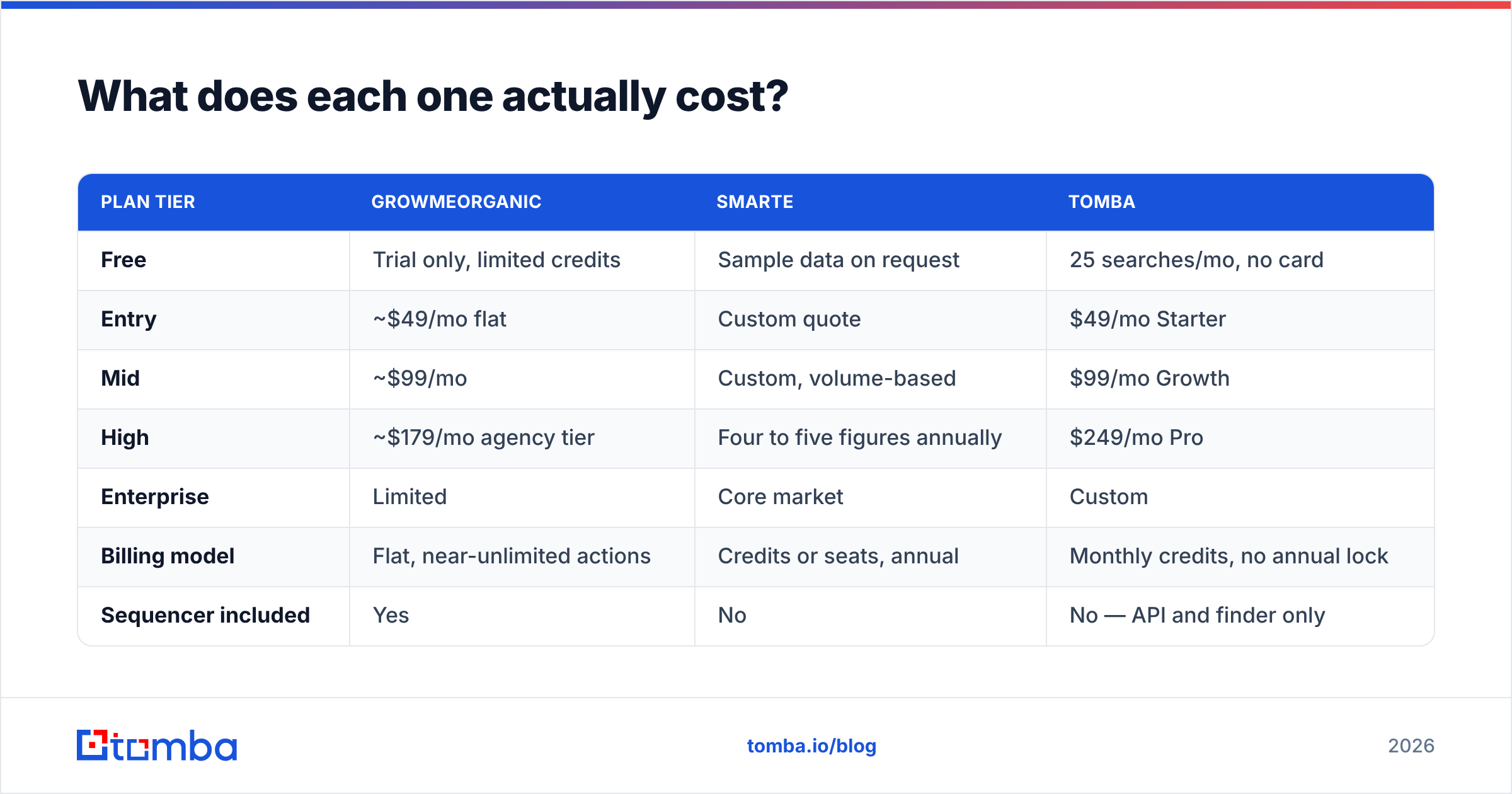
| Plan tier | GrowMeOrganic | Smarte | Tomba |
|---|---|---|---|
| Free | Trial only, limited credits | Sample data on request | 25 searches/mo, no card |
| Entry | ~$49/mo flat | Custom quote | $49/mo Starter |
| Mid | ~$99/mo | Custom, volume-based | $99/mo Growth |
| High | ~$179/mo agency tier | Four to five figures annually | $249/mo Pro |
| Enterprise | Limited | Core market | Custom |
| Billing model | Flat, near-unlimited actions | Credits or seats, annual | Monthly credits, no annual lock |
| Sequencer included | Yes | No | No — API and finder only |
| API access | Limited | Yes | Yes, on all paid plans |
Read the flat-rate claim carefully. "Unlimited" in the scraping category means unlimited within fair-use rate limits. The real ceiling is your LinkedIn account's tolerance, not the vendor's billing system. Smarte's quote scales with records exported. Model your annual contact volume before the first call, or you will over-buy.
The math changes if you only need the email-finding piece. Tomba pricing starts with a free tier of 25 searches a month, and Starter is $49/mo. The same email finder API is on every paid plan. That is often the cheapest way to add accurate emails to a stack you already like.
What about the alternatives to both?#
Neither tool is the obvious default in 2026. For many teams, the honest answer is a split stack.
Where the alternatives fit:
- Pure email finding at volume — a dedicated finder with a domain search endpoint and bulk email finder processing beats a bundled scraper on hit rate and bounce rate. It is the vendor's only product.
- Verified purchased lists — BookYourData sells pay-as-you-go verified B2B lists with a bounce guarantee. That suits teams who want a one-time list with no subscription and no scraper. It is a genuinely different buying model from both tools here.
- All-in-one prospecting suites — Apollo and similar platforms trade per-record data depth for breadth. See our notes on Apollo alternatives for where that trade breaks down.
- CRM-native enrichment — if most of your records already live in HubSpot or Salesforce, an enrichment integration may win on total cost. HubSpot documents its own data enrichment approach if you want a baseline.
- LinkedIn-specific workflows — a focused LinkedIn finder turns profile URLs into verified work emails. You skip the account exposure of a full extraction tool.
The pattern across all five is the same: unbundle. The all-in-one price looks great until you notice one thing. You are paying for a mediocre version of the component that decides whether your campaign works at all.
How should you choose between them?#
The GrowMeOrganic vs Smarte call comes down to one constraint. Work backward from that constraint, not from the feature list.
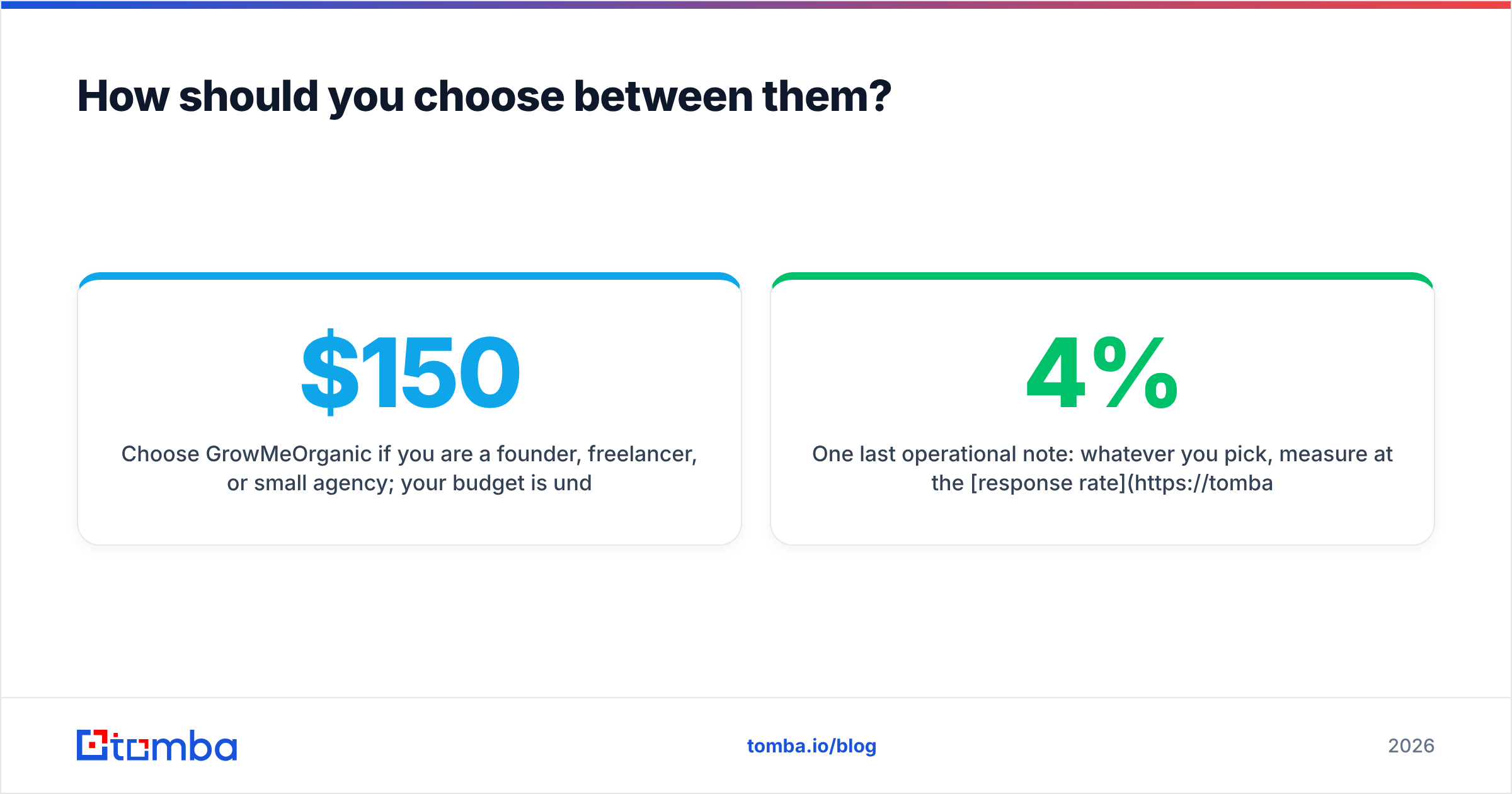
Choose GrowMeOrganic if you are a founder, freelancer, or small agency. Your budget is under $150 a month, your buyers are easy to find on LinkedIn, and one login beats best-in-class parts. Add a verifier before you send. That single step fixes most of the complaints in its reviews.
Choose Smarte if your CRM is full of stale records. Your buyers sit in EMEA or APAC, legal or procurement will review your sourcing, and you need direct dials and intent next to emails. You will also need a sequencer, so budget for the whole stack.
Choose neither if your real problem is "my emails bounce." That is a finding and verification problem. Neither of these tools is engineered to solve it. Buying a bigger bundle to fix an accuracy gap is how outbound budgets quietly double while reply rates stay flat.
One last operational note. Measure at the response rate level, not at list size. A 2,000-contact list at 4% bounce beats a 10,000-contact list at 18% every quarter. The second one also costs you your domain.
Get accurate emails without switching your whole stack#
You do not have to crown a winner in GrowMeOrganic vs Smarte to fix the thing that is costing you replies. Both source contacts. Neither is built to guarantee that the address in the row will accept mail tomorrow morning.
Try the Tomba Email Finder next to whichever platform you pick. The free tier gives you 25 searches a month with no card. Starter is $49/mo, and the API drops into the workflow you already run — Sheets, HubSpot, or a bulk CSV. Run 200 of your existing contacts through it, compare the bounce rate against your current source, and let the numbers decide the rest of your stack.
Related guides#
Ready to find emails that actually work?
Join 150,000+ professionals who stopped guessing and started sending. Free credits on signup — no credit card required.
Get the Tomba newsletter
Practical outbound tactics and product updates — once every two weeks.
About the author