GrowMeOrganic vs SMTP Ghost: Which Outreach Tool Wins?
GrowMeOrganic bundles a B2B database with sequences. SMTP Ghost is built to scale sending across many inboxes. Here is where each actually wins, what they cost, and why your data layer decides the outcome.
TL;DR
- GrowMeOrganic is an all-in-one prospecting platform: built-in B2B contact database, LinkedIn/Sales Navigator extraction, email finding, and drip sequences in one subscription.
- SMTP Ghost is a sending-first platform: unlimited-style inbox connections, rotation, warmup, and volume campaigns. It assumes you bring your own list.
- If you have no list, GrowMeOrganic gets you moving faster. If you have lots of leads and a scaling problem, SMTP Ghost is the better sending engine.
- Neither one fixes the thing that actually kills campaigns: stale, unverified contact data. Both will happily send to a 12% bounce list.
- The stable pattern for 2026: dedicated data layer (verified emails) → sending platform. Tools change; a clean list is the asset.
What are GrowMeOrganic and SMTP Ghost, actually?#
They get compared constantly because both show up in "cold email tool" searches, but they solve opposite halves of the problem.
GrowMeOrganic is an India-built, all-in-one B2B prospecting suite. Its pitch is that you never leave the tab: search a contact database, scrape LinkedIn or Sales Navigator with the Chrome extension, pull emails, drop them into a drip sequence, and send from your connected Gmail or Outlook. It is a data-plus-outreach bundle sold on unlimited-ish usage. You can see the current feature set on growmeorganic.com.
SMTP Ghost sits at the other end. It is infrastructure for people who already have leads and want to send at volume without torching a single domain. Multiple inboxes, sending rotation across them, warmup, per-inbox throttling, campaign sequencing, reply detection. The product logic is: sending is the bottleneck, so make sending cheap and parallel.
That difference explains almost every disagreement you will read in reviews. A founder with zero prospects loves GrowMeOrganic and finds SMTP Ghost empty. An agency running 40 inboxes for six clients finds GrowMeOrganic's sending limits claustrophobic and SMTP Ghost obvious.

How do GrowMeOrganic and SMTP Ghost compare head to head?#
Pricing on both tools moves — lifetime deals, annual discounts, and repackaged tiers are common in this segment. Treat the numbers below as directional and confirm on the vendor's own page before you buy.
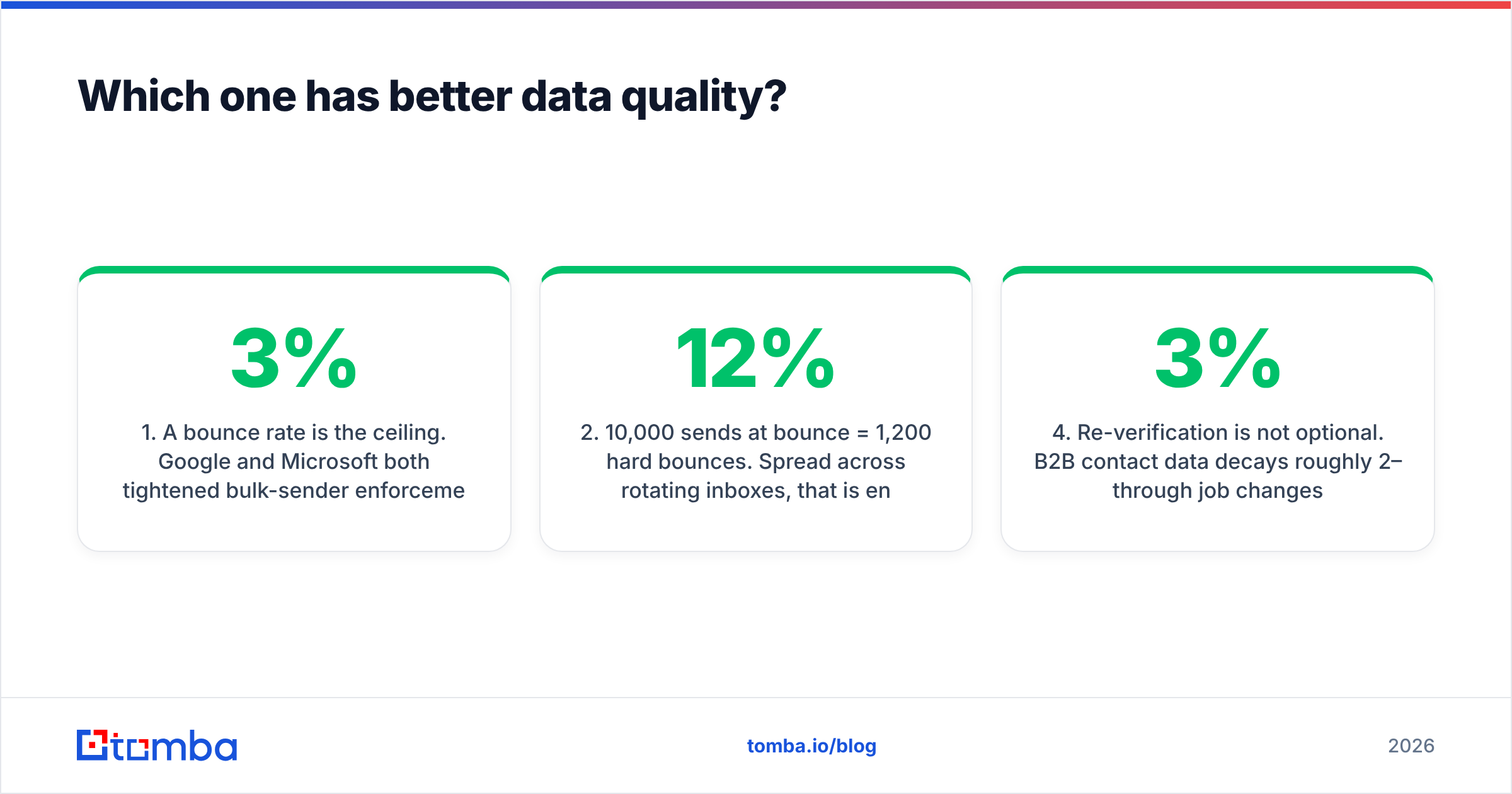
| Attribute | GrowMeOrganic | SMTP Ghost |
|---|---|---|
| Primary job | Find prospects + send sequences | Send at scale from many inboxes |
| Built-in contact database | Yes (claimed 500M+ contacts) | No — bring your own list |
| LinkedIn extraction | Yes, Chrome extension for LinkedIn + Sales Nav | Not a core feature |
| Email verification | Basic, bundled | Basic / list-cleaning oriented |
| Inbox connections | Limited by plan | Many; rotation is the headline feature |
| Warmup | Limited | Built in, core to the product |
| Typical entry price | Roughly $49–$79/mo billed annually | Roughly $40–$100/mo depending on tier |
| Best for | Solo founders, small teams with no list | Agencies, high-volume outbound teams |
| Weakest point | Data freshness and bounce rates | Zero help sourcing contacts |
| Learning curve | Low | Medium (domains, DNS, rotation setup) |
The table makes the tradeoff blunt. GrowMeOrganic is breadth at the cost of depth in any one layer. SMTP Ghost is depth in one layer and nothing in the others.
Which one has better data quality?#
Neither is a data company, and that matters more than any feature checkbox.
GrowMeOrganic's database is bundled — you are not paying a premium for it, and the pricing reflects that. Users consistently report usable coverage in North America and India, thinner results in EMEA mid-market, and noticeable decay on contacts that have not been re-verified. Scrape-based extraction from LinkedIn gets you names and companies reliably; the email address attached to that name is the part that goes stale.
SMTP Ghost does not claim a database at all, which is honest but means the quality question lands entirely on whatever CSV you upload.
Here is the arithmetic nobody in a sales demo walks you through:
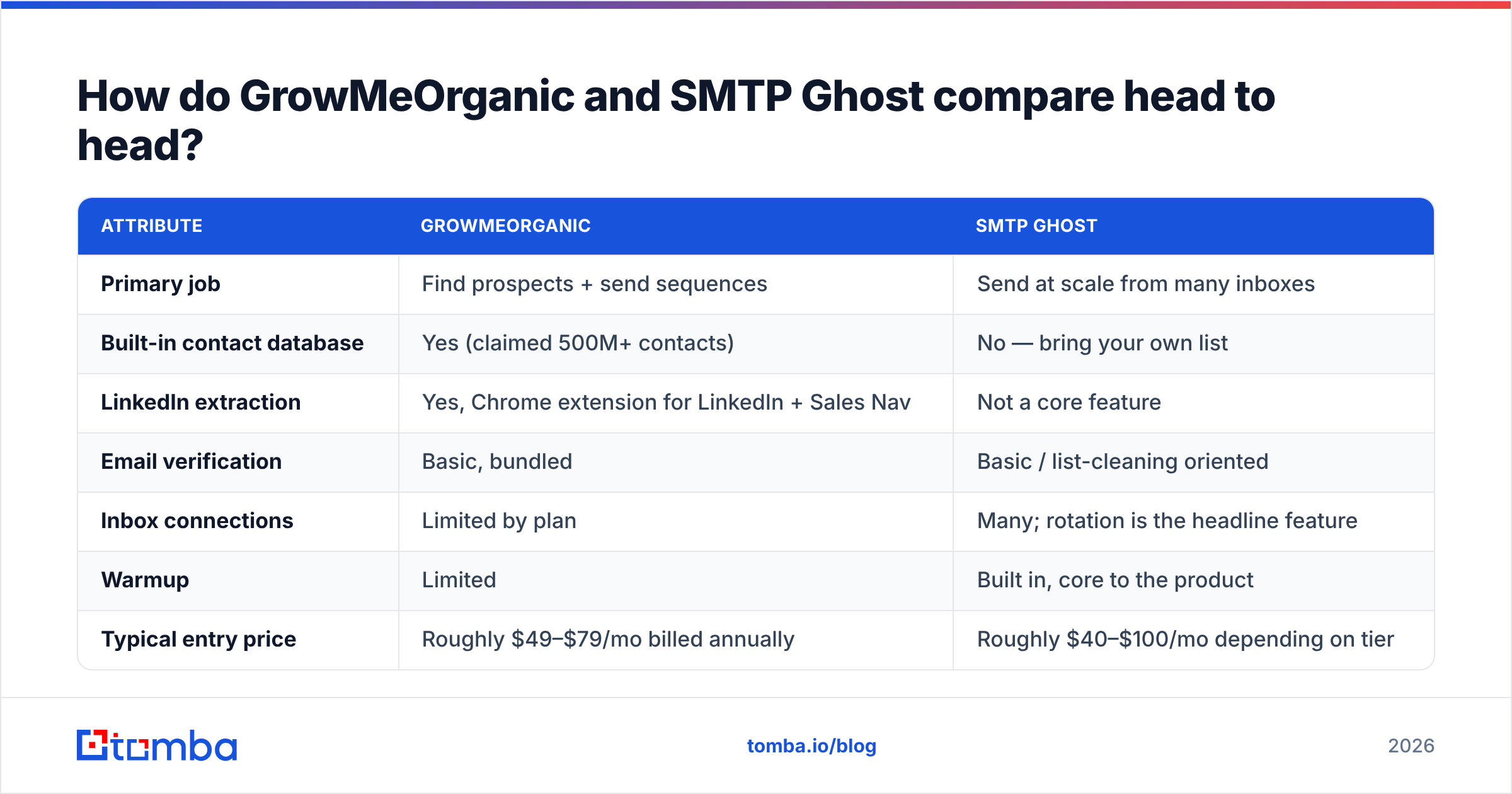
- A 3% bounce rate is the ceiling. Google and Microsoft both tightened bulk-sender enforcement, and Google's published bulk sender guidelines set a spam-complaint threshold that unverified lists blow through fast.
- 10,000 sends at 12% bounce = 1,200 hard bounces. Spread across rotating inboxes, that is enough to poison a whole domain group in under two weeks.
- Rotation hides the symptom, not the cause. Sending bad data from twenty inboxes just distributes the reputation damage; it does not reduce it.
- Re-verification is not optional. B2B contact data decays roughly 2–3% per month through job changes alone. A list you bought in January is materially different by June.
- The fix is cheap relative to the damage. Verifying a list costs a fraction of a burned domain plus the six-week warmup to replace it.
This is where a dedicated layer earns its keep. Running your list through a proper email verifier before it touches either platform is the single highest-leverage step in the whole workflow — and it is platform-agnostic, so it survives you switching tools next year.
Is GrowMeOrganic better than SMTP Ghost for cold email?#
For a specific profile, yes. For most scaling teams, no.
GrowMeOrganic wins when:
- You are a solo founder or a two-person team with no existing prospect list.
- You want one subscription instead of three, and you are willing to trade some quality for that.
- Your volume is modest — a few hundred to a couple thousand sends per month.
- You are prospecting heavily on LinkedIn and want extraction plus sending in the same seat.
SMTP Ghost wins when:
- You already have a data source you trust (a provider, a scraper, an in-house researcher).
- You are running multiple domains and inboxes and need rotation, throttling, and warmup that actually work.
- You are an agency sending on behalf of several clients and need isolation between them.
- Your bottleneck is deliverability engineering, not lead sourcing.
There is a third case worth naming: teams that pick GrowMeOrganic for the data, get frustrated with the sending, and then bolt on a dedicated sender anyway. At that point you are paying for an all-in-one and using half of it. If you can see that ending coming, skip the middle step.
What does the sending architecture look like in practice?#
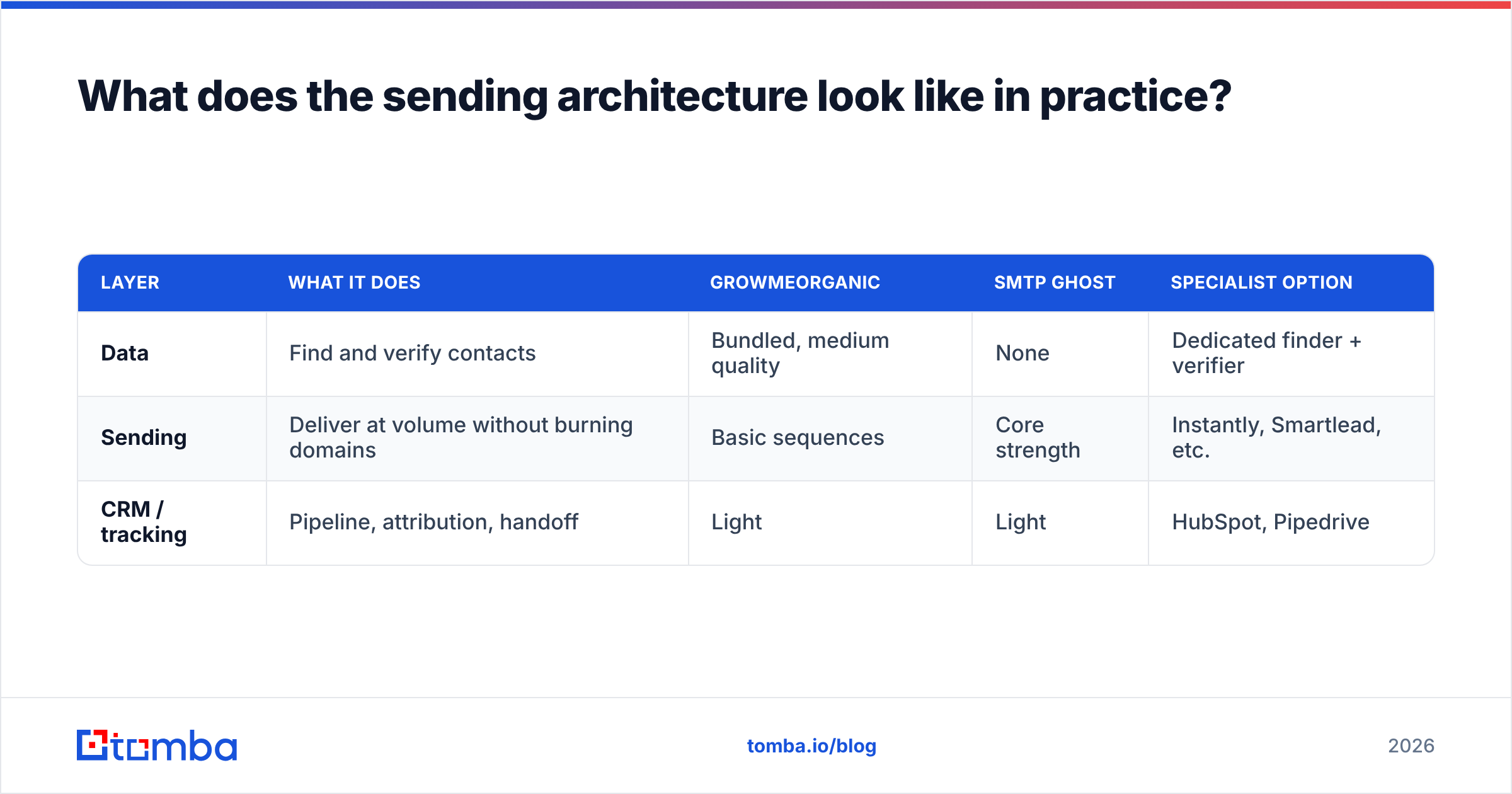
Cold outreach in 2026 has effectively split into three layers, and understanding the split makes the vendor choice much easier.
| Layer | What it does | GrowMeOrganic | SMTP Ghost | Specialist option |
|---|---|---|---|---|
| Data | Find and verify contacts | Bundled, medium quality | None | Dedicated finder + verifier |
| Sending | Deliver at volume without burning domains | Basic sequences | Core strength | Instantly, Smartlead, etc. |
| CRM / tracking | Pipeline, attribution, handoff | Light | Light | HubSpot, Pipedrive |
Most failed outbound programs are diagnosed as a "copy problem" when they are actually a layer-one problem. If 30% of your sends never reach a human, no subject line rescues the campaign. The email deliverability conversation starts with list hygiene, not with SPF records — though you need those too.
A practical build for a small team looks like this: source and verify with a dedicated data tool, push clean rows into your sender of choice, and let the CRM own everything post-reply. Each layer is replaceable without rebuilding the other two.

What do the reviews actually say?#
Public review sites are useful here mostly for spotting the recurring complaint, not the star rating. Categories on G2 group both tools loosely under sales engagement, which flattens the real difference.
Recurring GrowMeOrganic themes:
- Praise for value — a lot of functionality per dollar, especially on lifetime or annual deals.
- Praise for the LinkedIn extension workflow speed.
- Complaints about email accuracy and bounce rates on database exports.
- Complaints about support responsiveness during peak periods.
- Some friction on sending limits once campaigns grow.
Recurring SMTP Ghost themes:
- Praise for the inbox rotation and warmup working as advertised.
- Praise for cost per send at volume relative to enterprise sequencers.
- Complaints about setup complexity — DNS, domains, and inbox provisioning are on you.
- The obvious gap: no lead source, so it is a partial solution by design.
Notice that the GrowMeOrganic complaints cluster on data, and the SMTP Ghost complaints cluster on setup. Neither is a surprise given what each product is. Both are fixable with the right adjacent tooling; only one of them is fixable by trying harder.
How do you fix the data layer without adding three more tools?#
You need two capabilities, not three: finding the right address, and confirming it is still alive.
An email finder handles the first. Give it a name plus a company domain and it returns the most probable work address with a confidence score, drawing on pattern detection plus source verification. For account-based work, domain search flips the input: give it a company domain and get back the contacts it knows about, with roles, so you can build a multi-threaded list for one account instead of a single point of failure.
Verification handles the second. Real verification means MX lookup, SMTP handshake, catch-all detection, role-address flagging, and disposable-domain screening — not just a regex that confirms there is an @ in the string. The catch-all case in particular trips up most bundled verifiers; a catch-all verifier is what separates "accepts everything" from "actually deliverable."
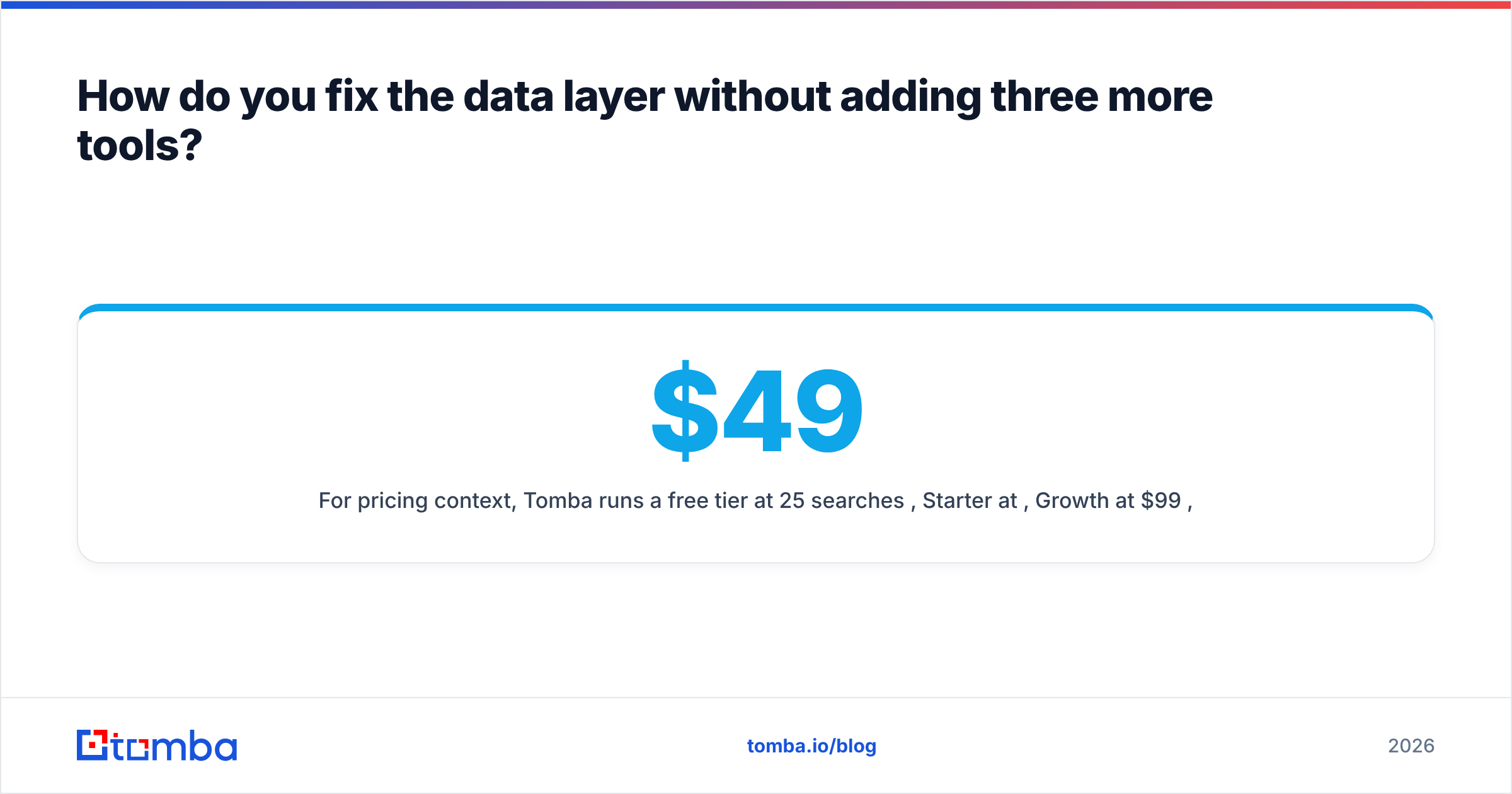
For pricing context, Tomba runs a free tier at 25 searches per month, Starter at $49/mo, Growth at $99/mo, and Pro at $249/mo, with enterprise pricing on request. Full Tomba pricing is public. That is a separate line item on top of whichever sender you pick — and it is usually the cheapest line item that saves the most money, because it is the one preventing domain replacement costs.
The integration cost is lower than people expect. Both GrowMeOrganic and SMTP Ghost accept CSV imports, and a Tomba API call can slot into whatever enrichment step already exists in your stack. There is no rip-and-replace.
Which should you pick?#
Decide on your actual constraint, not the feature list.
Pick GrowMeOrganic if you are early, list-poor, budget-constrained, and want one login. Accept that you will need to verify exports before sending, and plan for that from day one rather than after your first bounce spike.
Pick SMTP Ghost if sending volume and domain safety are your bottleneck, you already have a data pipeline, and you are comfortable owning DNS and inbox provisioning. It does its one job well.
Pick neither as your data layer. This is the honest recommendation regardless of which sender you land on. Bundled databases are a convenience feature inside products whose real business is something else. When your campaign performance depends on address accuracy, that dependency deserves its own tool with its own accountability.
Run this test before committing: take 200 contacts from your target segment, source them through the tool you are evaluating, verify them independently, and measure the delta. If 25 of 200 come back invalid, you now know your real bounce rate before you have risked a domain — and you know exactly what the bundled data is worth.
A quick sanity check on scale: at 2,000 sends per month, a 12% bad-data rate wastes 240 sends. At 20,000, it wastes 2,400 and starts moving your sender reputation in the wrong direction. The problem does not scale linearly — it compounds, because reputation damage reduces inbox placement for the good addresses too.
Ready to fix the layer both tools skip?#
GrowMeOrganic and SMTP Ghost are both reasonable picks inside their lane. Neither will save a campaign built on decayed contact data.
Start with the Tomba Email Finder to source verified work emails by name, company, or domain — with confidence scoring and source attribution so you know what you are sending to. The free tier gives you 25 searches to benchmark accuracy against whatever list you have now. Run the 200-contact test, compare the delta, and then decide which sender deserves your budget.
Related guides#
Ready to find emails that actually work?
Join 150,000+ professionals who stopped guessing and started sending. Free credits on signup — no credit card required.
Get the Tomba newsletter
Practical outbound tactics and product updates — once every two weeks.
About the author