GrowMeOrganic vs Sparkle: Which B2B Prospecting Tool Wins?
GrowMeOrganic sells volume. Sparkle sells AI-assisted precision. We break down pricing, data accuracy, deliverability risk, and which one actually belongs in your 2026 outbound stack.
GrowMeOrganic vs Sparkle comes down to one choice: buy volume, or buy precision. GrowMeOrganic bundles the whole outbound stack on a flat plan. Sparkle builds smaller, AI-enriched lists that you push into the sequencer you already own. This guide compares both on price, data quality, and bounce risk.
TL;DR
- GrowMeOrganic is an all-in-one, volume-first tool. You get LinkedIn scraping, a bundled B2B database, email finding, and a cold email sender on flat plans.
- Sparkle sits at the other end. It is a leaner, AI-led layer. It favours small, well-researched lists over raw record count, and it bills by credits or seats.
- Neither is a pure data vendor. If your bottleneck is email accuracy, both will frustrate you — bundled databases decay faster than dedicated finders do.
- The honest split on GrowMeOrganic vs Sparkle: pick GrowMeOrganic if you want one tool and one bill. Pick Sparkle if you want a short, clean list you will tailor by hand. Add a dedicated finder to either one if you are judged on bounce rate.
- Prices move. We checked everything below in August 2026. Confirm on each vendor's pricing page before you buy.
What are GrowMeOrganic and Sparkle?#
GrowMeOrganic is an India-based B2B prospecting suite. It grew popular on a simple promise: stop paying four vendors. One login gets you a LinkedIn and Sales Navigator extractor, a contact database, an email finder, a verifier, and a cold email sequencer. You pay a flat monthly fee instead of per-credit metering. Agencies and solo founders like that shape, because the bill does not spike when a campaign goes well.
Sparkle takes the opposite bet. Instead of "everything, unlimited," it leans into AI-assisted list building. You describe your ICP. The tool then builds and enriches a smaller set of accounts and contacts, and you push them into the sequencer you already run. It is a scalpel where GrowMeOrganic is a Swiss Army knife. That one choice drives the rest of this comparison: price, data freshness, and who is still happy after 90 days.
One framing helps here. GrowMeOrganic plays for cost per contact. Sparkle plays for quality per contact. So "which is better" really asks which of those two numbers hurts your pipeline right now.
GrowMeOrganic vs Sparkle: how do they compare feature by feature?#
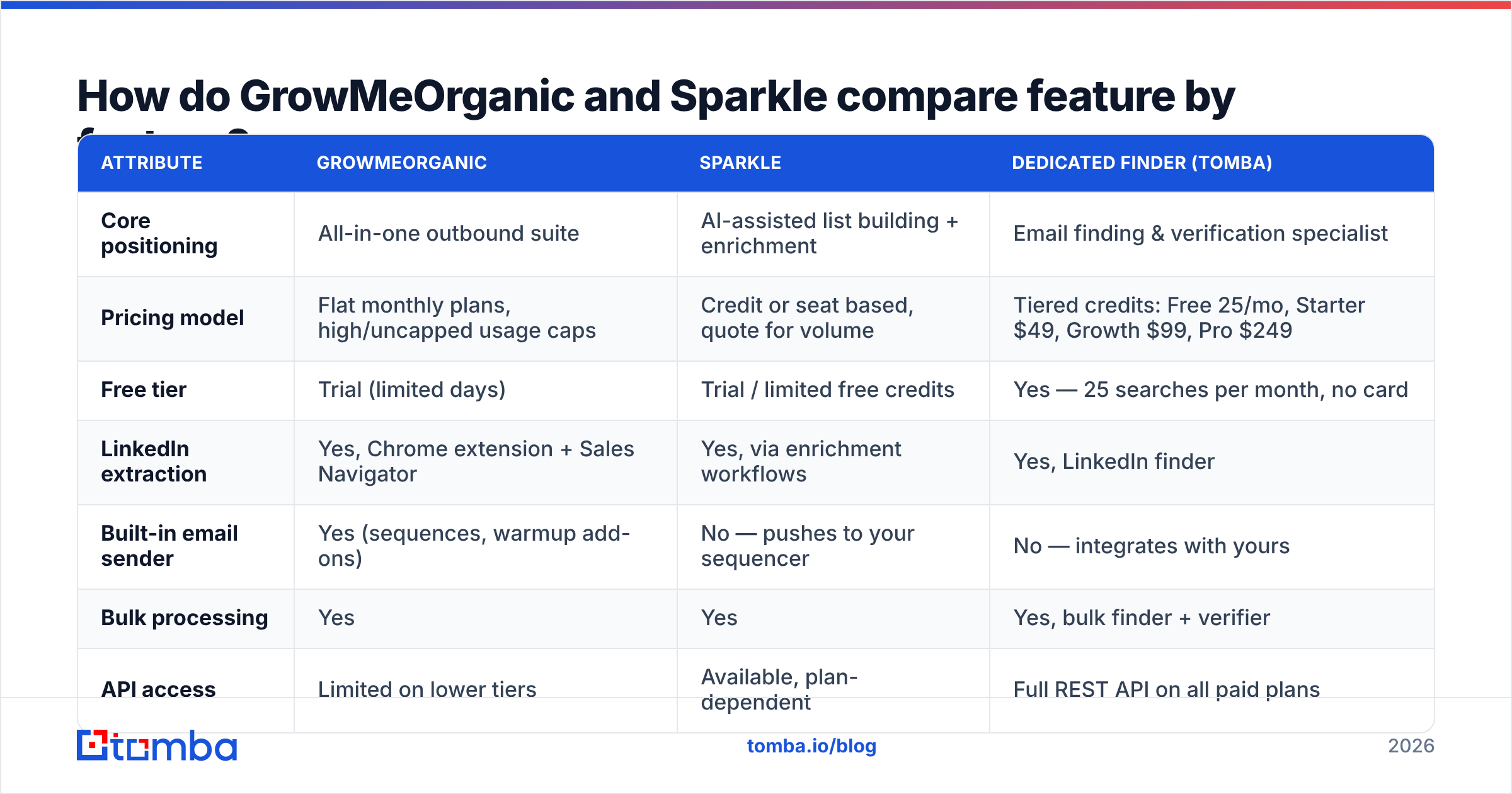
Here's the head-to-head on the attributes that actually change your day-to-day workflow. Where a vendor doesn't publish a hard number, we say so rather than inventing one.
| Attribute | GrowMeOrganic | Sparkle | Dedicated finder (Tomba) |
|---|---|---|---|
| Core positioning | All-in-one outbound suite | AI-assisted list building + enrichment | Email finding & verification specialist |
| Pricing model | Flat monthly plans, high/uncapped usage caps | Credit or seat based, quote for volume | Tiered credits: Free 25/mo, Starter $49, Growth $99, Pro $249 |
| Free tier | Trial (limited days) | Trial / limited free credits | Yes — 25 searches per month, no card |
| LinkedIn extraction | Yes, Chrome extension + Sales Navigator | Yes, via enrichment workflows | Yes, LinkedIn finder |
| Built-in email sender | Yes (sequences, warmup add-ons) | No — pushes to your sequencer | No — integrates with yours |
| Bulk processing | Yes | Yes | Yes, bulk finder + verifier |
| API access | Limited on lower tiers | Available, plan-dependent | Full REST API on all paid plans |
| Catch-all handling | Basic | Basic | Dedicated catch-all verifier |
| Best for | Agencies, high-volume SMB outbound | Focused ABM-style lists | Teams judged on bounce rate |

The table makes the trade obvious. GrowMeOrganic wins the "how many tools do I need" question outright. Sequencing inside the same product is convenient, and for a two-person agency it removes a whole vendor relationship. Sparkle wins the "how much junk do I have to clean" question, because a smaller list has fewer places to hide bad records.
What neither wins is depth on verification. A verifier bundled inside a suite is almost always lighter than a product whose whole reputation rests on it. That is not a knock on either vendor. It is how bundling works everywhere, from cameras in phones to spellcheckers in word processors.
GrowMeOrganic vs Sparkle: which one has better data accuracy?#
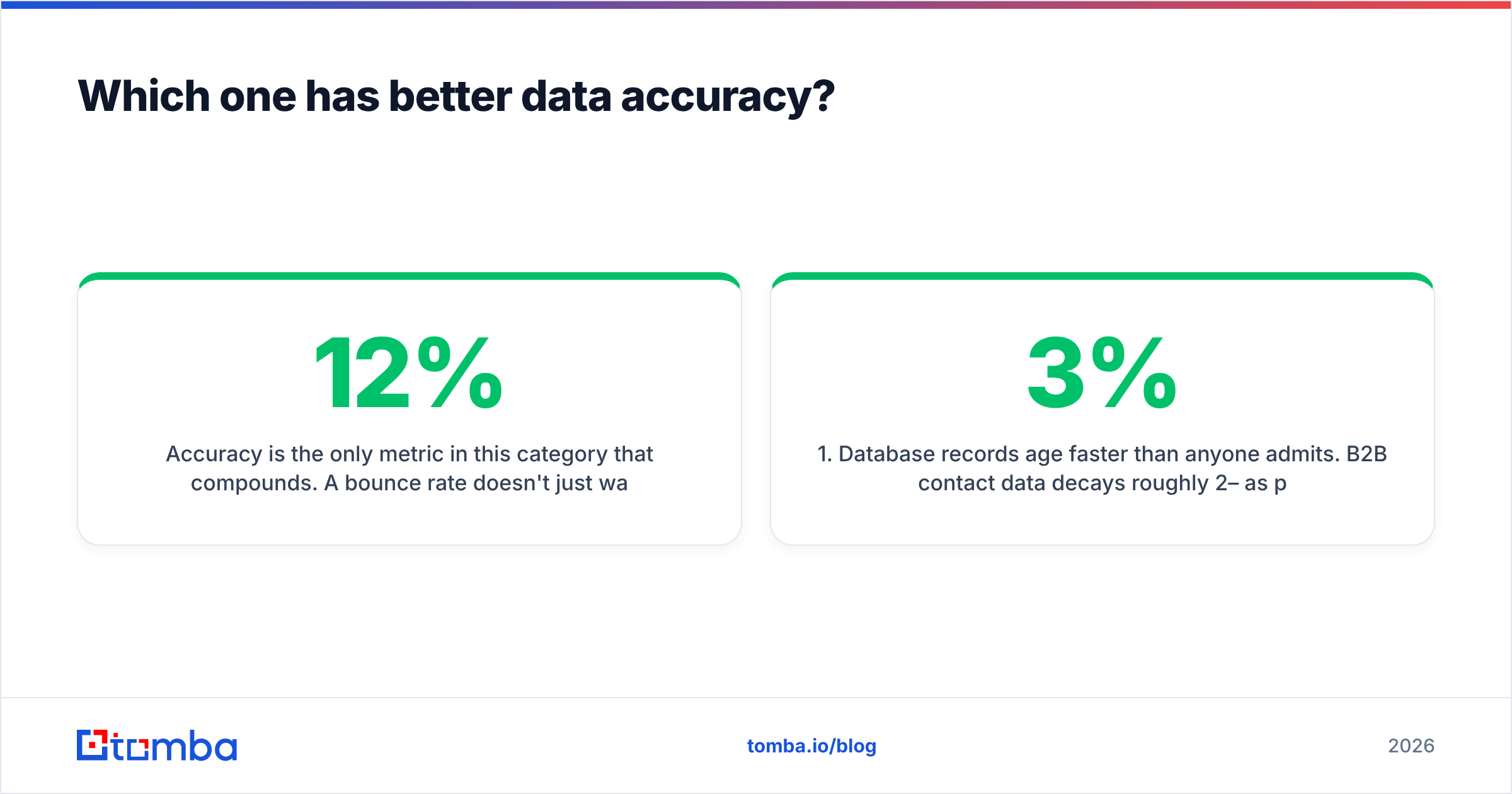
Accuracy is the only metric here that compounds. A 12% bounce rate does not just waste 12% of your sends. It drags sender reputation down and quietly hurts inbox placement for the other 88%. Mailbox providers read bounces as a sign that you do not know who you are mailing.

The same patterns show up whenever teams audit a GrowMeOrganic vs Sparkle trial against a dedicated finder:
- Records age fast. B2B contact data decays 2–3% per month as people change roles. A database refreshed once a quarter is always behind a finder that checks on request.
- "Verified" means different things. Some tools call an address verified after a syntax and MX check. That catches typos, not job changes. Real checks go to the SMTP level and flag role addresses.
- Catch-all domains are where scores go to die. Many domains accept every address at the gateway. Tools that mark them "valid" inflate their own numbers and hand you the bounce later. A catch-all verifier is the honest fix.
Two more patterns show up once you look at the pricing model behind the data:
- Pattern guessing is not finding. Making up
first.last@domain.comand calling it a hit is a coin flip at any company with two Sarah Chens. Confidence scores backed by real sources are the difference. - Volume incentives fight accuracy. When a plan sells unlimited contacts, the product's job is to return a row. When a plan meters credits, its job is to return a correct row, because a miss costs you nothing.
That last point is the awkward one for flat-rate suites. GrowMeOrganic is not careless. It is that an uncapped plan rewards coverage over precision, and coverage is the cheaper thing to build. Sparkle dodges part of this by enriching fewer records with more care. It is still not a verification specialist.
So in the GrowMeOrganic vs Sparkle accuracy race, neither one is the safe answer on its own. If bounce rate is the number your VP asks about on Monday, run every list through a dedicated email verifier first. It costs less than one blown domain reputation.
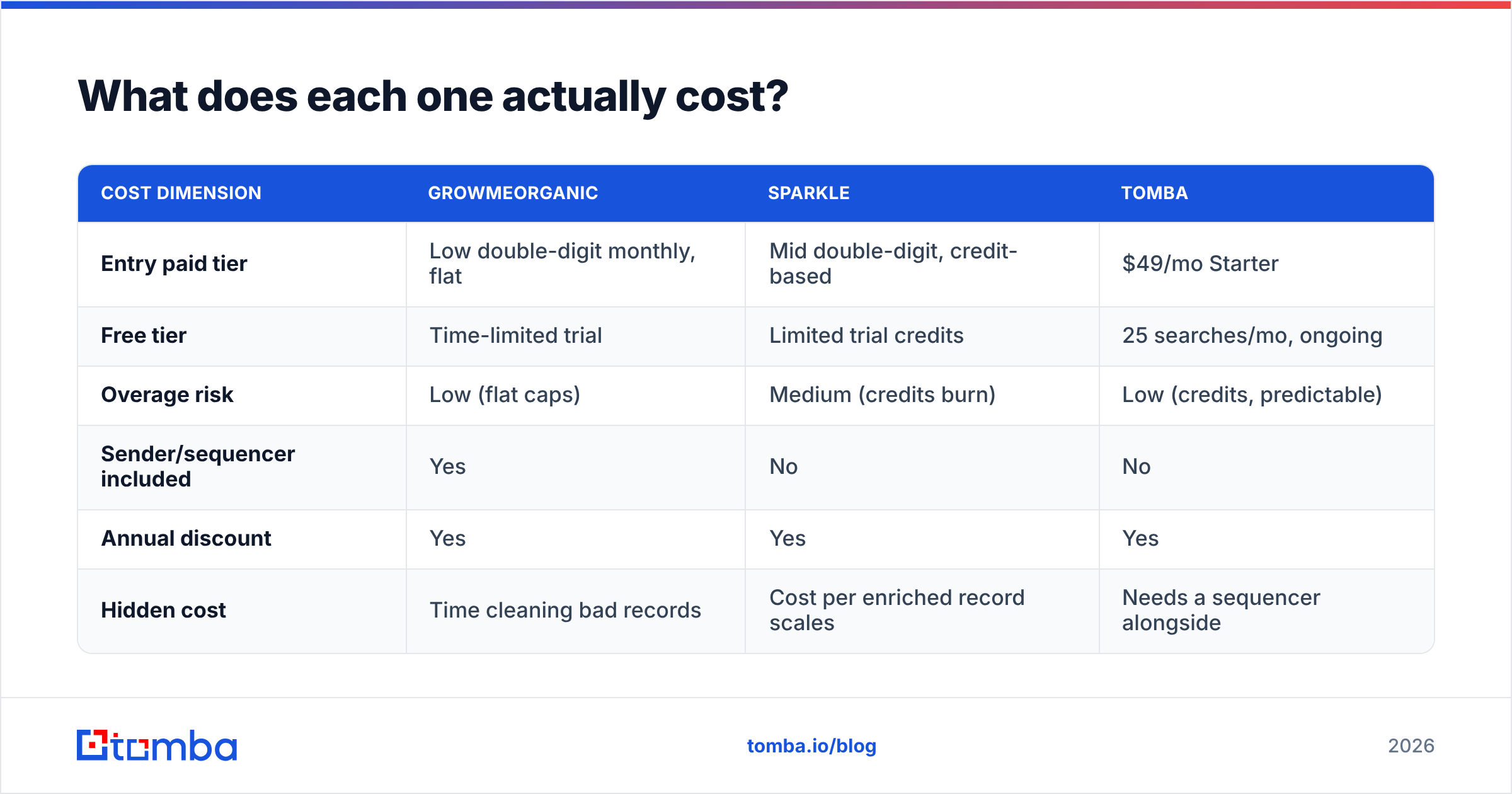
GrowMeOrganic vs Sparkle: what does each one actually cost?#
Both vendors change pricing more often than they change positioning. Treat the shape of each plan as the durable part, and the figures as a snapshot.
| Cost dimension | GrowMeOrganic | Sparkle | Tomba |
|---|---|---|---|
| Entry paid tier | Low double-digit monthly, flat | Mid double-digit, credit-based | $49/mo Starter |
| Free tier | Time-limited trial | Limited trial credits | 25 searches/mo, ongoing |
| Overage risk | Low (flat caps) | Medium (credits burn) | Low (credits, predictable) |
| Sender/sequencer included | Yes | No | No |
| Annual discount | Yes | Yes | Yes |
| Hidden cost | Time cleaning bad records | Cost per enriched record scales | Needs a sequencer alongside |
The flat-rate model is tempting, and it really is cheaper for high-volume, low-effort outbound. But the hidden cost line matters. Pull 20,000 contacts, find a quarter of them stale, and you have bought a cleanup project rather than a pipeline. Model it honestly and cheap contacts plus cleanup time plus inbox damage often costs more than a shorter, better list.
Sparkle's credit model fails the other way. It stays honest at small scale, then gets expensive fast when someone enriches an entire industry. Set a burn alert in week one.
For comparison, Tomba pricing runs Free at 25 searches a month, Starter at $49, Growth at $99, Pro at $249, plus custom Enterprise. It is credit-metered, so a miss costs you nothing. Nothing rewards the tool for returning a guess.

Who should choose GrowMeOrganic?#
Pick GrowMeOrganic when the following describe you:
- You're an agency running many small campaigns. Flat pricing across client accounts is easier to resell than metered credits you have to reconcile.
- Your outbound is volume-led, not account-led. If the plan is 5,000 sends a month at a 1.5% reply rate, coverage beats precision on pure unit economics.
- You want one vendor, one login, one invoice. Sequencing inside the same tool removes a whole class of CSV shuffling and integration debugging.
- Your ICP is broad. Wide databases shine when "anyone in SaaS marketing, 50–500 headcount" is a real target rather than a placeholder.
Where it will let you down: strict data governance, deep API work on lower tiers, and any team held to a hard 3% bounce ceiling. Check recent reviews on G2 before you commit to a year. Sentiment in this category shifts fast after each database refresh.
Who should choose Sparkle?#
Pick Sparkle when these are true:
- You run account-based motions. Fifty well-researched accounts with enriched contacts beat five thousand names when your ACV is five figures.
- You already own your sequencer. If Instantly, Smartlead, or a CRM-native sequencer is entrenched, GrowMeOrganic's bundled sender is a feature you'll pay for and never open.
- Tailored copy is your edge. Extra context, such as role, tech stack, and recent triggers, only helps if a human or an AI writer uses it.
- You'd rather cap quality than cap volume. Smaller lists are easier to QA, and QA is what protects your domain.
Where it will let you down: pure volume plays, and teams that need one tool because nobody has time to wire things up. Sparkle assumes you have a stack. If you don't, that guess costs you.
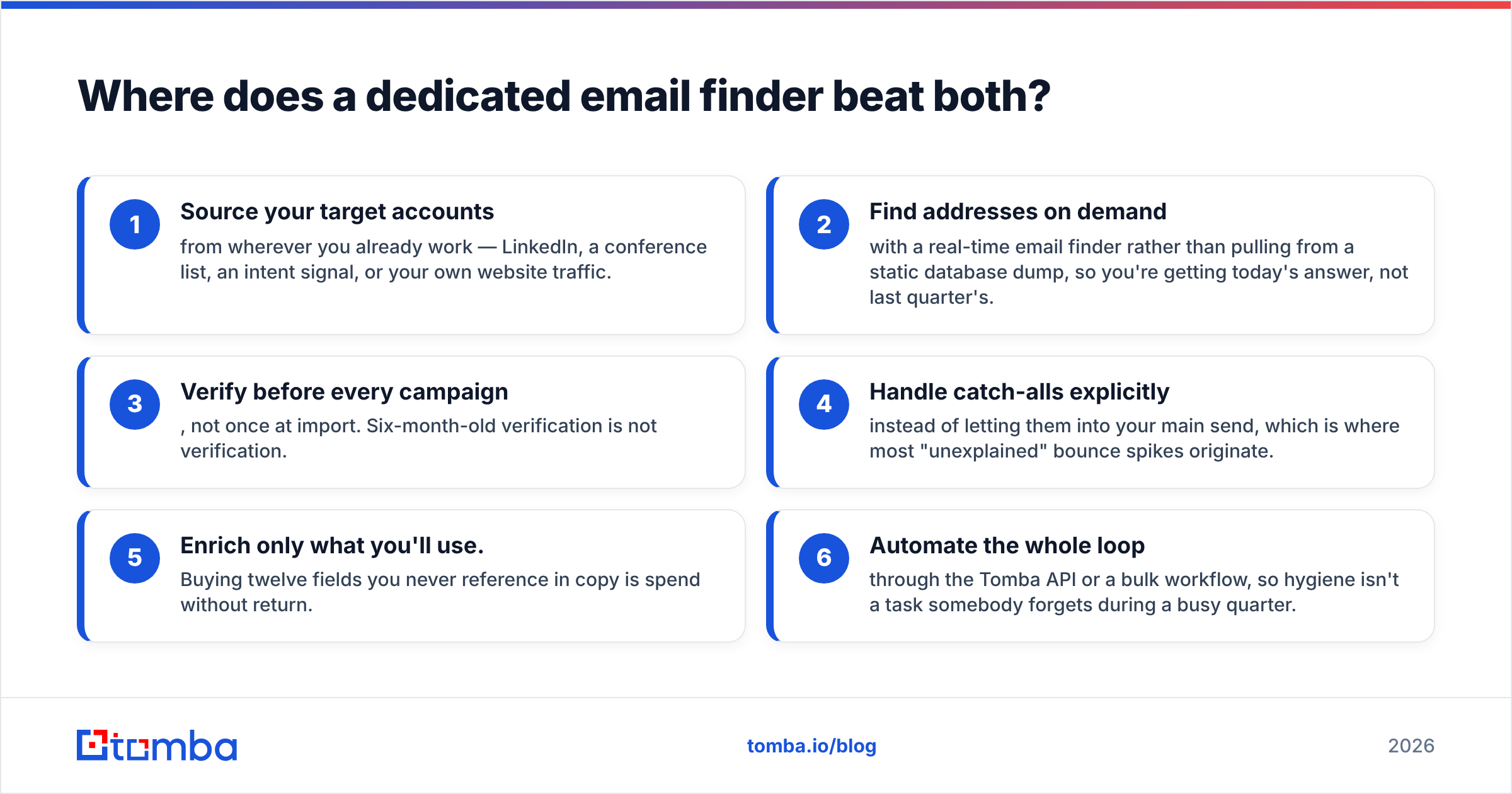
Where does a dedicated email finder beat both?#
There's a third path that most comparison posts skip: don't buy a suite at all, buy the layer that's failing.
Most outbound stacks in 2026 already have a sequencer and a CRM. What they lack is a data layer that returns correct addresses at the moment of send, not at the moment of the last database refresh. That is a different product category. It is also where a specialist beats both sides of the GrowMeOrganic vs Sparkle debate, on the only axis that matters: accuracy per address.
A practical setup that beats either suite on inbox rates:
- Source your target accounts from wherever you already work — LinkedIn, a conference list, an intent signal, or your own website traffic.
- Find addresses on demand with a real-time email finder instead of a static database dump. You get today's answer, not last quarter's.
- Verify before every campaign, not once at import. Six-month-old verification is not verification.
- Handle catch-alls explicitly instead of letting them into your main send, which is where most "unexplained" bounce spikes originate.
- Enrich only what you'll use. Buying twelve fields you never reference in copy is spend without return.
- Automate the whole loop through the Tomba API or a bulk workflow, so hygiene is not a task someone forgets in a busy quarter.
This stack costs less than most all-in-one plans, and it fails gracefully. If one layer underperforms, you swap that layer instead of moving your whole outbound motion. If you want the technical background on why hard bounces hurt so much, the Wikipedia entry on bounce messages is a decent primer.
What's the verdict on GrowMeOrganic vs Sparkle?#
GrowMeOrganic vs Sparkle has no universal winner, and any post that declares one is selling something.
GrowMeOrganic wins on breadth, a bill you can predict, and speed to first campaign. If you are a lean agency or a founder who needs to be sending by Thursday, it is the faster answer.
Sparkle wins on list quality, fit with an existing stack, and account-based work where a human touches every contact. If reply rates are your problem, not volume, it is the better bet.
Both lose to a dedicated finder on one narrow question: does the address you are about to mail exist? That is not a knock on either product. It is the predictable cost of bundling. The teams with the healthiest domains rarely lean on a suite's built-in verifier as the last line of defence.
Run the cheap test before you commit. Take 200 known-good contacts from a segment you understand. Pull them through each tool's trial. Measure match rate and bounce rate against what you already know. Two hours of work settles an argument that could otherwise run a full quarter.
Ready to fix the accuracy layer first?#
If your outbound is stalling on bounces rather than volume, start where the damage is. The Tomba Email Finder returns confidence-scored, source-backed addresses in real time, and it works next to whichever sequencer you run. It starts free with 25 searches a month. That is enough to benchmark it against your GrowMeOrganic vs Sparkle shortlist before you spend anything. Test it on a segment you know, compare the bounce rate, and let the numbers pick your stack.
Related guides#
Ready to find emails that actually work?
Join 150,000+ professionals who stopped guessing and started sending. Free credits on signup — no credit card required.
Get the Tomba newsletter
Practical outbound tactics and product updates — once every two weeks.
About the author