GrowMeOrganic vs SphereScout: Which B2B Tool Wins in 2026
One is an all-in-one LinkedIn scraping and outreach suite. The other is a lean prospecting scout. Here is how GrowMeOrganic and SphereScout actually differ on data quality, seat limits, and cost per usable contact.
GrowMeOrganic vs SphereScout is really a question about breadth. One tool bundles everything. The other stays light. This GrowMeOrganic vs SphereScout guide compares both on data quality, seat limits, and cost per usable contact.
TL;DR
- GrowMeOrganic is an all-in-one suite. It scrapes LinkedIn, ships a B2B database, finds emails, and sends cold email. You are buying breadth.
- SphereScout is the leaner, newer option. It focuses on prospecting and contact discovery, and it has a much smaller public footprint. Check its current limits before you commit budget.
- Neither tool wins on raw email accuracy. Both bundle finding into a workflow, so you inherit their verification pipeline — good or bad.
- Already own a sequencer? Paying twice for a sending engine is the most common overspend in this category.
- Run the same 200-lead list through both, plus a dedicated finder. Measure cost per verified, deliverable contact — not credits, not "matches."
What are GrowMeOrganic and SphereScout?#
GrowMeOrganic sells itself as one subscription that replaces four tools: a LinkedIn and Sales Navigator scraper, a B2B contact database, an email finder and verifier, and a cold email sender with drip sequences. The pitch on growmeorganic.com leans on unlimited-style usage. A long lifetime-deal history made it popular with agencies and solo founders.
SphereScout sits at the other end. It is smaller and newer. The product is built around contact discovery and list building, not the full send-and-track loop. Public docs, reviews, and outside benchmarks are thin. So treat every number you read about it — including any in this post — as something to confirm on the vendor's own pricing page and in a trial.
That gap matters more than any feature checkbox. The GrowMeOrganic vs SphereScout choice is really a bet on evidence. A mature tool with 400 public reviews in G2's lead intelligence category has a known failure mode. A tool with 12 reviews has an unknown one. Neither is disqualifying. They just need different amounts of testing before you scale spend.
GrowMeOrganic vs SphereScout: how do they compare head-to-head?#
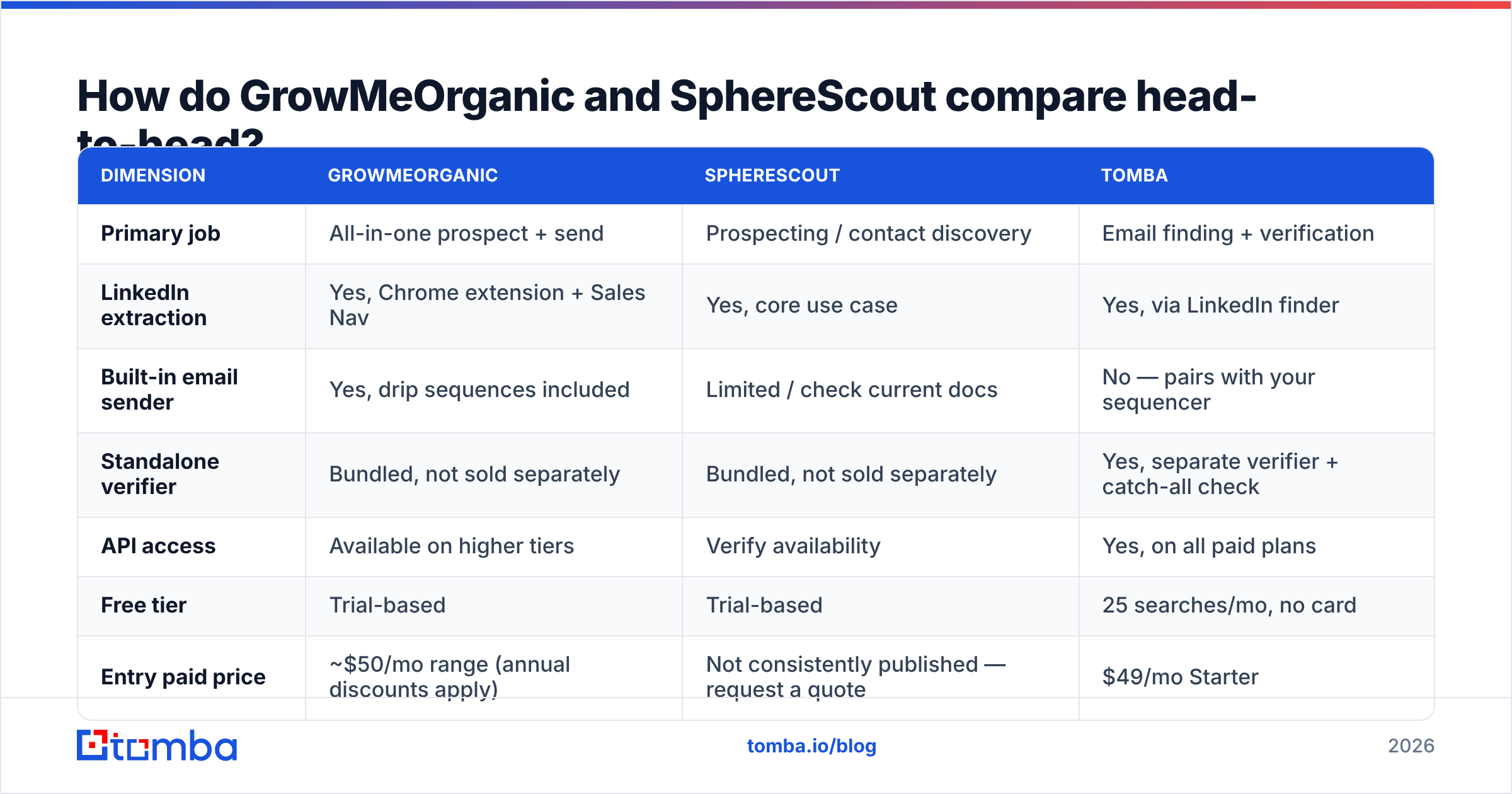
Here is the honest side-by-side. I added a dedicated email-finding tool in the third column so you can see what the bundle premium actually buys.
| Dimension | GrowMeOrganic | SphereScout | Tomba |
|---|---|---|---|
| Primary job | All-in-one prospect + send | Prospecting / contact discovery | Email finding + verification |
| LinkedIn extraction | Yes, Chrome extension + Sales Nav | Yes, core use case | Yes, via LinkedIn finder |
| Built-in email sender | Yes, drip sequences included | Limited / check current docs | No — pairs with your sequencer |
| Standalone verifier | Bundled, not sold separately | Bundled, not sold separately | Yes, separate verifier + catch-all check |
| API access | Available on higher tiers | Verify availability | Yes, on all paid plans |
| Free tier | Trial-based | Trial-based | 25 searches/mo, no card |
| Entry paid price | ~$50/mo range (annual discounts apply) | Not consistently published — request a quote | $49/mo Starter |
| Best for | Agencies wanting one bill | Teams testing a lighter workflow | Teams that need accuracy, not another inbox |
Two things jump out. First, GrowMeOrganic only pays off if you truly use the sender. Already run Instantly, Smartlead, Lemlist, or HubSpot Sequences? Then you are paying for a second sending engine you will never plug a domain into. Second, neither bundled tool sells verification as a standalone product. That is the step that decides whether your campaign lands or bounces.
GrowMeOrganic vs SphereScout: which one finds more valid emails?#
Accuracy is where bundled suites get graded generously. Vendors quote a "match rate" — the share of your rows that came back with something. Buyers hear "accuracy." Those are two different numbers. The gap between them is where your sender reputation goes to die.

Four numbers to demand from both vendors before you buy:
- Match rate — how many of your 200 input rows returned any address at all.
- Deliverable rate — how many of those survived an independent SMTP check from a third-party email verifier you control.
- Catch-all share — how many landed on domains that accept everything. A catch-all is not a verified email. It is a coin flip you paid for.
- Credit burn on failure — do you get charged for a "found" address that bounces? Some tools refund. Some do not.
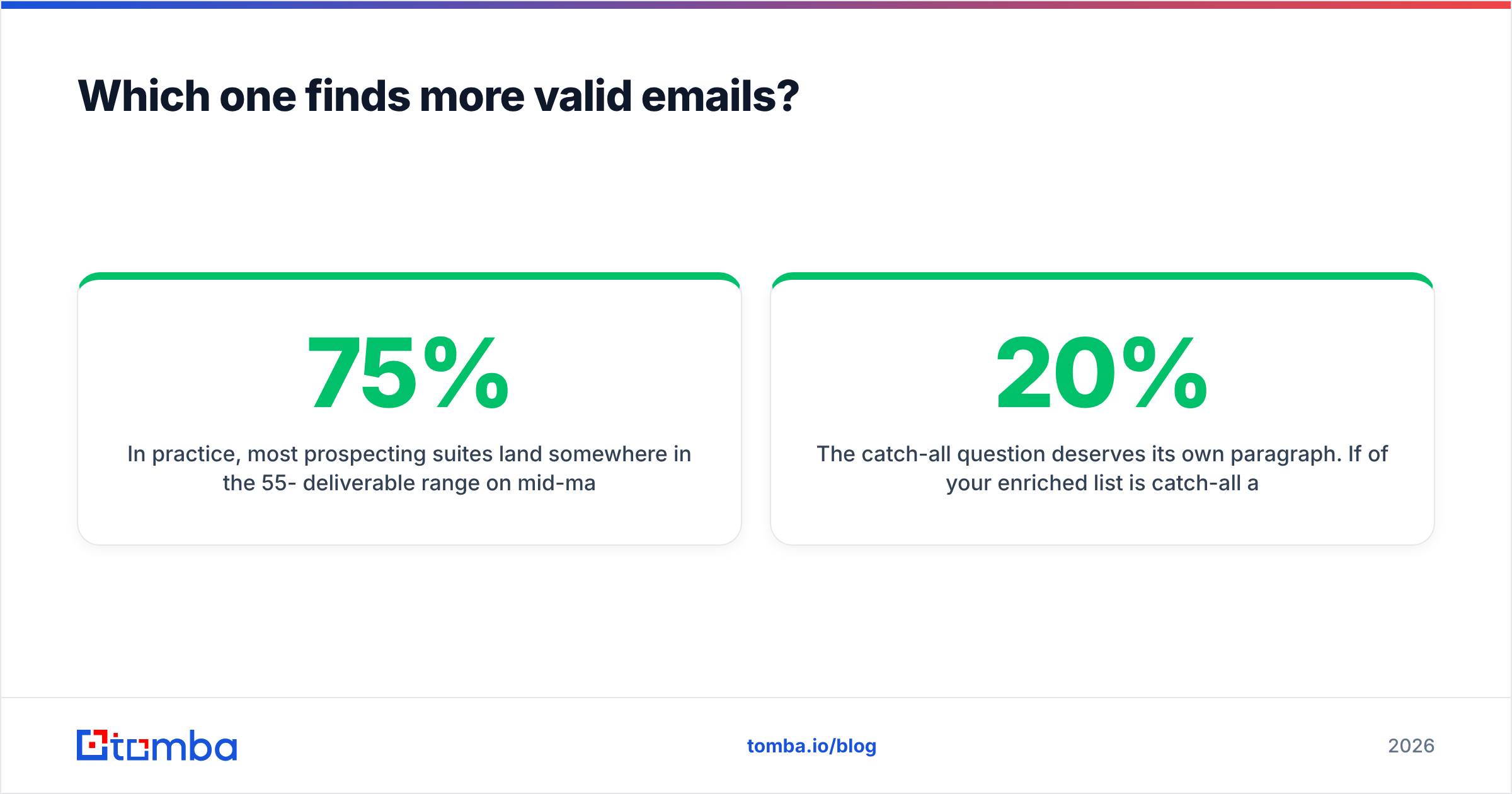
Most prospecting suites land in the 55-75% deliverable range on mid-market B2B domains. Assume both tools sit in that band until your own test says otherwise. A dedicated finder that publishes its data sources and runs SMTP-level checks tends to score higher. But the only number that counts is the one from your ICP, your domains, your list.
Catch-alls deserve their own note. Say 20% of your enriched list is catch-all and your tool marks it green. You send 200 emails into a void. Your bounce rate crosses 5%. Then you spend three weeks nursing the domain back to health. Run catch-alls through a dedicated catch-all verifier before they touch a sequence, no matter which tool sourced them.
What does GrowMeOrganic vs SphereScout cost per usable contact?#
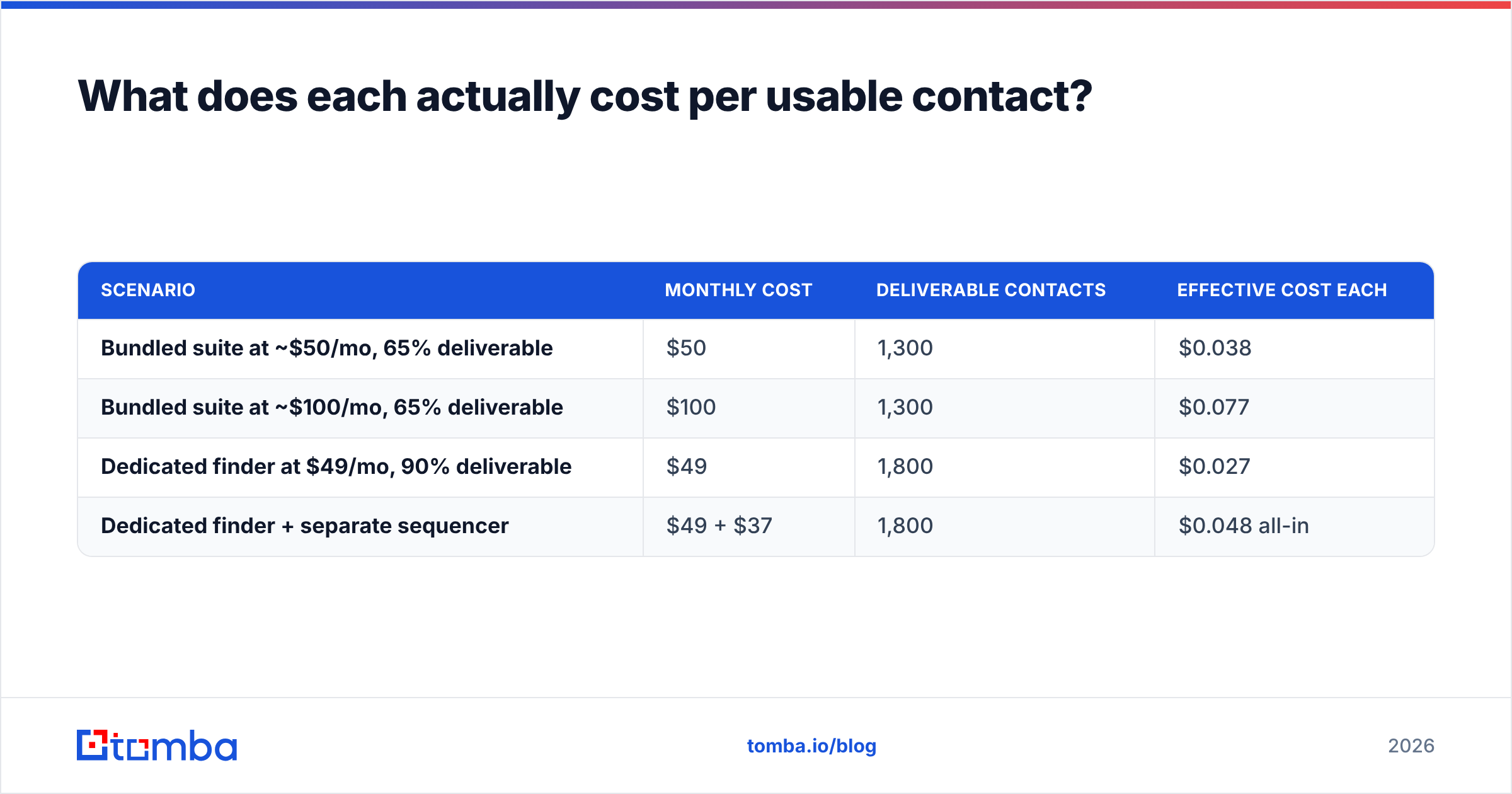
Sticker price is the wrong unit. Cost per verified, deliverable contact is the right one. Here is the math on a 2,000-contact month.
| Scenario | Monthly cost | Deliverable contacts | Effective cost each |
|---|---|---|---|
| Bundled suite at ~$50/mo, 65% deliverable | $50 | 1,300 | $0.038 |
| Bundled suite at ~$100/mo, 65% deliverable | $100 | 1,300 | $0.077 |
| Dedicated finder at $49/mo, 90% deliverable | $49 | 1,800 | $0.027 |
| Dedicated finder + separate sequencer | $49 + $37 | 1,800 | $0.048 all-in |
The bundle looks cheaper on the invoice. It looks more expensive per outcome. The exception is simple: it wins if you truly retire another subscription. That is the whole decision in one line. Compare it against published Tomba pricing and against whatever quote SphereScout gives you. Then re-run the table with your own deliverable rate.
One cost nobody budgets for: seats. All-in-one suites often charge per user. Adding two SDRs can quietly double your bill. Ask both vendors, in writing, what the price does when headcount goes from 1 to 5.
Who should pick GrowMeOrganic?#
In a GrowMeOrganic vs SphereScout matchup, GrowMeOrganic is the better fit when:
- You have no sequencer yet. One bill, one login, one support queue beats stitching three tools together for a two-person team.
- You run an agency with many small clients. Broad usage limits and a single workspace cut admin work more than a 10-point accuracy edge would.
- Your motion is LinkedIn-first. The extension plus Sales Navigator workflow is the product's strongest muscle.
- You want predictable spend. A flat monthly fee is easier to defend internally than variable credits.
It is the weaker fit in three cases. Your deliverability is already fragile. You need enrichment through an API inside your own pipeline. Or your CRM, not a standalone tool, is the system of record. On that last point: if HubSpot or Salesforce owns your contact data, you want enrichment that writes into the CRM cleanly. A parallel database drifts out of sync within a quarter.
Who should pick SphereScout?#
On the other side of the GrowMeOrganic vs SphereScout split, SphereScout makes sense when:
- You want a lighter tool. Not every team needs a sender, a database, and a scraper in one shell. Some just need contacts.
- You are early and price-sensitive. Newer vendors often price low to win logos. Ask for the startup rate.
- You are willing to test properly. Less public benchmarking means you have to do the benchmarking. Budget a week.
Be careful with contract length. When a vendor has a thin public track record, insist on monthly billing for the first 90 days. The annual discount is worth roughly 20%. Being locked into a data source that under-delivers on your ICP costs far more than that in wasted sending days.

Where does a dedicated email finder beat both?#
The case against bundles is not that they are bad. It is that they are tuned for the average customer's average need. Data quality is where averages hurt most.

A focused finder wins on four axes:
- Verification as a product, not a checkbox. Separate finder, verifier, and catch-all tools get measured on their own. Regressions surface instead of hiding inside a bundled "match rate."
- API-first workflows. If enrichment has to run in your pipeline, on a webhook, or as a nightly job, you need a real email finder API — not a UI with an export button.
- Bulk economics. Feeding 50,000 rows through a bulk email finder is a different job than clicking a browser extension 50,000 times.
- No seat tax on data. Data volume and headcount should not share a lever.
One more note for completeness. Is your bottleneck raw list volume in a specific vertical, rather than enrichment of lists you already have? Then a database provider like BookYourData is a fair parallel path. It often complements a finder instead of competing with it. Different job, different tool. Pairing a solid database with independent verification is a sound stack.
How do you run a fair GrowMeOrganic vs SphereScout bake-off?#
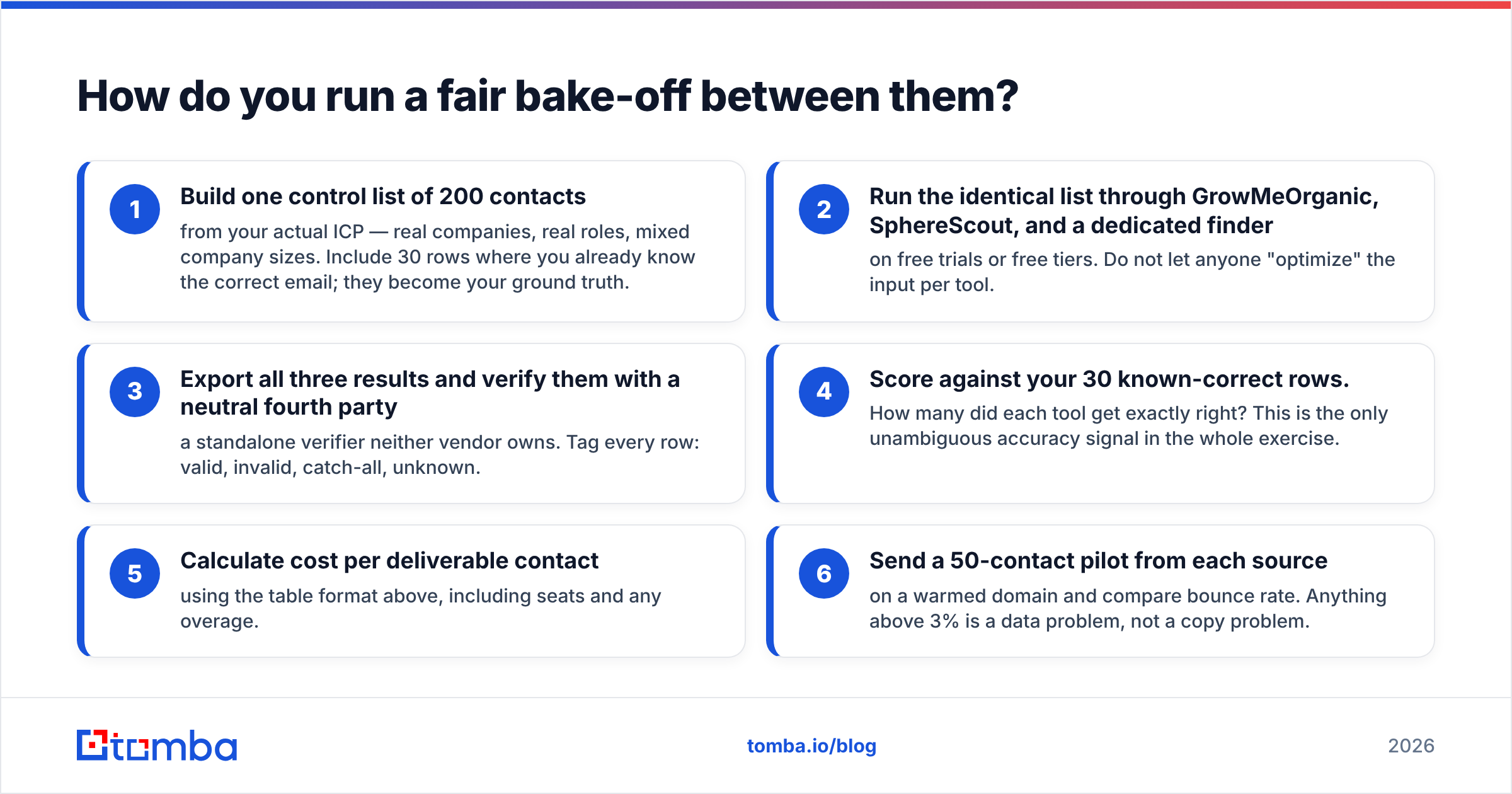
Do not compare marketing pages. Compare outputs. This takes about four hours and settles the argument for good.
Start with the setup:
- Build one control list of 200 contacts from your real ICP — real companies, real roles, mixed company sizes. Include 30 rows where you already know the correct email. Those are your ground truth.
- Run the identical list through GrowMeOrganic, SphereScout, and a dedicated finder on free trials or free tiers. Do not let anyone "optimize" the input per tool.
- Export all three results and verify them with a neutral fourth party — a standalone verifier neither vendor owns. Tag every row: valid, invalid, catch-all, unknown.
Then score what came back:
- Score against your 30 known-correct rows. How many did each tool get exactly right? This is the only clean accuracy signal in the whole exercise.
- Calculate cost per deliverable contact using the table format above, including seats and any overage.
- Send a 50-contact pilot from each source on a warmed domain and compare bounce rates. Anything above 3% is a data problem, not a copy problem.
Whoever wins step 4 and step 6 wins your budget. Everything else — UI polish, integration count, support speed — is a tiebreaker, not a decider.
So what is the verdict on GrowMeOrganic vs SphereScout?#
The GrowMeOrganic vs SphereScout verdict splits three ways.
GrowMeOrganic wins if you need one tool for everything and have no sending stack yet. Its breadth is real. Its LinkedIn workflow is mature. A single invoice has genuine value for agencies and solo operators.
SphereScout wins if you want something lighter and cheaper, and you are ready to validate it yourself. It is a reasonable bet. But it is a bet, so price and contract it that way.
Neither wins if your real problem is bounce rate. In that case you do not need a different suite. You need a better data layer under the suite you already have. Keep your sequencer. Keep your CRM. Swap only the enrichment step. That is a one-afternoon change, and it usually moves deliverability more than a full platform migration would.
Start with a free tier before you sign either annual contract. Tomba's Email Finder gives you 25 searches a month at no cost, with SMTP-level verification, catch-all detection, and a full API on every paid plan from $49/mo. Run your 200-lead control list through it alongside both tools. Verify all three with a neutral checker. Then let the deliverable-contact number pick your stack instead of a pricing page.
Related guides#
Ready to find emails that actually work?
Join 150,000+ professionals who stopped guessing and started sending. Free credits on signup — no credit card required.
Get the Tomba newsletter
Practical outbound tactics and product updates — once every two weeks.
About the author