GrowMeOrganic vs Tomba: Which Email Finder Wins in 2026?
GrowMeOrganic bundles LinkedIn scraping, email finding, and sequences into one seat. Tomba goes deep on email data and APIs. Here is where each one actually wins in 2026.
TL;DR
- GrowMeOrganic is a bundle. LinkedIn/Sales Navigator extraction, an email finder, a basic CRM, and a cold-email sender in one seat. Breadth is the selling point.
- Tomba is a data layer. Email finder, verifier, domain search, catch-all handling, enrichment, and a documented API. Depth is the selling point.
- If you live in LinkedIn and want one tool to scrape, write, and send, GrowMeOrganic covers more of the workflow for one price.
- If bounce rate is what keeps you up at night, or you need to enrich records programmatically inside a CRM or product, Tomba is the better fit — Tomba pricing starts at $49/mo with a free 25-search tier.
- Plenty of teams run both. Scrape with one, verify with the other. That combination usually beats either tool alone.
What are GrowMeOrganic and Tomba, exactly?#
They are not the same category of product, which is why "which is better" has no clean answer until you say what you are doing.
GrowMeOrganic is an all-in-one B2B prospecting suite built around a Chrome extension. You browse LinkedIn or Sales Navigator, extract lists of profiles, let the tool append emails and phone numbers, drop those contacts into a lightweight CRM, and fire cold-email sequences from your own mailbox. The pitch is unlimited-flavored pricing and one subscription instead of four.
Tomba is a contact-data platform. The email finder resolves a name plus a domain into a work address, the email verifier checks whether that address will accept mail, and domain search returns every discoverable address at a company with the pattern behind it. Around that core sit a phone finder, data enrichment, a catch-all verifier, bulk processing, and a REST API with SDKs.
The practical difference: GrowMeOrganic wants to be the whole outbound motion. Tomba wants to be the accurate contact record that any outbound motion depends on.
Which one finds more valid emails?#
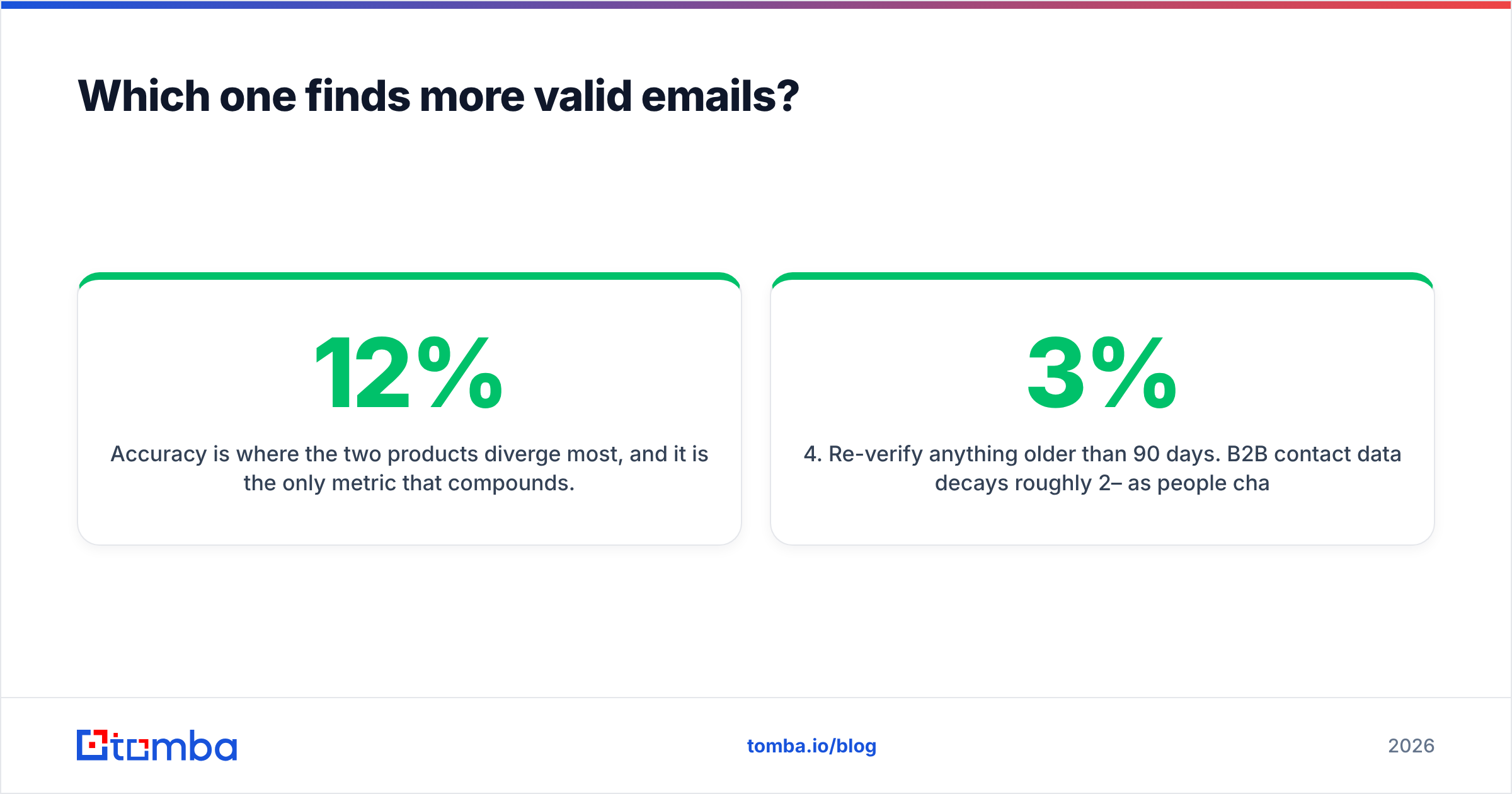
Accuracy is where the two products diverge most, and it is the only metric that compounds. A 12% bounce rate does not just waste 12% of your sends — it drags your sender reputation down and taxes the other 88%.
Tomba's model is verification-first. Every returned address carries a confidence score and a verification status, and the SMTP-level check runs against the receiving server rather than relying purely on pattern inference. Catch-all domains — the ones that accept anything at the gateway and bounce silently later — get routed to a dedicated catch-all verifier instead of being returned as a false "valid."

GrowMeOrganic's finder is competent but built for volume inside a scraping workflow. In practice, users report solid hit rates on mid-market and SMB domains and thinner coverage on enterprise domains with unusual formats or heavy gateway protection. The tool does include verification, but it is a step in the pipeline rather than the product's centre of gravity — which is a reasonable design choice for a suite, not a flaw.
Two habits fix most of this regardless of vendor:
- Never send to an unverified list. Run a second verification pass on any scraped file before it touches a sequence.
- Segment catch-alls separately. Send them a low-volume test batch first rather than mixing them into your main send.
- Watch the pattern, not the address. If a domain resolves to
first.last@, a returnedfirstlast@for the same company is a red flag. - Re-verify anything older than 90 days. B2B contact data decays roughly 2–3% per month as people change jobs.
How do GrowMeOrganic and Tomba compare feature by feature?#
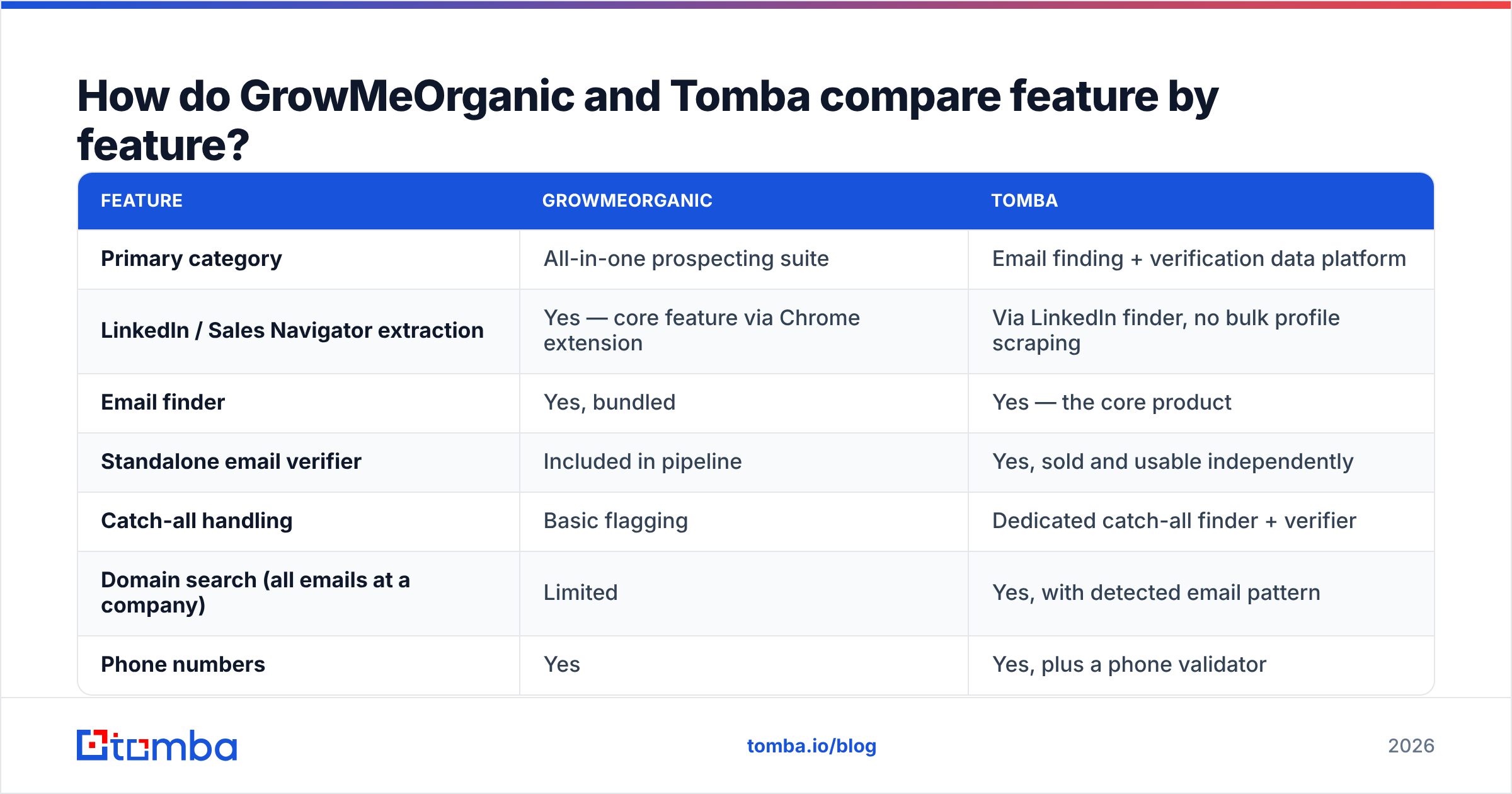
Here is the head-to-head. Figures reflect publicly listed plans at the time of writing; both vendors change packaging, so confirm on their own pricing pages before you buy.
| Feature | GrowMeOrganic | Tomba |
|---|---|---|
| Primary category | All-in-one prospecting suite | Email finding + verification data platform |
| LinkedIn / Sales Navigator extraction | Yes — core feature via Chrome extension | Via LinkedIn finder, no bulk profile scraping |
| Email finder | Yes, bundled | Yes — the core product |
| Standalone email verifier | Included in pipeline | Yes, sold and usable independently |
| Catch-all handling | Basic flagging | Dedicated catch-all finder + verifier |
| Domain search (all emails at a company) | Limited | Yes, with detected email pattern |
| Phone numbers | Yes | Yes, plus a phone validator |
| Cold email sending / sequences | Yes, built in | No — integrates with your sender |
| Built-in CRM | Yes, lightweight | No — integrates with HubSpot, Salesforce, Pipedrive |
| Public API | Limited | Full REST API with SDKs and an MCP server |
| Bulk processing | Yes, CSV-based | Yes — bulk finder and verifier + Sheets/Excel add-ins |
| Free tier | Trial-based | 25 searches/mo, ongoing |
| Entry paid plan | ~$49–79/mo range | $49/mo Starter |
| Best for | Solo founders and small teams running LinkedIn-first outbound | RevOps, agencies, and developers who need clean data at scale |

The table makes the trade obvious. GrowMeOrganic wins on the number of jobs it does. Tomba wins on how well it does the one job that everything else depends on.
How do pricing and credits actually compare?#
Both vendors price on credits, and both use the word "unlimited" more loosely than buyers would like. Read the fair-use language.
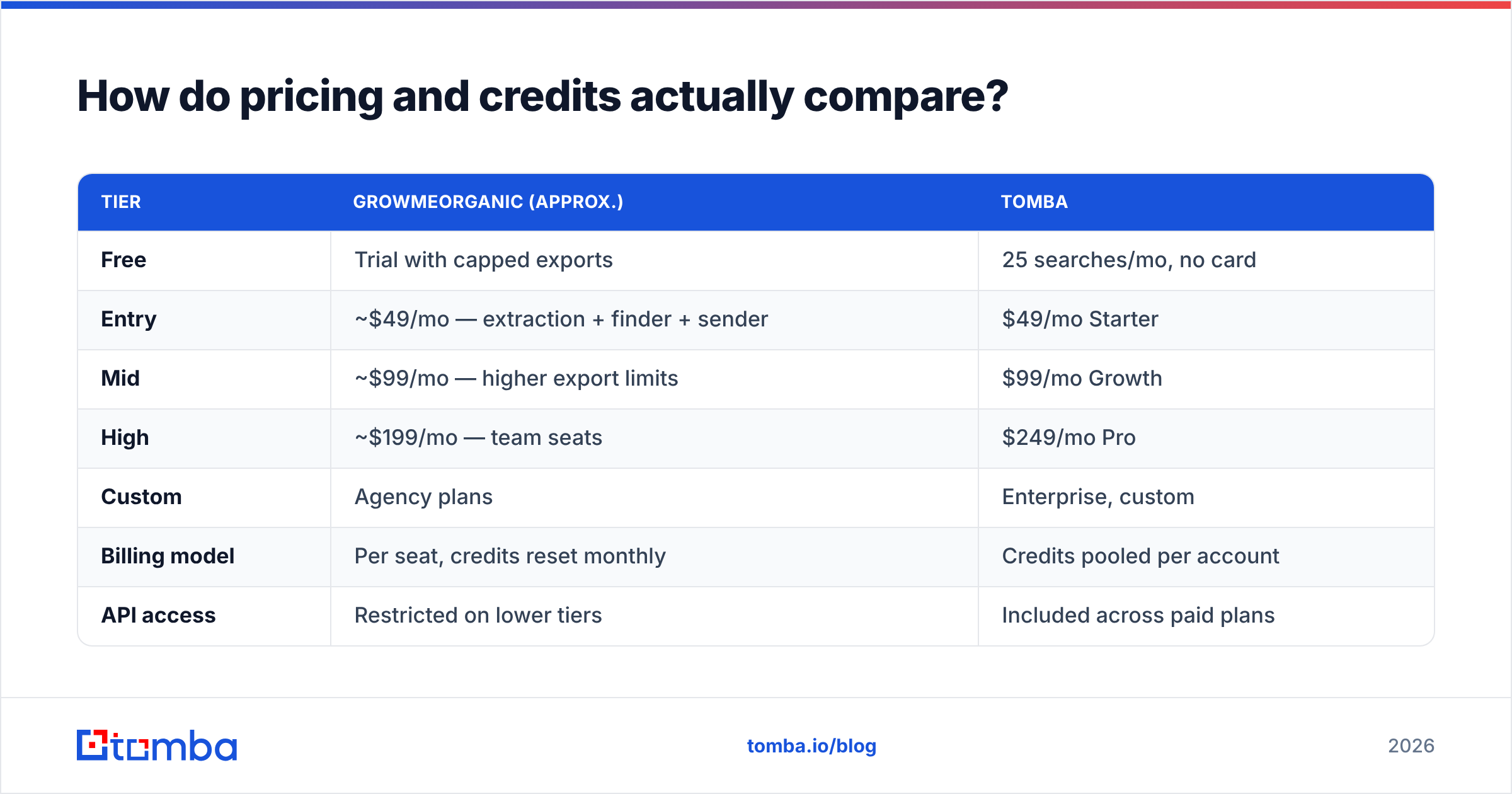
| Tier | GrowMeOrganic (approx.) | Tomba |
|---|---|---|
| Free | Trial with capped exports | 25 searches/mo, no card |
| Entry | ~$49/mo — extraction + finder + sender | $49/mo Starter |
| Mid | ~$99/mo — higher export limits | $99/mo Growth |
| High | ~$199/mo — team seats | $249/mo Pro |
| Custom | Agency plans | Enterprise, custom |
| Billing model | Per seat, credits reset monthly | Credits pooled per account |
| API access | Restricted on lower tiers | Included across paid plans |
The honest read on cost: if you would otherwise pay for a scraper, a finder, and a sequencer separately, GrowMeOrganic's bundle is genuinely cheaper. If you already own a sequencer you like — Instantly, Smartlead, Lemlist, Outreach — you are paying for a sender you will never open, and buying data as data is the cheaper path.
One more line item people forget: wasted sends. If a $49 tool gives you a 14% bounce rate and a $49 tool gives you a 3% bounce rate on the same list, the second one is not the same price. It is cheaper, and it protects a mailbox that costs weeks to rebuild.
Is GrowMeOrganic's LinkedIn extraction worth it?#
Yes, with caveats — and the caveats are not really about GrowMeOrganic.
Bulk profile extraction from LinkedIn sits outside LinkedIn's user agreement, and enforcement has tightened. Accounts running heavy extraction get rate-limited, restricted, or banned. That is a platform risk you take on regardless of which scraper you use, and it is worth pricing into the decision if the LinkedIn account in question is a founder's personal profile with a decade of network on it.
What extraction buys you is filtering that no static database can match: current title, current company, recent activity, headcount bands, and shared-connection signals, all queried live. If your ICP is defined by "raised a Series A in the last six months and just hired a first RevOps person," Sales Navigator plus extraction is the fastest way to build that list. A static B2B database is better at coverage and worse at recency of role.
Tomba's approach here is narrower on purpose. Give it a LinkedIn profile URL and it returns the work email. Give it a domain and it returns the org chart's worth of addresses it can verify. It does not try to be your scraper — which means it also does not put your LinkedIn account at risk.
Which tool fits which team?#
Match the tool to the shape of your motion, not to the feature count.
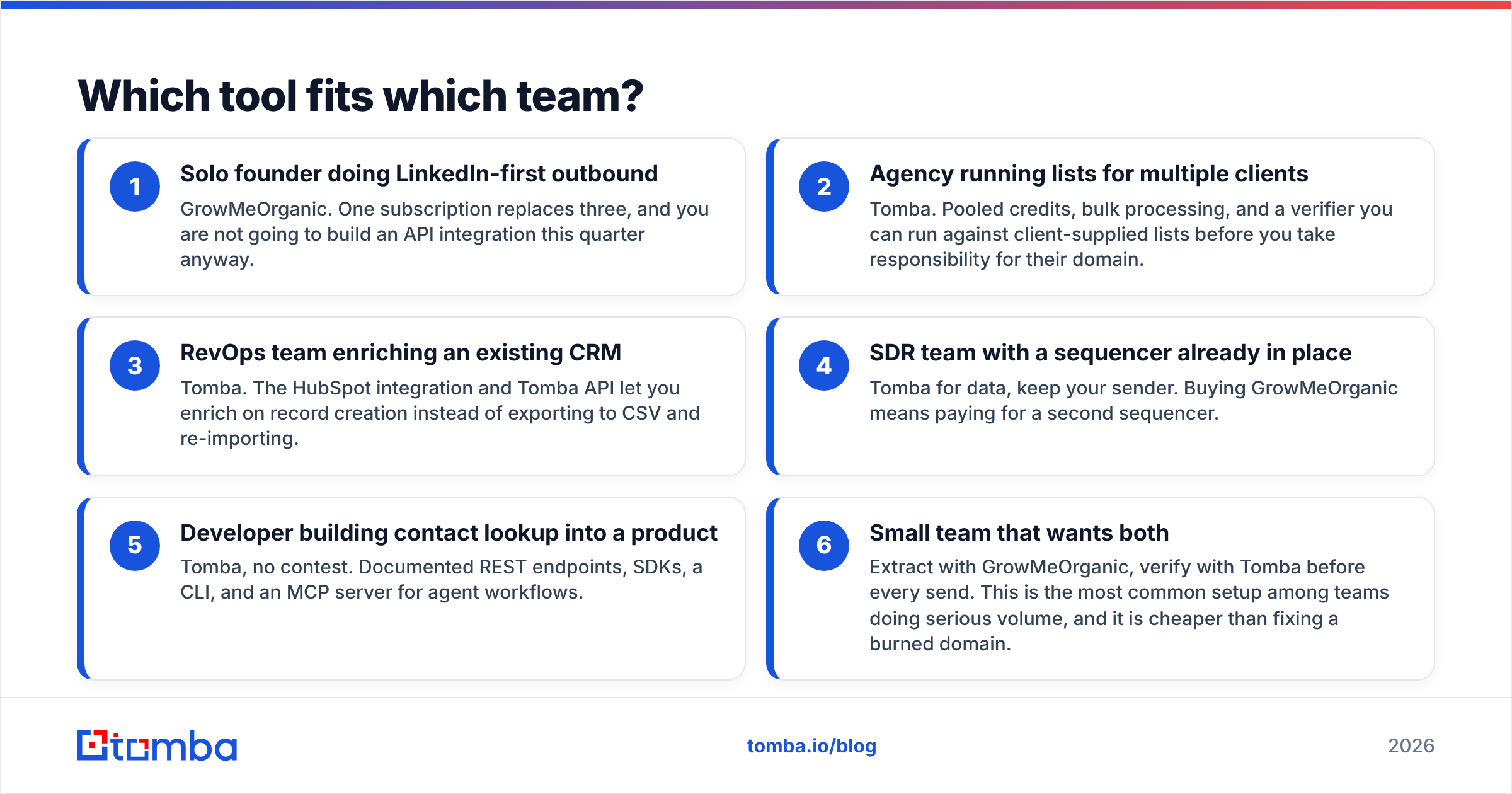
- Solo founder doing LinkedIn-first outbound — GrowMeOrganic. One subscription replaces three, and you are not going to build an API integration this quarter anyway.
- Agency running lists for multiple clients — Tomba. Pooled credits, bulk processing, and a verifier you can run against client-supplied lists before you take responsibility for their domain.
- RevOps team enriching an existing CRM — Tomba. The HubSpot integration and Tomba API let you enrich on record creation instead of exporting to CSV and re-importing.
- SDR team with a sequencer already in place — Tomba for data, keep your sender. Buying GrowMeOrganic means paying for a second sequencer.
- Developer building contact lookup into a product — Tomba, no contest. Documented REST endpoints, SDKs, a CLI, and an MCP server for agent workflows.
- Small team that wants both — Extract with GrowMeOrganic, verify with Tomba before every send. This is the most common setup among teams doing serious volume, and it is cheaper than fixing a burned domain.
What about deliverability and verification?#
This is the part buyers underweight and then pay for later.
Google and Yahoo's bulk-sender requirements, in force since 2024, put a hard ceiling on spam complaints and require authenticated sending. A list with a high invalid rate produces bounces, bounces produce reputation damage, and reputation damage produces silent spam-foldering that no open-rate dashboard will explain to you. Email deliverability is not a separate discipline from data quality — it is downstream of it.
A defensible pre-send checklist:
- Authenticate first. SPF, DKIM, and DMARC on every sending domain. HubSpot's deliverability documentation is a solid non-vendor reference on the basics.
- Verify twice. Once at list build, once immediately before the send if more than a few weeks passed.
- Quarantine catch-alls. Treat them as a separate, slower segment.
- Cap daily volume per mailbox. New mailboxes should ramp, not launch.
- Remove role addresses.
info@,sales@, andsupport@inflate complaint rates and rarely convert in B2B.
GrowMeOrganic handles the first-pass verification adequately for a suite. Tomba is built to be the second pass — which is exactly why the two-tool setup keeps showing up in real stacks.
What do reviewers say about each?#
Public review sites are noisy, but the pattern is consistent enough to be useful. Check current scores yourself on G2 rather than trusting a number in a blog post that ages badly.
GrowMeOrganic's positive reviews cluster on value-for-money and the "everything in one place" experience. Its critical reviews cluster on data gaps in certain regions and verticals, and on the sequencing module feeling thinner than a dedicated sender. That is the expected profile for a bundle.
Tomba's positive reviews cluster on accuracy, API quality, and support responsiveness. Its critical reviews cluster on the absence of a built-in sequencer and the fact that it will not scrape LinkedIn in bulk for you. Also the expected profile — for a focused tool.
Neither pattern is a scandal. They are just the honest consequences of two different product bets.
What is the verdict?#
Pick GrowMeOrganic if you are a small team whose outbound starts and ends inside LinkedIn, you do not already own a sequencer, and consolidating four subscriptions into one is worth accepting slightly softer data quality.
Pick Tomba if accuracy is the constraint, if you need to enrich records programmatically, if you run lists on behalf of clients, or if you already have a sending stack you are happy with and just need the contact layer to stop lying to you.
Pick both if you have the budget and the volume. Extraction gives you recency; verification gives you deliverability. They are complements, not substitutes, and running them together costs less than one burned sending domain.
The wrong move is buying a bundle to save $40 a month and then discovering three months later that a third of your sends never landed. Data quality is the input to everything else in the funnel — including the sequences and the CRM you bought the bundle for.
Start with the data layer. Run your next list through the Tomba Email Finder and see the confidence scores and verification statuses on real prospects before you commit to anything. The free tier gives you 25 searches a month with no card, Starter is $49/mo, and every paid plan includes API access so you can wire it into whatever you are already using. Find the addresses, verify them, then send — in that order.
Related guides#
Ready to find emails that actually work?
Join 150,000+ professionals who stopped guessing and started sending. Free credits on signup — no credit card required.
Get the Tomba newsletter
Practical outbound tactics and product updates — once every two weeks.
About the author