GrowMeOrganic vs Voila Norbert (2026): Which One Wins?
One is an all-in-one prospecting suite with a LinkedIn scraper, the other is a focused email finder with a clean API. Here is how GrowMeOrganic and Voila Norbert actually compare on data quality, pricing, and cost per verified contact.
TL;DR — GrowMeOrganic vs Voila Norbert in 30 seconds#
- GrowMeOrganic is an all-in-one prospecting suite: LinkedIn/Sales Navigator scraping, a local B2B database, email finding, and a built-in cold email sender. It sells volume and breadth.
- Voila Norbert is a focused, veteran email finder and verifier with a clean API and a pay-as-you-go option. It sells simplicity and predictability.
- Accuracy is the real differentiator. Bundled "unlimited" finders tend to return more guessed, unverified addresses; specialist finders return fewer results but a cleaner list.
- Cost per verified contact matters more than sticker price. A $39 plan that gives you 40% deliverable data is more expensive than a $49 plan at 90%.
- If you want both breadth and verification in one workflow, a specialist stack — an email finder plus a separate email verifier — usually beats either tool on cost per booked meeting.
What is GrowMeOrganic?#
GrowMeOrganic is a lead generation platform aimed at agencies, recruiters, and small outbound teams who want one subscription instead of five. The pitch is breadth: a Chrome extension that pulls profiles from LinkedIn and Sales Navigator, an internal B2B contact database, an email finder, an email verifier, and a drip campaign sender that connects to your own mailbox.
The appeal is obvious. You export 500 profiles from a Sales Navigator search, enrich them in the same tab, drop them into a sequence, and hit send — without touching a CSV or a second vendor. Its plans are marketed around "unlimited" email finding, which is why it shows up constantly in budget-tool roundups.
The trade-off is also obvious: a platform that does eight things rarely does any single one as well as a tool that does one. In practice, the enrichment layer is the weakest link, and that is exactly where the money leaks.
What is Voila Norbert?#
Voila Norbert has been in the email-finding market since 2014, which in this category makes it an elder statesman. You give it a first name, last name, and a company domain; it returns the most likely corporate email address with a confidence score. It also ships bulk CSV upload, an email verification product, a documented API, and integrations with the usual CRMs and sequencers.
Norbert is deliberately narrow. There is no LinkedIn scraper, no built-in database you can browse by job title, and no cold email sender. It expects you to already have a list of names and companies — from a scraper, an event roster, a CRM export, or a research VA — and it turns that list into contactable addresses.
For teams who already own their prospecting motion and just need a reliable enrichment step, that focus is a feature, not a gap.
How do GrowMeOrganic and Voila Norbert compare feature by feature?#
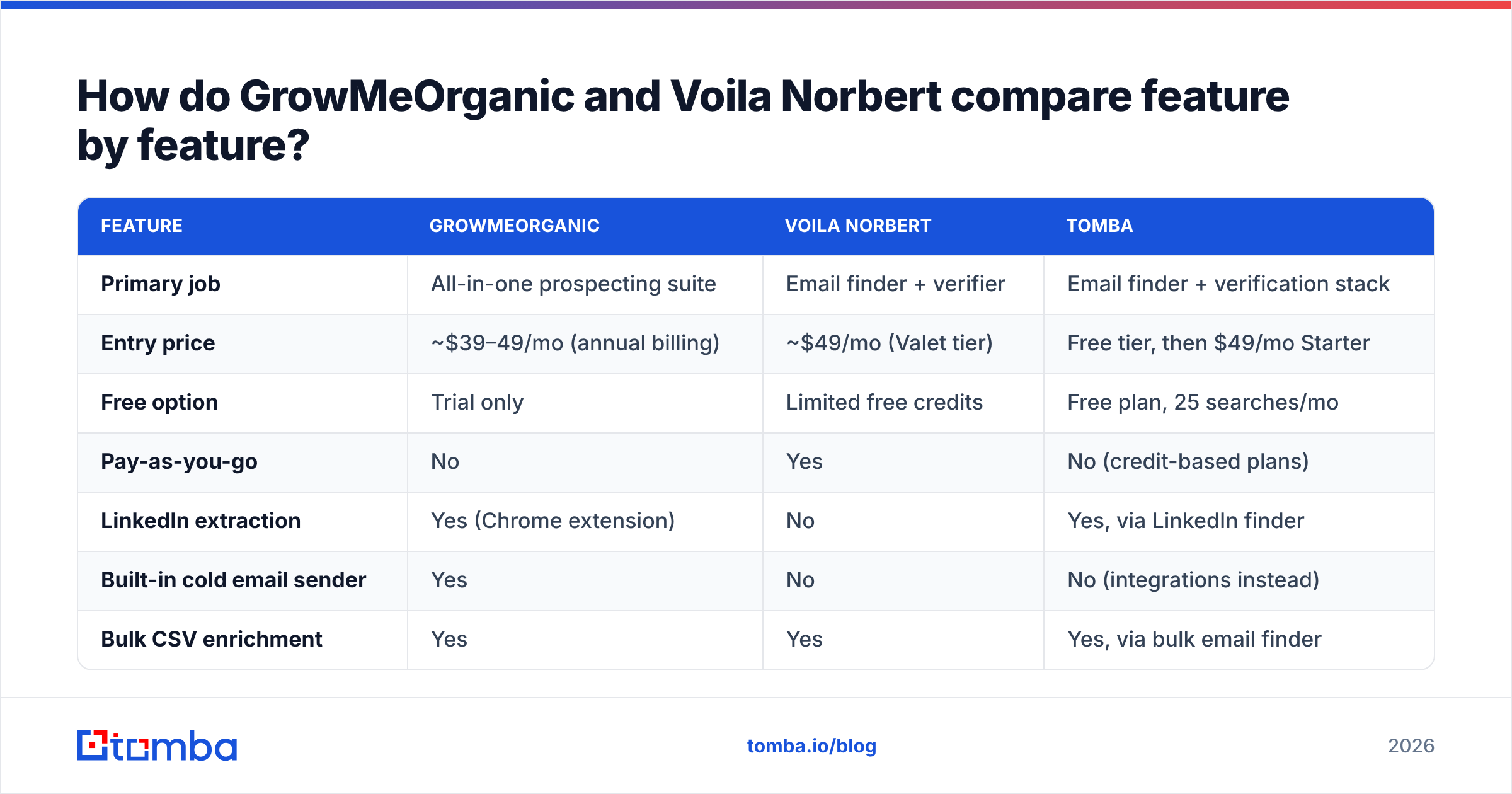
Here is the head-to-head on the attributes that change your day-to-day workflow. Treat all pricing as "published at the time of writing" — every vendor in this category reprices at least once a year, so confirm on the vendor page before you buy.
| Feature | GrowMeOrganic | Voila Norbert | Tomba |
|---|---|---|---|
| Primary job | All-in-one prospecting suite | Email finder + verifier | Email finder + verification stack |
| Entry price | ~$39–49/mo (annual billing) | ~$49/mo (Valet tier) | Free tier, then $49/mo Starter |
| Free option | Trial only | Limited free credits | Free plan, 25 searches/mo |
| Pay-as-you-go | No | Yes | No (credit-based plans) |
| LinkedIn extraction | Yes (Chrome extension) | No | Yes, via LinkedIn finder |
| Built-in cold email sender | Yes | No | No (integrations instead) |
| Bulk CSV enrichment | Yes | Yes | Yes, via bulk email finder |
| Catch-all handling | Basic | Basic | Dedicated catch-all verifier |
| Public API | Limited | Yes, well documented | Yes, full REST Tomba API |
| Best for | Solo founders wanting one tool | Teams needing clean enrichment | Teams that need volume and verified data |

The pattern in that table is the whole story. GrowMeOrganic wins on surface area. Voila Norbert wins on doing one thing predictably. Neither is wrong — they are answers to different questions.
Which tool finds more valid email addresses?#
Short answer: Voila Norbert typically returns a smaller list with a higher deliverable rate; GrowMeOrganic returns a bigger list with more junk in it.
This happens because of how the two products are built. A finder can either discover an address (it has seen it in a crawled source, a signature, a public dataset, a git commit) or guess it (apply first.last@domain.com and check whether the mail server rejects it). Guessing is cheap, which is what makes "unlimited" plans economically possible. Discovery is expensive, which is why specialist tools meter credits.

The problem with guessed addresses is that SMTP validation lies to you on two very common configurations:
- Catch-all domains accept every address at the domain, so a guess "passes" verification and still bounces at the human level. Around a fifth of mid-market B2B domains are configured this way.
- Greylisting and anti-harvesting servers (common on Microsoft 365) return soft responses that some tools optimistically read as "valid."
If your finder cannot distinguish "verified from a real source" from "not rejected by the server," your bounce rate becomes a lottery. And bounces are not just wasted sends — they damage sender reputation, which quietly suppresses the deliverability of every campaign you run afterwards.
How to test this yourself before you commit: take 100 contacts you already have verified addresses for, strip the emails, run the names and domains through each trial, and score three numbers — hit rate (how many returned anything), accuracy (how many matched your known-good address), and false-positive rate (how many returned a different address with high confidence). The third number is the one vendors never publish, and it is the one that costs you.
What does each one actually cost per verified contact?#
Sticker price is the wrong metric. Run this calculation instead:
Cost per verified contact = (monthly price ÷ usable contacts) where usable = returned contacts × accuracy rate
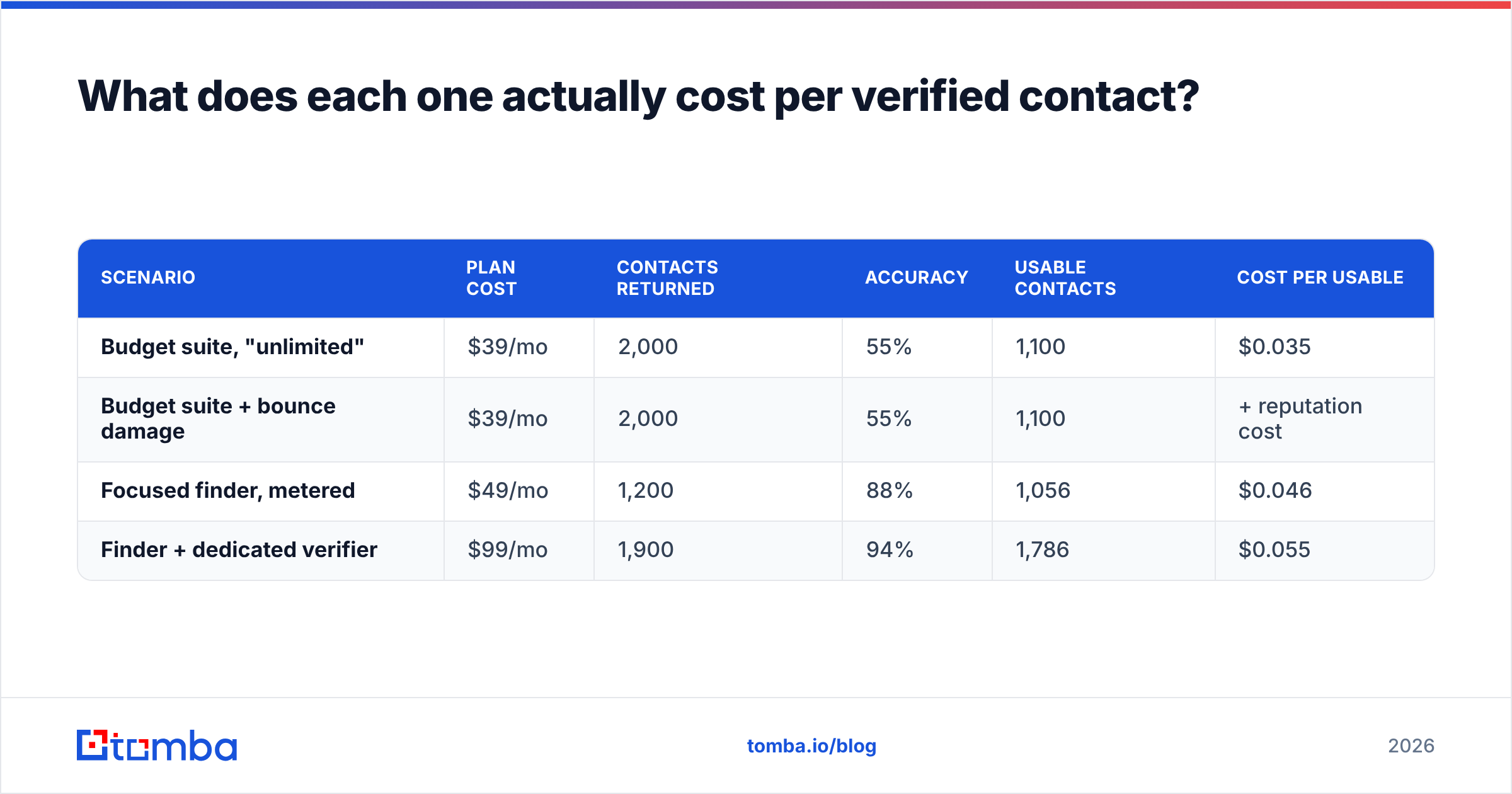
Work an example on a 2,000-contact month:
| Scenario | Plan cost | Contacts returned | Accuracy | Usable contacts | Cost per usable |
|---|---|---|---|---|---|
| Budget suite, "unlimited" | $39/mo | 2,000 | 55% | 1,100 | $0.035 |
| Budget suite + bounce damage | $39/mo | 2,000 | 55% | 1,100 | + reputation cost |
| Focused finder, metered | $49/mo | 1,200 | 88% | 1,056 | $0.046 |
| Finder + dedicated verifier | $99/mo | 1,900 | 94% | 1,786 | $0.055 |
On paper the cheap suite wins on unit cost. In the real world it usually loses, because the fourth column of that table has an invisible fifth column: the deliverability tax. A 12% bounce rate on a new sending domain can get your mailbox throttled within two weeks, and recovering a burned domain takes longer than the money you saved. Google and Yahoo's bulk sender requirements — documented in Google's own sender guidelines — put a hard spam-complaint ceiling on senders, and dirty lists are the fastest way to hit it.
Voila Norbert's pay-as-you-go option is genuinely useful here: if you enrich in bursts (a conference list, a funding-round batch), you avoid paying for a subscription you use twice a quarter. GrowMeOrganic has no equivalent, so seasonal users end up over-subscribed.
For reference on how Tomba prices the same workload, the Tomba plans run Free (25 searches/mo), Starter at $49/mo, Growth at $99/mo, and Pro at $249/mo, with verification included in the same credit pool rather than sold as a second product.
Is GrowMeOrganic better than Voila Norbert for cold outreach?#
It depends entirely on whether you want the sending engine in the same box.
Choose GrowMeOrganic if:
- You are a team of one to three and consolidating vendors matters more than best-in-class data.
- LinkedIn is your primary source. The extension-plus-database combo removes a real step from your workflow.
- You want sequences included. Not paying separately for Instantly, Smartlead, or Lemlist is a genuine saving at small volume.
- Your ICP is broad. If you are running wide, low-personalisation campaigns, a lower accuracy rate hurts less.
Choose Voila Norbert if:
- You already have a sequencer you like and only need the enrichment layer.
- You need an API. Norbert's documentation is mature and stable — it is the safer pick for anything you are wiring into a product or an internal RevOps script.
- Your volume is spiky. Pay-as-you-go beats a subscription you idle.
- Deliverability is your bottleneck, not list size.
There is a third answer that most comparison posts skip: many teams end up running a scraper for sourcing and a specialist enrichment layer for data quality, because the bundled finder inside a suite is almost never the part the vendor invested in. If that is where you land, look at what the enrichment step needs to cover — domain search for company-wide sweeps, catch-all handling for the ~20% of domains that accept everything, and bulk processing that does not choke on a 10,000-row CSV.
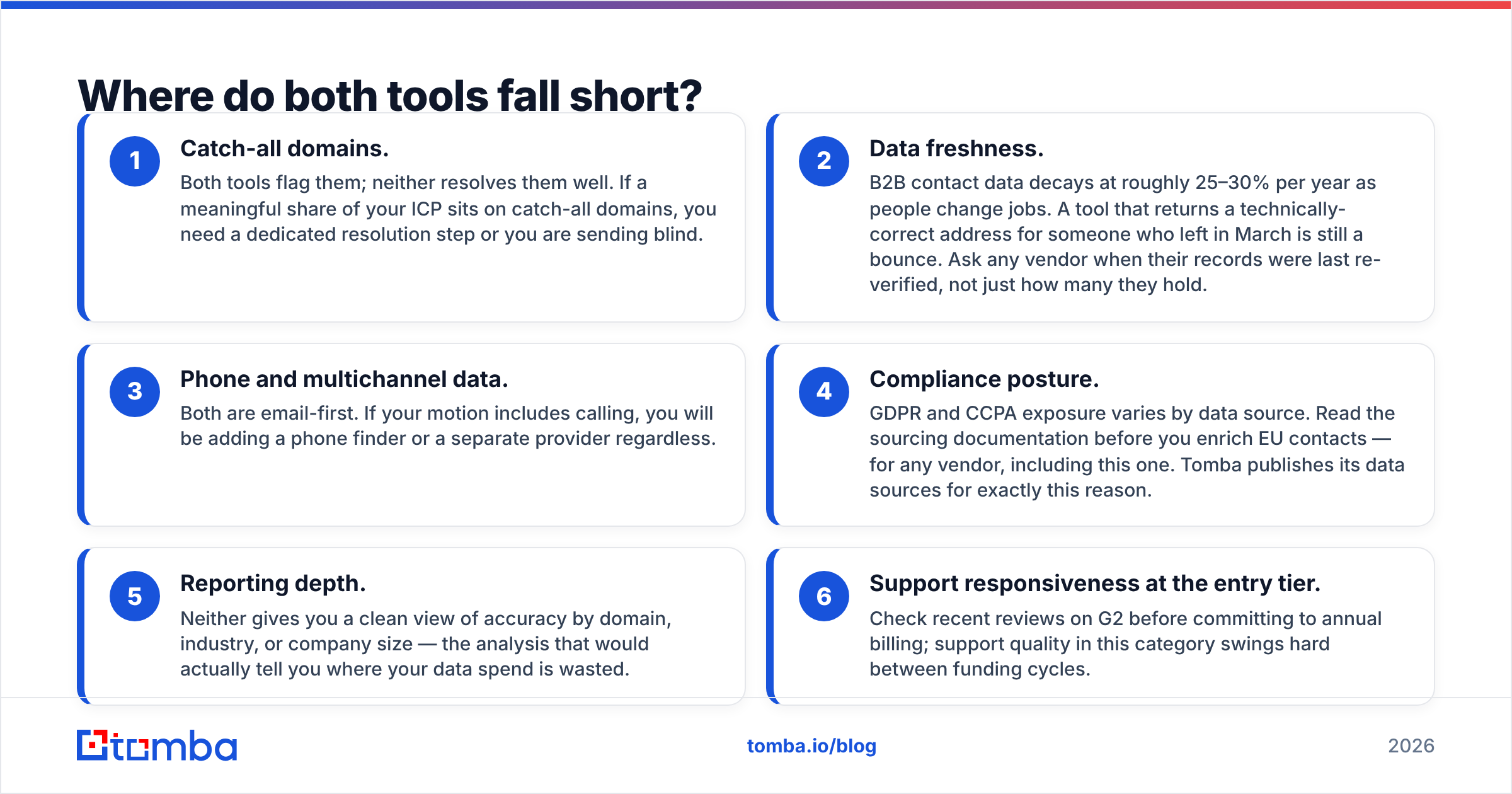
Where do both tools fall short?#
Neither product is a complete outbound stack in 2026. The honest gaps:
- Catch-all domains. Both tools flag them; neither resolves them well. If a meaningful share of your ICP sits on catch-all domains, you need a dedicated resolution step or you are sending blind.
- Data freshness. B2B contact data decays at roughly 25–30% per year as people change jobs. A tool that returns a technically-correct address for someone who left in March is still a bounce. Ask any vendor when their records were last re-verified, not just how many they hold.
- Phone and multichannel data. Both are email-first. If your motion includes calling, you will be adding a phone finder or a separate provider regardless.
- Compliance posture. GDPR and CCPA exposure varies by data source. Read the sourcing documentation before you enrich EU contacts — for any vendor, including this one. Tomba publishes its data sources for exactly this reason.
- Reporting depth. Neither gives you a clean view of accuracy by domain, industry, or company size — the analysis that would actually tell you where your data spend is wasted.
- Support responsiveness at the entry tier. Check recent reviews on G2 before committing to annual billing; support quality in this category swings hard between funding cycles.
Which should you pick in 2026?#
Pick GrowMeOrganic if you are a solo founder or a small agency, LinkedIn is your list source, and you want one invoice covering sourcing, enrichment, and sending. Accept that you will be verifying the output before you send it.
Pick Voila Norbert if you already own your sequencing and sourcing, you value a stable API and predictable credits, and you would rather receive 1,200 good addresses than 2,000 uncertain ones.
Pick a specialist stack if your bounce rate is already above 3%, your domain reputation is a live concern, or your outbound volume is high enough that a five-point accuracy difference is worth more than a $40/month price difference. At 5,000 sends a month, five points of accuracy is 250 contacts — worth far more than the subscription gap.
Whatever you choose, run the 100-contact benchmark before you sign an annual deal. Ten minutes of testing beats twelve months of regret, and every vendor here — including the one publishing this post — should be able to survive that test.
Ready to see what your list looks like with verified data?#
If the deciding factor is data quality rather than feature count, start with the Tomba Email Finder. The free tier gives you 25 searches a month with no card required — enough to run the same 100-contact benchmark you should be running against GrowMeOrganic and Voila Norbert. Find emails by name and domain, sweep a whole company with domain search, and push verified contacts straight into your sequencer through the API or a native integration. Compare the accuracy numbers side by side, then pick the tool that actually lands in inboxes.
Related guides#
Ready to find emails that actually work?
Join 150,000+ professionals who stopped guessing and started sending. Free credits on signup — no credit card required.
Get the Tomba newsletter
Practical outbound tactics and product updates — once every two weeks.
About the author