GrowMeOrganic vs Woodpecker: Which Cold Email Tool Wins in 2026?
GrowMeOrganic bundles a B2B database with LinkedIn scraping and sequences. Woodpecker is a deliverability-first sending engine. Here is which one actually fits your outbound motion in 2026 — and where both leave gaps.
GrowMeOrganic vs Woodpecker is a match-up between two different jobs. One tool finds leads. The other sends mail well. Here is which side fits your outbound stack in 2026.
TL;DR
- GrowMeOrganic is a data + sending bundle. You get a B2B contact database, a LinkedIn scraper, an email finder, and email sequences. One flat price covers all of it. Breadth is the selling point. Depth is not.
- Woodpecker is a sending engine, not a data source. It has no contact database. It does have adaptive sending, inbox rotation, deliverability checks, and reply detection. All of it has been tested since 2015.
- The two price models do not line up. GrowMeOrganic charges per plan with credit caps. Woodpecker charges per contacted prospect and per email slot. Cost tracks volume, not seats.
- Neither tool is a real verification layer. Both ship email finding as a side feature. Both will hand you catch-all addresses that can burn your domain.
- The realistic 2026 stack: dedicated data + verification (Tomba, Apollo, or a database vendor) feeding a dedicated sender (Woodpecker, Instantly, Smartlead). GrowMeOrganic wins when budget forces one bill instead of two.
What are GrowMeOrganic and Woodpecker?#
They solve different halves of the same job. That is why the match-up is useful.
GrowMeOrganic is an all-in-one B2B prospecting platform built around a Chrome extension. You scrape leads from LinkedIn, Sales Navigator, Google Maps, or its own claimed 575M+ contact database. Then you push those leads into an email sequence. It all happens in one dashboard. The pitch is a flat price and near-unlimited use. It grew its early audience through lifetime-deal channels.
Woodpecker is a cold email sending platform from Poland. It has shipped since 2015. It does not sell you data. It takes the list you already have and sends it as well as it can. You get mailbox warm-up, adaptive send volume, and inbox rotation across several accounts. You also get bounce shielding, conditional follow-ups, and reply sorting. It can tell an out-of-office note from a real human reply. Agencies like it because it handles many client workspaces cleanly.
So the honest framing of GrowMeOrganic vs Woodpecker is not "which is better." Ask this instead. Do you need a lead source with sending attached? Or a sending engine you feed yourself?
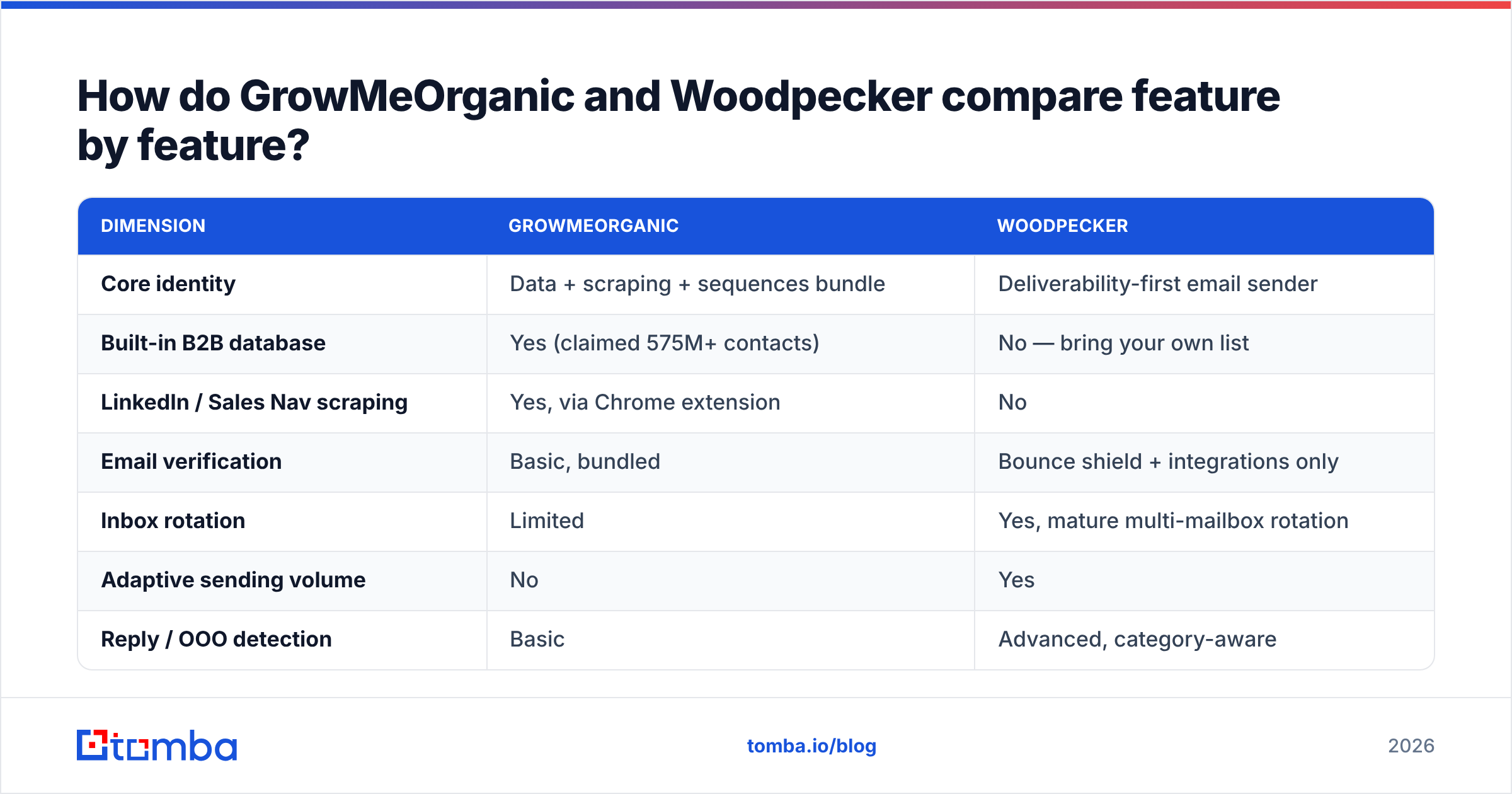
GrowMeOrganic vs Woodpecker: feature by feature#
| Dimension | GrowMeOrganic | Woodpecker |
|---|---|---|
| Core identity | Data + scraping + sequences bundle | Deliverability-first email sender |
| Built-in B2B database | Yes (claimed 575M+ contacts) | No — bring your own list |
| LinkedIn / Sales Nav scraping | Yes, via Chrome extension | No |
| Email verification | Basic, bundled | Bounce shield + integrations only |
| Inbox rotation | Limited | Yes, mature multi-mailbox rotation |
| Adaptive sending volume | No | Yes |
| Reply / OOO detection | Basic | Advanced, category-aware |
| Agency multi-client workspaces | Workarounds needed | Native, well-regarded |
| Entry pricing model | Flat plan tiers, credit-capped | Per contacted prospect + email slots |
| Typical entry cost | ~$49–$79/mo range | ~$29+/slot/mo, scales with prospects |
| Best for | Solo founders, budget teams, one bill | Agencies, deliverability-sensitive senders |
Two things stand out.
First, GrowMeOrganic is wider but each feature is thinner. The scraper works. The database is large, yet stale in pockets. The sequencer sends, but it does not adapt.
Second, Woodpecker is narrow and deep. It has spent a decade on one problem: getting mail into the inbox. Bounce shielding shows it. The tool pauses a campaign when bounce rates spike, so you do not burn a domain overnight.

Which one has better data quality?#
In GrowMeOrganic vs Woodpecker, only one side sells data. So the real question is simple. Is GrowMeOrganic's data good enough to skip a dedicated provider?
Short answer: usually not, if outbound is a main channel.
Scraped databases share one flaw. A contact record is a snapshot of a moment. It shows the day a title was crawled, or the day a company page listed a headcount. B2B contact data goes stale at roughly 25-30% per year, by widely cited industry estimates. Job changes in tech have made that worse.
A claim of 575M contacts is not a claim of 575M correct contacts. No vendor markets the gap.
GrowMeOrganic's LinkedIn scraping helps a bit. A profile you scrape today shows today's title. But LinkedIn does not expose work emails. So the tool still has to guess the address from a pattern — first.last@, f.last@, firstinitiallast@ — and hope. Guessing without an SMTP-level check is where bounce rates come from.
This is where a dedicated email finder earns its keep. It matches the pattern against real, sourced addresses instead of guessing. Run an email verifier before any list touches a sender. That cuts the bounce risk neither tool will absorb for you.

Both tools also handle catch-all domains poorly. A catch-all server accepts every address at the domain. Standard checks then return "unknown" instead of valid or invalid. Catch-alls can be 20-30% of an enterprise list. Sending to them blind is a coin flip. Dropping them all throws away real buyers. A catch-all verifier that probes deeper is the only clean fix, and neither platform offers one.
Is Woodpecker's deliverability edge real?#
Yes. It is the strongest reason to pick it, and the clearest gap in GrowMeOrganic vs Woodpecker.
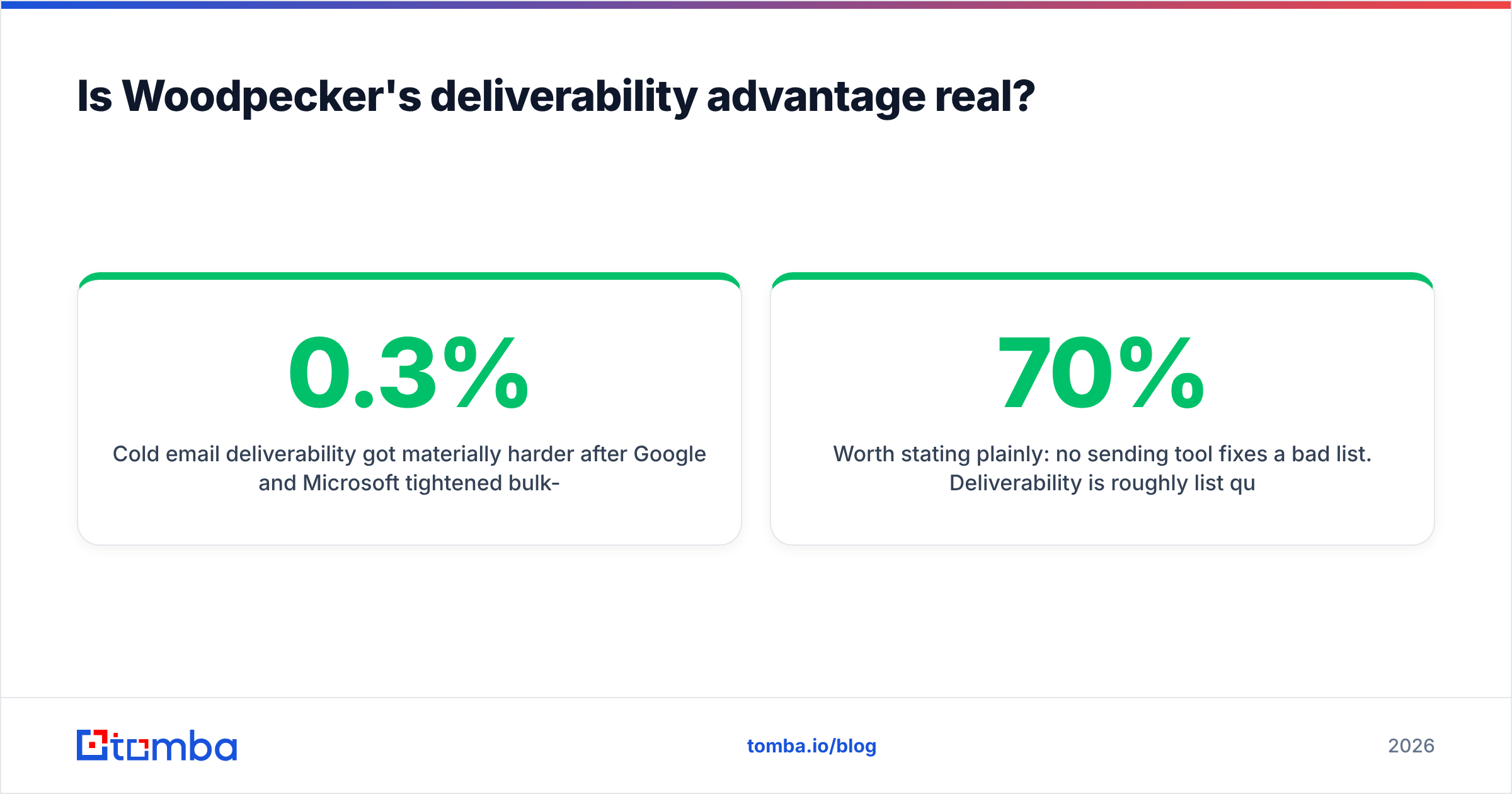
Cold email got harder after Google and Microsoft tightened bulk-sender rules. The rules are public. Set up SPF, DKIM, and DMARC. Keep spam complaints under 0.3%. Make it easy to unsubscribe. Google's bulk sender guidelines spell this out. What changed is enforcement. Inbox providers now act on reputation signals in days, not months.
Woodpecker's design matches that reality:
- Adaptive sending — it tunes daily volume per mailbox based on engagement, instead of blasting a fixed number.
- Inbox rotation — one campaign spreads across several mailboxes, so no single address carries the full load.
- Bounce shield — campaigns pause on their own when hard bounces cross a limit. A bad list segment does less damage.
- Deliverability monitor — it keeps checking your domain setup and inbox placement, not just once at setup.
- Reply sorting — it splits auto-responders, out-of-office notes, and real replies. Your response rate stays honest.
GrowMeOrganic sends email fine. It does not match that depth. Your main domain is hard to replace. If you send from it, the gap is worth more than the price difference.
One more point. No sending tool fixes a bad list. Deliverability is roughly 70% list quality and 30% sending mechanics. Woodpecker gives you the best available 30%. It cannot save the other 70%. That part is a data problem. Run a free email checker on a sample first.
How does GrowMeOrganic vs Woodpecker pricing compare?#
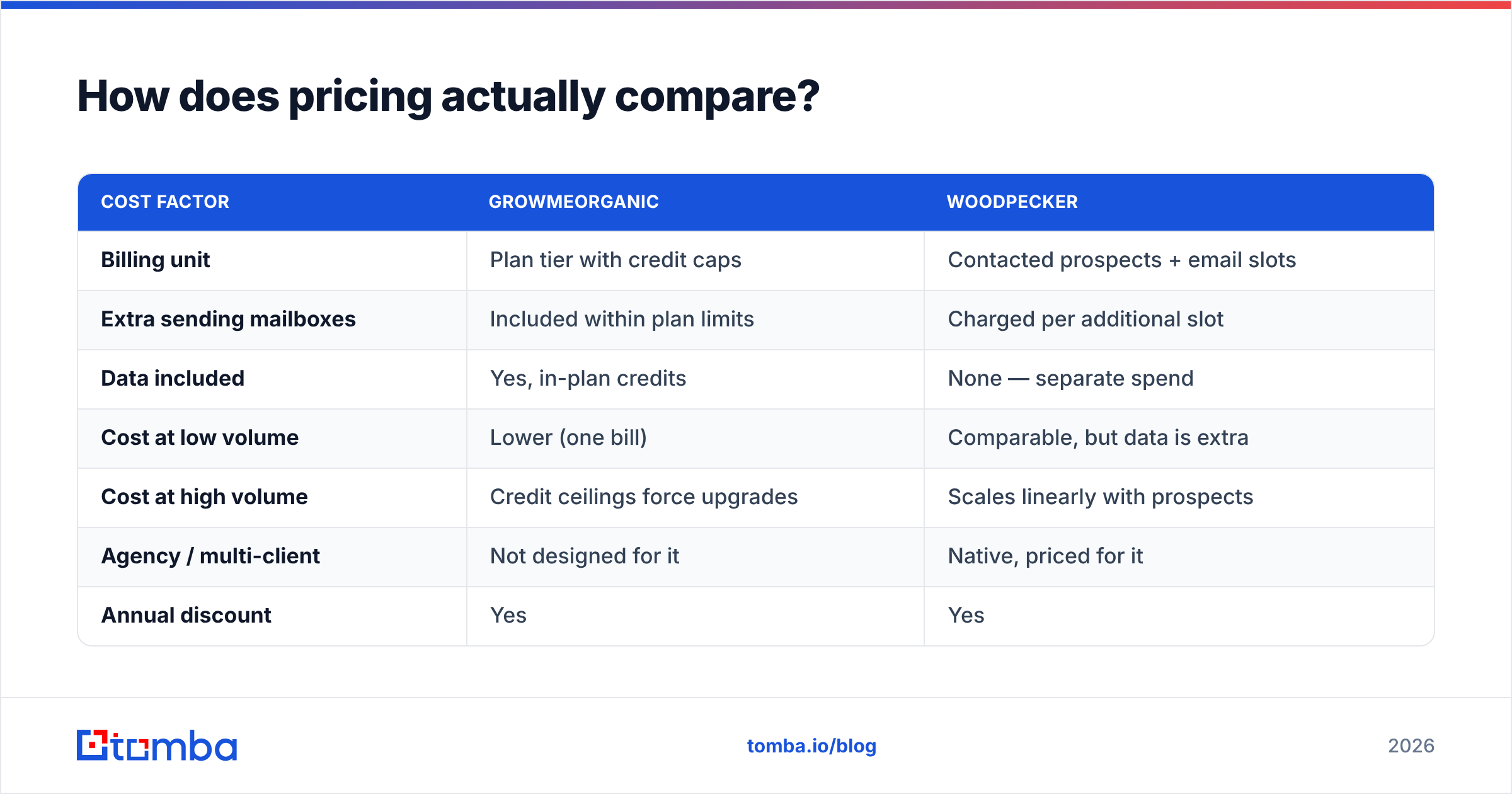
Most comparison posts get lazy here. The two vendors price on different axes.
| Cost factor | GrowMeOrganic | Woodpecker |
|---|---|---|
| Billing unit | Plan tier with credit caps | Contacted prospects + email slots |
| Extra sending mailboxes | Included within plan limits | Charged per additional slot |
| Data included | Yes, in-plan credits | None — separate spend |
| Cost at low volume | Lower (one bill) | Comparable, but data is extra |
| Cost at high volume | Credit ceilings force upgrades | Scales linearly with prospects |
| Agency / multi-client | Not designed for it | Native, priced for it |
| Annual discount | Yes | Yes |
The practical read: at 500 prospects a month, GrowMeOrganic is cheaper, because data is bundled. At 5,000+ prospects a month, it flips. You will outgrow the credit ceilings. You will buy extra data anyway. Woodpecker plus a data vendor often costs about the same, with far better output.
On the data side, Tomba pricing starts free at 25 searches a month. Paid tiers run $49/mo (Starter), $99/mo (Growth), and $249/mo (Pro). Enterprise is custom. A data layer at $49–$99 plus Woodpecker is a real budget line. It is also where most teams land after a year of bundled-tool frustration.
Check the review sites too. Both tools have current listings on G2 with recent verified reviews. The complaint patterns there beat any vendor comparison page — including this one.

Who should choose GrowMeOrganic?#
Pick GrowMeOrganic if most of these fit:
- You are solo or a two-person team. One bill and one dashboard beat best-of-breed when nobody has time to wire tools together.
- Your ICP is SMB and local. Google Maps scraping is handy for local services and territory building.
- You send under a few thousand contacts a month. You will not hit the credit ceilings that make the plan tiers annoying.
- You send from a secondary domain. If a reputation hit is survivable, you can trade sending depth for price.
- You want LinkedIn scraping in the same tool. A separate scraper, finder, and sender is real overhead at small scale.
Where it lets you down: sequence logic is basic and deliverability tooling is thin. Support response times draw steady complaints. Database accuracy swings by region and industry. Test it against a list you can verify yourself before you trust it at volume.
Who should choose Woodpecker?#
GrowMeOrganic vs Woodpecker tilts to Woodpecker if:
- You run an agency. Multi-client workspaces are native, not a workaround. That alone decides it for many buyers.
- You send from your main domain. Bounce shielding and adaptive volume are insurance on an asset you cannot replace.
- You already have a data source. With Apollo or a database subscription in place, you need the best sender, not another bundle.
- Reply handling matters. Smart follow-ups stop you from emailing someone who already answered. That is the fastest way to look automated.
- You manage email deliverability as a metric, rather than hoping it works.
Where it lets you down: no data, no scraping, no enrichment. Per-prospect pricing surprises people who budgeted for a flat seat. The UI is clean but less dense than Instantly or Smartlead, which have shipped fast since 2023.
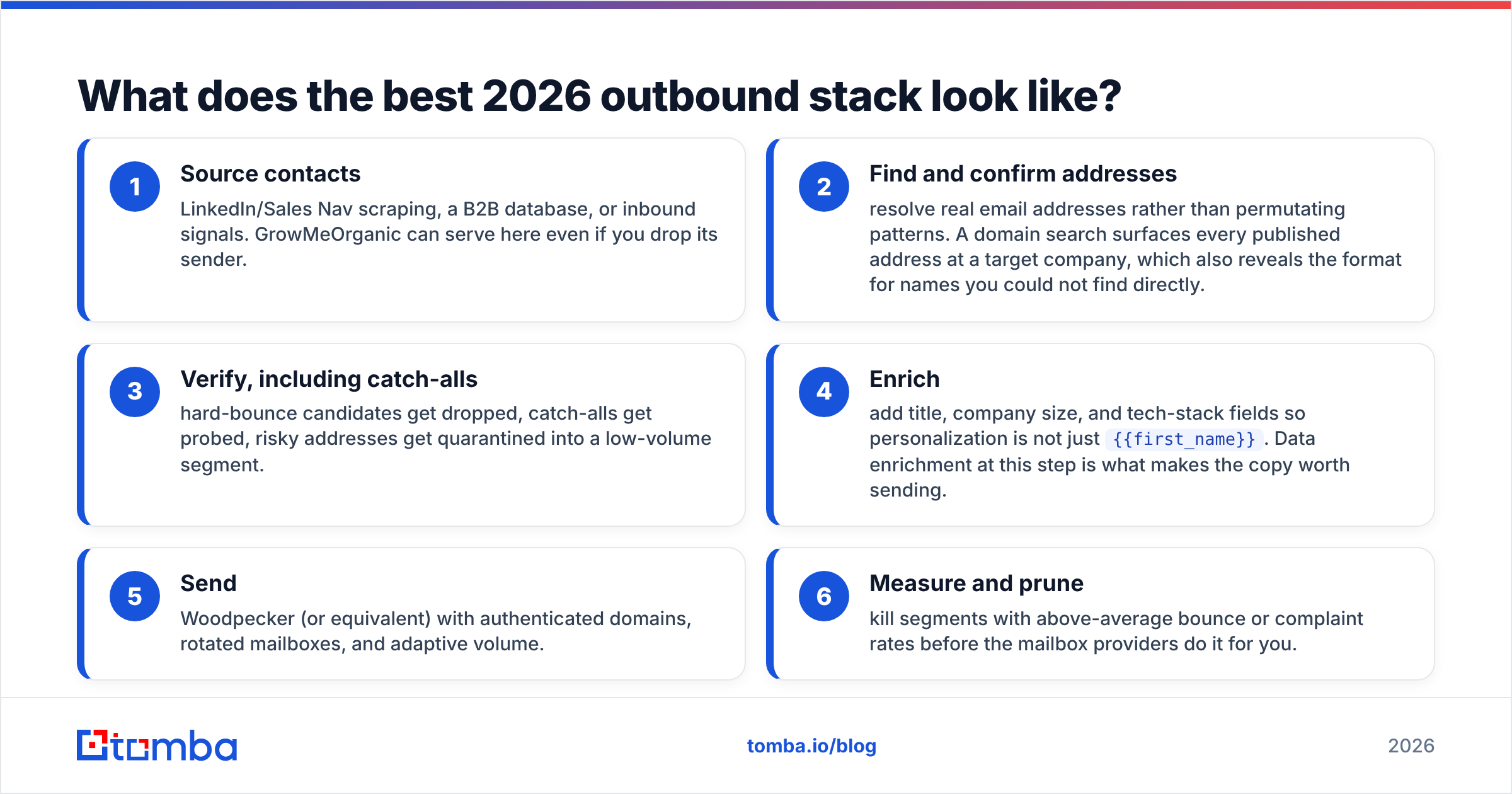
What does the best 2026 outbound stack look like?#
Split the job. Data, verification, and sending are three different problems. Past the first few thousand contacts, specialists beat bundles.
A working setup:
- Source contacts — scrape LinkedIn, buy a database, or use inbound signals. GrowMeOrganic can serve here even if you drop its sender.
- Find real addresses — a domain search surfaces every published address at a target company. It also reveals the name format for people you could not find directly.
- Verify, catch-alls included — drop hard-bounce risks, probe catch-alls, and park risky addresses in a low-volume segment.
- Enrich — add title, company size, and tech stack. Data enrichment is what makes the copy worth sending.
- Send — Woodpecker or an equal, with signed domains, rotated mailboxes, and adaptive volume.
- Measure and prune — cut segments with high bounce or complaint rates before the inbox providers do it for you.
Skip step 3 and the rest stops mattering. A clean, signed domain still lands in spam when 22% of the list is invalid. Bounce rate is itself a reputation signal. That gap is the one thing GrowMeOrganic vs Woodpecker never settles for you.
For teams weighing the whole category, here is how the data layer options stack up on accuracy and coverage:

The verdict on GrowMeOrganic vs Woodpecker#
Woodpecker wins the thing that decides campaigns. GrowMeOrganic wins the thing that decides budgets.
Is outbound email a real revenue channel? Would a burned domain hurt? Then take Woodpecker and buy data on the side. Its deliverability work is not marketing copy. It is a decade of engineering on a problem that keeps getting harder.
Still testing whether outbound works at all? On a tight budget, with a spare domain and modest volume, GrowMeOrganic gets you sending this week for one price. Just know the trade. You give up data accuracy and sending depth for convenience. Plan the move for when volume grows.
The mistake in GrowMeOrganic vs Woodpecker is treating either one as complete. GrowMeOrganic's data needs a check before it hits a sender. Woodpecker needs a data source before it has anything to send. The gap in the middle is accurate, verified, enriched contacts. That gap is where most cold email programs quietly fail.
Close it first. Run your list through Tomba's Email Finder to get real, sourced addresses instead of guessed patterns. Verify what comes back. Then hand a clean file to whichever sender you pick. Start free with 25 searches a month, no card needed. See your list's real validity rate before the next campaign goes out.
Related guides#
Ready to find emails that actually work?
Join 150,000+ professionals who stopped guessing and started sending. Free credits on signup — no credit card required.
Get the Tomba newsletter
Practical outbound tactics and product updates — once every two weeks.
About the author