GrowMeOrganic vs Xverum: B2B Data Tools Compared (2026)
One sells seats, credits, and a campaign sender. The other sells multi-million-row data feeds you pipe into your own stack. Here is how GrowMeOrganic and Xverum actually differ on price, coverage, accuracy, and who should buy which.
TL;DR
- GrowMeOrganic and Xverum are not really competitors. GrowMeOrganic is a seat-based prospecting suite (find contacts, load a sequence, hit send). Xverum is a data-as-a-service vendor that ships bulk company and people datasets into your warehouse or S3 bucket.
- Buy GrowMeOrganic if a two-to-ten person sales team needs contacts and a sender in one tab. Buy Xverum if you have engineers, a warehouse, and a need for tens of millions of records refreshed on a schedule.
- Pricing shapes differ completely: GrowMeOrganic publishes SaaS tiers starting around $49/month; Xverum quotes annual data contracts and does not publish a self-serve price.
- Neither tool is built to verify a single email on demand at high accuracy — that gap is where a dedicated finder-plus-verifier layer earns its keep.
- The honest answer for most teams under 20 reps: skip the bulk data contract, and pair a lightweight finder with whatever sender you already pay for.
What are GrowMeOrganic and Xverum?#
They solve the same underlying problem — "get me contact data for people who might buy" — from opposite ends of the stack.
- GrowMeOrganic is an all-in-one prospecting platform aimed at SMBs and agencies. It bundles a B2B contact database, a LinkedIn/Sales Navigator extractor, an email finder, and a drip-campaign sender behind one subscription. You log in, build a list, and email it from the same UI. See the official product site for current feature claims.
- Xverum is a B2B data provider, not an outreach tool. It sells structured datasets — company profiles, people profiles, job postings, local business listings — delivered as flat files or via API on a refresh cadence. There is no sequence builder, no inbox, no mail merge. See xverum.io for dataset scope.
- Delivery model is the sharpest difference. GrowMeOrganic hands you credits inside an app. Xverum hands you a feed you are expected to load, dedupe, and model yourself.
- Buyer profile follows from that. GrowMeOrganic is bought by a founder or an SDR lead with a credit card. Xverum is bought by a RevOps, data, or product team with an annual budget and someone who can write SQL.
- Time-to-first-email is minutes with GrowMeOrganic and weeks with Xverum, because Xverum's output is an input to something else you still have to build.
If you are comparing these two because a listicle put them on the same page, that listicle was wrong. Compare them on what you actually plan to do with the rows.
How accurate is the contact data on each side?#
Accuracy is where both models get uncomfortable, and for different reasons.
GrowMeOrganic's database is aggregated and enriched from public sources, and its email finder guesses patterns then validates them. That works well for mid-market companies with predictable formats (first.last@) and gets shaky on catch-all domains, small agencies, and non-US TLDs. Users on G2 consistently praise the price-to-volume ratio and consistently flag bounce rates on older records — which is what you would expect from any database sold at that tier.
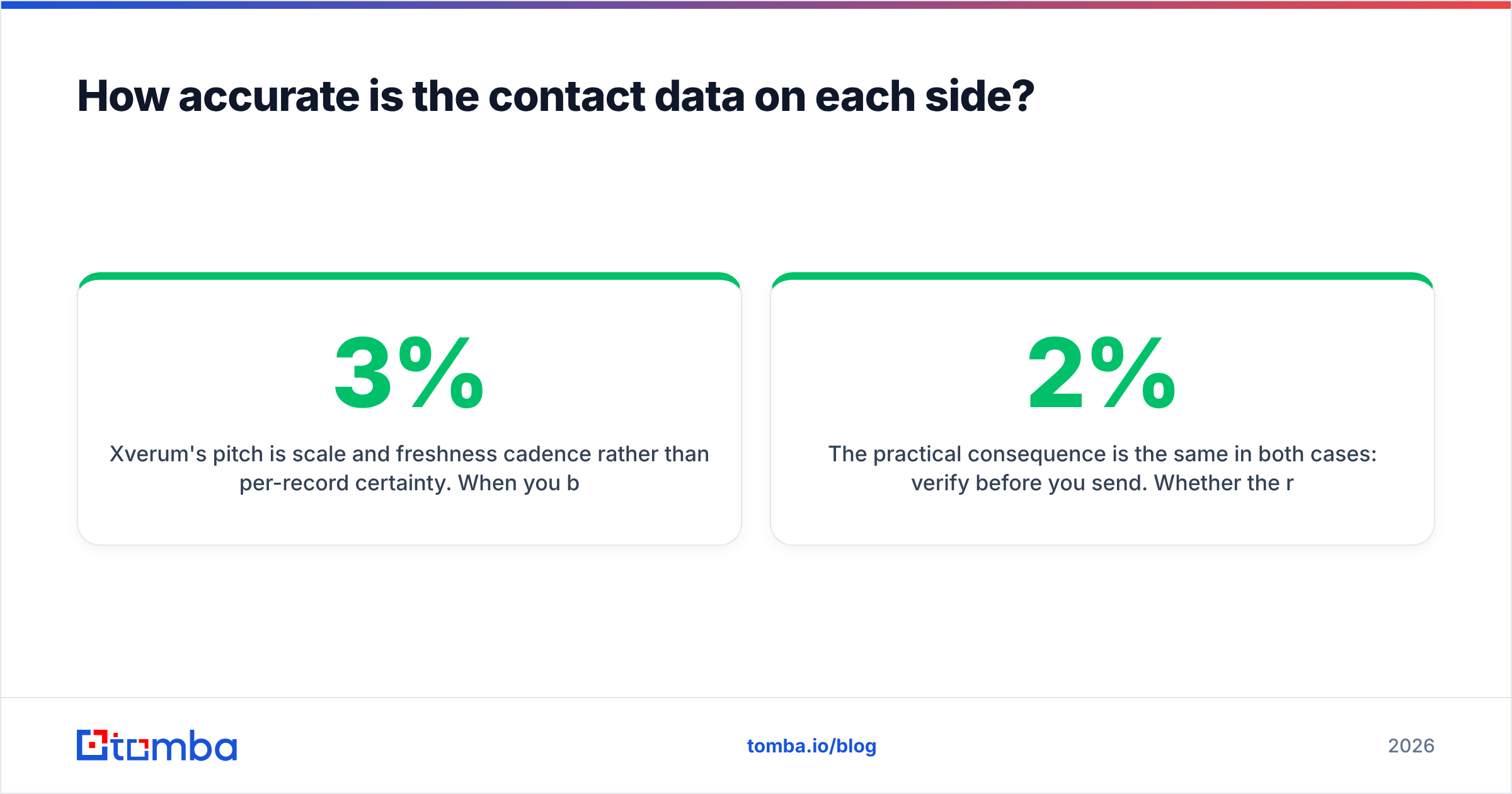
Xverum's pitch is scale and freshness cadence rather than per-record certainty. When you buy 100M+ profiles as a feed, nobody SMTP-checks each mailbox for you at delivery time. The dataset is a snapshot; the decay clock starts the moment it lands. B2B contact data decays fast — the widely cited figure is roughly 2-3% per month for job-change churn alone, which compounds to a quarter of your file being stale within a year.

The practical consequence is the same in both cases: verify before you send. Whether the row came from a UI credit or a Parquet file, a separate email verifier pass is the difference between a 2% bounce rate and a 12% one — and above roughly 3%, mailbox providers start throttling you regardless of how good your copy is.
Two accuracy details people miss:
- Catch-all domains are reported as "valid" by lazy validators. They are not valid; they accept everything and bounce later, or worse, silently dump you in a spam trap. A dedicated catch-all verifier is the only honest way to score them.
- Role accounts (
info@,sales@,hello@) inflate database counts. A vendor quoting "500 emails per company" is often quoting role accounts and generic aliases, not named humans.
GrowMeOrganic vs Xverum: how do they compare head to head?#
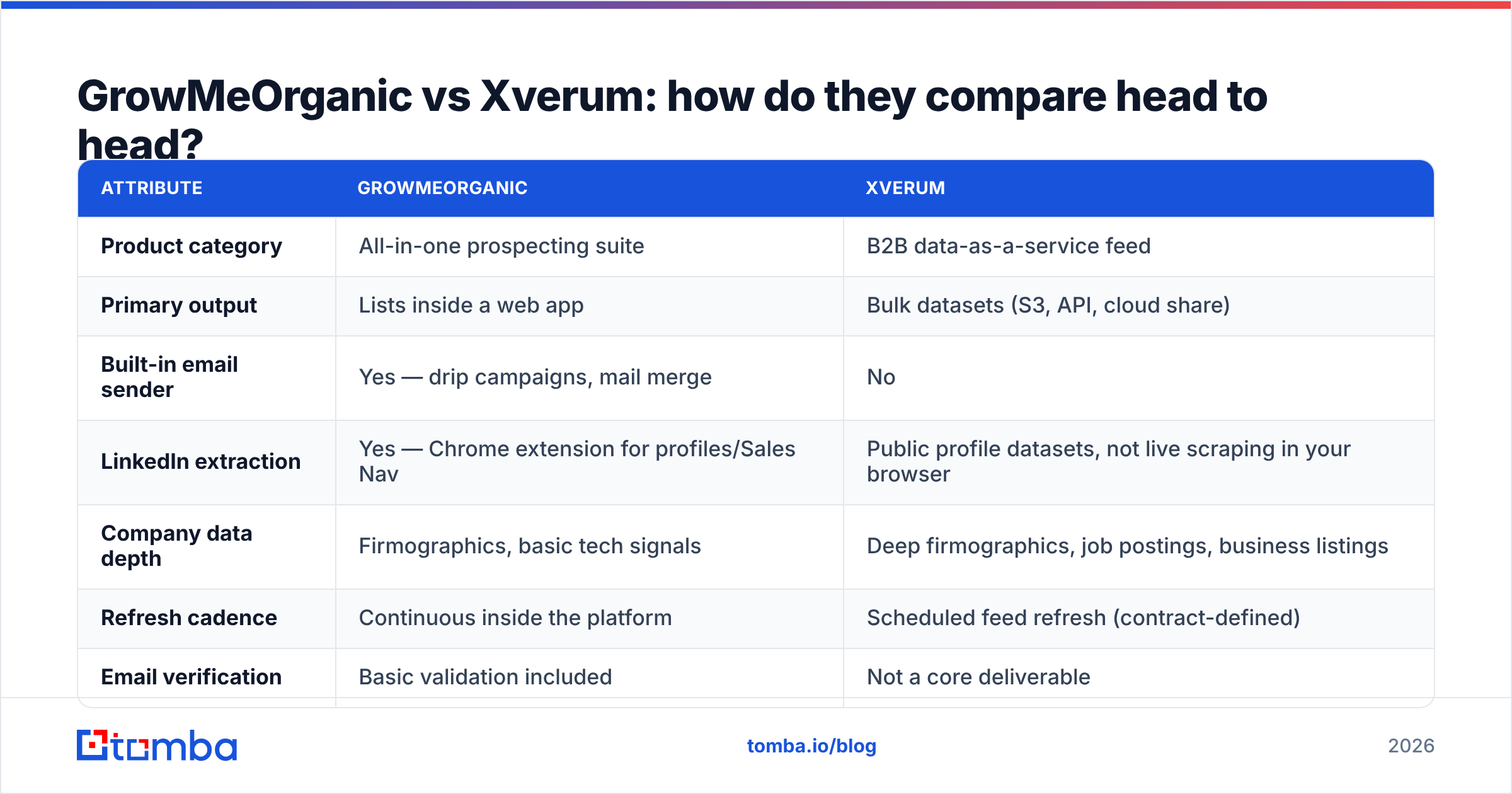
Here is the side-by-side on the attributes that change your decision. Treat vendor-published figures as directional — both companies change packaging often, so confirm on their sites before you sign anything.
| Attribute | GrowMeOrganic | Xverum |
|---|---|---|
| Product category | All-in-one prospecting suite | B2B data-as-a-service feed |
| Primary output | Lists inside a web app | Bulk datasets (S3, API, cloud share) |
| Built-in email sender | Yes — drip campaigns, mail merge | No |
| LinkedIn extraction | Yes — Chrome extension for profiles/Sales Nav | Public profile datasets, not live scraping in your browser |
| Company data depth | Firmographics, basic tech signals | Deep firmographics, job postings, business listings |
| Refresh cadence | Continuous inside the platform | Scheduled feed refresh (contract-defined) |
| Email verification | Basic validation included | Not a core deliverable |
| Minimum commitment | Monthly SaaS plan | Annual data contract, custom quote |
| Technical lift to deploy | None — log in and go | High — ETL, storage, modeling, dedupe |
| Best fit | 1-20 seat sales teams, agencies | Data teams, platforms, ABM at scale |
| Worst fit | Enterprise data pipelines | A three-person startup that just wants to email 500 CTOs |

The table makes the fork obvious. If any row in the "technical lift" line makes you wince, Xverum is not your tool this quarter — not because it is weak, but because you would be buying a raw ingredient and no kitchen.
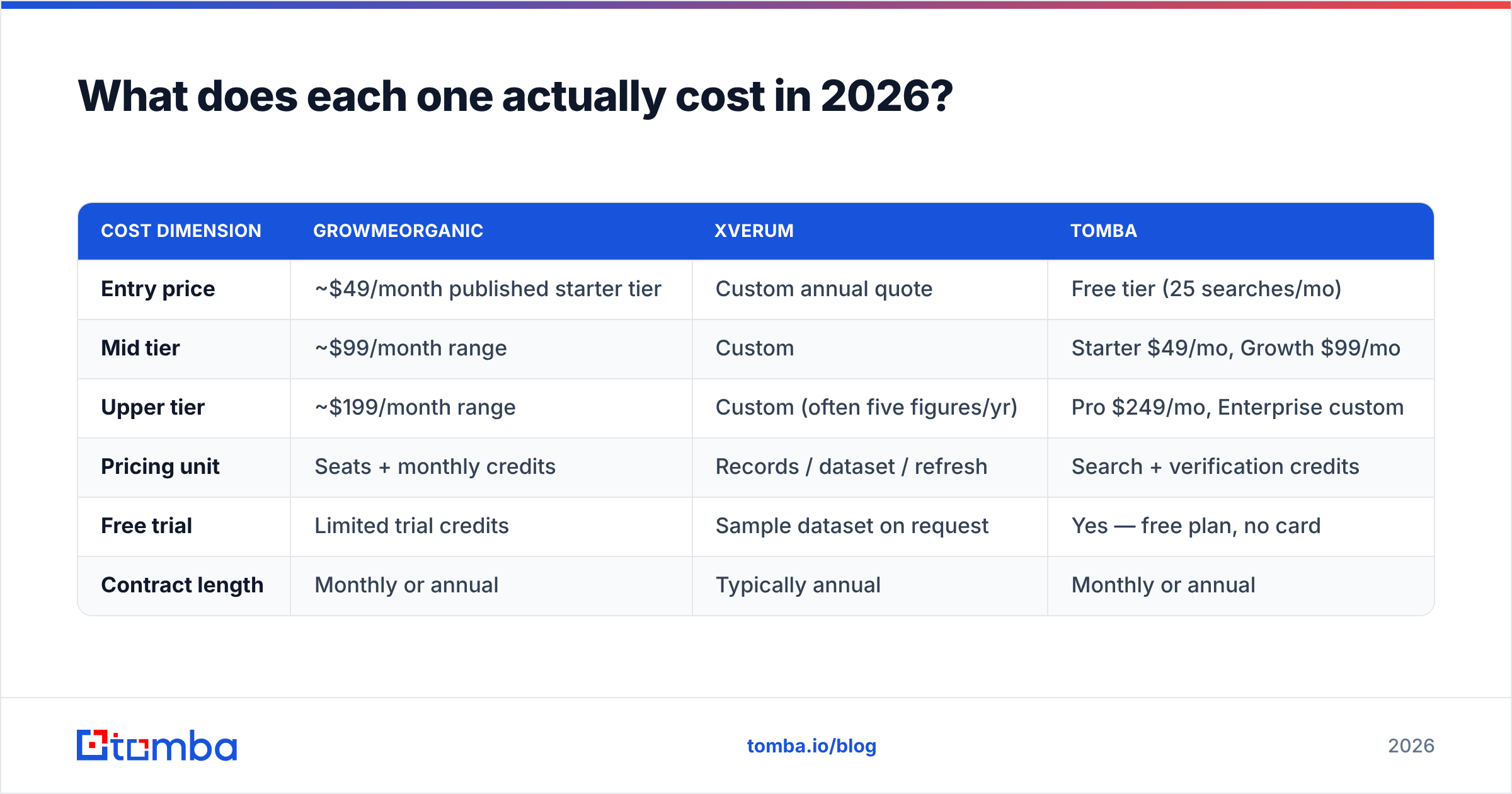
What does each one actually cost in 2026?#
Pricing is the second place these two diverge structurally: one publishes, one quotes.
| Cost dimension | GrowMeOrganic | Xverum | Tomba |
|---|---|---|---|
| Entry price | ~$49/month published starter tier | Custom annual quote | Free tier (25 searches/mo) |
| Mid tier | ~$99/month range | Custom | Starter $49/mo, Growth $99/mo |
| Upper tier | ~$199/month range | Custom (often five figures/yr) | Pro $249/mo, Enterprise custom |
| Pricing unit | Seats + monthly credits | Records / dataset / refresh | Search + verification credits |
| Free trial | Limited trial credits | Sample dataset on request | Yes — free plan, no card |
| Contract length | Monthly or annual | Typically annual | Monthly or annual |
Always confirm live numbers on the vendor's own pricing page; SaaS tiers move. What does not move is the shape: GrowMeOrganic is a predictable per-seat expense you can cancel in a month. Xverum is a procurement conversation with legal review, a data-processing agreement, and a renewal date.
Two cost traps worth naming:
- Credit rollover. Suite tools often expire unused credits monthly. If your team prospects in bursts (a Q1 push, then quiet), you pay for capacity you never touched.
- Storage and engineering. A bulk feed's sticker price is not its total cost. Warehouse storage, an ETL job, a dedupe strategy, and someone to own it when it breaks are all real line items. Budget engineering hours, not just the contract.
For the record on our own numbers, since we are in the comparison: Tomba pricing runs Free (25 searches/mo), Starter $49/mo, Growth $99/mo, Pro $249/mo, and Enterprise custom. We are the finder-and-verifier layer in this picture, not a sender and not a bulk feed.
Which one should your team actually choose?#
Pick by the shape of your problem, not by feature count.
Choose GrowMeOrganic if:
- You have 1-20 people doing outbound and no data engineer.
- You want list-building and sending in one bill instead of three.
- Your ICP is mid-market and reasonably well documented online.
- You value cancel-anytime flexibility over per-record depth.
Choose Xverum if:
- You are building a product, a scoring model, or an ABM system that consumes data programmatically.
- You need coverage measured in tens of millions of records, refreshed on a schedule.
- You already have a warehouse and someone who owns the pipeline.
- Your legal and procurement teams need a formal data agreement, not a checkout page.
Choose neither — and assemble your own — if:
- You already pay for a sender you like (Instantly, Smartlead, Lemlist, HubSpot sequences) and only need contacts.
- Your bounce rate is the actual bottleneck, not list volume.
- You want to enrich records inside a CRM or spreadsheet rather than migrate to a new UI.
That third case is more common than vendors admit. A lot of teams buy an all-in-one because the bundle looks cheap, then keep using their old sender anyway — and end up paying twice for sending while under-paying for data quality.

What are the hidden limitations of each approach?#
GrowMeOrganic's limits are ceiling limits. Bundled senders are rarely as good as dedicated ones. Deliverability controls — inbox rotation, per-domain throttling, granular warmup — tend to be thinner in a suite than in a focused platform. If you scale past a few thousand sends a month, you will likely outgrow the sending half and keep only the data half. And because credits are consumed inside the app, exporting your work into another workflow can feel like fighting the product.
Xverum's limits are floor limits. You cannot start small. There is no "let me test 50 contacts before Tuesday's call" motion. A feed also gives you no per-record confidence score at send time, so you still need a verification step before anything touches a mailbox. And the freshness you bought is the freshness at delivery — a contact who changed jobs the day after the refresh looks perfectly valid in your file.
Both share one blind spot: verification at the moment of send. A record verified in January and emailed in June is an unverified record. That is why serious outbound teams re-verify at list-build time rather than trusting the source, no matter how premium the source was. Google and Microsoft both tightened bulk-sender requirements in recent years — HubSpot's deliverability guidance is a decent neutral primer on why list hygiene now outranks copy tricks.
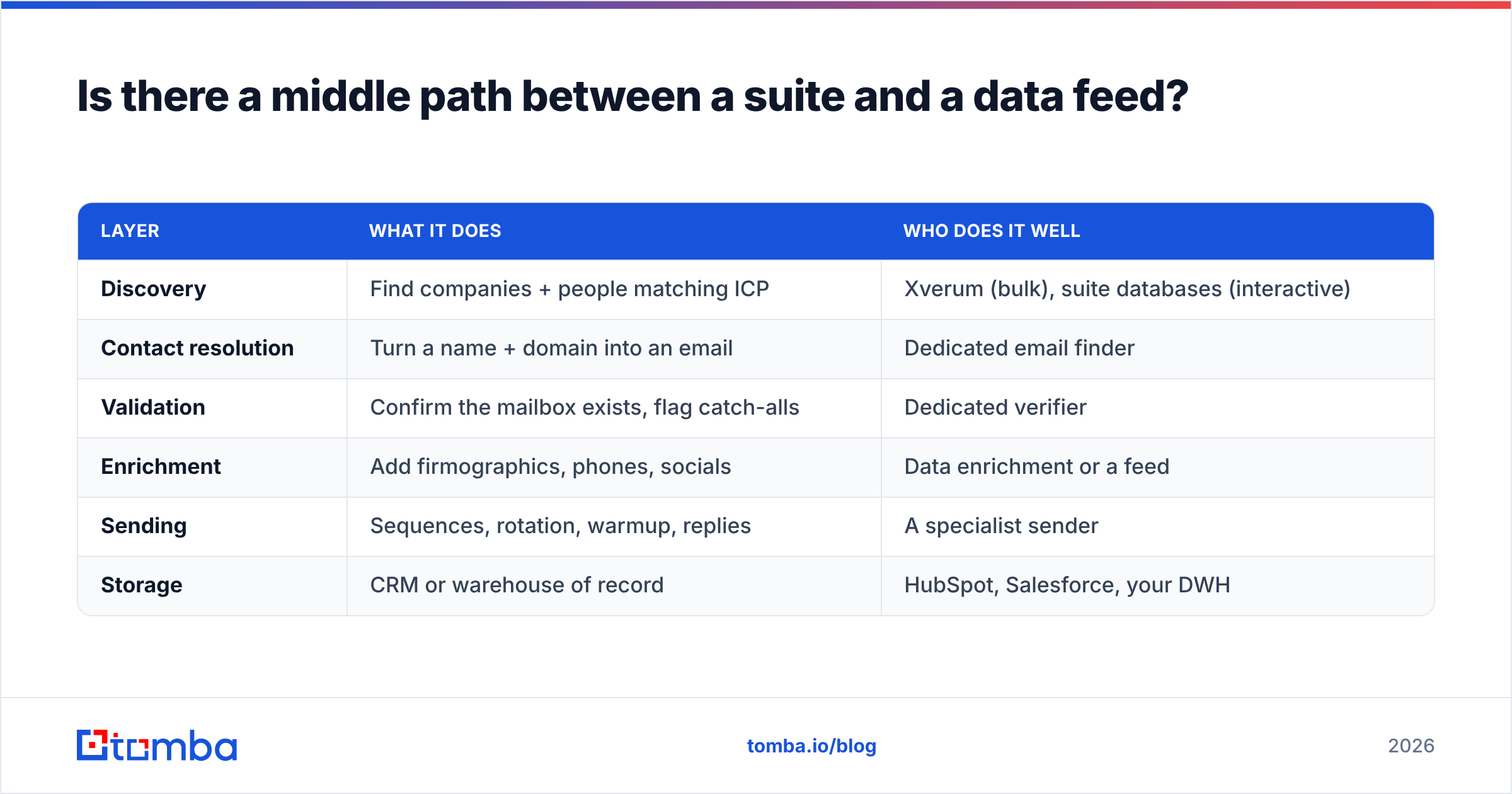
Is there a middle path between a suite and a data feed?#
Yes, and it is the setup most efficient teams land on after they have tried both: decouple the layers.
| Layer | What it does | Who does it well |
|---|---|---|
| Discovery | Find companies + people matching ICP | Xverum (bulk), suite databases (interactive) |
| Contact resolution | Turn a name + domain into an email | Dedicated email finder |
| Validation | Confirm the mailbox exists, flag catch-alls | Dedicated verifier |
| Enrichment | Add firmographics, phones, socials | Data enrichment or a feed |
| Sending | Sequences, rotation, warmup, replies | A specialist sender |
| Storage | CRM or warehouse of record | HubSpot, Salesforce, your DWH |
Decoupling costs a little more in subscriptions and saves a lot in wasted sends. It also means one weak layer does not poison the rest: if your sender underperforms, you swap it without losing your data, and vice versa.
Practically, that looks like: pull target accounts from wherever you already have them, run a domain search to map the org, resolve named contacts through a finder API, verify in bulk, then push the clean rows into your sender through an integration or the Tomba API. For teams working out of spreadsheets, the same flow runs inside Google Sheets or Excel without any pipeline work at all.
Frequently asked questions#
Is GrowMeOrganic a direct Xverum competitor? No. They overlap on "we have B2B contact data" and diverge on everything else. A closer Xverum comparison is another data-as-a-service vendor; a closer GrowMeOrganic comparison is another all-in-one prospecting suite.
Which has better email accuracy? Neither publishes an independently audited number, and you should be skeptical of any vendor that claims one without methodology. The reliable move is to verify a sample of 200-500 records from either source and measure your own bounce rate before committing.
Can I use Xverum data with a normal sales team? Only if someone converts the feed into something a rep can use — a CRM sync, a filtered view, a Sheet. Raw feeds are not a rep-facing product.
Do I need a separate verifier if the tool says it verifies? If you send more than a few hundred emails a month, yes. Bundled validation is usually a syntax and MX check, not a mailbox-level check, and it rarely resolves catch-alls properly.
What about phone numbers? Neither is a phone-first vendor. If dials matter to your motion, budget for a dedicated phone finder rather than expecting either platform to cover it well.
The verdict#
GrowMeOrganic wins on time-to-value for small teams. Xverum wins on scale for data teams. Most companies need neither at full price — they need clean, verified contacts feeding a sender they already own.
If that describes you, start with the layer that determines everything downstream: contact resolution and verification. Tomba Email Finder turns a name and a domain into a verified, deliverable address — with domain search, catch-all detection, bulk processing, and an API that drops into whatever pipeline you have. The free tier gives you 25 searches a month, no card required, which is enough to benchmark it against whatever list you are currently paying for. Run the same 200 contacts through both and let the bounce rate settle the argument.
Related guides#
Ready to find emails that actually work?
Join 150,000+ professionals who stopped guessing and started sending. Free credits on signup — no credit card required.
Get the Tomba newsletter
Practical outbound tactics and product updates — once every two weeks.
About the author