GrowMeOrganic vs YAMM (Yet Another Mail Merge): 2026 Verdict
GrowMeOrganic bundles a B2B database with sequences; YAMM sends mail merges straight from Gmail for a few dollars a year. Here is which one actually fits your outbound motion — and where both leave gaps.
GrowMeOrganic vs YAMM is a fight between two different jobs. One tool finds contacts. The other sends mail merges from Gmail. Pick the wrong one and you either pay for a suite you barely touch, or you blast a stale list from your main inbox.
TL;DR
- GrowMeOrganic is an all-in-one prospecting suite: a claimed 575M+ contact database, a LinkedIn scraper, an email finder, and a cold email sequencer. Plans start near $49/mo on annual billing.
- YAMM (Yet Another Mail Merge) is not a prospecting tool. It is a Google Workspace add-on that merges a Google Sheet into Gmail drafts. It costs $25–$50 per user per year and brings no contact data.
- They look like rivals only because both end with "an email got sent." GrowMeOrganic answers who do I email. YAMM answers how do I send 400 personal emails from my own inbox today.
- Neither is a data-accuracy play. GrowMeOrganic's bundled emails need outside verification. YAMM has none at all, so a stale sheet burns your Gmail reputation.
- Best stack for most teams: find and verify contacts with a dedicated tool like Tomba Email Finder, then send with YAMM if you are small and Gmail-native, or with GrowMeOrganic if you want sequencing in the same tab.
What are GrowMeOrganic and YAMM, exactly?#
They solve different halves of the same problem. Confusing them is the most expensive mistake buyers make here.
GrowMeOrganic is an Indian-built, all-in-one B2B prospecting platform. Under one login you get a searchable contact database, a Chrome extension that pulls contacts off LinkedIn and Sales Navigator, an email finder, an email verifier, and a drip-sequence sender. It sells on unlimited-ish usage: most plans advertise unlimited email credits rather than per-credit metering. See growmeorganic.com for the current plan sheet.
YAMM, short for Yet Another Mail Merge, is a Google Sheets add-on from French developer Romain Vialard's team. You put contacts in a spreadsheet. You write a draft in Gmail with {{First name}}-style placeholders. You hit Start, and YAMM sends each one through your own Gmail account. It tracks opens, clicks and bounces, and writes the status back into the sheet. That is the whole product. It has been around since 2014, and it is very good at that one job.
The distinction matters because your bottleneck is rarely sending. Sending is close to free. The bottleneck is correct, verified, permission-appropriate contact data. That is where both tools have limits.
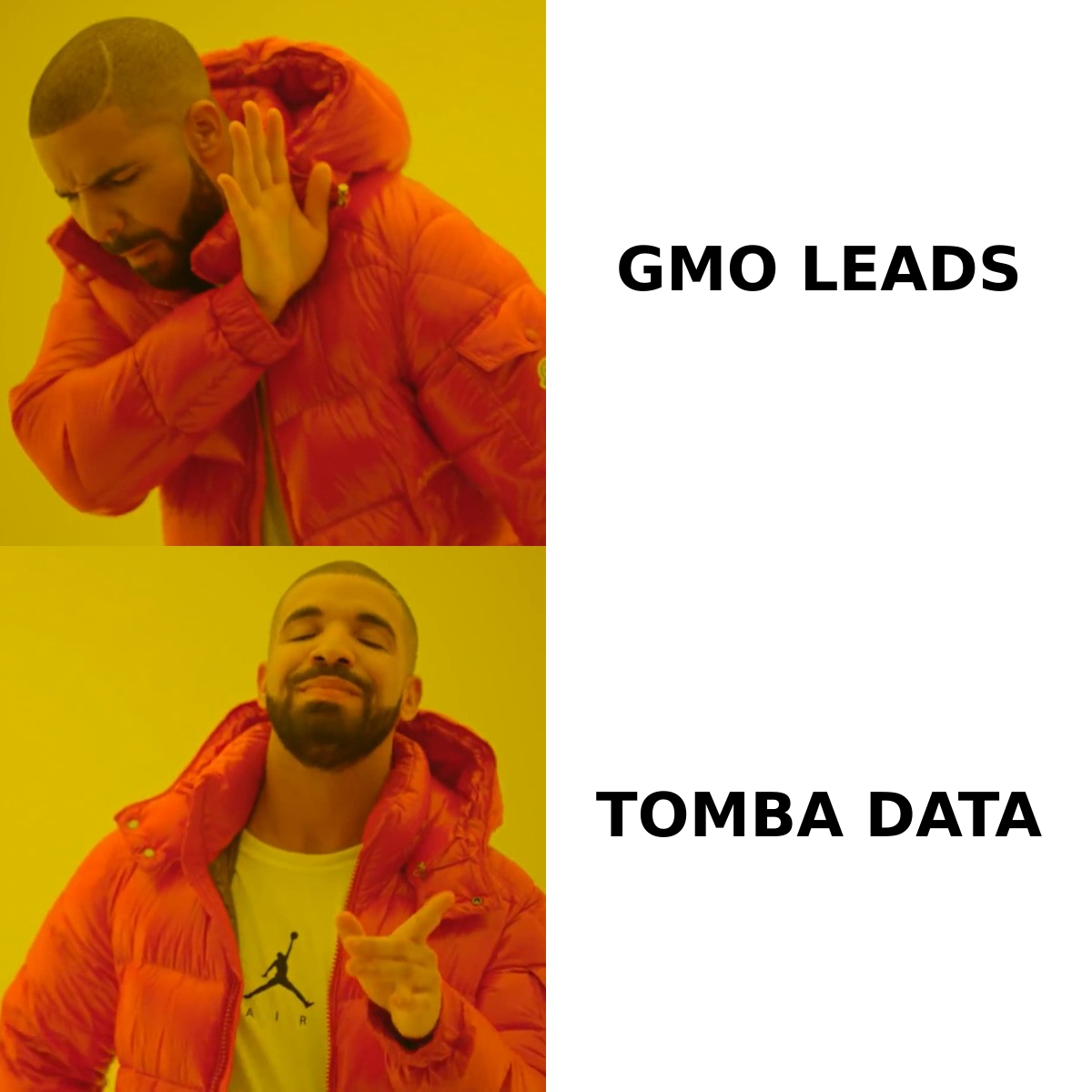
GrowMeOrganic vs YAMM: how do they compare head to head?#
| Attribute | GrowMeOrganic | YAMM (Yet Another Mail Merge) |
|---|---|---|
| Product type | All-in-one prospecting + sequencing suite | Google Sheets → Gmail mail merge add-on |
| Entry price | ~$49/mo billed annually (Founder plan) | ~$25/user/yr (Personal), ~$50/user/yr (Pro) |
| Contact database | Yes — 575M+ contacts claimed | None |
| Email finder | Built in | None |
| Email verification | Basic, bundled | None |
| LinkedIn scraping | Yes (Chrome extension, Sales Nav supported) | No |
| Sending infrastructure | Own SMTP / connected mailboxes | Your Gmail account only |
| Daily send ceiling | Per-mailbox limits you configure | 400/day (free Gmail: 50), 1,500/day Workspace |
| Multi-step sequences | Yes, with follow-up conditions | No — one send per campaign, manual follow-ups |
| Open / click tracking | Yes | Yes, written back to the sheet |
| CRM sync | Native + Zapier | Sheet-based; Zapier via workarounds |
| Learning curve | Moderate — it is a full platform | Under 10 minutes |
| Best for | SDR teams needing data + cadence in one tool | Solo founders, recruiters, ops folks living in Gmail |
The table makes the trade obvious. GrowMeOrganic costs roughly 12–20x more per year and does about 8x more things. YAMM is a scalpel. GrowMeOrganic is a Swiss Army knife with a slightly dull blade on every tool.
Which one gives you better contact data?#
GrowMeOrganic, by default. But "better than nothing" is a low bar, and you should not treat its output as verified.
YAMM has no data layer at all. Whatever sits in your Google Sheet is what gets sent. Export a list from a 2023 conference and YAMM will blast every dead address on it. Your Gmail account takes the bounce damage.
GrowMeOrganic bundles a large database and a finder. Reviewers on G2 flag the same pattern: broad coverage, uneven accuracy, and stale records in smaller markets and outside the US. The unlimited-credits model is part of the reason. When credits are free, there is less pressure to reject a low-confidence guess. A tool that meters credits only charges you for a result it believes in.
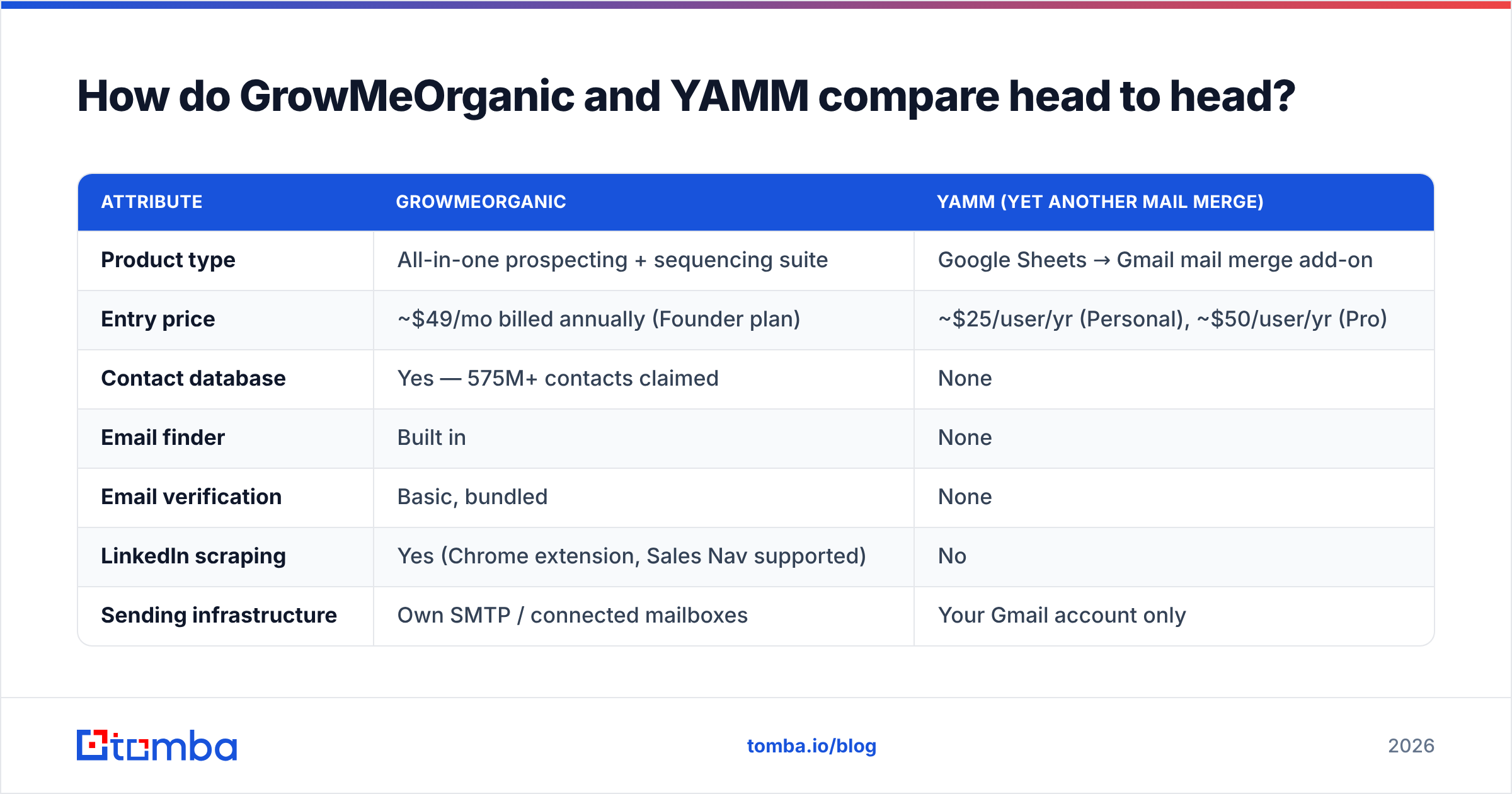
That gap is why most disciplined teams verify every list, wherever it came from:
- Source the contact — from the GrowMeOrganic database, a LinkedIn export, or a domain search against the target company.
- Confirm the pattern — check whether the company uses
first.last@,flast@, or something custom before you trust a single guess. - Verify the mailbox — run the address through an email verifier that does SMTP-level checks, not just syntax and MX.
- Flag catch-all domains — roughly 15–20% of B2B domains accept everything. Route these through a catch-all verifier instead of guessing.
- Suppress the rest — anything unverifiable stays out of the send. A 3% bounce rate is the practical ceiling before Gmail and Microsoft throttle you.
Skip step 3 with YAMM and you gamble your primary Gmail identity. That is the same address you use for customers, invoices and calendar invites. The risk is worse than with a platform that sends from a burner domain.
Is YAMM good enough for cold outreach in 2026?#
For cold outreach at volume, no. For warm, opted-in, or one-to-few sends, it is excellent and hard to beat on price.
Here is the constraint that decides it. YAMM sends through your Gmail account, which means:
- Your daily cap is Google's cap. 400 recipients/day on Workspace via add-ons, 1,500 on some plan tiers, 50 on free Gmail. There is no mailbox rotation.
- Your primary domain absorbs all reputation damage. No separate sending domain, and no wall between cold outreach and your real business mail.
- There are no automated follow-ups. About 80% of replies on cold sequences come from messages 2 through 4. A single-shot tool caps your reply rate. You can run a second merge against non-repliers, but you do it by hand.
- No warmup, no inbox rotation, no send-time throttling. These are table stakes for cold email in 2026, now that Google and Yahoo have tightened bulk-sender rules. Google's own bulk sender guidelines list the spam-rate thresholds you have to stay under.
Where YAMM wins outright: newsletters to a small opted-in list, recruiter outreach to candidates who applied, event follow-ups, customer announcements, and university or nonprofit comms. Anything where the reader already knows you and volume stays under a few hundred a day. At $50/year, nothing else touches it for that job.
For real cold outbound you want proper email deliverability hygiene: a separate domain, warmed mailboxes, and SPF/DKIM/DMARC aligned. That is a different category of tool.
Where does GrowMeOrganic actually fall short?#
Three places, and they are worth knowing before you commit to an annual plan.
Annual-only pricing on the good tiers. The advertised entry price assumes yearly billing. Monthly costs a lot more. Refunds on annual plans come up often in public reviews, so test hard during any trial window.
Deliverability tooling is thin. GrowMeOrganic sends and sequences, but it is not a deliverability-first platform. There is no serious warmup network, and inbox rotation lags behind dedicated senders like Instantly or Smartlead. If you want that layer, read an Instantly alternative comparison instead of expecting an all-in-one to cover it.
Data depth outside the US and India. Coverage thins out for European mid-market, Japanese, and LATAM companies. If your ICP sits there, test 50 target accounts before you buy. Do not trust the headline contact count.
The unlimited trap. Unlimited credits sound generous. But the real limit on cold email is not credits. It is how many good addresses you can safely send to per day. Unlimited bad data does not help. That is why "unlimited" plans tend to convert worse than metered ones: you send more, you bounce more, you land in spam.

What should you actually buy?#
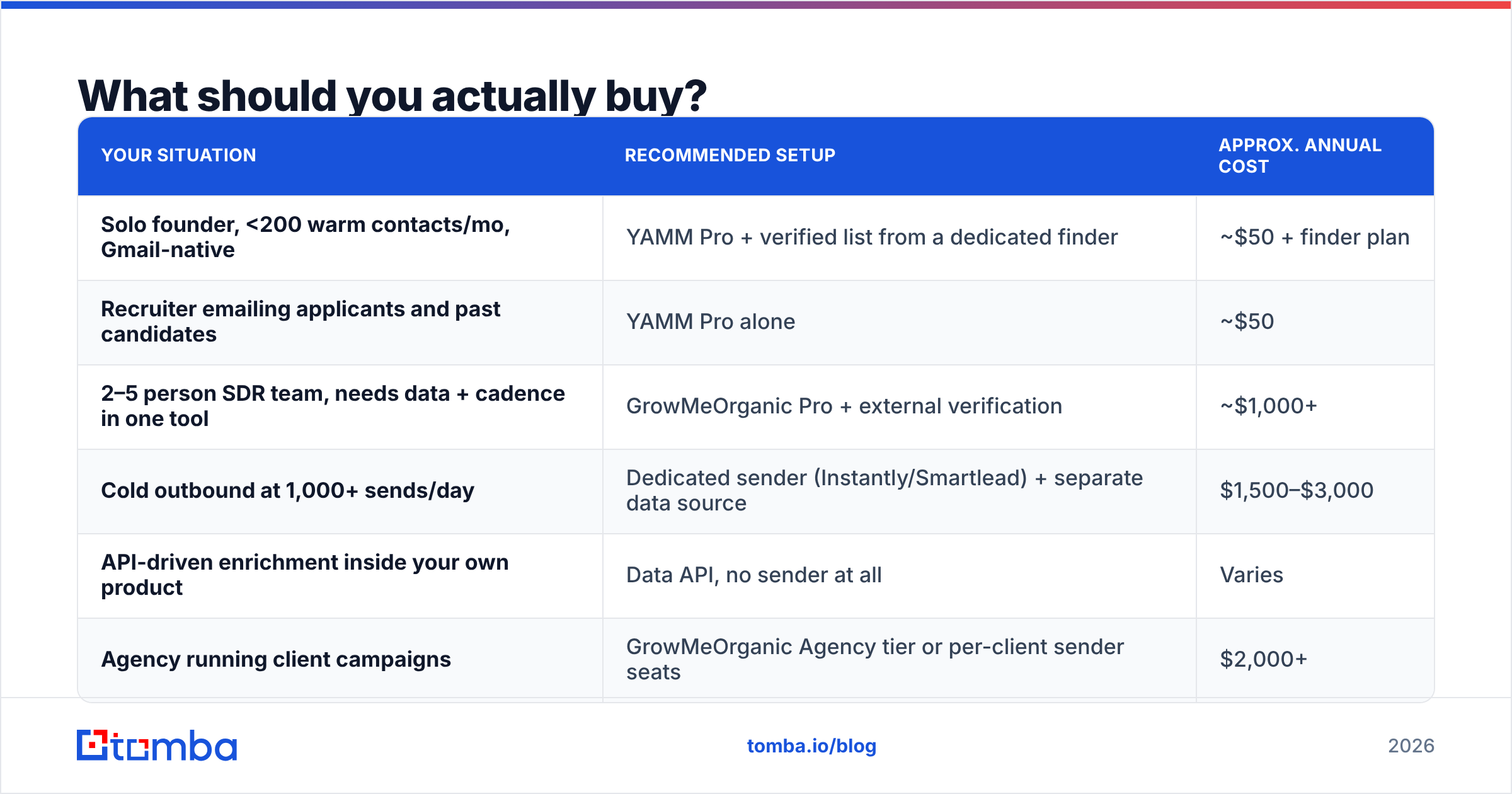
Match the tool to the job, not to the feature list.
| Your situation | Recommended setup | Approx. annual cost |
|---|---|---|
| Solo founder, <200 warm contacts/mo, Gmail-native | YAMM Pro + verified list from a dedicated finder | ~$50 + finder plan |
| Recruiter emailing applicants and past candidates | YAMM Pro alone | ~$50 |
| 2–5 person SDR team, needs data + cadence in one tool | GrowMeOrganic Pro + external verification | ~$1,000+ |
| Cold outbound at 1,000+ sends/day | Dedicated sender (Instantly/Smartlead) + separate data source | $1,500–$3,000 |
| API-driven enrichment inside your own product | Data API, no sender at all | Varies |
| Agency running client campaigns | GrowMeOrganic Agency tier or per-client sender seats | $2,000+ |
Notice what every row shares: the data source is a separate decision from the sending tool. That separation is the real lesson here. Bundling saves a login. It rarely saves you from bad addresses.
How do you build the data half properly?#
Treat contact sourcing as its own pipeline with its own quality gate, whichever sender you pick.
A workable pattern that fits both GrowMeOrganic and YAMM:
- Define the account list first. Firmographics before contacts. Pull target domains from your CRM, a funding database, or a job-board signal.
- Run domain-level discovery. For each domain, find who exists and in what role before you guess at one person's address. Company-wide discovery beats one-off lookups on hit rate.
- Enrich with the fields you will personalize on. Title, seniority, location, tech stack. If you cannot personalize on it, do not collect it. Data enrichment only pays off when it feeds a merge field.
- Verify before export. Every address, every time. Bounces are the one metric that compounds against you.
- Push clean rows into the sender. For YAMM that is a Google Sheet, and a Google Sheets add-on can fill and verify the columns in place. For GrowMeOrganic, import the CSV into a list.
If you run this in bulk, a bulk email finder handles thousands of rows in one pass. No clicking through a Chrome extension profile by profile. That single change usually saves more SDR hours per week than any sequencing feature either tool ships.
Also worth knowing: if you start from LinkedIn rather than a domain list, a dedicated LinkedIn finder turns profile URLs into verified work emails. You skip the scraping-compliance headaches that browser extensions collect. LinkedIn now polices extension-based extraction hard, and account restrictions are a real cost that never shows up in a pricing table.
Which tool wins?#
Neither, cleanly. In a GrowMeOrganic vs YAMM matchup that is the honest verdict, not a hedge.
YAMM wins on price-to-value for its narrow job. If your list is warm and your volume is modest, paying $50/year beats $1,000/year for a suite you use 20% of. It has been stable for over a decade, it does not break, and it does not try to be a CRM.
GrowMeOrganic wins if you truly need the bundle — database plus scraper plus sequencer — and you accept mid-tier data accuracy for a single subscription line item. For a 2–5 person team in a US-heavy market, that trade can pencil out.
Both lose to a split stack if outbound drives your revenue. A dedicated data source plus a dedicated sender, each best-in-class, costs about the same as one all-in-one. Peer platforms like BookYourData take the same specialist approach on the data side, pay-as-you-go and verification-first. That focus is why split stacks beat bundles on deliverability.
The decision tree is short. If sending is your problem, pick YAMM. If workflow consolidation is your problem, pick GrowMeOrganic. If data quality is your problem — and under 500 sends a day, it usually is — neither tool is where your first dollar should go.
Start with the data layer#
Whichever sender you land on, the emails still have to be real. Tomba's email finder turns names and domains into verified work addresses, with SMTP-level checking, catch-all detection, and a confidence score on every result. So the list you drop into YAMM's Google Sheet or GrowMeOrganic's campaign builder does not bounce.
The free tier gives you 25 searches a month, enough to test against your own known-good contacts first. Paid plans start at $49/mo on Starter and $99/mo on Growth, with full Tomba pricing published upfront. Run 50 target accounts through it, compare the hit rate with your current source, and let the bounce rate decide.
Related guides#
Ready to find emails that actually work?
Join 150,000+ professionals who stopped guessing and started sending. Free credits on signup — no credit card required.
Get the Tomba newsletter
Practical outbound tactics and product updates — once every two weeks.
About the author