Growth Genius Alternatives: 7 Better Options for 2026
Growth Genius bundles data, sequencing, and managed outbound into one retainer. Here is how seven alternatives compare on price, data accuracy, and control — and which one actually fits your team.
TL;DR
- Growth Genius sells a bundle: contact data, email and LinkedIn sequencing, and (on higher tiers) a managed team running campaigns for you. You pay for the bundle whether or not you use all of it.
- Most teams looking at Growth Genius alternatives actually need only two of those three layers — accurate contact data and a sending tool — and can rebuild the stack for a fraction of a managed retainer.
- If your bottleneck is data quality, start with a dedicated finder/verifier like Tomba (Free tier, Starter $49/mo). If it is sending volume, look at Instantly or Smartlead. If it is bandwidth, a managed agency is the honest like-for-like swap.
- The single biggest cost driver nobody quotes you: bounce rate. A 12% bounce list burns domains faster than any sequencer can rescue.
- Skip to the comparison table if you just want the pricing and fit summary.
What is Growth Genius and who is it actually for?#
Growth Genius is a Toronto-based outbound sales platform that packages three things most teams otherwise buy separately: a B2B contact database, a multichannel sequencer (email plus LinkedIn), and optional done-for-you campaign management. You can check the current productisation on their own site at growthgenius.ai. The pitch is straightforward — instead of stitching together a data vendor, a sending tool, and a freelancer, you sign one contract and get pipeline.
That model works well for a specific buyer: a founder-led or 1-2 rep sales team with budget but no outbound operator on staff. It works badly for two other buyers, and those are the ones searching for alternatives:
- Teams that already have SDRs. You are paying a premium for managed execution you do not need. The data and the sequencer are the only parts you use.
- Teams with a niche ICP. Bundled databases are broad by design. If you sell to marine logistics compliance officers in the Nordics, a general database will return thin, stale coverage — and you will still be exporting to a spreadsheet and hand-checking rows.
The second point is the real reason most switching conversations start. Sequencers are commoditised in 2026; almost all of them rotate inboxes, spin text, and warm domains. Contact data is not commoditised. That is where the variance lives, and it is where your cost per booked meeting is actually decided.

Why do teams leave bundled outbound platforms?#
Across switching threads on G2 and in-house post-mortems, the same five reasons repeat. Read them as a diagnostic — whichever one describes you determines which alternative below is correct.
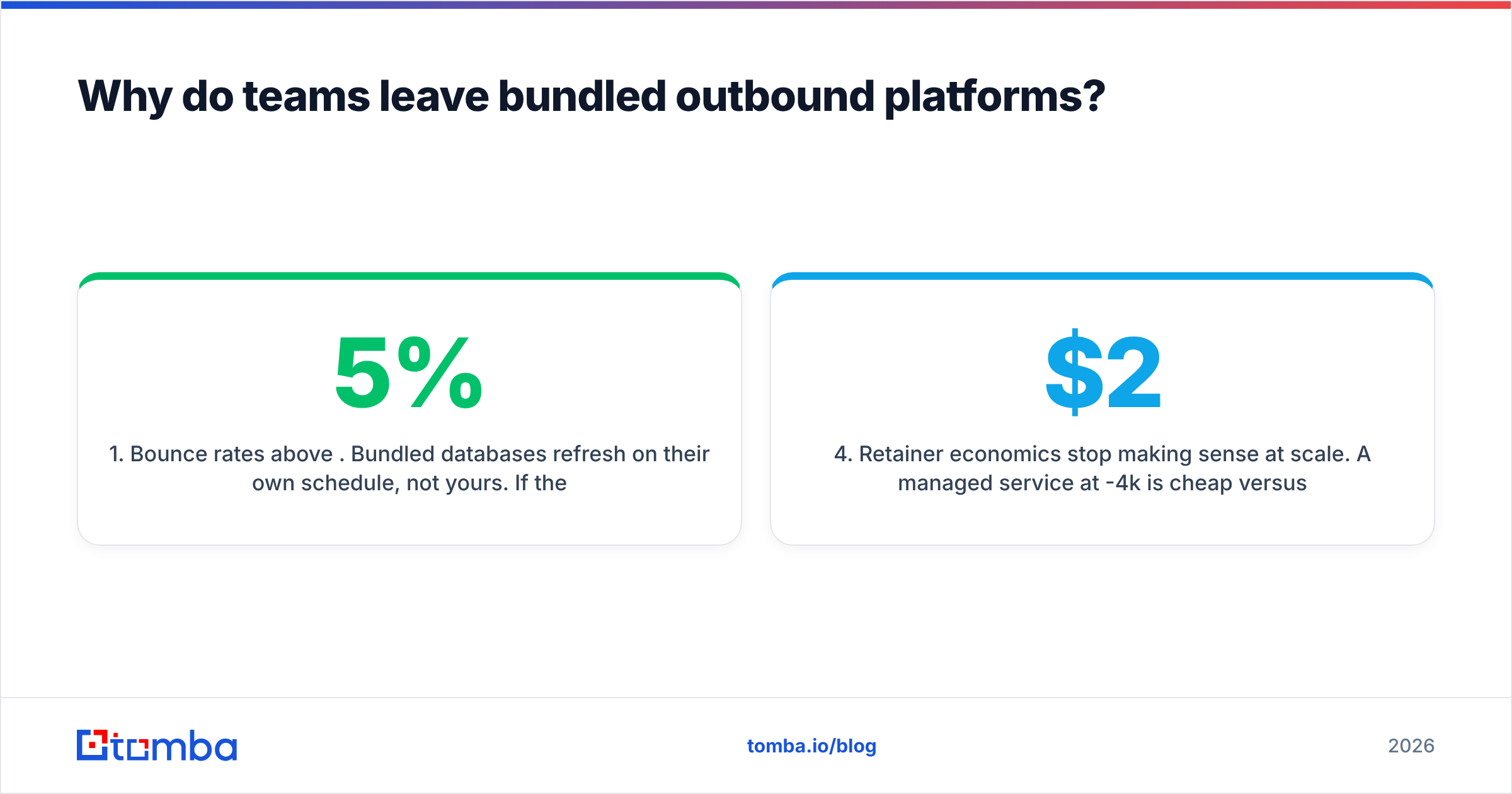
- Bounce rates above 5%. Bundled databases refresh on their own schedule, not yours. If the platform does not re-verify at export time, you are mailing contacts that changed jobs eight months ago. Google and Microsoft both treat sustained hard bounces as a spam signal, which quietly caps everything downstream.
- Credit models that punish exploration. Many bundles charge a credit for a reveal even when the record is unusable. Prospecting is inherently exploratory; a pricing model that taxes exploration pushes reps toward lazy, broad lists.
- No API, or an API behind an enterprise tier. If you cannot enrich inside your own CRM or a script, every workflow becomes a manual export-import loop.
- Retainer economics stop making sense at scale. A managed service at $2-4k/mo is cheap versus a $90k SDR. It is expensive versus a $49/mo data tool plus a $37/mo sender once you have someone who can run it.
- You want your data to outlive the contract. Contacts sourced through a managed engagement often live in the vendor's system. When you leave, you want a clean, verified CSV — not a login you no longer pay for.
If reasons 1-3 describe you, you need better infrastructure. If 4-5 describe you, you need to unbundle.
How do the main Growth Genius alternatives compare?#
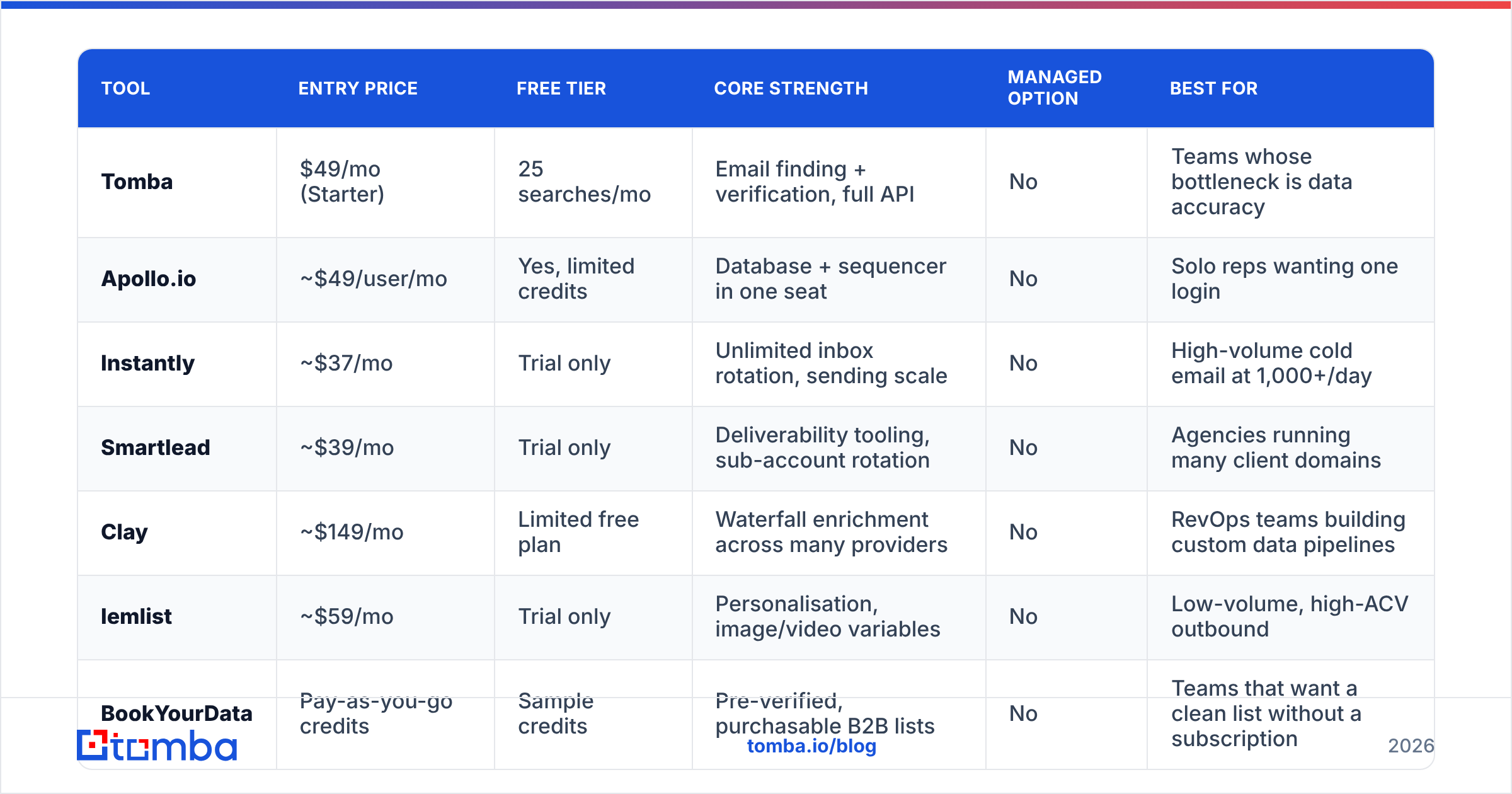
Pricing below reflects publicly listed entry tiers as of early 2026 and changes often — always confirm on the vendor's own pricing page before you budget. "Managed" means a human team runs campaigns for you.
| Tool | Entry price | Free tier | Core strength | Managed option | Best for |
|---|---|---|---|---|---|
| Tomba | $49/mo (Starter) | 25 searches/mo | Email finding + verification, full API | No | Teams whose bottleneck is data accuracy |
| Apollo.io | ~$49/user/mo | Yes, limited credits | Database + sequencer in one seat | No | Solo reps wanting one login |
| Instantly | ~$37/mo | Trial only | Unlimited inbox rotation, sending scale | No | High-volume cold email at 1,000+/day |
| Smartlead | ~$39/mo | Trial only | Deliverability tooling, sub-account rotation | No | Agencies running many client domains |
| Clay | ~$149/mo | Limited free plan | Waterfall enrichment across many providers | No | RevOps teams building custom data pipelines |
| lemlist | ~$59/mo | Trial only | Personalisation, image/video variables | No | Low-volume, high-ACV outbound |
| BookYourData | Pay-as-you-go credits | Sample credits | Pre-verified, purchasable B2B lists | No | Teams that want a clean list without a subscription |
| Belkins / agencies | ~$3k+/mo retainer | No | Full done-for-you SDR function | Yes | No in-house outbound bandwidth |
Two things stand out. First, no unbundled tool costs more than $150/mo at entry, which means a data tool plus a sender lands under $100/mo — roughly 3% of a managed retainer. Second, only the agency column replaces the labour. If the reason you bought a bundle was that nobody on your team wants to write sequences, swapping to a cheaper sequencer solves nothing.
Which alternative fits which problem?#
Tomba — when the data layer is the problem#
Tomba is not a sequencer and does not pretend to be. It is the data layer: email finder, email verifier, domain search, catch-all handling, phone lookup, and enrichment, all exposed through a documented API and spreadsheet add-ins.
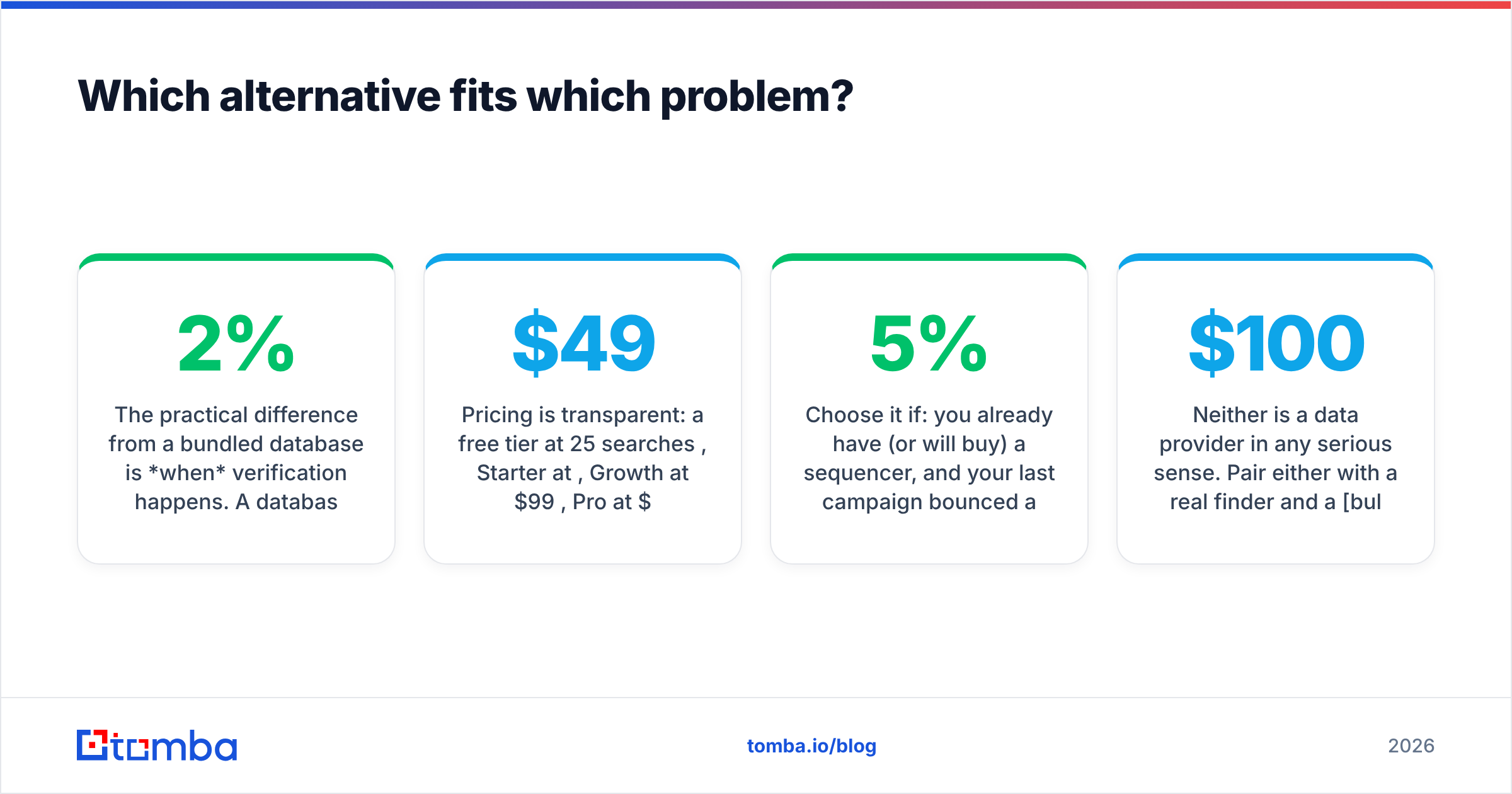
The practical difference from a bundled database is when verification happens. A database gives you a record that was true whenever it was last crawled. A finder-plus-verifier resolves and checks the address at the moment you ask, which is what actually keeps bounce rates in the 1-2% band. Catch-all domains — the ones that accept everything at SMTP and tell you nothing — are handled as their own class rather than silently marked valid.
Pricing is transparent: a free tier at 25 searches/mo, Starter at $49/mo, Growth at $99/mo, Pro at $249/mo, and custom Enterprise. Full Tomba pricing is public, and the Tomba API is available on paid plans rather than gated behind an enterprise call.
Choose it if: you already have (or will buy) a sequencer, and your last campaign bounced above 5%. Skip it if: you want one vendor to also send the emails.
Apollo.io — when you want one login#
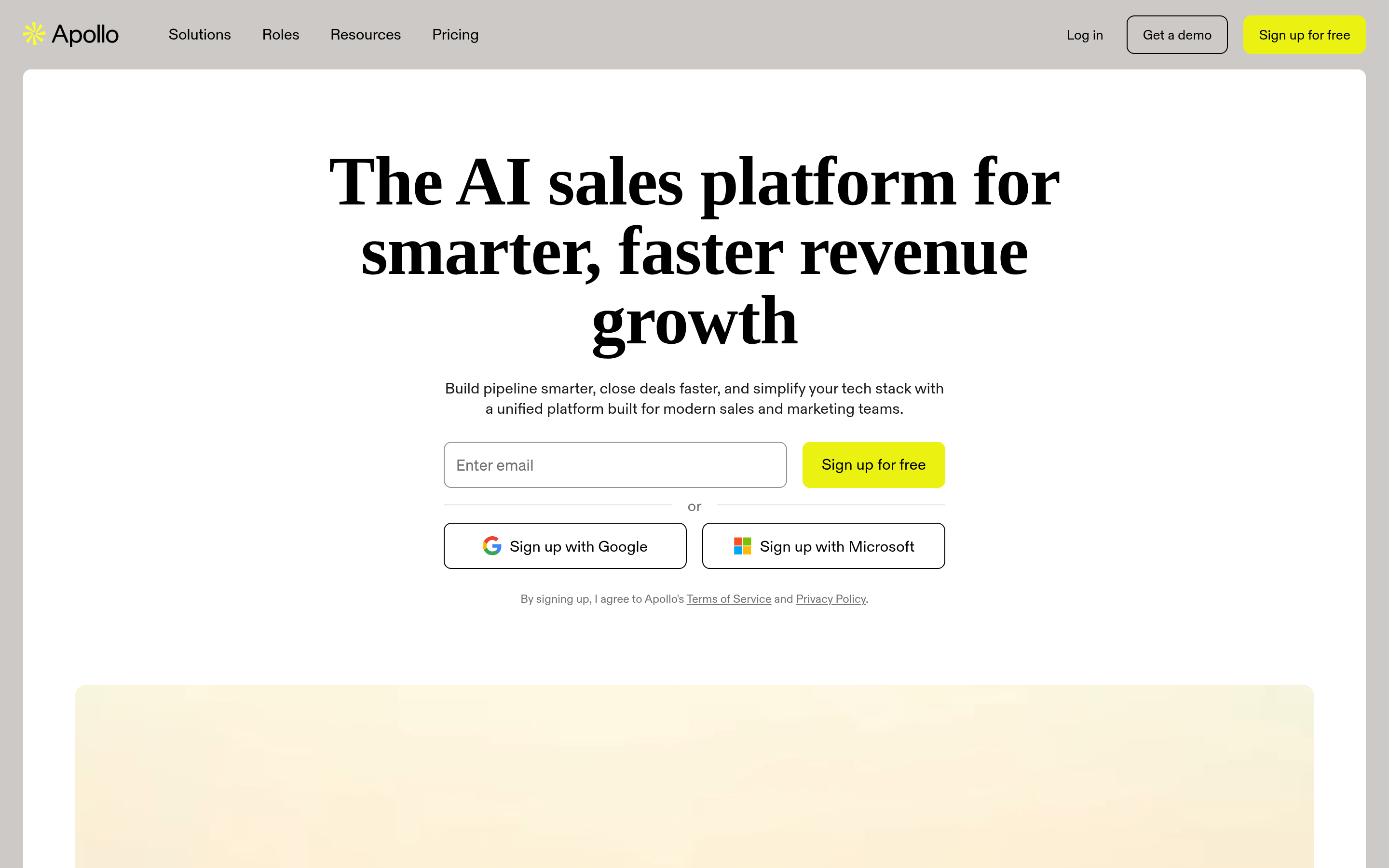
Apollo bundles a large contact database with a built-in sequencer, which makes it the closest structural match to Growth Genius minus the managed layer. See apollo.io for current tiering. The trade-off is well documented by users: broad coverage, uneven accuracy in non-US markets and at smaller companies, and a credit system that consumes budget during list-building. Teams that need Apollo's breadth but better hit rates often run Apollo for discovery and a verifier before send — which is exactly what an Apollo alternative comparison usually concludes.
Choose it if: you are one or two reps and consolidation matters more than precision.
Instantly and Smartlead — when sending is the constraint#
Both solve the same problem: mailing at volume without torching domains. Unlimited or high-cap inbox connections, automatic rotation, warmup networks, and per-domain reputation tracking. Smartlead leans agency-friendly with sub-accounts and white-labelling; Instantly leans simpler for in-house teams.
Neither is a data provider in any serious sense. Pair either with a real finder and a bulk email finder workflow and you have most of what a bundle offers for under $100/mo.
Choose them if: your list is fine and your open rates still cratered.
Clay — when you need custom enrichment logic#
Clay is a data orchestration table: you define waterfall logic across dozens of providers, run conditional enrichment, and pipe results into your CRM. It is the most powerful option here and the one most likely to sit unused. It rewards a dedicated RevOps owner and punishes teams without one. Entry pricing near $149/mo climbs quickly with credit consumption.
Choose it if: you have someone whose job title contains "operations."
lemlist — when personalisation carries the campaign#
Low volume, high average contract value, and sequences where each email genuinely differs. lemlist's variable system (including image and landing-page personalisation) is built for that shape of outbound. It is a poor fit for 2,000-contact blasts.
BookYourData — when you want a clean list, not a subscription#
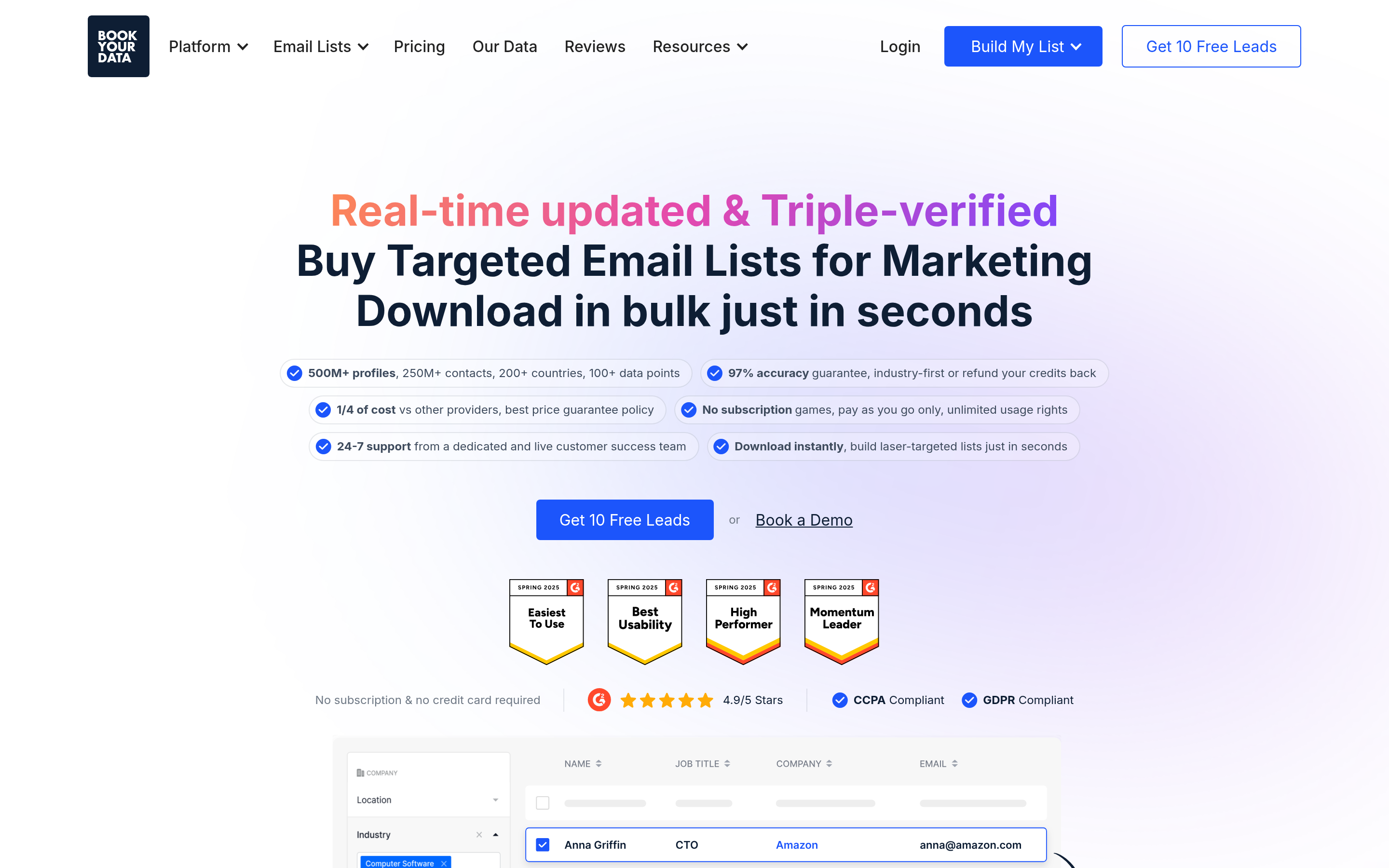
BookYourData takes a different route: pre-verified B2B contact lists on a pay-as-you-go credit model, with an accuracy guarantee and no monthly commitment. For teams that run outbound in bursts — a quarterly campaign, a conference push, a new market test — the absence of a subscription is a genuine advantage over both Growth Genius and most SaaS alternatives on this list. It is a respectable option when your need is "give me 5,000 clean contacts in this segment" rather than "give me a search interface."
An agency — when the real gap is people#
Be honest about this one. If you bought Growth Genius primarily for the managed layer, the only true replacement is another managed provider. Belkins, Martal, and similar shops run the full function: list building, copy, sending, reply handling, meeting booking. Expect $3,000/mo and up, plus a ramp period. Anything cheaper is usually a single offshore VA with a Smartlead login, which you can hire directly for less.

What does an unbundled stack actually cost?#
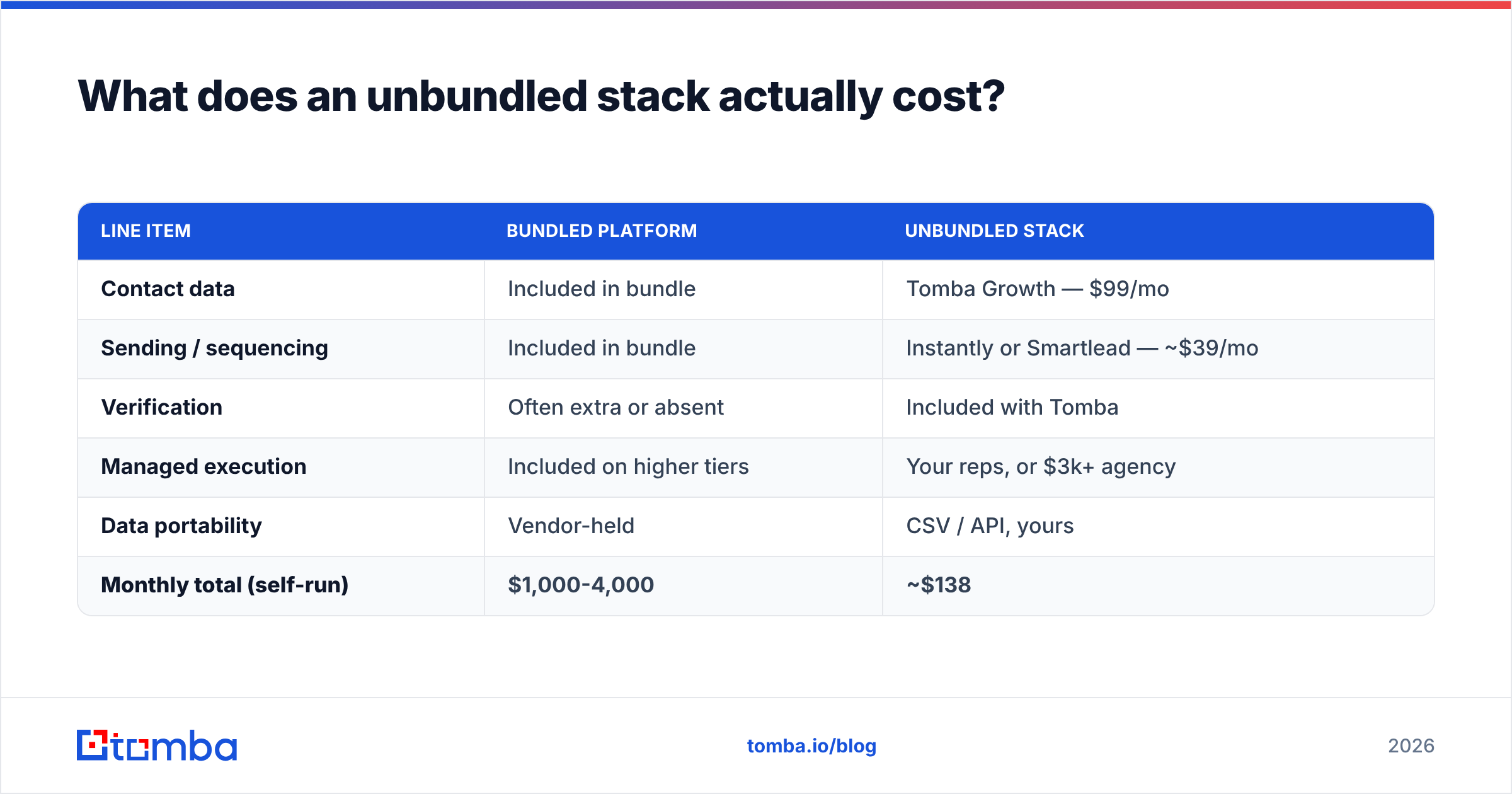
Here is the arithmetic that drives most switches. Assume a two-rep team sending 1,500 emails per month.
| Line item | Bundled platform | Unbundled stack |
|---|---|---|
| Contact data | Included in bundle | Tomba Growth — $99/mo |
| Sending / sequencing | Included in bundle | Instantly or Smartlead — ~$39/mo |
| Verification | Often extra or absent | Included with Tomba |
| Managed execution | Included on higher tiers | Your reps, or $3k+ agency |
| Data portability | Vendor-held | CSV / API, yours |
| Monthly total (self-run) | $1,000-4,000 | ~$138 |
The unbundled column assumes you have someone to run it. That is the entire trade. What you are really buying at $1,000+/mo is not software — it is the person operating it. Price the software honestly and you can decide whether that person should be a vendor or a hire.
One more line item that never appears on either invoice: domain replacement. Sustained hard bounces above ~5% degrade sender reputation to the point where you buy new domains and warm them for three weeks. That cycle costs more in lost pipeline than any tier difference on this page, which is why verification belongs in the stack regardless of which sequencer you choose.
How should you migrate without losing pipeline?#
Run the swap in parallel, not as a cutover. A workable four-week sequence:
- Week 1 — export everything. Pull every contact, sequence, and reply thread out of the incumbent while your login is still active. Do this before you give notice.
- Week 2 — re-verify the export. Run the full list through verification. Expect 8-20% of a 12-month-old bundled list to fail. That number is your real justification for switching, and it is worth documenting for whoever signs the contract.
- Week 3 — rebuild one sequence on the new stack. One ICP, one sequence, new domains warmed in advance. Compare reply rate against the incumbent's same-segment numbers, not against a benchmark blog post.
- Week 4 — decide on the managed layer. If the new stack performs and nobody has time to run it, hire the agency then. Do not buy it preemptively.
Keep both running through week 3. The temptation to cancel early to save one month's fee has cost more teams a quarter of pipeline than it has ever saved in software spend.
Which Growth Genius alternative should you pick?#
Short version, by symptom:
- Bounces and bad data → a dedicated finder and verifier. Start on Tomba's free tier and measure the bounce delta on a real list.
- One rep, wants one login → Apollo.io.
- Volume and deliverability → Instantly or Smartlead, paired with a verifier.
- Custom enrichment pipelines → Clay, if you have an ops owner.
- Burst campaigns, no subscription → BookYourData.
- No bandwidth at all → a managed agency, and budget accordingly.
The mistake to avoid is swapping one bundle for another bundle and expecting different results. If the previous platform underdelivered because the data was stale, a new sequencer with a nicer UI will reproduce the outcome at a lower price point. Fix the layer that is actually broken.
Start with the data layer#
If your last campaign bounced, went to spam, or returned reply rates you would rather not report, the cheapest useful experiment is to test your existing list against a real verification pass before you sign anything else. Take 500 contacts from your current provider, run them through Tomba Email Finder and the verifier, and look at the failure rate. If it comes back under 3%, your data is fine and your problem is copy or targeting. If it comes back at 10%+, you have found your bottleneck — and $49/mo fixes it faster than any retainer will.
Related guides#
Ready to find emails that actually work?
Join 150,000+ professionals who stopped guessing and started sending. Free credits on signup — no credit card required.
Get the Tomba newsletter
Practical outbound tactics and product updates — once every two weeks.
About the author