GTM Engineer Skills: The 2026 Stack, Salary and Roadmap
GTM engineering job ads list 15 tools and one vague sentence about "automation." Here is what the role actually requires day to day, which skills compound, and how to build them in 90 days.
TL;DR#
- GTM engineering is data plumbing with a quota attached. The job is to turn messy company and contact data into a system that puts the right person in front of the right rep at the right time — repeatedly, without a human copy-pasting.
- The three skills that compound are data modeling (SQL and spreadsheets), API literacy (auth, pagination, rate limits, webhooks), and CRM object design. Everything else is tooling that will churn.
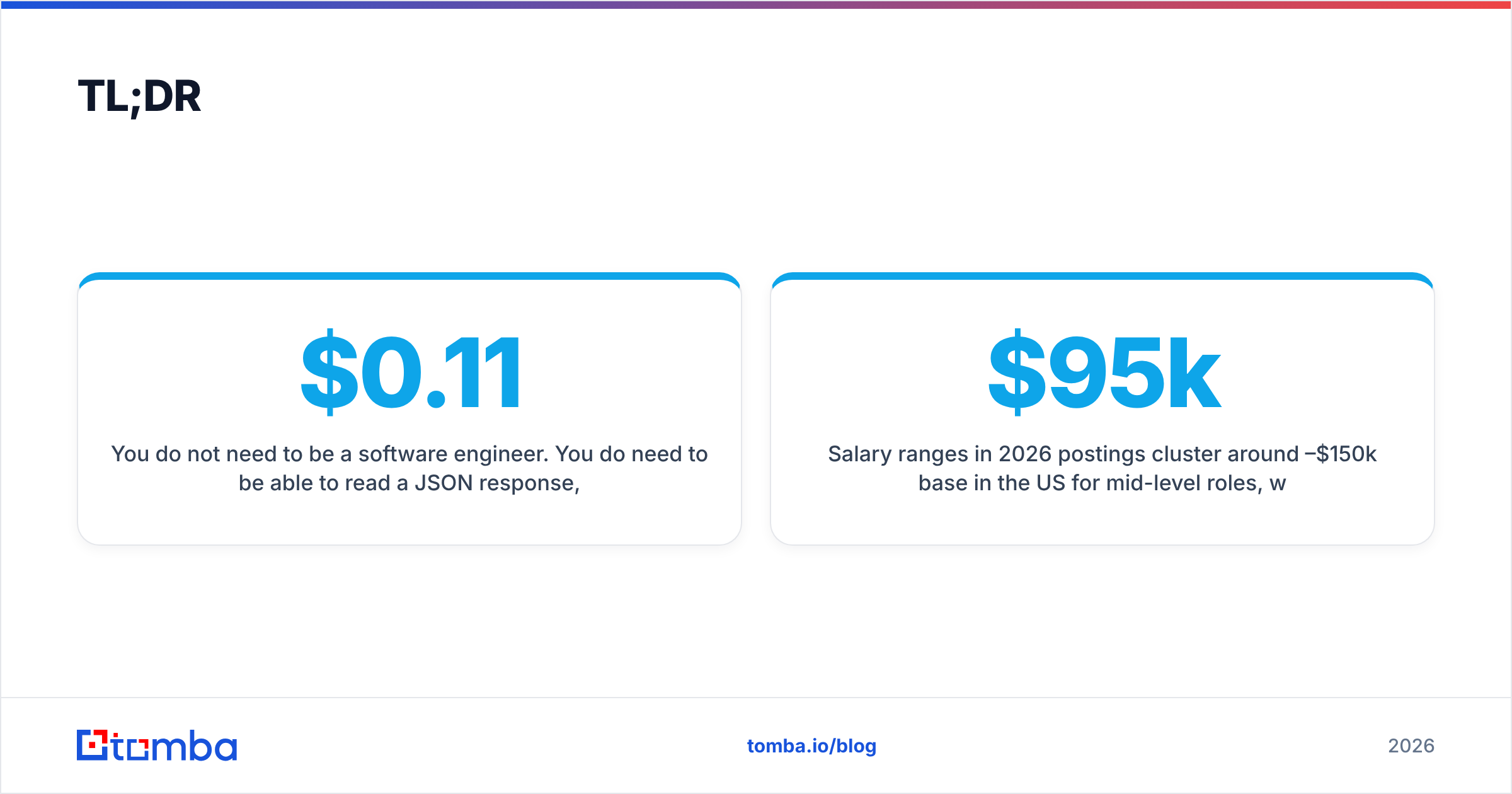
- You do not need to be a software engineer. You do need to be able to read a JSON response, debug a failed webhook, and explain why your enrichment waterfall costs $0.11 per contact.
- Salary ranges in 2026 postings cluster around $95k–$150k base in the US for mid-level roles, with senior/lead GTM engineering titles pushing higher when they own revenue attribution.
- The role breaks down when the GTM engineer becomes the only person who understands the system. Documentation and handoff are underrated skills on this list.
What is a GTM engineer, and why did this role appear?#
A GTM engineer is the person who builds and maintains the automated systems that find, enrich, score, route, and message prospects. Think of them as the plumber of the revenue org: nobody notices the pipes until the kitchen floods, and then everyone notices at once.
The role appeared because three things happened at the same time. Outbound got harder — inbox providers tightened enforcement and generic sequences stopped working. Data got cheaper and more fragmented, so no single vendor covers a full territory. And a layer of no-code and API-first tools made it possible for one non-engineer to build what used to take a sprint from a product team.
The result: teams stopped hiring three more SDRs and started hiring one person who could make the existing SDRs three times more efficient. That person sits somewhere between revenue operations, data engineering, and growth marketing — which is exactly why job descriptions for the role are such a mess.
The clearest framing comes from how Gartner has described the broader shift in commercial teams: buying groups are larger, buyer research happens before any seller contact, and the winning teams are the ones that operationalize data rather than add headcount. GTM engineering is that operationalization, staffed.
What GTM engineer skills actually matter in 2026?#
Here are the six capabilities that show up in every functioning GTM engineering practice, ranked by how much leverage they give you.
- Data modeling and SQL. You need to answer "how many accounts in our ICP have we touched in the last 90 days, and what happened?" without asking anyone. That means joins, dedupe logic, window functions, and a working mental model of primary keys. If you can only do this in a spreadsheet, you will hit a ceiling around 50,000 rows.
- API literacy. Not "can you write a REST server" — "can you read the docs, get an API key working, handle pagination, respect a 429, and parse the response." Most GTM tools expose more through their API than their UI. The gap between GTM engineers who use APIs and those who use CSV exports is the single biggest productivity divide in the discipline.
- CRM object architecture. Leads vs. contacts vs. accounts, custom objects, lifecycle stages, field-level validation. Get this wrong and every downstream report lies to you. HubSpot and Salesforce both publish detailed object model docs — read the one your company uses, cover to cover, once.
- Enrichment and verification strategy. Knowing which provider to call first, when to fall back, and when to stop paying. A waterfall that hits three vendors for every contact burns budget on records you would have thrown away after verification anyway. Sequence matters: cheap filters first, expensive lookups last.
- Deliverability fundamentals. SPF, DKIM, DMARC, domain warmup, bounce thresholds, seed testing. A GTM engineer who builds a beautiful pipeline into a burned sending domain has built nothing. This is where most self-taught GTM engineers have the biggest blind spot.
- Systems documentation. Diagrams, runbooks, a plain-English description of what breaks when the enrichment job fails on a Sunday. This is the skill that converts a GTM engineer from a person into a function.

Notice what is not on that list: prompt engineering as a standalone skill, and mastery of any specific vendor. Both matter, neither compounds. The tool you spend six months mastering in 2026 may not exist in 2028; the ability to model a many-to-many relationship between accounts and buying-group members will still be worth money.
Which skills do job ads ask for versus what the work requires?#
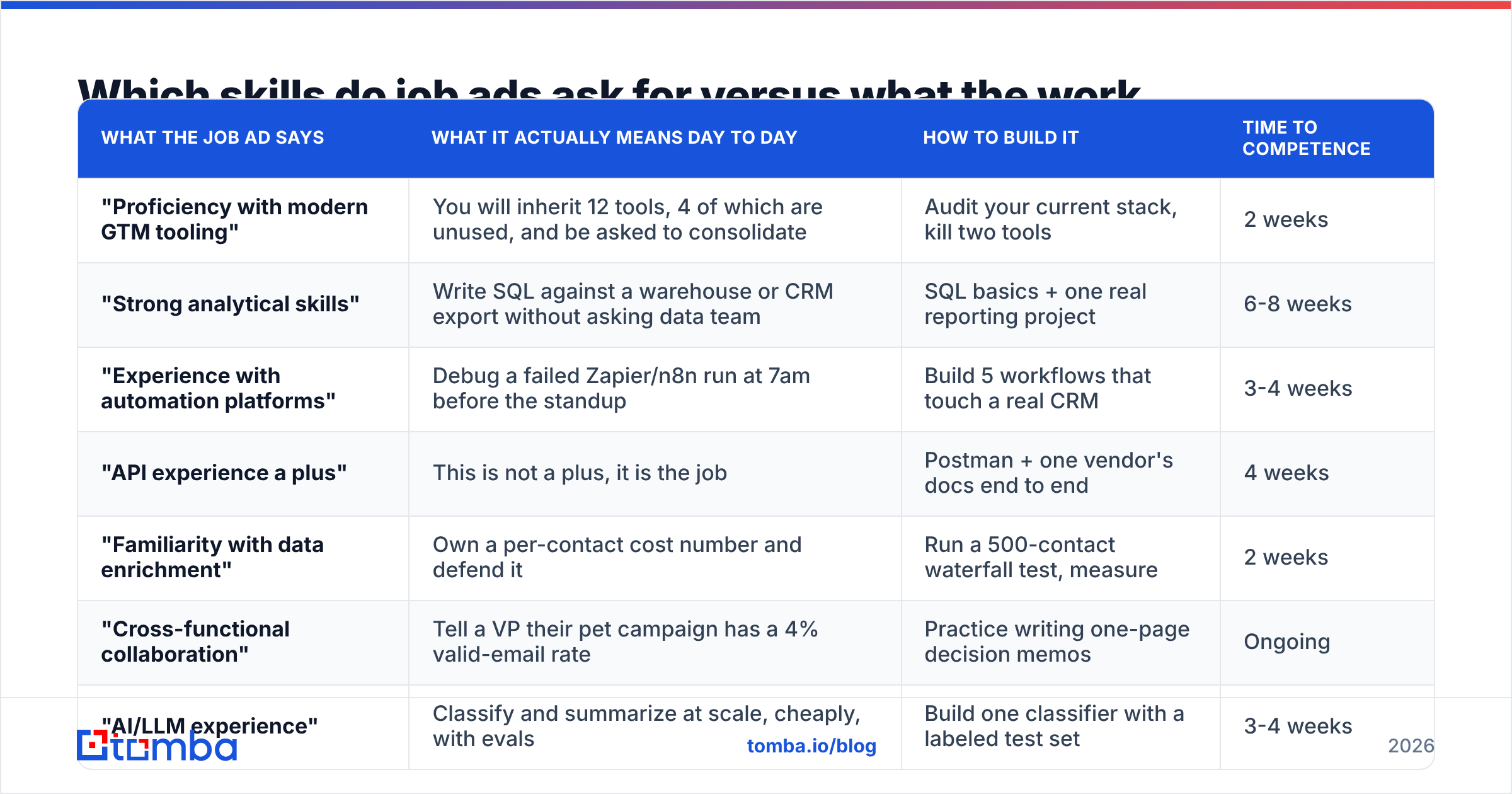
Job descriptions for this role are written by people who have never done it. Here is the honest translation table.
| What the job ad says | What it actually means day to day | How to build it | Time to competence |
|---|---|---|---|
| "Proficiency with modern GTM tooling" | You will inherit 12 tools, 4 of which are unused, and be asked to consolidate | Audit your current stack, kill two tools | 2 weeks |
| "Strong analytical skills" | Write SQL against a warehouse or CRM export without asking data team | SQL basics + one real reporting project | 6-8 weeks |
| "Experience with automation platforms" | Debug a failed Zapier/n8n run at 7am before the standup | Build 5 workflows that touch a real CRM | 3-4 weeks |
| "API experience a plus" | This is not a plus, it is the job | Postman + one vendor's docs end to end | 4 weeks |
| "Familiarity with data enrichment" | Own a per-contact cost number and defend it | Run a 500-contact waterfall test, measure | 2 weeks |
| "Cross-functional collaboration" | Tell a VP their pet campaign has a 4% valid-email rate | Practice writing one-page decision memos | Ongoing |
| "AI/LLM experience" | Classify and summarize at scale, cheaply, with evals | Build one classifier with a labeled test set | 3-4 weeks |
The pattern: the ad emphasizes breadth, the work rewards depth in data and APIs. Candidates who list 20 tools and cannot explain a left join lose to candidates who list 5 tools and can.
How technical does a GTM engineer really need to be?#
Somewhere between "power user" and "junior backend developer," and closer to the first than most people expect.
A useful test: could you build this without asking an engineer?
- Pull a list of companies matching a firmographic filter
- For each company, find the two people holding a target title
- Find and verify their work emails, discarding anything risky
- Push valid records into the CRM with source attribution
- Log the cost per valid contact to a sheet you can query later
That's a five-step pipeline. Every step is a documented API call plus a bit of glue. You need enough Python or JavaScript to write the glue — roughly the level of "I can write a loop, handle an exception, and read a stack trace." You do not need to know how to deploy a service, write tests, or design a database schema from scratch.
The Tomba API is a reasonable first target for this exact exercise because the surface is small: one endpoint to search a domain, one to find an email, one to verify it. If you can build that pipeline against a small API, you can build it against a large one.
Where GTM engineers do need real rigor is idempotency. Run your job twice by accident and you should not create 4,000 duplicate contacts. That single concept — "what happens if this runs again?" — separates hobbyist automations from production ones.
What does a GTM engineering stack look like in 2026?#
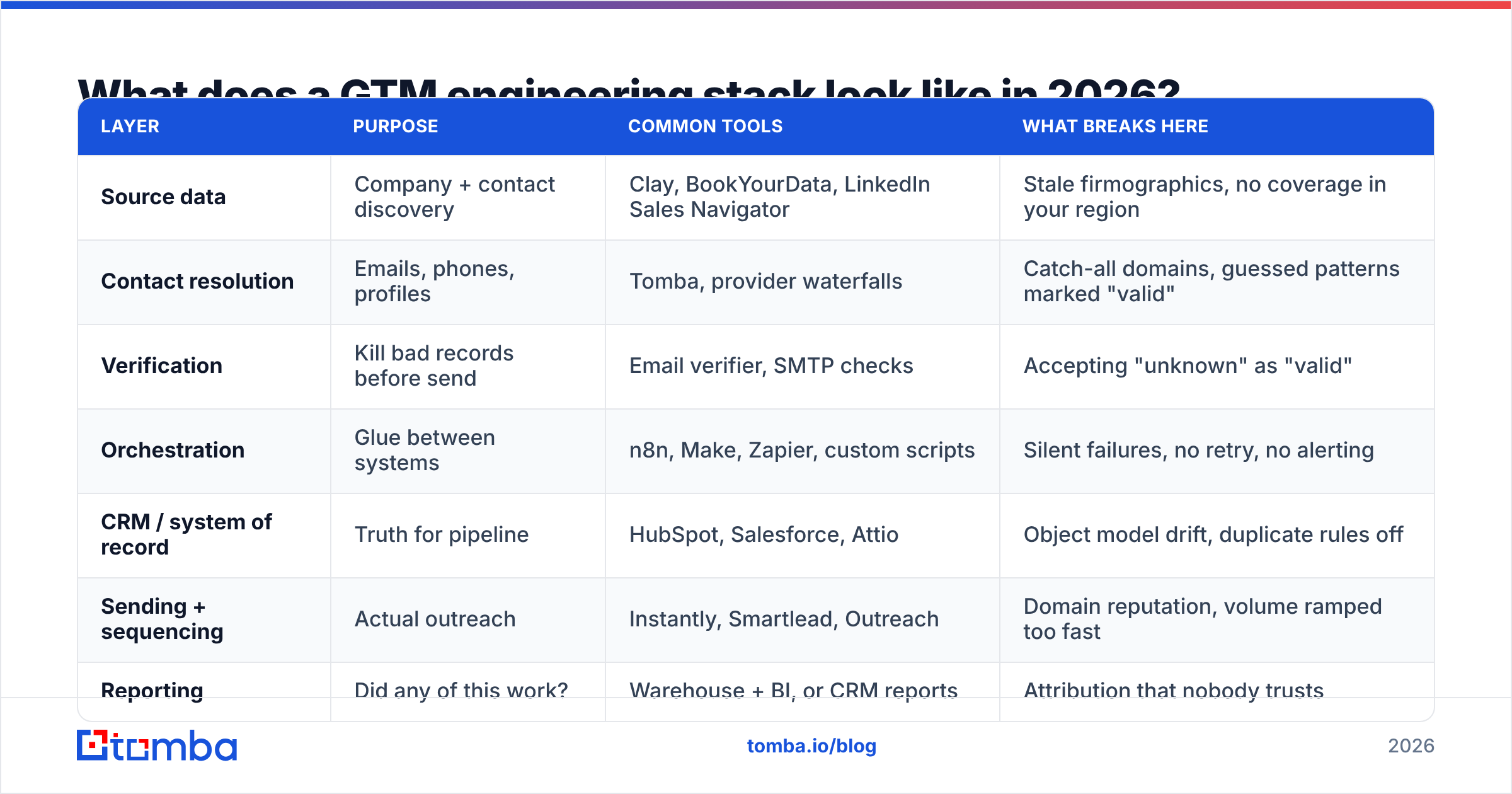
Stacks vary, but the layers do not. Here is a representative build, with what each layer is actually responsible for.
| Layer | Purpose | Common tools | What breaks here |
|---|---|---|---|
| Source data | Company + contact discovery | Clay, BookYourData, LinkedIn Sales Navigator | Stale firmographics, no coverage in your region |
| Contact resolution | Emails, phones, profiles | Tomba, provider waterfalls | Catch-all domains, guessed patterns marked "valid" |
| Verification | Kill bad records before send | Email verifier, SMTP checks | Accepting "unknown" as "valid" |
| Orchestration | Glue between systems | n8n, Make, Zapier, custom scripts | Silent failures, no retry, no alerting |
| CRM / system of record | Truth for pipeline | HubSpot, Salesforce, Attio | Object model drift, duplicate rules off |
| Sending + sequencing | Actual outreach | Instantly, Smartlead, Outreach | Domain reputation, volume ramped too fast |
| Reporting | Did any of this work? | Warehouse + BI, or CRM reports | Attribution that nobody trusts |
Two things to notice. First, the expensive layers are not the ones that break most often — orchestration is cheap and fails constantly. Second, every layer needs an owner, and in most companies that owner is the same one person.
For teams running high volume, the layer worth investing in first is verification, because it protects everything downstream. Bad records inflate your cost per contact, depress your reply rate, and quietly damage the sending domain that took you six weeks to warm up. Running a bulk verify pass before every campaign is boring, cheap, and the highest-ROI habit on this list.

How do you build these GTM engineer skills in 90 days?#
A realistic plan for someone coming from SDR, RevOps, or marketing ops.
Days 1–30: data fluency. Learn SQL properly — SELECT, JOIN, GROUP BY, window functions. Do it against your own CRM export, not a tutorial dataset, so the questions matter to you. In parallel, read your CRM's object model documentation end to end. By day 30 you should be able to answer three pipeline questions nobody has asked yet.
Days 31–60: API and orchestration. Get an API key for one enrichment provider and one CRM. Build the five-step pipeline described earlier. Make it idempotent. Make it log failures somewhere you will actually look. Then break it deliberately — revoke the key, feed it a malformed row — and fix it. Debugging is the skill; building is the easy part.
Days 61–90: deliverability and cost. Set up SPF, DKIM and DMARC on a test domain from scratch. Warm it. Send a small campaign through your own pipeline. Then build the cost model: what did one valid, verified, in-ICP contact cost you, all-in? Most people skip this step and then cannot justify their own budget.
At the end of 90 days you will not be senior. You will be dangerous in the right way — able to ship a working system and explain its failure modes, which is more than a lot of people holding the title today can do.
What do GTM engineers get paid, and is the title worth chasing?#
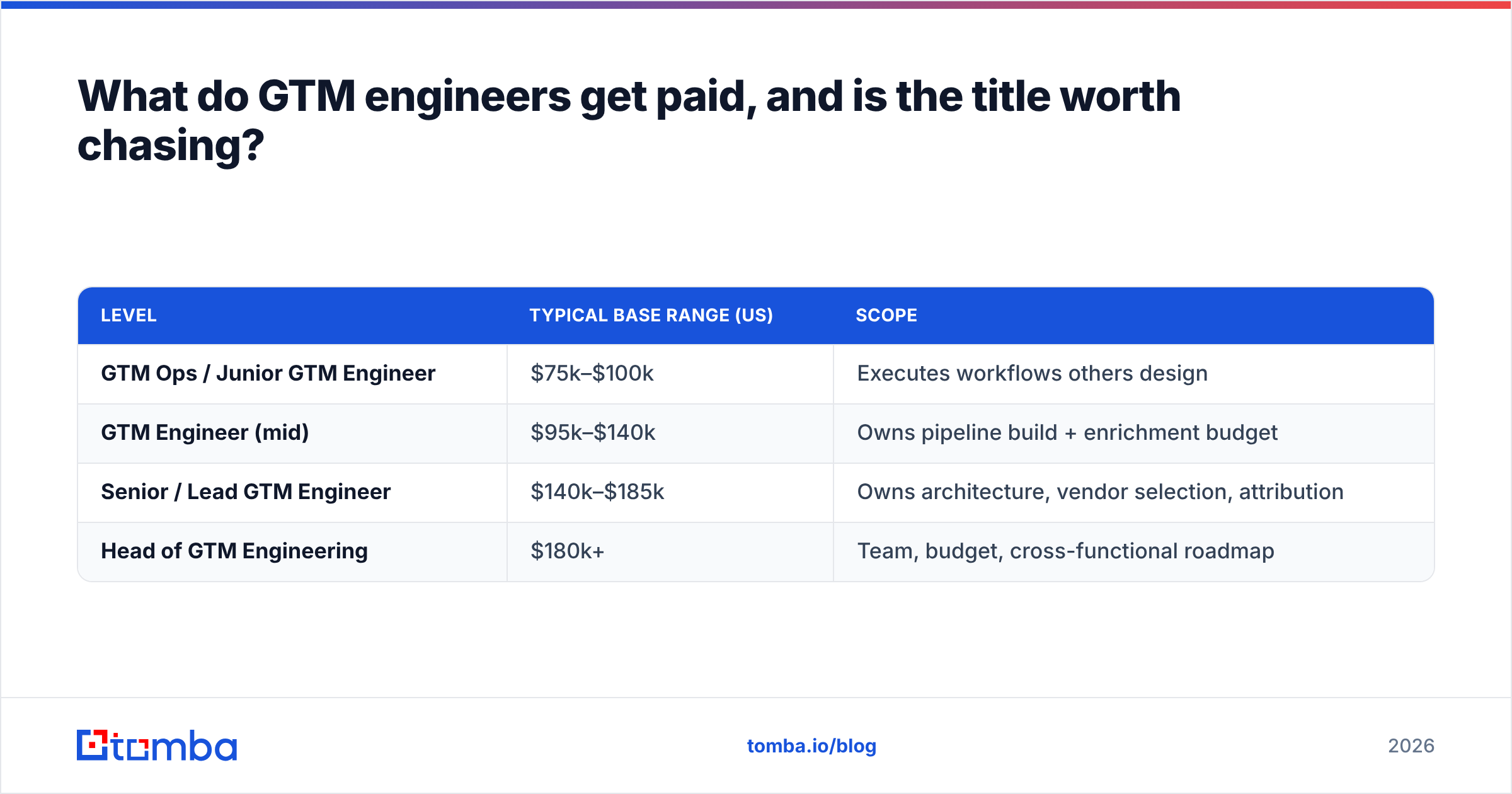
Compensation for GTM engineering roles in 2026 postings generally lands in these bands for the US market, with heavy variance by company stage and whether the role owns revenue targets:
| Level | Typical base range (US) | Scope |
|---|---|---|
| GTM Ops / Junior GTM Engineer | $75k–$100k | Executes workflows others design |
| GTM Engineer (mid) | $95k–$140k | Owns pipeline build + enrichment budget |
| Senior / Lead GTM Engineer | $140k–$185k | Owns architecture, vendor selection, attribution |
| Head of GTM Engineering | $180k+ | Team, budget, cross-functional roadmap |
Check current ranges on G2 reviews and job boards rather than trusting any single number — the title is young enough that comp is genuinely inconsistent.
Is it worth chasing? If you like building systems and are comfortable being measured on pipeline, yes. The skills transfer cleanly to RevOps, data analytics, and product-led growth roles. If you want a role with a clean scope and predictable weeks, no — GTM engineering is an on-call function with a marketing budget.
Where does the GTM engineer role break down?#
Three failure modes, all predictable.
The bus-factor problem. One person builds everything, documents nothing, and leaves. The system runs for six weeks, then a token expires and nobody knows which of the 40 automations died. Fix: a one-page runbook per pipeline, stored where non-technical people can find it.
The tool-collector problem. Every new vendor gets a trial, half get purchased, none get deprecated. Cost per contact quietly triples. Fix: a quarterly audit where every tool has to justify itself against a metric, and a hard rule that adding a tool means removing one.
The garbage-in problem. The most sophisticated routing logic in the world cannot fix an unverified list. If 22% of your contacts bounce, your sequencing tool is not the problem and neither is your copy. Fix: verification as a non-negotiable gate, plus contact enrichment that fills in the firmographic fields your scoring model depends on.
The common thread: GTM engineering fails on discipline, not on technical ability. The people who last in the role are the ones who treat the pipeline like production infrastructure — versioned, monitored, documented — rather than like a clever hack that happened to work once.
Where should you start this week?#
Pick the pipeline that costs your team the most manual hours and rebuild it end to end with an API instead of a CSV. That single project will surface every gap in your skill set faster than any course.
If that pipeline involves finding and verifying work emails — and for most GTM engineers it does — start with Tomba Email Finder. You can find email addresses by domain, name, or company through the UI or the API, verify them before they ever reach your CRM, and keep a clean cost-per-valid-contact number you can defend in a budget review. The free tier gives you 25 searches a month to test the flow, Starter is $49/mo, and Growth at $99/mo covers most single-operator GTM engineering builds. Full Tomba pricing is public, so you can model your cost per contact before you commit to anything.
Build the boring pipe well. The rest of the stack is replaceable.
Related guides#
Ready to find emails that actually work?
Join 150,000+ professionals who stopped guessing and started sending. Free credits on signup — no credit card required.
Get the Tomba newsletter
Practical outbound tactics and product updates — once every two weeks.
About the author