8 Best Harmonic Alternatives in 2026 (Free and Paid Tools)
Harmonic is strong at spotting startups early, but it is not a contact database and the seat pricing stings. Here are eight Harmonic alternatives compared on coverage, contact data, workflow fit and real cost.
TL;DR
- Harmonic.ai is a startup-discovery and private-company signal platform. It is very good at telling you which company just raised, hired, or spun out — and much weaker at handing you a verified email for the person you want to reach.
- Most teams evaluating Harmonic alternatives are actually solving one of three different problems: cheaper company signals, deeper firmographics, or contact data that lands in the inbox.
- Crunchbase and Tracxn win on price for basic company discovery. PitchBook and CB Insights win on depth if you have an investor-grade budget. Specter and Clay win on workflow automation.
- If your bottleneck is "I found the company, now who do I email?", pair a signal source with a dedicated contact layer such as Tomba, Apollo, or BookYourData rather than paying for one platform that half-does both.
- Budget reality check: Harmonic quotes annually per seat and rarely lands under four figures a month for a team. A signal source plus a $49/mo contact tool covers most seed-to-Series-B outbound motions.
What is Harmonic and who actually uses it?#
Harmonic is a private-company intelligence platform built around one core promise: find startups before anyone else does. It ingests founder profiles, headcount changes, GitHub and app-store activity, website launches, and funding events, then surfaces companies that are accelerating on those signals.
The primary buyers are venture capital sourcing teams, corporate development groups, and — increasingly — GTM teams at companies that sell to startups (dev tools, fintech infrastructure, hiring platforms). If your ICP is "seed-stage AI company that just hired its second engineer," Harmonic is genuinely good at that.
Where teams start shopping for Harmonic alternatives:
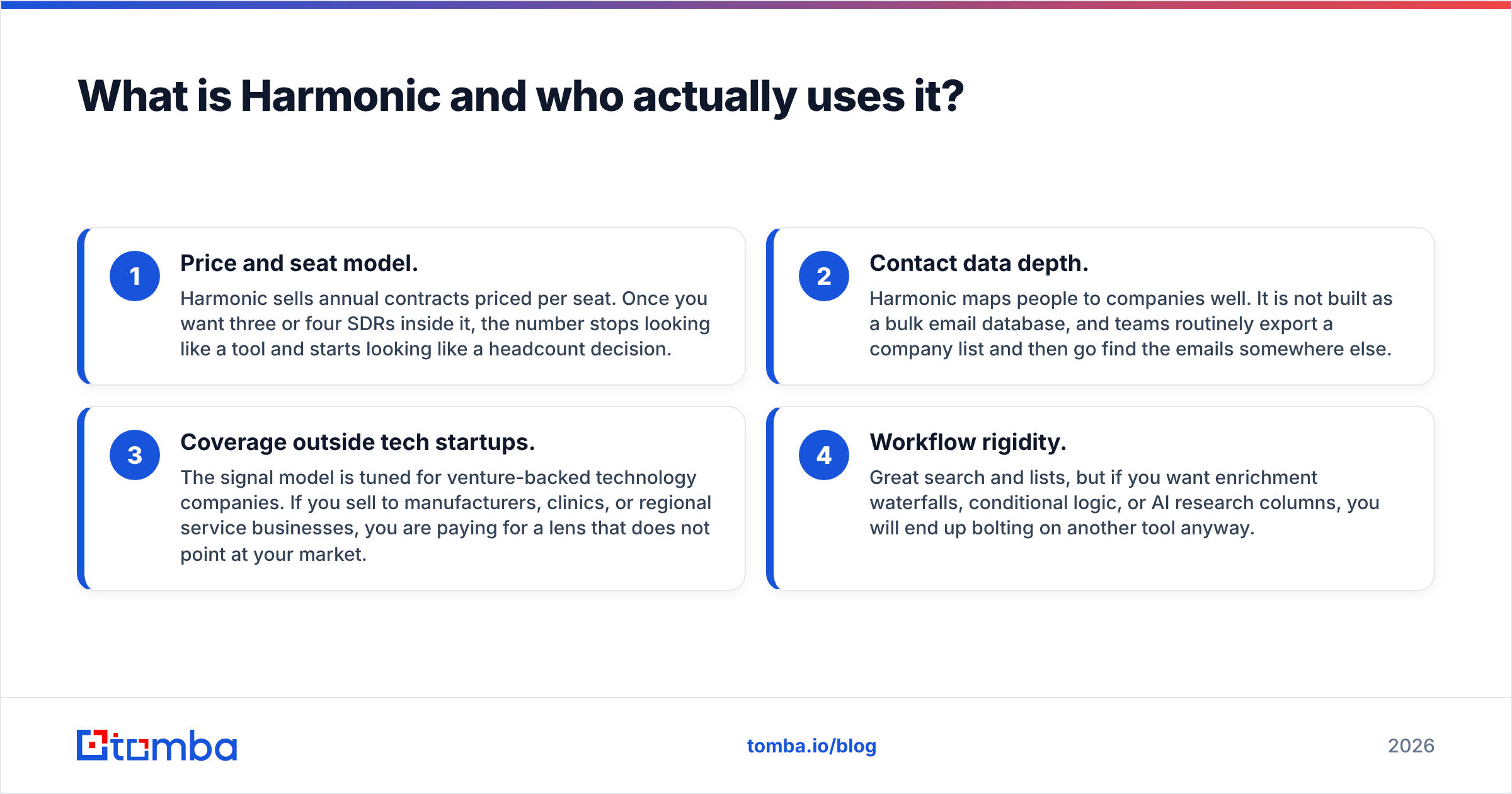
- Price and seat model. Harmonic sells annual contracts priced per seat. Once you want three or four SDRs inside it, the number stops looking like a tool and starts looking like a headcount decision.
- Contact data depth. Harmonic maps people to companies well. It is not built as a bulk email database, and teams routinely export a company list and then go find the emails somewhere else.
- Coverage outside tech startups. The signal model is tuned for venture-backed technology companies. If you sell to manufacturers, clinics, or regional service businesses, you are paying for a lens that does not point at your market.
- Workflow rigidity. Great search and lists, but if you want enrichment waterfalls, conditional logic, or AI research columns, you will end up bolting on another tool anyway.
None of that makes Harmonic a bad product. It makes it a specialist. The question is whether you need the specialist or a cheaper generalist plus a contact layer.

How should you evaluate Harmonic alternatives?#
Score every option on five axes rather than feature-count. Most comparison posts list 40 features; four of them actually change your pipeline.
- Signal freshness — how fast does a new funding round, hire, or product launch show up? Weekly refresh is table stakes; daily is what you are paying a premium for.
- Company coverage breadth — venture-backed tech only, or the full long tail of private companies including bootstrapped and non-tech?
- Contact resolution — can you get from company to a named decision maker to a deliverable email address without three exports? This is where most startup-data platforms quietly fail.
- Cost per usable contact — not per seat, not per credit. Divide your annual spend by the number of contacts that actually got a reply-eligible send.
- Pipe-out — native CRM sync, API, Sheets, or CSV-only? A tool that cannot push into HubSpot or Salesforce becomes a manual copy-paste job within two weeks.
Run any shortlist through those five and the field narrows fast.
Which Harmonic alternatives are worth comparing in 2026?#
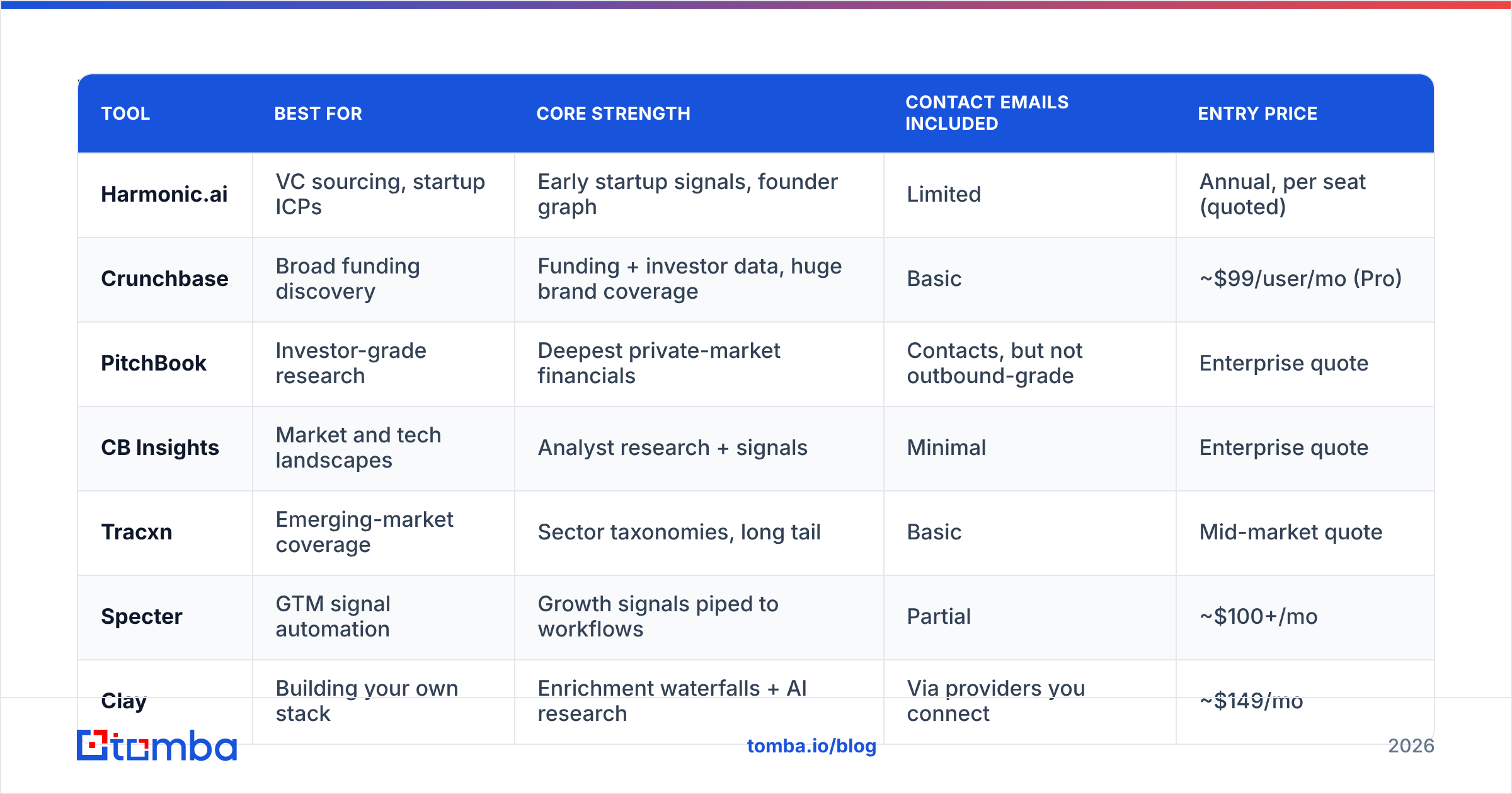
| Tool | Best for | Core strength | Contact emails included | Entry price |
|---|---|---|---|---|
| Harmonic.ai | VC sourcing, startup ICPs | Early startup signals, founder graph | Limited | Annual, per seat (quoted) |
| Crunchbase | Broad funding discovery | Funding + investor data, huge brand coverage | Basic | ~$99/user/mo (Pro) |
| PitchBook | Investor-grade research | Deepest private-market financials | Contacts, but not outbound-grade | Enterprise quote |
| CB Insights | Market and tech landscapes | Analyst research + signals | Minimal | Enterprise quote |
| Tracxn | Emerging-market coverage | Sector taxonomies, long tail | Basic | Mid-market quote |
| Specter | GTM signal automation | Growth signals piped to workflows | Partial | ~$100+/mo |
| Clay | Building your own stack | Enrichment waterfalls + AI research | Via providers you connect | ~$149/mo |
| Tomba | Contact layer on any list | Email finding + verification, API-first | Yes, core product | Free tier, then $49/mo |
| BookYourData | Pay-as-you-go contact lists | Prebuilt B2B lists, no subscription lock-in | Yes | Credit packs |
Crunchbase — the default budget swap#
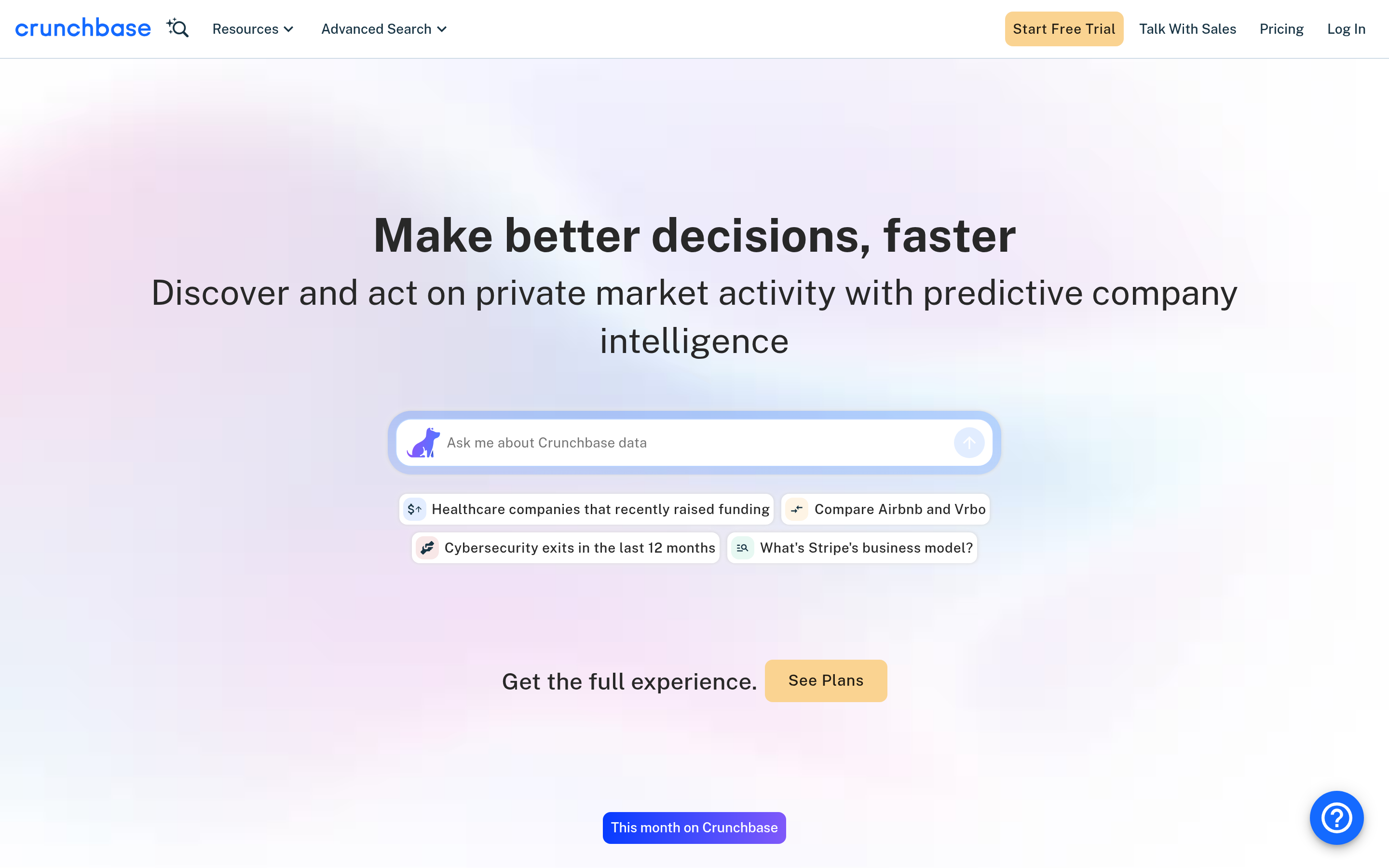
Crunchbase is the alternative most teams try first, and for good reason: funding rounds, investors, acquisitions, and a company graph that everyone in your org already recognizes. Crunchbase Pro sits around $99 per user per month, which is a meaningful step down from a Harmonic contract.
What you give up is signal earliness. Crunchbase is excellent at recording what happened; Harmonic is better at flagging what is about to. If your motion is "reach out within 72 hours of the round announcement," Crunchbase is fine. If it is "reach out before the round," it is not.
PitchBook and CB Insights — the heavyweight route#
If your reason for leaving Harmonic is not enough depth, these are the upgrades, not the downgrades. PitchBook gives you cap tables, valuations, comparables, and deal history that no GTM-first tool touches. CB Insights layers analyst research and market maps on top of company data.
Both are enterprise-priced and both are research tools first. Neither is a sensible purchase for an SDR team of three. Buy them if a partner or a corp-dev lead is the primary user.
Tracxn — coverage outside Silicon Valley#
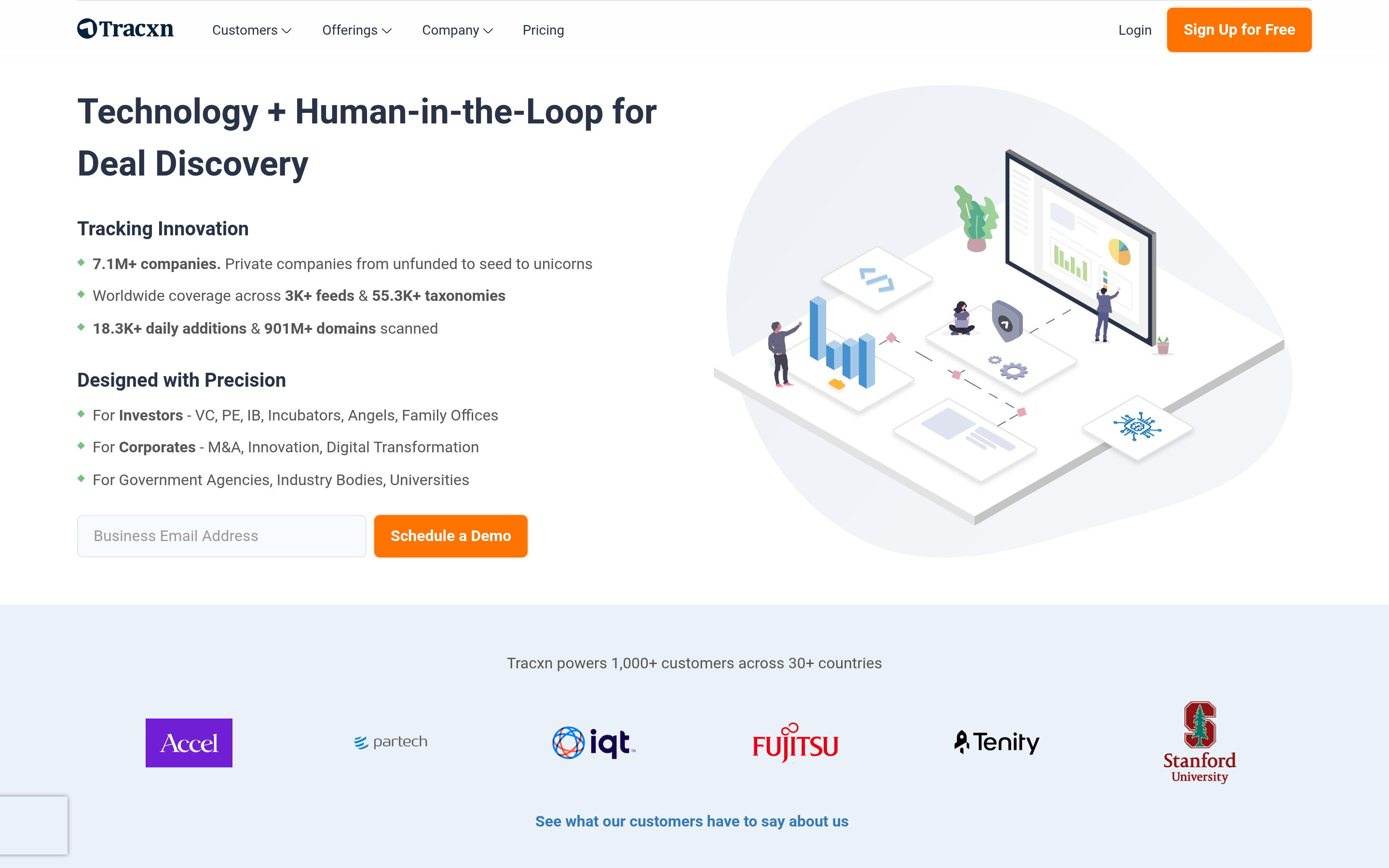
Tracxn's differentiator is taxonomy and geographic reach. If you sell into India, Southeast Asia, the Middle East, or Latin America, Tracxn typically indexes companies that US-centric platforms miss entirely. Sector trees are hand-maintained, which makes "show me every private company in embedded insurance in Brazil" a query that actually returns something useful.
Specter — signals wired into the workflow#

Specter is the closest philosophical match to Harmonic: growth signals on private companies, with an emphasis on pushing those signals into your stack rather than making you browse a UI. Headcount velocity, web traffic trends, hiring patterns, and app-store movement all come through as structured fields you can filter on.
It is generally cheaper than Harmonic and more automation-friendly. It is also less mature on founder-level data.
Clay — build the platform instead of buying it#
Clay is not a data source; it is a data orchestration layer. You bring a company list, then run it through a waterfall of providers, AI research prompts, and conditional logic until each row has what you need. Plenty of teams replace Harmonic with "Crunchbase list → Clay enrichment → sequencer" and cut spend substantially.
The catch is that Clay bills for credits on top of whatever providers you connect, and someone on your team has to own the tables. It is powerful and it is not free time.
BookYourData — buy the list, skip the subscription#
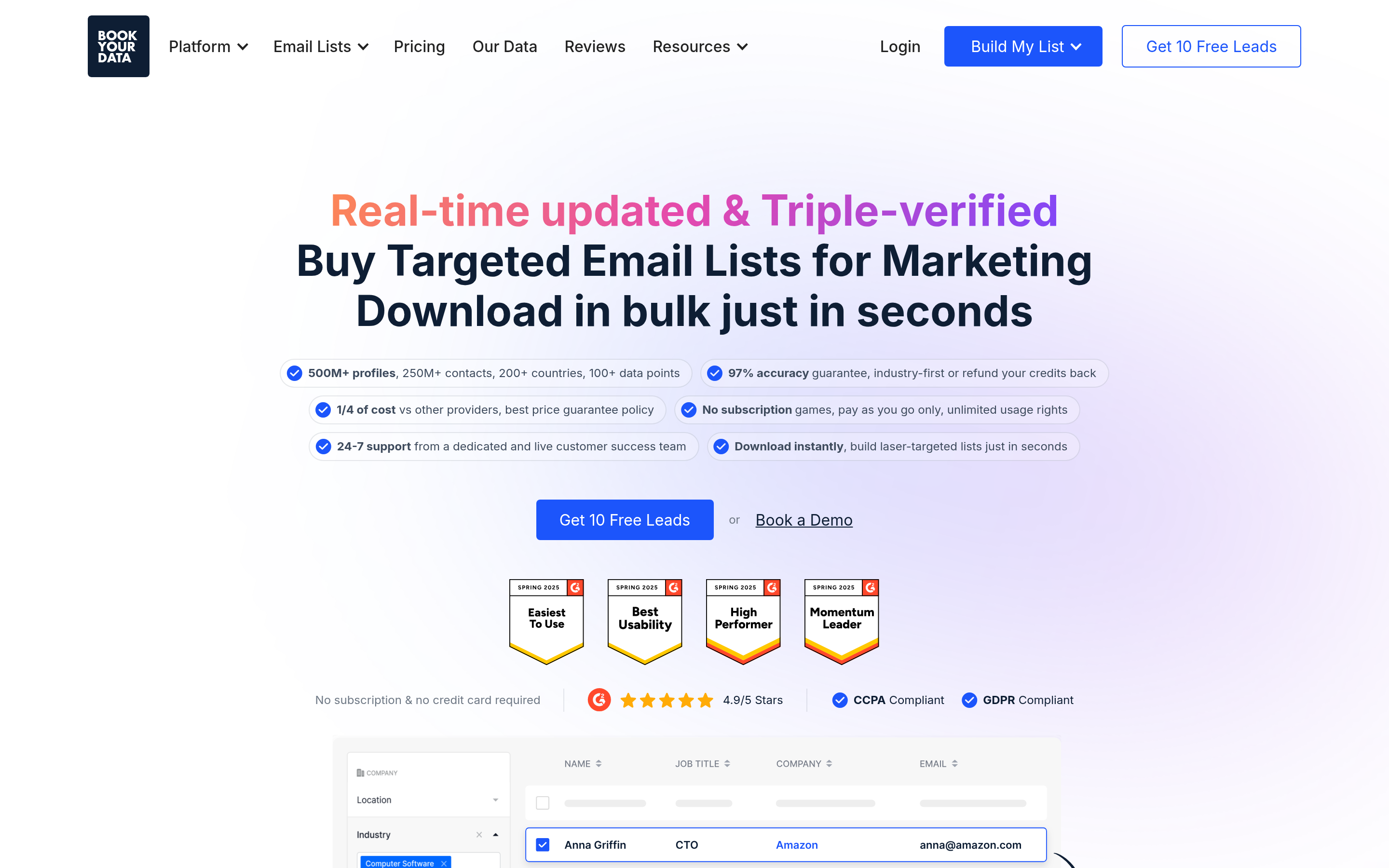
BookYourData takes a different shape: prebuilt, filterable B2B contact lists sold on a pay-as-you-go credit model with an accuracy guarantee. There is no annual seat commitment, which makes it a clean fit for teams running campaign-shaped outbound rather than always-on prospecting. If you know your ICP by title, industry, and geography — and you do not need real-time startup signals — it removes a whole category of tooling from your stack.
Tomba — the contact layer under everything else#
Tomba is not a startup-discovery platform and does not pretend to be. It solves the step after discovery: turning a company domain into verified, deliverable contact data.
The practical pattern looks like this. Pull your target companies from whichever signal source fits your ICP. Run domain search to map who works there and in what role. Run the email finder on the specific people you want. Push everything through the email verifier before it touches your sequencer.
Tomba pricing starts with a free tier at 25 searches a month, then Starter at $49/mo, Growth at $99/mo, and Pro at $249/mo, with Enterprise quoted. For teams whose real complaint about Harmonic was "I am paying five figures and still exporting to find emails," splitting the job across a cheap signal source and a $49/mo contact layer is usually the cheaper, faster answer.

Is Harmonic still worth it for anything?#
Yes — for one job, done well.
If you are a venture investor sourcing pre-seed and seed companies, Harmonic's founder graph and stealth-company detection are hard to replicate by stitching cheaper tools together. Knowing that two ex-Stripe engineers registered a domain and started committing to a new repo three weeks ago is not something Crunchbase will tell you.
Keep Harmonic if:
- Sourcing is your product. Investors and corp-dev teams get direct ROI from earliness.
- Your ICP is venture-backed tech, narrowly. The signal model is tuned for exactly that population.
- Two or three seats cover the team. The economics break at scale, not at small headcount.
Replace Harmonic if:
- You sell to private companies broadly, not just funded startups.
- Your team exports to a contact tool anyway — you are paying twice for one workflow.
- You need API-first enrichment inside your own systems rather than a UI people log into.
What does a replacement stack actually cost?#
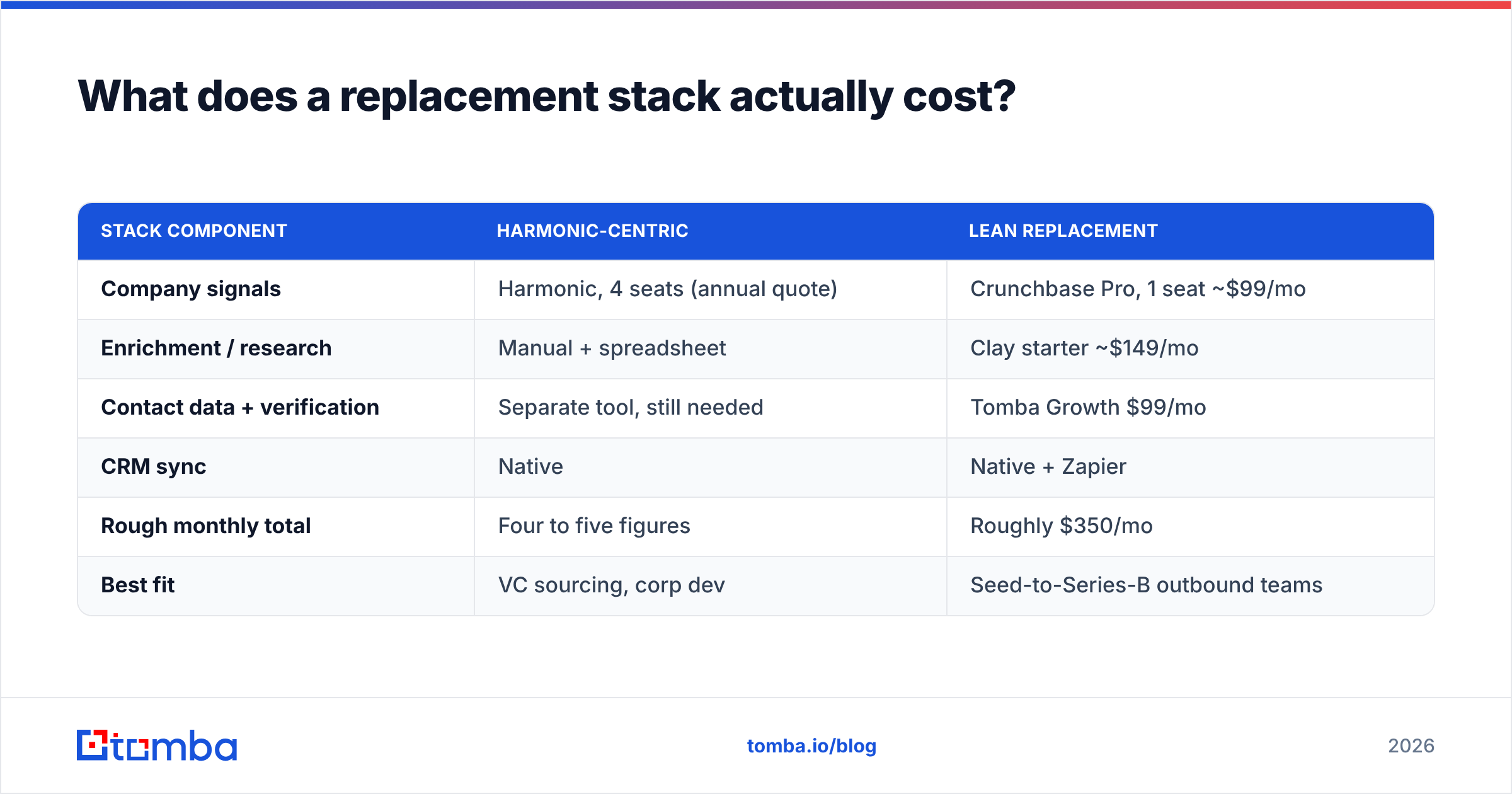
Here is a concrete comparison for a four-person outbound team working a startup ICP.
| Stack component | Harmonic-centric | Lean replacement |
|---|---|---|
| Company signals | Harmonic, 4 seats (annual quote) | Crunchbase Pro, 1 seat ~$99/mo |
| Enrichment / research | Manual + spreadsheet | Clay starter ~$149/mo |
| Contact data + verification | Separate tool, still needed | Tomba Growth $99/mo |
| CRM sync | Native | Native + Zapier |
| Rough monthly total | Four to five figures | Roughly $350/mo |
| Best fit | VC sourcing, corp dev | Seed-to-Series-B outbound teams |
The lean stack is not strictly better. You lose signal earliness and you gain three vendor relationships to manage. But for a GTM team measured on meetings booked rather than deals sourced, the trade is usually worth it — and the saved budget funds a lot of sending infrastructure.
One caveat that catches teams switching stacks: cheaper company data often means messier contact data downstream. Bounce rates above 3% will drag your sender reputation down fast, and no amount of signal quality rescues a domain that has been throttled. Verify before you send, every time — this is the single highest-leverage step in the whole replacement stack.
How do you migrate off Harmonic without losing pipeline?#
Run the swap in parallel for one full cycle rather than cancelling and hoping.
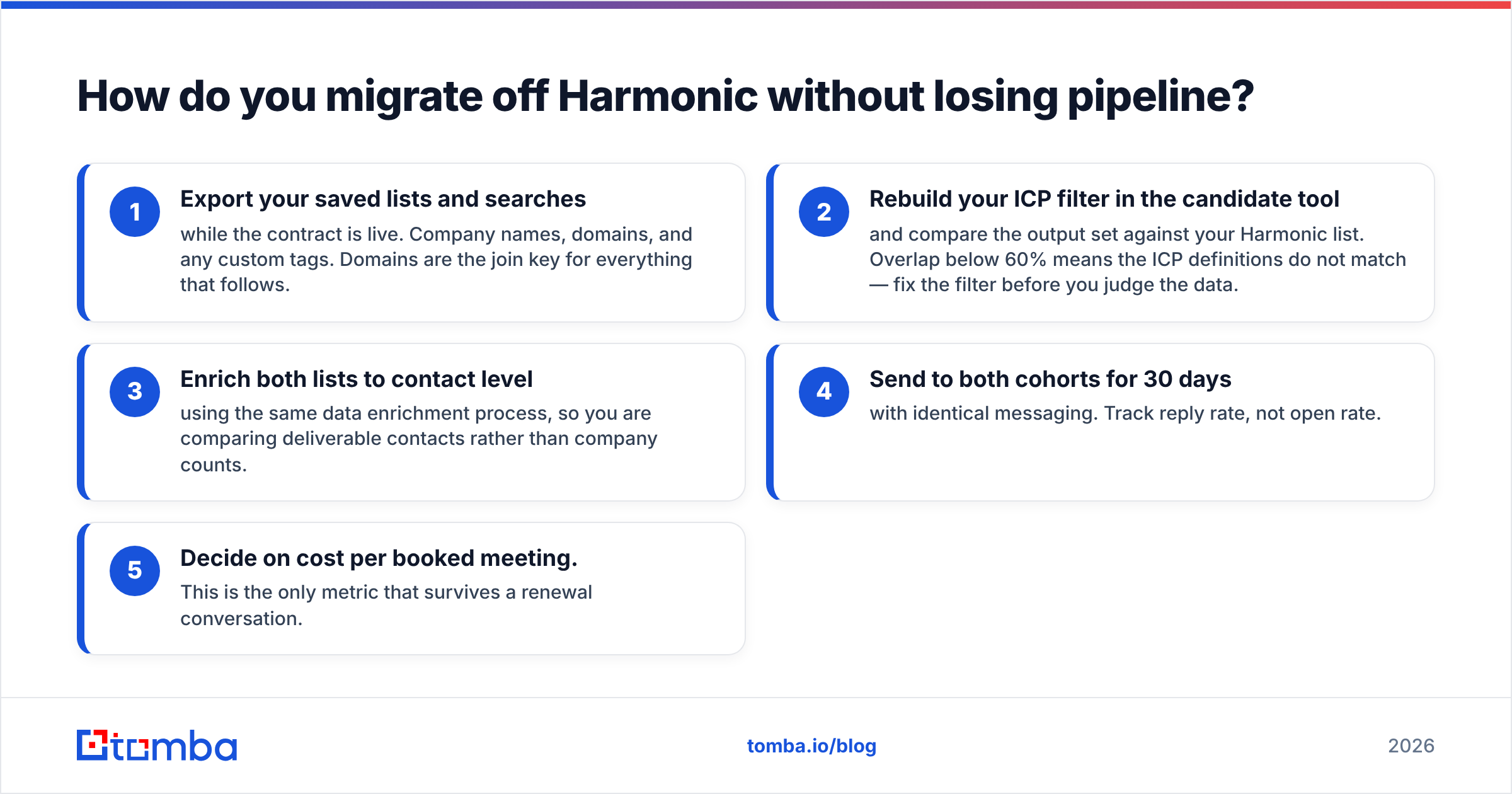
- Export your saved lists and searches while the contract is live. Company names, domains, and any custom tags. Domains are the join key for everything that follows.
- Rebuild your ICP filter in the candidate tool and compare the output set against your Harmonic list. Overlap below 60% means the ICP definitions do not match — fix the filter before you judge the data.
- Enrich both lists to contact level using the same data enrichment process, so you are comparing deliverable contacts rather than company counts.
- Send to both cohorts for 30 days with identical messaging. Track reply rate, not open rate.
- Decide on cost per booked meeting. This is the only metric that survives a renewal conversation.
Teams that skip step four almost always regret the switch, because the tool was never the variable — the ICP definition was.
For anything at volume, wire the enrichment step into your own systems with the Tomba API or run periodic refreshes through the bulk email finder so the comparison is apples to apples rather than one analyst clicking through a UI.
Which alternative should you pick?#
- Cheaper company discovery: Crunchbase, or Tracxn if your market is outside the US.
- Deeper private-market research: PitchBook, with CB Insights if you also need analyst framing.
- Signals wired into automation: Specter, or Clay if you want to compose your own sources.
- List-based campaigns without a subscription: BookYourData.
- Contact data that actually delivers: Tomba, layered under whichever of the above you choose.
Most teams do not need a Harmonic replacement. They need Harmonic's output — a good company list — from a cheaper source, and then a reliable way to turn that list into inboxes.
That second half is the part that decides whether the campaign works. Start with the Tomba Email Finder free tier, run 25 of your current target companies through it, and compare the deliverable-contact count against whatever you are exporting today. If the numbers favor the swap, Starter at $49/mo covers a full outbound cycle for less than a single seat on most of the platforms on this list.
Related guides#
// get started
Find, verify and enrich your first contacts today
Start on the free plan with 25 searches a month, then scale when your team is ready.
Free plan · No credit card required · GDPR & CCPA
// about the author