Harmonic vs Jet Leads Pro: Which B2B Data Tool Wins in 2026
One platform tracks startup growth signals, the other sells lead lists. We compare Harmonic vs Jet Leads Pro on coverage, transparency, pricing, and contact accuracy so you can pick without wasting a quarter.
TL;DR
- Harmonic is a startup and people intelligence platform. It tracks company growth signals — headcount changes, funding, founder moves — and is priced for teams that buy data as a strategic asset, not a per-lead commodity.
- Jet Leads Pro positions itself as a low-cost bulk lead source. Its public footprint is thin: no widely indexed pricing page, no meaningful third-party review volume, and no published accuracy methodology. Treat any coverage claim as unverified until you run your own test.
- They are not really the same product. Harmonic answers "which companies should I care about right now?" Jet Leads Pro answers "give me a lot of contacts cheaply."
- Neither is a substitute for a dedicated verification layer. Signal platforms go stale on contact records, and bulk lists bounce. Budget for a separate finder and verifier regardless of which you pick.
- If you are choosing today: pick Harmonic for signal-led outbound at a funded startup, pick a transparent bulk provider over Jet Leads Pro unless you can validate a sample first, and put a verification step in front of your sequencer either way.
What are Harmonic and Jet Leads Pro?#
Short answer: they solve different problems and get compared only because both end up as a CSV in your CRM.
Harmonic is a company and people intelligence platform built for venture investors, corp dev teams, and growth-stage GTM orgs. Its pitch is breadth plus freshness on the company side — a large index of private companies with continuously refreshed attributes like headcount trajectory, hiring velocity, funding events, and founder history. You use it to build a watchlist, then act when something changes.
Jet Leads Pro sits in the crowded bracket of bulk B2B lead vendors: pay a flat fee, download contacts, upload to a sequencer. That category ranges from genuinely good (transparent sourcing, published bounce SLAs, refund policies) to genuinely bad (scraped 2019 exports resold as fresh data). Jet Leads Pro's problem for a buyer in 2026 is not that it is bad — it is that there is very little independent evidence either way. Search G2 or Capterra and you will not find the review depth you would get for an established vendor. That absence is itself a data point.
So the honest framing of Harmonic vs Jet Leads Pro is not "which is better." It is: do you need a signal engine, or do you need volume — and how much verification risk are you willing to absorb?
What does Harmonic actually do well?#
Harmonic's core competence is watching private companies change over time.
- Company graph breadth. Harmonic indexes millions of private companies, including pre-seed and bootstrapped ones that traditional firmographic databases miss entirely because they have no filings and no press.
- Change detection, not snapshots. The valuable part is the delta — a company going from 12 to 31 engineers in two quarters, a second-time founder registering a new entity, a Series A closing. Static databases tell you what a company is; Harmonic tells you what it is becoming.
- People intelligence. Founder and operator histories are first-class objects, which matters if your ICP is "people who did X at Y and just left."
- API-first delivery. Harmonic is designed to be piped into your own scoring model or warehouse rather than lived in as a UI. That is a real advantage for RevOps teams building their own revenue operations stack.
- Enterprise-shaped pricing. Pricing is quote-based and lands well above self-serve tools. That is fine if data drives your entire sourcing motion, and terrible if you just need 2,000 emails this month.
The trade-off is blunt: Harmonic is optimized for finding the right accounts, not for handing you a ready-to-send contact list with verified inboxes attached. Teams routinely pair it with a separate contact layer.

What is Jet Leads Pro, and how much can you verify?#
Here is where a neutral review has to be uncomfortable.
Jet Leads Pro markets bulk B2B contact data at a low price point. What you cannot easily confirm from public sources:
- Where the data comes from. No published sourcing methodology, no statement on consent basis or opt-out handling. For anything touching EU or UK contacts, GDPR legitimate-interest documentation is not optional — you need the vendor to hand you a record of processing, not a vibe.
- How fresh it is. No stated refresh cadence. Bulk lists decay at roughly 2-2.5% per month as people change jobs, which compounds to a third of a list being wrong inside a year.
- What the bounce rate is. Reputable vendors publish an accuracy floor and refund credits above it. Absent that, you are the QA department.
- Whether reviews are independent. Thin third-party review volume on the major software marketplaces means you cannot triangulate claims.
None of that means the product does not work. It means the burden of proof sits entirely on you, and the correct move is to buy the smallest possible sample, verify 100% of it, and only then decide. If the vendor will not sell you a small sample, that answers the question.
How do Harmonic and Jet Leads Pro compare head-to-head?#
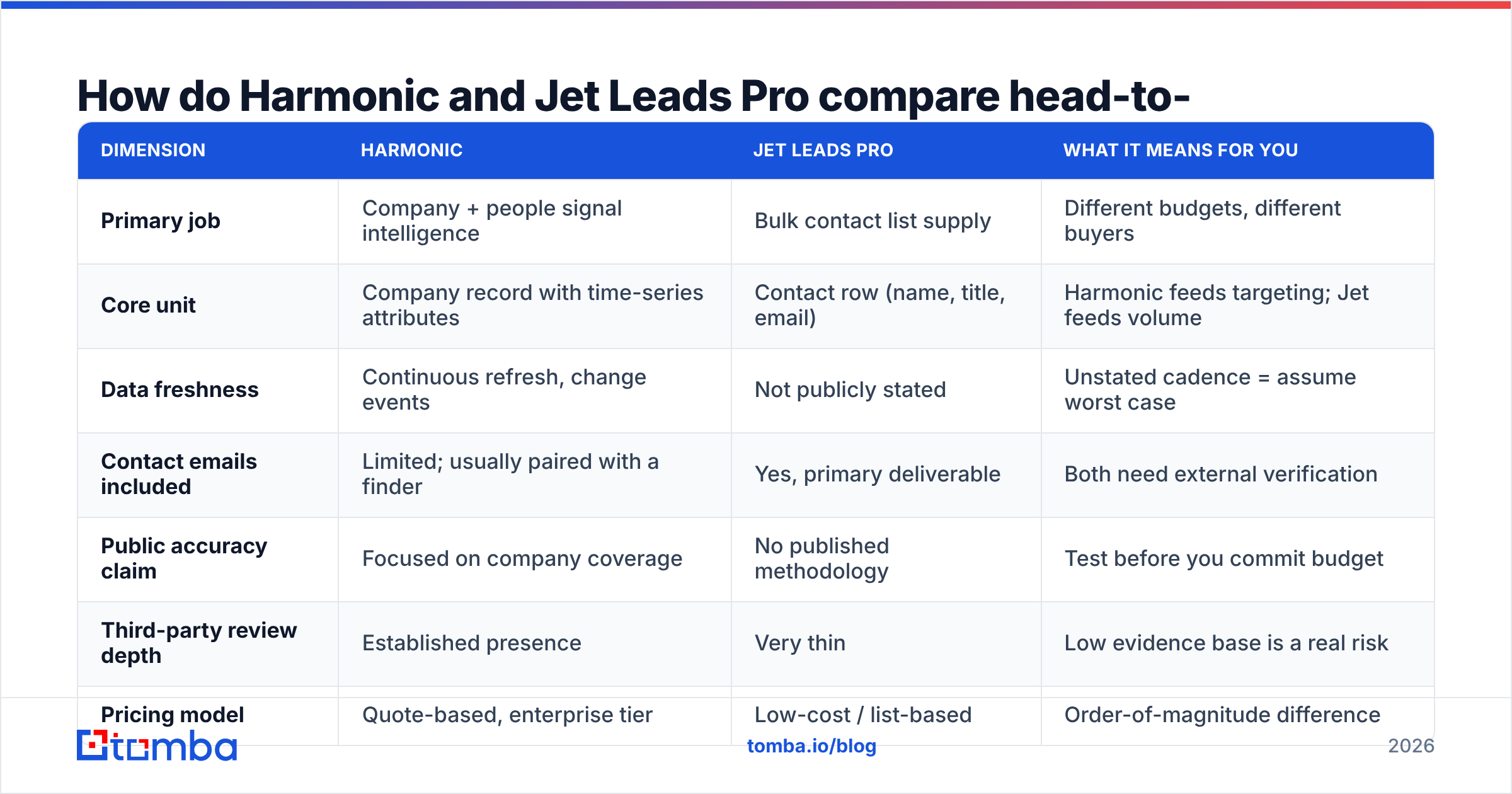
| Dimension | Harmonic | Jet Leads Pro | What it means for you |
|---|---|---|---|
| Primary job | Company + people signal intelligence | Bulk contact list supply | Different budgets, different buyers |
| Core unit | Company record with time-series attributes | Contact row (name, title, email) | Harmonic feeds targeting; Jet feeds volume |
| Data freshness | Continuous refresh, change events | Not publicly stated | Unstated cadence = assume worst case |
| Contact emails included | Limited; usually paired with a finder | Yes, primary deliverable | Both need external verification |
| Public accuracy claim | Focused on company coverage | No published methodology | Test before you commit budget |
| Third-party review depth | Established presence | Very thin | Low evidence base is a real risk |
| Pricing model | Quote-based, enterprise tier | Low-cost / list-based | Order-of-magnitude difference |
| API access | Yes, central to the product | Unclear | Matters for automated enrichment |
| Best fit | VC, corp dev, signal-led outbound | High-volume, low-ACV testing | Match to your motion, not to hype |
| Biggest weakness | Cost; not a turnkey contact source | Unverifiable provenance | Neither is complete alone |
Two rows deserve emphasis. First, "contact emails included" — Harmonic buyers almost always bolt on a dedicated finder because signal data and deliverable inbox data are different engineering problems. Second, "public accuracy claim" — in 2026, a vendor that will not publish a bounce threshold is asking you to fund their QA.
Which one wins on contact data accuracy?#
Neither, if you send without verifying. That is the honest verdict.
Signal platforms like Harmonic are excellent at telling you that a 40-person Series A company just hired its first VP of Sales. They are not built to guarantee that first.last@company.com will accept mail today. Bulk providers deliver an email in every row, which feels better, but a filled cell is not a valid cell — a row that resolves to a departed employee still counts as "delivered data" on the vendor's side and as a hard bounce on yours.
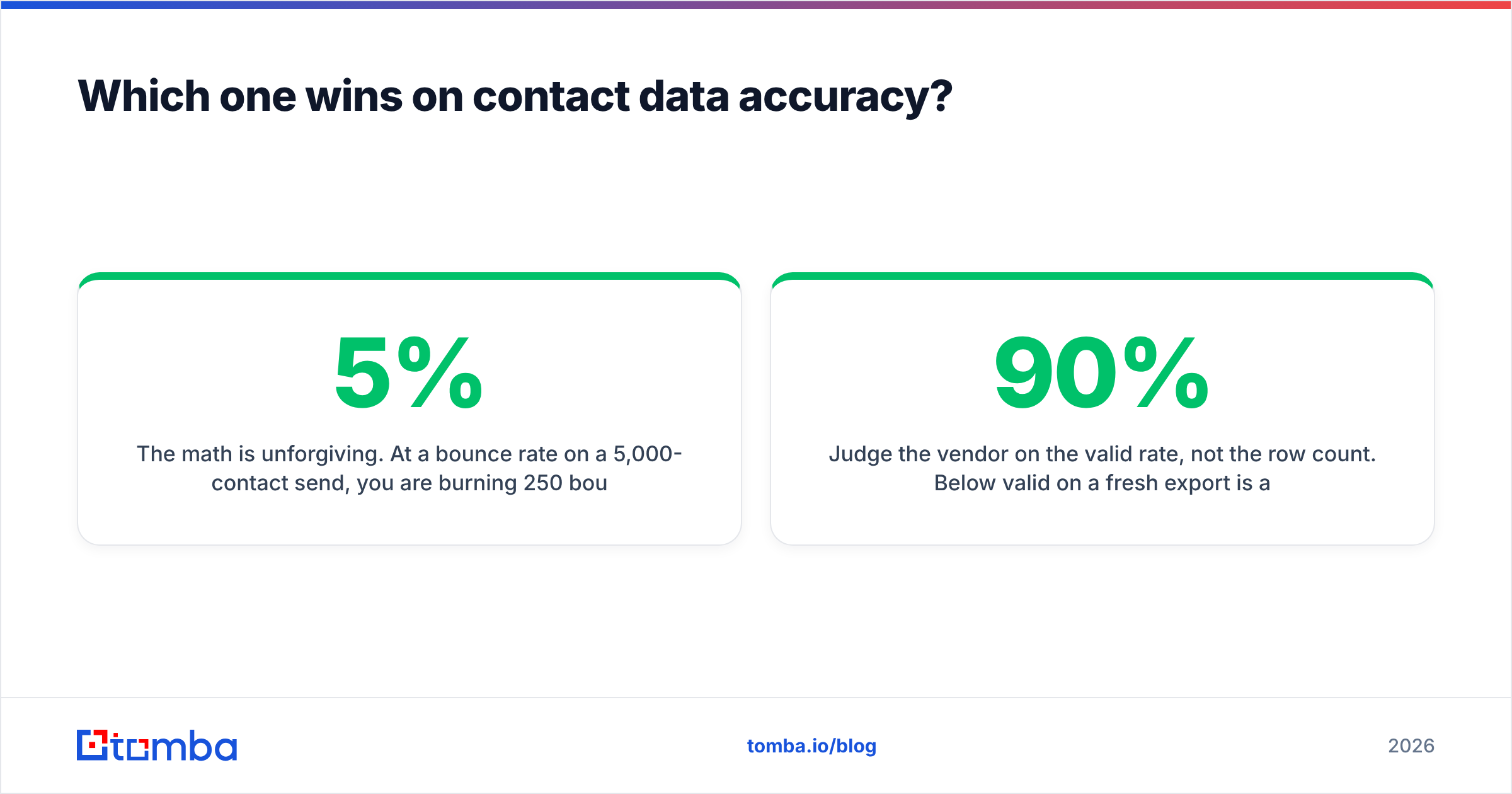
The math is unforgiving. At a 5% bounce rate on a 5,000-contact send, you are burning 250 bounces against a domain reputation that Google and Microsoft evaluate on rolling windows. Cross 2-3% consistently and your email deliverability degrades for every campaign afterward, including the ones with good data. The cost of a bad list is never the list price.
The practical protocol, regardless of vendor:
- Buy or export the smallest viable sample — 200-500 rows is enough to measure.
- Run every row through an email verifier before it touches a sequencer. Split results into valid, invalid, catch-all, and unknown.
- Judge the vendor on the valid rate, not the row count. Below 90% valid on a fresh export is a red flag; below 80% means you are paying to damage your domain.
- Re-verify anything older than 60 days. Even a great list decays.
- Treat catch-all domains separately — they need a catch-all verifier pass rather than a blind send.

What does each one cost in practice?#
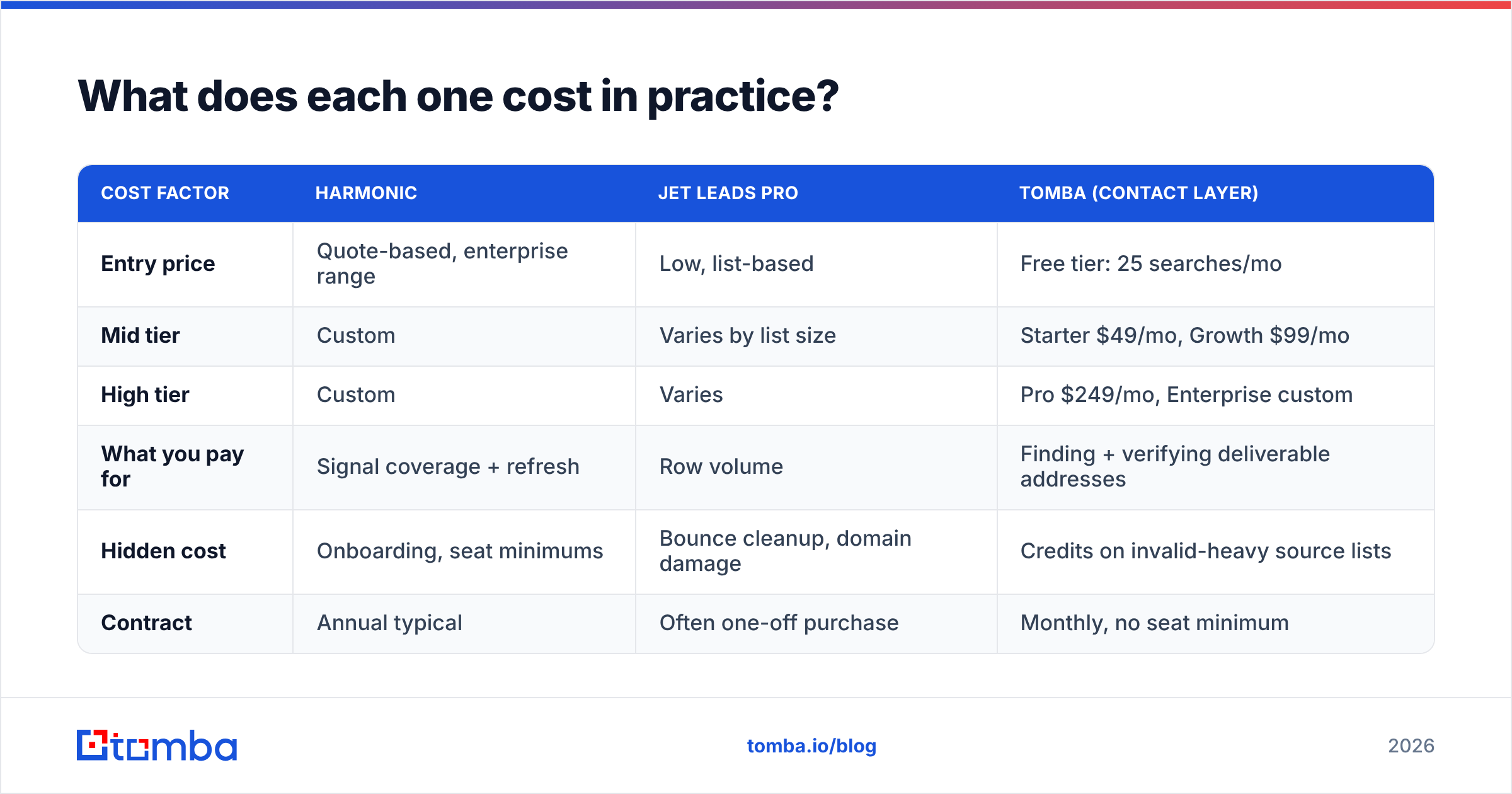
| Cost factor | Harmonic | Jet Leads Pro | Tomba (contact layer) |
|---|---|---|---|
| Entry price | Quote-based, enterprise range | Low, list-based | Free tier: 25 searches/mo |
| Mid tier | Custom | Varies by list size | Starter $49/mo, Growth $99/mo |
| High tier | Custom | Varies | Pro $249/mo, Enterprise custom |
| What you pay for | Signal coverage + refresh | Row volume | Finding + verifying deliverable addresses |
| Hidden cost | Onboarding, seat minimums | Bounce cleanup, domain damage | Credits on invalid-heavy source lists |
| Contract | Annual typical | Often one-off purchase | Monthly, no seat minimum |
The hidden-cost row is where most teams get surprised. A $200 list that produces a 25% bounce rate and forces you to warm a new sending domain for three weeks is not a $200 list. Meanwhile a quote-based platform that replaces two SDRs' worth of manual research can be cheap at $30k. Price the outcome, not the invoice. Full Tomba pricing is published openly, which is the baseline transparency you should demand from every vendor in this stack.
Who should choose which?#
- Choose Harmonic if your ICP is defined by change — recently funded, rapidly hiring, newly founded by a known operator — and you have the budget and the engineering capacity to consume an API. It is the strongest option in this comparison for investors and for GTM teams that score accounts before they touch them.
- Choose a bulk provider (with caution) if you are running high-volume, low-ACV outbound where the economics tolerate breakage, and you can validate a sample first. If Jet Leads Pro passes your own verification test at a reasonable valid rate, the price is compelling. If it does not, no discount fixes it.
- Choose neither as your only tool if you actually need deliverable inboxes. Both categories assume you bring a verification layer.
- Choose a hybrid if you want the realistic 2026 stack: a signal source for targeting, a data enrichment and finder layer for contacts, and a verifier gate before the sequencer.
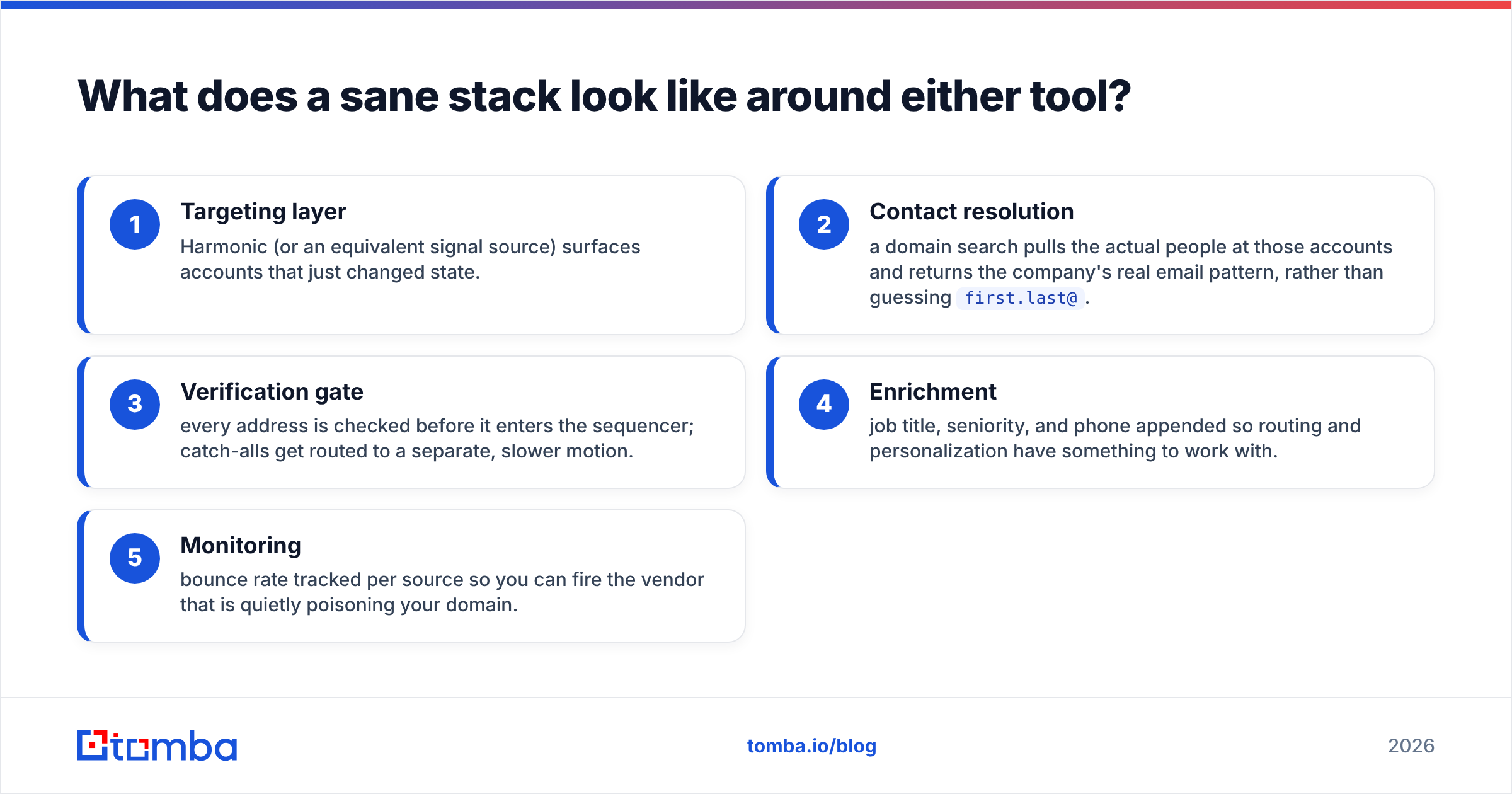
What does a sane stack look like around either tool?#
Think of it like buying produce. Harmonic is the farmer who tells you which fields are ripe this week. A bulk list vendor is the wholesaler selling crates sight-unseen. Verification is you actually opening the crate before you serve it to customers. You need all three roles filled; the mistake is assuming one vendor fills all of them.
A workable pipeline:
- Targeting layer — Harmonic (or an equivalent signal source) surfaces accounts that just changed state.
- Contact resolution — a domain search pulls the actual people at those accounts and returns the company's real email pattern, rather than guessing
first.last@. - Verification gate — every address is checked before it enters the sequencer; catch-alls get routed to a separate, slower motion.
- Enrichment — job title, seniority, and phone appended so routing and personalization have something to work with.
- Monitoring — bounce rate tracked per source so you can fire the vendor that is quietly poisoning your domain.
Step 5 is the one nobody builds and everybody needs. Tag every contact with its origin. Three months later you will know, with numbers instead of opinions, whether Harmonic-sourced accounts or list-sourced accounts converted — and whether Harmonic vs Jet Leads Pro was even the right question for your team.
For teams building this in code rather than spreadsheets, the Tomba API handles the finder and verifier steps in the same call chain, so the resolution and gate stages collapse into one job rather than two vendors and a manual export.
The verdict#
Harmonic wins on transparency, freshness, and strategic value — if you can afford it and your motion is signal-led. Jet Leads Pro can only win on price, and only after you have personally verified a sample, because the public evidence base is too thin to lend it trust by default. If you cannot get a sample, walk.
But the more useful conclusion is that this comparison has a gap in the middle. Neither product is designed to guarantee that the emails you send today land in an inbox. That is a separate job, and it is the cheapest insurance in your entire GTM budget.
Start with the Tomba Email Finder to resolve real, verified contacts at the accounts your signal layer flags — the free tier gives you 25 searches a month to test against your current list before you commit to anything, and Starter runs $49/mo when you are ready to scale. Run your existing Harmonic or Jet Leads Pro export through it first; the valid-rate number you get back will make the vendor decision for you.
Related guides#
Ready to find emails that actually work?
Join 150,000+ professionals who stopped guessing and started sending. Free credits on signup — no credit card required.
Get the Tomba newsletter
Practical outbound tactics and product updates — once every two weeks.
About the author