Harmonic vs LeadzenAI: Which B2B Data Tool Wins in 2026?
Harmonic tracks startups and founder signals. LeadzenAI hands you contact records at a fraction of the price. Here is an honest, side-by-side look at coverage, accuracy, pricing and the workflows each one actually fits.
Harmonic vs LeadzenAI is an odd matchup. One tool finds companies. The other finds people. This guide shows what each one does well, and what it costs you to pick the wrong one.
TL;DR
- Harmonic is a company-intelligence platform built for startup discovery. It tracks funding events, headcount growth, founder history, and team-level signals. It sells to VCs, corp dev, and enterprise GTM teams on quote-based pricing.
- LeadzenAI is a prospecting database. Search for people by title, industry, or company, then pull emails and phone numbers. Pricing is credit-based and published, and the buyer is the SMB sales team.
- They are not the same product. Harmonic answers "which companies should I care about?" LeadzenAI answers "who do I email at this company?"
- Neither one replaces a verification layer. Whichever you pick, run the exported addresses through an email verifier before the first send.
- If you only need accurate work emails at domains you already know, a focused email finder at $49/mo beats both on cost per usable contact.
What is Harmonic and who actually buys it?#
Harmonic is a private-market data company. Its core asset is a company graph that refreshes constantly. It holds tens of millions of company records. Each record carries funding rounds, investor ties, headcount trends, job postings, web traffic shifts, and founder work history.
The buyer profile is narrow. Venture funds use Harmonic to spot companies before a round goes public. Corporate development teams use it to map acquisition targets. Enterprise GTM teams use it to build territory lists from growth signals instead of static firmographics. Think "show me every seed-stage company that added three engineers in the last 60 days and just posted a Head of Sales role."
That framing also explains what Harmonic is not. It is not a contact database you point at an account list to get a VP's mobile number. People data exists, and it is strong on founders and executives. But the product is built around company discovery and signal tracking. You surface accounts first and contacts second.
You get the data through a web app, a Chrome extension, an API, and pushes into CRMs and deal-flow tools like Affinity, Salesforce, and HubSpot. Most technical teams end up buying the API. They treat Harmonic as a feed into an internal scoring model, not as a UI a rep logs into daily.
What is LeadzenAI and how is it different?#
LeadzenAI sits at the other end of the market. It is a B2B prospecting platform with a contact database, a Chrome extension for LinkedIn profiles, bulk search, and real-time lookup. Filter by job title, seniority, industry, location, or company size. Then export a list with emails and, on some records, phone numbers.
The company is based in India, and the coverage shows it. APAC and Indian mid-market data runs deeper than what most US-centric vendors carry. North American and European coverage is solid, but not best in class. If you sell into Indian SaaS, manufacturing, or services firms, that regional density is the strongest reason to buy.
Pricing is the second reason. It is published, credit-based, and far cheaper than most Western rivals. Picture a two-person team testing an outbound motion. A quote-based enterprise contract and a card-swipe monthly plan are not the same decision. One lets you run the experiment this week. The other does not.
Harmonic vs LeadzenAI: how do they compare head-to-head?#
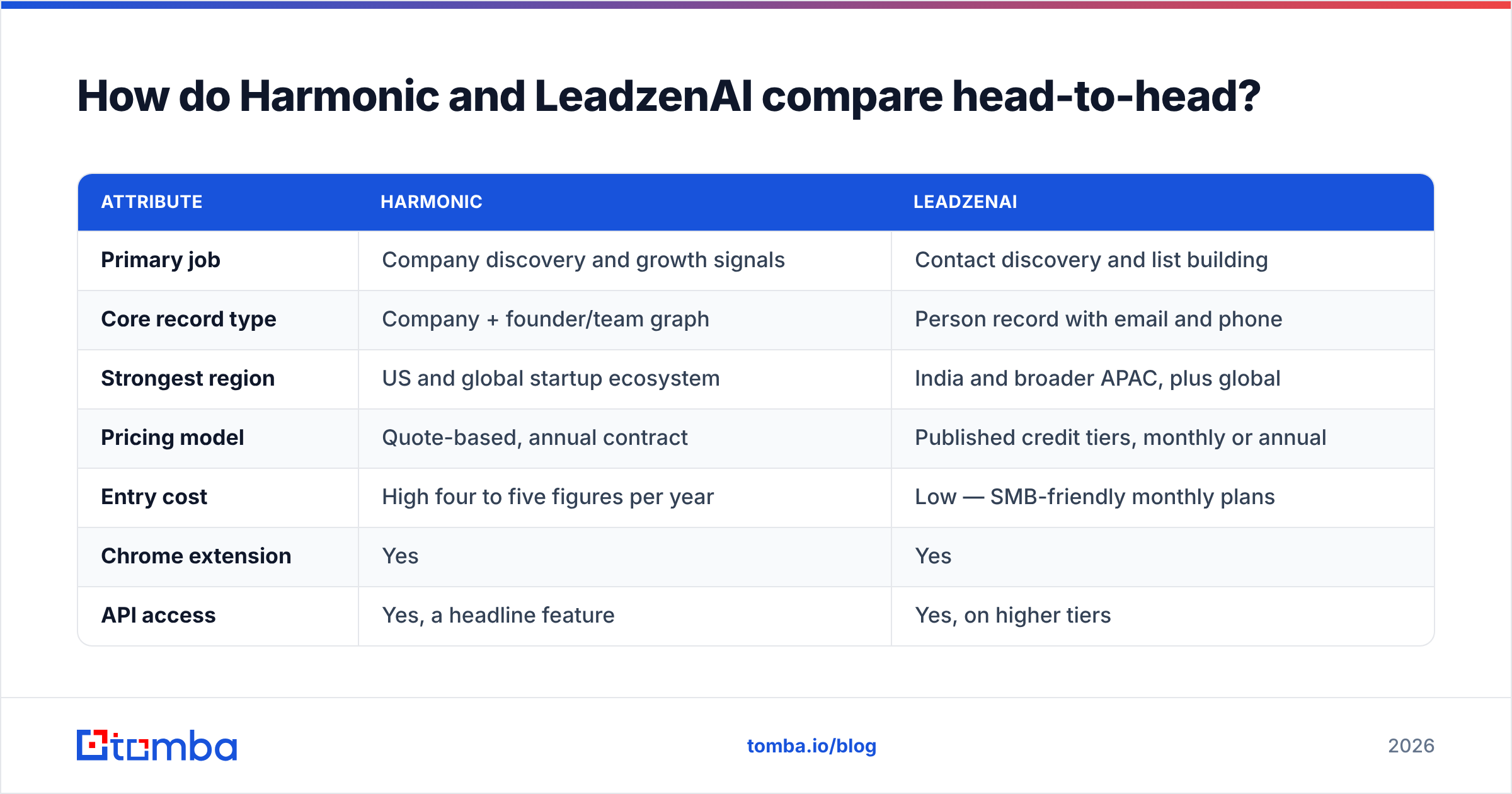
| Attribute | Harmonic | LeadzenAI |
|---|---|---|
| Primary job | Company discovery and growth signals | Contact discovery and list building |
| Core record type | Company + founder/team graph | Person record with email and phone |
| Strongest region | US and global startup ecosystem | India and broader APAC, plus global |
| Pricing model | Quote-based, annual contract | Published credit tiers, monthly or annual |
| Entry cost | High four to five figures per year | Low — SMB-friendly monthly plans |
| Chrome extension | Yes | Yes |
| API access | Yes, a headline feature | Yes, on higher tiers |
| Bulk export | Yes, contract-dependent | Yes, credit-dependent |
| Built-in email verification | Limited | Basic, not a substitute for a dedicated verifier |
| Best fit | VCs, corp dev, enterprise RevOps | SMB and mid-market SDR teams |
Read that table twice before you shortlist. The two tools barely overlap. A fund that treats LeadzenAI as a Harmonic substitute will miss the funding and growth signals. An SDR team that treats Harmonic as a LeadzenAI substitute will be shocked by the invoice.

What data does each platform actually give you?#
Here is what actually lands in your CRM after a search on each. Start with the company layer:
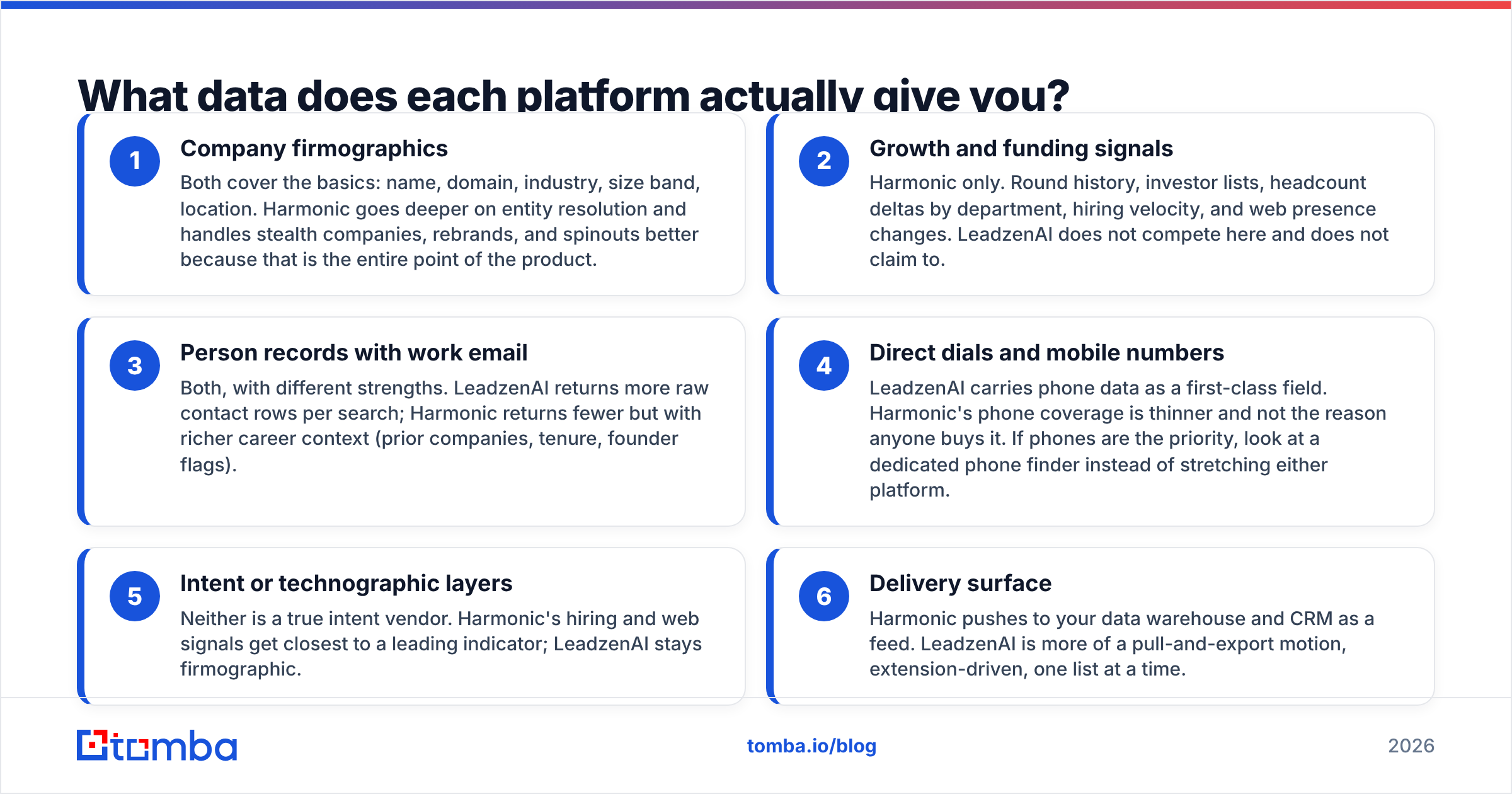
- Company firmographics — Both cover the basics: name, domain, industry, size band, and location. Harmonic goes deeper on entity resolution. It handles stealth companies, rebrands, and spinouts better, because that is the whole point of the product.
- Growth and funding signals — Harmonic only. Round history, investor lists, headcount change by department, hiring speed, and web presence shifts. LeadzenAI does not compete here, and does not claim to.
- Intent or technographic layers — Neither is a true intent vendor. Harmonic's hiring and web signals come closest to a leading indicator. LeadzenAI stays firmographic.
Now the people layer, where the Harmonic vs LeadzenAI gap flips the other way:
- Person records with work email — Both, with different strengths. LeadzenAI returns more raw contact rows per search. Harmonic returns fewer rows with richer career context, such as prior companies, tenure, and founder flags.
- Direct dials and mobile numbers — LeadzenAI treats phone data as a first-class field. Harmonic's phone coverage is thin, and it is not why anyone buys it. If phones are the priority, use a dedicated phone finder instead of stretching either platform.
- Delivery surface — Harmonic pushes to your data warehouse and CRM as a feed. LeadzenAI is a pull-and-export motion, driven by the extension, one list at a time.
Is Harmonic worth the price for outbound prospecting?#
Honest answer: usually not, if outbound email is your only use case.
Harmonic pays off when the timing of a company signal is worth money to you. A fund that closes one extra deal because it saw a hiring spike four weeks early has covered the contract many times over. A RevOps team that reroutes territory each quarter on funding events gets similar leverage.
But say your workflow is simple: here are 800 target domains, get me the head of engineering at each. Then you are paying enterprise prices for a discovery engine you will barely touch. That job is a domain search problem, and it costs a tiny fraction of a private-market data contract.
There is a procurement reality too. Quote-based pricing means a sales cycle, a security review, and an annual commitment. Teams that need to be live this week rarely choose Harmonic, however good the data is. Reviews on G2 flag the same trade-off across this category. The data is strong, the commitment is heavy, and the payoff depends on whether you actually use the signals.
Is LeadzenAI accurate enough for cold email?#
It is accurate enough to start with. It is not accurate enough to send blind. The same holds for every contact database, including the expensive ones.
Contact data decays fast. Industry consensus puts B2B decay at roughly 25 to 30 percent a year. People change jobs, domains migrate, and roles get reshuffled. Vendors refresh on different cycles, and no vendor refreshes every record all the time. So the record you export today may have been checked three weeks ago, or three quarters ago. The export rarely tells you which.
This is where teams get burned. They pull a 5,000-row list, drop it straight into a sequence, hit an 8 percent bounce rate, and torch their sending domain in week one. The fix is boring and non-negotiable:
- Export from LeadzenAI, Harmonic, or any other provider.
- Deduplicate against your CRM so you do not email existing contacts again.
- Run the full list through a verification pass. Drop anything that is not deliverable.
- Send catch-all domains through a catch-all verifier instead of guessing. Those mail servers accept everything and confirm nothing.
- Only then load the survivors into your sequencer.
Do that, and a mid-priced database performs about as well as a premium one for cold outreach. Skip it, and the premium database will not save you either.

How does the pricing math actually work out?#
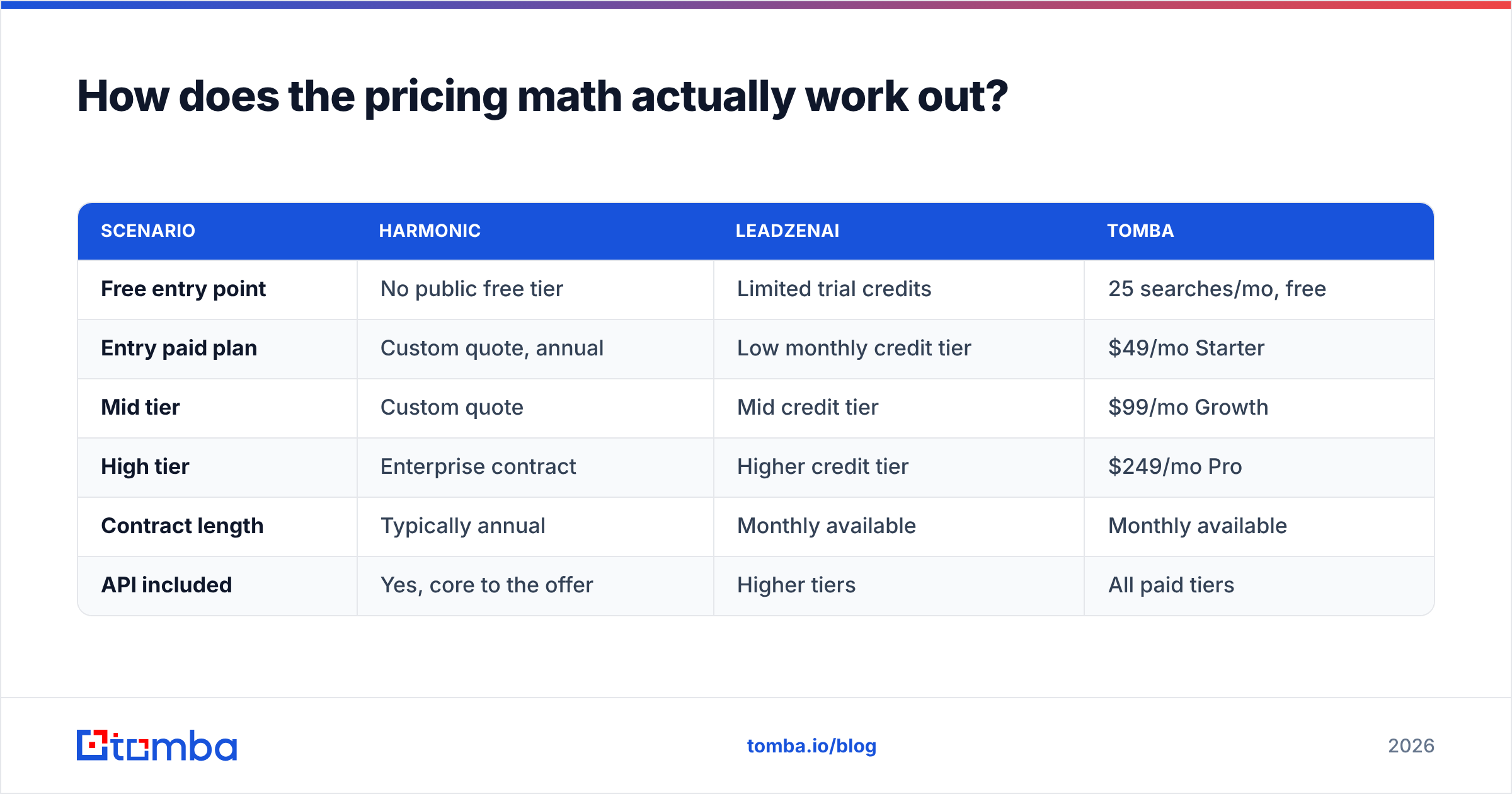
| Scenario | Harmonic | LeadzenAI | Tomba |
|---|---|---|---|
| Free entry point | No public free tier | Limited trial credits | 25 searches/mo, free |
| Entry paid plan | Custom quote, annual | Low monthly credit tier | $49/mo Starter |
| Mid tier | Custom quote | Mid credit tier | $99/mo Growth |
| High tier | Enterprise contract | Higher credit tier | $249/mo Pro |
| Contract length | Typically annual | Monthly available | Monthly available |
| API included | Yes, core to the offer | Higher tiers | All paid tiers |
Sticker price is the wrong comparison. What matters is cost per usable contact. Say a cheap tool returns 1,000 rows and 550 are deliverable. A mid-priced tool returns 700 rows and 620 are deliverable. The cheap tool costs more per usable contact. Before you commit to anything, run the same 100-domain test list through each candidate, verify the output the same way, and divide.
Most teams who run that test find their real spend problem is credit waste on records nobody can verify. It is not the subscription line item. You can check current Tomba pricing against your own test results in about fifteen minutes.
Harmonic vs LeadzenAI: which one should you choose in 2026?#
Choose Harmonic if:
- You invest in, acquire, or partner with early-stage companies, and timing is your edge.
- You need a company graph piped into a warehouse or scoring model, not a UI for reps.
- You have budget for an annual data contract, and a team that will act on the signals.
Choose LeadzenAI if:
- Your ICP skews toward India or wider APAC, where its density is genuinely different.
- You are a small team that needs published pricing and a monthly commitment.
- You want emails and phones in one export, with no procurement cycle.
Choose neither — or add a third layer — if:
- You already know your target accounts and just need contacts at those domains.
- Bounce rate, not list size, is the constraint on your outbound program.
- You need programmatic lookups inside a product or internal tool, not a seat-based UI.
That third case is more common than vendor marketing admits. Plenty of teams buy a $30k discovery platform to solve what is really a lookup-and-verify problem.
Where does Tomba fit alongside either tool?#
Tomba is narrower than both on purpose. It is not a private-market intelligence graph, and it is not an all-in-one prospecting suite. It finds and verifies professional email addresses. You get a free tier, a $49/mo Starter plan, and an email finder API on every paid tier rather than behind an enterprise gate.
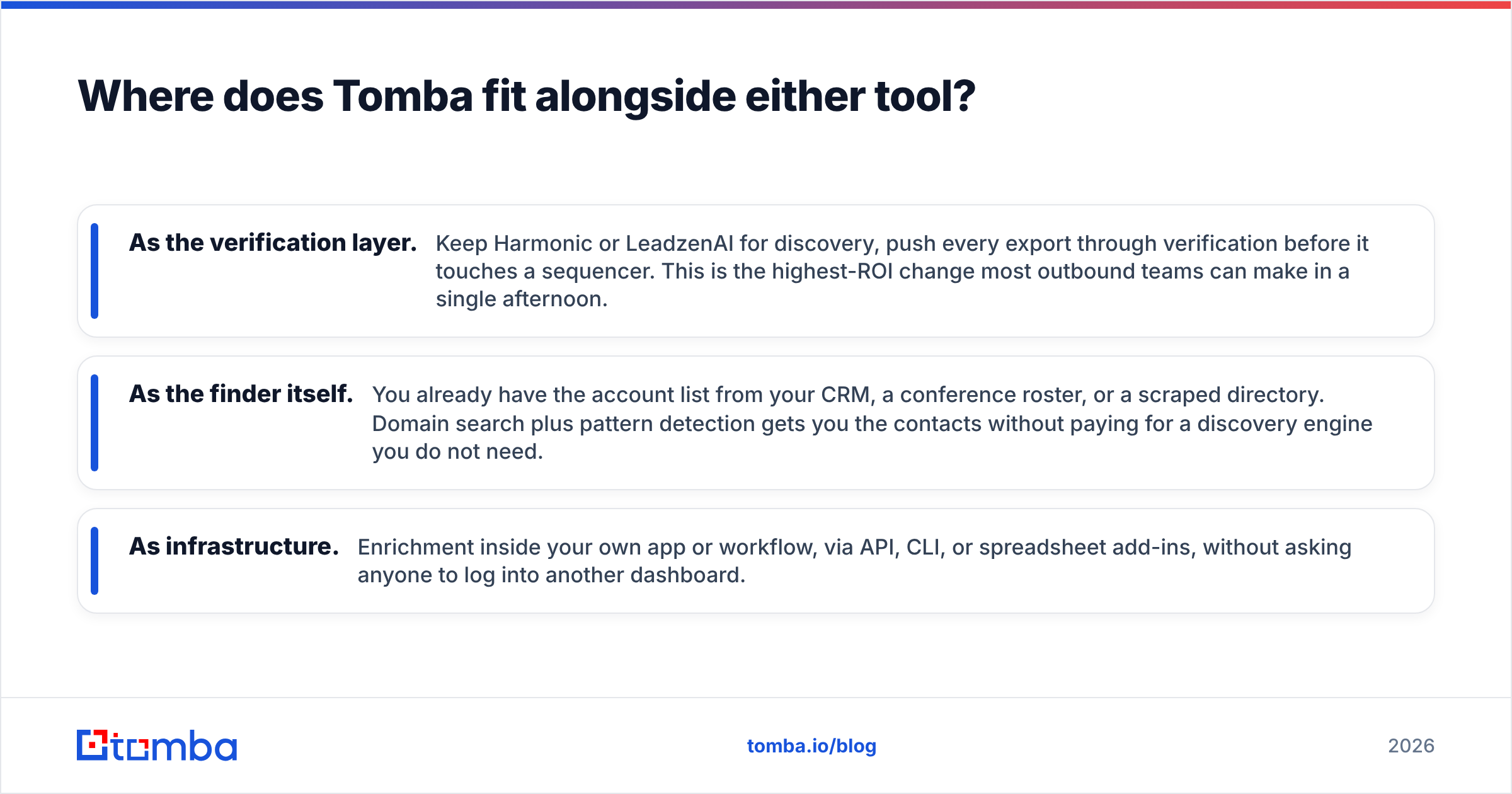
In practice, teams run it in one of three shapes:
- As the verification layer. Keep Harmonic or LeadzenAI for discovery. Push every export through verification before it touches a sequencer. Most outbound teams can make this change in one afternoon, and it pays back fast.
- As the finder itself. You already have the account list, from your CRM, a conference roster, or a scraped directory. Domain search plus pattern detection gets you the contacts, with no discovery engine to pay for.
- As infrastructure. Enrich inside your own app or workflow through the API, CLI, or spreadsheet add-ins. Nobody has to log into another dashboard.
None of this makes Harmonic or LeadzenAI a bad purchase. It means you should scope the purchase honestly. Buy Harmonic for signals. Buy LeadzenAI for regional contact volume at a price a small team can absorb. Then separate the "which addresses actually work" question from both, because that is the one that decides whether your emails land at all.
Start with the piece that changes your numbers fastest. Run your next 100 target domains through the Tomba Email Finder on the free tier — 25 searches a month, no card. Compare the deliverable-contact count against whatever list your current provider hands you. If the math favors you, Starter is $49/mo and the API comes with it.
Related guides#
Ready to find emails that actually work?
Join 150,000+ professionals who stopped guessing and started sending. Free credits on signup — no credit card required.
Get the Tomba newsletter
Practical outbound tactics and product updates — once every two weeks.
About the author