Harmonic vs Warpleads: Which B2B Data Tool Wins in 2026?
Harmonic tracks startup and headcount signals. Warpleads exports lead lists in bulk. They solve opposite halves of the same problem — here is which one actually fits your pipeline in 2026.
TL;DR
- Harmonic is a company-and-people intelligence platform built around growth signals: funding rounds, headcount changes, founder history, and startup discovery. You use it to decide who is worth contacting.
- Warpleads is a bulk lead-export platform: filter a large B2B contact database, export thousands of rows, push them into a sequencer. You use it to decide how many people you can contact this week.
- They are not really competitors. They sit at opposite ends of the same pipeline, and teams that buy one usually still need the other half.
- Neither is primarily a verification layer. Both hand you emails you should re-check before a send — bounce rate is where cheap lists get expensive.
- Pick Harmonic if timing and account selection drive your motion (VC, recruiting, PLG-to-enterprise). Pick Warpleads if volume and cost-per-lead drive it (agencies, SDR teams running high-volume outbound).
What are Harmonic and Warpleads?#
Short version: Harmonic finds the companies worth chasing; Warpleads gives you a pile of contacts to chase.
Harmonic built its reputation in the venture and talent-sourcing world. Its core asset is a continuously refreshed graph of private companies and the people inside them — when a company was founded, who joined, who left, how fast headcount is moving, which investors are on the cap table, what the website copy says today versus six months ago. The product is sold as both a search UI and an API, and a lot of its heaviest usage is programmatic: firms pipe Harmonic data into their own scoring models rather than clicking around in a dashboard.
Warpleads comes from the opposite tradition — the outbound tooling world. Its pitch is straightforward: a large contact database with filtering, an on-demand enrichment path, and export limits generous enough that you are not counting credits every morning. Buyers are typically lead-gen agencies and SDR teams that need to fill a cold email sequencer every week and care mostly about cost per usable contact.
That difference in origin explains almost every difference in the products. Harmonic optimizes for signal freshness on companies. Warpleads optimizes for volume and unit economics on contacts.
How do Harmonic and Warpleads compare head-to-head?#
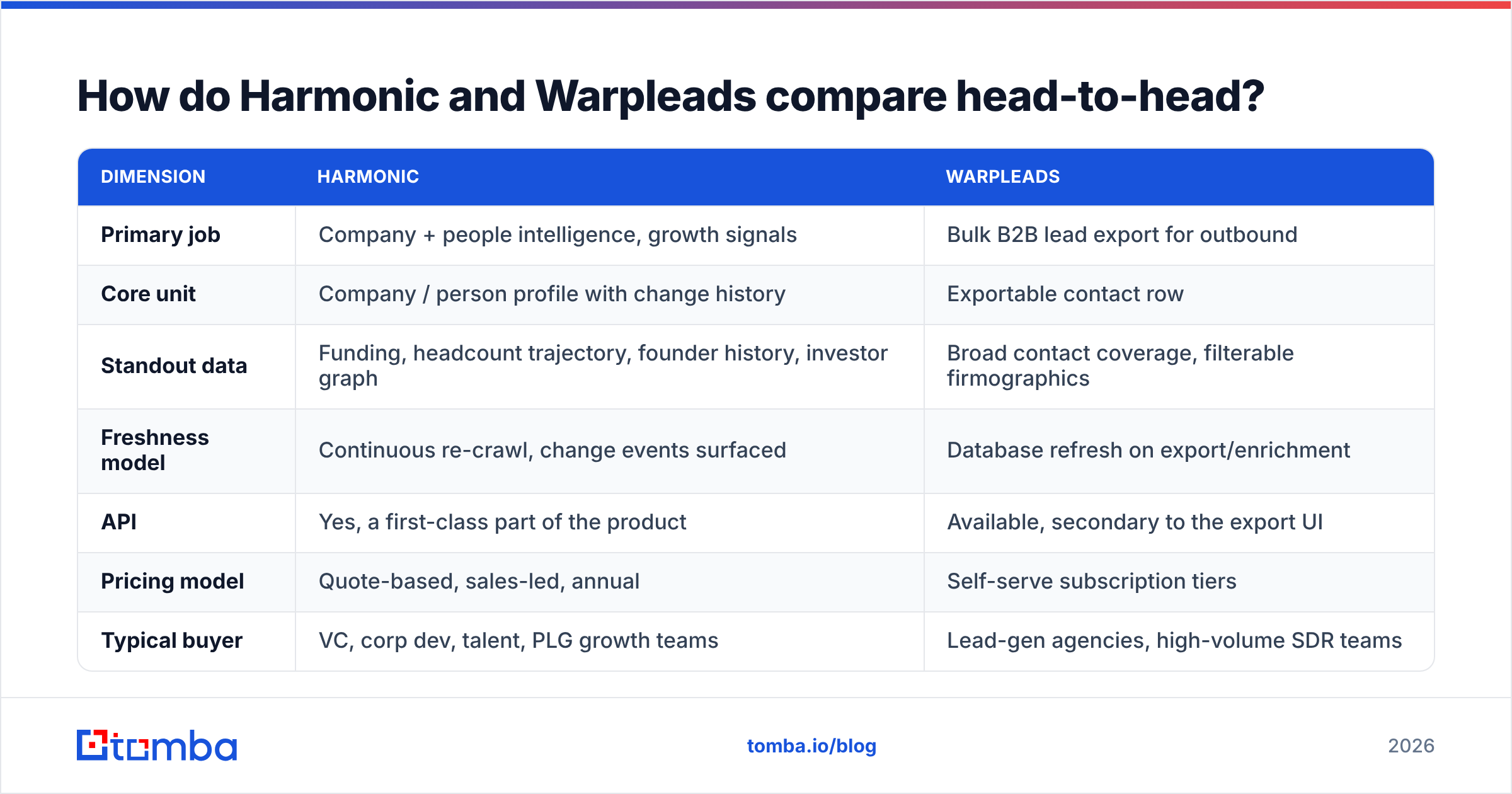
Pricing on both platforms moves, and Harmonic in particular is quote-based rather than published — treat the pricing row as directional and confirm on the vendor's site before you buy.
| Dimension | Harmonic | Warpleads |
|---|---|---|
| Primary job | Company + people intelligence, growth signals | Bulk B2B lead export for outbound |
| Core unit | Company / person profile with change history | Exportable contact row |
| Standout data | Funding, headcount trajectory, founder history, investor graph | Broad contact coverage, filterable firmographics |
| Freshness model | Continuous re-crawl, change events surfaced | Database refresh on export/enrichment |
| API | Yes, a first-class part of the product | Available, secondary to the export UI |
| Pricing model | Quote-based, sales-led, annual | Self-serve subscription tiers |
| Typical buyer | VC, corp dev, talent, PLG growth teams | Lead-gen agencies, high-volume SDR teams |
| Email verification | Not the product's focus | Basic; re-verification still recommended |
| Best at | Deciding who and when | Deciding how many |
| Weak at | Cheap per-contact volume | Timing signals and account prioritization |
The row that matters most is the last two. Harmonic will tell you that a 40-person Series A company just hired its first head of RevOps three weeks ago. Warpleads will tell you there are 8,000 RevOps titles in mid-market SaaS you can export today. Those are different questions, and confusing them is how teams end up paying enterprise prices for something they wanted volume from, or blasting 8,000 people because nobody scored the list.
What is Harmonic actually good at?#
Timing. Most B2B data tools give you a snapshot. Harmonic's value is in the delta — the fact that a company went from 12 to 31 employees in a quarter, or that a specific ex-Stripe engineer just registered a domain and pushed a landing page. If your motion depends on catching a company at a moment (a raise, a first sales hire, a sudden hiring spike in a department you sell to), that delta is the product.
Private-company depth. Public-company data is commoditized. Seed-and-earlier private company data is not, and that is where Harmonic concentrates. For anyone selling into startups, that coverage gap versus generic databases is real.
API-first design. Harmonic gets used as infrastructure. Teams pull profiles nightly, score them against their own ICP model, and only surface the top slice to reps. If your team has an analyst or engineer who can own that pipeline, the platform rewards it. If you do not, you are paying for a lot of capability you will click past.
Where it disappoints: contactability. Harmonic is excellent at telling you a company matters. It is not built to be your bulk source of verified, sendable work emails at agency scale. Many teams pair it with a dedicated email finder to turn a prioritized account list into an actual send list.
What is Warpleads actually good at?#
Cost per contact at volume. This is the whole thesis. When you are sending tens of thousands of emails a month, the difference between $0.02 and $0.15 per contact decides whether the channel is profitable. Warpleads is priced and packaged for teams doing exactly that math.
Export ergonomics. Filter, export, upload to your sequencer, go. There is very little ceremony. For an agency onboarding a new client on Monday and needing a list live by Wednesday, that speed is the feature.
Low friction to start. Self-serve signup and published tiers mean you can evaluate it without a procurement cycle. Compare that to a sales-led annual contract where you cannot even see a number until the second call.
Where it disappoints: discrimination. A big filterable database gives you everyone who matches a title and a size band. It does not tell you which 200 of those 8,000 people have a reason to reply this month. That is the gap Harmonic-style signal data fills — and it is why "cheap leads" and "good leads" are not the same purchase.
How does the underlying data actually differ?#
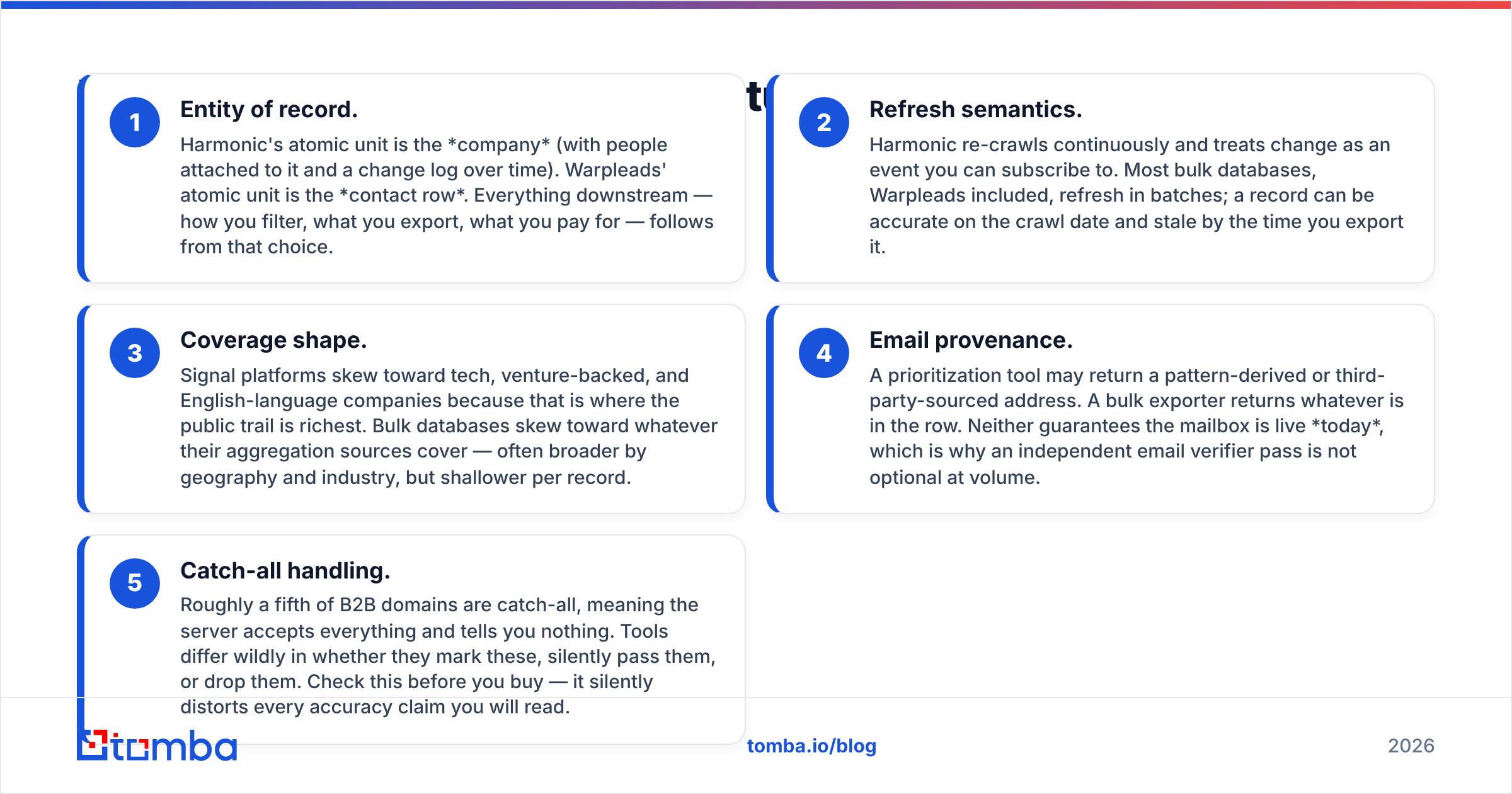
This is where most comparison posts wave their hands. The concrete differences:
- Entity of record. Harmonic's atomic unit is the company (with people attached to it and a change log over time). Warpleads' atomic unit is the contact row. Everything downstream — how you filter, what you export, what you pay for — follows from that choice.
- Refresh semantics. Harmonic re-crawls continuously and treats change as an event you can subscribe to. Most bulk databases, Warpleads included, refresh in batches; a record can be accurate on the crawl date and stale by the time you export it.
- Coverage shape. Signal platforms skew toward tech, venture-backed, and English-language companies because that is where the public trail is richest. Bulk databases skew toward whatever their aggregation sources cover — often broader by geography and industry, but shallower per record.
- Email provenance. A prioritization tool may return a pattern-derived or third-party-sourced address. A bulk exporter returns whatever is in the row. Neither guarantees the mailbox is live today, which is why an independent email verifier pass is not optional at volume.
- Catch-all handling. Roughly a fifth of B2B domains are catch-all, meaning the server accepts everything and tells you nothing. Tools differ wildly in whether they mark these, silently pass them, or drop them. Check this before you buy — it silently distorts every accuracy claim you will read.

Which one wins for your use case?#
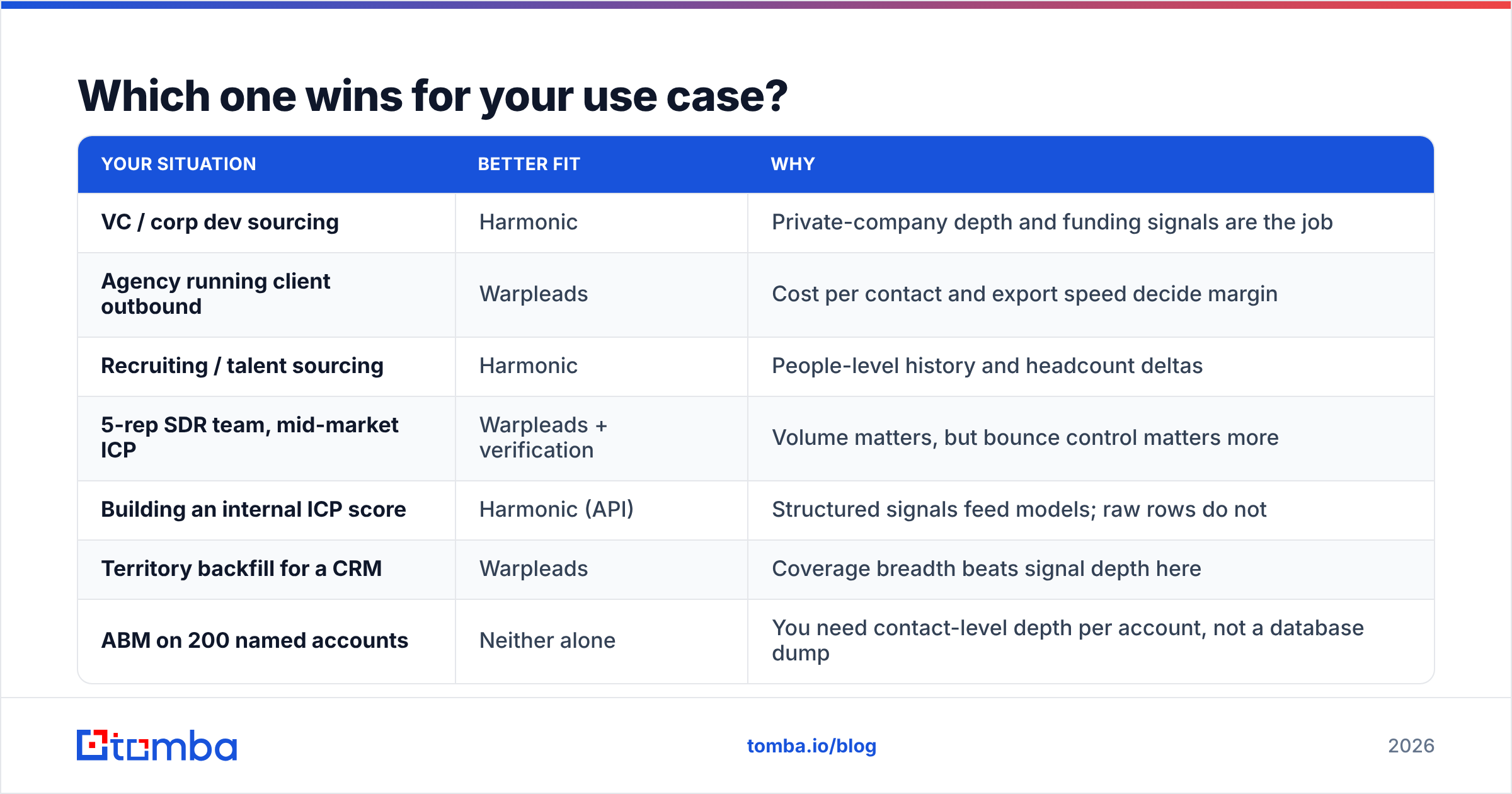
| Your situation | Better fit | Why |
|---|---|---|
| VC / corp dev sourcing | Harmonic | Private-company depth and funding signals are the job |
| Agency running client outbound | Warpleads | Cost per contact and export speed decide margin |
| Recruiting / talent sourcing | Harmonic | People-level history and headcount deltas |
| 5-rep SDR team, mid-market ICP | Warpleads + verification | Volume matters, but bounce control matters more |
| Building an internal ICP score | Harmonic (API) | Structured signals feed models; raw rows do not |
| Territory backfill for a CRM | Warpleads | Coverage breadth beats signal depth here |
| ABM on 200 named accounts | Neither alone | You need contact-level depth per account, not a database dump |
That last row is worth sitting with. Neither product is designed for "I know my 200 accounts, get me every relevant decision-maker inside each one." That is a domain search problem — you start from the company domain and enumerate the people, rather than starting from a filter and hoping the right accounts fall out.
What about pricing?#
Warpleads publishes self-serve tiers; Harmonic does not publish pricing and routes you through sales, which in practice means an annual commitment. That structural difference tells you more than any specific number:
- Sales-led + annual signals a product priced against the value of a decision (a fund's investment, a key hire). Seat counts are usually small and per-seat costs are high.
- Self-serve + monthly signals a product priced against volume. Per-unit cost is low; you are expected to consume a lot.
Before you sign either, run the same three checks:
- Ask for a coverage sample against your actual ICP. Not a demo list — 500 rows of your real target segment. Match rate on a curated demo tells you nothing.
- Verify the sample independently. Run the exported emails through a neutral checker and count hard bounces, catch-alls, and role addresses separately. Vendor-reported accuracy and your measured deliverable rate are different numbers.
- Price the whole stack, not the tool. If a cheap list needs a verification pass and an enrichment pass, the real cost per usable contact can be 3-4x the headline. Compare stacks, not line items.
Public review data on G2 is useful for spotting support and billing complaints, but be skeptical of accuracy claims in reviews — almost nobody measures them the same way.
Do you still need a third tool?#
Usually, yes — and it is the boring one.
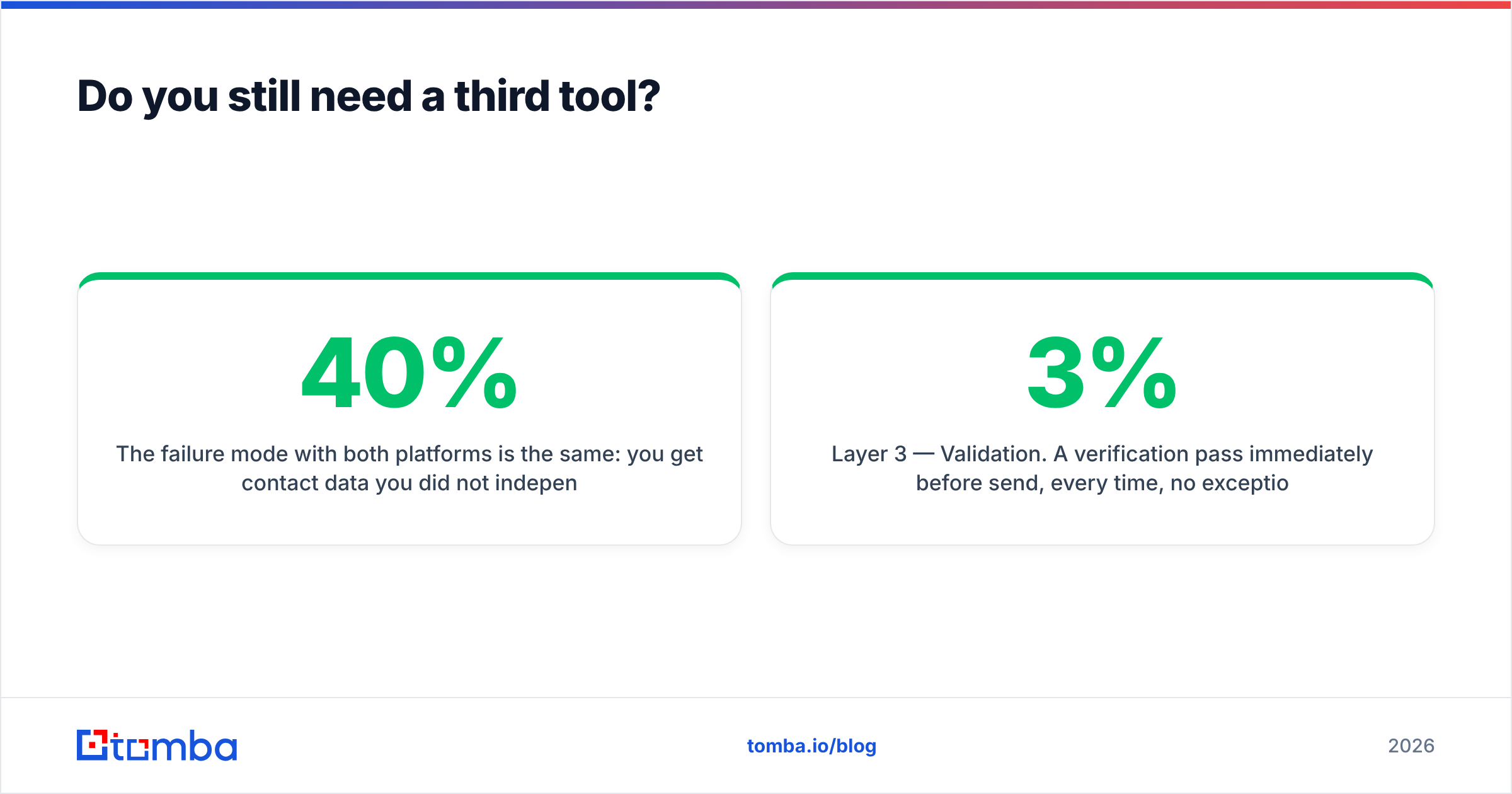
The failure mode with both platforms is the same: you get contact data you did not independently validate, load it into a sequencer, and discover the cost two weeks later when your domain reputation is already damaged. A 40% bounce rate on a 10,000-address send does not just waste 4,000 emails; it teaches mailbox providers that your domain sends to dead addresses, and your good emails start landing in spam. Recovering sender reputation takes far longer than building it. HubSpot's research on email benchmarks is a reasonable starting point for what healthy looks like, but the operational rule is simpler: keep hard bounces under 2%, and you never have to think about it.
A practical three-layer stack looks like this:
- Layer 1 — Prioritization. Harmonic, or your own signal model. Decides which accounts get attention this month.
- Layer 2 — Contact acquisition. Warpleads for breadth, or a domain-first finder when you already know the accounts. This is also where data enrichment fills gaps in rows you already own.
- Layer 3 — Validation. A verification pass immediately before send, every time, no exceptions. Lists decay roughly 2-3% per month as people change jobs; a list verified in March is not a verified list in July.
Teams that skip layer 3 to save money are the same teams that later pay a deliverability consultant to un-burn their domain.
So, Harmonic or Warpleads?#
Buy Harmonic if your bottleneck is knowing where to aim. If your reps have plenty of names but no idea which ones are in-market, more rows will not help. Signal data will. Budget for a sales cycle and someone technical to make the API earn its price.
Buy Warpleads if your bottleneck is volume at a workable cost. If you already know your ICP cold and just need to keep the top of the funnel full without blowing the budget, a self-serve bulk exporter is the right shape of tool. Add verification and treat it as part of the cost, not an optional extra.
Buy neither yet if you have fewer than 300 target accounts. At that scale, a database subscription is overkill. Start from the account list you already have, enumerate contacts by domain, verify, and send.
Whichever way you go, the contact layer is where deals actually get won or bounced. Tomba's Email Finder is built for exactly that layer — find professional addresses by domain, name, or company, with verification built into the same workflow so you are not stitching three vendors together. The free tier gives you 25 searches a month to test match rates against your own list, and paid plans start at $49/mo on Starter, with Growth at $99/mo when volume picks up. Full Tomba pricing is public — no sales call required to see a number.
Run your next 500 prospects through it and compare the deliverable rate against whatever you are exporting today. That single test will settle the buying decision faster than any comparison table, including this one.
Related guides#
Ready to find emails that actually work?
Join 150,000+ professionals who stopped guessing and started sending. Free credits on signup — no credit card required.
Get the Tomba newsletter
Practical outbound tactics and product updates — once every two weeks.
About the author