9 Best Hippo Video Alternatives in 2026 (Free and Paid)
Hippo Video bundles recording, personalization, and analytics into one seat price — but that seat price adds up fast. Here are nine alternatives compared on pricing, CRM depth, personalization, and the outbound workflows they actually fit.

TL;DR
- Hippo Video is strong at one thing: turning a single recording into hundreds of personalized variants with CRM triggers attached. Most teams leave because per-seat pricing scales badly once SDRs and CSMs both want access.
- If you want cheap async video and nothing else, Loom or Vimeo Record wins. If you want video welded to your CRM, Vidyard is the closest like-for-like swap.
- For outbound-first teams doing dynamic personalization at volume, Sendspark and Potion are the two credible challengers — both were built for cold email, not internal comms.
- Covideo and Dubb are better fits for phone-heavy and SMB sales teams; Bonjoro owns the customer-onboarding and post-purchase use case.
- No video tool fixes bad data. A personalized video sent to a bounced address is a wasted render — verify addresses before you record anything.
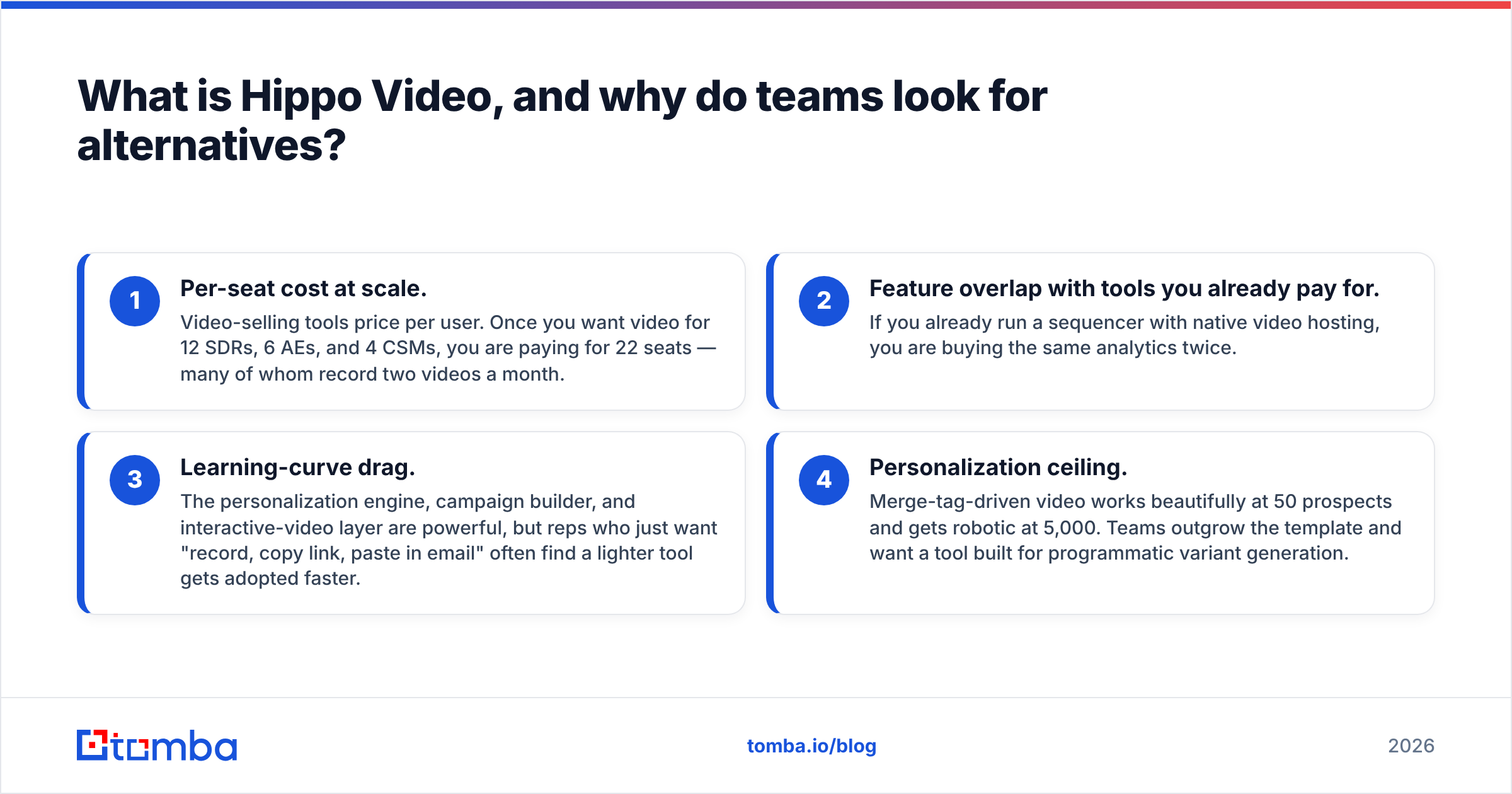
What is Hippo Video, and why do teams look for alternatives?#
Hippo Video is a video-selling platform: screen and webcam recording, a landing page for each video, dynamic personalization (name, company, logo, website in the thumbnail or background), viewer analytics, and integrations into Salesforce, HubSpot, Outreach, and Gmail. It sits in the same bracket as Vidyard and Covideo — the "video for revenue teams" category rather than the "video for marketing" category.
It is a genuinely capable product. The reasons teams shop around are almost always the same four:
- Per-seat cost at scale. Video-selling tools price per user. Once you want video for 12 SDRs, 6 AEs, and 4 CSMs, you are paying for 22 seats — many of whom record two videos a month.
- Feature overlap with tools you already pay for. If you already run a sequencer with native video hosting, you are buying the same analytics twice.
- Learning-curve drag. The personalization engine, campaign builder, and interactive-video layer are powerful, but reps who just want "record, copy link, paste in email" often find a lighter tool gets adopted faster.
- Personalization ceiling. Merge-tag-driven video works beautifully at 50 prospects and gets robotic at 5,000. Teams outgrow the template and want a tool built for programmatic variant generation.
If any of those describe you, the list below is sorted by which job you are hiring the tool to do — not by which vendor pays the most for reviews.
What should you look for in a Hippo Video alternative?#
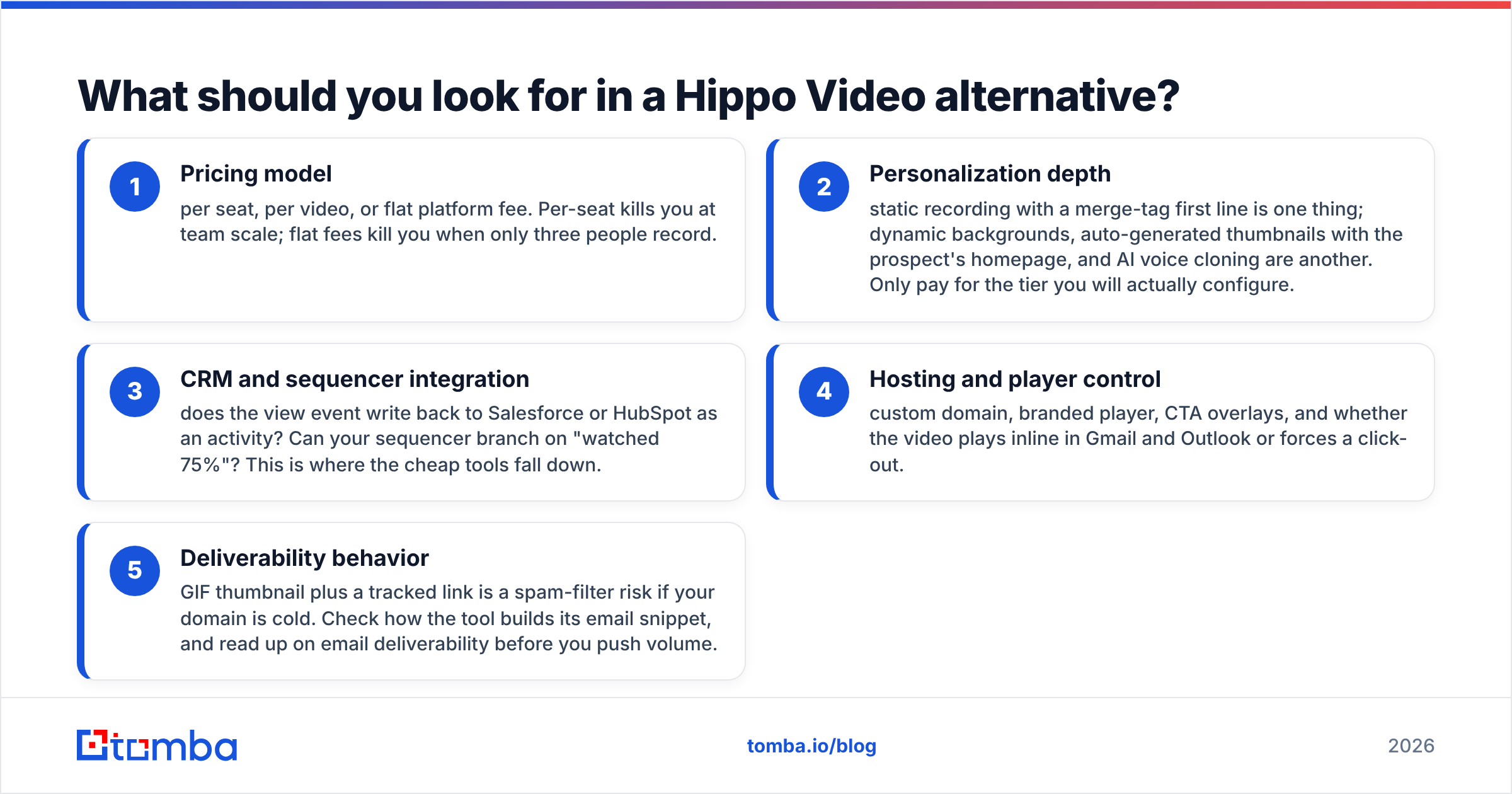
Before you compare logos, get clear on the five decision axes. Most buying mistakes come from optimizing for the wrong one.
- Pricing model — per seat, per video, or flat platform fee. Per-seat kills you at team scale; flat fees kill you when only three people record.
- Personalization depth — static recording with a merge-tag first line is one thing; dynamic backgrounds, auto-generated thumbnails with the prospect's homepage, and AI voice cloning are another. Only pay for the tier you will actually configure.
- CRM and sequencer integration — does the view event write back to Salesforce or HubSpot as an activity? Can your sequencer branch on "watched 75%"? This is where the cheap tools fall down.
- Hosting and player control — custom domain, branded player, CTA overlays, and whether the video plays inline in Gmail and Outlook or forces a click-out.
- Deliverability behavior — GIF thumbnail plus a tracked link is a spam-filter risk if your domain is cold. Check how the tool builds its email snippet, and read up on email deliverability before you push volume.
What are the 9 best Hippo Video alternatives in 2026?#
Pricing below reflects publicly listed plans at the time of writing; video vendors change tiers often, so treat these as ballpark and confirm on the vendor site.
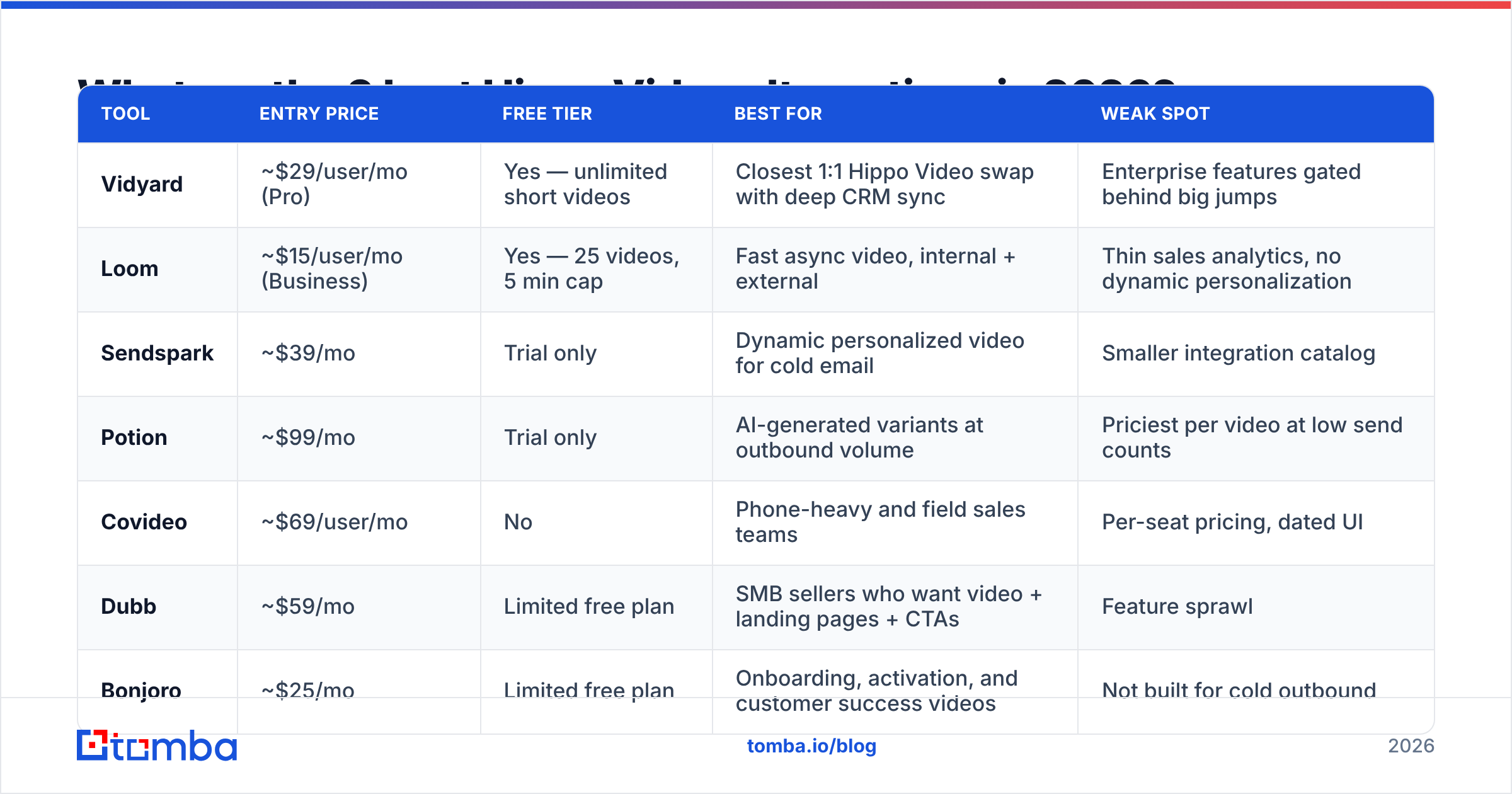
| Tool | Entry price | Free tier | Best for | Weak spot |
|---|---|---|---|---|
| Vidyard | ~$29/user/mo (Pro) | Yes — unlimited short videos | Closest 1:1 Hippo Video swap with deep CRM sync | Enterprise features gated behind big jumps |
| Loom | ~$15/user/mo (Business) | Yes — 25 videos, 5 min cap | Fast async video, internal + external | Thin sales analytics, no dynamic personalization |
| Sendspark | ~$39/mo | Trial only | Dynamic personalized video for cold email | Smaller integration catalog |
| Potion | ~$99/mo | Trial only | AI-generated variants at outbound volume | Priciest per video at low send counts |
| Covideo | ~$69/user/mo | No | Phone-heavy and field sales teams | Per-seat pricing, dated UI |
| Dubb | ~$59/mo | Limited free plan | SMB sellers who want video + landing pages + CTAs | Feature sprawl |
| Bonjoro | ~$25/mo | Limited free plan | Onboarding, activation, and customer success videos | Not built for cold outbound |
| Tolstoy | ~$0–$99/mo | Yes | Interactive, branching video on site and in email | Different job than 1:1 selling |
| Vimeo Record | ~$12/mo | Yes | Cheap hosting when you only need a reliable player | No sales workflow layer at all |
Vidyard — the closest like-for-like replacement#
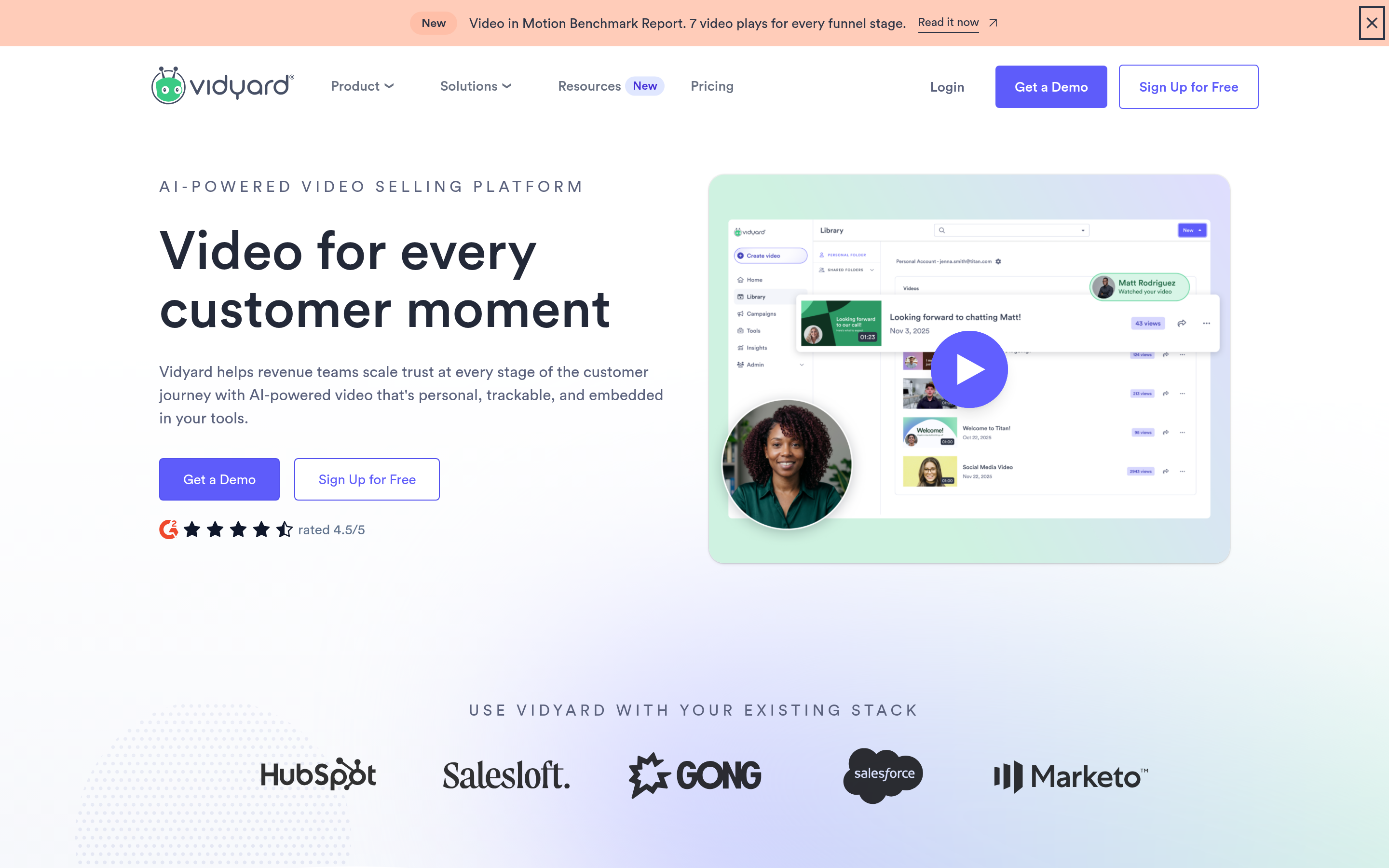
Vidyard is the default answer when someone says "not Hippo Video, but same category." Recording, hosting, a real video CMS, AI script generation, and view-tracking that writes activity into Salesforce and HubSpot properly. The free plan is unusually generous for evaluation — unlimited short recordings with the Vidyard player.
Pick it if: your rev-ops team wants video engagement data as a first-class object in the CRM, and you have budget for per-seat licenses.
Skip it if: you want programmatic variant generation for thousands of prospects. Vidyard's personalization is good but it is fundamentally a recording tool, not a rendering engine.
Loom — the adoption winner#
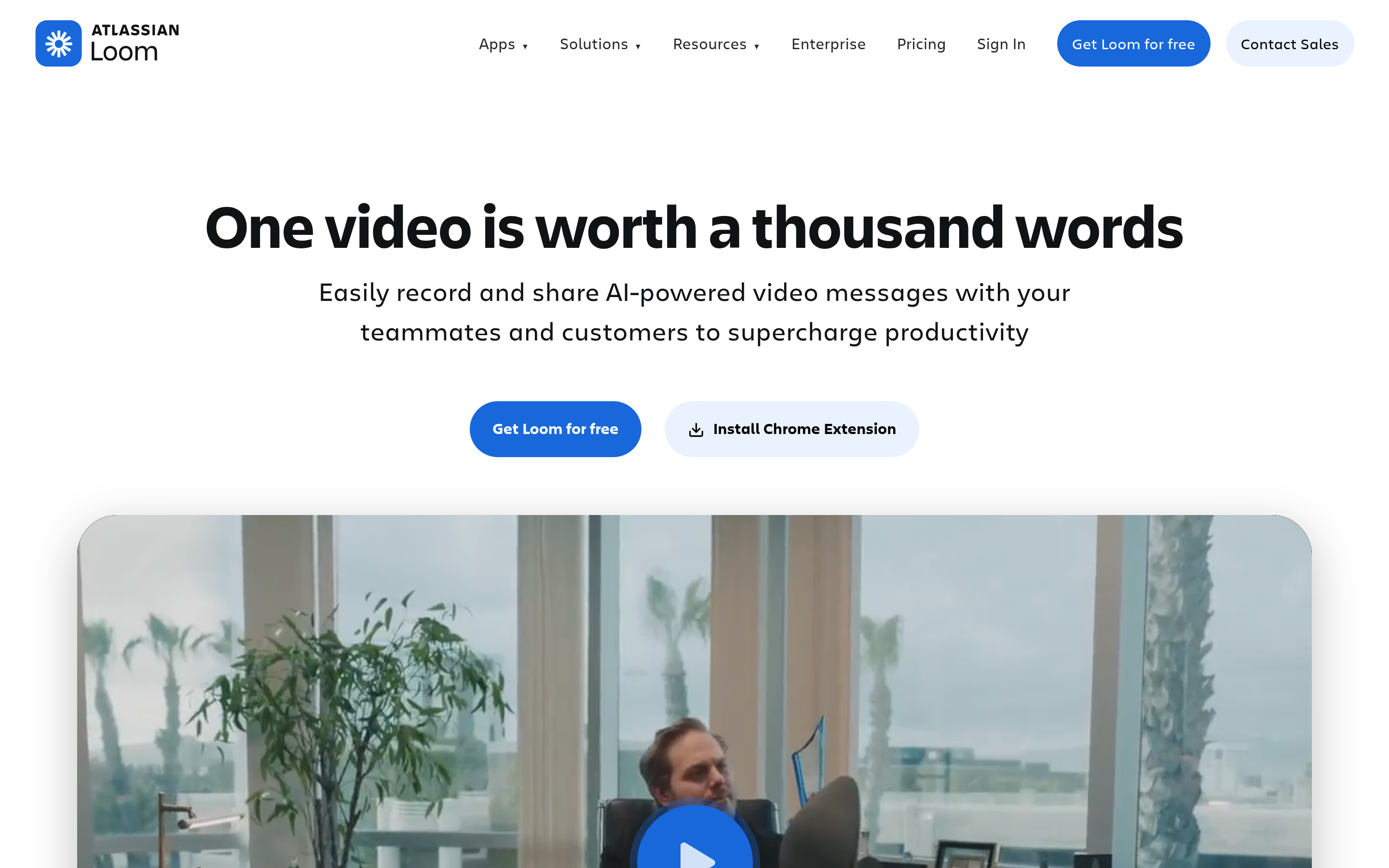
Loom's advantage is not features, it is that people actually use it. The extension is fast, the link works everywhere, and no rep needs training. Business-tier pricing lands well under most video-selling tools, and the transcript, AI title, and chapter features are solid.
Pick it if: your video use case is 70% internal (handoffs, demos for the team, async standups) with a bit of external sharing.
Skip it if: your CFO expects to see video views attributed to pipeline. Loom's analytics tell you who watched; they do not tell your sequencer to branch.
Sendspark — outbound-native personalization#
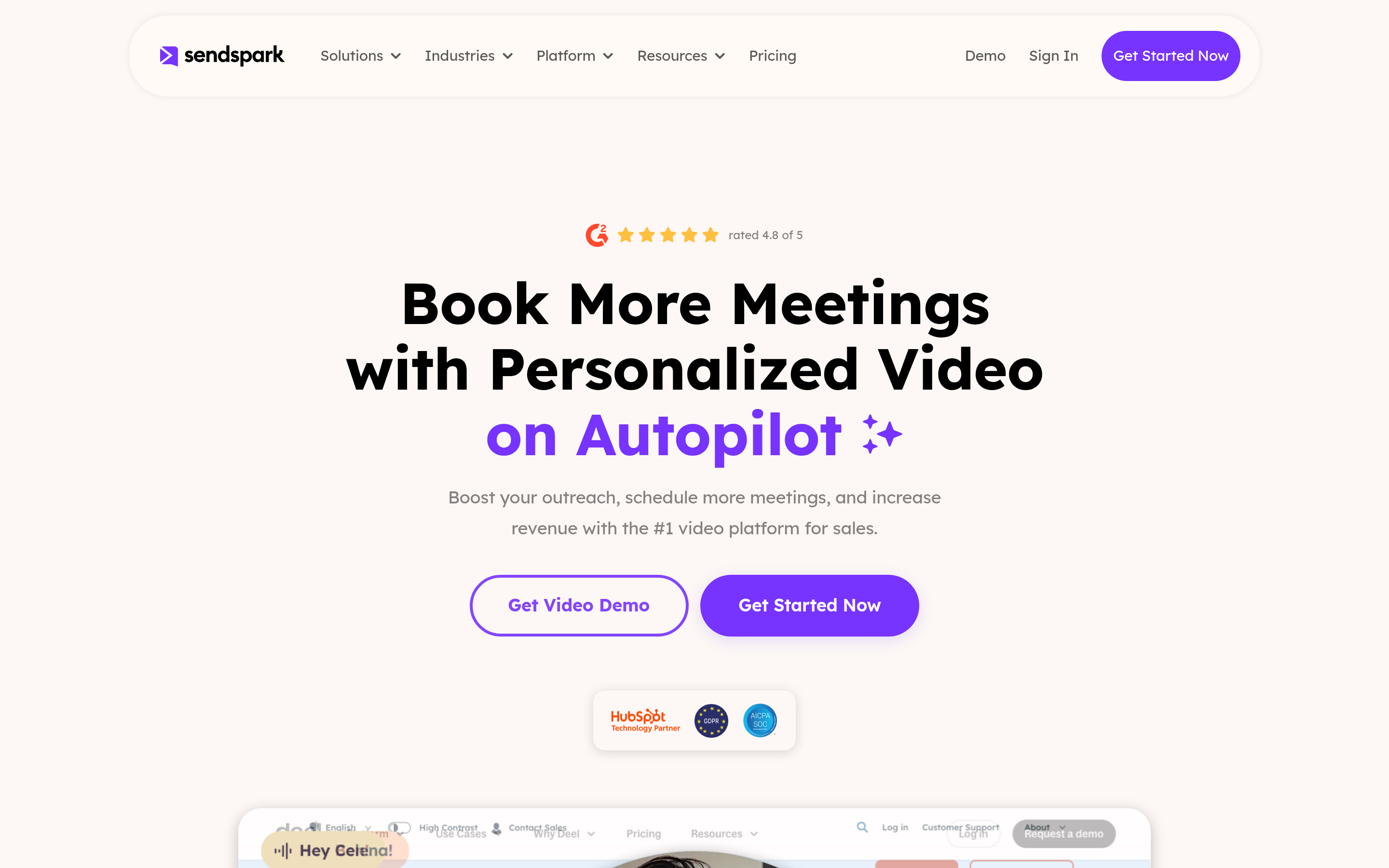
Sendspark was designed for cold email from day one. Record one base video, feed it a CSV or CRM list, and it generates per-prospect variants with a dynamic background showing the prospect's own website, plus an animated thumbnail for the email body. It integrates with the sequencers outbound teams actually run.
Pick it if: your primary job to be done is "make cold email reply more often" and you are sending hundreds of videos a month.
Skip it if: you need enterprise CRM governance or SSO on a small plan.
Potion — AI variants at volume#
Potion leans hardest into AI: record once, and it swaps the spoken first line per prospect using a clone of your voice, so every prospect hears their own name and company. When it works, it is uncanny in a good way. When the audio splice is off, it is uncanny in a bad way — test heavily before you scale.
Pick it if: you are running high-volume outbound and want personalization that survives 2,000 sends without re-recording.
Skip it if: your list is under a few hundred contacts a month. At that volume the per-video economics are poor and you may as well record manually.
Covideo — built for the phone-first seller#
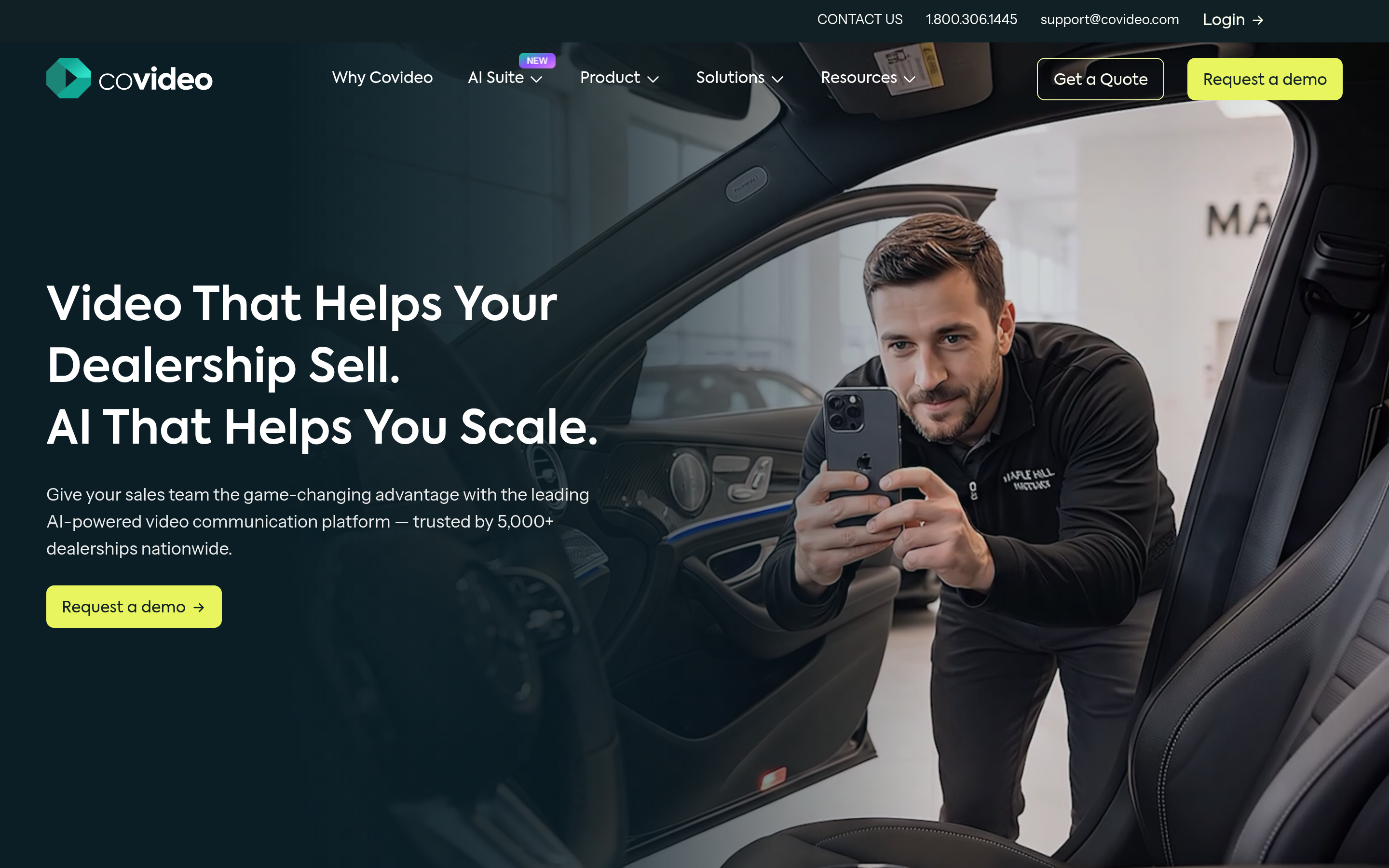
Covideo is the veteran of the category, heavily used in automotive, mortgage, staffing, and other industries where sellers work a phone list. Strong mobile app, text-message video delivery, and a support model that suits teams who do not have a rev-ops function.
Pick it if: your sellers are on the road and half your delivery is SMS.
Skip it if: you want modern API access and self-serve pricing.
Dubb — the SMB all-in-one#
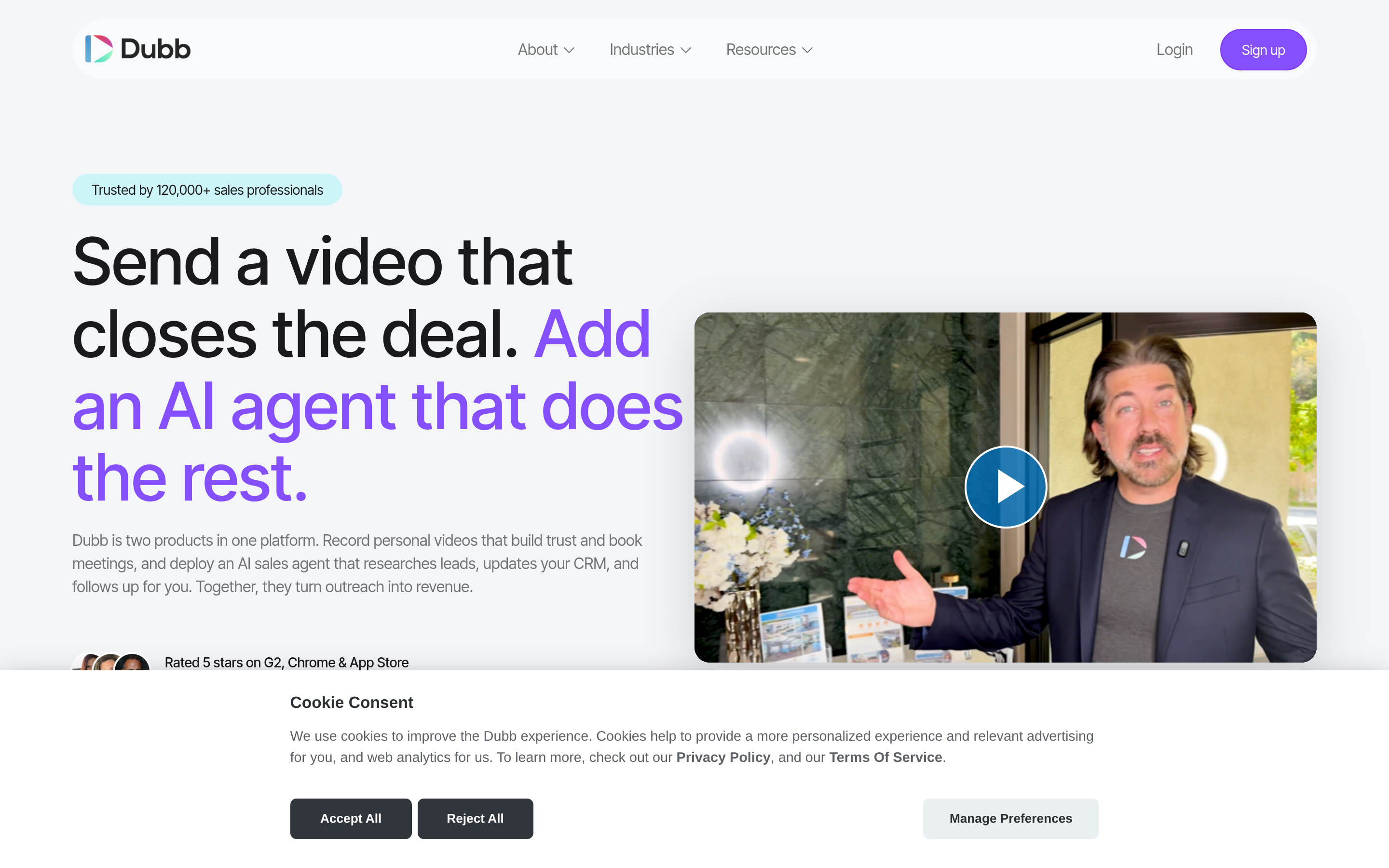
Dubb bundles recording, hosting, landing pages, CTAs, email and SMS sending, and a light CRM. That breadth is either the reason to buy it or the reason not to. For a two-person agency it can replace three subscriptions; for a 30-person sales org it will lose to specialized tools.
Bonjoro — post-sale, not pre-sale#
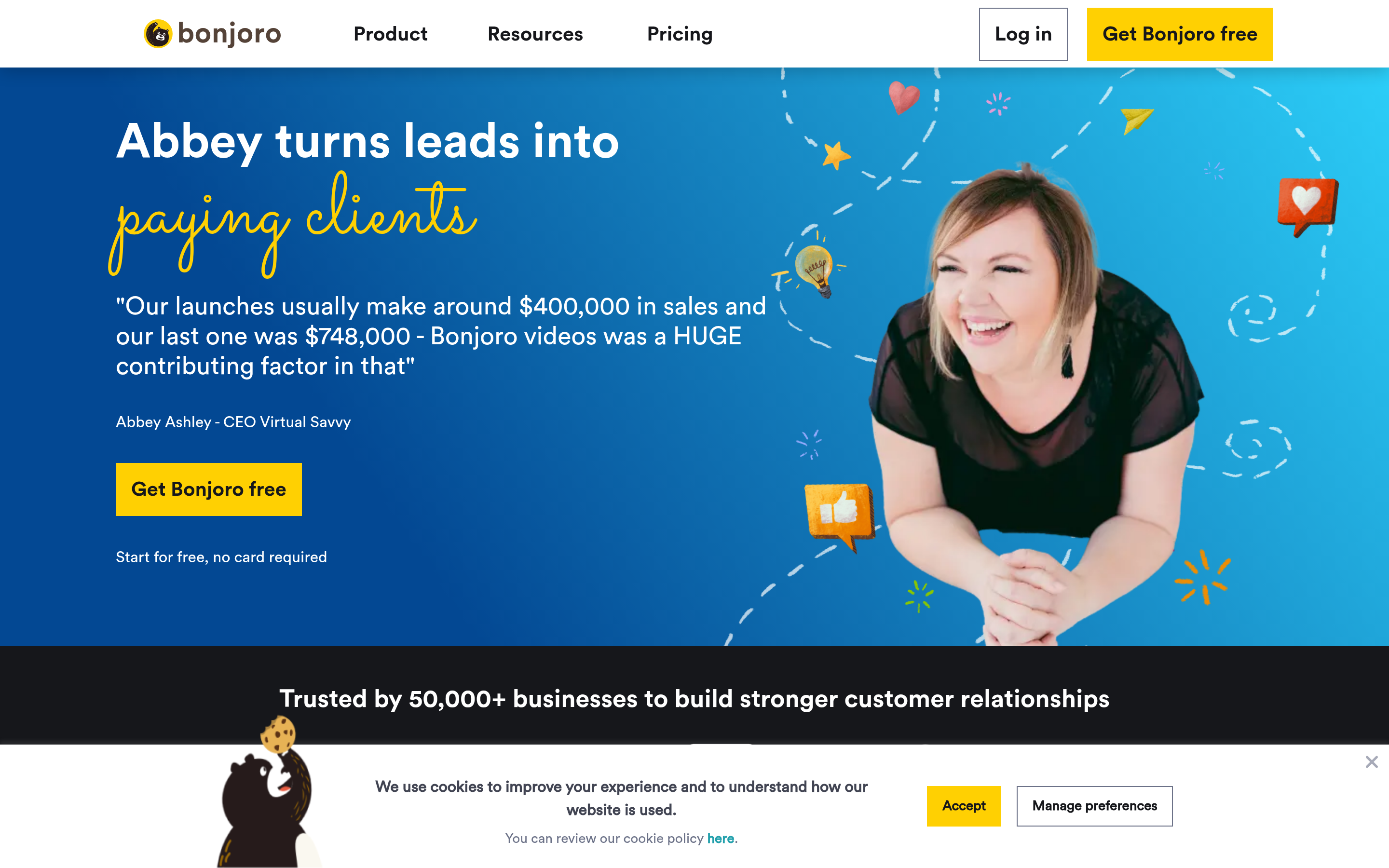
Bonjoro is the odd one out and deserves a mention precisely because so many teams buy a sales video tool for a customer problem. Bonjoro triggers "record a welcome video" tasks from your product events — a new signup, a plan upgrade, an activation milestone — and routes them to the right CSM. Response rates on post-purchase video are dramatically better than on cold video, because the recipient already knows you.
Tolstoy — interactive and branching#
Tolstoy handles a different shape of video: branching, choose-your-path experiences embedded on landing pages, in emails, and on product pages. It is not a 1:1 selling tool. It is on this list because a chunk of "we need Hippo Video" requests are actually "we need an interactive product tour."
Vimeo Record — cheap, boring, reliable#
If your requirement is genuinely just "host the video, give me a link that always plays," Vimeo is the least glamorous and most dependable choice. No sales workflow, no CRM writeback, no personalization. Very low cost per seat.
Which Hippo Video alternative is cheapest?#
Cheapest depends on shape, not sticker price:
- Under 5 recorders, mostly async sharing: Loom or Vimeo. You will spend under $100/month total.
- 5–15 sellers who need CRM attribution: Vidyard. Per-seat, but the analytics justify it.
- Outbound team sending 500+ videos/month: Sendspark or Potion. Flat platform pricing beats per-seat here, and the personalization actually scales.
- Field or phone sales: Covideo, despite the per-seat cost, because SMS delivery is native.
The trap is buying a per-seat plan for an org where six people record weekly and sixteen record twice a year. Split the team: named seats for the power users, a free tool for everyone else.

Does video prospecting still work in 2026?#
Yes — but the honest version is narrower than the vendor case studies suggest.
Video lifts reply rates most in the middle and bottom of your sequence, not step one. A cold first touch with an embedded GIF thumbnail from an unknown domain looks exactly like the phishing pattern spam filters were trained on. A video on step three, after a prospect has opened twice, converts far better and carries less deliverability risk.
Video also works best when the recording proves something a paragraph cannot: a 40-second screen share of a bug on their pricing page, a walkthrough of their competitor's checkout flow, a real audit. Generic "Hi {{FirstName}}, just wanted to reach out" video is worse than plain text, because it costs you 90 seconds per prospect to produce the same rejection.
Check the current review distributions on G2 before you sign anything — the category churns fast, and last year's leader is not automatically this year's.
How do you get the contact data behind video outreach?#
This is the part most video comparisons skip, and it is the part that determines your ROI.
Video is the most expensive personalization format per prospect. Even with AI variant generation, you are paying real money per render and real attention per review. Which means the cost of a bad address is much higher than in plain-text outbound: a bounced send does not just waste a credit, it wastes the render and dents your sender reputation at the same time.
A workable sequence looks like this:
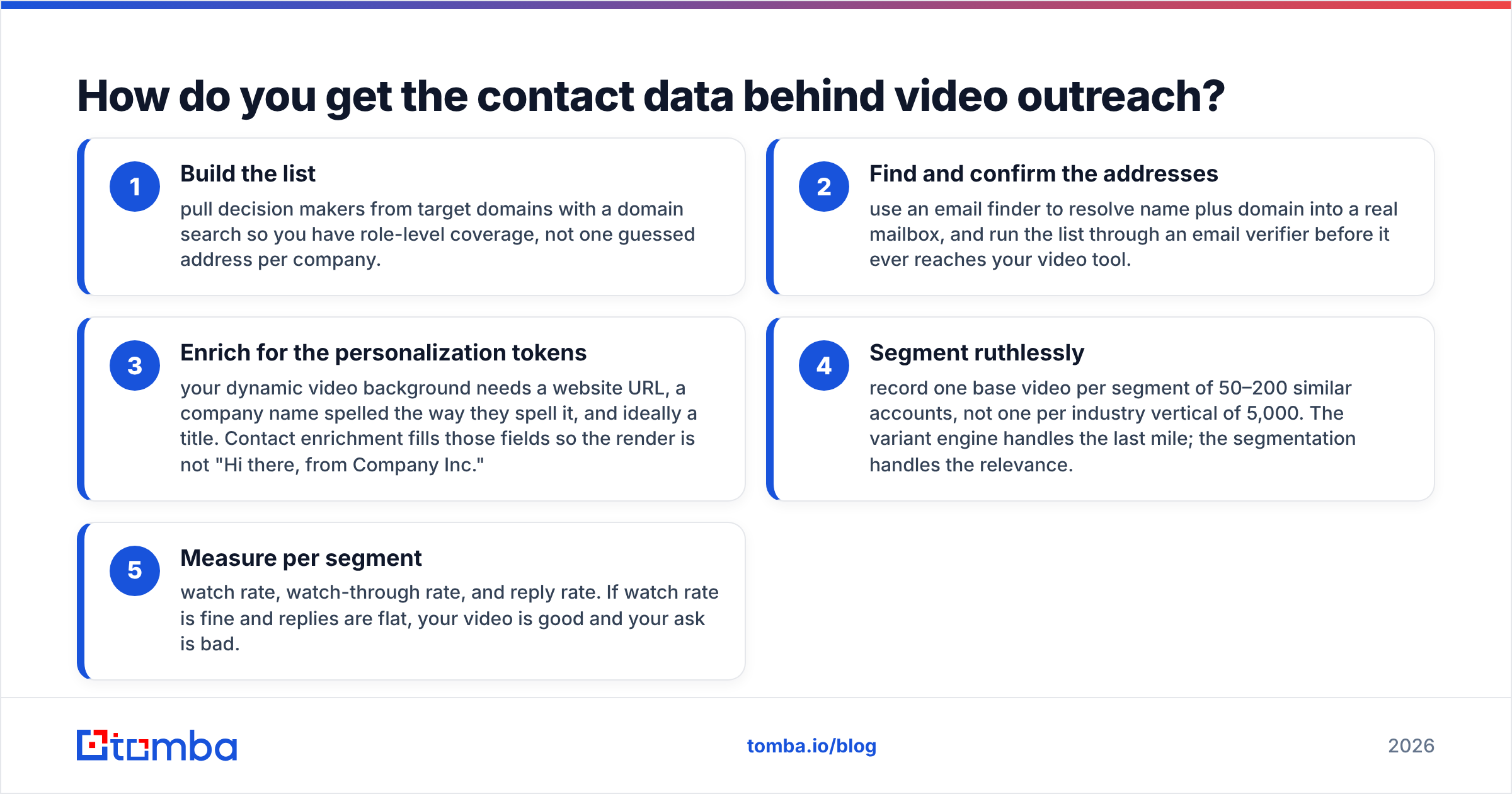
- Build the list — pull decision makers from target domains with a domain search so you have role-level coverage, not one guessed address per company.
- Find and confirm the addresses — use an email finder to resolve name plus domain into a real mailbox, and run the list through an email verifier before it ever reaches your video tool.
- Enrich for the personalization tokens — your dynamic video background needs a website URL, a company name spelled the way they spell it, and ideally a title. Contact enrichment fills those fields so the render is not "Hi there, from Company Inc."
- Segment ruthlessly — record one base video per segment of 50–200 similar accounts, not one per industry vertical of 5,000. The variant engine handles the last mile; the segmentation handles the relevance.
- Measure per segment — watch rate, watch-through rate, and reply rate. If watch rate is fine and replies are flat, your video is good and your ask is bad.
Get steps 1–3 wrong and it does not matter which of the nine tools you picked. Get them right and even Loom plus a spreadsheet outperforms an expensive platform running on stale data.
Which one should you actually pick?#
- Replacing Hippo Video feature-for-feature: Vidyard.
- Cutting cost with minimal disruption: Loom, plus a free tier for occasional recorders.
- Scaling personalized cold video: Sendspark first, Potion if you need voice-level personalization.
- Phone and field sales: Covideo.
- Post-sale and onboarding: Bonjoro.
- Just hosting: Vimeo.
Run a two-week pilot with two tools, not five. Send the same 100 prospects the same offer through both, and compare reply rate — not watch rate, which every vendor will happily inflate for you.
Start with the data, then pick the camera#
Whichever video tool you land on, its output is only as good as the list you point it at. Tomba's Email Finder resolves verified business addresses from a name and domain, with a free tier of 25 searches a month and paid plans starting at $49/month — see full Tomba pricing for volume tiers. Build the verified, enriched list first, then decide whether your prospects need Vidyard, Sendspark, or a plain Loom link. The list is what compounds; the video tool is replaceable.
Related guides#
Ready to find emails that actually work?
Join 150,000+ professionals who stopped guessing and started sending. Free credits on signup — no credit card required.
Get the Tomba newsletter
Practical outbound tactics and product updates — once every two weeks.
About the author