HitHorizons vs Pubrio: Which B2B Data Tool Wins in 2026?
HitHorizons sells registry-grade company records. Pubrio sells AI-assisted contact discovery. They solve different halves of the same problem — here's how to tell which half you're actually missing.
HitHorizons vs Pubrio looks like a head-to-head fight. It isn't. One tool sells company records pulled from official registries. The other sells contact records built with AI. Here is how to tell which half you actually need.
TL;DR
- HitHorizons and Pubrio are not really competitors. HitHorizons is a company-data platform built on official business-registry filings. Pubrio is an AI-assisted B2B prospecting tool built on contact records. Buying one when you needed the other is the most common mistake here.
- Pick HitHorizons if your bottleneck is company truth: legal entity names, registration IDs, corporate hierarchies, sector codes, and European market maps for TAM sizing, KYC, or research.
- Pick Pubrio if your bottleneck is people: finding the right contact at a target account, then getting an email or phone number into a sequence this week.
- Neither is a complete GTM stack. HitHorizons rarely hands you a decision-maker's inbox. Pubrio's contact data needs verification before you send, like every AI-enriched database.
- The cheapest fix for most teams is a firmographic source plus a finder-and-verifier layer. That is where a tool like Tomba's email finder at $49/mo slots in, well below either platform's enterprise pricing.
What is HitHorizons and who actually uses it?#
HitHorizons is a company information database. It draws on official national business registries, mostly across Europe, with some global coverage. It does not scrape LinkedIn or collect self-reported profiles. Instead it pulls the paperwork companies must file by law: registered legal name, registration number, incorporation date, registered address, industry classification, and — where the registry publishes it — financial filings and ownership links.
That provenance is the entire product. A compliance analyst asks one question: is this the same legal entity that signed the contract, or a subsidiary with a similar trading name? Registry data answers it. A scraped B2B database does not.
Typical users:
- Market researchers and strategy teams sizing a European market by country, sector, and revenue band.
- Risk, KYC, and procurement teams checking that a counterparty exists and mapping its corporate family tree.
- Data teams enriching a CRM with canonical entity IDs, so that 'Siemens AG', 'Siemens A.G.' and 'SIEMENS' stop being three accounts.
- ABM planners building a target account list that holds up in front of a CFO, because it rests on filings rather than guesses.
What HitHorizons is not built to do: hand you the VP of Engineering's mobile number. Registry filings list directors and registered agents, not the buying committee.
What is Pubrio and what problem does it solve?#
Pubrio sits on the other side of the funnel. It is a B2B lead-generation platform with a contact database and AI-assisted search. You describe the buyer you want in plain language. It returns a list of people, and you export them with work emails — plus phone numbers on higher tiers. It also ships a browser extension, so you can pull contacts while you browse a company site or a social profile, and it enriches lists you already have.
The pitch is speed. A rep might spend forty minutes building a list of twenty-five heads of RevOps at Series B SaaS companies. Pubrio returns something usable in a few minutes. That is a real gain. It is why this category — Apollo, Lusha, RocketReach, Seamless.AI, Pubrio — keeps growing.
The trade-off is provenance. AI-assisted contact discovery infers records from public signals and contributed data. It is fast and broad, and it decays. Contact records rot at roughly 2-3% per month as people change jobs. So pair any tool in this class with real-time email verification before a campaign goes out. Do not trust the file at export time.

Ignore the image path above if it hasn't rendered. The point stands. The gap between a 3% bounce rate and a 14% bounce rate is almost never database size. It is whether anyone checked the record on the day you sent.

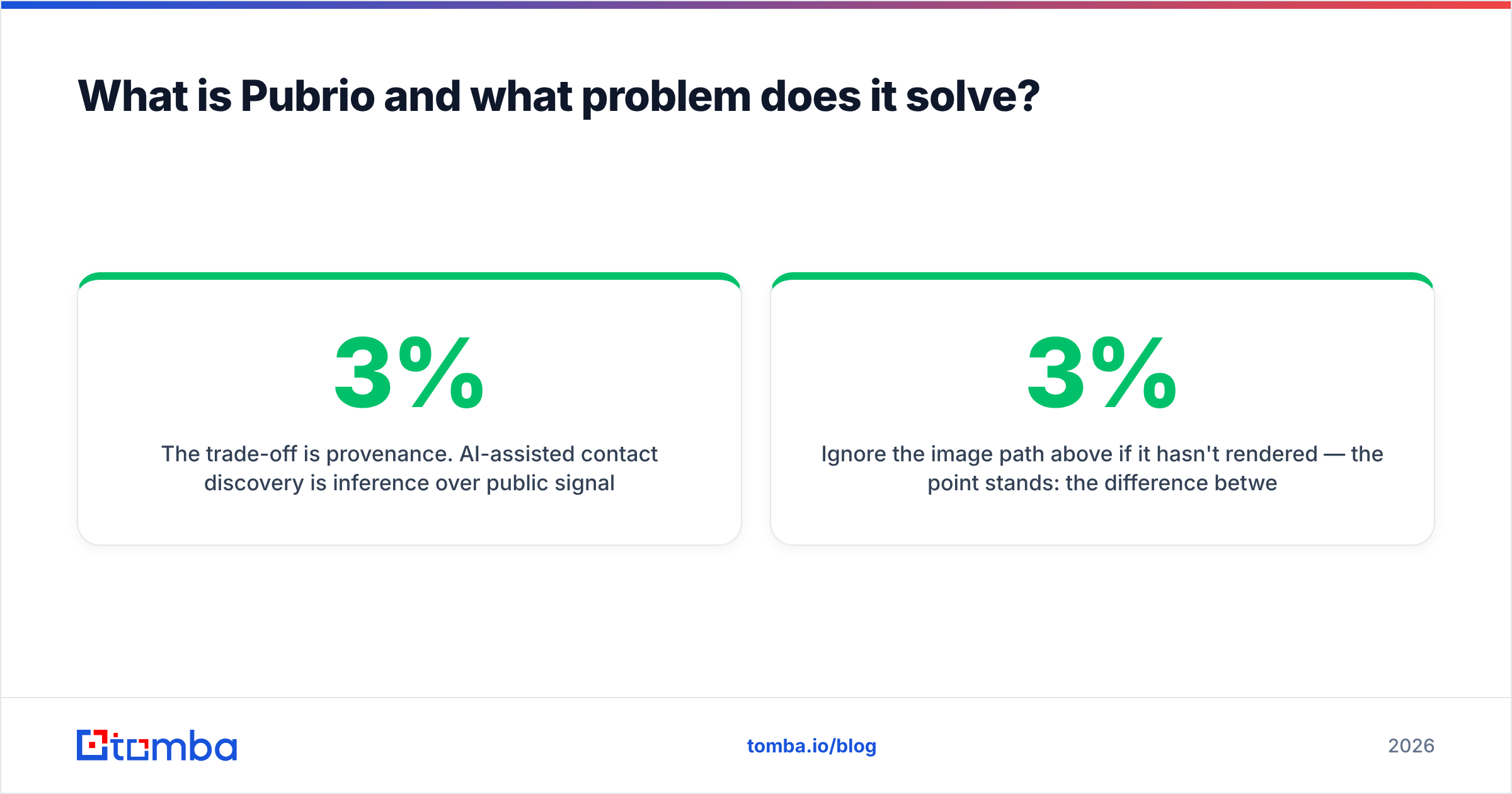
HitHorizons vs Pubrio: how do the two differ structurally?#
This is the table that matters most. It explains every other difference downstream.
| Dimension | HitHorizons | Pubrio |
|---|---|---|
| Core record type | Legal entity (company) | Person (contact) |
| Primary data source | Official business registries and filings | Aggregated web signals, contributed data, AI inference |
| Geographic strength | Europe-first, strong on EU registries | Global, strongest in US/English-speaking markets |
| Refresh model | Tied to registry filing cadence (slow but authoritative) | Continuous crawling and re-inference (fast, decays) |
| Email addresses | Not the product; generic/registered contacts at best | Core deliverable, per-person work emails |
| Phone numbers | Registered company numbers | Direct dials on higher tiers |
| Corporate hierarchy | Yes — parent/subsidiary links from filings | Limited, usually flat company records |
| Typical buyer | Research, risk, compliance, data ops | SDRs, founders, growth and demand gen |
| Typical failure mode | 'Great company list, no one to email' | 'Great contact list, 12% bounced' |
Read the last two rows together. They describe the same team six weeks apart. In quarter one you buy firmographics and find you can't reach anyone. In quarter two you buy contacts and your domain reputation takes the hit.
HitHorizons vs Pubrio: which one has better data accuracy?#
Accuracy means different things on each side. A head-to-head number would mislead you.
The HitHorizons question is: does this record match the legal reality? The input is a registry filing, so the answer is usually yes — with a lag. Say a company changed its registered address in March and filed in June. The platform shows June. That lag is fine for compliance work. It is not fine for 'who just moved offices'.
The Pubrio question is: will this email land? That is a probabilistic claim about one inbox on one day. Vendors in this category advertise deliverability in the 90-95% range. Buyer reviews on G2 show weaker real-world results across the whole segment, not just one vendor. Treat every published accuracy claim as a ceiling, not a floor — including claims from tools we like.
Three practical rules, whichever you buy:
- Never trust an export. Run a verification pass on the day you send, not the day you bought. A bulk verify job costs less than one blocklisting.
- Segment catch-all domains separately. Roughly a third of B2B domains accept everything at the SMTP layer. Standard verification then returns 'unknown'. A dedicated catch-all verifier is the only honest way to score them.
- Measure bounce rate by source. Blending HitHorizons companies with Pubrio contacts and a third finder? Tag the source column. Within two campaigns you will know which vendor earns its line item.
How do the two compare on pricing and packaging?#
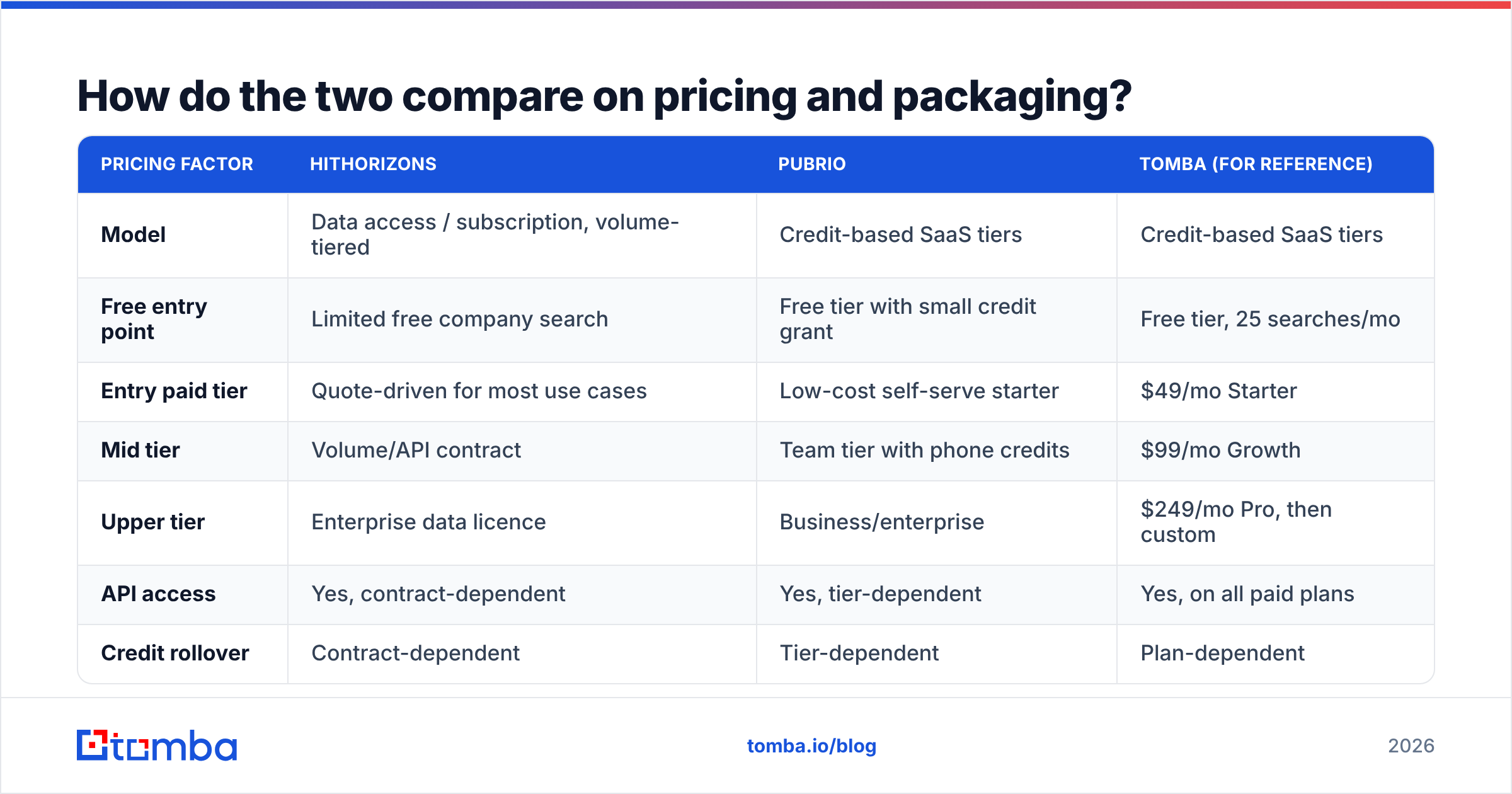
Neither vendor publishes a simple per-seat price for every tier. Both use credit-based packaging that shifts with region and contract length. Check current numbers on each vendor's site before you budget. What you can compare is the shape of the pricing.
| Pricing factor | HitHorizons | Pubrio | Tomba (for reference) |
|---|---|---|---|
| Model | Data access / subscription, volume-tiered | Credit-based SaaS tiers | Credit-based SaaS tiers |
| Free entry point | Limited free company search | Free tier with small credit grant | Free tier, 25 searches/mo |
| Entry paid tier | Quote-driven for most use cases | Low-cost self-serve starter | $49/mo Starter |
| Mid tier | Volume/API contract | Team tier with phone credits | $99/mo Growth |
| Upper tier | Enterprise data licence | Business/enterprise | $249/mo Pro, then custom |
| API access | Yes, contract-dependent | Yes, tier-dependent | Yes, on all paid plans |
| Credit rollover | Contract-dependent | Tier-dependent | Plan-dependent |
The structural point is simple. HitHorizons prices like a data licence. Pubrio prices like a seat tool. If you have three SDRs, seat pricing wins. If you have one analyst who needs the whole European market in a file, licence pricing wins. Buy both and you pay twice for overlapping company records. That is the most common line item to cut when you audit your stack.
Some teams only need to find and verify the email once the company is known. A focused finder costs far less than either platform. Full Tomba pricing starts at $49/mo, usually below a single enterprise data seat.
Which is better for outbound prospecting?#
Pubrio, without much argument — that is the job it was built for. HitHorizons will hand you a clean list of 4,000 German manufacturers with 50-200 employees. Then you sit and stare at a spreadsheet with no names in it.
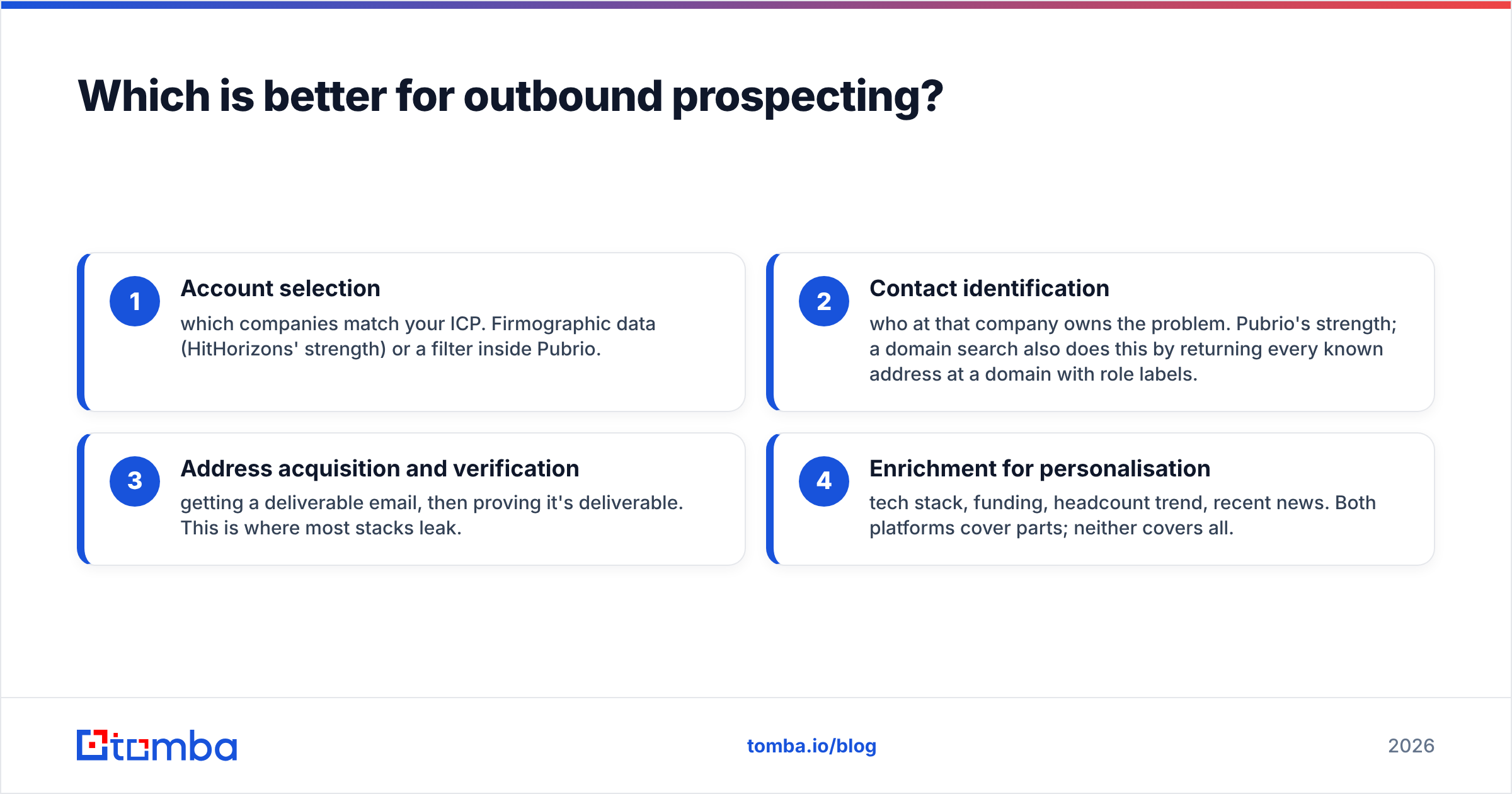
But 'Pubrio wins outbound' is not the same as 'Pubrio is enough for outbound'. A working outbound data flow has four stages, and most tools cover two:
- Account selection — which companies match your ICP. Firmographic data is the HitHorizons strength; a filter inside Pubrio also works.
- Contact identification — who at that company owns the problem. That is the Pubrio strength. A domain search does it too, returning every known address at a domain with role labels.
- Address acquisition and verification — getting a deliverable email, then proving it is deliverable. This is where most stacks leak.
- Enrichment for personalisation — tech stack, funding, headcount trend, recent news. Both platforms cover parts. Neither covers all.
Teams that run all four stages with one vendor almost always overpay on stage 1 or under-deliver on stage 3.
What about compliance, GDPR, and data provenance?#
Here the comparison genuinely separates. For some buyers it removes the choice entirely.
HitHorizons deals largely in company data. That sits outside the strictest personal-data rules in most places. Registry filings are public by statutory design. If your legal team has vetoed contact databases, registry-sourced firmographics may be the only enrichment source you are allowed to use.
Pubrio, like every B2B contact platform, processes personal data. A work email address counts as personal data under GDPR, even in a business context. That is workable. Legitimate interest is a recognised lawful basis for B2B outreach in the EU, and the ICO's guidance on direct marketing sets out what it requires. But workable means you need a documented basis, a suppression process, and a way to honour deletion requests — including deletion from your CRM, not just the vendor's.
Ask either vendor two questions in writing before you sign:
- Where does each field come from, per record? 'Proprietary AI' is not an answer. Registry, contributed, or crawled — you need the label for your Article 14 notice.
- What is the deletion SLA, and does it propagate? If a person opts out at the vendor, does your exported copy get flagged?
Where does each platform fall short?#
HitHorizons weak points:
- No buying-committee visibility. Directors on a filing are not the people who evaluate your software.
- Filing lag. Registry cadence means weeks or months on changes that outbound cares about.
- Coverage skew. Excellent where registries are digitised and open. Thinner where they are not.
- Not built for a sequencer. You need a middle layer before any of it reaches a campaign.
Pubrio weak points:
- Decay is invisible at export. A record you pull today may already be three months stale, and nothing in the CSV tells you which.
- Catch-all handling. Like most of the category, unresolvable domains land in a bucket you either send to blind or throw away.
- Corporate hierarchy is shallow. Subsidiary-versus-parent confusion is common. That matters if your territory rules are entity-based.
- Credit economics. Failed or unverified lookups can still burn credits on some tiers. Read the fine print on what counts as a billable query.
HitHorizons vs Pubrio: which should you choose in 2026?#
Straight verdict:
- Research, risk, or corporate development in Europe → HitHorizons. Nothing in the prospecting category replaces registry provenance.
- An SDR team or a founder doing outbound → Pubrio, or one of its many peers. Trial two of them. Run the same 500-record test list through both. Compare verified-deliverable counts, not raw record counts.
- You already have your account list and just need contacts → Neither. You need a finder-and-verifier, and platform pricing for that job is waste.
- You are building an internal data pipeline → Firmographics from a registry source, contacts from an API, verification as a separate always-on step. That separation is what keeps the stack auditable when someone asks why bounce rates moved.
The honest framing: this is only a fair fight while you are still unsure which half of the problem you have. Once you know, the answer is usually obvious. Often it is 'a third, cheaper thing'.
Is the missing piece stage three — turning a known company and a known name into a verified, deliverable address at volume? Start with the Tomba Email Finder. The free tier gives you 25 searches a month, so you can test against your own list before you spend anything. Starter is $49/mo. The same lookups run through the Tomba API if you would rather wire them into a pipeline than click through a UI.
Run it head-to-head against whatever you pay for now. Let the bounce rate settle the argument.
Related guides#
Ready to find emails that actually work?
Join 150,000+ professionals who stopped guessing and started sending. Free credits on signup — no credit card required.
Get the Tomba newsletter
Practical outbound tactics and product updates — once every two weeks.
About the author