HitHorizons vs SalesIntel (2026): Which B2B Data Tool Wins?
One maps official company registries across Europe. The other sells human-verified US contacts with intent signals. Here is where each one actually earns its budget line in 2026 — and where both leave you stranded.
HitHorizons vs SalesIntel is a strange matchup. One tool maps companies. The other finds people. Here is how to pick the right one.
TL;DR
- HitHorizons vs SalesIntel is not a like-for-like fight. HitHorizons is a registry-backed company database built on official European filings. SalesIntel is a US-centric contact database with human-verified emails, direct dials, and intent data.
- Pick HitHorizons when you need to size, segment, or check companies in Europe. Think legal names, registration numbers, VAT IDs, industry codes, and ownership.
- Pick SalesIntel when your buyers sit in North America. You get named people, phone numbers, and Bombora intent you can drop into a sequencer today.
- Neither one does the whole job. HitHorizons hands you companies with almost no reachable contacts. SalesIntel hands you contacts, thin coverage outside the US, and enterprise-style pricing.
- The usual fix is a company-data layer plus a dedicated email finder. It resolves and verifies addresses on demand, so you do not pay twice for two overlapping static databases.
What is HitHorizons, exactly?#
HitHorizons is a company intelligence database. It pulls data from official business registers and statistical offices, mostly across Europe. Stated coverage runs to well over 100 million companies, and the data lineage traces back to Dun & Bradstreet. You can check the current scope on the HitHorizons site.
Each record is about the business, not the people inside it:
- Registered legal name and trading names
- National registration number, VAT ID, and legal form
- Registered address and country
- NACE / industry classification
- Revenue and employee bands, where filings show them
- Corporate hierarchy — parents, subsidiaries, and branches
That is a narrow kind of useful, and it is real. Registry data is the source of truth when you sell into regulated industries, run KYC checks, onboard suppliers, or build a European TAM model. It also cleans up a messy CRM fast, because you can match rows against real legal entities. Free web search is available. Exports, bulk lists, and API access sit behind paid plans.
What you do not get is an inbox. HitHorizons will tell you that a 240-person manufacturer in Bavaria is real, files accounts, and belongs to a Dutch parent. It will not tell you who runs procurement there. It will not give you their email.
What is SalesIntel, exactly?#
SalesIntel sits on the other side of the table. It is a B2B contact and account platform aimed at US sales and marketing teams. Its edge has always been human verification. A research team re-checks contact records on a rolling cycle instead of trusting crawlers alone.
The stack usually includes:
- Contacts with business emails and direct dial mobile numbers
- Firmographics and technographics (what software an account runs)
- Bombora intent data on the topics you track
- "Research on Demand" — you ask for a missing contact and researchers go build it
- Native pushes into Salesforce, HubSpot, Outreach, Salesloft, and similar
Reviewers rate SalesIntel highest on direct dials and on how fast that research team moves. The recurring complaint, visible across G2 reviews, is coverage outside North America. Credit limits are the other sore point once a team gets busy. Treat all of it as directional. Data quality swings hard by vertical.
HitHorizons vs SalesIntel: how do they compare head to head?#
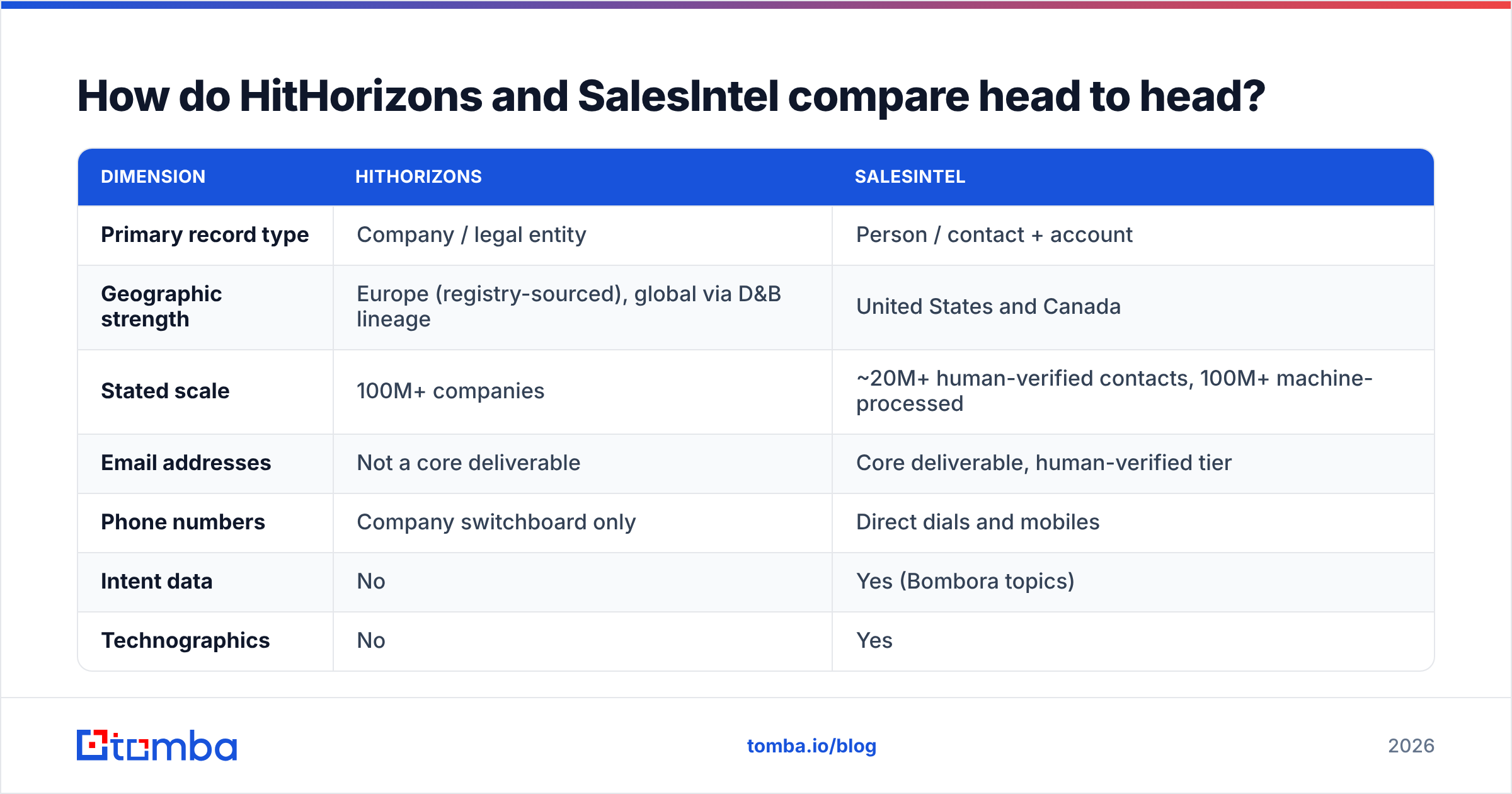
Here is the honest side-by-side. Where a price is not public, it says so instead of guessing. Neither vendor publishes a full rate card as of early 2026.
| Dimension | HitHorizons | SalesIntel |
|---|---|---|
| Primary record type | Company / legal entity | Person / contact + account |
| Geographic strength | Europe (registry-sourced), global via D&B lineage | United States and Canada |
| Stated scale | 100M+ companies | ~20M+ human-verified contacts, 100M+ machine-processed |
| Email addresses | Not a core deliverable | Core deliverable, human-verified tier |
| Phone numbers | Company switchboard only | Direct dials and mobiles |
| Intent data | No | Yes (Bombora topics) |
| Technographics | No | Yes |
| Data provenance | Official registers, statistical offices | Human research + automated collection + community |
| Free access | Free web search, limited | Free trial / limited demo credits |
| Pricing model | Credit / subscription tiers, published tiers for smaller users | Quote-based, seat + credit hybrid, enterprise-weighted |
| Typical buyer | RevOps, compliance, market research, finance | SDR teams, demand gen, mid-market AEs |
| Realistic entry cost | Low hundreds per year | Four to five figures per year |
| Best single use case | European TAM sizing and entity resolution | US outbound list building with intent |
The table makes the real answer obvious. Asking "HitHorizons vs SalesIntel" is often the wrong question. You are comparing a map to a phone book. The better question is which layer your pipeline is missing.
HitHorizons vs SalesIntel: which one has better data coverage?#
Coverage is not one number. Split it into the four things that change your results.
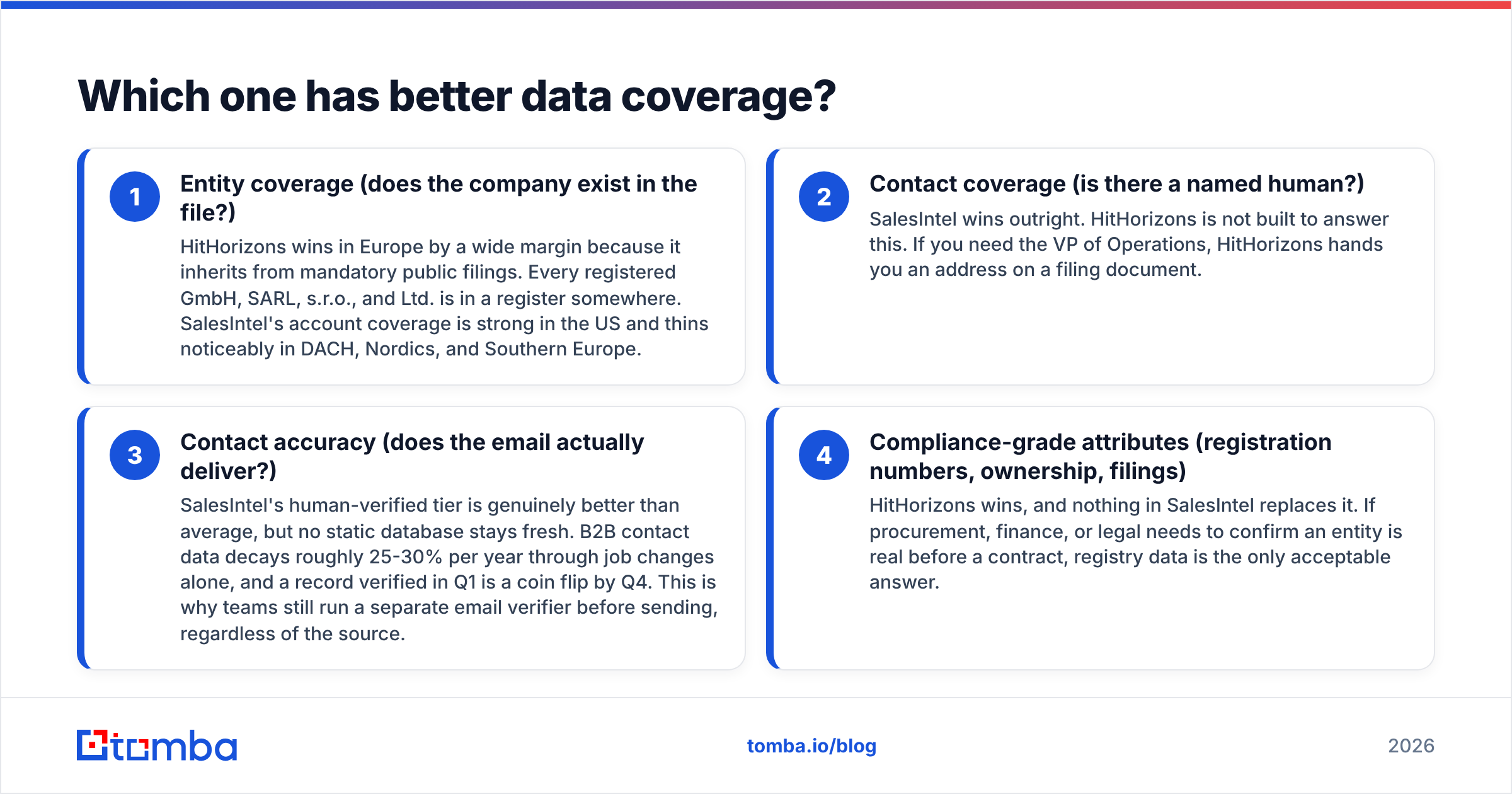
1. Entity coverage — is the company in the file at all?
HitHorizons wins in Europe by a wide margin. It inherits from filings that are required by law. Every registered GmbH, SARL, s.r.o., and Ltd. sits in a register somewhere. SalesIntel is strong on US accounts and thins out in DACH, the Nordics, and Southern Europe.
2. Contact coverage — is there a named human?
SalesIntel wins outright. HitHorizons is not built for this. Ask it for the VP of Operations and you get an address off a filing document.
3. Contact accuracy — does the email actually deliver?
SalesIntel's human-verified tier beats the market average. Still, no static database stays fresh. B2B contact data decays roughly 25-30% a year through job changes alone. A record checked in Q1 is a coin flip by Q4. That is why teams run a separate email verifier before they send, whatever the source.
4. Compliance-grade attributes — registration numbers, ownership, filings
HitHorizons wins, and SalesIntel has no answer here. When finance or legal needs proof that an entity is real, registry data is the only thing that counts.
That split is why many teams that weigh HitHorizons vs SalesIntel end up buying neither. Others buy one and pair it with a cheaper resolution layer.
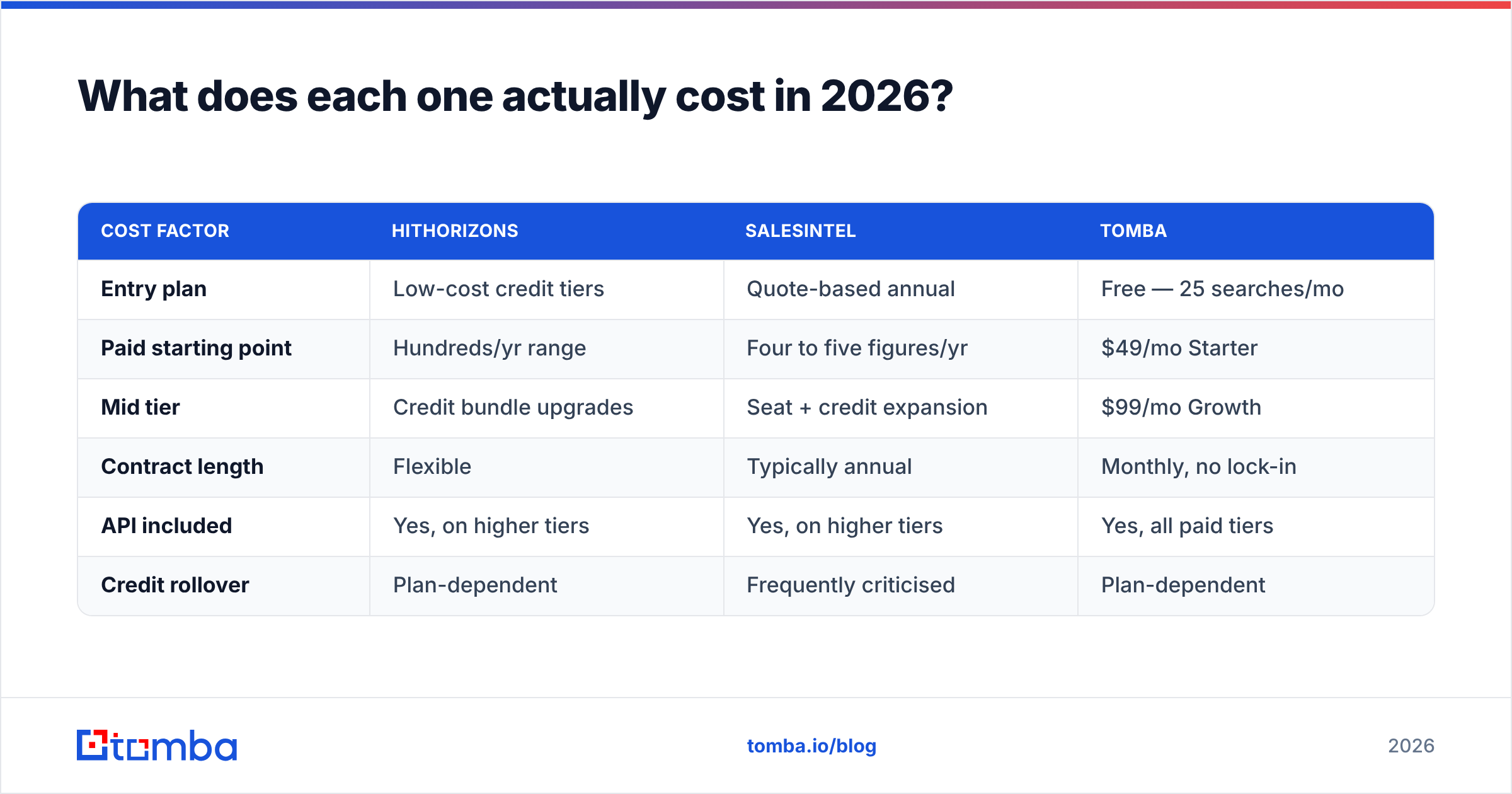
What does each one actually cost in 2026?#
Budget is where this comparison stops being academic.
HitHorizons prices for analysts. There are self-serve tiers with credit bundles for company profiles and exports, plus API access for developers. One analyst can run on a few hundred euros a year. That fits on a departmental card.
SalesIntel prices like a sales platform: an annual contract, a price per seat, and a credit pool on top. Public reports and buyer chatter put real team deployments in the five-figure range each year. The low end is for small seat counts only. There is rarely a month-to-month escape hatch, and unused credits come up again and again in reviews.
| Cost factor | HitHorizons | SalesIntel | Tomba |
|---|---|---|---|
| Entry plan | Low-cost credit tiers | Quote-based annual | Free — 25 searches/mo |
| Paid starting point | Hundreds/yr range | Four to five figures/yr | $49/mo Starter |
| Mid tier | Credit bundle upgrades | Seat + credit expansion | $99/mo Growth |
| Contract length | Flexible | Typically annual | Monthly, no lock-in |
| API included | Yes, on higher tiers | Yes, on higher tiers | Yes, all paid tiers |
| Credit rollover | Plan-dependent | Frequently criticised | Plan-dependent |
Full Tomba pricing is public, and that is worth saying plainly. When a vendor hides the number, the number is a negotiation. Negotiations favour the side that does them every day. It is also why the HitHorizons vs SalesIntel choice often comes down to contract shape, not data.
Is HitHorizons better than SalesIntel for outbound?#
No, and it does not try to be. If your job is booking meetings this quarter, HitHorizons alone leaves you with a very accurate list of companies you cannot contact.
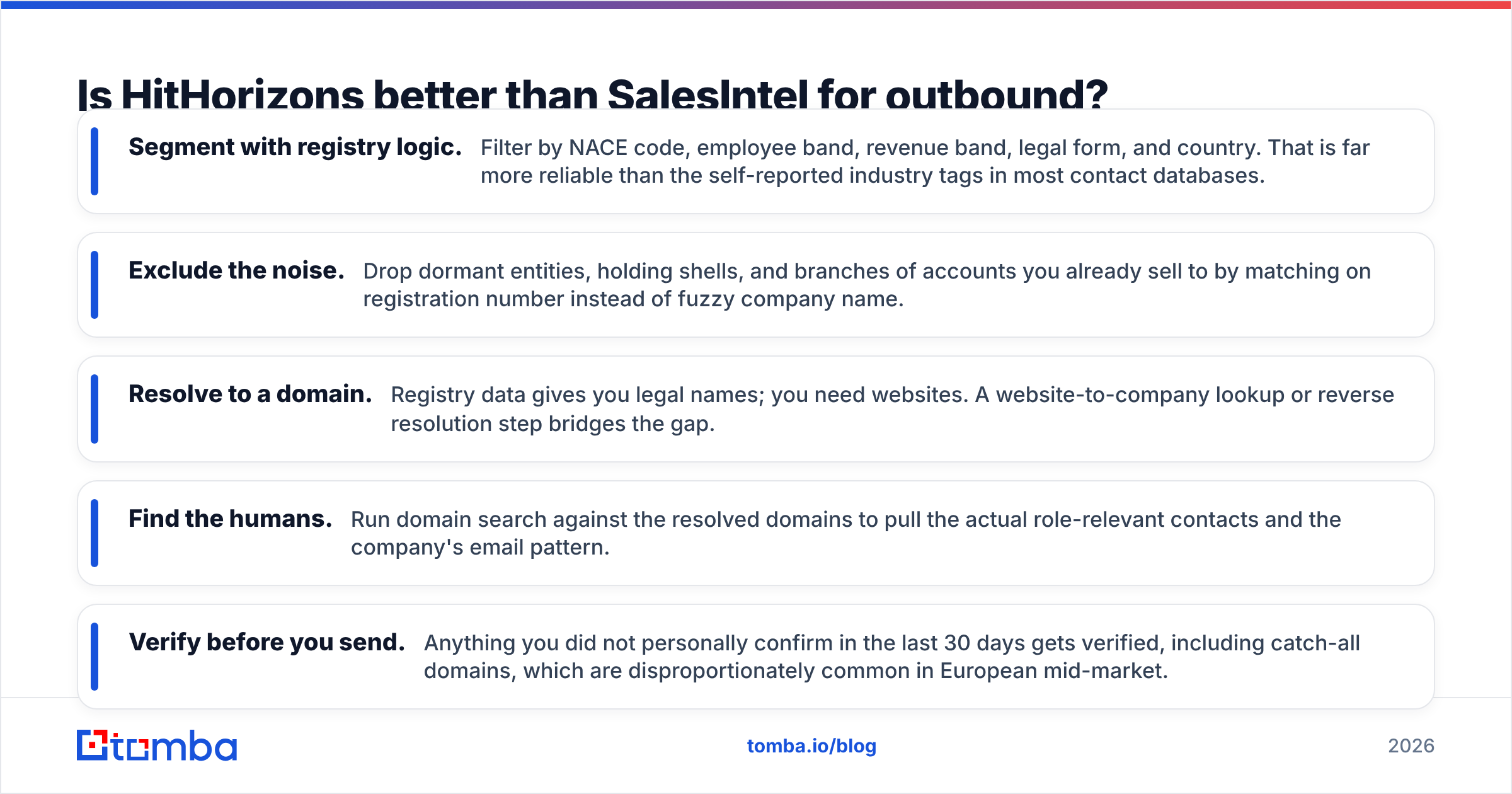
Flip the framing, though. HitHorizons is a great targeting layer for European outbound. The workflow looks like this:
- Segment with registry logic. Filter by NACE code, employee band, revenue band, legal form, and country. That beats the self-reported industry tags in most contact databases.
- Cut the noise. Drop dormant entities, holding shells, and branches of accounts you already sell to. Match on registration number, not on fuzzy company names.
- Resolve to a domain. Registry data gives you legal names. You need websites. A website-to-company lookup bridges that gap.
- Find the people. Run domain search on those domains to pull the right roles and the company's email pattern.
- Verify before you send. Check anything you did not confirm in the last 30 days. Catch-all domains matter most here, and they are common in the European mid-market.
That five-step chain costs a fraction of a SalesIntel contract. In Europe it builds lists SalesIntel cannot match. It also falls apart in the US, where SalesIntel's direct dials and intent signals are hard to copy.
Where do both tools fall short?#
Both sides of the HitHorizons vs SalesIntel debate have real gaps.
HitHorizons limits
- No contact-level data. You leave with entities, not people.
- Filings lag reality. Employee and revenue figures for small firms are often stale, or banded so widely they cannot drive scoring.
- Coverage outside Europe is much weaker than the headline number suggests.
- The interface suits research sessions, not bulk sales work.
SalesIntel limits
- Coverage drops off sharply outside the US. That is fatal if your buyers are European.
- Annual contracts and seat pricing put it out of reach for small teams and solo founders.
- Human verification runs on a cycle, not in real time. Records still decay between passes.
- Research-on-Demand is excellent, but it takes time. It will not rescue you mid-sprint.
- Intent data is a hint, not a qualified lead. Teams over-trust it all the time.
None of this is disqualifying. It is just the shape of each product.
HitHorizons vs SalesIntel: which one should you buy?#
Match the tool to your real bottleneck.
- Your buyers are European and you cannot even name the accounts. HitHorizons, plus a contact layer. SalesIntel will not save you here.
- Your buyers are US mid-market and reps burn hours on manual research. SalesIntel earns its price, if you can fund the year and fill the seats.
- You need compliance-grade entity checks. HitHorizons, no debate. A contact database is not a legal source.
- You need lots of verified emails at a price you can predict. Neither. Both are static databases. A dedicated email finder priced per search is the cheaper unit.
- You are two people testing a new market. Start free or near-free. Do not sign a five-figure contract to test an idea you may drop in six weeks.
- You already own company data and just need reachable people. Skip both. Add resolution and verification on top of what you have.
One pattern runs through all of it. The company layer and the contact layer are separate buys. Bundling them badly is how data budgets quietly triple. Analysts have made this argument for years — Gartner's sales technology research is a fair place to start — and the tooling has finally caught up.
How do you fill the gap between them?#
However the HitHorizons vs SalesIntel call goes, you still need one more step. Something has to turn a company into a verified, reachable inbox. That is the job Tomba does.
Point the Tomba Email Finder at a domain and a name. It returns the address, a confidence score, and the sources behind it. Run data enrichment to fill in the rest of the record. Verify everything before it reaches your sequencer, so bounces never touch your sender reputation.
It starts free with 25 searches a month. Paid plans are $49/mo Starter and $99/mo Growth, and the API is included on every paid tier. So you can bolt it onto whichever database you picked above instead of replacing it.
Use registry data to decide who is worth contacting. Use Tomba to actually reach them.
Related guides#
Ready to find emails that actually work?
Join 150,000+ professionals who stopped guessing and started sending. Free credits on signup — no credit card required.
Get the Tomba newsletter
Practical outbound tactics and product updates — once every two weeks.
About the author