HitHorizons vs Tomba (2026): Company Data vs Emails
HitHorizons sells registry-grade company records. Tomba sells verified work emails. Here is where each one actually earns its budget in 2026 — and why most outbound teams end up needing both.
TL;DR
- HitHorizons and Tomba are not really competitors. HitHorizons is a company-level database built on official European business registry filings; Tomba is a contact-level platform built to find and verify work email addresses.
- If your bottleneck is "which companies exist, what are they registered as, and what do their financials look like," HitHorizons is the stronger pick.
- If your bottleneck is "I have the company, now get me a deliverable inbox for the VP of Ops," Tomba is the stronger pick, starting at $49/mo with a free tier of 25 searches.
- Firmographic records do not carry verified personal email addresses, so registry-first teams almost always bolt an email finder on top.
- The realistic 2026 stack for European outbound: registry data for account selection and compliance, an email finder plus verifier for contact discovery and deliverability.
What is HitHorizons and what does it actually do?#
HitHorizons is a company information database. Its core proposition is breadth of company records across Europe: legal entity names, registration identifiers, addresses, industry codes, size bands, and financial indicators sourced from official national business registers and commercial data partners. The company publicly positions itself around coverage of tens of millions of European entities, and you can browse a lot of it from the HitHorizons site without paying anything.
That sourcing model matters more than the raw record count. Registry-derived data is slow-moving but authoritative. When a German GmbH files updated accounts, that filing eventually becomes a data point. You are not looking at a scraped guess about headcount — you are looking at a derivative of a legal filing. For anyone doing credit checks, supplier due diligence, market sizing, or KYC-adjacent work, that provenance is the entire value.
What HitHorizons is not built to do is hand you a person. Business registers list directors and officers, not the demand-gen manager you actually want to email. Registry filings contain a company's registered address, not firstname.lastname@company.com. That distinction is the whole reason this comparison exists.
Typical HitHorizons use cases:
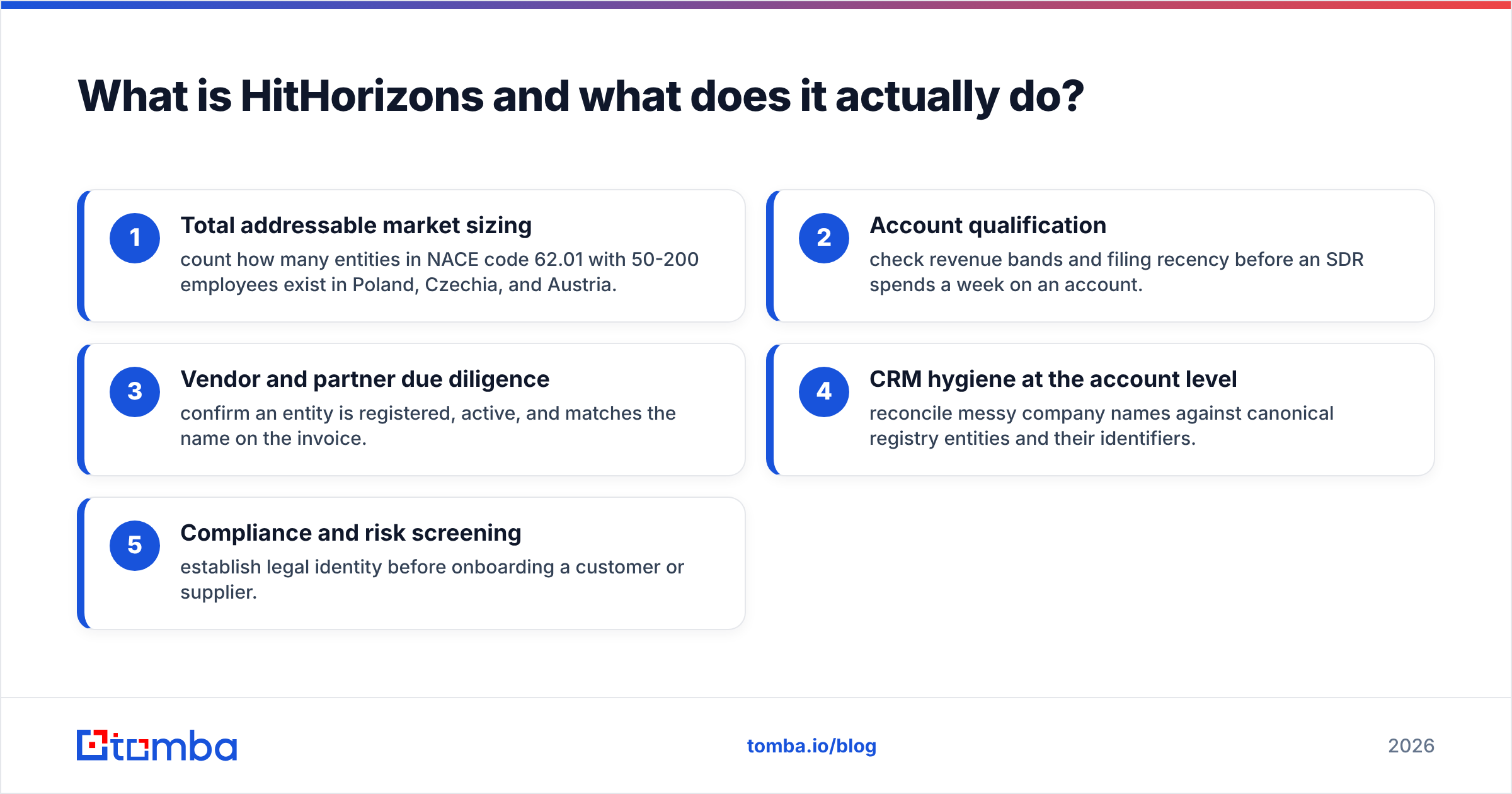
- Total addressable market sizing — count how many entities in NACE code 62.01 with 50-200 employees exist in Poland, Czechia, and Austria.
- Account qualification — check revenue bands and filing recency before an SDR spends a week on an account.
- Vendor and partner due diligence — confirm an entity is registered, active, and matches the name on the invoice.
- CRM hygiene at the account level — reconcile messy company names against canonical registry entities and their identifiers.
- Compliance and risk screening — establish legal identity before onboarding a customer or supplier.
What is Tomba and where does it fit?#
Tomba is a contact-data platform. The core product is the email finder: give it a company domain plus a person's name, or just a domain, and it returns professional email addresses with a confidence score and, where available, the sources it inferred the pattern from.
Around that core sit the pieces you need to make outbound actually land: an email verifier for syntax, MX, and SMTP-level checks, a domain search that returns every known address on a domain, a catch-all verifier for the domains that accept everything and confirm nothing, a phone finder, and data enrichment that adds job title, seniority, and company context to a contact you already have.
Where HitHorizons answers "does this company exist and what is it," Tomba answers "who works there and how do I reach them without burning my sender reputation."
HitHorizons vs Tomba: how do they compare at a glance?#
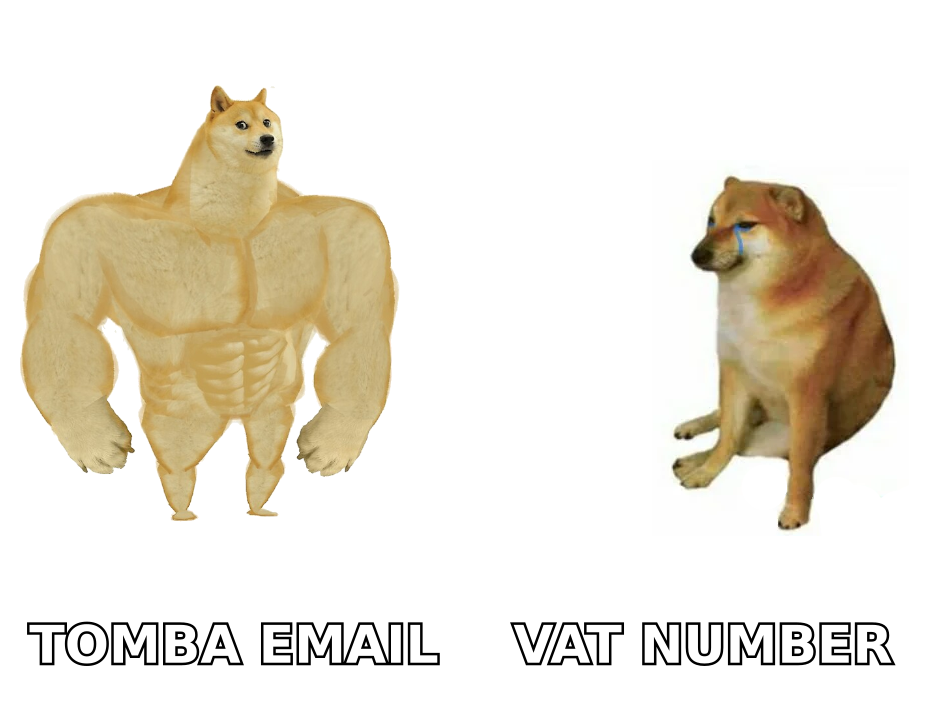
| Attribute | HitHorizons | Tomba |
|---|---|---|
| Primary unit of data | Company / legal entity | Person / email address |
| Core data source | Official business registers, financial filings | Web sources, pattern inference, SMTP validation |
| Geographic strength | Europe (registry-driven, deep) | Global, wherever a company has a domain |
| Email addresses | Not the product; generic or absent | Core product, with confidence scores |
| Email verification | No | Yes — syntax, MX, SMTP, catch-all handling |
| Phone numbers | Company switchboard where filed | B2B phone finder and validator |
| Financial data | Yes — revenue, filings, size bands | No |
| Entry price | Free browsing, paid credit/subscription tiers | Free tier (25 searches/mo), Starter $49/mo |
| API | Yes | Yes — REST API, CLI, MCP server |
| Best for | Market sizing, due diligence, compliance | Cold outbound, recruiting, list building |
| Weakness | No person-level contact data | No registry filings or financial statements |
The table makes the honest verdict obvious: these tools sit at different layers of the same pipeline. Comparing them head-to-head on "which is better" is like comparing a map to a phone book. You want the map to pick the neighborhood and the phone book to knock on the right door.
Which one has better data coverage?#
Coverage is only meaningful when you specify coverage of what.
- Entity coverage — HitHorizons wins outright in Europe. Registry-sourced databases include dormant, tiny, and non-digital companies that never show up in web-scraped B2B datasets. A three-person Slovak manufacturer with no LinkedIn presence still has a filing.
- Contact coverage — Tomba wins, because it is the only one of the two that produces person-level email addresses at all. Domain-based discovery works anywhere a company has a website, including outside Europe.
- Freshness — different failure modes. Registry data lags by filing cycles, sometimes a year or more on financials. Contact data decays faster (people change jobs constantly) but is re-verifiable on demand, which registry filings are not.
- Depth per record — HitHorizons goes deeper on the company object. Tomba goes deeper on the person object. Neither substitutes for the other.
If you sell into Europe and need to know that a company is legally active before you invest a sequence in it, registry data earns its keep. If you sell anywhere and need an inbox that accepts mail, contact data earns its keep. Most teams discover this the expensive way: they buy a beautiful account list, then realize they have zero people to email.
How does the pricing compare?#
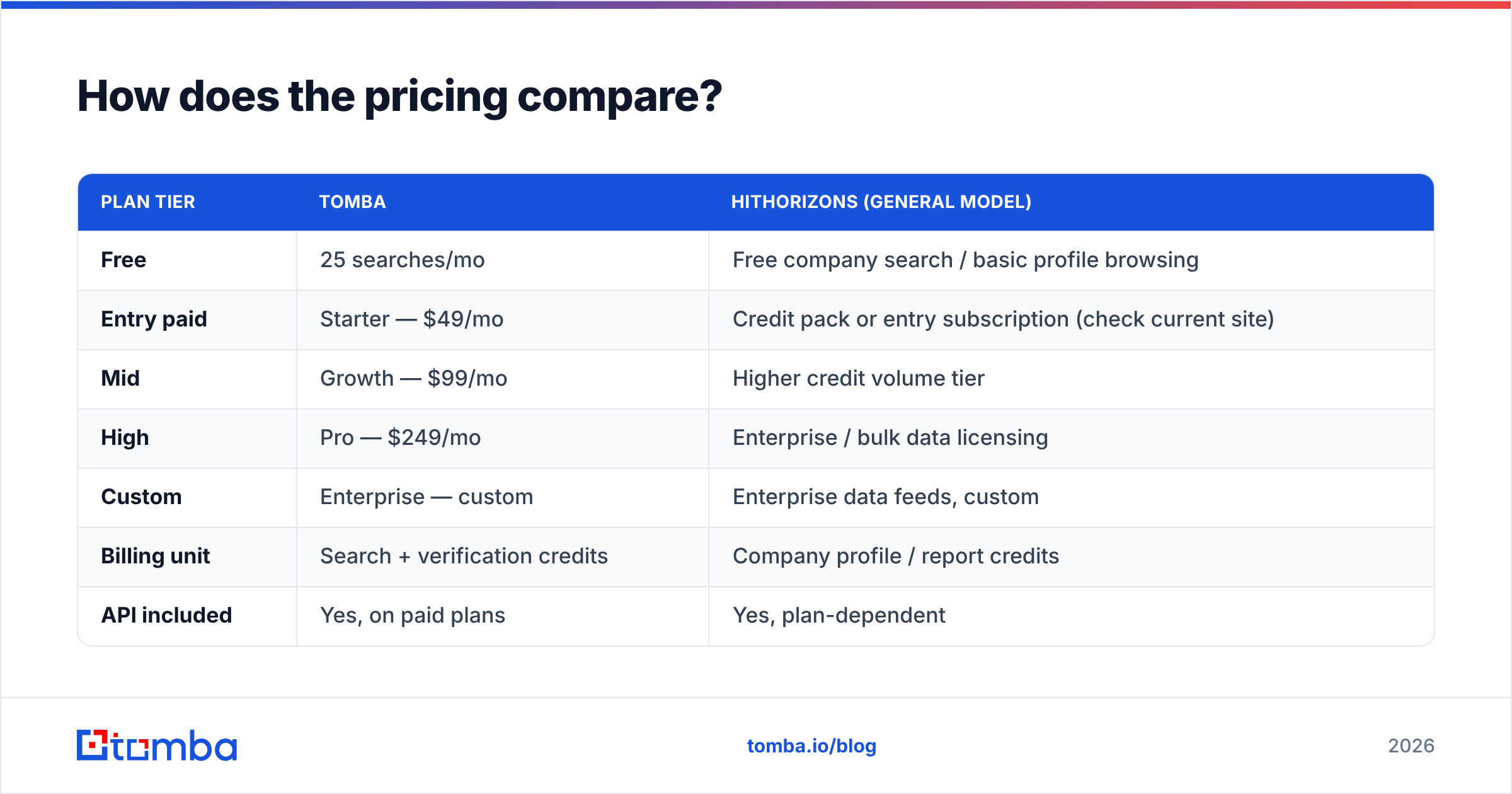
Tomba's pricing is published and flat. HitHorizons uses a credit/subscription model with a browsable free layer, and the specifics move often enough that you should confirm on their site rather than trust any blog post, including this one.
| Plan tier | Tomba | HitHorizons (general model) |
|---|---|---|
| Free | 25 searches/mo | Free company search / basic profile browsing |
| Entry paid | Starter — $49/mo | Credit pack or entry subscription (check current site) |
| Mid | Growth — $99/mo | Higher credit volume tier |
| High | Pro — $249/mo | Enterprise / bulk data licensing |
| Custom | Enterprise — custom | Enterprise data feeds, custom |
| Billing unit | Search + verification credits | Company profile / report credits |
| API included | Yes, on paid plans | Yes, plan-dependent |
Full Tomba pricing is public, and the credit model covers finding and verifying in the same pool, which matters because verification is not optional. An unverified list is a deliverability incident waiting to happen.
The budget math that actually decides this: a company record you buy once stays roughly valid for a year. A contact record decays at roughly 2-3% per month as people change roles, which is why contact tools are priced as recurring credits and registry data is often priced as one-off reports or licensed feeds. Do not model them the same way in your spreadsheet.
Which tool fits which job?#
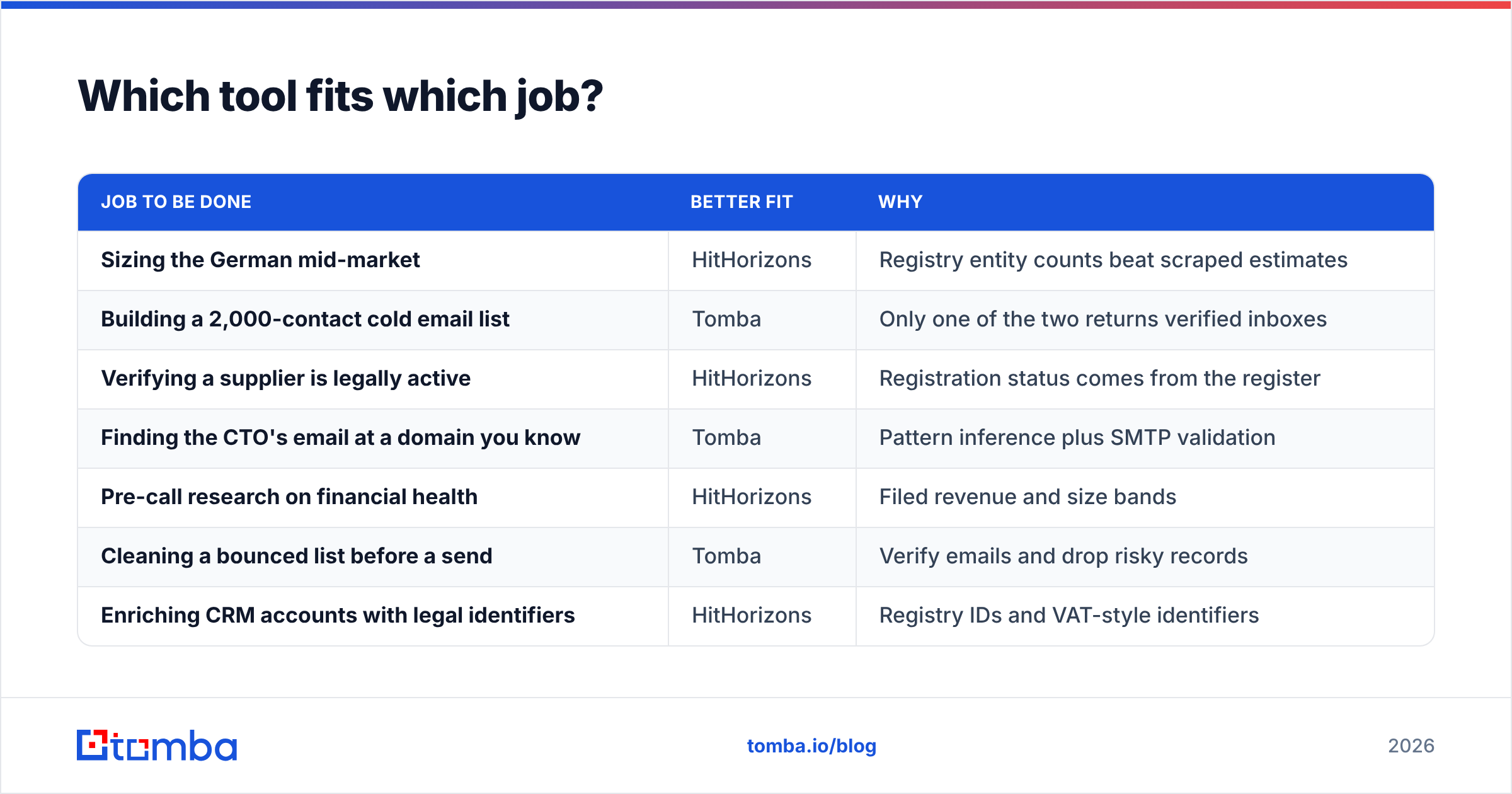
| Job to be done | Better fit | Why |
|---|---|---|
| Sizing the German mid-market | HitHorizons | Registry entity counts beat scraped estimates |
| Building a 2,000-contact cold email list | Tomba | Only one of the two returns verified inboxes |
| Verifying a supplier is legally active | HitHorizons | Registration status comes from the register |
| Finding the CTO's email at a domain you know | Tomba | Pattern inference plus SMTP validation |
| Pre-call research on financial health | HitHorizons | Filed revenue and size bands |
| Cleaning a bounced list before a send | Tomba | Verify emails and drop risky records |
| Enriching CRM accounts with legal identifiers | HitHorizons | Registry IDs and VAT-style identifiers |
| Enriching CRM contacts with title and seniority | Tomba | Person-level enrichment |
Can you use both together?#
Yes, and that is the setup most European outbound teams land on. The handoff is clean because the two tools share a join key: the company domain.
- Select accounts in the registry layer. Filter by country, industry code, employee band, and filing recency. You end up with a list of legal entities that genuinely match your ICP, including companies that never appear in LinkedIn-scraped datasets.
- Resolve entities to domains. This is the step everyone underestimates. Registry data gives you a legal name, not always a website. Budget cleanup time here, or use a website-matching step before you go further.
- Run domain search for contacts. Feed each domain into domain search to pull every known address on that domain, with department and seniority signals so you can pick the right person instead of emailing
info@. - Verify before you send. Run the whole list through verification. Drop invalids, quarantine catch-alls into a separate lower-volume sequence, and keep your bounce rate under 2%.
- Push to CRM and sequence. Write registry fields (entity ID, revenue band, country) and contact fields (email, title, confidence score) into the same record so reps see legal reality and contact reality on one screen.
The Tomba API handles steps 3 and 4 in bulk, which matters once your list crosses a few thousand rows and manual exports stop being viable.
What about accuracy, and how should you measure it?#
Accuracy means two different things here, and vendors exploit the ambiguity.
For registry data, accuracy means fidelity to the source filing. The question is whether the record matches what the national register holds and how stale it is. A dataset can be 100% faithful and still show you 2024 financials in 2026 because that is the last filing available. That is not a data quality failure; it is how statutory reporting works.
For contact data, accuracy means deliverability. The only test that counts is whether mail sent to that address reaches a real human without bouncing. Confidence scores are a prediction; SMTP verification is closer to evidence. Even then, catch-all domains accept everything at the gateway and tell you nothing, which is why a dedicated catch-all verifier exists as a separate step rather than a checkbox.
Practical benchmark before you commit to either vendor: take 100 records you can independently confirm. For registry data, spot-check ten against the national register directly. For contact data, run a small verified send and measure the actual bounce rate, not the vendor's claimed accuracy percentage. Third-party review sites like G2 are useful for reading the complaint patterns, but they are no substitute for testing on your own ICP. Vendor accuracy claims are almost always measured on their easiest data segment.
What are the real limitations of each?#
HitHorizons limitations:
- No person-level email addresses, so it cannot be your only outbound data source.
- Financial data lags filing cycles; treat revenue figures as historical, not current.
- Coverage strength is European. If your ICP is US-heavy SaaS, the registry advantage largely evaporates.
- Entity-to-domain matching is your problem to solve, and it is messier than it sounds.
Tomba limitations:
- No financial statements, registration IDs, or legal-entity hierarchy. It will not help your compliance team.
- Coverage depends on a company having web presence. Genuinely offline businesses are hard.
- Catch-all domains stay ambiguous no matter which vendor you use. Anyone claiming otherwise is selling you a guess.
- Credits are consumed by searching, so sloppy input lists waste budget. Clean your domains first.
How do the alternatives compare?#
If neither fits cleanly, the adjacent options split along the same fault line. On the company-data side you have the large commercial bureaus and open-data projects — the OpenCorporates model is worth understanding before you pay for anything, since some of what you need may already be public. On the contact-data side, options range from all-in-one sales platforms to specialist verified-data vendors like BookYourData, which sells pre-built verified B2B lists and is a solid choice when you want records without running discovery yourself.
The choice usually comes down to whether you want to build lists (finder plus verifier, pay per search) or buy them (pre-built database, pay per record). Both are legitimate. Building is cheaper at scale and more precise on niche ICPs; buying is faster on day one.
The verdict: which should you pick?#
Pick HitHorizons if your primary question is about companies — do they exist, are they active, how big are they, can we safely do business with them — and if your market is European. It is the better instrument for account selection, due diligence, and market sizing, and registry provenance is something no scraper can replicate.
Pick Tomba if your primary question is about people — who do I contact and will my email land. It is purpose-built for that job, priced predictably, and the verification layer means you are not gambling your domain reputation on a guess.
Pick both if you run serious European outbound, because the two halves of the problem do not overlap and neither vendor is pretending to solve the other's half.
Ready to solve the contact half? Start with the Tomba Email Finder on the free tier — 25 searches a month, no card required — and run it against ten accounts you already know. If the emails verify and the sequences land, upgrading to Starter at $49/mo is an easy call. If they do not, you have lost nothing but ten minutes.
Related guides#
Ready to find emails that actually work?
Join 150,000+ professionals who stopped guessing and started sending. Free credits on signup — no credit card required.
Get the Tomba newsletter
Practical outbound tactics and product updates — once every two weeks.
About the author