HitHorizons vs Warpleads: Which B2B Data Tool Wins in 2026?
HitHorizons sells registry-grade company records. Warpleads sells unlimited-export lead lists. They solve different halves of the same problem — here's which one your outbound motion actually needs, and where both fall short.
TL;DR
- HitHorizons is a company-data platform built on official European business registries — roughly 100M+ company records with legal names, registration IDs, industry codes, and financials. It is not a contact database. You will not get a prospect's email from it.
- Warpleads is an outbound lead-list platform whose selling point is unlimited exports on a flat monthly fee, pulling from a large B2B contact pool plus intent-style filters. It gives you contacts fast, but volume and accuracy are in tension.
- They are not really competitors. HitHorizons answers "is this company real, and how big is it?" Warpleads answers "give me 10,000 rows to email on Monday."
- Both leave the same gap open: verified, current email addresses at the person level. Registry data has no emails; unlimited-export data has plenty of stale ones.
- The practical 2026 stack for most teams: pick one for account selection, then run every address through a dedicated finder/verifier before it touches your sending domain.
What is HitHorizons and where does its data come from?#
HitHorizons is a company intelligence database sourced primarily from official national business registers across Europe, aggregated into a single searchable index. Think of it as a phone book for legal entities: it knows the registered name, the entity ID, the founding date, the NACE industry code, the registered address, and — where the filing is public — headcount bands and revenue figures.
That sourcing model has a specific consequence. Registry data is authoritative but slow. A company that changed its trading address last week may not update in the register for months. In exchange, you get something most B2B databases can't offer: a record you can defend in an audit. That's why HitHorizons tends to show up in compliance, KYC, credit-risk, and market-sizing workflows rather than in a sales rep's daily prospecting.
What HitHorizons does well:
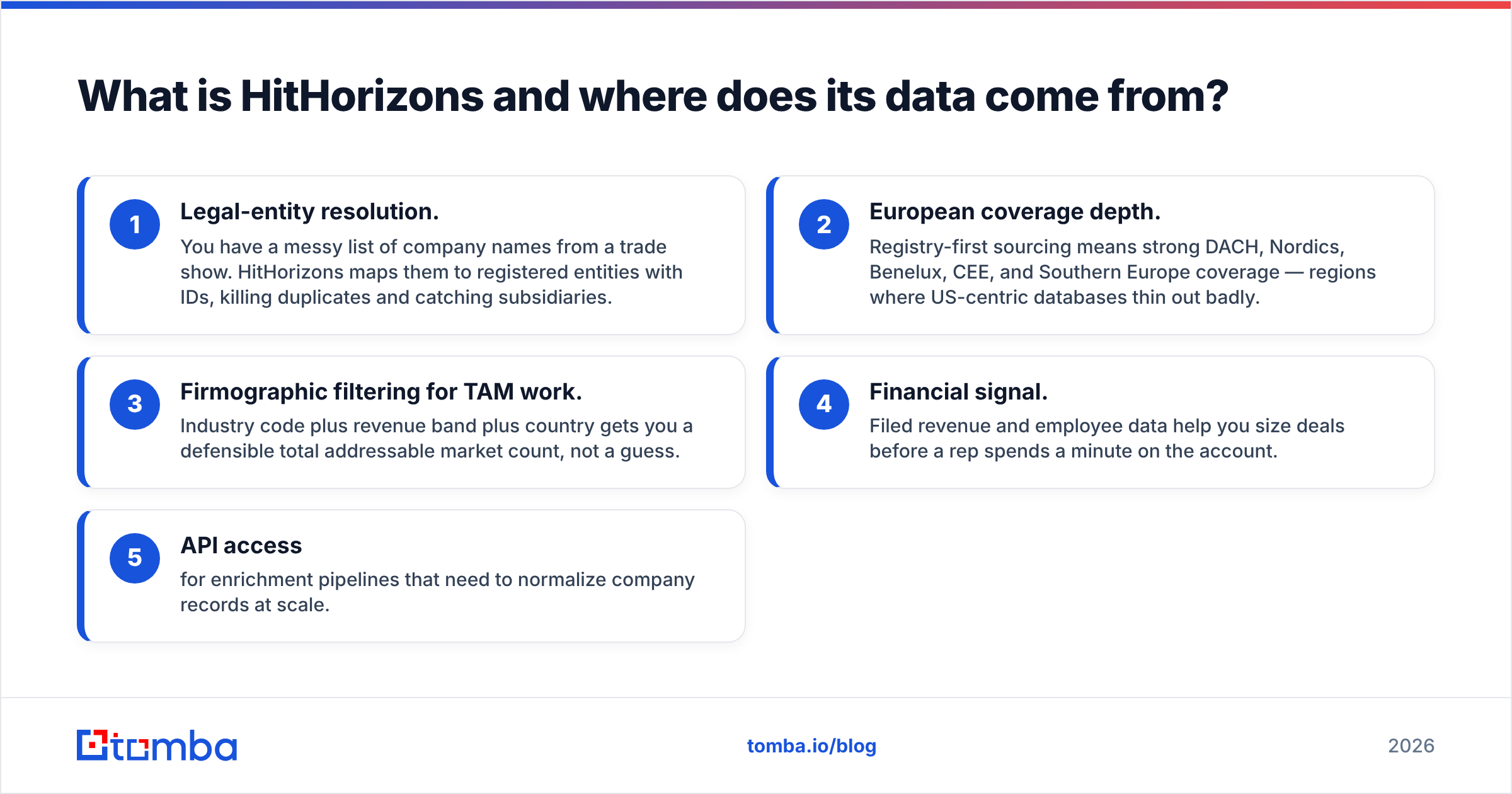
- Legal-entity resolution. You have a messy list of company names from a trade show. HitHorizons maps them to registered entities with IDs, killing duplicates and catching subsidiaries.
- European coverage depth. Registry-first sourcing means strong DACH, Nordics, Benelux, CEE, and Southern Europe coverage — regions where US-centric databases thin out badly.
- Firmographic filtering for TAM work. Industry code plus revenue band plus country gets you a defensible total addressable market count, not a guess.
- Financial signal. Filed revenue and employee data help you size deals before a rep spends a minute on the account.
- API access for enrichment pipelines that need to normalize company records at scale.
What it does not do: give you a named decision-maker, their job title as of this quarter, their email, or their direct dial. That's the whole ballgame for outbound, and it's simply out of scope.

What is Warpleads and who is it built for?#
Warpleads sits at the opposite end. It's an outbound-first lead generation platform whose headline promise is unlimited exports — a flat subscription instead of per-credit metering, so agencies and high-volume SDR teams can pull tens of thousands of rows without watching a counter tick down.
The product typically bundles:
- A large global B2B contact database with the standard filters (title, seniority, industry, headcount, geography, tech stack)
- Bulk list building and CSV export without hard credit caps on the export plans
- Some degree of email validation on the way out
- Integrations into common sequencers so lists move into campaigns quickly
If your bottleneck is "I need volume and my credits ran out on day nine," Warpleads is built precisely for you. Agencies running many client campaigns in parallel are the archetypal buyer.
The trade-off is structural, not a knock on any one vendor. Unlimited-export economics push toward breadth over freshness. When a provider charges a flat fee regardless of how many rows you pull, the incentive is to make the pool large, not to re-verify every record every month. Anyone who has run a 20,000-row export and watched a 12% bounce rate come back knows the shape of this problem. The fix is not to abandon volume — it's to add a verification layer you control.
HitHorizons vs Warpleads: how do they actually compare?#
Here is the head-to-head on the attributes that change your buying decision. Where public pricing is not consistently published, treat the cell as "quote-based" rather than a number to plan around.
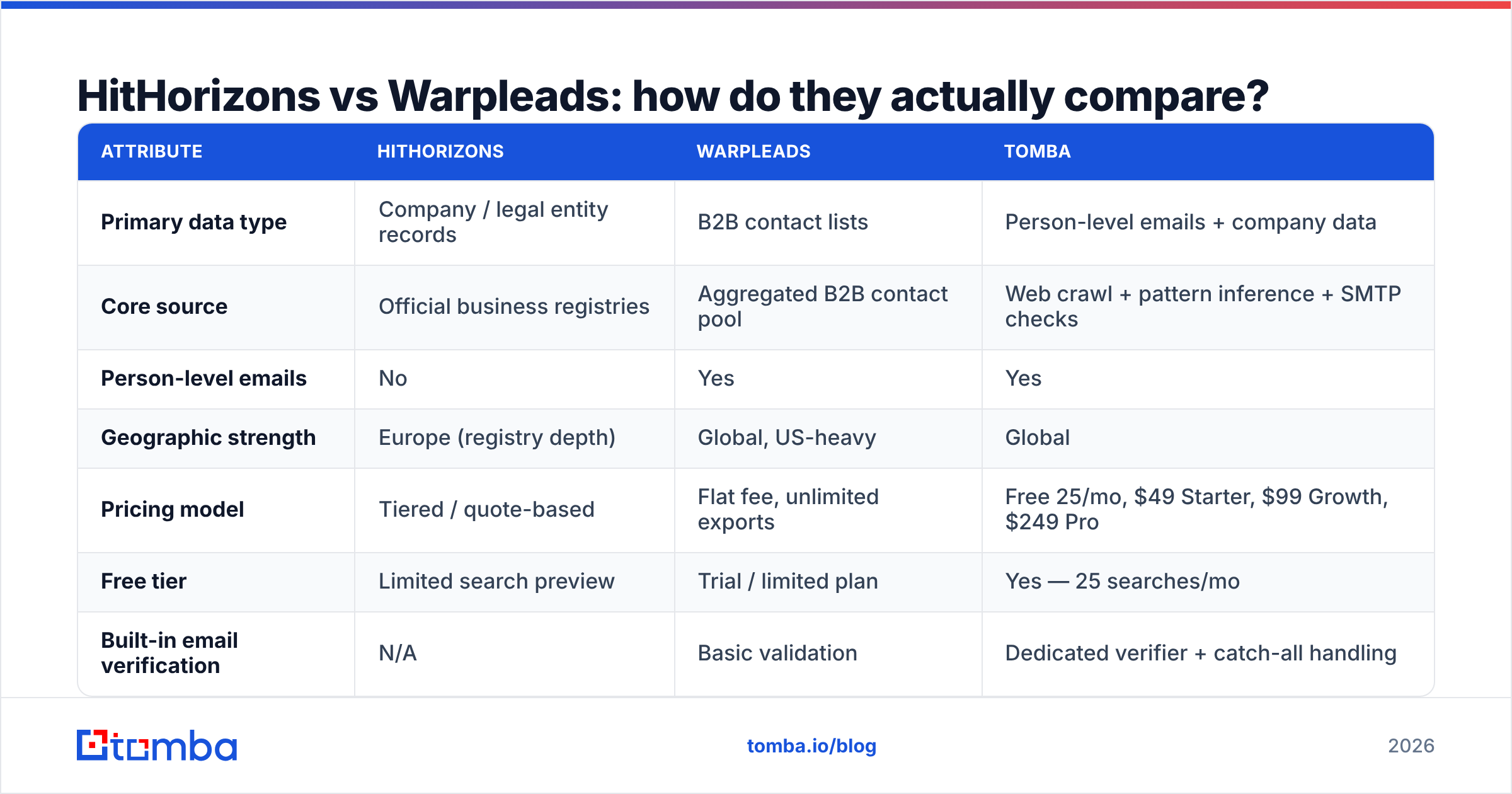
| Attribute | HitHorizons | Warpleads | Tomba |
|---|---|---|---|
| Primary data type | Company / legal entity records | B2B contact lists | Person-level emails + company data |
| Core source | Official business registries | Aggregated B2B contact pool | Web crawl + pattern inference + SMTP checks |
| Person-level emails | No | Yes | Yes |
| Geographic strength | Europe (registry depth) | Global, US-heavy | Global |
| Pricing model | Tiered / quote-based | Flat fee, unlimited exports | Free 25/mo, $49 Starter, $99 Growth, $249 Pro |
| Free tier | Limited search preview | Trial / limited plan | Yes — 25 searches/mo |
| Built-in email verification | N/A | Basic validation | Dedicated verifier + catch-all handling |
| Best for | TAM sizing, KYC, entity resolution | High-volume agency list building | Verifying and finding the addresses you actually send to |
| Weak spot | No contacts, no emails | Freshness at volume | Not a registry/financials source |
Read that table as a division of labour, not a leaderboard. If someone tells you HitHorizons "beats" Warpleads, they've misunderstood at least one of the two products.
Which one should you buy for outbound prospecting?#
Short answer: Warpleads, if you must pick one — but only with a verification step bolted on.
The reasoning is simple. Outbound needs three things in order: a list of accounts worth contacting, a named human at each account, and a deliverable address for that human. HitHorizons gives you the first with unusual rigour and stops. Warpleads gives you all three, with the third being the shakiest.
Where HitHorizons wins outright is account selection quality in Europe. If you sell to German Mittelstand manufacturers with €10-50M revenue, registry filtering will produce a cleaner account list than any generic contact database's firmographic guesswork. You then need a separate motion to find the people — which is exactly where a dedicated email finder fits, taking a company domain and a name and returning a verified address.
Where Warpleads wins outright is speed to first campaign. Filter, export, load into your sequencer, send. For an agency onboarding a new client on a Monday with a Friday deadline, that matters more than registry-grade provenance.
A realistic hybrid many teams land on:
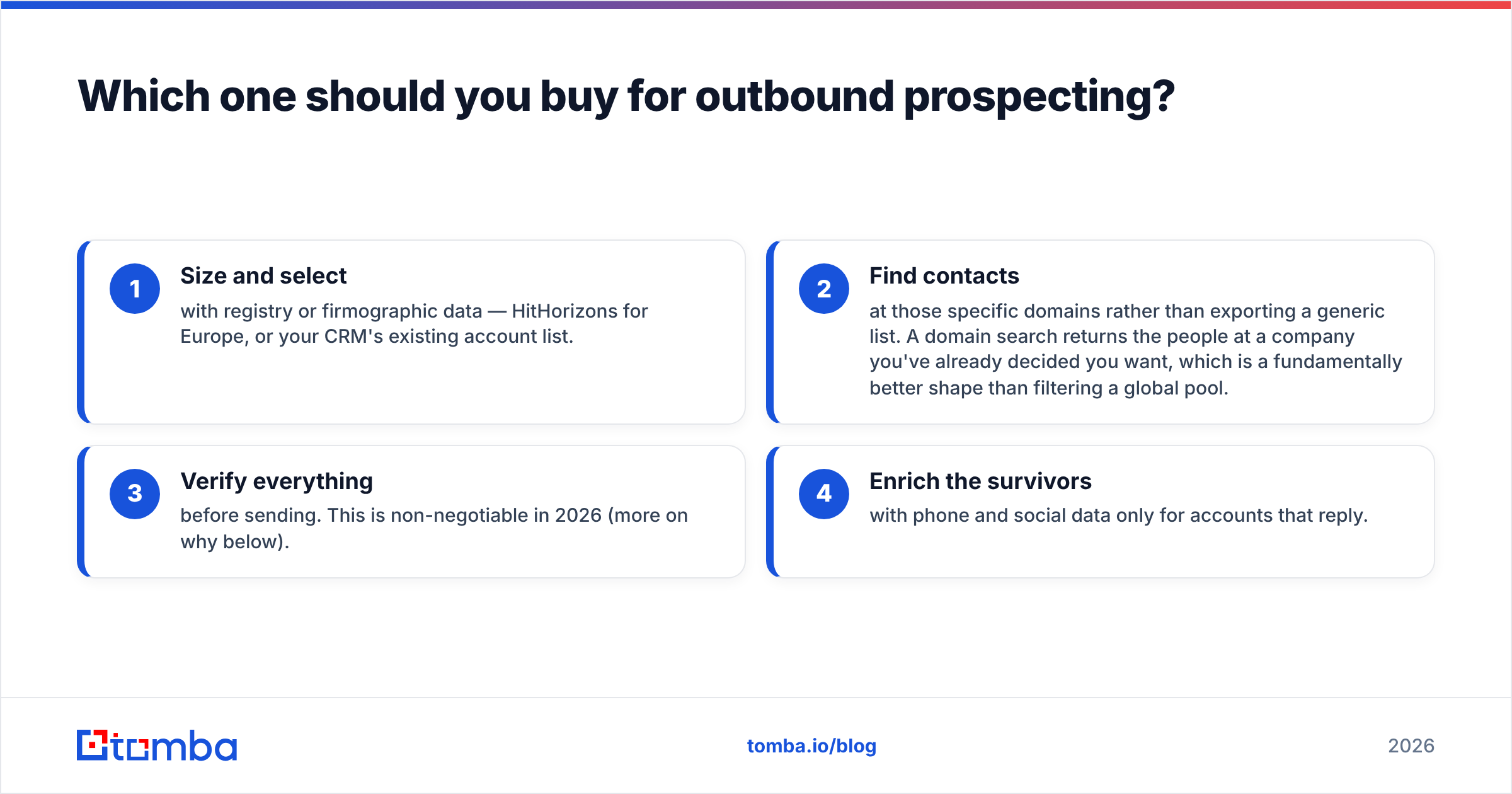
- Size and select with registry or firmographic data — HitHorizons for Europe, or your CRM's existing account list.
- Find contacts at those specific domains rather than exporting a generic list. A domain search returns the people at a company you've already decided you want, which is a fundamentally better shape than filtering a global pool.
- Verify everything before sending. This is non-negotiable in 2026 (more on why below).
- Enrich the survivors with phone and social data only for accounts that reply.
Why does email verification matter more than the database you pick?#
Because your sender reputation is the asset, and bounces are the fastest way to burn it.
Since Google and Yahoo tightened bulk-sender requirements, the tolerance for sloppy lists has effectively gone to zero. Google's own sender guidelines put the spam-complaint threshold at 0.3% and require authentication and easy unsubscribe for bulk senders. High bounce rates compound the damage: mailbox providers read them as a signal that you're sending to a purchased, unmaintained list.
Run the arithmetic. A 20,000-row export with a 12% invalid rate is 2,400 bounces. Spread over a week of sending from two domains, that is enough to put you in spam folders for months — and the cost of rebuilding sender reputation dwarfs whatever you saved on unlimited exports.
This is the argument for treating your data source and your verification layer as separate purchases. You want your list provider optimizing for coverage and your verifier optimizing for accuracy, because a single vendor doing both has an incentive to grade its own homework. Running exports through an independent email verifier — including proper catch-all verification, which is where most cheap validators quietly give up and return "unknown" — is the single highest-ROI step in the whole pipeline.

What are the honest weaknesses of each tool?#
HitHorizons weaknesses:
- No contact layer. You will need a second tool no matter what. Budget for it.
- Registry lag. Filings update on statutory schedules, not in real time. A company that pivoted six months ago may still show its old NACE code.
- Europe-weighted. If your ICP is US SMBs, the registry advantage largely evaporates and you're better served elsewhere.
- Not a prospecting UI. Reps won't live in it. It's an ops and analysis tool.
Warpleads weaknesses:
- Freshness at scale. Unlimited export plans and per-record freshness pull against each other. Assume you need to verify.
- Title drift. Job-title fields in large aggregated pools decay fast — people get promoted, laid off, and re-titled constantly.
- Volume is a trap without discipline. The ability to export 50,000 rows tempts teams into spray-and-pray, which is precisely what modern filtering punishes.
- Compliance homework is yours. Any bulk B2B list needs a GDPR/CCPA legitimate-interest assessment before it hits a European inbox. That's on you, not the vendor.
Worth noting: neither of these is a scandal. They're the predictable shape of each business model. A registry aggregator will always trail reality slightly; a flat-fee export tool will always favour breadth. Knowing which failure mode you're buying is the whole point of a comparison like this.
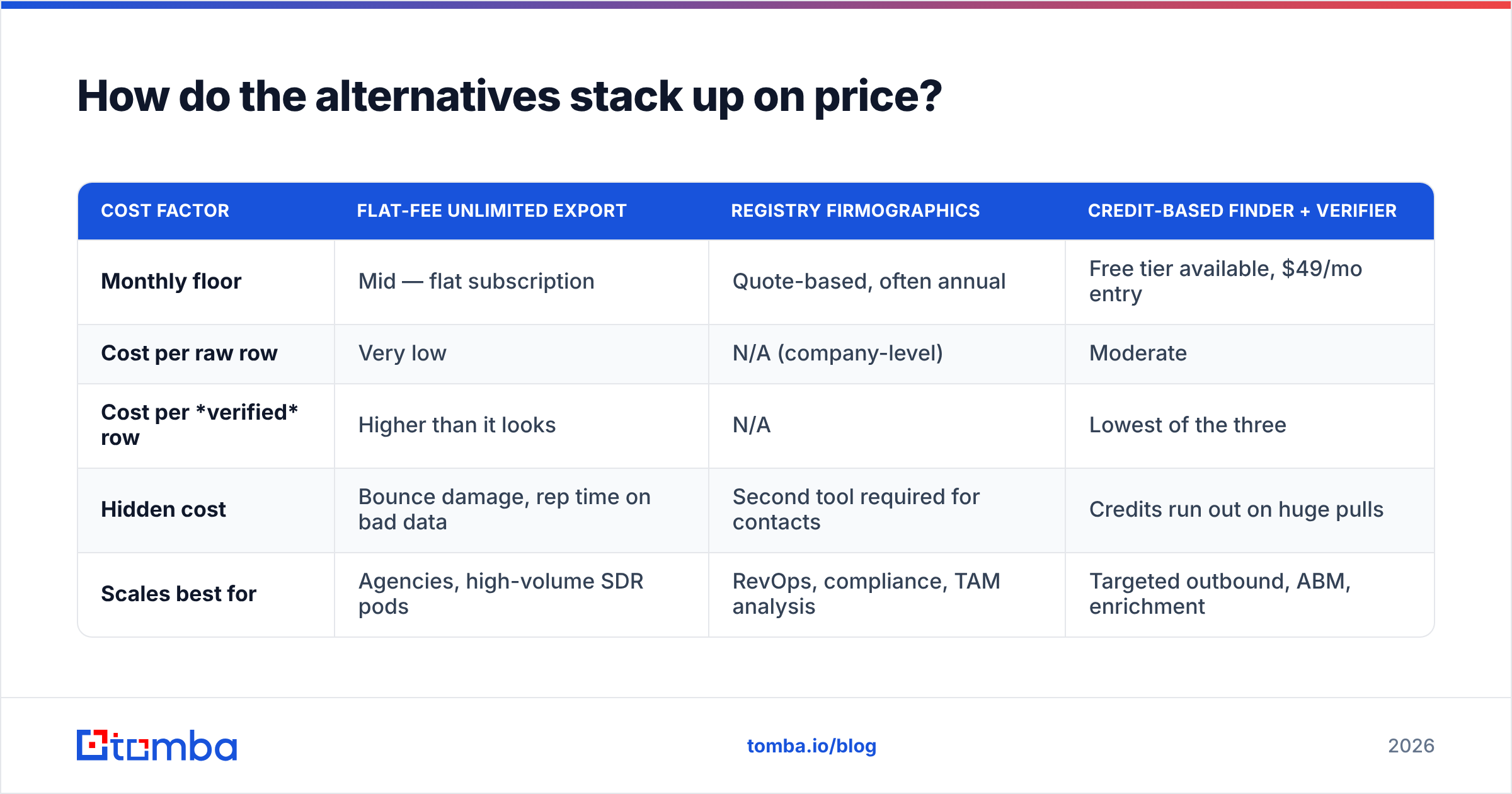
How do the alternatives stack up on price?#
Cost per usable contact is the only metric that matters, and it's not the sticker price. A cheap list with a 15% bounce rate and a 40% wrong-title rate is more expensive than a pricier list that's accurate, once you count rep hours and domain damage.
| Cost factor | Flat-fee unlimited export | Registry firmographics | Credit-based finder + verifier |
|---|---|---|---|
| Monthly floor | Mid — flat subscription | Quote-based, often annual | Free tier available, $49/mo entry |
| Cost per raw row | Very low | N/A (company-level) | Moderate |
| Cost per verified row | Higher than it looks | N/A | Lowest of the three |
| Hidden cost | Bounce damage, rep time on bad data | Second tool required for contacts | Credits run out on huge pulls |
| Scales best for | Agencies, high-volume SDR pods | RevOps, compliance, TAM analysis | Targeted outbound, ABM, enrichment |
For teams comparing entry points, Tomba pricing starts with a free tier at 25 searches per month, then $49/mo Starter, $99/mo Growth, and $249/mo Pro — which is a useful reference point for what accurate, per-record data actually costs when accuracy rather than volume is the product. Enterprise is quote-based.
If you're evaluating a broader field, it's worth also looking at BookYourData, which sells pay-as-you-go verified B2B lists with an accuracy guarantee — a genuinely different commercial model from both tools here, and a strong option if you want to buy contacts outright without a subscription. Cross-referencing user reviews on G2 before committing to any annual contract is time well spent; the review volume tells you more about real-world data quality than any vendor page.
What does a working 2026 stack actually look like?#
Concretely, for a 5-rep team selling software into European mid-market:
- Account list — registry firmographics (HitHorizons or equivalent) filtered to country, NACE code, and revenue band. Output: 800 qualified companies with domains.
- Contact discovery — run those 800 domains through a domain-level search to surface the 3-5 relevant titles per company. Output: ~3,000 named contacts.
- Verification pass — validate every address, flag catch-alls separately rather than lumping them into "risky," and drop hard fails. Expect to lose 8-15%.
- Enrichment — add phone numbers only for tier-one accounts using a phone finder, since dial data is expensive and mostly wasted on tier three.
- Send — warm domains properly, cap daily volume per mailbox, and monitor email deliverability weekly rather than after the quarter goes sideways.
Note what step 2 replaces: the generic 20,000-row export. You're not buying fewer contacts because you're cheap — you're buying fewer contacts because targeted lists convert better and don't torch your domain. That's a strategy decision, and it's the one place where the "unlimited exports" pitch can lead a team astray.
If your motion genuinely is high-volume — an agency running twelve client campaigns, say — then flip it: Warpleads for the raw pull, independent verification before every send, and registry data only when a client needs European entity precision.
Final verdict: HitHorizons or Warpleads?#
Buy HitHorizons if your problem is knowing which companies exist, are real, are solvent, and fit your ICP — especially in Europe. It is a company-intelligence tool and an excellent one for that job. Pair it with something that finds people.
Buy Warpleads if your problem is list volume and predictable cost, you run many campaigns in parallel, and you have the discipline to verify before sending. The flat-fee model is genuinely useful for agencies whose credit consumption is unpredictable.
Buy neither as a complete solution. Both leave the same hole: a current, deliverable email address attached to a named human at an account you actually want. That's a distinct job, and it deserves a distinct tool.
That's where Tomba fits. The Tomba Email Finder takes a name and a domain and returns a verified professional address with a confidence score and the sources behind it — so you can layer it on top of whichever database you chose without replacing it. Start on the free tier at 25 searches a month, test it against a sample of your existing list, and see how many rows your current provider is quietly getting wrong. If the bounce rate drops, you've found your missing layer.
Related guides#
Ready to find emails that actually work?
Join 150,000+ professionals who stopped guessing and started sending. Free credits on signup — no credit card required.
Get the Tomba newsletter
Practical outbound tactics and product updates — once every two weeks.
About the author