HitHorizons vs Zintlr (2026): Which B2B Data Tool Wins?
HitHorizons maps European company registries. Zintlr hands you contacts and personality profiles. They solve different halves of the same problem — here is which one belongs in your stack, and what neither of them does well.
TL;DR
- HitHorizons is a company database, not a contact database. It aggregates official European business-register records — legal names, registration IDs, NACE codes, revenue bands, addresses — and is strongest for account research, TAM sizing, KYC, and compliance checks.
- Zintlr is a contact database with a prospecting layer. It sells person-level records (work emails, direct dials) plus a "personality intelligence" angle designed to shape how you write the outreach.
- They barely overlap. Choosing between them is usually a category mistake: if you need to know which companies exist in Poland with 50-200 employees, that's HitHorizons. If you need the head of ops at 400 of them, that's Zintlr.
- Both leave the same gap: neither is built to be the last line of defense before you hit send. Contact records decay 25-30% a year, and a database subscription is not a verification layer.
- Practical stack for most teams: account data from a firmographic source, contact discovery + verification from a dedicated email finder, sequencing somewhere else.
What are HitHorizons and Zintlr, exactly?#
HitHorizons is a European company-data platform. Its core asset is aggregated data pulled from official national business registers across roughly 30+ European countries, normalised into a single schema with a persistent company identifier. You get legal entity names, registration and VAT numbers, registered addresses, industry classification (usually NACE codes), incorporation dates, and — where the local register publishes it — filed financials like turnover and employee counts.
That last part matters more than it sounds. In Europe, financial disclosure is uneven. Czech and UK filings are rich and public; other markets publish almost nothing without a paid registry request. HitHorizons is essentially a normalisation service on top of that mess, plus search, filtering, exports, and an API.
Zintlr sits on the other side of the funnel. It's a B2B prospecting platform: search a database of company and people records, filter by title, geography, headcount and industry, then pull work emails and phone numbers into a list or a CRM. Its differentiator is "personality intelligence" — behavioural profiles inferred from public signals, intended to tell your rep whether a given prospect wants three bullet points or a paragraph of context. It ships a Chrome extension for LinkedIn workflows and positions itself as an all-in-one alternative to the expensive incumbents.
So the honest framing of HitHorizons vs Zintlr is not "which is better" — it's "which layer of the data problem am I actually trying to solve?"

How do their data models actually differ?#
This is the part that determines everything downstream — coverage, freshness, compliance posture, and what you can legally do with the export.
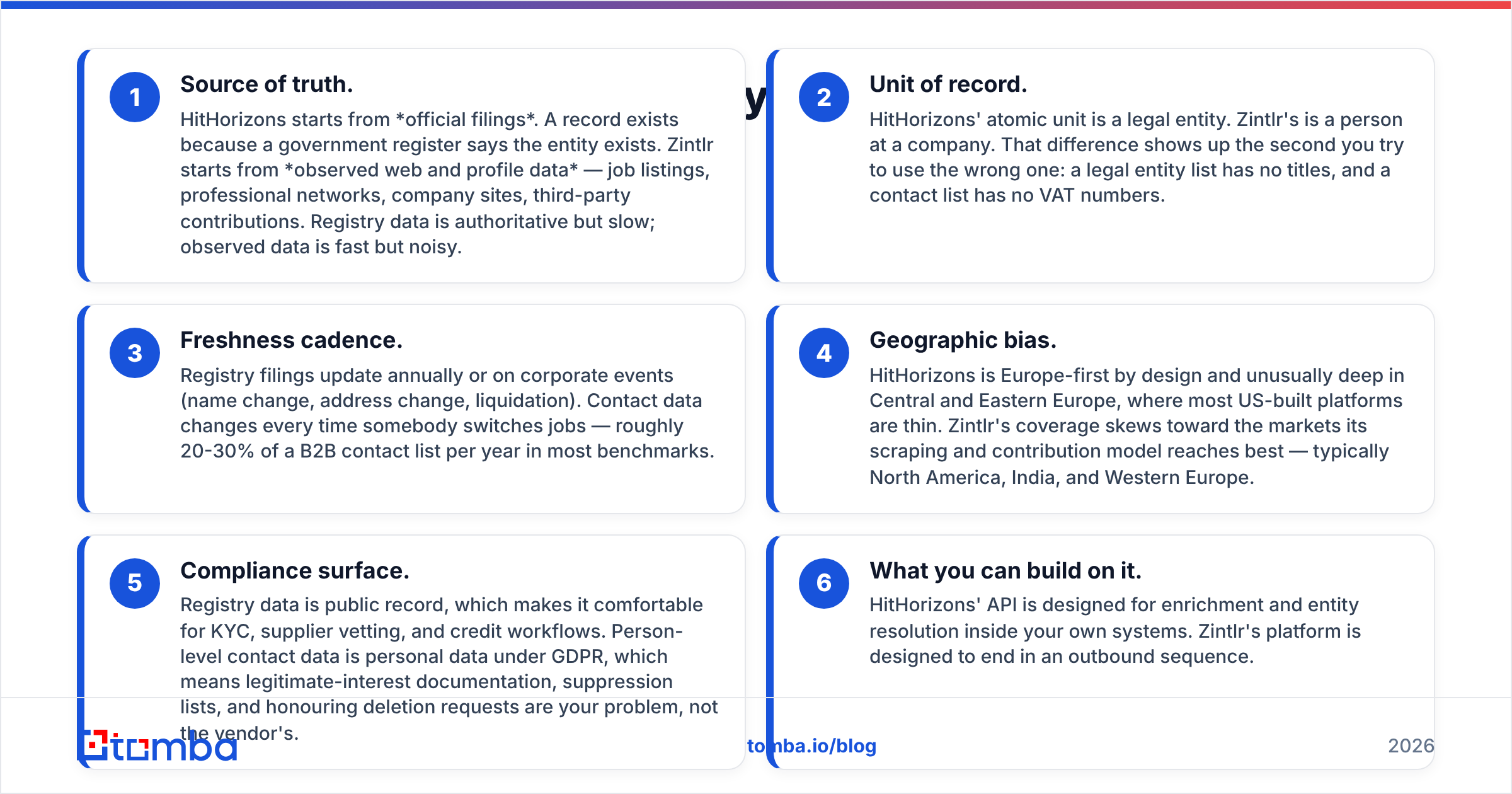
- Source of truth. HitHorizons starts from official filings. A record exists because a government register says the entity exists. Zintlr starts from observed web and profile data — job listings, professional networks, company sites, third-party contributions. Registry data is authoritative but slow; observed data is fast but noisy.
- Unit of record. HitHorizons' atomic unit is a legal entity. Zintlr's is a person at a company. That difference shows up the second you try to use the wrong one: a legal entity list has no titles, and a contact list has no VAT numbers.
- Freshness cadence. Registry filings update annually or on corporate events (name change, address change, liquidation). Contact data changes every time somebody switches jobs — roughly 20-30% of a B2B contact list per year in most benchmarks.
- Geographic bias. HitHorizons is Europe-first by design and unusually deep in Central and Eastern Europe, where most US-built platforms are thin. Zintlr's coverage skews toward the markets its scraping and contribution model reaches best — typically North America, India, and Western Europe.
- Compliance surface. Registry data is public record, which makes it comfortable for KYC, supplier vetting, and credit workflows. Person-level contact data is personal data under GDPR, which means legitimate-interest documentation, suppression lists, and honouring deletion requests are your problem, not the vendor's.
- What you can build on it. HitHorizons' API is designed for enrichment and entity resolution inside your own systems. Zintlr's platform is designed to end in an outbound sequence.
Get those six straight and the rest of the comparison mostly writes itself.
HitHorizons vs Zintlr: how do they compare head to head?#
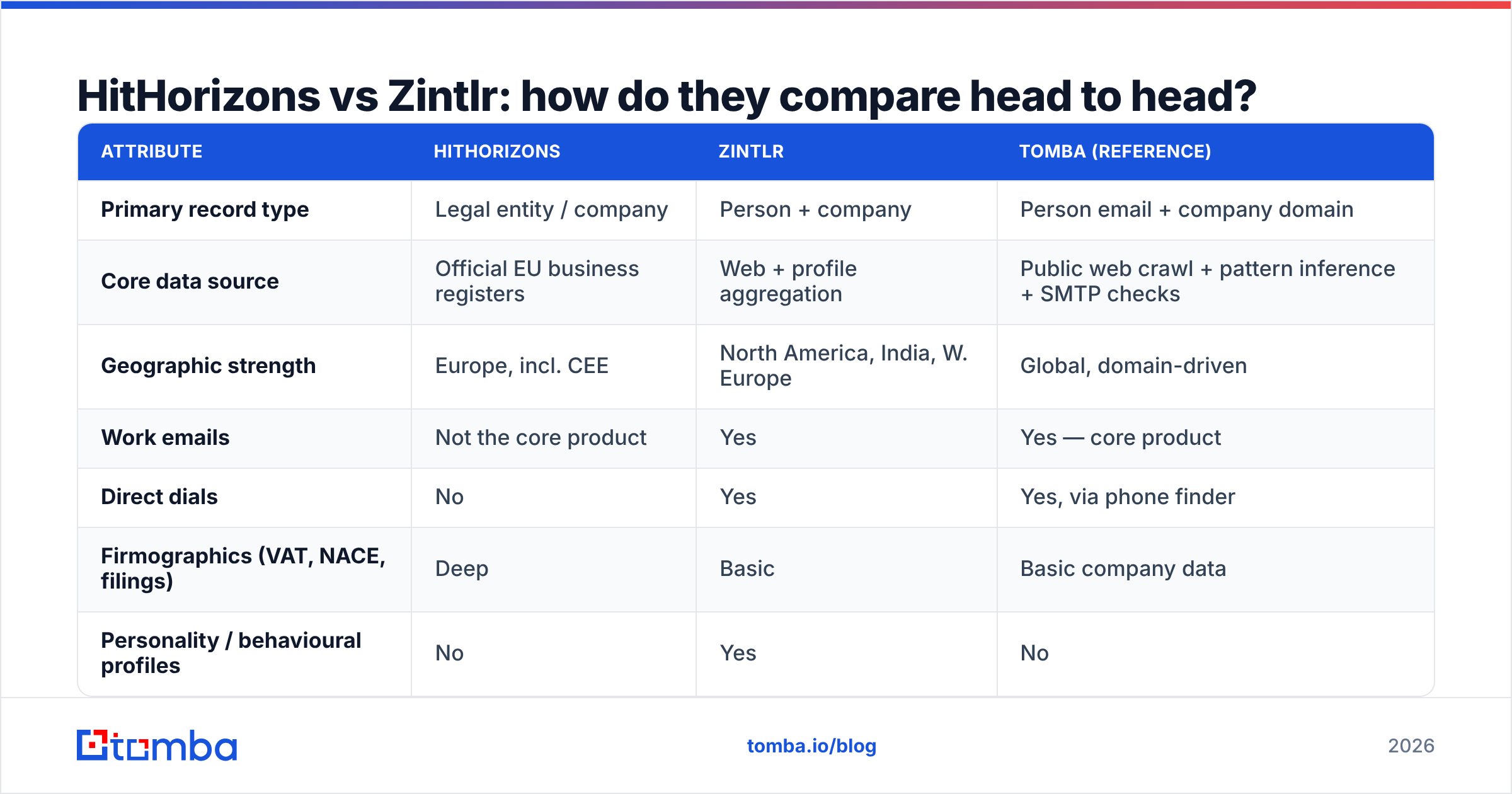
| Attribute | HitHorizons | Zintlr | Tomba (reference) |
|---|---|---|---|
| Primary record type | Legal entity / company | Person + company | Person email + company domain |
| Core data source | Official EU business registers | Web + profile aggregation | Public web crawl + pattern inference + SMTP checks |
| Geographic strength | Europe, incl. CEE | North America, India, W. Europe | Global, domain-driven |
| Work emails | Not the core product | Yes | Yes — core product |
| Direct dials | No | Yes | Yes, via phone finder |
| Firmographics (VAT, NACE, filings) | Deep | Basic | Basic company data |
| Personality / behavioural profiles | No | Yes | No |
| Built-in verification | N/A | Basic | Dedicated email verifier + catch-all handling |
| API for enrichment | Yes | Yes | Yes — Tomba API, CLI, MCP |
| Entry pricing | Credit/quote based | Published tiers, seat-based | Free 25/mo, then $49/mo |
| Best for | TAM sizing, KYC, supplier vetting | SDR contact sourcing | Finding + verifying emails at scale |
Two cells deserve a caveat. First, pricing on both platforms moves — HitHorizons leans toward credit packs and enterprise quotes depending on volume and API access, and Zintlr publishes seat-based tiers that have changed more than once. Check the vendor pages before you budget; treat anything you read in a comparison post (including this one) as directional. Second, "personality profiles" is a genuinely differentiated feature but an unaudited one. Treat it as a writing prompt, not a psychological assessment.
If you want third-party sentiment rather than vendor copy, both have listings on G2 worth skimming for the recurring complaints — those are usually more informative than the star average.
Which one is better for building a European TAM?#
HitHorizons, and it isn't close.
If your ICP is "manufacturing companies in Czechia, Slovakia, Poland and Hungary with €5-50M turnover," most US-built prospecting databases will return a thin, stale, mistranslated list. Registry-sourced data handles this properly: you filter on NACE code and turnover band, and you get the actual population of entities, including the ones that have never had a marketing site, never posted a job, and never appeared on a professional network.
That population view is worth real money in three situations:
- Market sizing that survives a board meeting. "There are 4,180 entities matching our ICP in these four countries" beats "our tool found 900 contacts."
- Supplier and partner vetting. Registration status, incorporation date, and filed financials are the inputs to a credit or risk decision. Scraped headcount estimates are not.
- Deduplicating your CRM. Legal entity IDs are the only reliable join key across subsidiaries, trading names, and rebrands.
What you cannot do with it is run outbound. A registry record gives you an entity and an address. It does not give you the person who owns the budget. That's the handoff point — and the moment where you need a domain search to turn a company list into a contact list.
Which one is better for contact-level outbound?#
Zintlr, with the usual caveats that apply to every contact database in this category.
For an SDR team whose job description is "get 60 verified prospects a day into the sequencer," Zintlr's shape is right: search, filter, pull emails and dials, push to CRM, work the list. The Chrome extension covers the LinkedIn-first workflow that most reps default to. The personality layer is the interesting bet — the claim is that matching message style to inferred behavioural type lifts reply rates. Directionally sensible, hard to isolate from every other variable in a cold-email test, and worth running as an A/B before you pay a premium for it.
The caveats:
- Coverage varies wildly by segment. Databases are not uniformly good. Run a coverage test on 200 accounts from your actual ICP before committing to an annual contract — not on the vendor's demo list.
- Seat-based pricing punishes small teams that need volume. If two people need 20,000 records a month, per-seat pricing is an expensive way to buy an API.
- Bundled verification is rarely enough. "Valid" in most prospecting tools means "syntactically fine and the domain has MX records." That is not the same as deliverable, and the difference lands in your bounce rate.

What do HitHorizons and Zintlr cost?#
Neither vendor makes this easy to compare, which is normal for the category.
HitHorizons prices around data volume and access method — self-serve credits for company profiles and reports, larger quotes for bulk downloads, data feeds, and API integration. The relevant budget question is not "how much per month" but "how many entity lookups will my enrichment job make, and does the contract cap them."
Zintlr publishes per-seat tiers with credit allocations attached. The relevant question there is the same one you ask of any prospecting tool: what counts as a credit, does a failed lookup burn one, and do unused credits roll over? Those three answers can swing effective cost by 3x between two tools with identical headline prices.
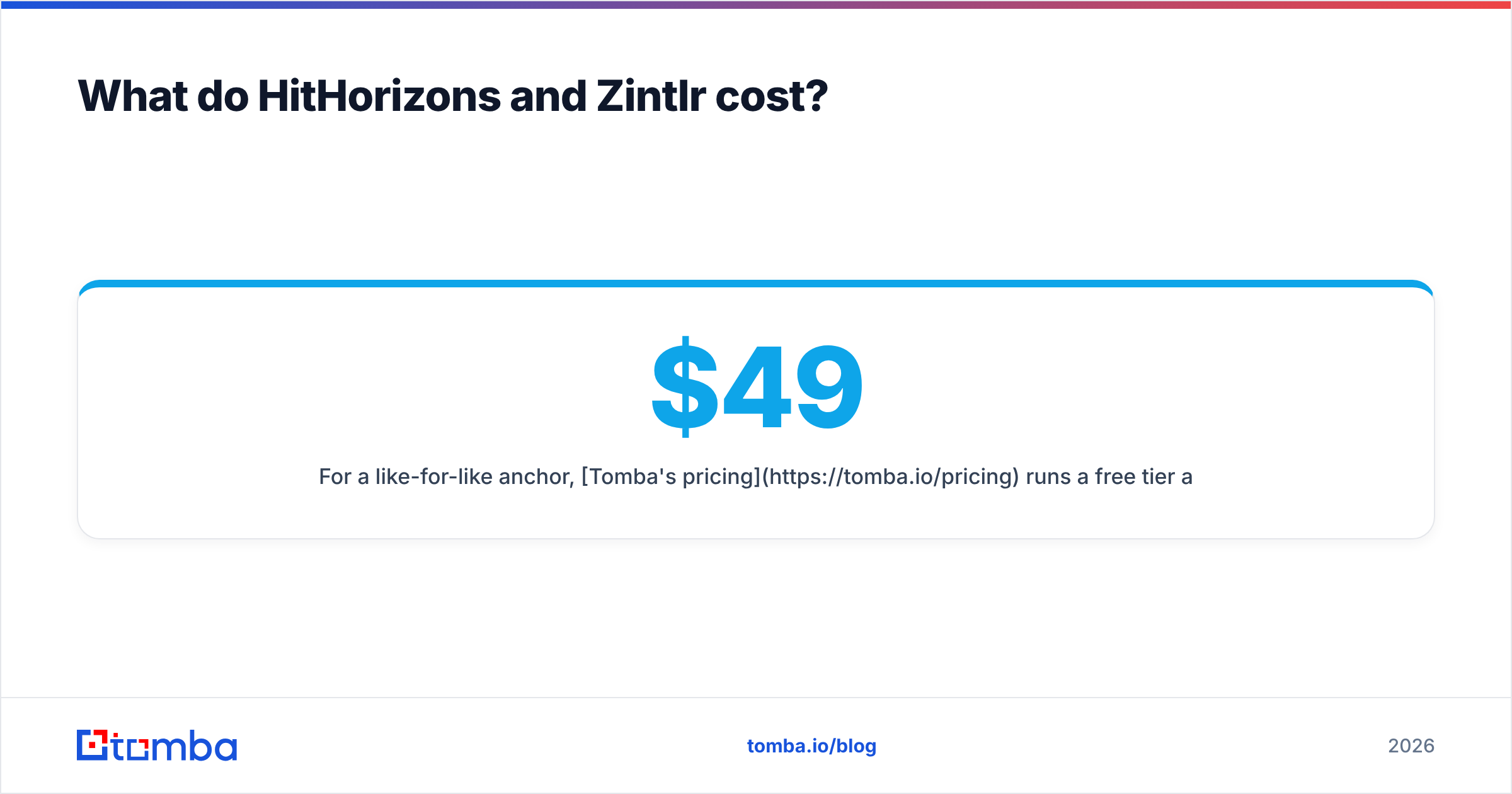
For a like-for-like anchor, Tomba's pricing runs a free tier at 25 searches/month, Starter at $49/mo, Growth at $99/mo, and Pro at $249/mo, with Enterprise on quote — priced on lookups rather than seats, so a two-person team buying volume doesn't get penalised for being small.
Where do both tools leave a gap?#
In the same place: the last 30 seconds before you press send.
A firmographic database tells you the company exists. A contact database tells you a person existed there, at some point, with some address. Neither is designed to answer "will this specific message land in this specific inbox today" — and that's the question that determines whether your domain reputation survives the quarter.
Three failure modes show up over and over:
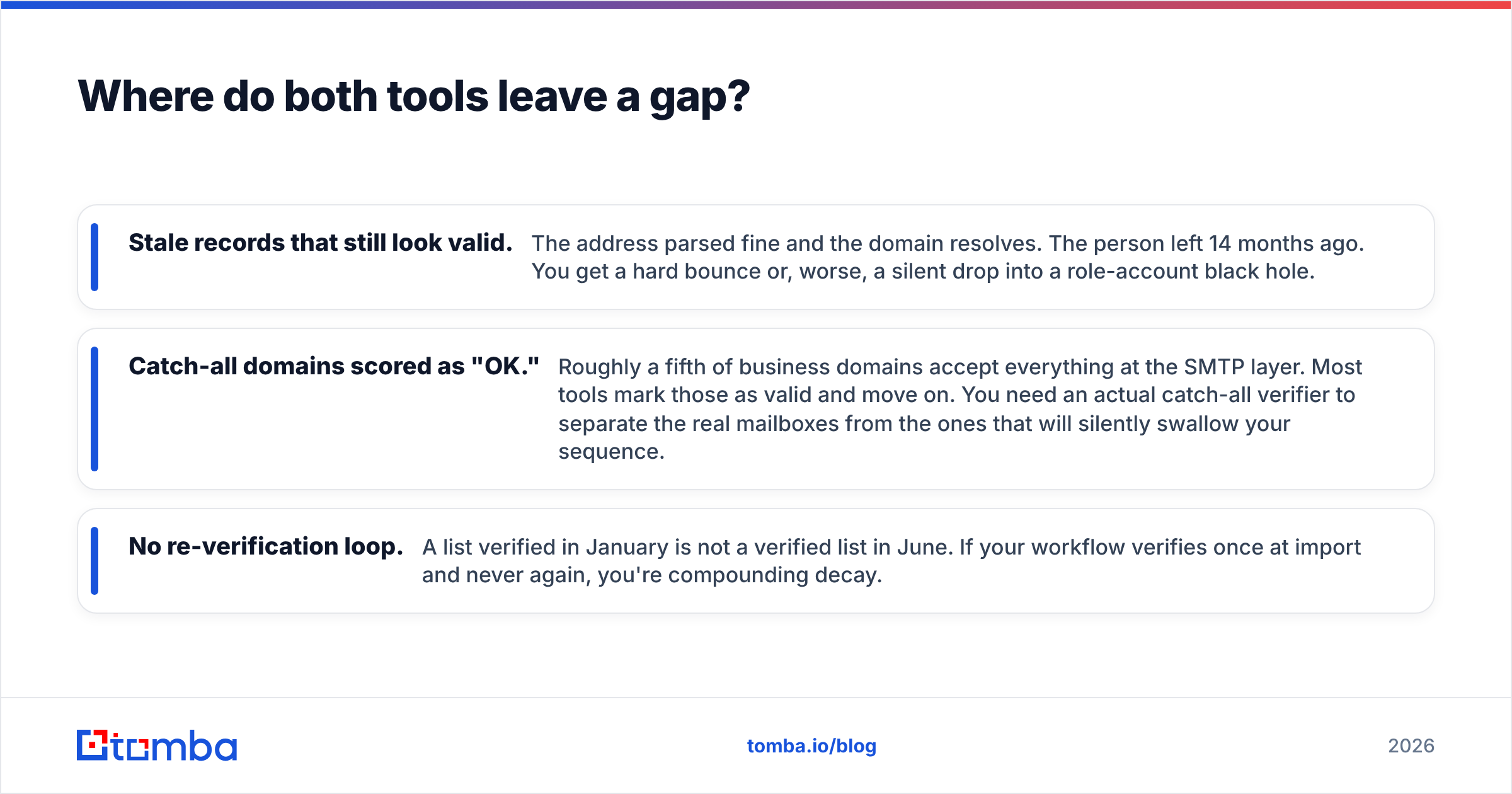
- Stale records that still look valid. The address parsed fine and the domain resolves. The person left 14 months ago. You get a hard bounce or, worse, a silent drop into a role-account black hole.
- Catch-all domains scored as "OK." Roughly a fifth of business domains accept everything at the SMTP layer. Most tools mark those as valid and move on. You need an actual catch-all verifier to separate the real mailboxes from the ones that will silently swallow your sequence.
- No re-verification loop. A list verified in January is not a verified list in June. If your workflow verifies once at import and never again, you're compounding decay.
The fix is architectural, not a matter of picking a better all-in-one. Keep the database that's genuinely good at your account layer, then run a dedicated discovery-and-verification step immediately before load. For high volumes, that means a bulk email finder and a scheduled re-verification job, not manual spot checks.
Which should you pick?#
Match the tool to the job, and be honest about which job you actually have:
- You need European entity data for TAM, KYC, or risk. HitHorizons. Nothing in the prospecting category comes close on registry depth in CEE.
- You need person-level contacts for SDR outbound. Zintlr, or another contact database — but run a 200-account coverage test on your real ICP first.
- You need both. That's the common case, and it's fine. Company layer from a registry source, contact layer from a finder, verification as a separate step. Resist the urge to buy one platform that half-does all three.
- You mostly need emails and hate paying per seat. Skip the platform question entirely and buy lookups from an API.
- You're enriching an existing CRM, not building lists. Neither front-end matters much. Compare the APIs, match rates, and per-record cost, then wire it up with data enrichment on a schedule.
One more thing worth saying plainly: no database vendor's published coverage number has ever survived contact with a real ICP. Every claim in this category — theirs, ours, everyone's — should be tested on 200 rows from your own pipeline before money changes hands. That test takes an afternoon and saves annual contracts.
Ready to close the gap between account lists and real inboxes?#
Whether your account data comes from a European registry source like HitHorizons or a contact platform like Zintlr, the step that decides your bounce rate is the same: finding the right person's address and confirming it's live before it enters a sequence.
That's what the Tomba Email Finder does — domain, name, or company in, verified professional email out, with catch-all detection and a verification layer built in rather than bolted on. Start on the free tier at 25 searches a month, test it against whatever list you already trust, and only upgrade if the match rate beats what you're paying for now.
Related guides#
Ready to find emails that actually work?
Join 150,000+ professionals who stopped guessing and started sending. Free credits on signup — no credit card required.
Get the Tomba newsletter
Practical outbound tactics and product updates — once every two weeks.
About the author