HitHorizons vs ZoomInfo: Which B2B Data Tool Wins in 2026?
HitHorizons sells registry-grade company data. ZoomInfo sells contacts, intent, and workflow. They are not the same purchase, and picking wrong costs you either a wasted year of seats or a database nobody can email.
TL;DR
- These tools solve different problems. HitHorizons is a company-level firmographic database built on official business-registry and commercial-register sourcing, strongest in Europe. ZoomInfo is a person-level contact and intelligence platform, strongest in North America.
- HitHorizons gives you the company; it does not hand you a mailbox. You get legal entity names, registration IDs, turnover bands, employee counts, industry codes and corporate hierarchies — not a verified work email for the VP of Ops.
- ZoomInfo gives you contacts and workflow, at enterprise cost. Public reporting and buyer reviews consistently put annual commitments in the five-figure range with seat minimums and multi-year terms.
- The cheapest correct answer is often neither, alone. Many teams pair a firmographic source for account selection with a dedicated email finder for contact data, and cut spend by 70–90% versus an all-in-one seat contract.
- Decide by geography and by unit of work. European entity resolution and compliance research → HitHorizons. US outbound at scale with intent signals → ZoomInfo. Contact discovery on a defined account list → a focused finder.
What is HitHorizons, and where does its data come from?#
HitHorizons is a company-information database. Think of it as a searchable index of the paperwork that exists whenever a business legally registers itself: the entity name, the registration number, the address of record, the reported turnover, the headcount band, the industry classification, and how that entity sits inside a parent-subsidiary tree.
Its center of gravity is Europe. Where US-first databases stitch together company profiles from web crawling, job postings and self-reported LinkedIn pages, HitHorizons leans on registry-derived and commercially sourced firmographic records. That difference matters more than it sounds. A registry record tells you the company legally exists, what it filed, and which entity is which — the sort of thing that survives a compliance review. A crawled profile tells you the company has a marketing website.
What HitHorizons is good at:
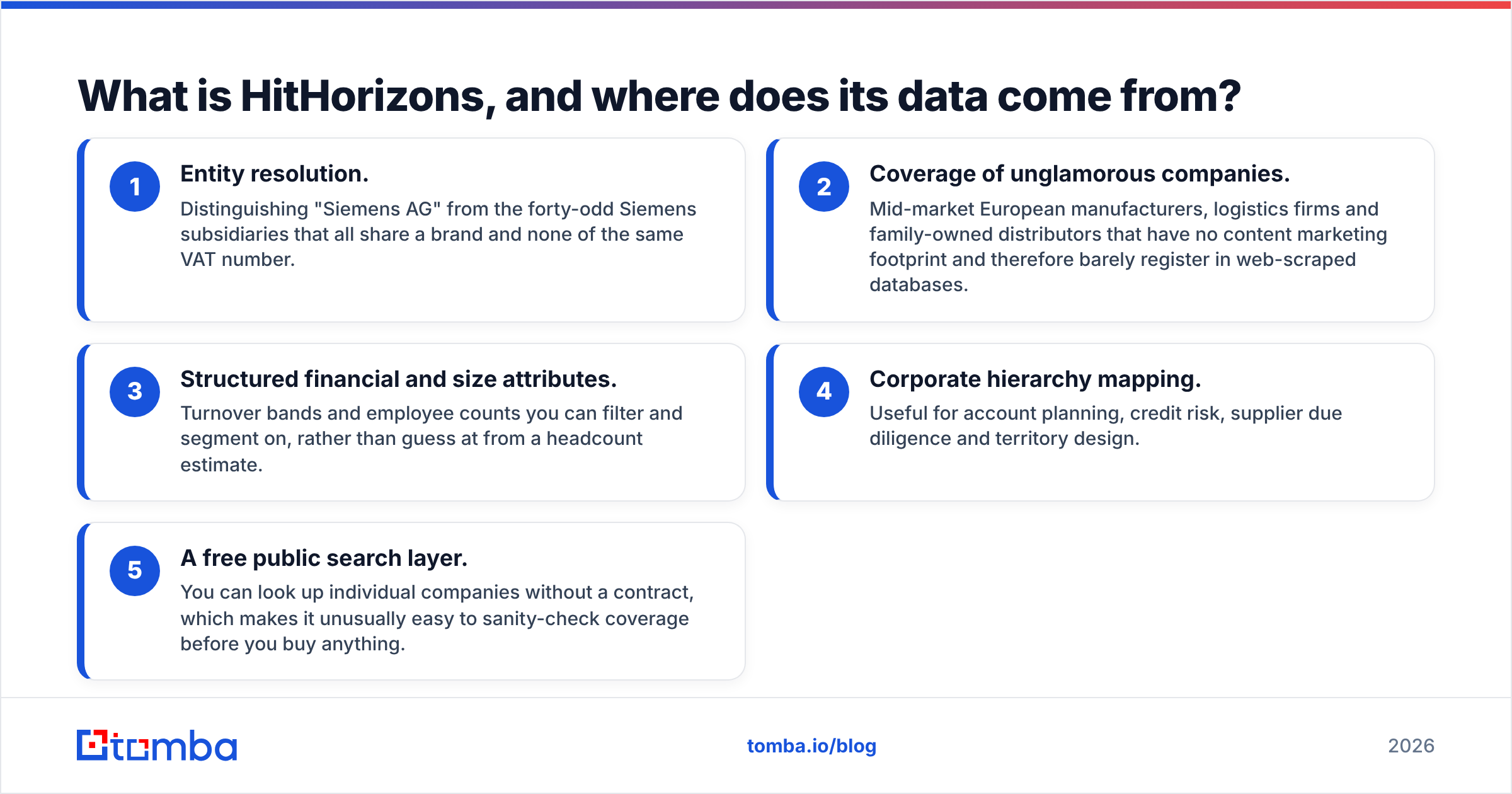
- Entity resolution. Distinguishing "Siemens AG" from the forty-odd Siemens subsidiaries that all share a brand and none of the same VAT number.
- Coverage of unglamorous companies. Mid-market European manufacturers, logistics firms and family-owned distributors that have no content marketing footprint and therefore barely register in web-scraped databases.
- Structured financial and size attributes. Turnover bands and employee counts you can filter and segment on, rather than guess at from a headcount estimate.
- Corporate hierarchy mapping. Useful for account planning, credit risk, supplier due diligence and territory design.
- A free public search layer. You can look up individual companies without a contract, which makes it unusually easy to sanity-check coverage before you buy anything.
What it is not: a prospecting tool. There is no sequence builder, no intent feed, no Chrome extension that drops a decision-maker's mobile number into your CRM. If your definition of "B2B data" includes "an email address I can send to on Tuesday," HitHorizons is only the first half of that job.

What is ZoomInfo, and what are you actually buying?#
ZoomInfo is the incumbent. It sells a person-level contact database — names, titles, work emails, direct dials, mobile numbers — layered with company firmographics, technographics, buying-intent signals, website visitor identification, conversation intelligence and a sequencing/engagement layer branded across its Copilot and SalesOS products.
The pitch is consolidation: one contract replaces a data vendor, an intent vendor, a dialer database and part of your engagement stack. For a 40-rep outbound org running North American motions, that consolidation is genuinely valuable. Your reps live in one interface, your RevOps team maintains one integration, and enrichment runs automatically against your CRM.
The catch is the commercial model. ZoomInfo does not publish list pricing. Buyer reviews on G2 and public procurement chatter consistently describe annual contracts starting in the low five figures and climbing quickly with seats, credit blocks and add-on modules like intent or Copilot. Multi-year terms and auto-renewal clauses are common enough that "read the renewal language" is standard advice from anyone who has signed one.
There is also a coverage asymmetry nobody at a demo volunteers. ZoomInfo's North American contact depth is excellent. Its European contact depth is thinner, and GDPR constraints mean the personal-data side of the product behaves differently in the EU than it does in the US. If your ICP is German Mittelstand or Nordic industrials, you can pay enterprise pricing for a database that is weakest exactly where you need it.
HitHorizons vs ZoomInfo: how do they compare head-to-head?#
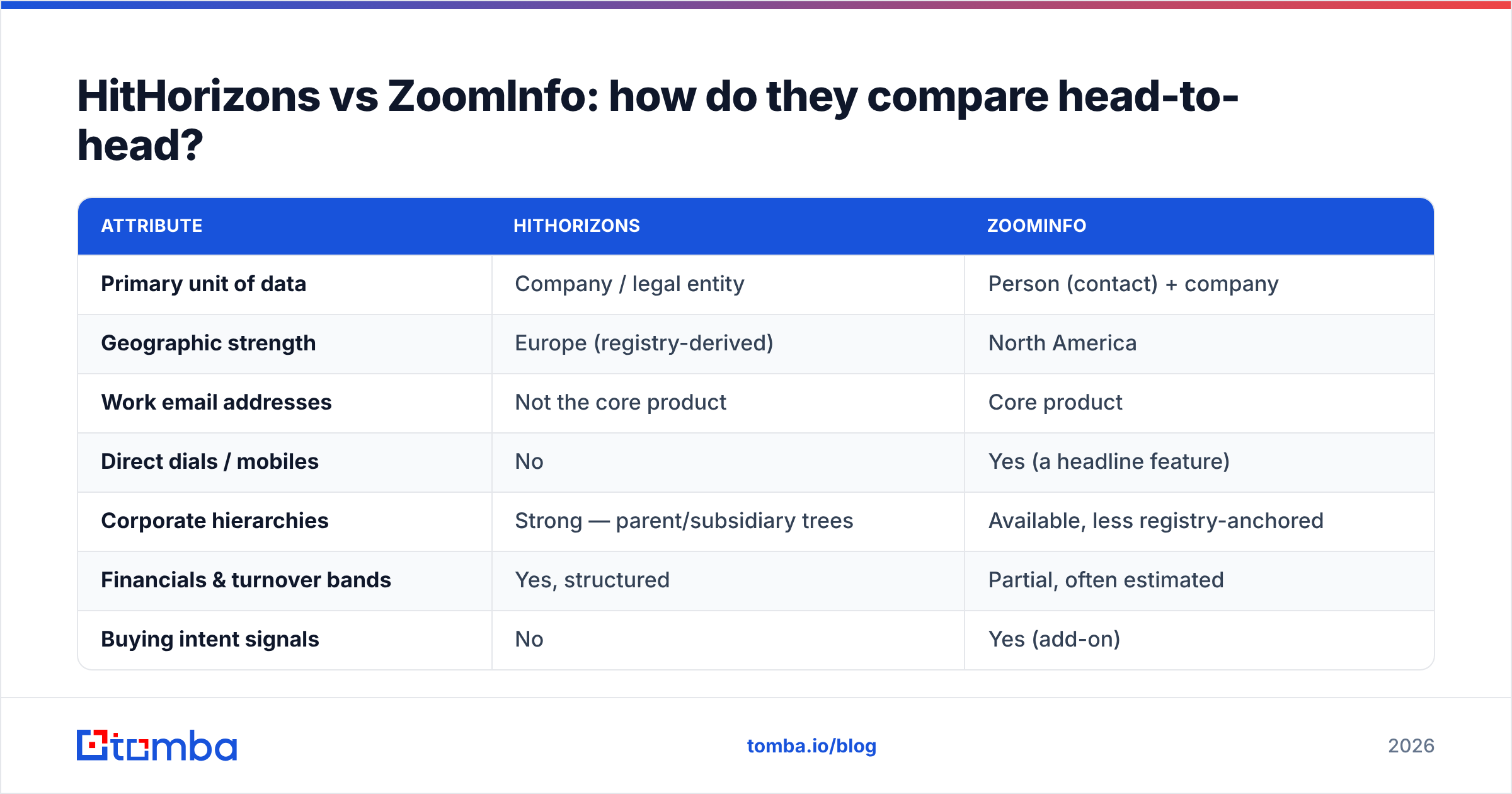
| Attribute | HitHorizons | ZoomInfo |
|---|---|---|
| Primary unit of data | Company / legal entity | Person (contact) + company |
| Geographic strength | Europe (registry-derived) | North America |
| Work email addresses | Not the core product | Core product |
| Direct dials / mobiles | No | Yes (a headline feature) |
| Corporate hierarchies | Strong — parent/subsidiary trees | Available, less registry-anchored |
| Financials & turnover bands | Yes, structured | Partial, often estimated |
| Buying intent signals | No | Yes (add-on) |
| Website visitor ID | No | Yes (add-on) |
| Sequencing / engagement | No | Yes |
| Free entry point | Free public company search | Free trial, gated |
| Typical annual cost | Low — plan tiers and data packages | Five figures and up, seat-based |
| Contract style | Self-serve friendly | Annual, often multi-year |
| Best for | Account selection, due diligence, EU TAM sizing | Full-stack US outbound at scale |
Read that table as two different purchases rather than two competing products. HitHorizons answers which companies exist and which ones match my criteria. ZoomInfo answers which humans work there and how do I reach them today.
Which one has better data accuracy?#
Wrong question — or at least an incomplete one. Accuracy is measured against the field you care about, and these two tools carry different fields.
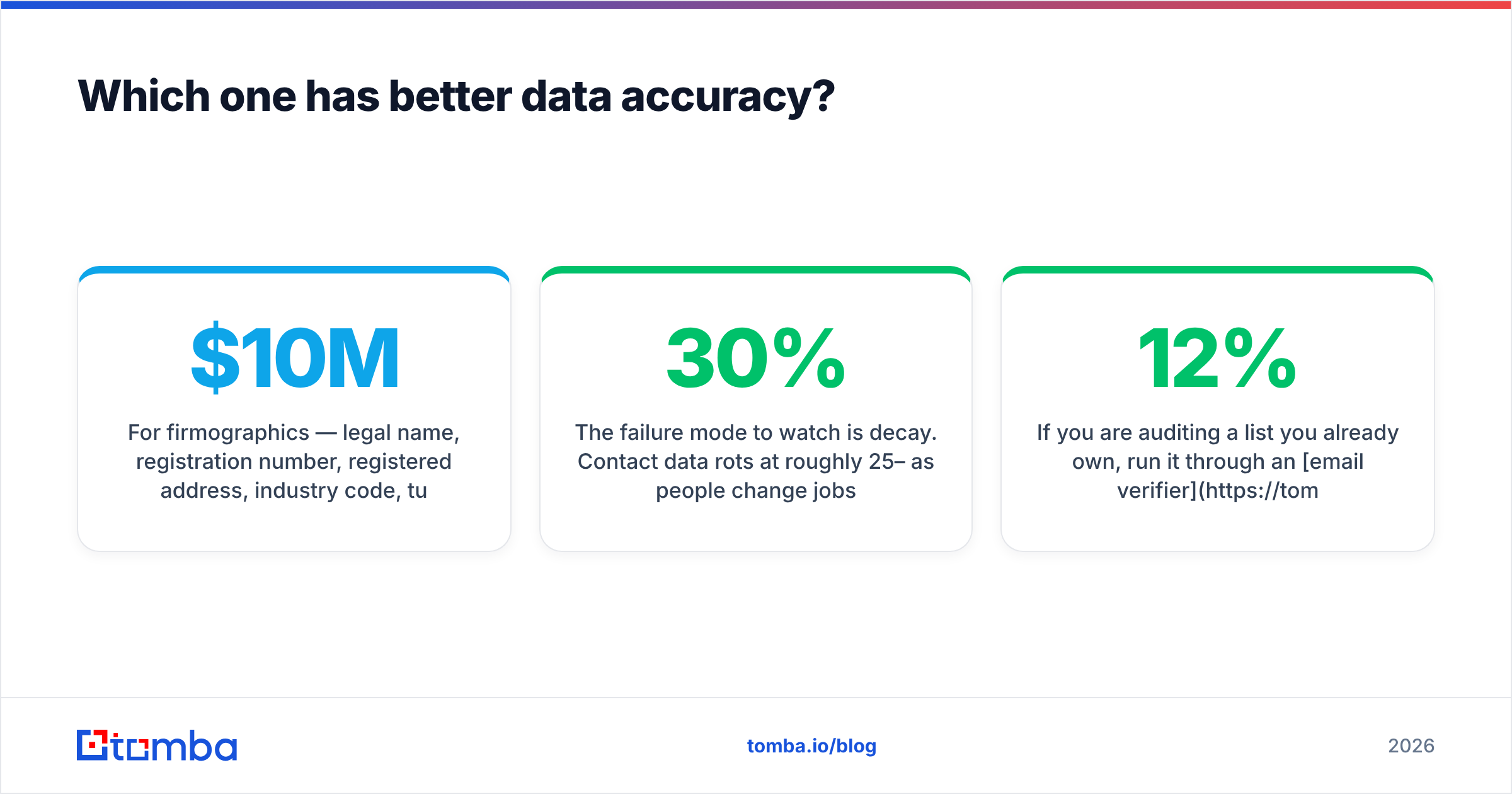
For firmographics — legal name, registration number, registered address, industry code, turnover band — registry-sourced data has a structural advantage. It comes from filings, not inference. When HitHorizons says a company reported €14M in turnover, that number traces to a document. When a web-scraped database estimates "$10M–$50M revenue," that is a model output with a confidence interval nobody shows you.
For contact data — a person's current work email and phone — the advantage flips hard. ZoomInfo invests enormously in contributory data, phone verification and title refresh cycles. HitHorizons simply does not compete here, because it never set out to.
The failure mode to watch is decay. Contact data rots at roughly 25–30% per year as people change jobs, which means any contact database you licensed 14 months ago is meaningfully wrong today. Firmographic data decays far more slowly — companies change legal address and reported turnover annually at most. That decay differential is the single strongest argument for buying firmographics on a long cycle and contact data on a short one, from different vendors, rather than paying one vendor to be mediocre at both.
If you are auditing a list you already own, run it through an email verifier before you draw conclusions about any vendor's accuracy. A 12% bounce rate is often a 14-month-old export, not a bad database.
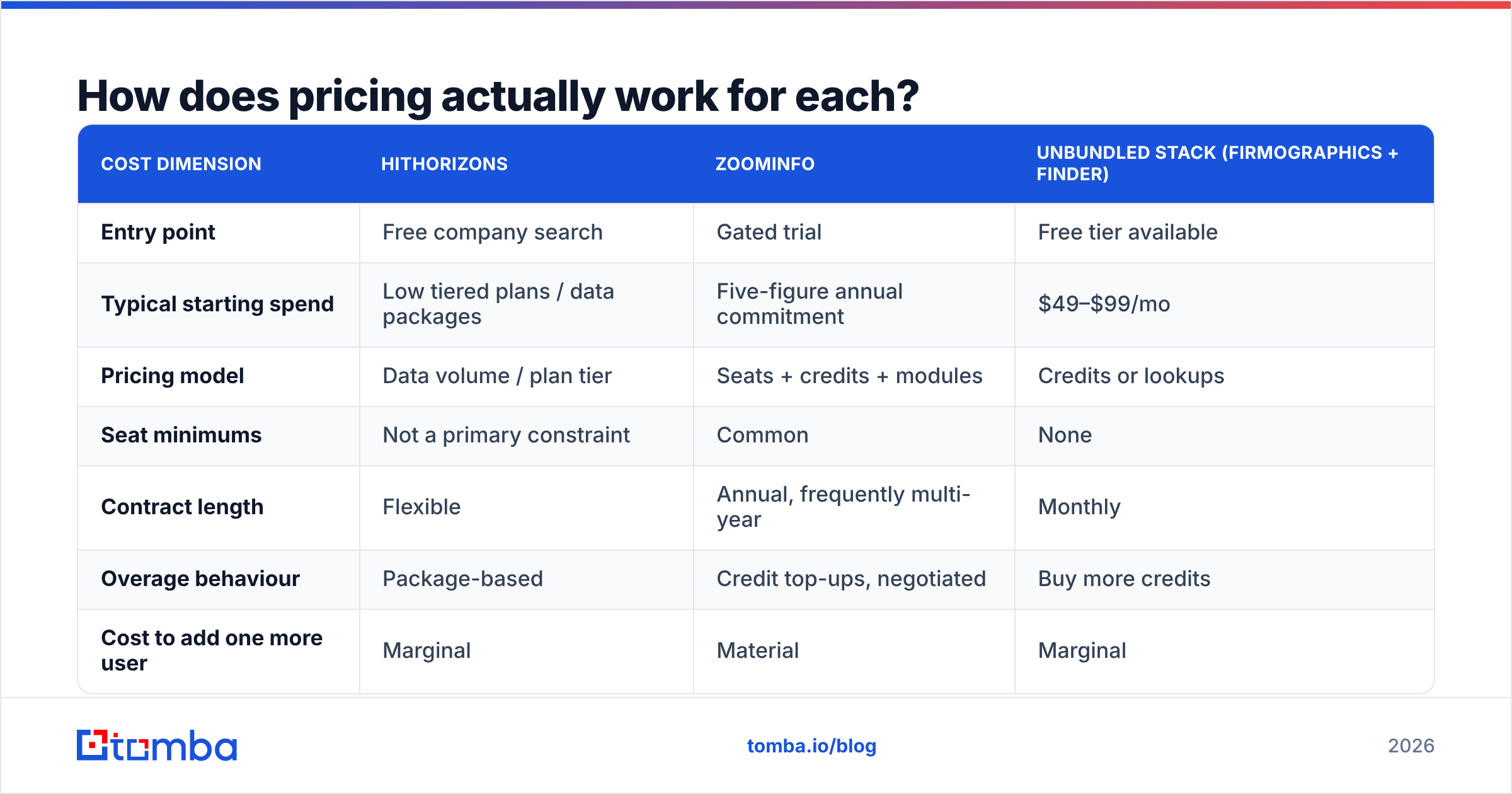
How does pricing actually work for each?#
| Cost dimension | HitHorizons | ZoomInfo | Unbundled stack (firmographics + finder) |
|---|---|---|---|
| Entry point | Free company search | Gated trial | Free tier available |
| Typical starting spend | Low tiered plans / data packages | Five-figure annual commitment | $49–$99/mo |
| Pricing model | Data volume / plan tier | Seats + credits + modules | Credits or lookups |
| Seat minimums | Not a primary constraint | Common | None |
| Contract length | Flexible | Annual, frequently multi-year | Monthly |
| Overage behaviour | Package-based | Credit top-ups, negotiated | Buy more credits |
| Cost to add one more user | Marginal | Material | Marginal |
Two practical notes. First, ZoomInfo's price is negotiable and quarter-end dependent — the number in your first quote is rarely the number you sign. Second, neither vendor publishes a public rate card you can rely on indefinitely, so treat every figure here as a directional benchmark and confirm current terms directly.
For comparison, transparent self-serve tooling sits in a different order of magnitude: Tomba pricing runs a free tier at 25 searches/month, Starter at $49/mo, Growth at $99/mo and Pro at $249/mo, with Enterprise custom. That is not a like-for-like replacement for ZoomInfo's full platform — it is deliberately narrower — but it reframes what "expensive" means when the job to be done is contact discovery on a known account list.

Which teams should pick HitHorizons?#
Choose HitHorizons when the company, not the person, is the unit of work:
- European TAM sizing. You need a defensible count of companies matching an industry code, turnover band and country before you commit a hiring plan to it.
- Compliance, KYC and supplier due diligence. Registration numbers and hierarchy trees are the deliverable, and an estimate does not pass audit.
- Territory and account planning. Splitting a market cleanly requires knowing which entities are subsidiaries of which parent, so two AEs do not both call the same corporate group.
- Credit and risk workflows. Structured financial attributes beat scraped guesses.
- Research-heavy, low-volume outbound. If you send 200 highly targeted emails a quarter, you do not need a platform. You need a good list and a reliable way to find the addresses.
Which teams should pick ZoomInfo?#
Choose ZoomInfo when volume, velocity and North America all appear in the same sentence:
- 20+ reps running US outbound daily, where per-rep productivity gains justify per-seat cost.
- You want intent and visitor identification in the same contract as your contact data, and you have the RevOps maturity to actually operationalise intent rather than let it decorate a dashboard.
- Direct dials are core to the motion. If your team lives on the phone, ZoomInfo's mobile coverage is the strongest single argument in its favour.
- You are consolidating four vendors into one and the procurement savings are real, not theoretical.
Be honest about the last one. Consolidation only saves money if you actually cancel the other four contracts. Most teams do not.
Is there a third option worth considering?#
Yes, and it is the one most teams under €10M ARR should price out before signing anything: unbundle the stack.
The logic is straightforward. Account selection and contact discovery are separate jobs with separate decay rates and separate best-in-class vendors. You can buy firmographic depth from a registry-grade source like HitHorizons — or, for lower-volume needs, from open sources plus targeted enrichment — and then resolve contacts on demand rather than licensing millions of records you will never touch.
That second half is where a focused email finder does the work. You feed it a company domain and a name, or just the domain, and it returns verified professional addresses with a confidence score. Domain search pulls the addressable contacts at a company you have already qualified. Data enrichment fills the gaps in records you already own, and the Tomba API wires the whole thing into your CRM without a seat license per rep.
The economics: a 3-person team running 1,500 targeted contacts a month pays roughly $99/mo on a self-serve finder plus whatever firmographic tier they need. The equivalent seat-based enterprise contract is typically 15–30x that. You lose intent data and the built-in sequencer — real losses, worth naming — and you keep the ability to change your mind in 30 days instead of 24 months.
Other credible entrants worth putting in the same evaluation: BookYourData for prepaid, pay-as-you-go verified B2B lists with no annual commitment (a genuinely different commercial model, and a good fit if you want to own the data outright rather than rent access), and dedicated verification tools if bounce rate rather than discovery is your bottleneck.
What should you check before signing either contract?#
- Run 50 real accounts through the free layer. HitHorizons lets you search publicly. Do it with your actual ICP, not the demo's cherry-picked examples.
- Ask for a coverage sample in your geography, not a global coverage number. "150M companies" is meaningless if 4% are in your target country.
- Test contact accuracy independently. Export 100 contacts and verify them with a neutral third-party checker before you assume the vendor's advertised accuracy rate.
- Read the renewal clause. Auto-renewal with a 60- or 90-day cancellation window is the single most common source of buyer regret in this category.
- Price the unbundled alternative. Even if you sign the platform, knowing the alternative's cost gives you leverage in the negotiation.
The verdict#
If your ICP is European and company-shaped, HitHorizons is the better data foundation and costs a fraction of the alternative — but plan for a separate contact-discovery layer, because it will not hand you mailboxes. If your ICP is North American, your team is large, and phone plus intent are central to the motion, ZoomInfo earns its price tag. If you are somewhere in between — a lean team with a defined account list and a need for verified addresses — buy neither platform and assemble the two pieces you actually use.
Start with the piece that unblocks sending. Point the Tomba Email Finder at the accounts you have already qualified, verify what comes back, and see how much of your outbound problem was ever a platform problem in the first place. The free tier covers 25 searches a month, which is enough to test the premise before anyone signs anything.
Related guides#
Ready to find emails that actually work?
Join 150,000+ professionals who stopped guessing and started sending. Free credits on signup — no credit card required.
Get the Tomba newsletter
Practical outbound tactics and product updates — once every two weeks.
About the author