How to Avoid Burnout in Sales: A 2026 Playbook for Reps
Sales burnout is not a willpower problem, it's a workload math problem. Here is the operating system that keeps quota-carrying reps productive without torching them by Q3.
TL;DR
- Sales burnout is rarely caused by "not being resilient enough." It is caused by high effort spent on low-yield activity, with feedback loops that are too slow to correct.
- The single biggest lever most reps ignore: data quality. Bad contact data inflates activity volume by 30-50% without adding a single extra conversation.
- Protect three things weekly — a fixed prospecting block, a hard stop, and one full recovery day. Everything else is negotiable.
- Managers cause more burnout than quotas do. Vague expectations, mid-quarter target changes, and activity-only scorecards are the top three offenders.
- Rebuild your week around outcomes per hour, not actions per day. The comparison tables below show what that shift looks like in practice.
What is sales burnout, exactly?#
Sales burnout is chronic occupational exhaustion caused by a mismatch between effort and reward, not by working hard. The World Health Organization classifies burn-out as an occupational phenomenon with three dimensions: energy depletion, mental distance from the job, and reduced professional efficacy. Every one of those maps cleanly onto a quota-carrying role.
Think of it like a car engine running at redline in second gear. The noise and fuel burn are enormous, the speedometer barely moves, and eventually something in the block cracks. Reps in this state are not lazy. They are usually the ones working the most hours. That is exactly the problem: they are pouring effort into a gear ratio that cannot convert it.
The distinction that matters for fixing it: stress is acute and recoverable, burnout is chronic and structural. You cannot sleep your way out of a broken territory, a 4% connect rate, or a list where one in three emails bounces. Time off helps you recover from stress. It does nothing about the system that produced the exhaustion in the first place.
Why do sales reps burn out faster than other teams?#
Four structural features of the job stack against you.
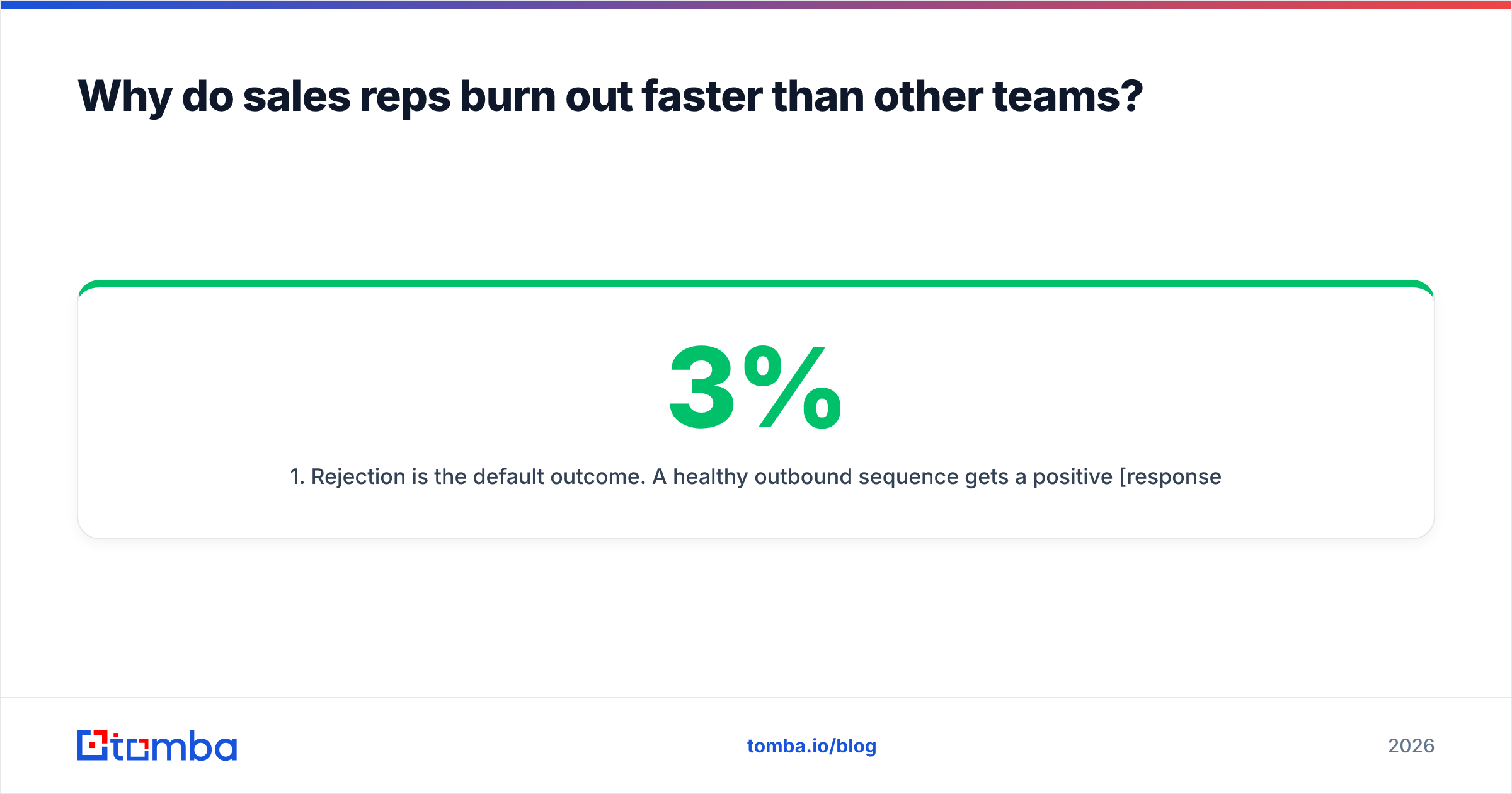
- Rejection is the default outcome. A healthy outbound sequence gets a positive response rate somewhere between 3% and 8%. That means 92-97% of your work produces silence or a no. Almost no other professional role has that base rate.
- The scoreboard resets every 30-90 days. Closing a record quarter buys you roughly one weekend of relief before the number goes back to zero. There is no accumulation of safety.
- Effort and outcome are decoupled in the short term. A rep can do everything right for six weeks and close nothing, because a deal slipped or a champion left. Humans tolerate hard work far better than they tolerate unpredictable reward.
- The work never has a natural end point. There is always one more account, one more follow-up, one more list to build. Without a manufactured stop, the job expands into every available hour.

Notice what is not on that list: "reps are not tough enough." Resilience training on top of a broken system is a coat of paint on rust.
How do you avoid burnout in sales day to day?#
Seven changes, ordered by impact per hour of effort to implement.
- Fix your data before you fix your effort. If 25% of your list is invalid, you are doing a quarter of your work for a guaranteed zero. Run every list through an email verifier before it enters a sequence. This is the cheapest burnout intervention that exists, because it removes work rather than adding it.
- Batch prospecting into one protected block. Two hours, same time daily, phone face-down, Slack closed. Context switching between building lists and running calls is what makes a nine-hour day feel like fourteen.
- Set a hard stop and defend it publicly. Tell your manager and your team the time. An announced boundary survives; a private intention does not.
- Track outcomes per hour, not actions per day. "80 dials" is an input you can hit while accomplishing nothing. "4 qualified conversations" is a result. Measuring inputs alone rewards the exact behaviour that burns people out.
- Cap the number of open deals you carry. Most reps can genuinely progress 12-18 opportunities. Beyond that, you are not managing a pipeline, you are performing anxiety across a spreadsheet. Disqualify aggressively.
- Build a "no-decision" ritual. Every Friday, kill the deals that have not moved in 30 days. The emotional weight of zombie deals is heavier than the pipeline value they represent.
- Take one full recovery day per week with zero work contact. Not a "light" day. Zero. Partial recovery days produce partial recovery, which compounds into a deficit over a quarter.
What does a sustainable sales week actually look like?#
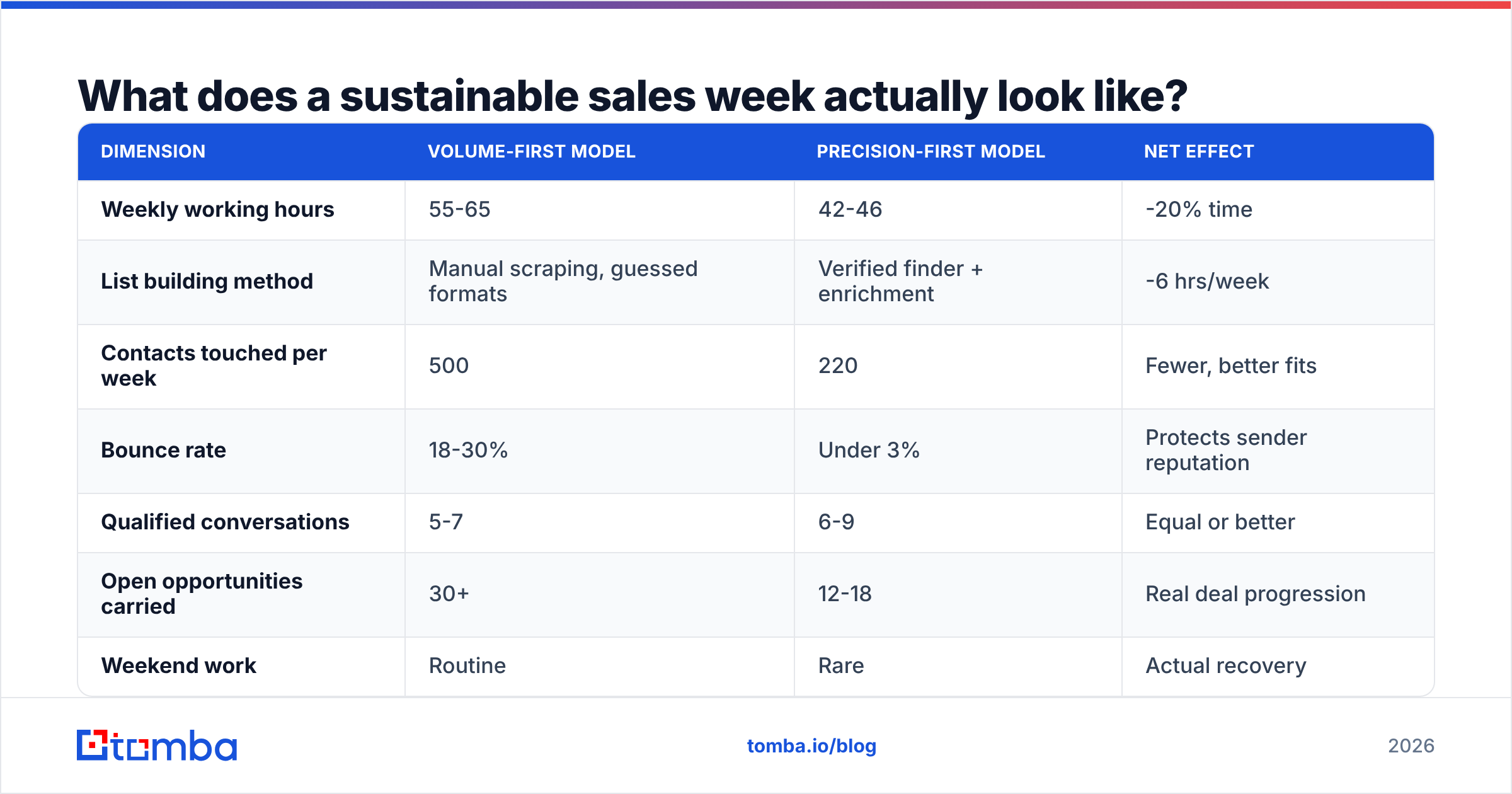
Here is the same rep, same quota, two operating models. The difference is not hours worked — it is where the hours go.
| Dimension | Volume-First Model | Precision-First Model | Net effect |
|---|---|---|---|
| Weekly working hours | 55-65 | 42-46 | -20% time |
| List building method | Manual scraping, guessed formats | Verified finder + enrichment | -6 hrs/week |
| Contacts touched per week | 500 | 220 | Fewer, better fits |
| Bounce rate | 18-30% | Under 3% | Protects sender reputation |
| Qualified conversations | 5-7 | 6-9 | Equal or better |
| Open opportunities carried | 30+ | 12-18 | Real deal progression |
| Weekend work | Routine | Rare | Actual recovery |
| Time to burnout signal | 2-3 quarters | Not typical | Career longevity |
The volume-first column is not a straw man. It is what most reps default to when their manager's only lever is "do more." The trap is that it appears to work for about two quarters, which is long enough for it to become the team norm before the attrition shows up.
Which activities are worth protecting and which should you cut?#
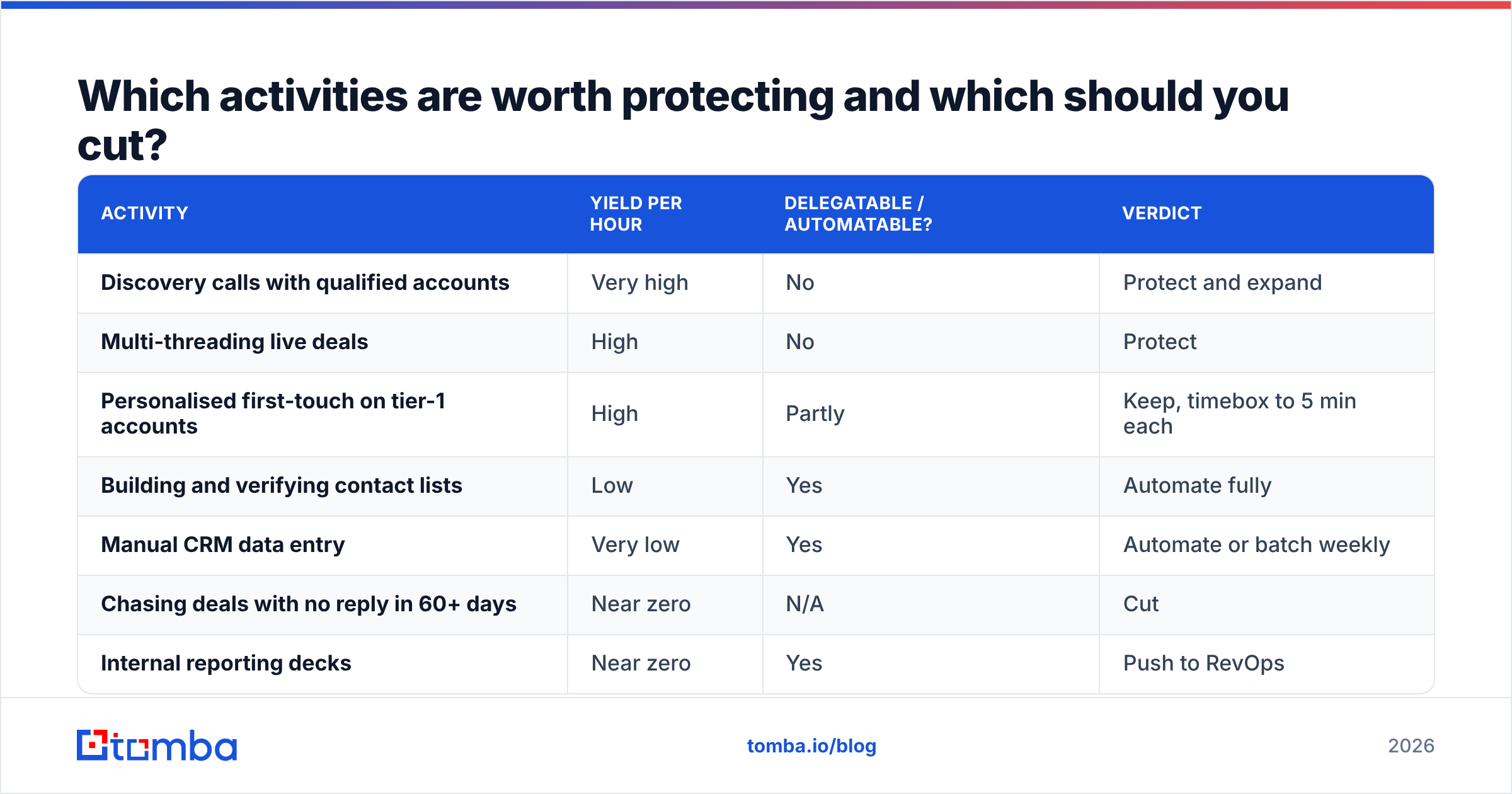
Sort every recurring task into four buckets. Most reps discover that a third of their week sits in the bottom two.
| Activity | Yield per hour | Delegatable / automatable? | Verdict |
|---|---|---|---|
| Discovery calls with qualified accounts | Very high | No | Protect and expand |
| Multi-threading live deals | High | No | Protect |
| Personalised first-touch on tier-1 accounts | High | Partly | Keep, timebox to 5 min each |
| Building and verifying contact lists | Low | Yes | Automate fully |
| Manual CRM data entry | Very low | Yes | Automate or batch weekly |
| Chasing deals with no reply in 60+ days | Near zero | N/A | Cut |
| Internal reporting decks | Near zero | Yes | Push to RevOps |
Run this exercise once a quarter. The bottom three rows are almost always where the extra ten hours a week are hiding — and they are the hours that generate the most resentment per minute, because they feel like work but produce nothing you can point at in a pipeline review.
Does better data actually reduce burnout, or is that just tooling talk?#
It reduces burnout because it changes the ratio of effort to reward, which is the mechanism burnout runs on.
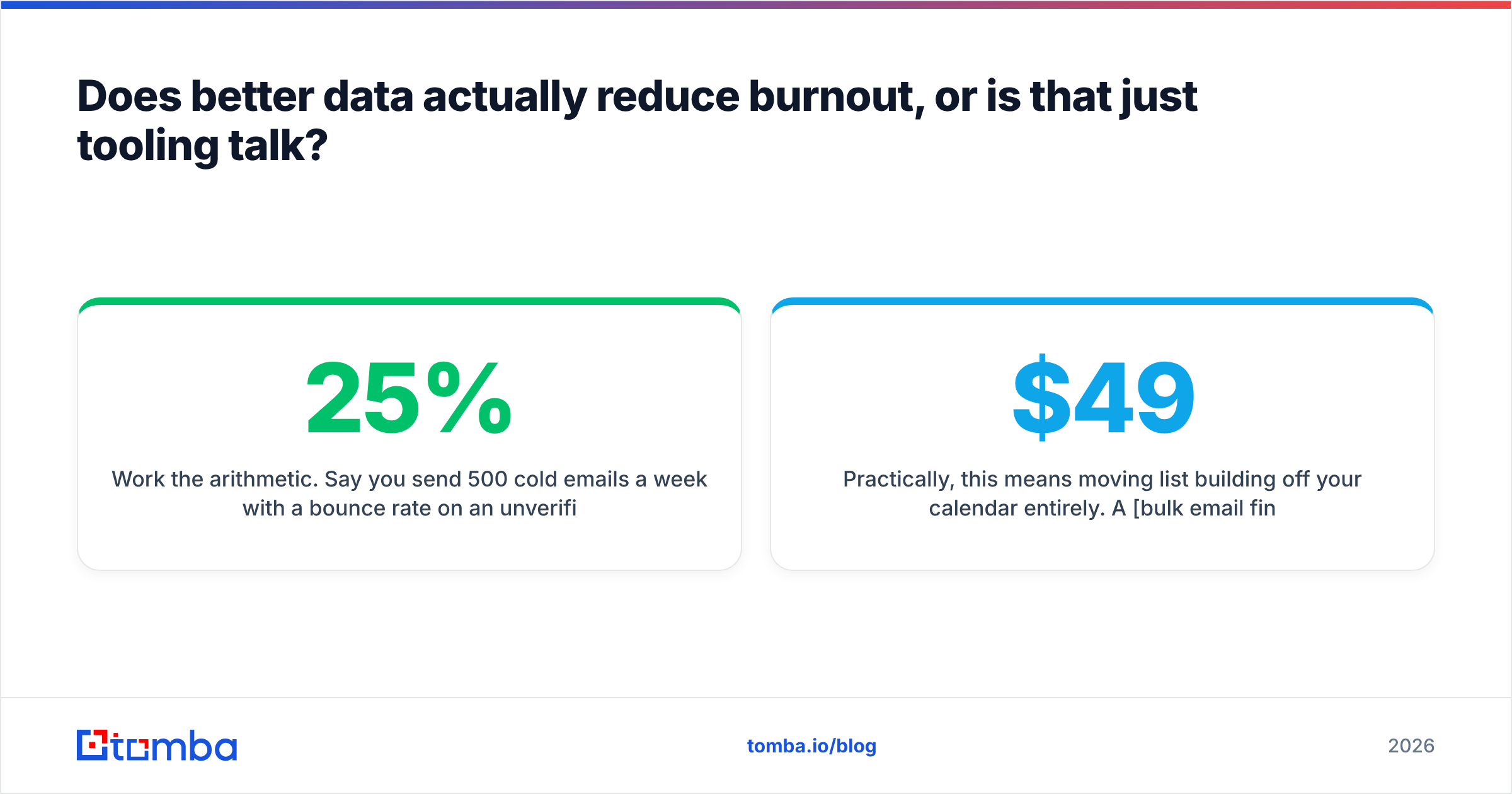
Work the arithmetic. Say you send 500 cold emails a week with a 25% bounce rate on an unverified list. That is 125 sends that were dead before you wrote them, plus the deliverability damage that drops the remaining 375 into spam folders at a higher rate. You did the full week of work for roughly two-thirds of the possible outcome, and your sender reputation is now worse for next week. Repeat that for a quarter and you have engineered a slow decline where effort rises and results fall — the textbook burnout curve.
Now flip it. Verified contacts, correct email patterns, and enrichment that tells you whether the person still works there. Same sending volume, drastically fewer wasted touches, and a feedback loop that responds to your effort. That is not a productivity story, it is a psychological one. Reps stay in the job when their work visibly moves something.

Practically, this means moving list building off your calendar entirely. A bulk email finder that processes a CSV of companies and names in one pass replaces what used to be a Sunday evening ritual for a lot of AEs. Tomba's pricing starts with a free tier at 25 searches per month for testing the accuracy on your own accounts, then $49/mo on Starter, $99/mo on Growth, and $249/mo on Pro. The relevant question is not the sticker price — it is whether six hours a week of your time is worth more than that.
One caution so this stays honest: tooling only helps if you actually delete the manual work it replaces. Reps who buy a data tool and keep the old workflow "just to double-check" end up with more work, not less. Cut the old process on day one.
How should sales managers prevent burnout on the team?#
Most burnout is manufactured upstream of the rep. If you run a team, these five things matter more than any wellness initiative you can buy.
- Stop changing targets mid-quarter. Nothing destroys motivation faster than a moving finish line. If the number must change, change it at the boundary, and explain the reasoning in full.
- Score outcomes, not just activity. Activity dashboards are useful diagnostics and terrible objectives. The moment "dials" becomes the KPI, you get 100 low-quality dials.
- Kill the always-on expectation. If you send Slack messages at 11pm, your team will answer at 11pm regardless of what your handbook says. Gartner's sales research has repeatedly flagged manager behaviour as a stronger driver of seller wellbeing than formal policy.
- Make territory and list quality a management responsibility. A rep with a stale territory is being asked to solve a data problem with personal effort. That is the definition of an unfair fight.
- Run one non-pipeline 1:1 per month. No forecast, no deal review. Ask what is draining them. You will hear about broken processes months before you would see them in attrition data.
For a broader view of coaching cadence and enablement structure, HubSpot's sales blog publishes a lot of usable manager-level material on this. And if you want the clinical framing, the occupational burnout literature is worth thirty minutes for anyone responsible for a team.
What is a realistic 30-day recovery plan?#
If you are already deep in it, do not attempt a full life redesign. Sequence it.
Week 1 — Stop the bleeding. Set a hard stop time. Delete Slack and email from your phone. Take one full day fully offline. That is the entire week's goal.
Week 2 — Audit the week. Log every hour for five days in a plain spreadsheet. Categorise against the yield table above. Do not change anything yet; you are collecting evidence, and the evidence is usually more damning than memory.
Week 3 — Cut and automate. Kill every deal with no movement in 60 days. Move list building to an automated workflow — a domain search plus verification pass usually replaces the bulk of it. Push reporting work back to whoever owns it.
Week 4 — Rebuild the calendar. One protected prospecting block. One deal-progression block. One admin block, batched. Everything else defends against those three. Then hold it for a full quarter before judging whether it worked.
If four weeks pass and nothing improves, the problem is the role, the manager, or the product — and no calendar system fixes those. That is a real answer, and sometimes the right one.
What should you do first?#
Start with the cheapest, highest-leverage fix: stop spending your energy on contacts that were never real. Run your current active list through verification and see what percentage comes back invalid. Most reps are shocked, and that number is a direct measure of the effort you have been donating for free.
The Tomba Email Finder exists for exactly this part of the job — finding verified professional email addresses by name, domain, or company so that the hours you spend prospecting produce conversations instead of bounces. Test it against 25 of your own accounts on the free tier before you spend anything. If the accuracy holds on accounts you already know, you have just bought back the block of your week that was costing you the most and returning the least.
Burnout in sales is not solved by caring less. It is solved by making sure that the work you do actually counts.
Related guides#
Ready to find emails that actually work?
Join 150,000+ professionals who stopped guessing and started sending. Free credits on signup — no credit card required.
Get the Tomba newsletter
Practical outbound tactics and product updates — once every two weeks.
About the author