How To Close A Sale in 2026: 9 Techniques That Still Work
Closing is not a magic phrase at the end of a call — it is the sum of everything you did before it. Here are 9 closing techniques, the data behind them, and the pipeline habits that make the close feel inevitable.
TL;DR
- Closing is a lagging indicator. If your close rate is bad, the problem is usually qualification, multi-threading, or a missing next step — not your final sentence.
- The nine techniques below (assumptive, summary, alternative, urgency, takeaway, question, puppy-dog, Ben Franklin, and the "next-step" close) each fit a specific deal shape. Using the wrong one on the wrong buyer is worse than using none.
- The single highest-leverage habit: never end a conversation without a calendared next step. Deals without a scheduled next meeting are effectively dead.
- Handle price objections by re-anchoring on cost of inaction, not by discounting. Discounts bought at the close cost you renewal leverage later.
- You cannot close pipeline you never built. Accurate contact data is the unglamorous input that makes the whole thing work.
What does "closing a sale" actually mean in 2026?#
Closing is the moment a buyer commits — signature, PO, or a verbal yes with a start date attached. That is it. Everything else people call "closing" is really discovery, qualification, consensus-building, and risk removal.
The old picture of the close — a rep leaning across a desk, delivering one killer line — describes maybe 5% of modern B2B. The average enterprise deal now involves six to ten stakeholders, and buyers spend most of their evaluation time in channels you cannot see. By the time you ask for the business, the decision is largely made. Your job at the close is to remove the last friction, not to manufacture desire.
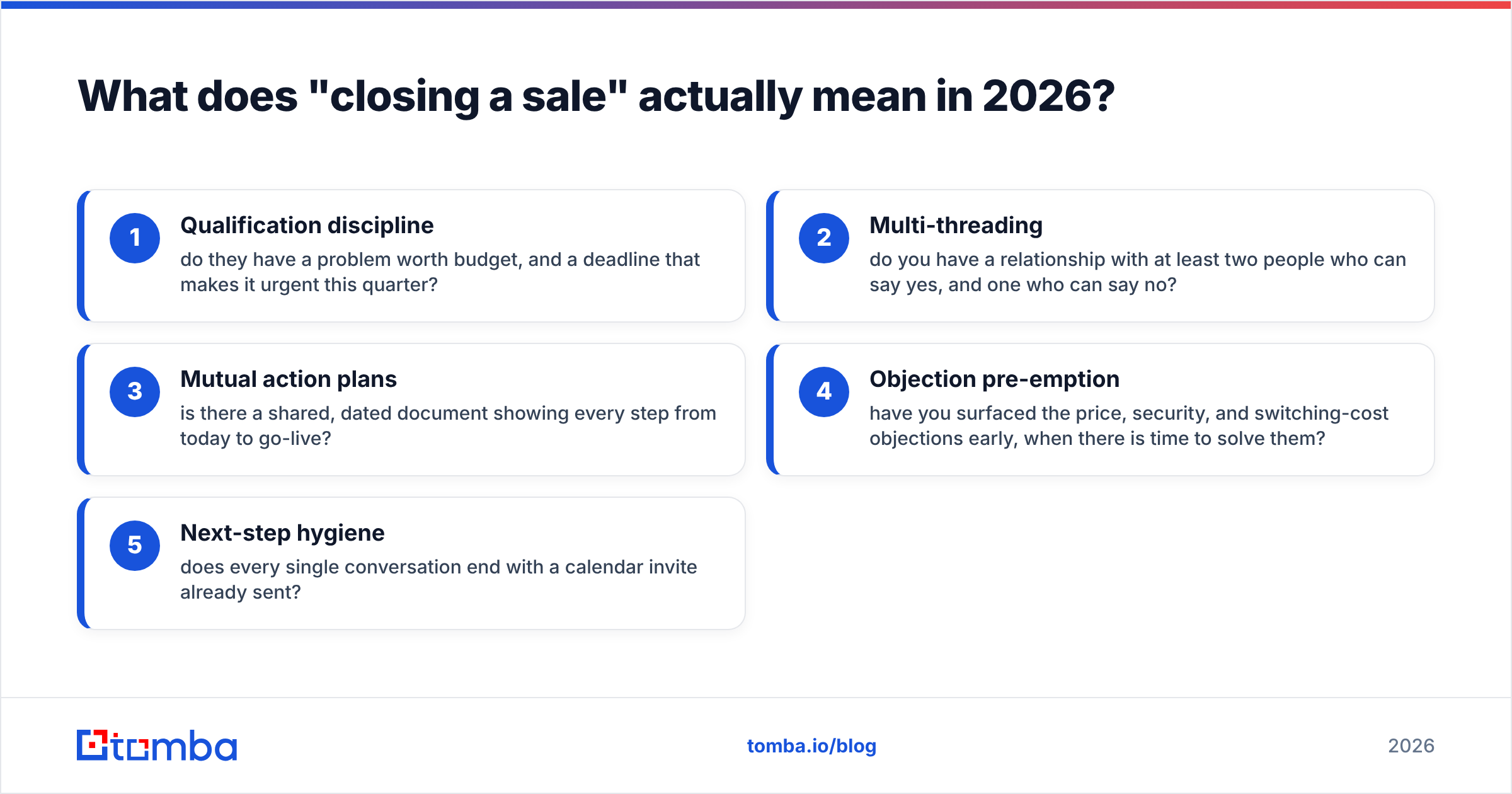
That reframe changes what you practice. Instead of drilling closing lines, you drill:
- Qualification discipline — do they have a problem worth budget, and a deadline that makes it urgent this quarter?
- Multi-threading — do you have a relationship with at least two people who can say yes, and one who can say no?
- Mutual action plans — is there a shared, dated document showing every step from today to go-live?
- Objection pre-emption — have you surfaced the price, security, and switching-cost objections early, when there is time to solve them?
- Next-step hygiene — does every single conversation end with a calendar invite already sent?
Get those five right and the close becomes administrative. Get them wrong and no technique saves you.
Which closing techniques still work, and when?#
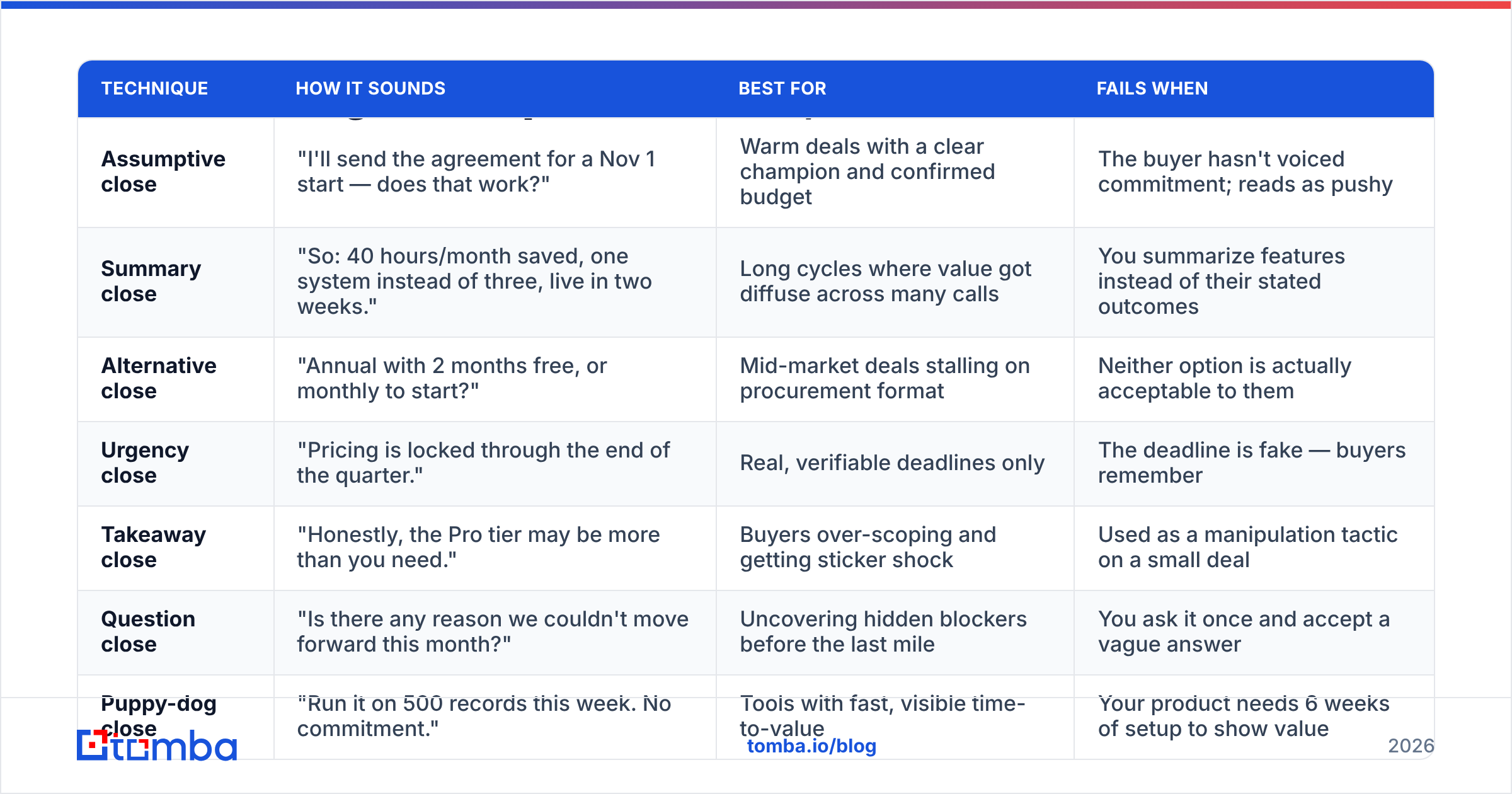
Here is the honest map. Each technique has a real use case and a real failure mode. Match them to deal size and buyer temperament, not to your mood.
| Technique | How it sounds | Best for | Fails when |
|---|---|---|---|
| Assumptive close | "I'll send the agreement for a Nov 1 start — does that work?" | Warm deals with a clear champion and confirmed budget | The buyer hasn't voiced commitment; reads as pushy |
| Summary close | "So: 40 hours/month saved, one system instead of three, live in two weeks." | Long cycles where value got diffuse across many calls | You summarize features instead of their stated outcomes |
| Alternative close | "Annual with 2 months free, or monthly to start?" | Mid-market deals stalling on procurement format | Neither option is actually acceptable to them |
| Urgency close | "Pricing is locked through the end of the quarter." | Real, verifiable deadlines only | The deadline is fake — buyers remember |
| Takeaway close | "Honestly, the Pro tier may be more than you need." | Buyers over-scoping and getting sticker shock | Used as a manipulation tactic on a small deal |
| Question close | "Is there any reason we couldn't move forward this month?" | Uncovering hidden blockers before the last mile | You ask it once and accept a vague answer |
| Puppy-dog close | "Run it on 500 records this week. No commitment." | Tools with fast, visible time-to-value | Your product needs 6 weeks of setup to show value |
| Ben Franklin close | Pros/cons list built together, out loud | Analytical buyers who need to feel they decided | You control the pen and stack the list |
| Next-step close | "Let's book 20 minutes Thursday with your CFO." | Every deal, every call, without exception | You leave it as "I'll follow up next week" |
The two that carry the most weight in modern B2B are the question close and the next-step close. The question close ("what would have to be true for this to happen this quarter?") converts vague hesitation into a named obstacle you can actually work on. The next-step close is not glamorous, but pipeline reviews across teams consistently show the same pattern: opportunities without a scheduled next meeting slip or die at a dramatically higher rate than those with one.
How do you handle the four objections that kill closes?#
Most lost deals die from four objections. None of them are really about your product.
"It's too expensive." This is almost never a statement about price. It is a statement about perceived value relative to an unclear ROI. Do not discount reflexively. Re-anchor: "What's the current cost of the manual process — hours, headcount, error rate?" Then put your price next to that number. If the gap isn't obvious, you have a discovery problem, not a pricing problem.
"Send me some information." The universal soft no. Respond with a trade: "Happy to. So I send the right thing — is the open question the security review, the integration list, or the pricing model?" Their answer is the real objection.
"We need to think about it." Fine — but think about what, and by when? Ask directly and put the answer in a calendar invite. Vague deliberation is where deals go to rot.
"We're already using [competitor]." Don't attack the incumbent. Ask what they'd change about it if they could. Switching costs are real, so your job is to quantify the pain of staying, not to argue the incumbent is bad. HubSpot's sales research library has good longitudinal data on how buyer objection patterns shift by segment if you want to benchmark your own call recordings.
One habit that pays off here: log the exact wording of every objection in your CRM, not a paraphrase. Patterns show up within 30 deals, and those patterns tell you which part of your pitch is under-built.
Why does most closing advice fail?#
Because it optimizes the last 5% of the process and ignores the 95% that determines the outcome.
Three specific failure modes:
- Closing an unqualified deal. No amount of technique overcomes an absent budget holder. If you cannot name the person who signs and the fiscal quarter the money comes from, you are not closing — you are hoping.
- Single-threading. You have one champion, they love you, and then they leave the company or get reassigned. The deal evaporates. Two contacts minimum, three for anything above five figures. A phone finder and direct-dial coverage help you reach the second and third stakeholder without waiting for an intro that never comes.
- Confusing enthusiasm with commitment. "This looks great, send the contract" is not a close. A signature is a close. Track your pipeline by verifiable commitments — security review scheduled, legal engaged, procurement ticket opened — not by vibes.
The research on B2B buying complexity is consistent across analysts. Gartner's B2B buying journey work documents how much of the process now happens without a rep in the room, which is exactly why single-threading and vibe-based forecasting fail so predictably.
What does a repeatable closing sequence look like?#
Here is a sequence you can run on nearly any B2B deal between $5k and $150k ACV. It is deliberately boring.
Step 1 — Confirm the problem in their words. Open the closing call by restating the pain using their exact language from discovery. If they correct you, you just avoided closing on the wrong value prop.
Step 2 — Quantify the gap. Put a number on the cost of the status quo. Hours, dollars, churned customers, missed SLAs. Whatever they measure.
Step 3 — Present the path, not the product. "Here's week one, week two, week four." Buyers commit to plans more readily than to features.
Step 4 — Ask the question close. "Is there anything that would stop us from getting this signed by the 15th?" Then be silent. The silence does more work than the question.
Step 5 — Solve the named blocker, live. Security questionnaire? Screen-share it and start filling it in. Procurement portal? Ask for the URL now. Momentum dies in async gaps.
Step 6 — Book the next dated step before you hang up. Even if the answer is yes, book the kickoff. Especially if the answer is "let me check" — book the check-in.
Step 7 — Send a written recap within an hour. Bullet points, decisions made, owner and date for each open item. This recap is your mutual action plan and your forecast evidence.
Run this consistently and your forecast accuracy improves before your close rate does — which is the correct order. Knowing which deals will not close is worth almost as much as closing more of them.
How does pipeline quality affect your close rate?#
Massively, and most teams measure it backwards.
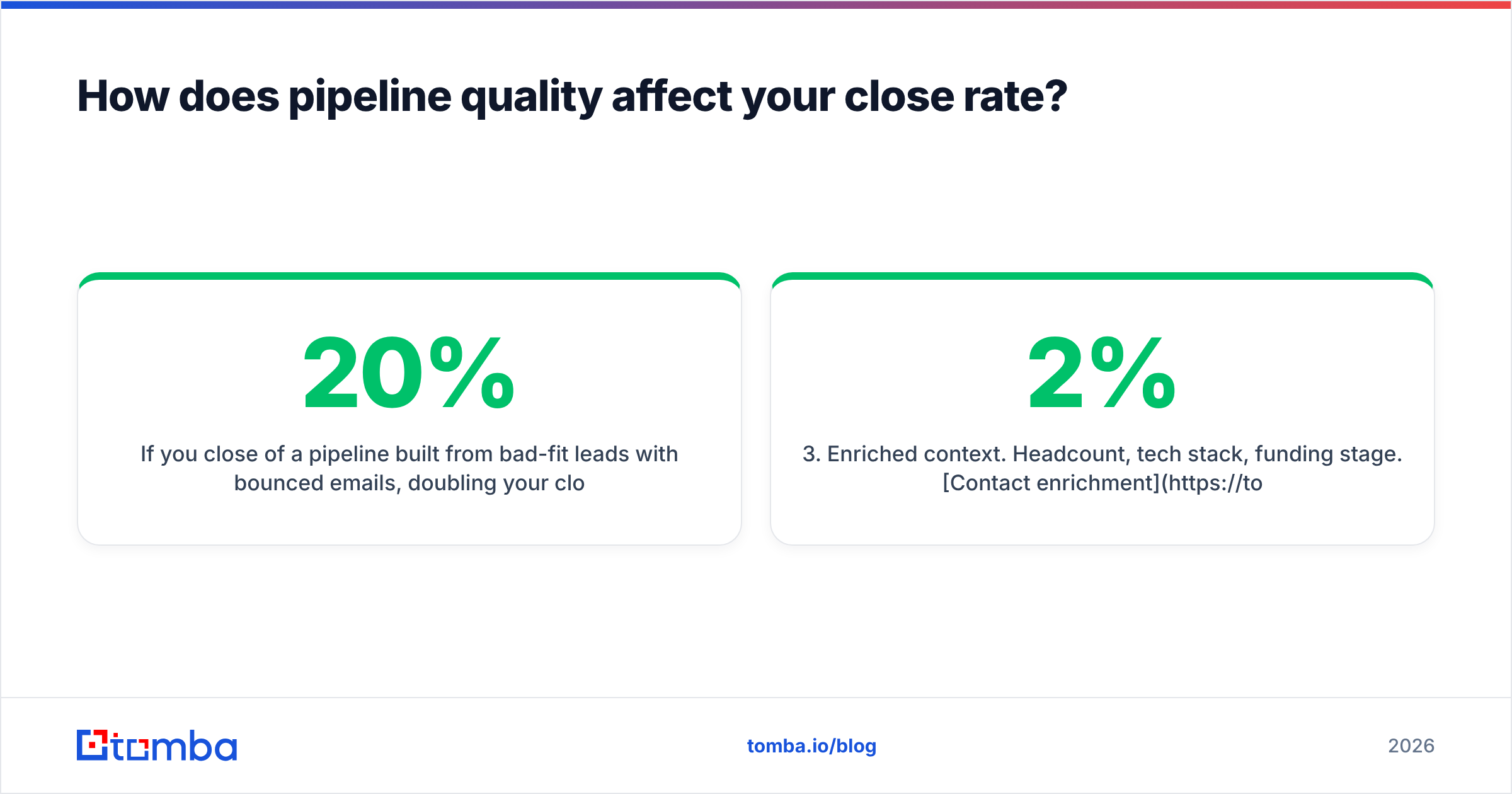
If you close 20% of a pipeline built from bad-fit leads with bounced emails, doubling your closing skill gets you to maybe 25%. Fixing the input gets you to 35% with the same skill. The math on outbound is unforgiving: a 30% bounce rate does not just waste sends, it damages sender reputation, which suppresses the deliverability of the good addresses too. You end up closing fewer deals while working harder.
Three input controls worth more than any closing script:
- Verified contact data. Run every list through an email verifier before it touches your sequencer. Bounces are a compounding tax.
- Right-person targeting. Reaching a manager when you need a VP costs you six weeks. Use domain search to map the whole department before you pick your entry point.
- Enriched context. Headcount, tech stack, funding stage. Contact enrichment turns a name into a reason to reach out, which is the difference between a 2% and an 8% reply rate.
For a competitive read on data providers in this space, G2's sales intelligence category is a reasonable neutral starting point — including peers like BookYourData, which does solid work on verified B2B contact lists and is a legitimate option if you prefer buying static datasets over querying an API.
How do you measure whether your closing is improving?#
Track four numbers, not one.
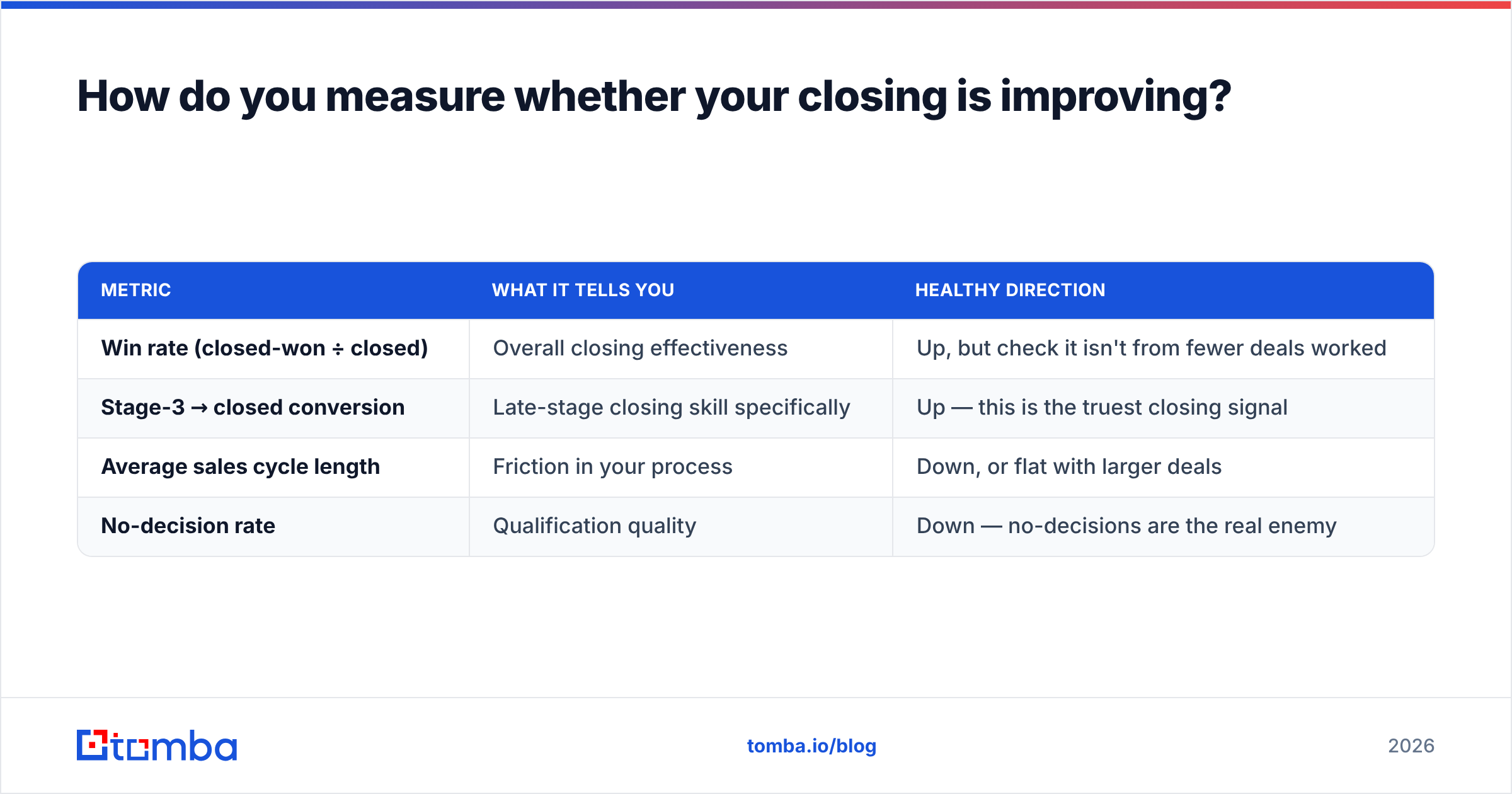
| Metric | What it tells you | Healthy direction |
|---|---|---|
| Win rate (closed-won ÷ closed) | Overall closing effectiveness | Up, but check it isn't from fewer deals worked |
| Stage-3 → closed conversion | Late-stage closing skill specifically | Up — this is the truest closing signal |
| Average sales cycle length | Friction in your process | Down, or flat with larger deals |
| No-decision rate | Qualification quality | Down — no-decisions are the real enemy |
The metric most teams over-index on is win rate. It is easy to game by disqualifying aggressively. The metric most teams ignore is the no-decision rate — deals that neither close nor lose, they just stop. High no-decision rates almost always mean you are not building enough urgency during discovery, and no closing technique fixes that at the end.
Review lost deals monthly, in a group, with call recordings. Not to assign blame, but to find the sentence where the deal actually died. It is usually three calls before anyone noticed.
What should you do this week?#
Pick one thing.
- If your close rate is fine but cycles are long: enforce the next-step close on every call for two weeks and measure cycle length.
- If deals stall late: start asking the question close at the end of discovery, not at the end of the process.
- If your no-decision rate is above 25%: your problem is qualification. Tighten entry criteria before touching your closing scripts.
- If you don't have enough at-bats to know: your problem is pipeline volume, and the fastest fix is better prospecting data, not better technique.
That last case is more common than reps admit. You cannot practice closing on four deals a quarter. Volume creates the reps that create the skill.
If pipeline volume is your bottleneck, start at the input. The Tomba Email Finder gets you verified, deliverable addresses for the decision-makers you actually need — by name, company, or full domain — so your sequences reach humans instead of bouncing. The free tier gives you 25 searches a month to test it against your own target accounts, and Tomba pricing starts at $49/mo for Starter if you need real volume. Build the pipeline first; the closing gets a lot easier when there is something worth closing.
Related guides#
// get started
Find, verify and enrich your first contacts today
Start on the free plan with 25 searches a month, then scale when your team is ready.
Free plan · No credit card required · GDPR & CCPA
Get the Tomba newsletter
Product and data updates
// about the author